
Doors and Windows of Serifos
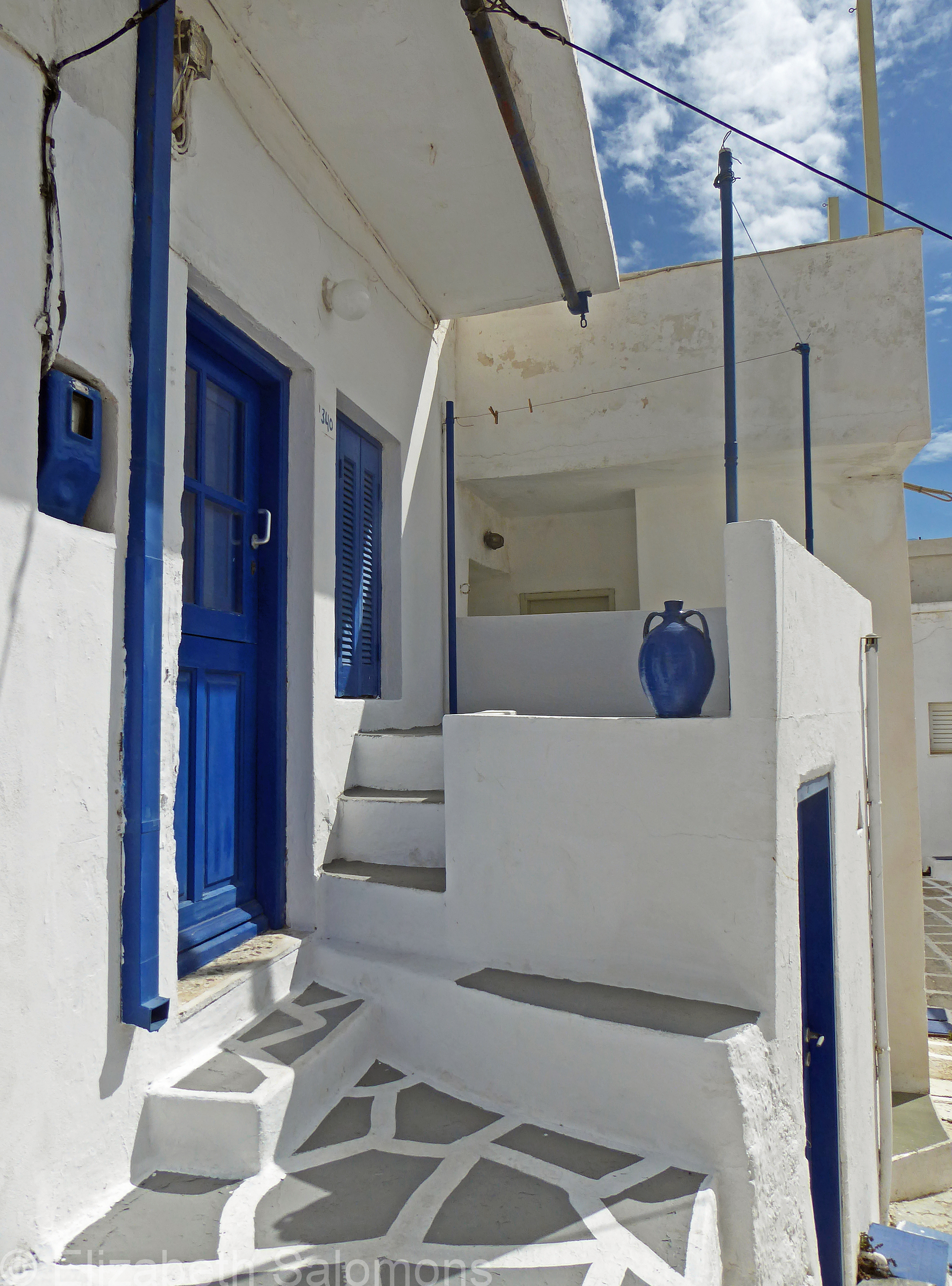
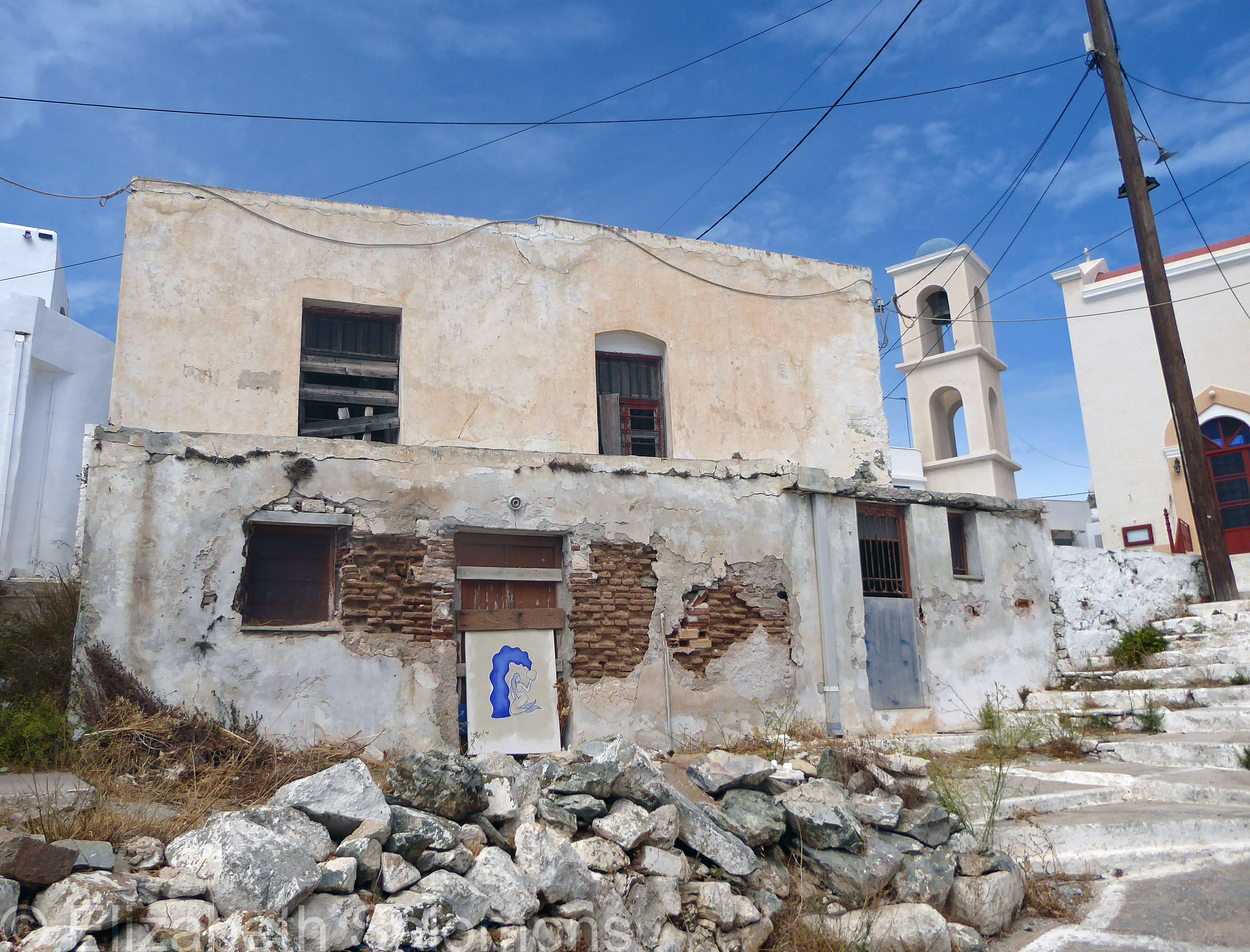
Naturally, I had far too many photos for my post about the Chora of Serifos, so here are some of the outtakes — most of them doors and windows.
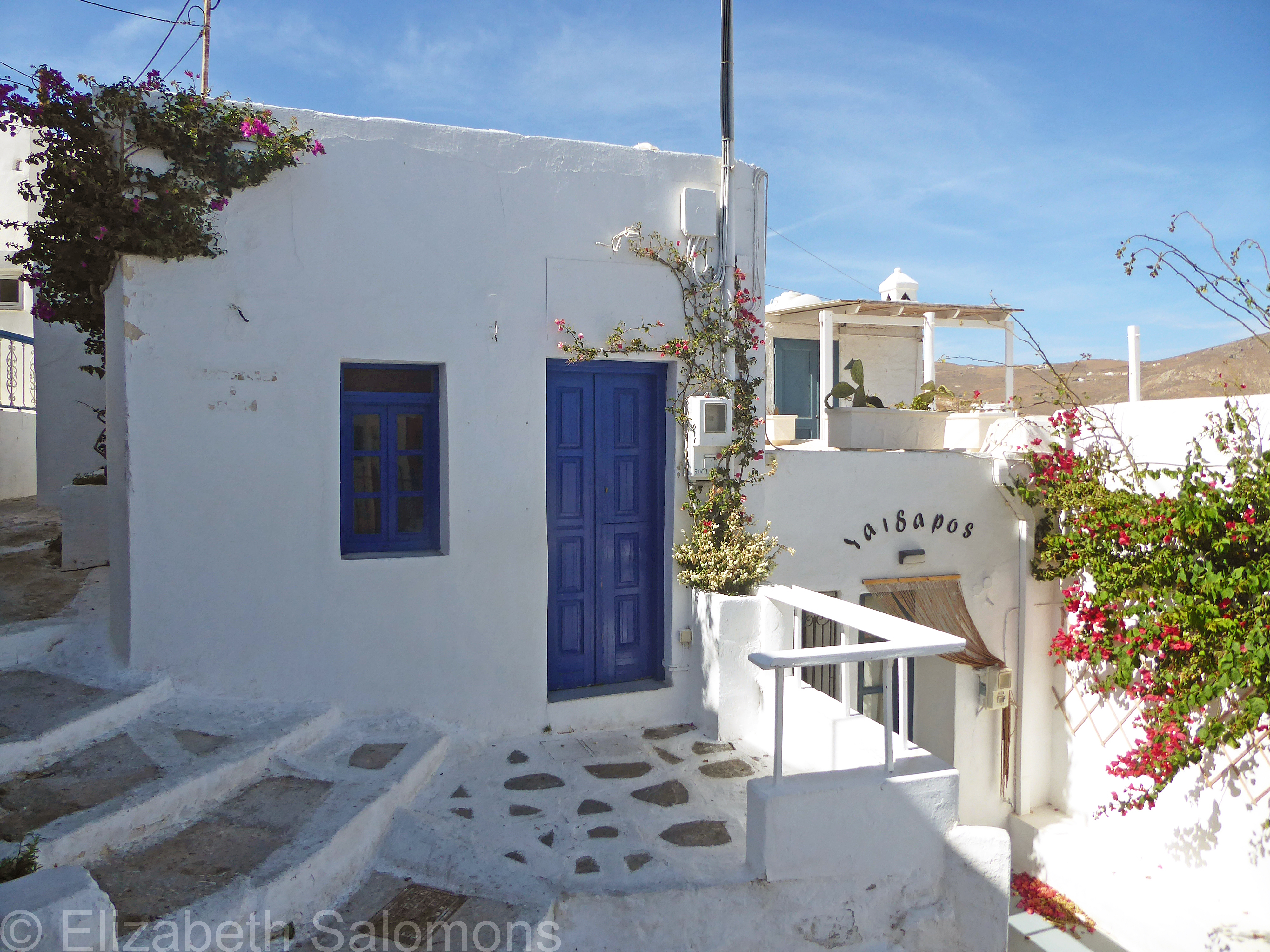
One might assume, as I did, that the colours of the Cycladic houses come from the Greek flag. Or from the colours of the Aegean Sea and the Grecian skies. But it turns out the blue-and-white colour scheme has a much more basic origin.
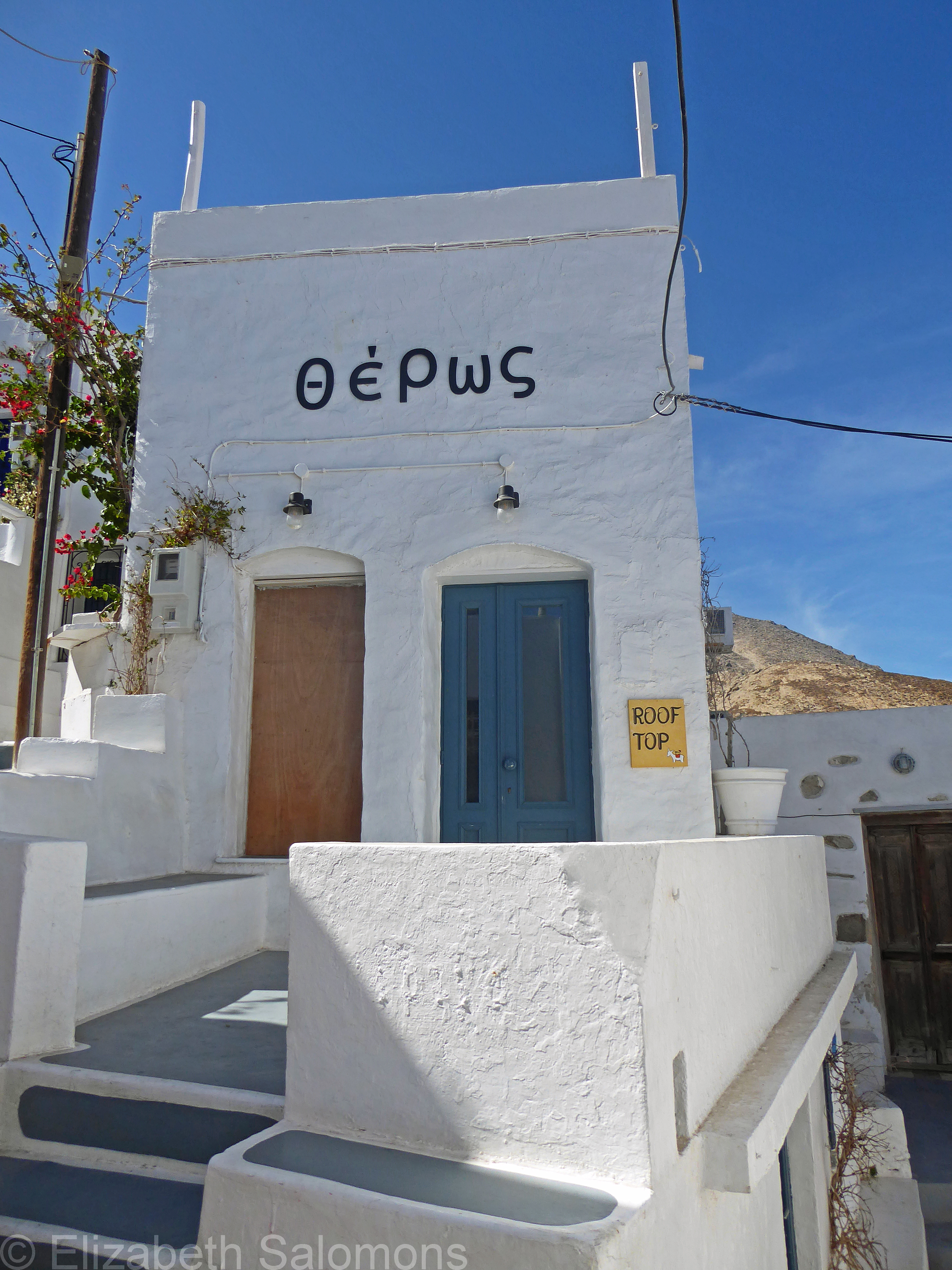
White is a practical choice, of course. Along with the thick stone walls and small windows, it helps the houses stay cool — an all-important consideration in the Mediterranean climate. But whitewash also contains limestone, a natural disinfectant, and during a cholera outbreak in 1938, it was ordered that whitewash be applied to all houses to help prevent the spread of the disease.
And blue? Turns out blue was the cheapest colour of paint available and after painting their boats, fishermen used any leftover paint on their houses.
Then, in 1967, the military dictatorship that ruled Greece at the time ordered all houses be painted blue and white because the colours were considered patriotic. White was linked to purity and independence (remember the uniforms of the Presidential Guard?). And, yes, blue represents the sea and the sky.
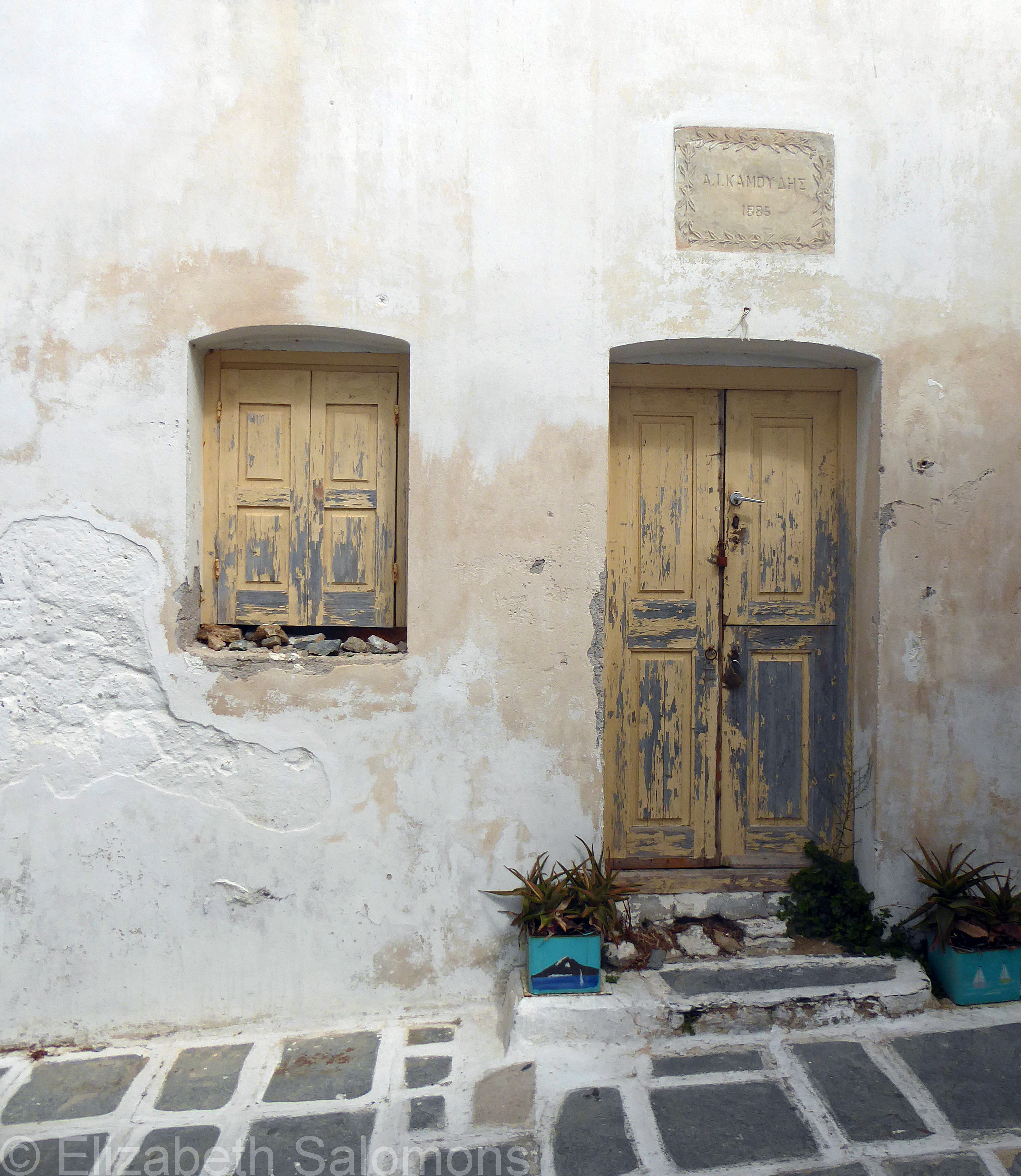
The colour scheme was made law in 1974. Those laws are no longer in place, but the blue and white colours have become so synonymous with the Greek islands that everyone keeps the traditional colours.
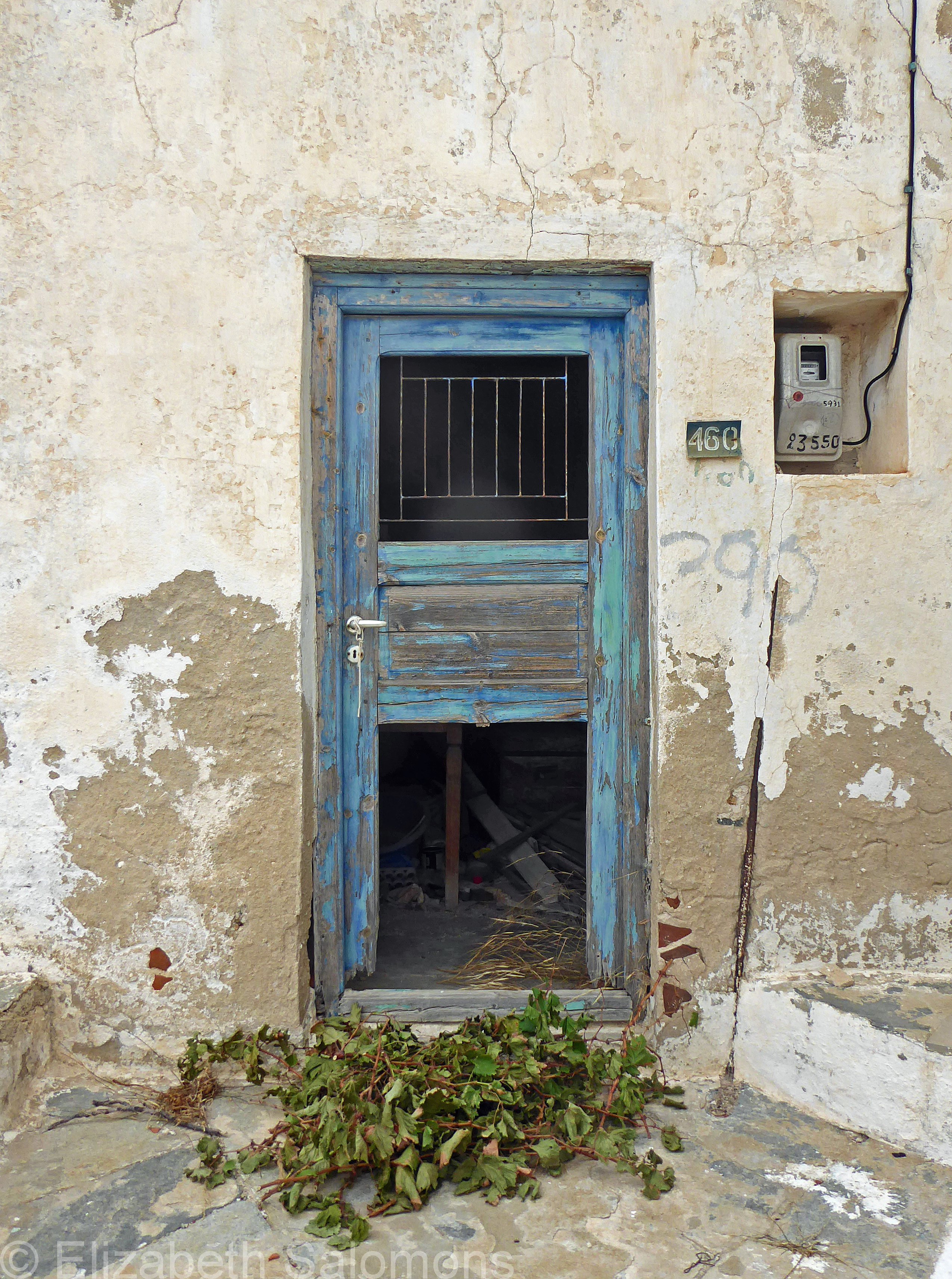
One final bit of trivia: many of the Greek islands were colonized by the Venetians and their influence can be seen in the construction of the doors and windows.


Following My Nose Through the Chora of Serifos
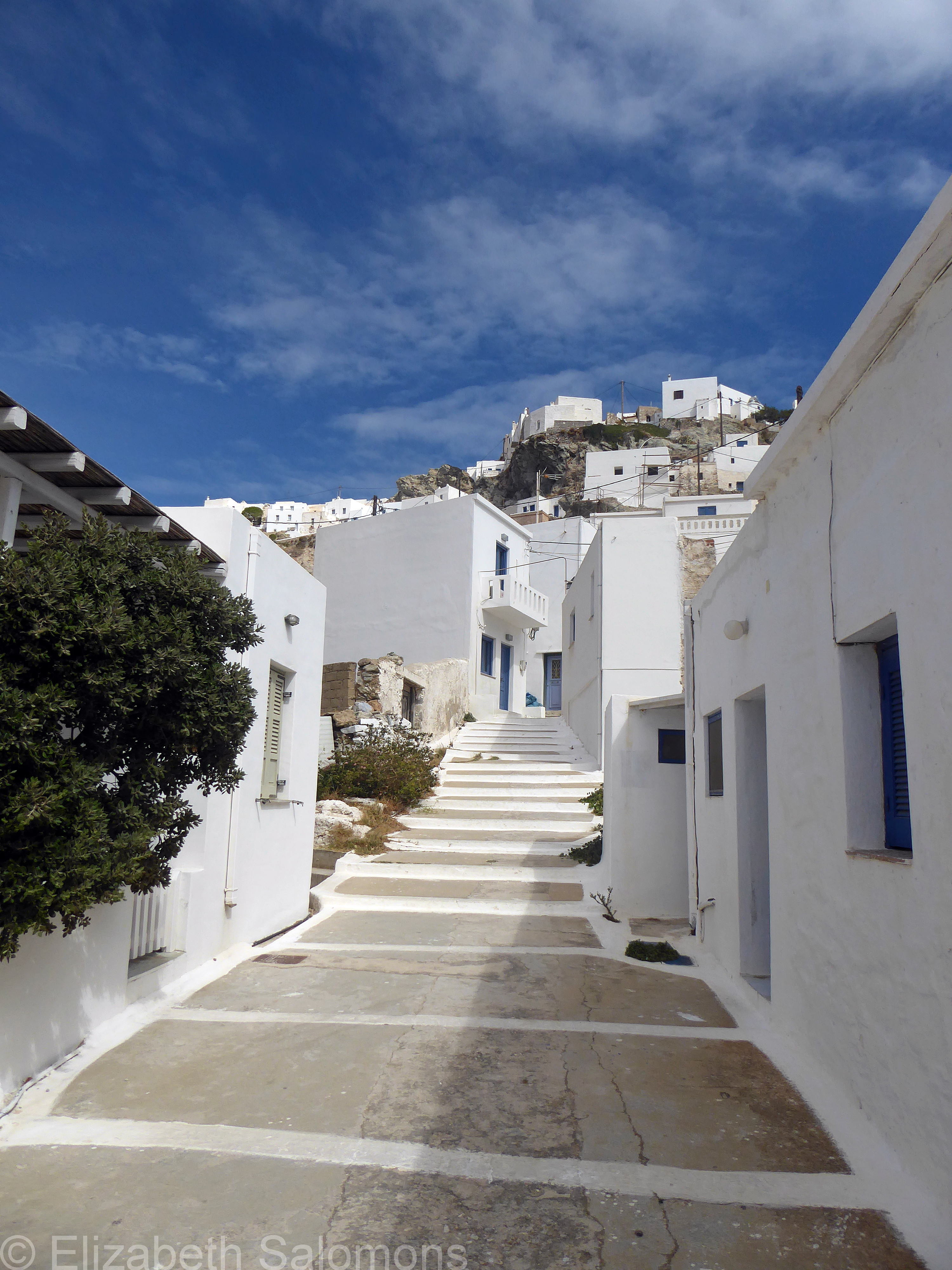
My first full day on Serifos, I walked out my door and followed my nose through the Chora. Did you know the word “labyrinth” comes from the Greek word laburinthos? Apparently Cycladic towns were traditionally built with meandering passageways to thwart the pirates that plied the Aegean back in medieval times.
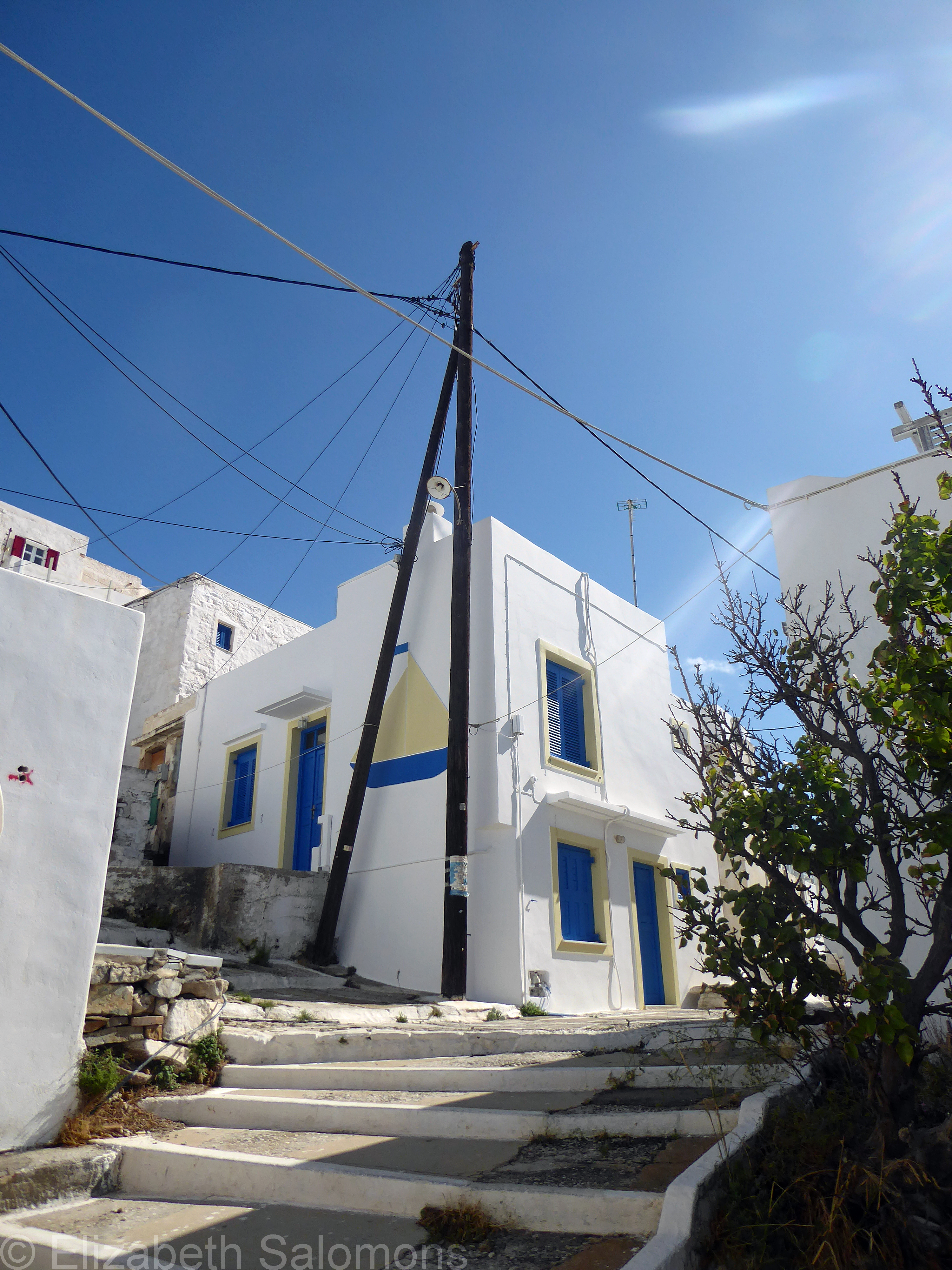
I can believe it. I never walked the same route twice in my wanderings through the Chora — and I promise you I couldn’t have if I tried.
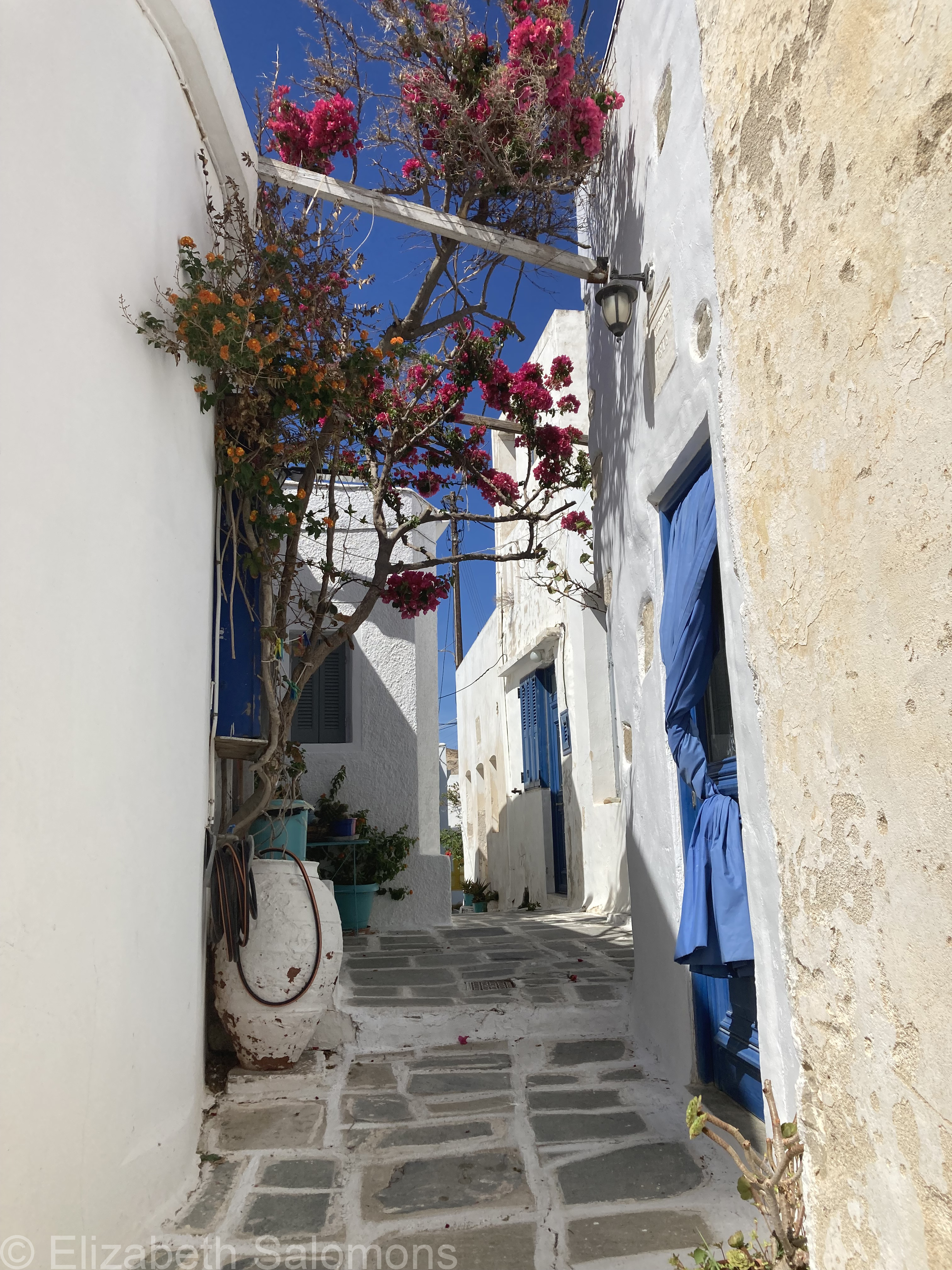
On this first day, I was looking for the main square I knew was up there somewhere. Signs scribbled on whitewashed walls with arrows that read “top” or “kastro” were helpful — I told myself if I kept walking up, I’d get there eventually.
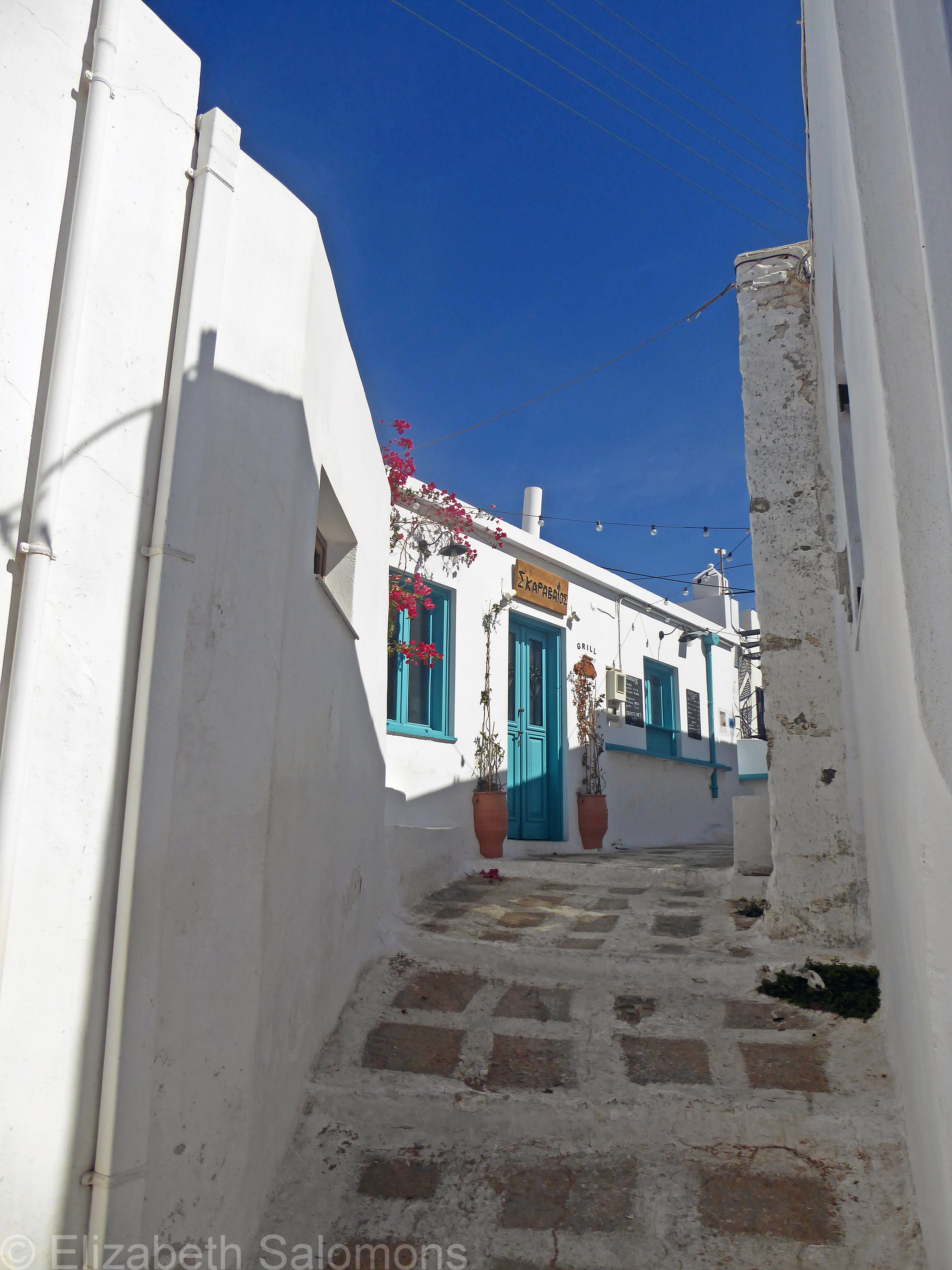
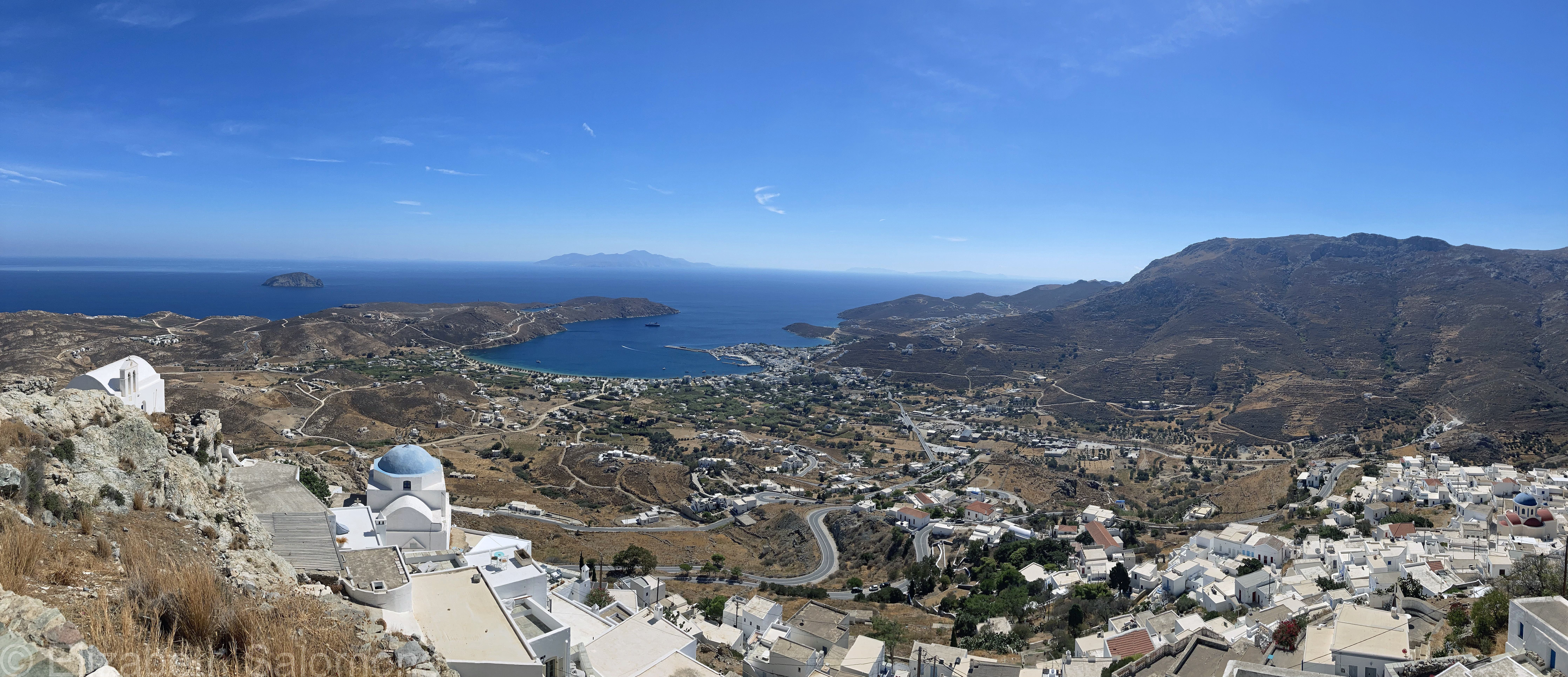
Turns out kastro is Greek for castle, which was built in 1434 by the Venetians (again, to protect the islanders from pirate raids). Only the ruins remain, but what a view!
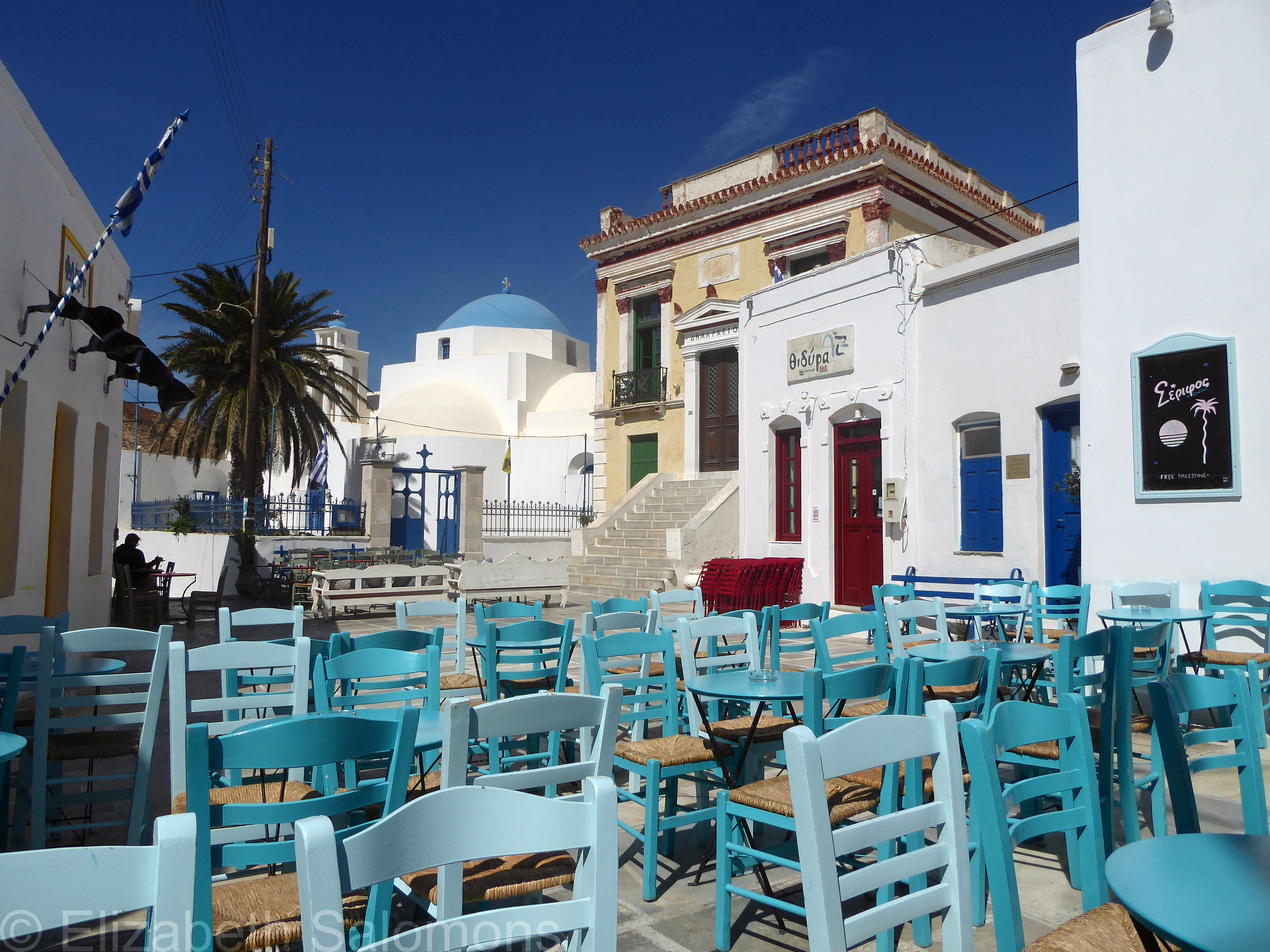
I had to backtrack a bit to find the main square I was looking for as it was not quite so high. Called Pano Piatsa, it was much smaller than I was expecting it to be. It’s also the only open public space in the Pano Chora (again, blame those pirates). The yellow building is the town hall and was built in 1908. There are a handful of restaurants and shops, but given the time of year I was there, every time I walked up to Pano Piatsa, another one had shut up for the season.
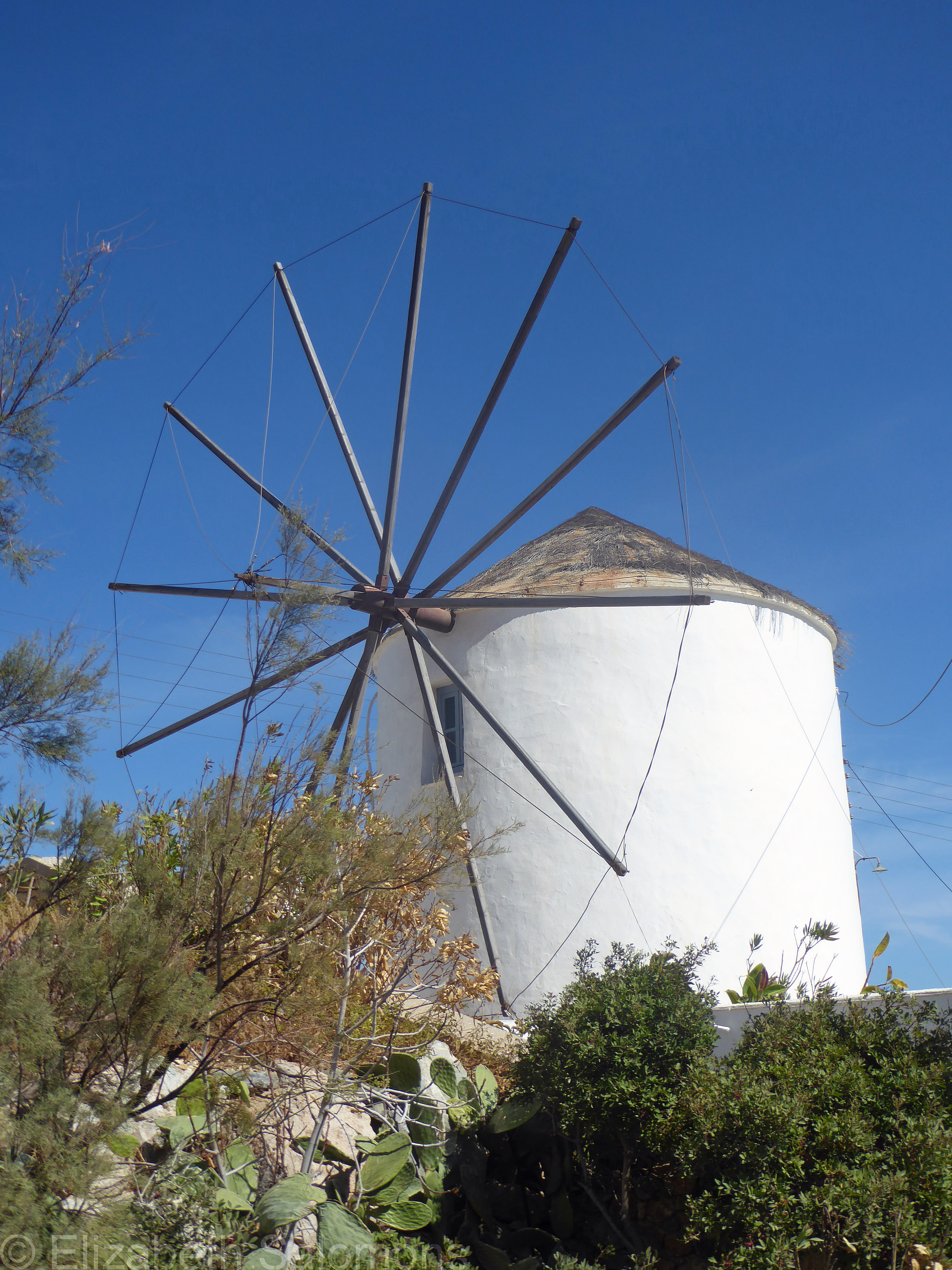
Further on from Pano Piatsa are three windmills still in pretty good shape.
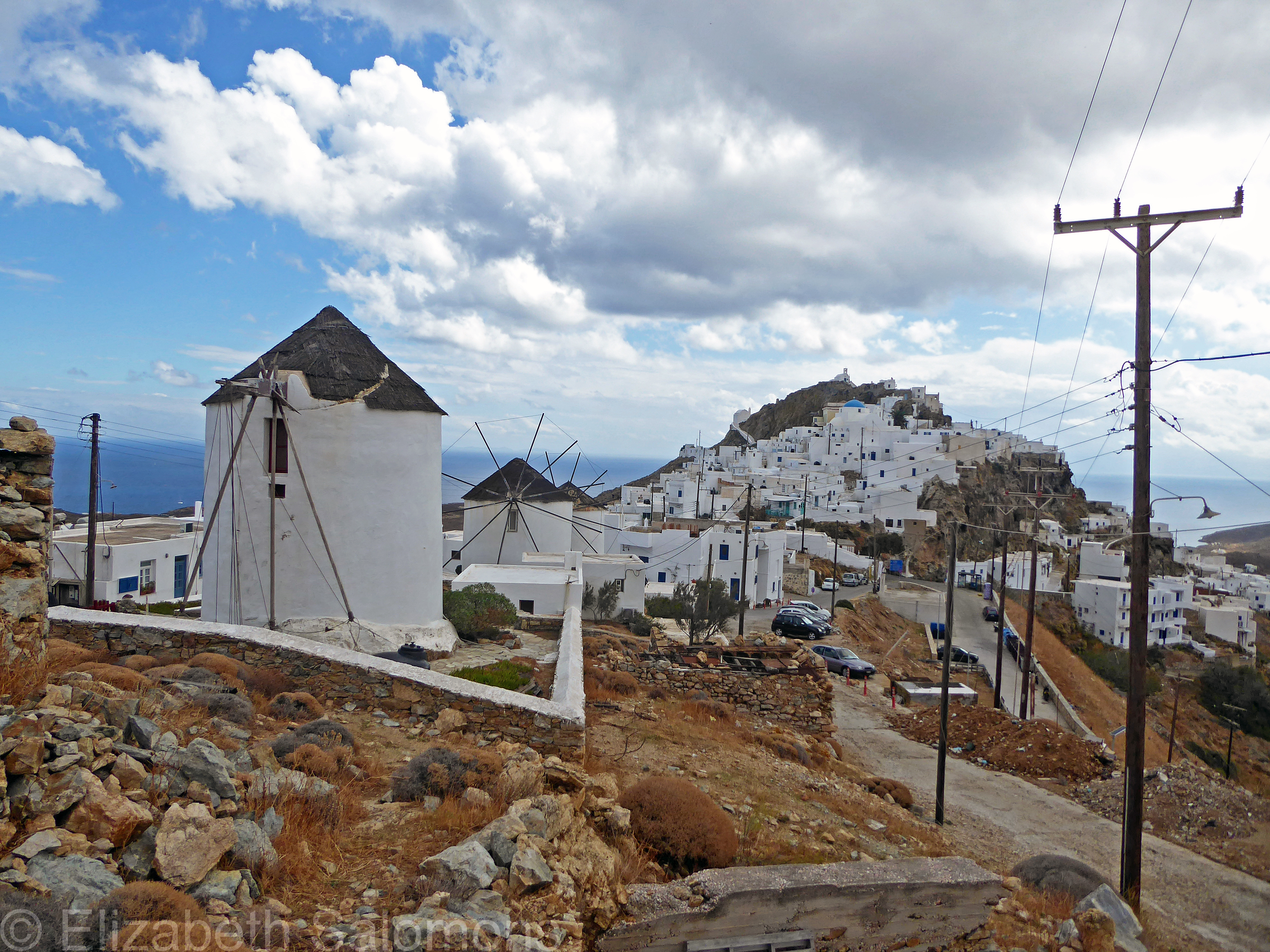
At one time, there were eight, all built to grind grain into flour.
Why are so many places in Greece named Chora, you may well wonder? It’s because it’s the Greek word for “town.” Typically, the first or biggest settlement on an island is referred to as the Chora.
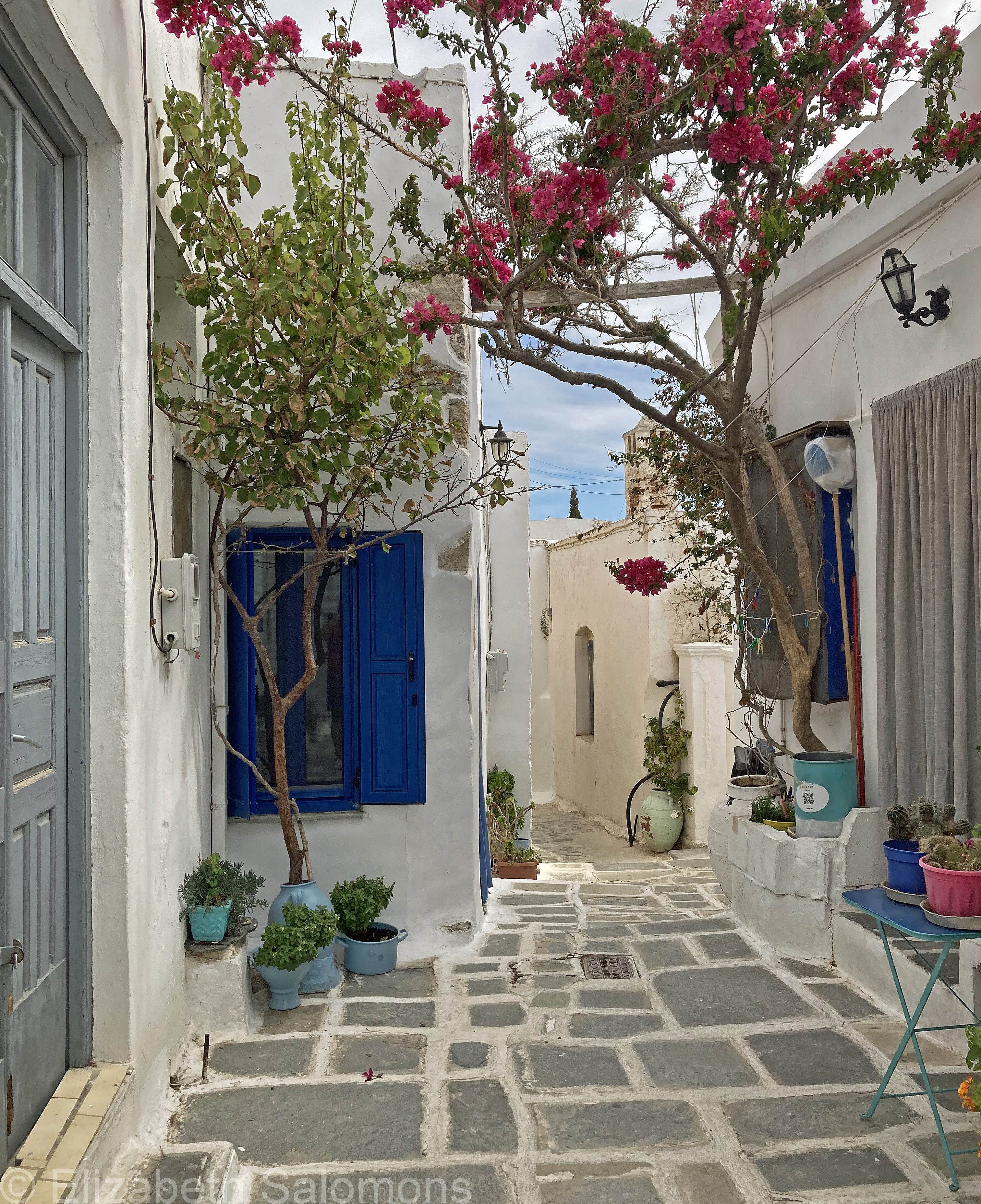
On Serifos, the Pano Chora (upper town) is the oldest part of the town; I was staying in the Kato Chora (lower town).

Some say the Chora of Serifos is the prettiest in the Cyclades. Who am I to argue?
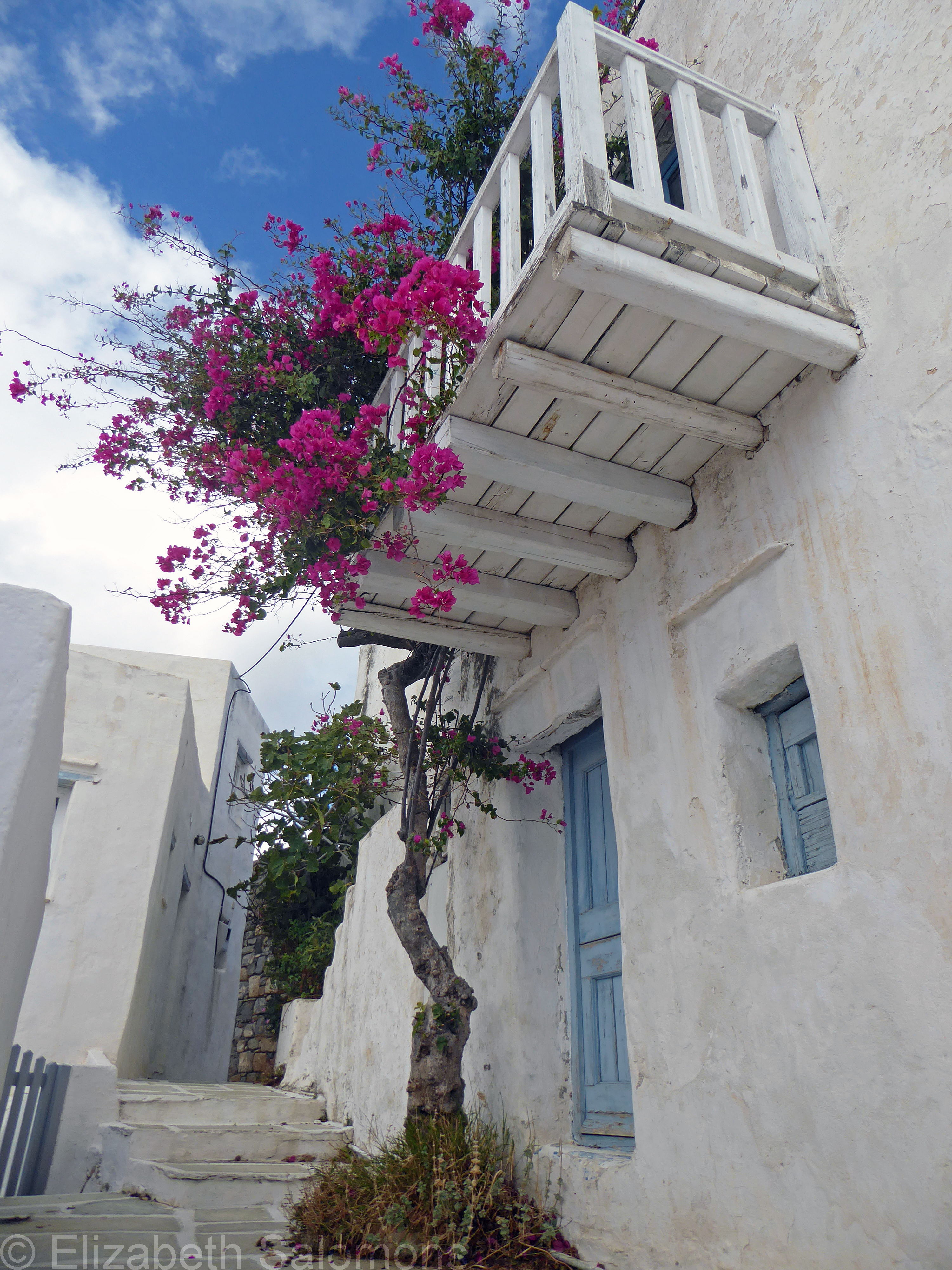
It felt special, living right in the Chora like I did. But most of the island life took place at Livadi. I was off to explore that next.
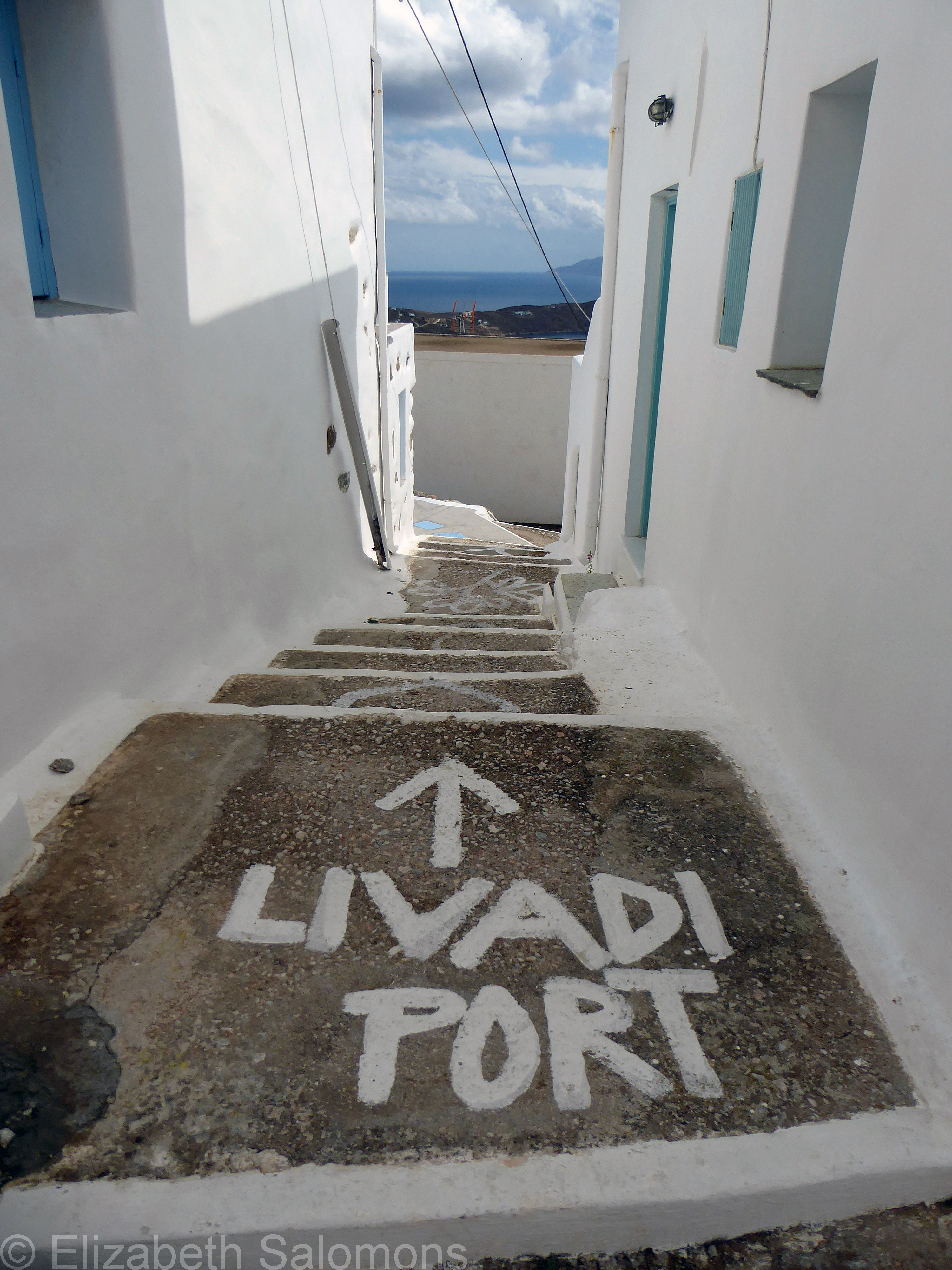
From Vancouver to Serifos
When I told people I was going to spend two weeks on a Greek island, their reaction was always, “Nice!” But when I told them I was going to Serifos, their reaction was always, “Where?”
Like most Canadians, they had never heard of the place. Nor had I, until I got a home exchange offer I couldn’t refuse.
Serifos is in the Cyclades, an island group in the Aegean Sea — the part of the Mediterranean that lies between Greece and Turkey.
It’s also a bit of a trek from here to there. First, a long-haul flight from Vancouver to Athens (via Heathrow), then a taxi ride from my Athens hotel to the Port of Piraeus, and, finally, a catamaran fast ferry to Serifos.
The fast ferries that ply the Aegean are nothing like our BC Ferries. Because they are fast ferries, there are no outer decks and my assigned seat was in the bowel of the vessel, nowhere near a window.

The port at Serifos, too, is nothing like the highly automated ferry docks that line the coast of BC. The ferry comes alongside the concrete pier for just a few minutes; there’s no dawdling when offboarding as a foot passenger.

But once I disembarked, it was a short walk to where my home exchange partner was waiting with her car. And not long after that, we were pulled over on the main road that goes between the port of Serifos to the Chora.
We got out of the car, I grabbed my bags, and she pointed up to a white house with green trim.
“See the solar panels on the roof?” she asked. I nodded. She had an appointment to get to, so we said goodbye and I made my way up the donkey path to my new (temporary) home.

It was a typical Cyclades house: small and square, white on the outside, cool on the inside, painted door and shutters.

I was delighted by the welcoming committee.

A couple of hours later, I had decompressed from my journey, unpacked, and was wondering what to do next when my home exchanger messaged me. She was on her way back to Livadi — that was the name of the town by the port. Did I want a ride?

Yes, please.
When she asked where she could drop me, I said I hadn’t eaten since breakfast. She stopped the car in front of a restaurant she liked.
“Go sit at one of the tables by the water,” she said. “They will come to you.”

And so I enjoyed my first meal of many on Serifos, overlooking an idyllic scene and marvelling at how long it had taken me to get here, literally and figuratively.
And relishing the thought that I had two whole weeks to explore the place.
The Acropolis
Since every time I turned around in Athens, I saw the Acropolis, it was only a matter of time before I got up close and personal.
The Acropolis is a sprawling complex of ruins that sits up high on a rocky plateau overlooking the city. Its name says it all: the word comes from the Greek akron (high point) and polis (city).
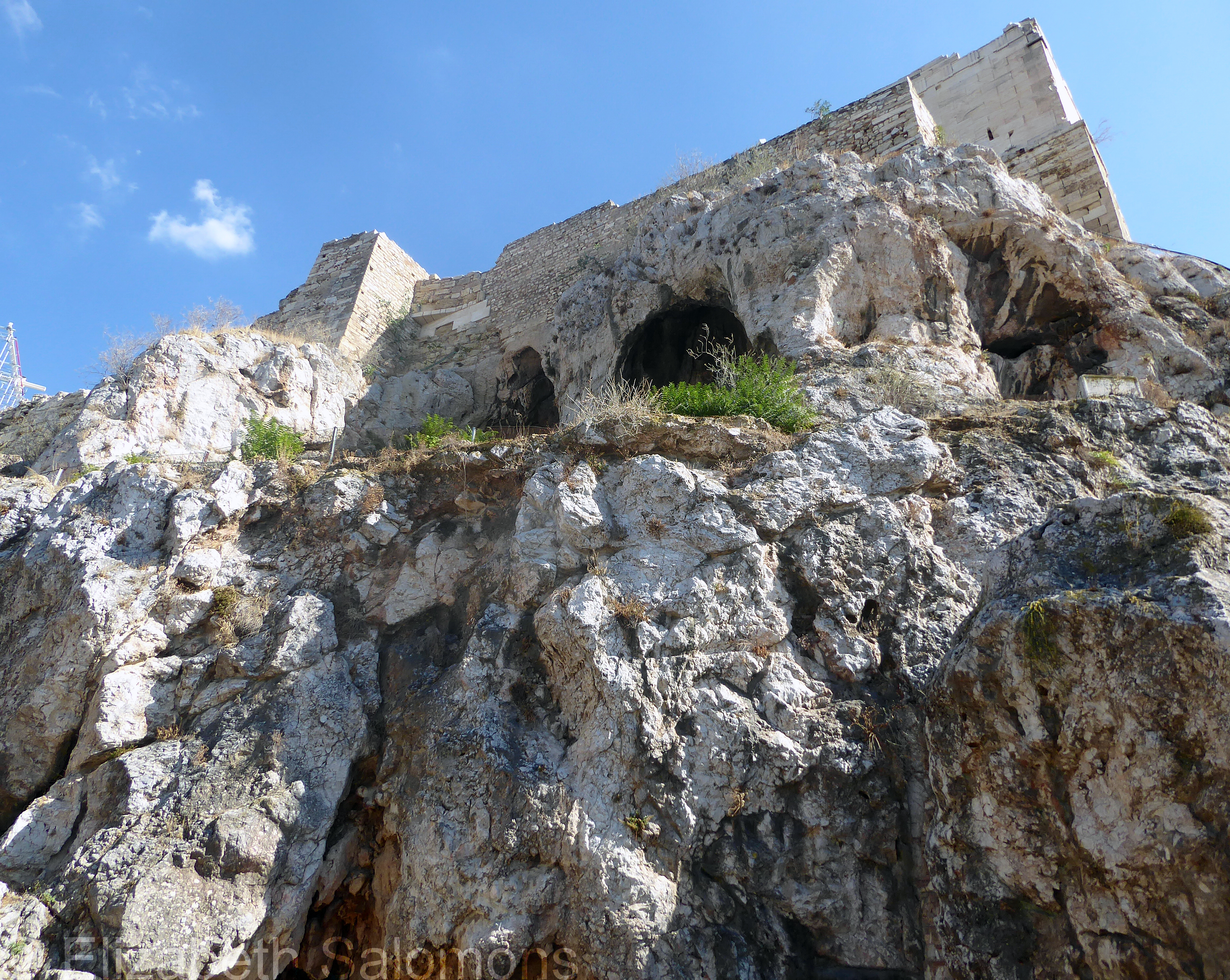
The first fortifications went up in the thirteenth century BCE and had a military purpose; around eighth century BCE, the site shifted to a religious focus dedicated to Athena, the goddess of Athens. A massive building program undertaken in the fifth century BCE resulted in the structures that have showcased ancient Greek’s architecture and art ever since.
I came in by the southeastern entrance, where a switchback trail leads you slowly up the hillside (called the “slopes”), past many ruins that serve as a teaser for the main event.


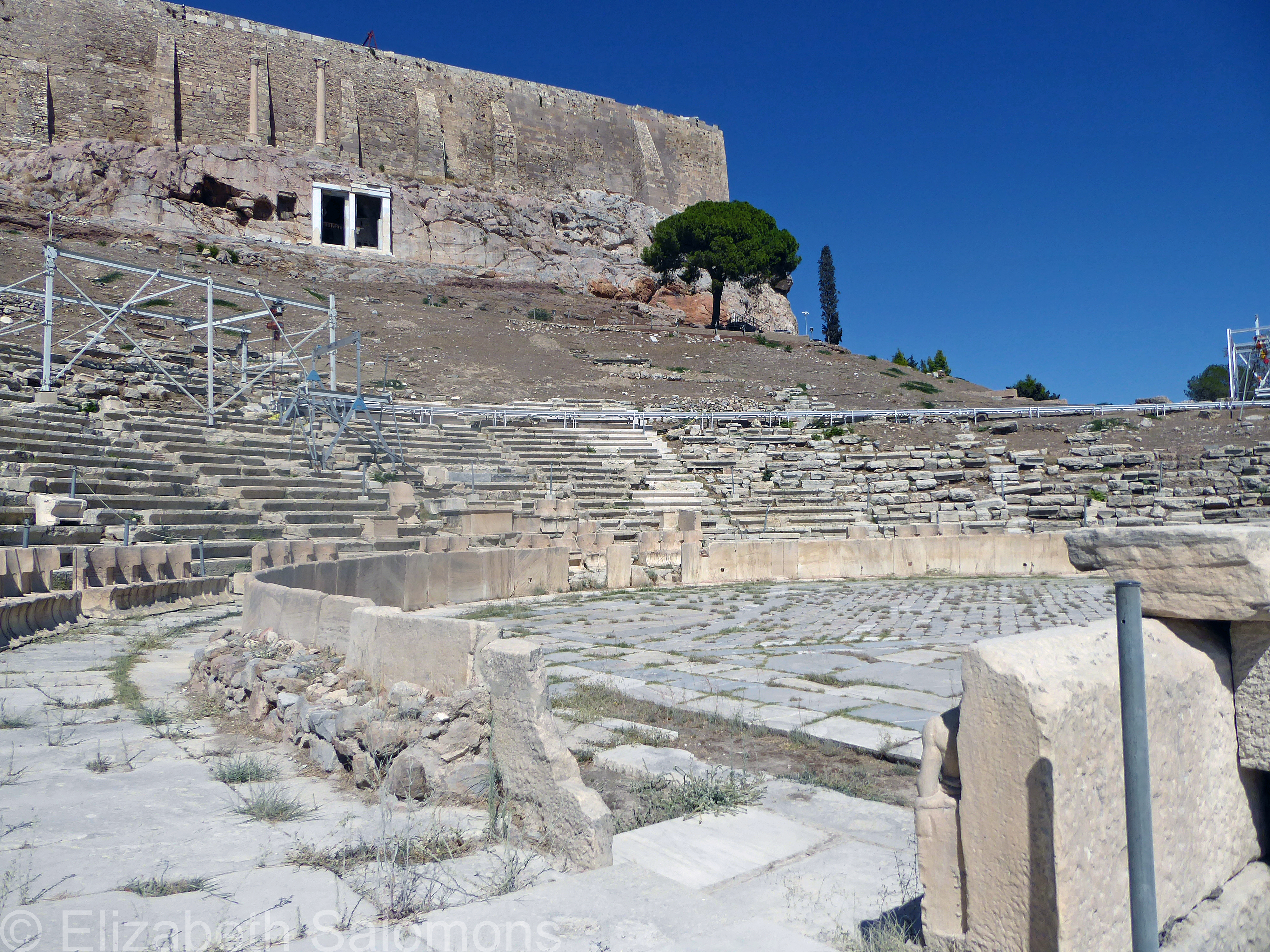
The Theatre of Dionysos is also located on the southern slopes. First built out of wood in the sixth century BCE, it was redone in stone and marble three hundred years later. It had room for 17,000 spectators seated in 64 tiers, of which 20 still survive.
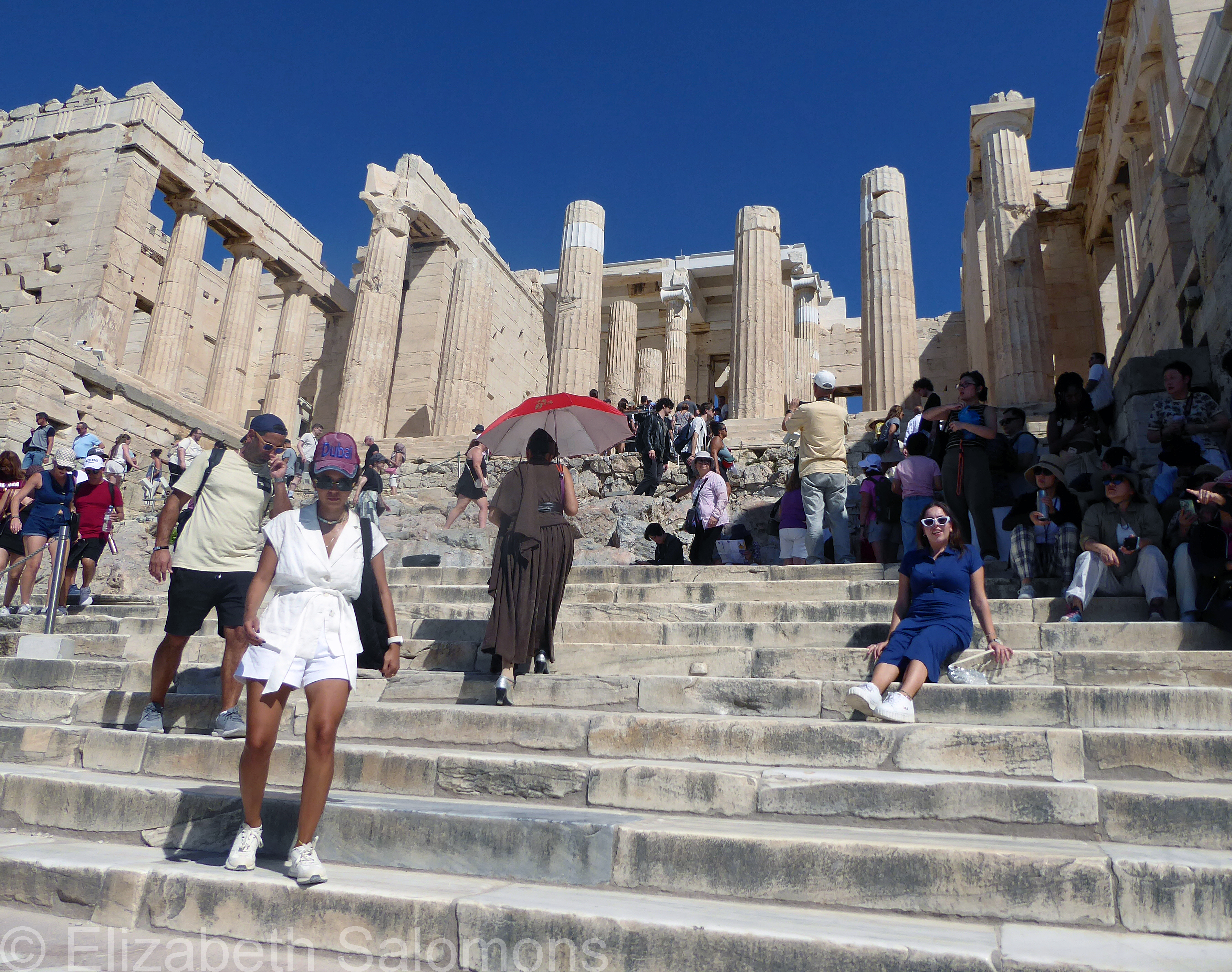
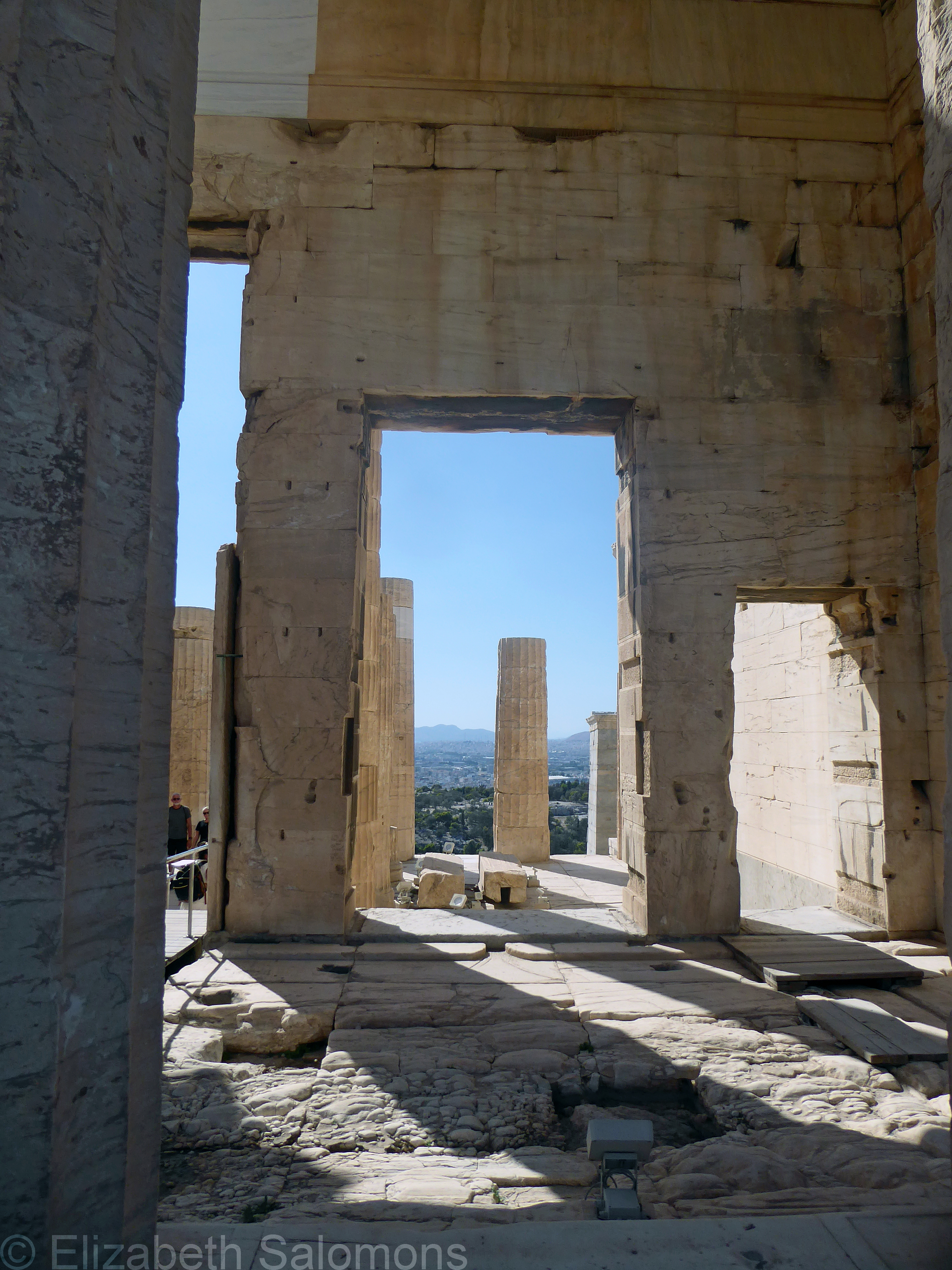
The Propylaea, built between 437 and 432 BCE, marks the entrance to the Acropolis. It was the only part of the Acropolis where I could not manage to get a photo without massive numbers of tourists.
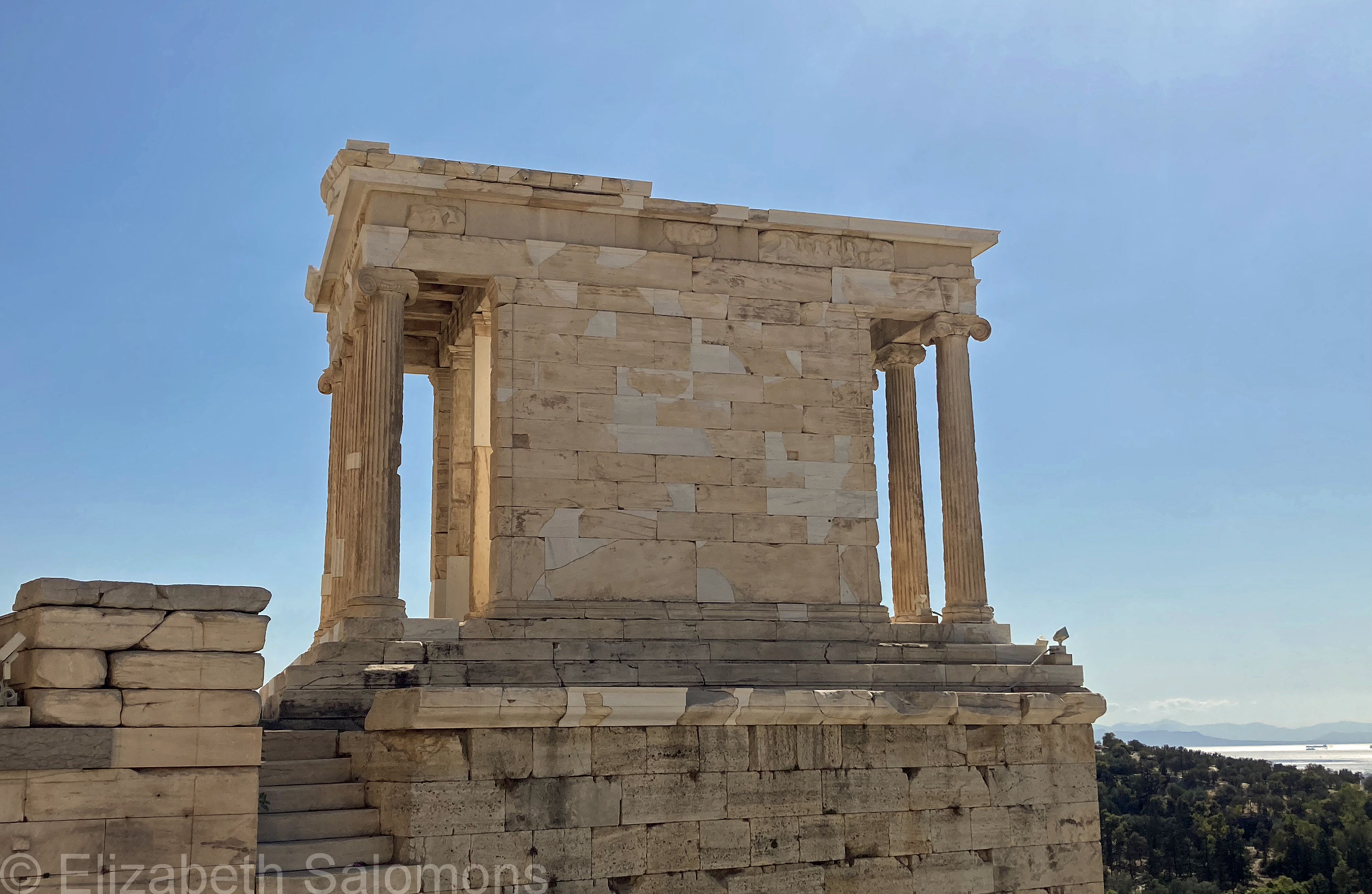
The Temple of Athena Nike (Athena as Victory) was completed in 425 BCE. It stands slightly before the Propylaea.
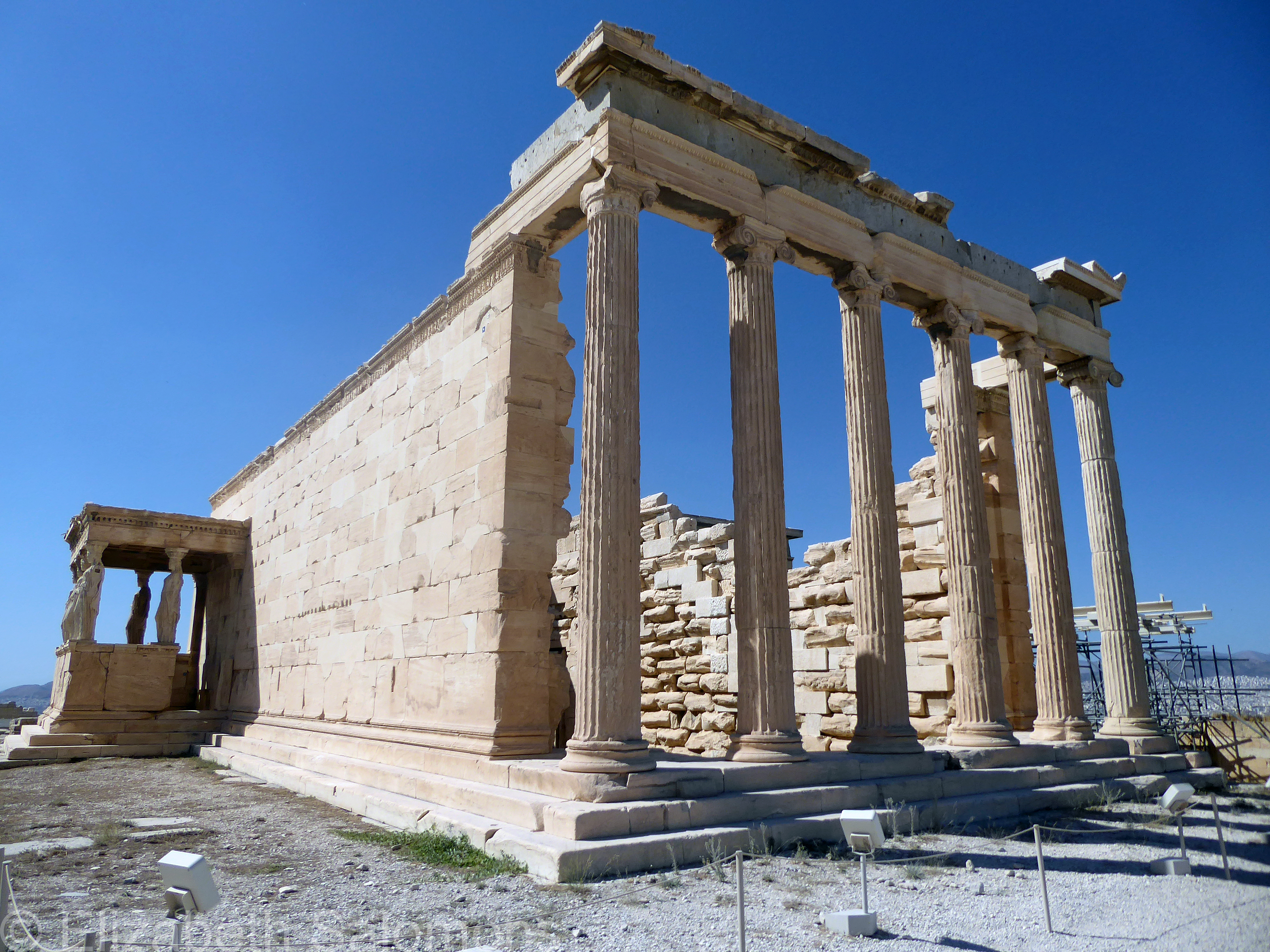
The Temple of Athena Polias (Athena of the City), or the Erechtheion, was finished in 406 BCE. This Ionic temple was built on the holiest part of the Acropolis, where Poseidon (god of the sea) struck the ground with his trident, creating a spring, and where Athena (goddess of wisdom) planted an olive tree.

(Quick aside: Athena and Poseidon were competing to see who would be patron of the newly founded city-state. The water in Poseidon’s spring was salty and so the citizens chose the olive tree, which would provide them with food, oil, and shade. This made Athena the winner and gave the city its name.)
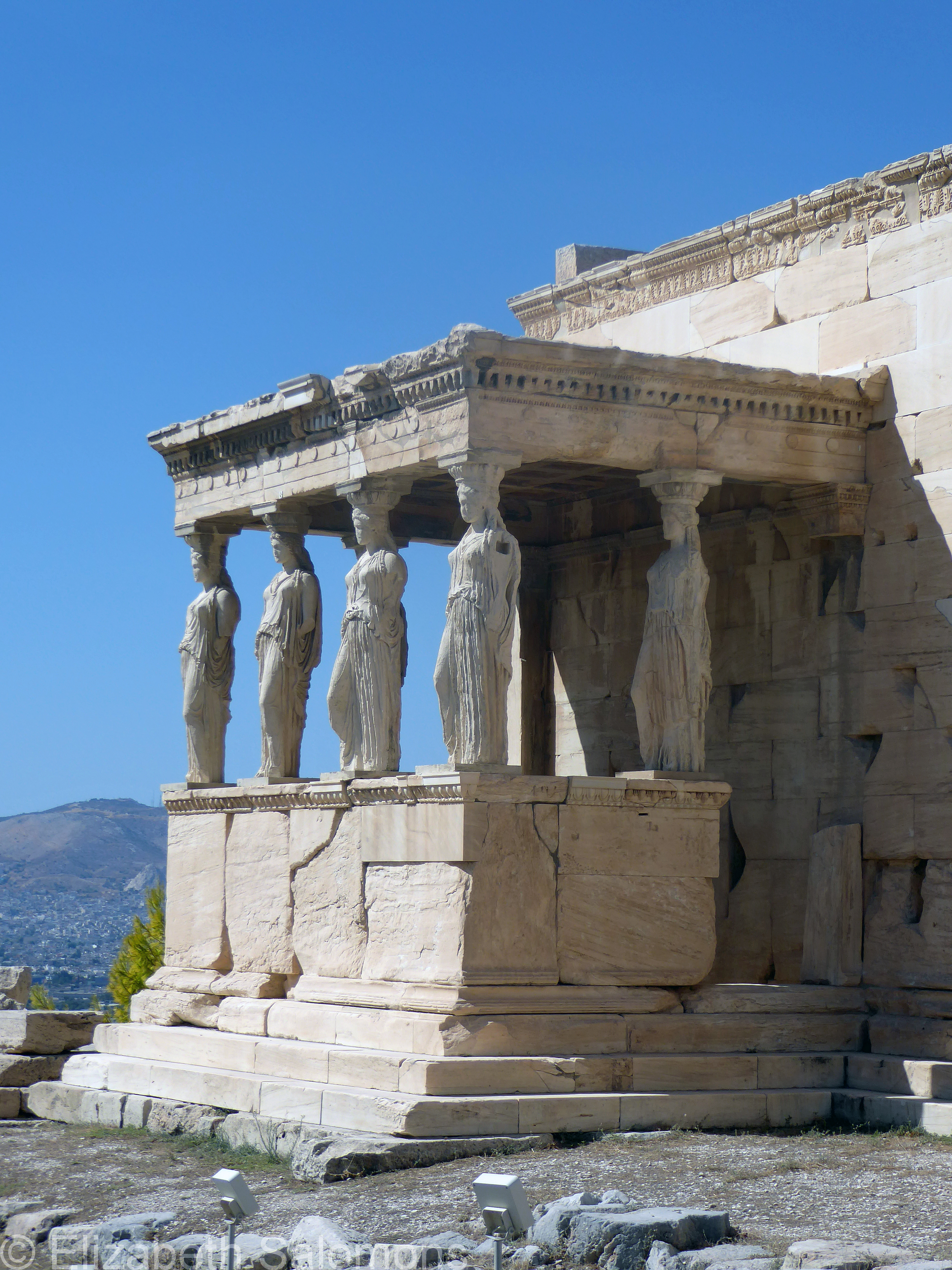
The six maiden columns of the Erechtheion, called the Caryatids, were completed in 415 BCE. The ones here are plaster replicas. Five of the originals are in the Acropolis Museum and the sixth is in the British Museum.
The largest structure on the Acropolis site is the Parthenon. This Doric temple, completed between 447 and 438 BCE, was dedicated to the goddess Athena Parthenos (Athena the Virgin). Its foundations are slightly concave and the columns slightly convex — an optical illusion that allows both to appear straight. When it was first built, its friezes were brightly painted.
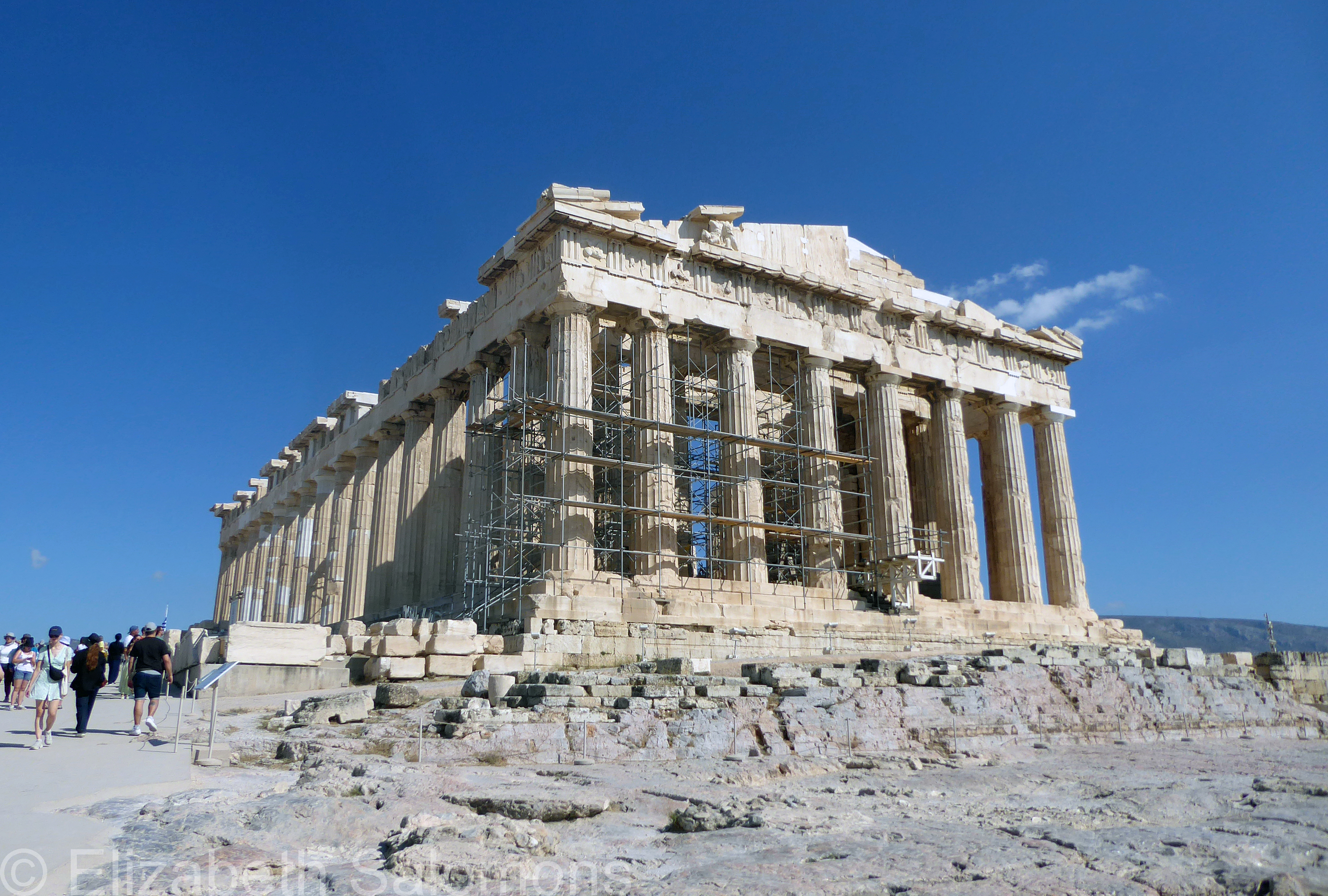
Sometime in the late third or fourth century CE, the interior of Pantheon was destroyed in a fire. In the sixth century CE, it was converted to an Orthodox church. In 1204, crusaders turned it into a Catholic church. When the Ottomans conquered Athens in 1458, it was converted to a mosque. And in 1687, when the Venetians held a siege of the Acropolis, a cannonball made a direct hit on the Parthenon. As it was being used as a powder magazine, the explosion destroyed the roof and much of its walls.
But the most severe damage to the Parthenon? That was between 1801 and 1812, when Lord Elgin carted half of its remaining sculptures off to England, along with sculptures from the Erechtheion, the Temple of Athena Nike, and the Propylaea. They remain there, displayed in the British Museum. The Greeks, naturally, want them back. The Elgin Marbles have been a source of tension between the two countries ever since.
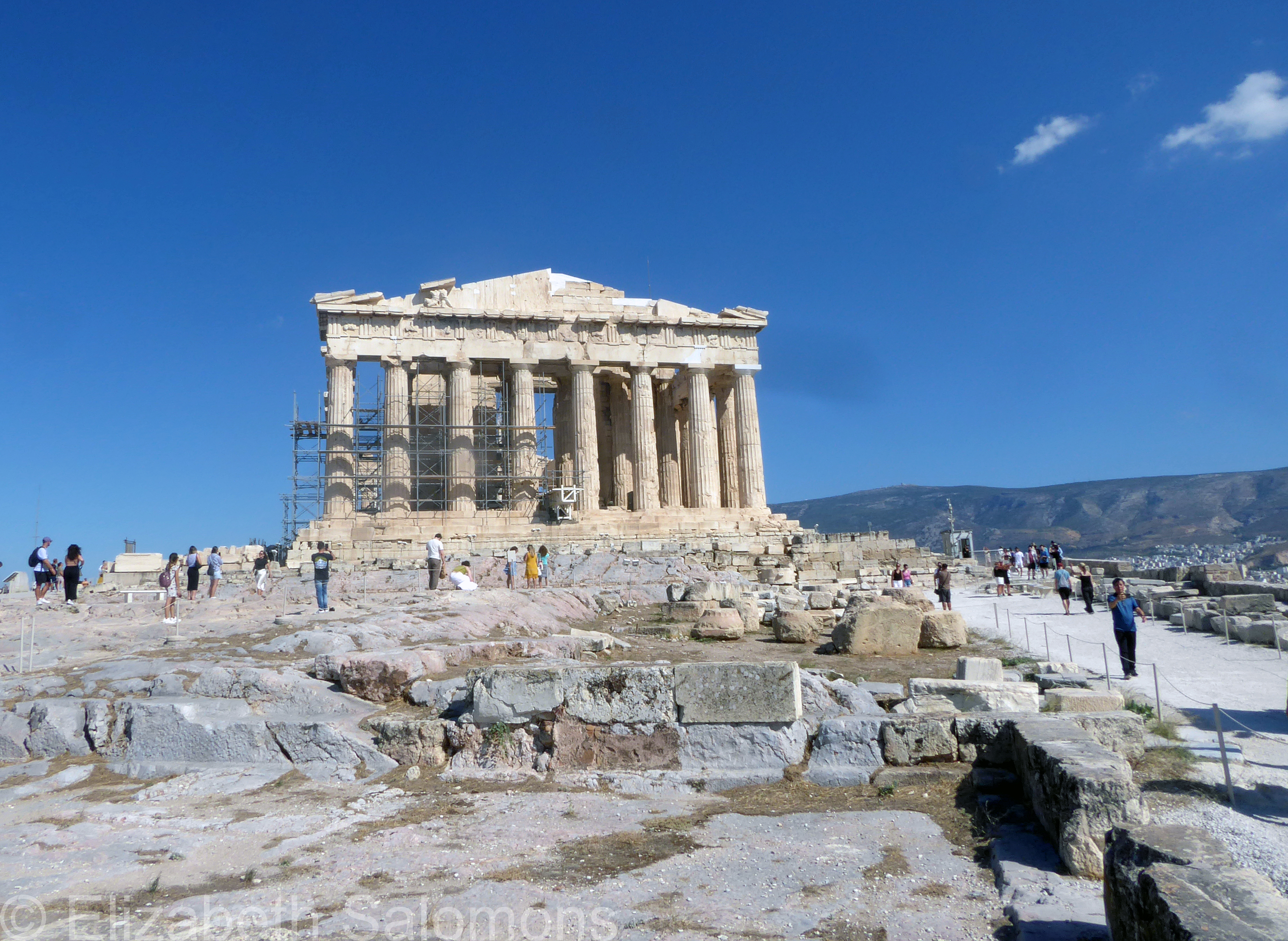
It doesn’t take long to walk through the Acropolis. I took my time, stretching my visit out to almost two hours (spent mostly waiting for people to move out of the frame as I took my photos), but you could speed through the entire complex in 30 minutes if you were in a rush. Bring plenty of water — it was hot, even in late September, and there’s no shade.
The Acropolis has been operating as an archaeological site since 1833, shortly after the establishment of the modern Greek state. It has always served as the religious and cultural centre of Athens, but it is also a symbol of the birthplace of democracy and the foundation of Western civilization. Yeah, no pressure there. Given the increasing fragility of democracies around the world (particularly noticeable this year, I might add), today seems like a good day to reflect on that legacy.
Happy Birthday, Canada House!
Canada is a great country: alike in the literal sense of vast extent from sea to sea and great in achievement and in promise, and it is right and necessary that its official representatives here should be housed in a manner worthy of the Dominion and adequate to the discharge of their ever-growing and important duties.”
— King George V
A hundred years ago today, King George V opened Canada House, also known as the High Commission of Canada in the United Kingdom, with these words. The building has a unique purpose in the relationship between Canada and the UK and a pretty cool address: Canada House, Trafalgar Square, London.
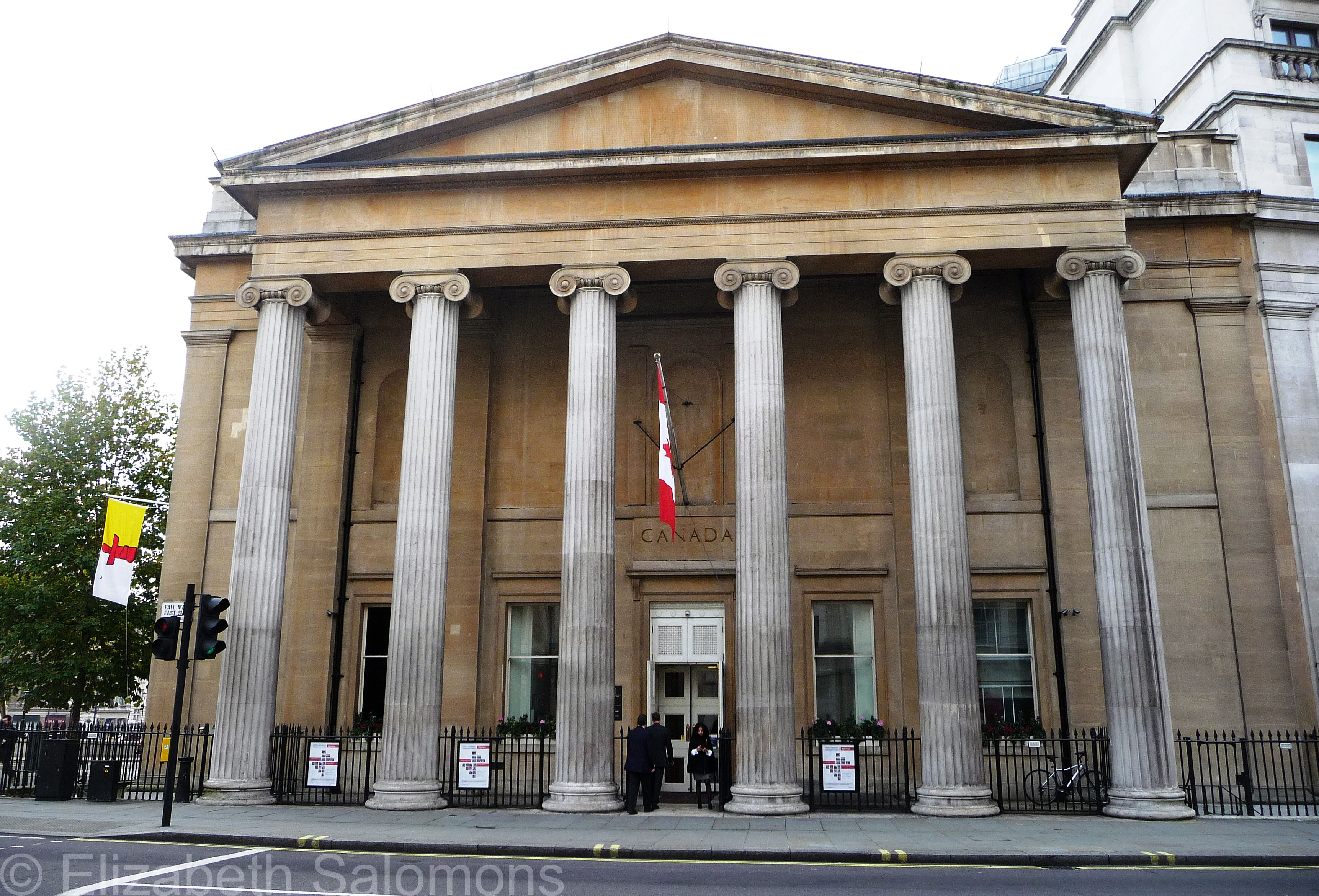
Completed in 1827, the building was purpose-built for a gentleman’s club known as the Union Club. Its architect was Sir Robert Smirke, designer of the British Museum and the Royal Opera House at Covent Garden. The Greek Revival style was a departure from the Regency era, and the style was adopted by many of the neighbours of Canada House, including the National Gallery, South Africa House, and St. Martin-in-the-Fields.
Canada bought the building in 1923. After extensive renovations, the High Commission moved in and has resided there ever since. London is Canada’s oldest diplomatic mission and its second largest, with a complement of 300 today. (In 1923, it numbered five.)
The reason Canada House is a High Commission, not an embassy, is because when it was established way back in 1880, Canada was still under colonial rule. (Fun fact: Canadians were considered British subjects until 1947.) Our first prime minister, Sir John A Macdonald, had a representative in London who acted on his behalf and whom Sir John A. wanted to call a resident minister. Britain said no to that idea and suggested the title of high commissioner instead. That title and the position became the standard for all members of the Commonwealth and is why Commonwealth nations send high commissioners, rather than ambassadors, to each other’s capitals.
As the Canadian diplomatic mission in London grew, it expanded into a second location on Grosvenor Square called Macdonald House, which was in use from 1961 to 2014.
In 2013, Canada bought the building next door to Canada House. Former home of the Sunlife Assurance Company of Canada, it was built at the same time as Canada House and in the same Greek Revival style. (Another fun fact: this building served as the overseas headquarters of the Canadian Army during World War II.) Renovation work converted the two buildings into one, Macdonald House was sold, and the High Commission has resided in one building since 2014.
I became aware of its centennial when I saw the coverage of King Charles and Queen Camilla’s visit to Canada House back in May. They dropped by to draw attention to their upcoming visit to Canada. That visit would be Charles’s 20th, but his first as Sovereign. The purpose of his visit was to attend the opening of Canada’s parliament and deliver the Speech from the Throne.
Given current world events, this was a pretty big deal. Indulge me as I take a moment to explain why. Some of my readers, especially the non-Commonwealth ones, might not understand.
Although Canada is an independent nation, we are a member of the Commonwealth, and one of 14 realms where, in addition to the United Kingdom, the Sovereign is also the Head of State. This means Charles III is also King of Canada.
The Throne Speech outlines the government’s agenda for the next session of parliament and is usually read by the Governor General, who is the King’s representative in Canada. But on just three occasions, the Sovereign has travelled to Canada to read the speech: King Charles last month, and his mother, Queen Elizabeth II, in 1957 and 1977.
After being sworn in as prime minister in March, Mark Carney made a quick overseas trip to Paris and London, stopping off in Iqaluit on his way back to Ottawa. Many saw this trip as symbolic; during his swearing-in ceremony, Carney pointed out that Canada was founded by three peoples: French, English, and Indigenous. While in London, he met with King Charles and asked him to open the next session of the Canadian parliament, should the Liberals be successful in the next election. Which they were.
Fast forward to May 27. Having the King open the 45th Parliament of Canada and deliver the Speech from the Throne highlighted to the world that we are a constitutional monarchy, and our system of government is much different than that of the republic to our south. Charles and Camilla were in Ottawa less than 24 hours, but were given a warm welcome by thousands of Canadians. Even anti-monarchists were heard to remark on the significance of the occasion.
About those current world events. Some people think Canada becoming the 51st state is a joke, but Canadians aren’t laughing. The Speech from the Throne reiterated Canada’s sovereignty and the need to rebuild our relationships with both the United States and the rest of the world.
The Throne Speech is always written by the government, but the Sovereign (or the Governor General, as the case may be) are expected to add a personal touch at the beginning. Charles did so with these words:
Every time I come to Canada, a little more of Canada seeps into my bloodstream — and from there straight to my heart.”
It was a bit surreal to hear King Charles speak about Canadian domestic issues such as building affordable homes and strengthening our border, but when he read the following words, his tone was heartfelt:
As the anthem reminds us: the True North is indeed strong and free.”
The entire chamber broke out in applause.
The monarchy has to remain apolitical, but they have been known to use symbols to express themselves. Canadians noticed when Charles wore his Canadian military honours while on a visit to a Royal Navy ship in early March, a day after meeting with Prime Minister Trudeau in London. The visit of Charles and Camilla to Canada House a week before their visit to Canada was another symbol.
I got up close and personal with Canada House over two days in the fall of 2010. The above photo is actually of the side entrance, not the main one by which the Royals and other distinguished guests enter. But it’s the entrance I used. See, when you’re a Canadian in London who has had her passport stolen while travelling on a crowded Tube train, you need to visit Canada House.
The wallet was stolen on a Saturday night, and I had to wait until Monday morning to get into the High Commission. By then it had been a long and stressful two nights for me, but the consular official who helped me was calming and reassuring. She had me sorted out in no time. I returned the next morning to pick up my temporary passport and was then able to leave for Paris, only one day later than scheduled.
So for me, Canada House isn’t just a symbol. And while I’m sure the people who helped me thought they were just doing their job, I needed them to do those jobs to get me home.
In the same way, asking the King of Canada to open our Parliament is more than a symbol. It’s his job. And this year, in these times, we needed him to do his job. It might not make any difference to the man sitting in the White House, but it sure reminded Canadians that we are strong and, indeed, free.
The Erickson

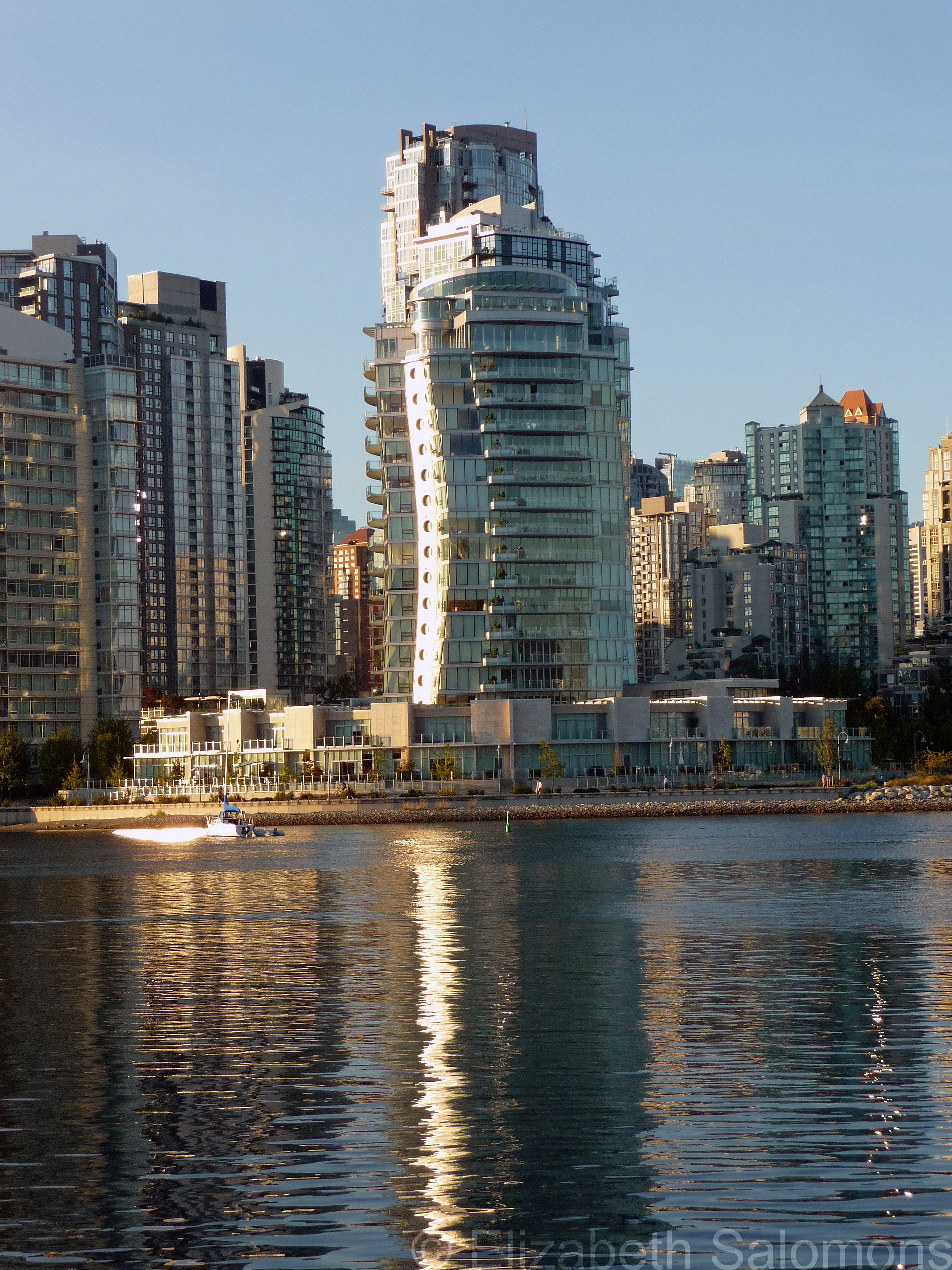
A year ago today, I started a series of posts on Vancouver buildings designed by Arthur Erickson. I have one last photo to post, and that’s this building, named, appropriately enough, The Erickson.
This condo was built on the former Expo Lands, on the north side of False Creek. It was finished in 2010, a year after Erickson died, and is one of the last projects he was involved with.
I remember when it went up. My walks along the seawall involved a detour to get around the construction, but now, the building looks like it’s been there forever.
Canada House

Here’s another Erickson design. This is Canada House, completed in 2009. It was built to house the Canadian athletes during the Vancouver 2010 Olympics, which ended 15 years ago today with another spectacular hockey win for Canada.
The condos have since been sold and an entirely new neighbourhood has sprung up on the south side of False Creek.
Waterfall Building

When I started researching the buildings designed by Arthur Erickson, I was surprised to learn that a concrete building I always walk past after seeing my hairdresser was one of his designs.

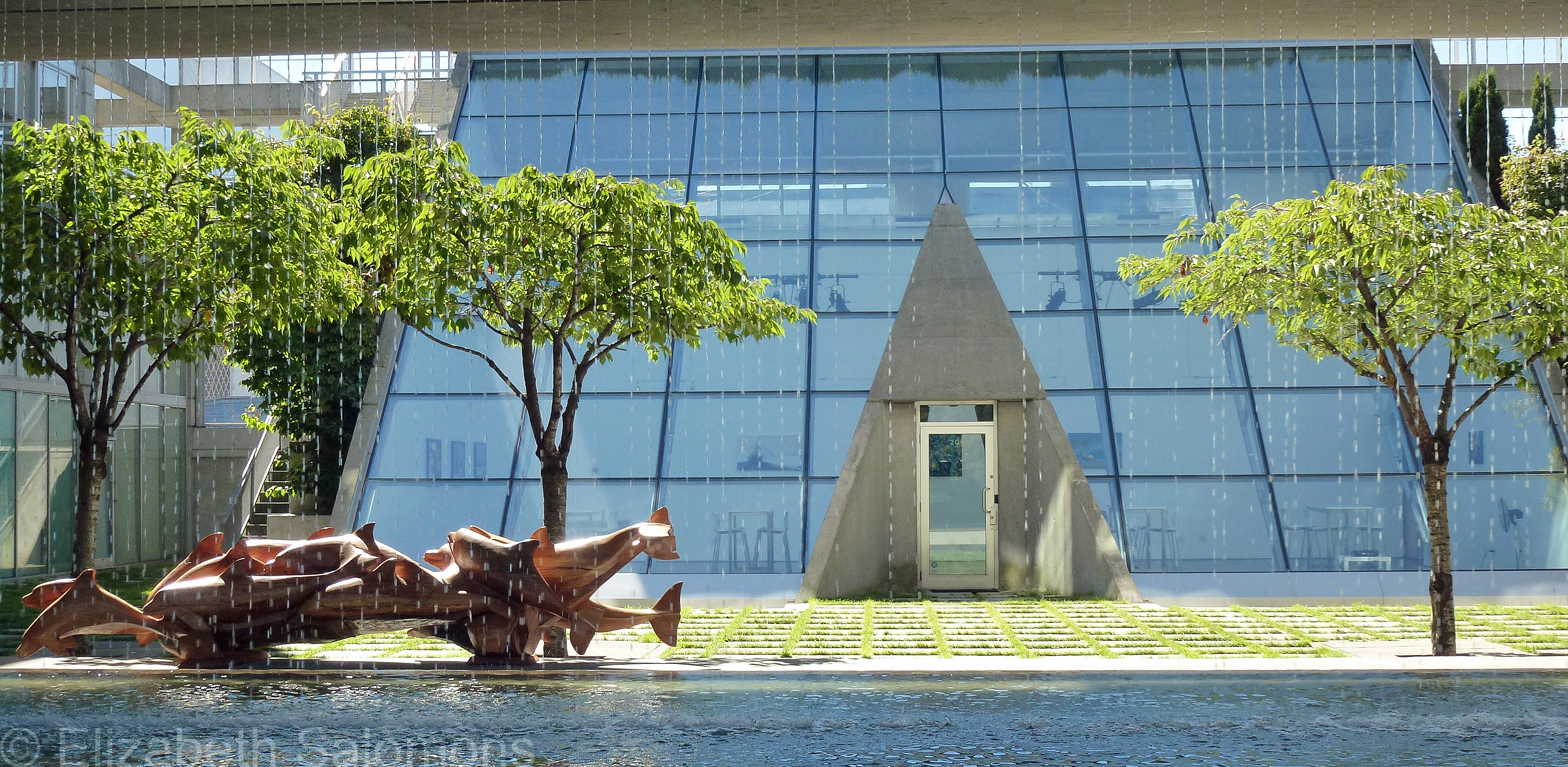
This is the Waterfall Building, named after the water feature that frames the entrance. Completed in 2001, it was intended as a live-work complex and is on a far smaller scale than the other Erickson buildings I have written about in this series.
Koerner Library

As someone who has worked with books most of her professional life, I appreciate a well-designed library. This is the Koerner Library at the University of British Columbia, designed by Arthur Erickson and completed in 1997. It is named after Walter C. Koerner, a forestry businessman and philanthropist long associated with the university.
Koerner Library is the largest of the 15 libraries at UBC’s Point Grey campus and home to the humanities and social sciences collections. What’s kind of neat, I think, is that it was built on top of the former Sedgewick Library, which was below ground level and used skylights to bring natural light into the stacks. That building is now the basement of the Koerner Library.

Robson Square

One could argue that the most iconic of Erickson designs in Vancouver is the Robson Square complex. Sprawled across three blocks in the centre of downtown, it is bookended by the Provincial Law Courts and the Vancouver Art Gallery.

Long before Erickson came on board, the plan was for a vertical building — the tallest in Vancouver. But the 1972 provincial election brought about a change in both government and architect. And when worries were expressed about the immense shadow that such a building would cast, the new architect, Arthur Erickson, declared, “Let’s turn it on its side.” His vision was for a public square that people could walk through, anchored by the law at one end and the arts at the other.
The Provincial Law Courts were completed in 1979.
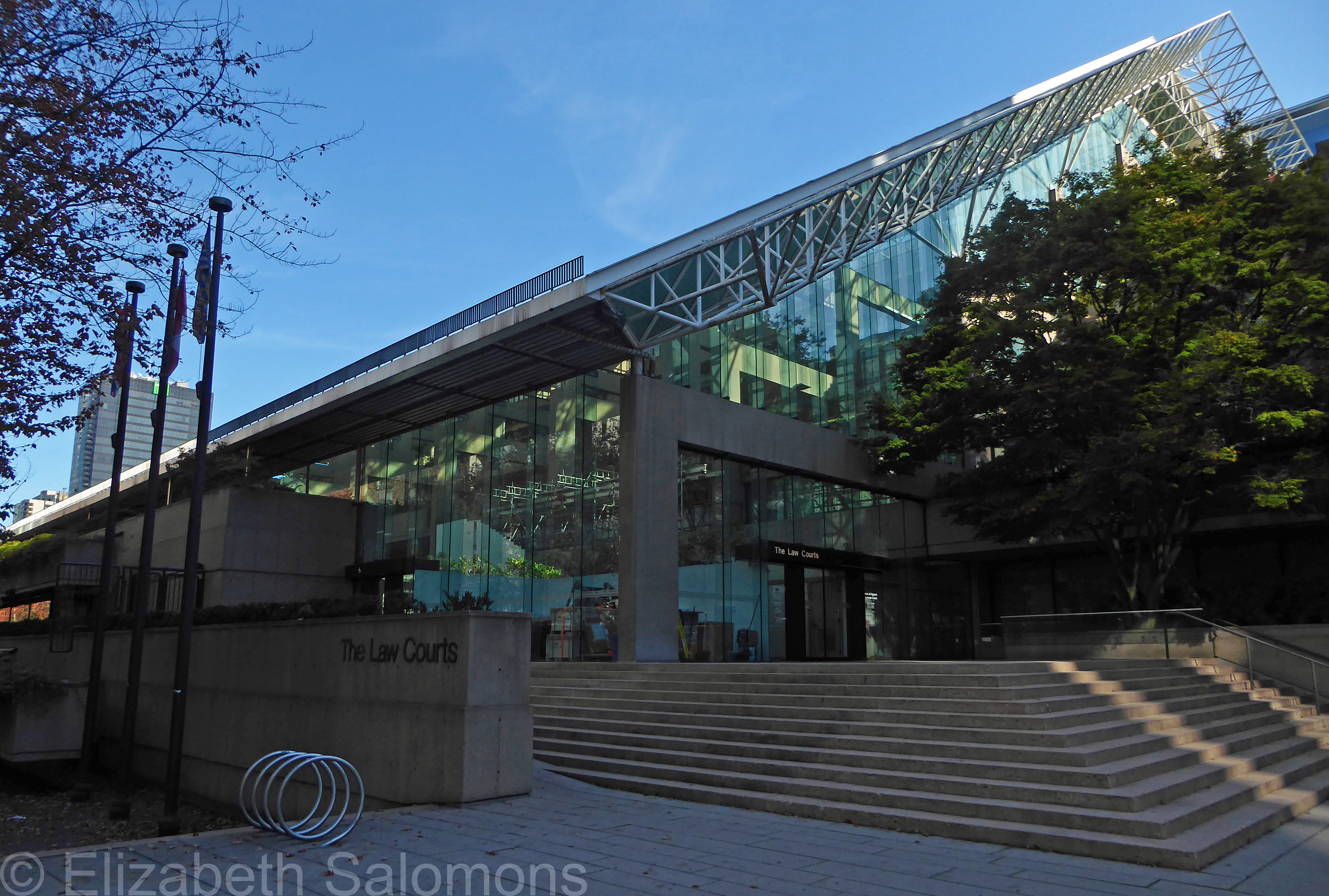
The renovation of the Vancouver Art Gallery, formerly the provincial courthouse, was completed in 1983.

The result is what Vancouver considers to be its main civic square. Curiously, though, our City Hall is located some three kilometres away. Why not downtown like most cities?
Good question, but that’s a topic for another post.
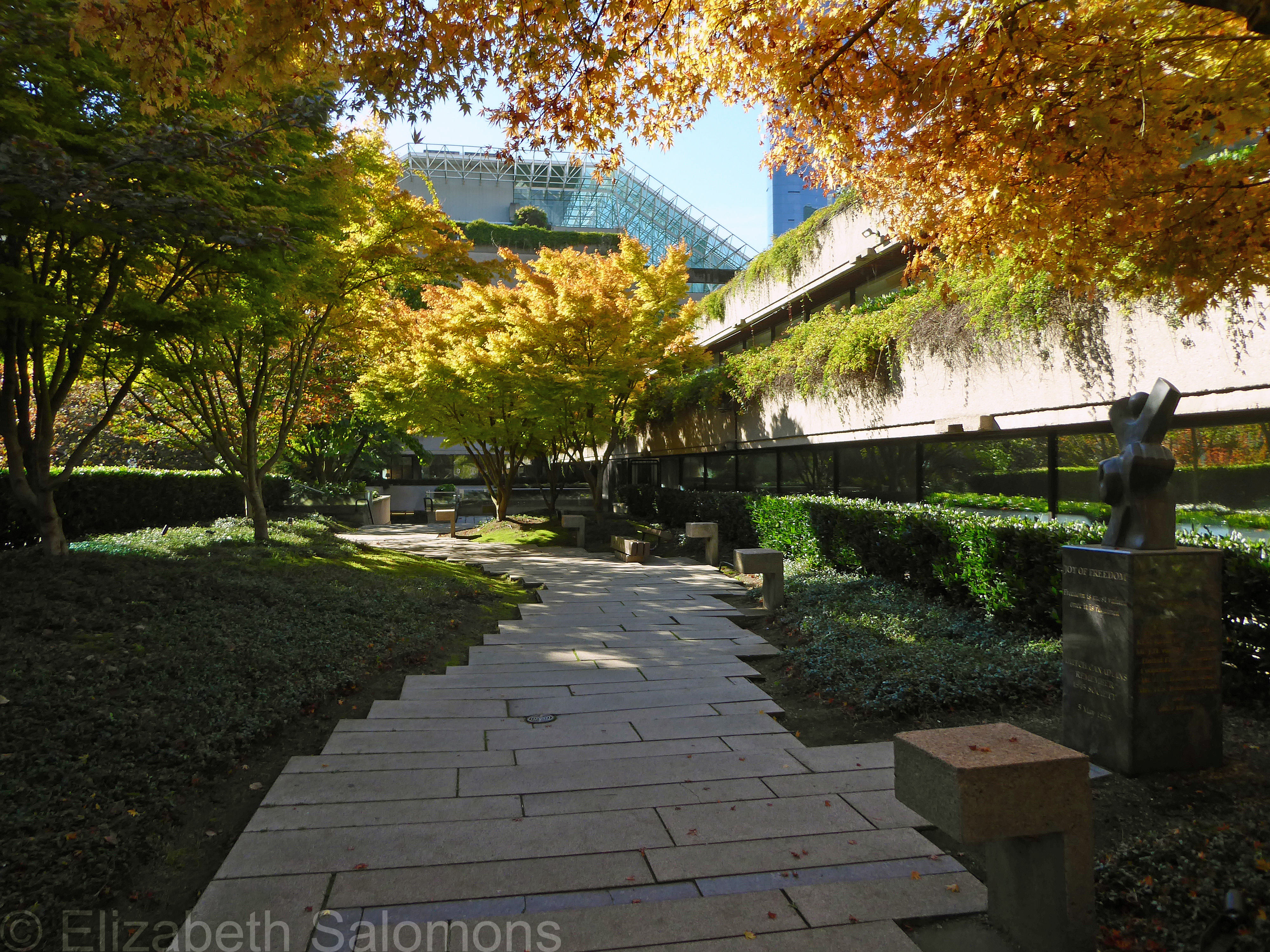
Cornelia Hahn Oberlander, the landscape architect who worked with Erickson on the Evergreen Building, designed the hanging gardens with its series of cascading waterfalls.
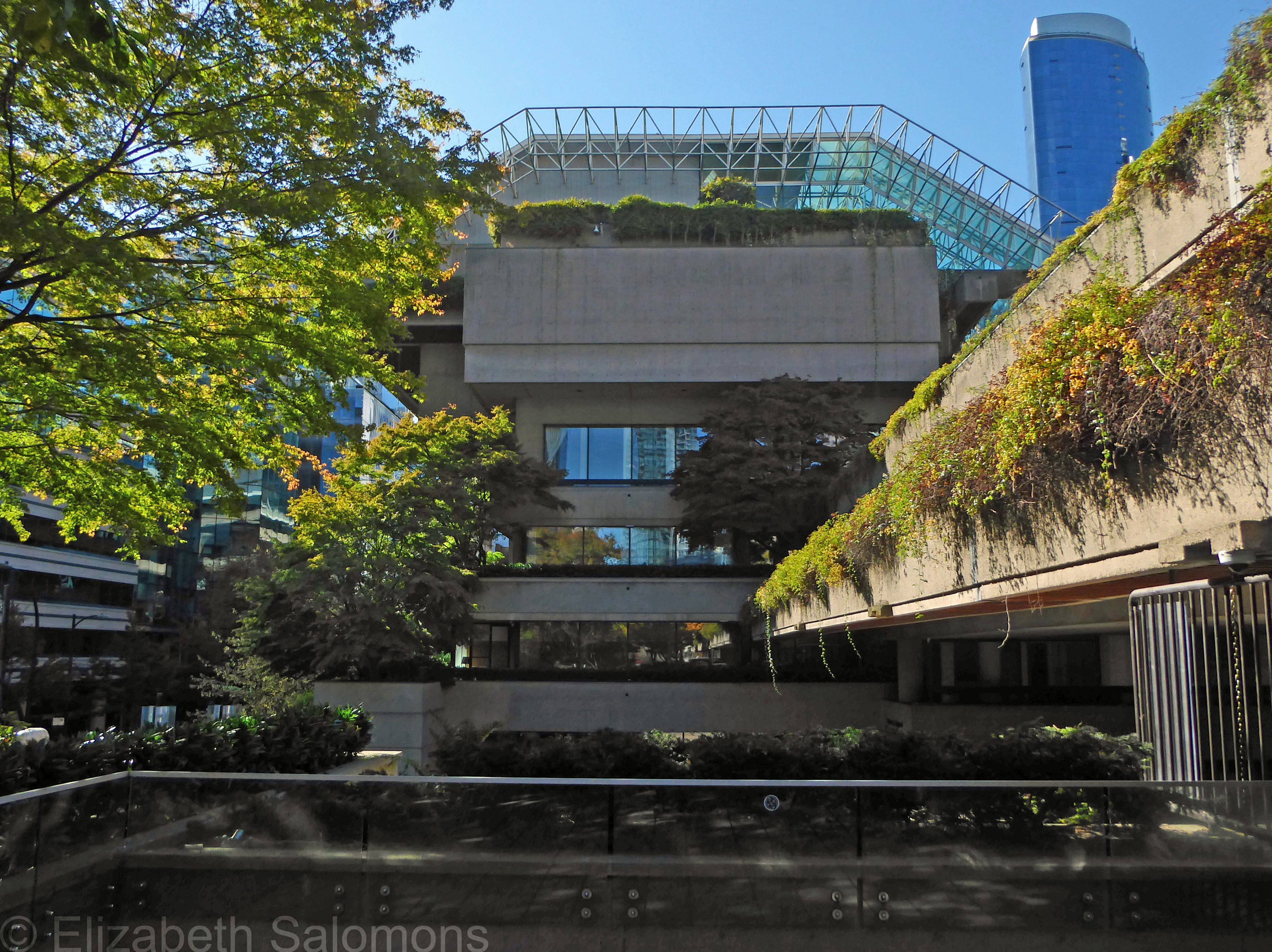
The law courts contain courtrooms, offices, and a law library. The entire complex is multi-level, with provincial government offices above ground and a sunken plaza with an ice rink below, offering free skating in the winter and salsa and ballroom dancing in the summer.

The buildings flanking the rink contain the classrooms and offices of the downtown campus of UBC.

Robson Square takes its name from downtown Vancouver’s main shopping street, which runs through the middle of the complex. That one-block stretch of Robson Street was first closed to vehicle traffic during the Vancouver Olympics, then every summer, and then permanently in 2017.
Robson Street is named after John Robson, a business man from Upper Canada who came west during the Fraser Canyon Gold Rush of 1859. He was a strong advocate for the Colony of British Columbia joining Confederation and eventually served as our ninth premier.


 There and Back Again