
The Erickson

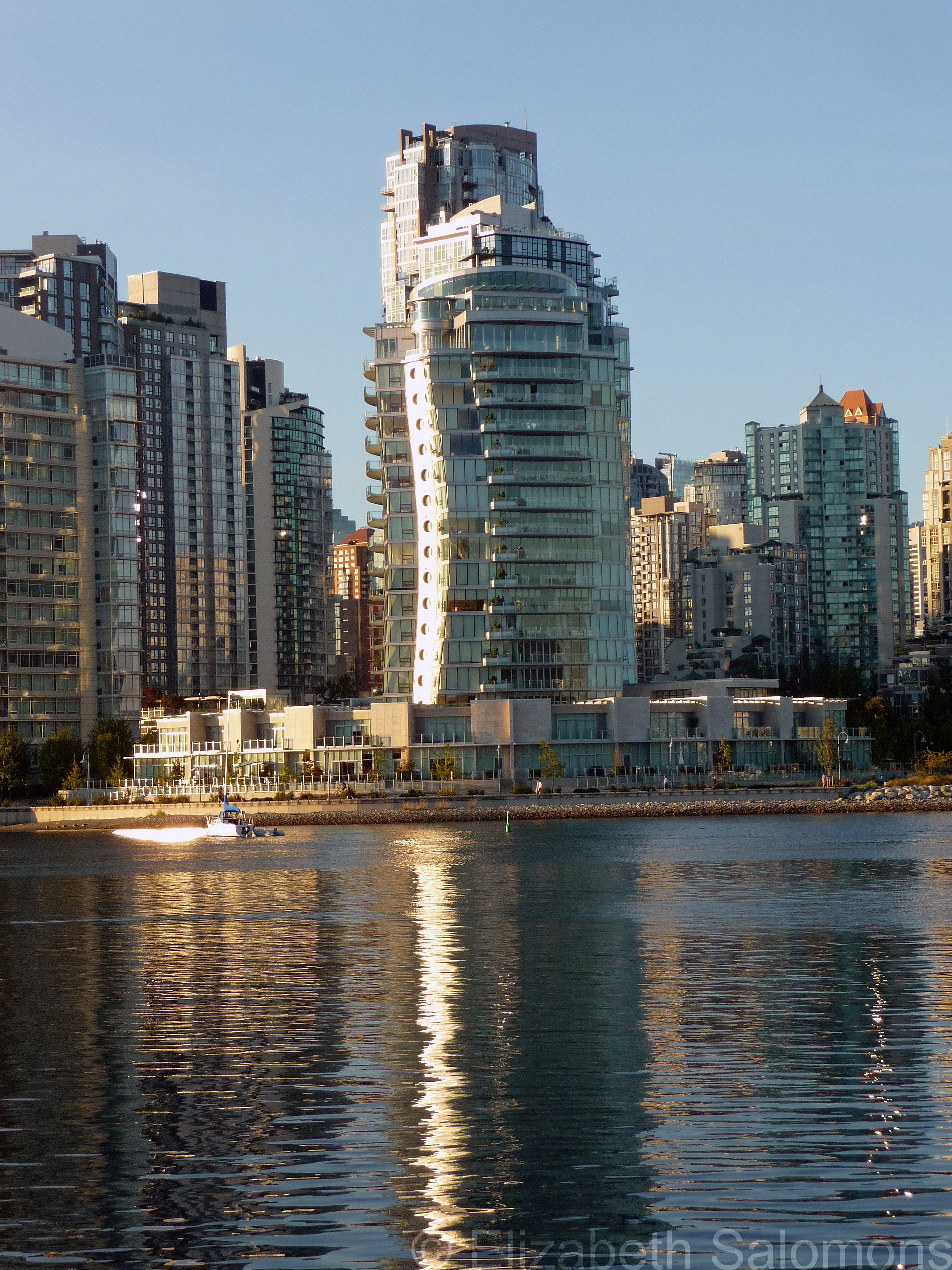
A year ago today, I started a series of posts on Vancouver buildings designed by Arthur Erickson. I have one last photo to post, and that’s this building, named, appropriately enough, The Erickson.
This condo was built on the former Expo Lands, on the north side of False Creek. It was finished in 2010, a year after Erickson died, and is one of the last projects he was involved with.
I remember when it went up. My walks along the seawall involved a detour to get around the construction, but now, the building looks like it’s been there forever.
Canada House

Here’s another Erickson design. This is Canada House, completed in 2009. It was built to house the Canadian athletes during the Vancouver 2010 Olympics, which ended 15 years ago today with another spectacular hockey win for Canada.
The condos have since been sold and an entirely new neighbourhood has sprung up on the south side of False Creek.
Through My Lens: Golden Hour on Beach Avenue
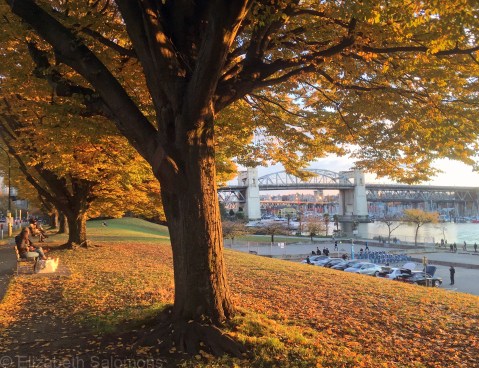
Golden hour. Magic hour.
No matter what you call it, end-of-day light is enchanting.
Through My Lens: Autumn Ride

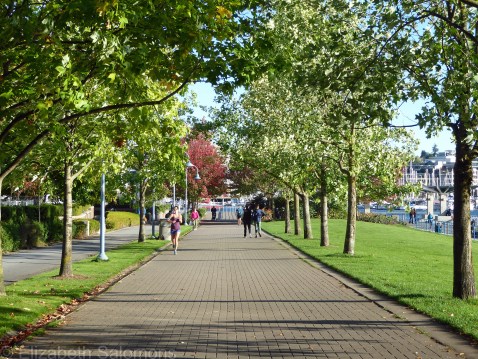
I like to think of this photo as a companion piece to a photo I took a year ago in almost the exact same spot. This is along the north side of False Creek.
Love these colours.
Through My Lens: Autumn Walk

After all my whinging about the rain, we’ve had some spectacular fall days these past couple of weeks.
And here’s a thing about Vancouver: when it stops raining, the entire city drops what they’re doing and goes for a walk.
Because, this time of year, we know it won’t last.
Vancouver Biennale: Giants
Every city needs art and art has to be in the middle of the people.” — OSGEMEOS

The Vancouver Biennale is a two-year-long outdoor public art installation that takes place every two or three years. The first was from 2005 to 2007, the second from 2009 to 2011, and the latest, the third Biennale, began in the spring of 2014 and finishes up this year.

The installations by world-renown artists are scattered across Greater Vancouver. The most impressive piece of this latest Biennale is Giants by the twin Brazilian brothers, Gustavo and Otávio Pandolfo, who call themselves OSGEMEOS. (Os gemeos is Portuguese for “the twins.”)

Giants consists of murals painted on six concrete silos located at Ocean Concrete on Granville Island. (An aside: this concrete factory is the last vestige of False Creek’s industrial past.) The murals alternate between facing the water and facing inland. They are colourful, and they are cheerful, which seems to be a hallmark of the most successful installations of the Biennale. None are intended to be permanent, but sometimes we just can’t bear to let them go. Hopefully this one will be kept on as well.
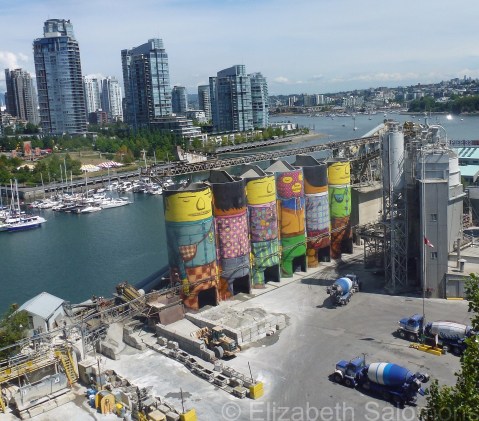
Oh, and any guesses as to how much paint was used?
A mere 1400 cans.
Expo Lands

When Expo 86 closed its gates 30 years ago today, it finished as a far more successful world’s fair than it ever expected to be. Sure, Vancouver had high hopes for the fair and saw it as a great way to celebrate its 100th birthday, as well as the 100th anniversary of the completion of the Canadian Pacific Railway that brought British Columbia into Confederation. A total of 38 countries participated, but it was getting the United States, the Soviet Union, China, and Cuba to all participate that was the real coup. And the number of visitors was far greater than predicted. Most British Columbians credit Expo with bringing the province out of one of its worst recessions.
On October 14, 1986, the question on everyone’s mind was: what happens to the fairgrounds? Prior to Expo 86, the 90-hectare site was an industrial wasteland. Sawmills and railway lands had been expropriated to make room for the fairgrounds (it boggles my mind that Vancouver had working sawmills in its downtown core in my lifetime), but with rezoning came all sorts of possibilities.
In the end, what came to be known as the Expo lands was sold to a single Chinese developer. The price was controversial, but in return for a good deal on the land, the developer agreed to build child-care centres, playgrounds, a community centre, and a school. Furthermore, the condos had to include a certain percentage of family-size units and affordable housing.
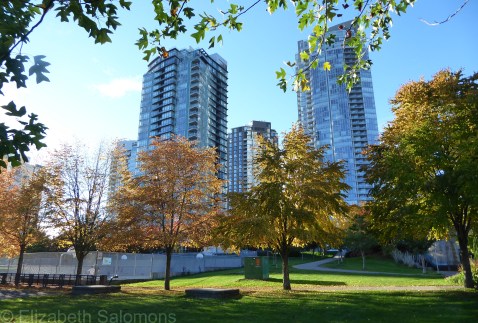
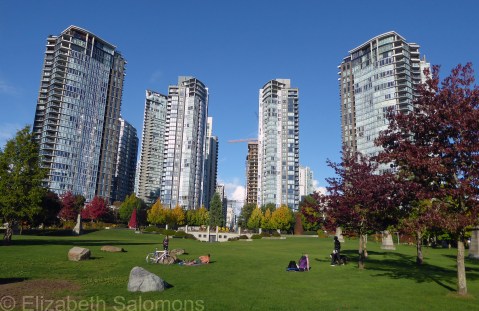
The result? A slow and careful development of a entirely new inner-city neighbourhood that, once populated, doubled the number of people living in Vancouver’s downtown core. It’s not completely finished; the last section still remains a parking lot while awaiting the demolishment of the Georgia and Dunsmuir Viaducts ― the remnants of the freeway into downtown Vancouver that never saw completion.
Vancouver is consistently rated as one of the most livable cities in the world and the development of the Expo lands has a lot to do with that rating. Today, the area is covered in condo towers. Agreed, they are not the most creative architecturally. But you only have to take a walk through the neighbourhood and marvel that, only 30 years ago, there was nothing there but a wide swath of empty land.
SkyTrain

Some say the most significant legacy of Expo 86 is our SkyTrain. It certainly is a fitting legacy for a world’s fair whose full name was World Exposition on Transportation and Communication.
During Expo, the SkyTrain took fairgoers from the Canada Pavilion at Canada Place to the main fairgrounds beside where Science World is located today.
The SkyTrain ― which now runs all the way to Surrey ― is a narrow elevated train. Too narrow, in my mind, as it’s too much of a crush at rush hour. And it’s so narrow that, when you compare it to subway trains like those in Toronto or New York, it feels like you’re riding a toy train.
The SkyTrain is all modern, though. It was the world’s first completely automated (read: driverless) rapid transit system. Daily ridership is around 400,000 passengers.
Science World
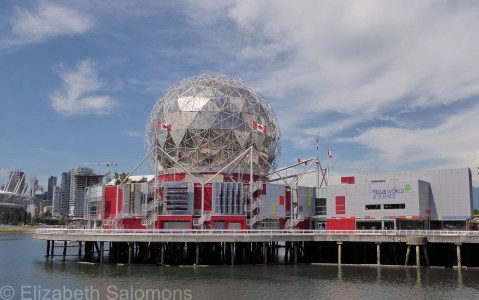
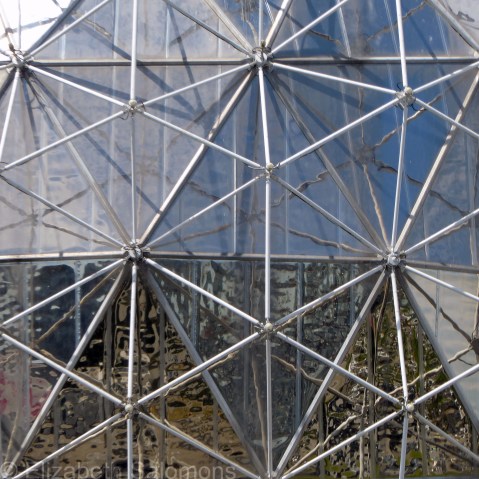
Another legacy site of Expo 86 is Science World. During Expo, it was called Expo Centre. Like most of the pavilions, it was intended to be dismantled at the end of the fair, but intense public opposition to that plan saved it, and it was turned into a science and technology centre instead.
During the 2010 Winter Olympics, it was transformed into Sochi World ― locally referred to as the Russia House ― to promote the 2014 Winter Olympics and to function as the hospitality area for the Russian national team.
Through My Lens: Foggy Bridges

Fog is a fact of life in Vancouver during the winter months. It can roll in from the ocean within a manner of minutes and stick around for weeks at a time. If the wind is in the right direction, I hear the fog horns from the freighter ships moored in English Bay, which is kinda cool. (What’s really cool is how they play those horns in harmony.)
The fog showed up again last night and was still here this morning, but I took this photo of the bridges over False Creek a few years ago.


 There and Back Again