
The Erickson

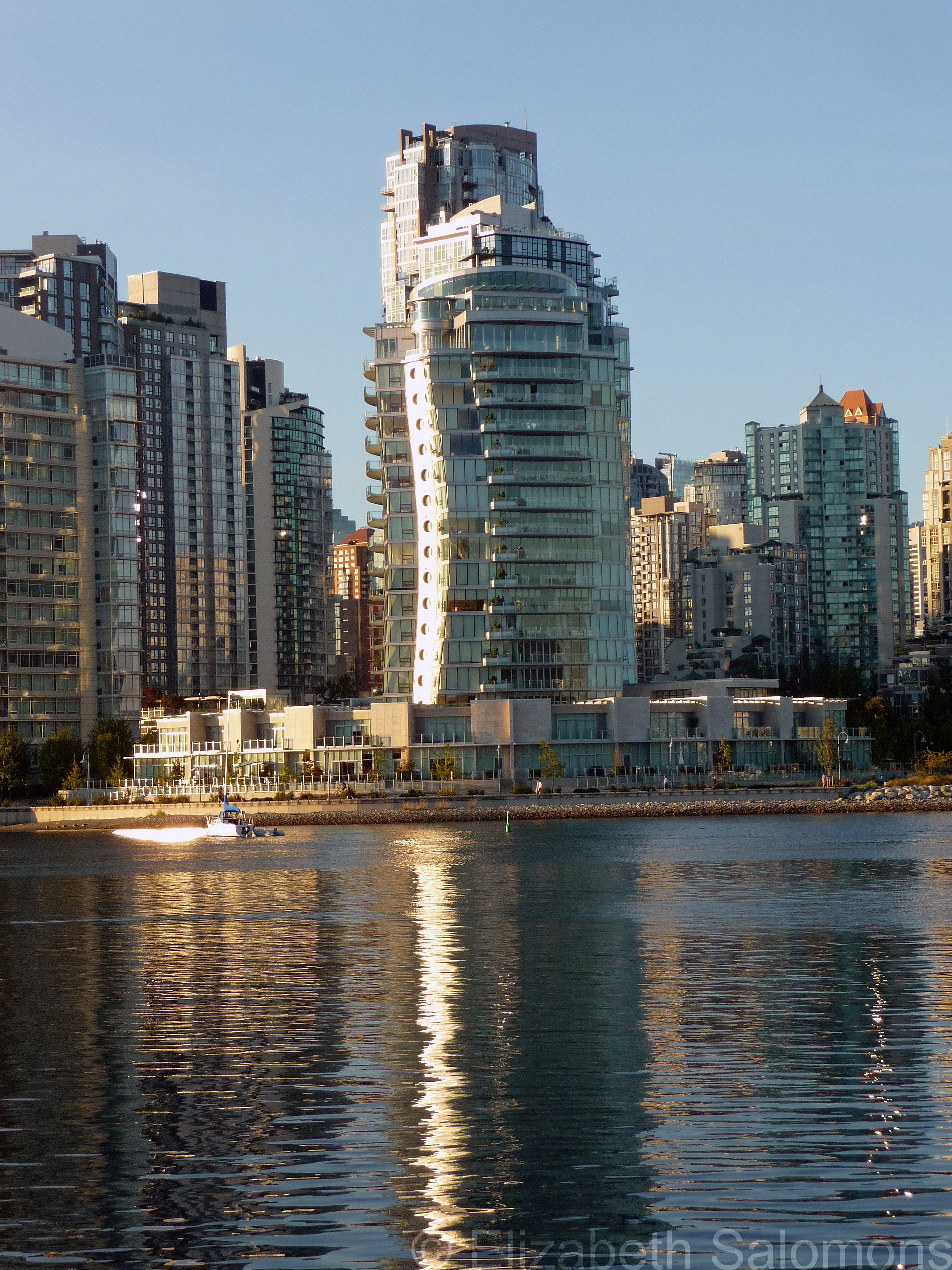
A year ago today, I started a series of posts on Vancouver buildings designed by Arthur Erickson. I have one last photo to post, and that’s this building, named, appropriately enough, The Erickson.
This condo was built on the former Expo Lands, on the north side of False Creek. It was finished in 2010, a year after Erickson died, and is one of the last projects he was involved with.
I remember when it went up. My walks along the seawall involved a detour to get around the construction, but now, the building looks like it’s been there forever.
Farewell to the Hudson’s Bay Company
It has come time to say goodbye to the oldest joint-stock merchandise company in the English-speaking world. As of today, all of the Hudson’s Bay Company retail stores have closed their doors — forever.

I’m sad it’s come to this. I keep telling myself that the demise of a department store should probably be the least of my concerns in light of everything that’s going on in the world right now. But Canadians are feeling bruised, battered, and betrayed by the current American administration. Given the sense of patriotism and nationalism that is rising up in this country, at this moment in time, the loss of The Bay hits hard. The company holds a claim on Canada’s origin story in a way no other Canadian corporation does.
The Hudson’s Bay Company came into being on May 2, 1670, when King Charles II gave a Royal Charter to the Governor and Company of Adventurers of England Trading into Hudson’s Bay. It was set up as a commercial enterprise, but the company became the de facto government in many parts of Western Canada. James Douglas, first governor of the colonies of British Columbia and Vancouver Island, was also Chief Factor of the Hudson’s Bay Company. Most cities in Western Canada started out as HBC trading posts. I have vivid memories of school trips to Fort Edmonton Park with its full-sized replica of the HBC fort established on the banks of the North Saskatchewan River in 1795. The origin of the Métis Nation, one of three Indigenous peoples given legal recognition by Canada’s Constitution, is closely tied to the fur trade. Some of the first treaties with Indigenous peoples were signed by employees of the Hudson’s Bay Company.
The HBC coat of arms consists of two elks supporting a shield with a red cross and a beaver in each quarter. Above the shield sits a fox. The motto is Pro pelle cutem, which is Latin for “a pelt for a skin.” The beaver is now Canada’s national animal. The iconic point blanket, introduced in 1779, is called that because of its points — short black lines woven into the edge of the blanket just above the coloured stripes. The number of points indicates the size of the blanket.

A replica of an HBC trading post at the Glenbow in Calgary
After Confederation, the Canadian government negotiated with the Hudson’s Bay Company to purchase the vast land mass draining into Hudson’s Bay. Known as Rupert’s Land, it covered about a third of present-day Canada — what is now Manitoba, Saskatchewan, and Alberta, southern Nunavut and the northern parts of Ontario and Quebec. The company received payment as well as title to a portion of the land, including its trading posts. As such, Hudson’s Bay became a land developer in addition to being a fur trader.
The trade in furs lasted until 1987 when the northern trading posts were sold or closed. But over time, as the west was populated with European settlers, the company’s focus shifted from trading for furs to supplying settlers with the goods and tools they needed to homestead. It restructured itself into three divisions — land sales, fur trade, and retail — and opened the first of six stores in Calgary in 1913. Edmonton, Saskatoon, Vancouver, Victoria, and Winnipeg soon followed; the original six stores all have similar architecture.
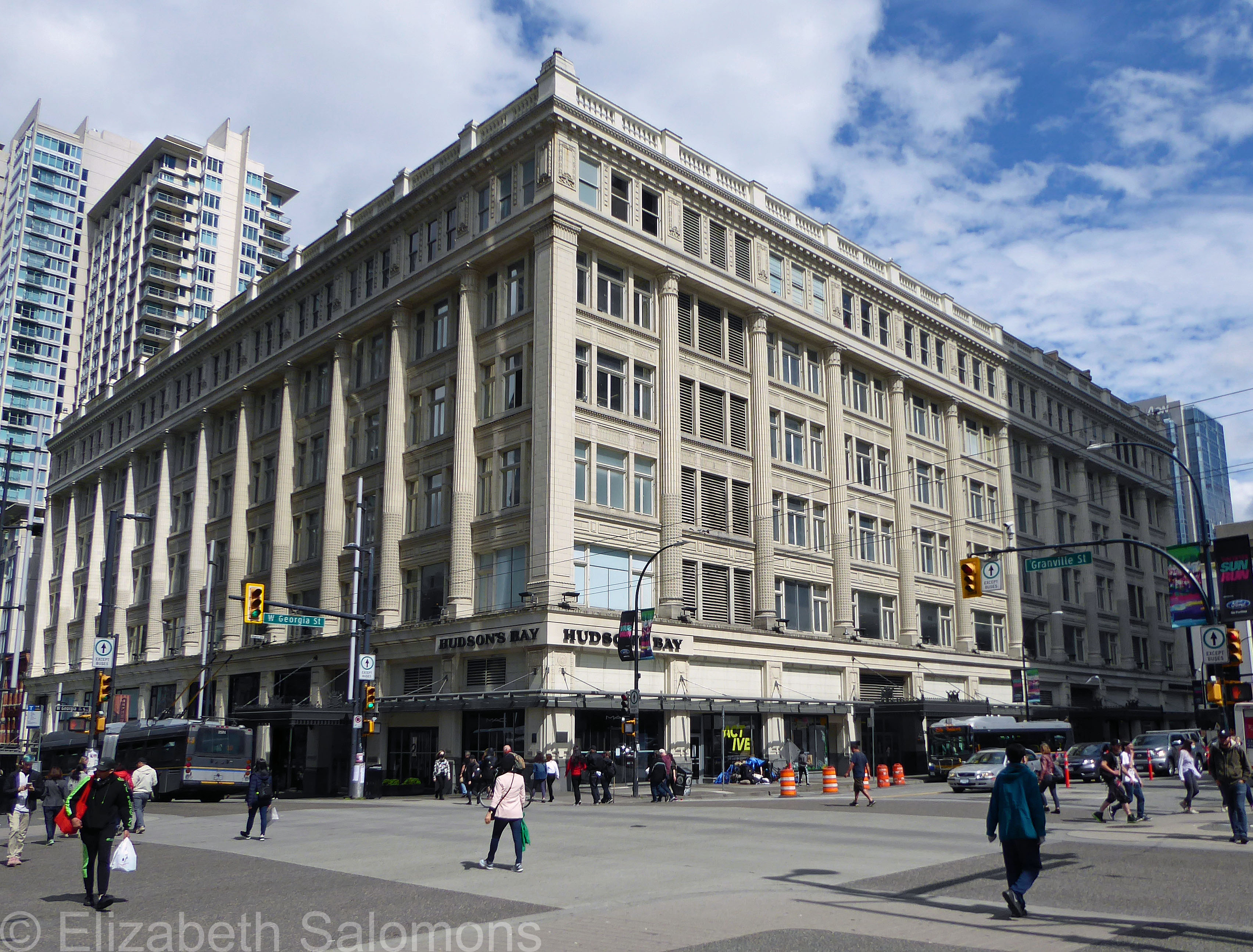
The Hudson’s Bay store in downtown Vancouver was built in 1914.
The company didn’t expand into eastern Canada until 1960, when it purchased Henry Morgan & Company, a Montreal-based department store chain. In 1970, a new Royal Charter, granted by Queen Elizabeth II, formally transferred the company’s headquarters from London to Winnipeg. The headquarters moved again in 1974, this time to Toronto, the same year Hudson’s Bay opened its first Toronto store at Yonge and Bloor. This was a store I knew well, as I worked across the street for a couple of years and would often pop over to The Bay on my lunch breaks.
Hudson’s Bay continued to expand, swallowing up Simpsons, Woodward’s, and K-Mart. In 2005, it partnered with the Canadian Olympic Committee and became the official merchandiser for the 2010 and 2012 Olympics. Those iconic red mittens that were sold out everywhere? I grabbed a pair as a last-minute impulse purchase, months before the Vancouver 2010 Olympics, with no inkling they would become such a hot commodity.

Wal-Mart began operations in Canada in the mid-1990s, around the same time that online shopping became a thing. The business model that had sustained the Hudson’s Bay throughout the twentieth century began to shift. In 2006, the company was sold to an American businessman and then, two years later, to an American equity company. There was a brief foray into Europe — I happened to be in Amsterdam the day that store open. Talk about worlds colliding.


The Bay began its long slow decline over the last six years or so. Many blame its demise on the failure of its American owners to understand the Canadian marketplace. In 2019, it sold off 400 stores and closed the Home Outfitter stores it had been operating for 20 years. When the company applied for creditor protection two months ago, it had just 80 retail stores left, along with its online store.
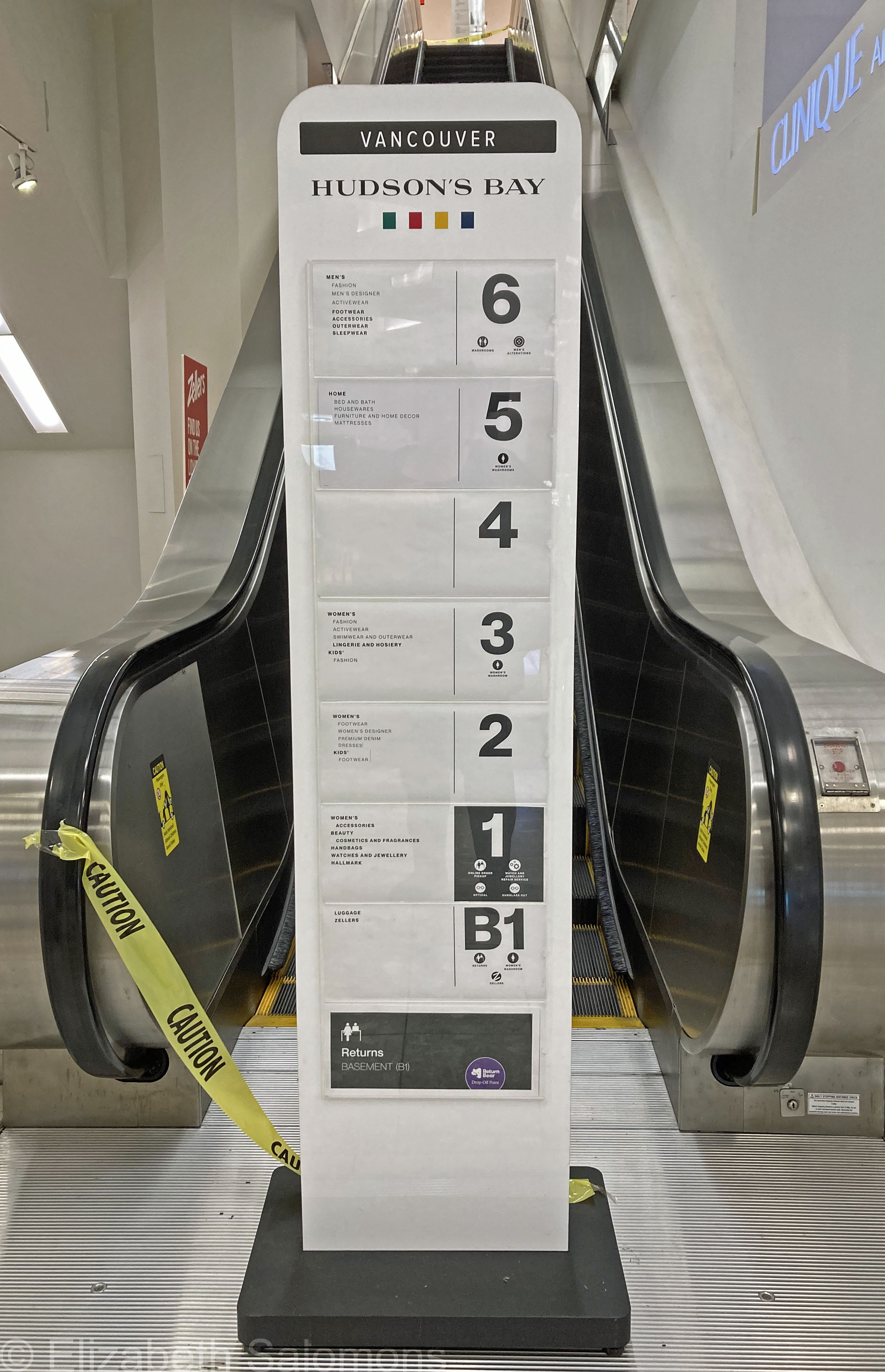
I have shopped at The Bay my entire life. Much of my kitchen was stocked at The Bay. It’s my go-to store for linens and socks and a fair-sized chunk of my office wardrobe. I even had a chance encounter with John Bishop, chef and former owner of Bishop’s Restaurant, in the housewares department while I deliberated over a choice of paring knives. But since the pandemic, I have struggled to find the items I want. When the elevators at the downtown Vancouver store were put out of service because the company couldn’t afford to maintain them, it was clear that Hudson’s Bay was on a downward trend that seemed unstoppable.
And so, while everyone was shocked, no one was surprised when the company went into receivership last March. I popped in to the downtown store on my way home from work shortly afterwards, looking for a point blanket. They had sold their last one just that morning, but I managed to snag the last cotton throw in stock. It has the signature stripes I was looking for.
I surprised myself when I choked up talking to the cashier who took my payment. He had only recently started working there, but said he felt bad for the women who had been working there for some 20 years. More than 8000 employees are out of a job as of today. In an economic climate that’s as unstable as Irish weather at the moment, I also feel for them.

With no working elevators, the stairs were the only way to the top in the Hudson’s Bay store in downtown Vancouver.
There is lots to still sort out. The HBC archives, consisting of thousands of business documents, personal journals, photographs, maps, artwork, and artifacts, are held in the Archives of Manitoba. But the company still has ownership of the Royal Charter, the one signed in 1670. Although it is a corporate document, it created a colonial government and is one of a handful of fundamental documents in Canada’s history, along with the British North American Act of 1867 and the Proclamation of the Constitution Act of 1982. Some have compared its significance to that of the American Declaration of Independence. It’s being auctioned off, will likely fetch millions, but I, like most historians, know it belongs in the archives, not a private collection.
I’m big on historical artifacts. I had always meant to get myself a point blanket and was kicking myself for having missed my chance. When my sister learned this, she offered me hers, which was sitting in a closet, unused. That blanket now sits in pride of place at the foot of my bed.
The role of the Hudson’s Bay Company in colonizing Western Canada is a complicated history that goes back 355 years and a month less a day. But, as I have written before, it is our history. And while department stores may not be the way we shop in this century, we can celebrate the history of the one where Canadians shopped for the past three and a half.
Happy Easter!
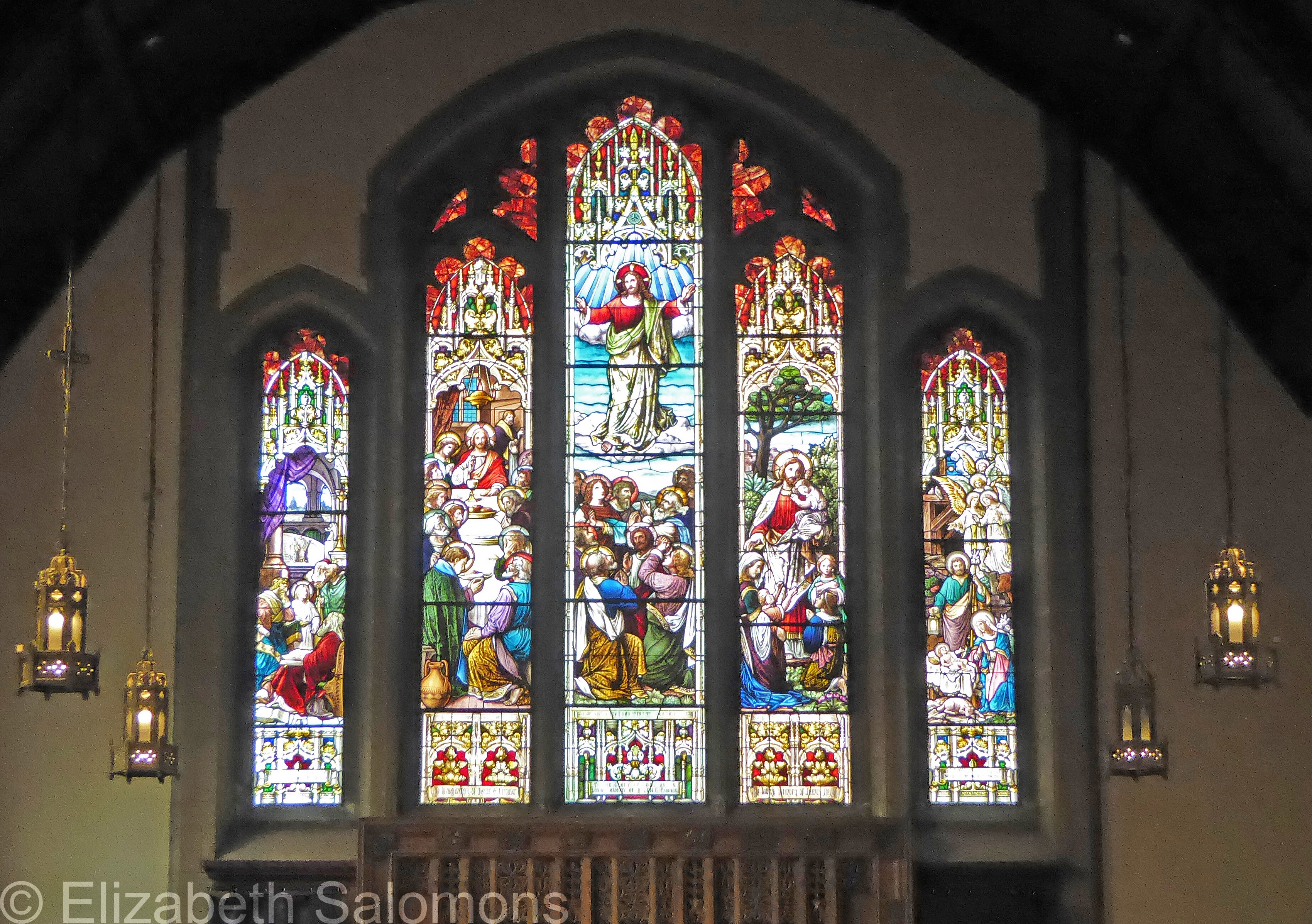
The Chancel Windows, Christ Church Cathedral, Vancouver, March 2025
Through My Lens: Christ Church Cathedral

Walk a few blocks down Burrard Street from First Baptist and St. Andrew’s-Wesley and you find yourself at the doors of Christ Church Cathedral. I’ve written about Vancouver’s Anglican cathedral before, on the occasion of its 125th birthday.
In the dozen years since, the Cathedral has put on a new roof with seismic upgrades; built a bell tower to house the four bronze bells that were cast for the Cathedral in Annecy, France; and upgraded and expanded the kitchen to better meet the needs of the Cathedral’s food ministry.
The new roof is nicely visible from this angle; the bell tower, not so much as it blends in completely with the building behind it.
Christ Church Cathedral is my photo choice for today, Palm Sunday.
Through My Lens: Central Presbyterian Church
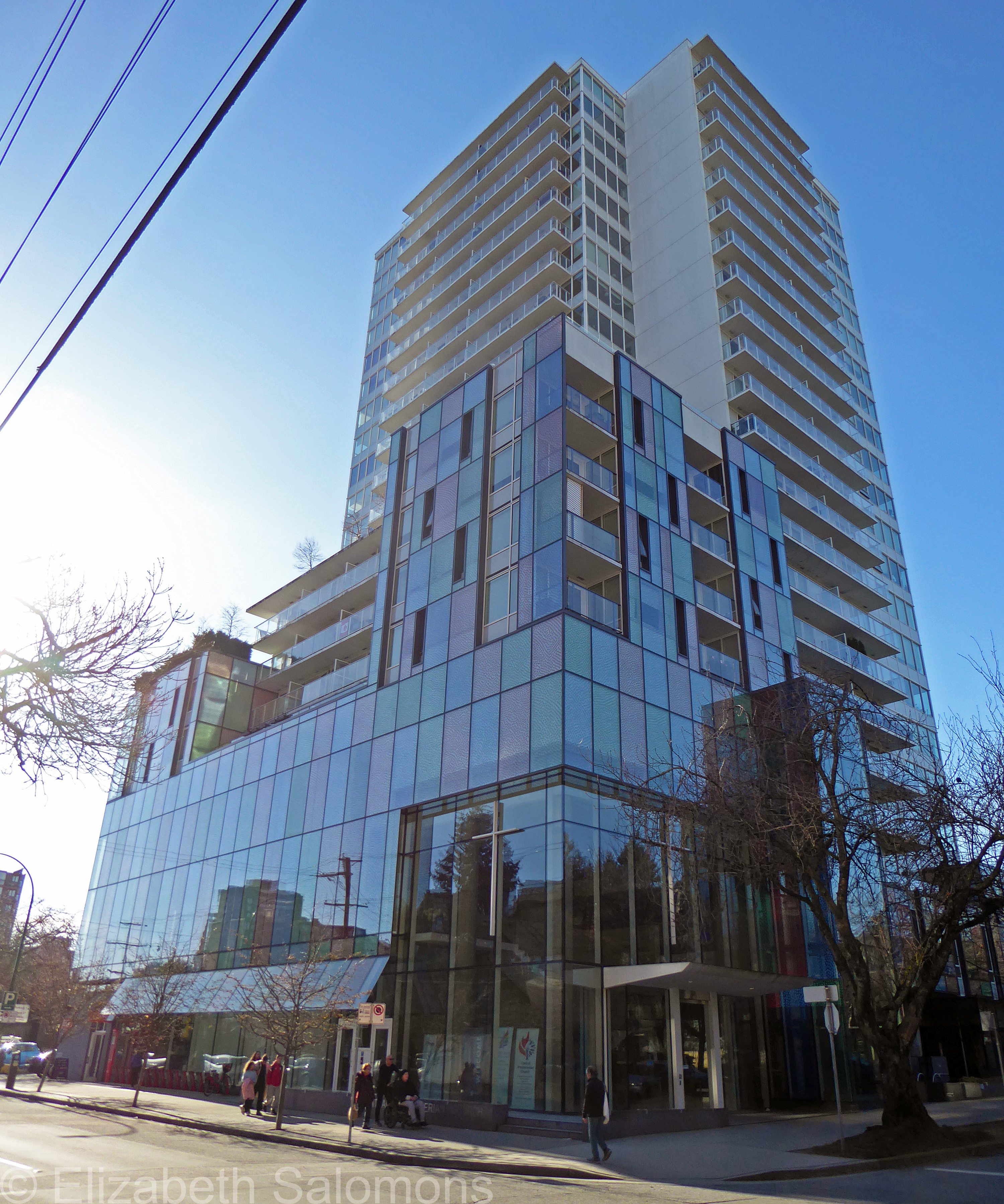
And now, for the Fifth Sunday of Lent, here’s something completely different.
This is Central Presbyterian Church. It doesn’t look like much of a church, does it? But that’s what I love about it.
The congregation has been active in the West End for more than 90 years and about a decade ago, they were coming to the realization that they were land rich, cash poor. Something had to be done with the aging building they’d been in for more than 35 years. It wasn’t by any stretch a heritage building — I would describe it as more of a concrete bunker, built in the Brutalist style that was in vogue at the time.
Central Presbyterian could have sold off their lot to a developer, but the congregation decided instead to go through the rezoning and development process themselves. This 23-storey building, completed in 2018, is the result.
There are retail and community spaces on the ground floor. Above that is a 300-seat sanctuary, a 50-seat chapel, other multi-purposes spaces, and a commercial kitchen. The tower consists of three floors of social housing and 15 floors of market rental housing. The income from those rental units funded the construction and now funds the social housing.
Several church communities in addition to Central Presbyterian worship in this building. There is also a daycare run by the YMCA.
All of that adds up to a congregation that takes its role as a community church quite literally.
Through My Lens: St. Andrew’s-Wesley United Church
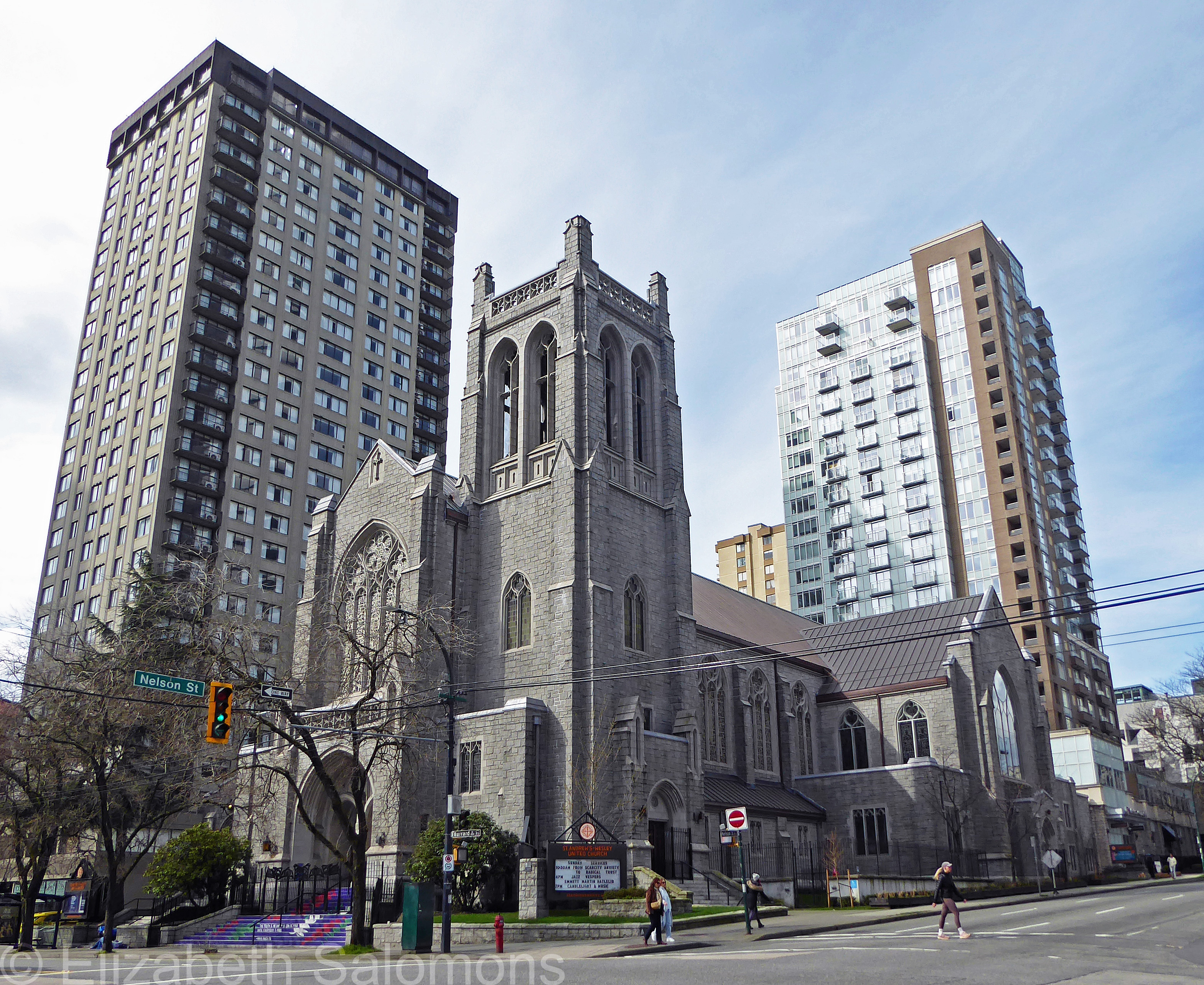
My photo choice for today, the Fourth Sunday of Lent, is St. Andrew’s-Wesley United Church. Located across the street from First Baptist Church, this building has been open for worship since 1933.
When the Methodists, the Presbyterians, and the Congregationalists came together in 1925 to form the United Church of Canada, two downtown congregations— Wesley Methodist on the southwest corner of Georgia and Burrard and St. Andrew’s Presbyterian on the northeast corner of Georgia and Richards—decided to come together as one congregation and jointly build a new church.
St. Andrew’s-Wesley is the result.
The late Gothic Revival building was built with Nelson Island granite and Haddington Island stone; inside, there is a vaulted timber ceiling. The first of the 27 Italian and French stained glass windows was commissioned by Prime Minister R. B. Bennett in memory of his sister, Evelyn Bennett Coats. Thanks to its excellent acoustics, the church is a popular venue for concerts. Jazz vespers takes place on Sunday afternoons and has done so for more than 30 years.
The 22-storey tower behind St. Andrew’s Wesley (at right in the photo) is St. Andrew’s Residence at Wesley Place. Income from the 200 rental units has funded various renovations of the main church building and provides income security for the dwindling congregation. The tower was completed in 2002 and was the largest development project ever taken on by the United Church anywhere in Canada.
Through My Lens: First Baptist Church

The origins of what became the First Baptist Church of Vancouver began with a Sunday School class of 30 children gathered at Blair’s Saloon on June 6, 1886. Exactly a week later, the saloon — and most of Vancouver — was destroyed in what became known as the Great Vancouver Fire.
The group picked itself up and built its first church on two lots purchased from the Canadian Pacific Railway. It soon outgrew that building, as well as the next, and so, in 1904, the congregation bought a lot at the corner of Burrard and Nelson for $4000.
This is where they built its current building, out of stone, in the Gothic Revival style. (The Toronto-based architects of Burke, Horwood, and White also designed the Hudson’s Bay buildings in Vancouver, Victoria, and Calgary.) The building was dedicated on June 9, 1911.
These days, Burrard Street is one of the busiest streets in downtown Vancouver, and condos abut the 114-year-old church. Until a few months ago, the building was surrounded by plywood construction fences due to restoration work of the main church building and construction of the 57-storey tower just behind it. The joint project between First Baptist and the developer provides market housing as well as a daycare, church office space, and a separate seven-storey building dedicated to social housing.
Joint projects between developers and old downtown churches have become something of a pattern in Vancouver — stay tuned to learn more.
First Baptist Church is my photo choice for today, the Third Sunday of Lent.
Through My Lens: St. Paul’s Anglican Church

For today, the Second Sunday of Lent, here is a photo of St. Paul’s Anglican Church, a small neighbourhood church in the heart of Vancouver’s West End. This parish first held services in 1889 in a building in what is now Yaletown. In 1898, that building was moved on skids to its current location to be much closer to where its parishioners lived. In 1905, a new, larger church was built in the Gothic Revival style, but out of wood instead of stone.
In 1973, the parish built an apartment high-rise for seniors on land they owned next door to the church. The income earned from this building, the Pendrellis, has become instrumental to funding the various ministries of St. Paul’s.
I love walking past this little wooden church in the heart of my neighbourhood. The building on the outside looks pretty much as it did in 1905. Standing on the church steps amidst those close-set trees, you could shut your eyes and imagine yourself in a rural country setting, but instead, you are in the heart of one of Canada’s densest neighbourhoods, surrounded by condo towers and apartment buildings, one block off the main commercial strip of Davie Village.
Just imagine being a witness to the transformation of that neighourhood, from home to Vancouver’s elite living in large mansions, to the bustling, diverse community it is today.
If only the walls of St. Paul’s could talk.
Through My Lens: Holy Rosary Cathedral
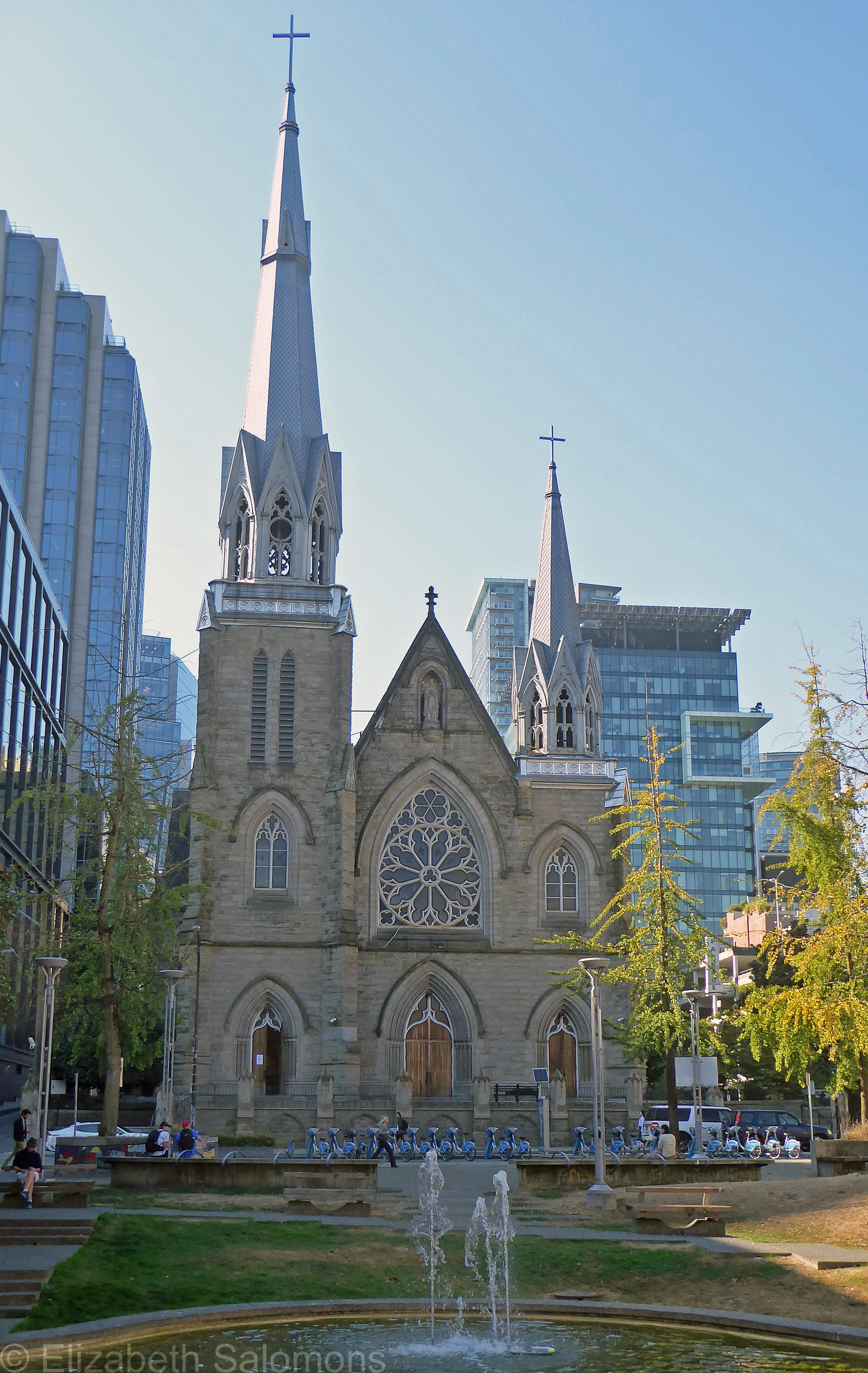
It seems like five minutes ago we were facing the start of winter and now, here we are, already back in the Season of Lent. For this year’s Lenten series, I’m going to take you on a tour of the churches of downtown Vancouver. My photo choice for today, the First Sunday of Lent, is Holy Rosary Cathedral. Its full name is the Metropolitan Cathedral of Our Lady of the Holy Rosary, and it serves as the cathedral for the Roman Catholic Archdiocese of Vancouver.
A church has stood on the site since 1885; construction on this building began in 1899 and was completed in just over a year. The architecture is late nineteenth-century French Gothic revival, a style common throughout Canada during the time period. Its walls are built from Gabriola Island sandstone.
These days, large building projects seem to take years to complete. What amazes me about the speed at which this church was built is that the population of Vancouver at the time was a mere 26,000 people.
Canada House

Here’s another Erickson design. This is Canada House, completed in 2009. It was built to house the Canadian athletes during the Vancouver 2010 Olympics, which ended 15 years ago today with another spectacular hockey win for Canada.
The condos have since been sold and an entirely new neighbourhood has sprung up on the south side of False Creek.


 There and Back Again