
Dishing: Jean-Georges
 Now that you’re all firmly resolved, and well and truly into your New Year’s diets, I thought I’d write a few posts about food. Any objections? I thought not.
And since I have at least eight friends and/or family members who are looking forward to visiting New York in 2013, I’m going to return to that city to talk about a fabulous meal I enjoyed there last summer.
It would not be a stretch to say that, once I knew I was going to New York, what I was most anticipating was eating at Jean-Georges. Ever since my first meal at Market here in Vancouver, after which I discovered Jean-Georges has no less than eight restaurants in New York, I was determined to one day eat at his flagship restaurant in the Trump Tower. Last summer, I had my chance. Before leaving Vancouver, I made reservations for Sunday lunch the weekend we would be in New York.
 The décor at Jean-Georges is lovely; very light and airy with floor-to-ceiling windows overlooking Columbus Circle. We had a great table at the far end of the room against the wall. The furnishings are almost identical to the Vancouver Market restaurant. I especially loved the silverware. Call me old-fashioned, but it’s such a treat to eat with real silver at a restaurant. Feels more like an occasion, in my mind.
 We perused the menu, made some tentative choices between ourselves, then asked for some tips about which wines to choose with the courses we were thinking of ordering. Our server offered to check with the sommelier, then came back with his recommendations. Wine at Jean-Georges is served by the glass, which I appreciated as I wanted to vary what I would drink with each course.
After we made our selections, we were offered a choice of four types of bread. Then came a trio of amuse-bouches: a small glass of carrot purée, sea urchin on a small piece of dark toast, and fried okra over a miso purée. These were amazing bites of wonderment. So much flavor in one tiny bite.

Carrot purée, sea urchin, and fried okra
For my first course, I had tomato gazpacho, which was poured from a silver pitcher overtop grated fresh, soft mozzarella and a bed of olive oil foam. The gazpacho had a nice spicy touch, and I could taste summer in the tomatoes. My friend ordered charred-corn ravioli, tomato salad, and basil fondue. This plate consisted of small, bite-sized ravioli, heirloom cherry tomatoes, and a basil-based sauce. It was very tasty, and I regretted not ordering it myself.
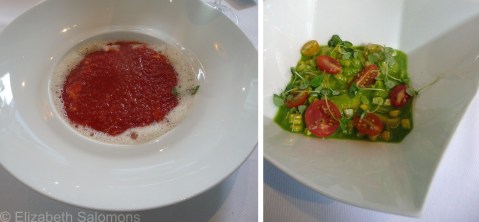
Tomato gazpacho and charred-corn ravioli
I wanted to taste one more course and so I ordered a second appetizer: a warm green asparagus salad, with Hollandaise sauce and a truffle vinaigrette, served on a bed of mesclan. This turned out to be my favourite course of the meal; I could eat asparagus every day for the rest of my life and never tire of it. The Hollandaise wasn’t too heavy, and the asparagus was perfectly steamed.

Asparagus salad
For my entrée, I selected the sesame-crusted salmon, which was served over a grilled eggplant purée and red chili butter. The butter provided a nice contrast, both in flavour and colour. It had a real kick, but was delicious with the salmon, which was perfectly cooked and a lovely pink colour.

Sesame-crusted salmon
My friend ordered the parmesan-crusted confit leg of organic chicken, with artichoke, basil, and lemon butter. She thought the lemon was too strong, but her chicken was moist and tender, just as a confit should be, and the parmesan crust was perfect. (Travel tip: Always travel with a friend who doesn’t mind you trying her food. You get to taste two meals for the price of one.)

Parmesan-crusted confit leg of chicken
Desserts at Jean-Georges are served as tastings: my friend ordered the cherry and I had the chocolate. She got sour cherry crème brûlée and marzipan, cherry sorbet, and deconstructed black forest ― the cream, cherries, and chocolate were served individually on a black slate slab.

Cherry dessert tasting
My chocolate tastings included white chocolate meringue with a layer of meyer lemon ice and cinnamon over top. I can’t say I tasted the cinnamon and, like my friend with her chicken, I found the lemon overpowering, almost to the point where I felt I was eating a dessert laced with household cleanser. However, Jean-Georges’ signature molten chocolate cake was delicious, with the vanilla bean ice cream on the side.
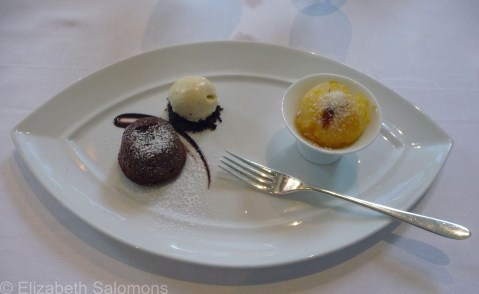
Chocolate dessert tasting
To go with our desserts, we each ordered a glass of Banyuls Reserva from Domaine La Tour Vieille in Roussillon. I know Banyuls from my visit to Roussillon many years ago, and it was the perfect accompaniment for both the chocolate- and cherry-based desserts.
But wait! There was more! We had scarcely made a start on our desserts when we were served a plate of homemade chocolates, another plate of miniature raspberry macaroons, and Jean-Georges’ homemade marshmallow, which is most definitely a step above the Kraft variety.
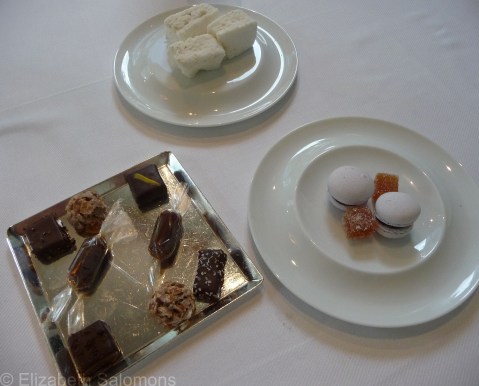
The finale
Although we had one server who seemed to be in charge of our table, we were waited on by several people throughout our lunch. The service was impeccably timed. Each dish was delivered in unison by two servers, and cleared the same way.
 After we had ordered our desserts, I asked to see the main menu once again, and when a server (not one of ours) noticed I was taking photos of the menu, he offered to give me a copy of both menus to take home. As he handed me the dark brown folder, he asked where we were from. He was very excited upon hearing I was from Vancouver, and told us he had a colleague from Vancouver. At this point, my friend jumped in and explained that I had eaten at Jean-Georges’ restaurant in Vancouver, and had been impressed, which was why we were here.
“That’s where my colleague worked!” he said. He then asked how the food compared and whether the meal I had just had was quite different from how food was served in the Vancouver restaurant.
“It’s very similar,” I said. “Just as delicious, but …” I paused as I thought for a second how to explain the difference, then said, “… but this is New York!”
He smiled knowingly and nodded. “Yeah,” he agreed. He reminded me of a young Woody Allen. Right down to his Noo Yawk accent and dark-rimmed glasses.
It was a delightful way to spend a Sunday afternoon in New York City. Lunch at Jean-Georges is a great deal as it’s prix fixe for two courses, with the option to order additional courses as I did. It was my first experience in a three-star Michelin restaurant, and now I have a new goal: to go back and try Jean-Georges’ seven other New York restaurants.
Recipe Box: Bitterballen
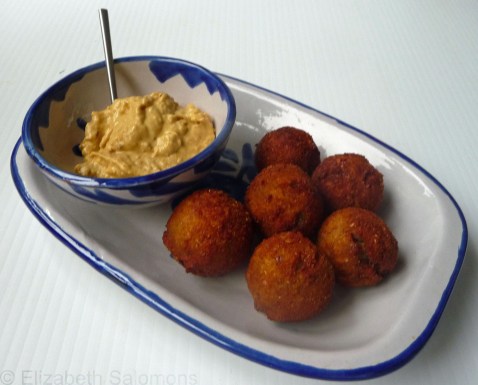
Every year around the holiday season, my mother used to make bitterballen. These little morsels are a savoury Dutch meat snack that (in our household at least) disappeared faster than Mom could make them.
In the Netherlands, bitterballen are served as bar snacks alongside alcohol. (A direct translation of bitterballen would be “balls to eat with bitters.”) I’ve had tapas in Spain that look exactly like bitterballen but are made with fish. (Which makes me wonder if the Spanish introduced the snack to the Low Countries. You know, back when they were the boss of them between the sixteenth and eighteenth centuries?)
Another version of the same Dutch snack in cylinder form are called kroketten (croquettes). These you can buy for a couple of euros in vending machines all over the Netherlands. You can imagine our delight when my brother and sisters and I saw kroketten so readily available on our first ever trip to Holland as kids. Christmas treats in a vending machine!?! How cool was that?
There’s a story behind the first time I made bitterballen myself. I was going to a party hosted by an Italian-Canadian friend of mine where there would be many other Italian-Canadians, and I wanted to bring something special. Now, I have to confess that, as a child of Dutch immigrants, I didn’t always like identifying myself as Dutch-Canadian. I would firmly tell my mother when she insisted I was Dutch that I was not. I was just a plain Canadian. No hyphens, please.
But back to the party. Hanging out with my Italian-Canadian friends had shown me a group of Canadians who completely and firmly embraced their heritage in a way that I had not been comfortable doing. Following their example, I decided it was time for me to embrace my heritage. And so, I brought a plate of bitterballen to the party and proudly placed them on the table beside the cannelloni and tiramisu.
The bitterballen were a hit and I’ve made them every Christmas since, sharing them with my friends of all ethnic origins. I find it ironic that it took a bunch of Italian-Canadians to help me appreciate my Dutchness, but there it is. I’m grateful to them for it.
Eet smakelijk!
Bitterballen
2 tablespoons butter
1 small onion, chopped
3 tablespoons flour
1 cup milk
1 tablespoon dried parsley
1 teaspoon salt
1 teaspoon Worcestershire sauce
1/4 teaspoon curry powder
2 cups ground cooked meat*
1 1/2 cups grated Gouda cheese**
2 eggs***
2 tablespoons water
1 1/2 cups bread crumbs
vegetable oil
1. Melt butter in a saucepan.
2. Sauté onion in the butter until soft.
3. Add flour, blend well, and cook for 1 minute.
4. Slowly add the milk. Cook until thickened, stirring constantly.
5. Add parsley, salt, Worcestershire sauce, curry powder, cooked meat, and cheese. Cook for another 5 minutes, then allow mixture to cool.
6. Mix the eggs and water together in a small bowl, and pour the bread crumbs into a second small bowl.
7. Shape the cooled meat mixture into small bite-sized balls about an inch in diameter.
8. Roll the balls in bread crumbs, the egg-and-water mixture, and bread crumbs again. (If you intend to freeze them, use three coats of bread crumbs.) Chill balls for at least an hour.
9. Heat the vegetable oil in a small sauce pan, then fry the bitterballen until golden brown (about 2 minutes). Drain on paper towels, and serve with your favourite mustard for dipping.
Notes:
*Ground roast beef is traditional, but use whatever type of meat or seafood you fancy. My mother used ground beef because there was rarely leftover roast beef in our home, and I do the same.
**Mom didn’t add Gouda cheese, but the recipe I use does and I like the flavour. The cheese also gives the meat mixture a firmer consistency for rolling.
***I find I usually need more than 2 eggs. Simply add another egg and tablespoon of water to the bowl as needed.
Dishing: Monk McQueens

Last night was one night I regretted showing up late to the party. Monk McQueens at Stamps Landing on the south side of False Creek has been a Vancouver landmark ever since it opened during Expo 86. And yet, I’d never been. The announcement that it was shutting its doors for the last time on December 31 of this year was what finally motivated me to experience this famous fresh seafood and oyster bar for myself.
I made an occasion of it by reserving a table for the same night a friend from Boston was going to be in town. And so, five of us gathered last night to enjoy a leisurely dinner and a bit of a catch-up. Our table in one of the corner windows gave us a terrific view of False Creek.
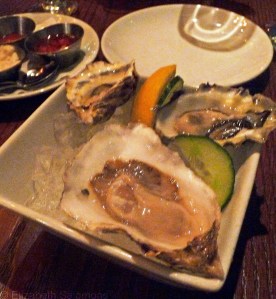
The food was delicious. My Bostonian friend and I shared a half dozen oysters on the half shell. For our mains, our party of five sampled almost every type of seafood on the menu: halibut, sea bass, sablefish, lobster, and scallops. We washed it all down with a very nice bottle of wine, and finished with coffee, brown sugar vanilla bean cheesecake, and Calvados. I can’t think of a nicer way to spend four hours with good friends on one of the last nights of the year.
Mahony & Sons Public House is moving in after Monk’s vacates the premises and will open sometime next summer. As much as I enjoy a good public house, it won’t be the same. Last night was proof that just because an establishment has been around since the Dark Ages (aka the 1980s) doesn’t mean it should be taken for granted. Pity I did.
Happy Birthday, Julia Child!
I could not let today go by without posting something about Julia Child. Today would have been her 100th birthday.
The piece of cake in this photo was my birthday treat to myself, one sunny wintry afternoon in Paris some eighteen months ago.
Happy birthday, Julia. And thank you.

Gâteau au chocolat fondant et crème anglaise
Dishing: ensemble
Update: ensemble closed in August 2012.
 A number of months ago, my friends took me out to celebrate my turning another year older and (this is debatable) another year wiser. I chose ensemble for the event ― it’s yet another new place on the north-east corner of Thurlow and Smithe in downtown Vancouver that has seen a high turnover of restaurants over the past few years.
  But, more than a year after its opening in May 2011, it looks like ensemble is here to stay. The executive chef is Dale MacKay, winner of Top Chef Canada Season 1, and one reason, in addition to the reviews I had read, why I chose this particular restaurant. I was curious if the judges at Top Chef Canada knew what they were doing when they gave MacKay the top prize.
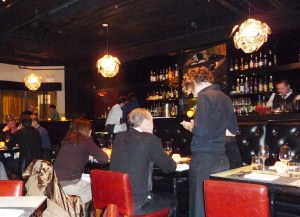
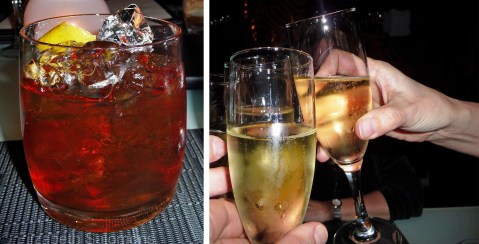
Two of my friends were waiting for me when I arrived; we ordered cocktails while we waited for our fourth companion, who finally showed up 45 minutes later. But, despite the busy room, there was absolutely no rushing us on the part of our server. The atmosphere was lively ― a perfect venue for a birthday party and for four boisterous, laughing friends who were in the mood to make a lot of noise.
Like many of Vancouver’s fine dining establishments, ensemble characterizes its food as “Contemporary French meets West Coast.” All of the dishes are tapa-sized, and we opted for the four-course tasting menu with wine pairings.
First up was a Dungeness crab crêpe with pineapple, daikon, and avocado. This appetizer was picture-perfect, served cold, fresh, and crisp, and the pineapple gave it the smallest hint of sweetness. I absolutely loved the wine choice: a bubbly Spanish cava.

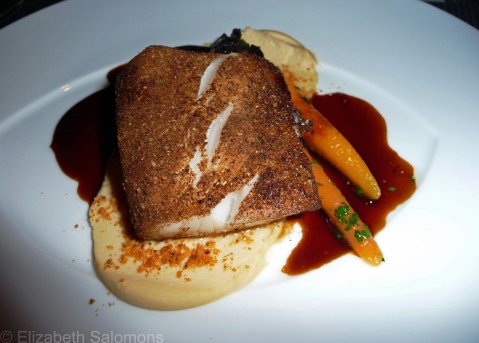
The second course was Moroccan spiced black cod, with chick peas, cashews, and black trumpet mushrooms. I’ve never had cod so delicate and light. The black trumpet mushrooms were the perfect accompaniment, as was the 2010 Pinot Gris from Penticton’s Poplar Grove winery.
The meat course was beef shin and fries, with watercress and a carrot purée, paired with the 2011 Enrique “Icque” Foster Malbec. Like the cod before it, the beef was melt-in-the-mouth quality. I’ve often eaten steak et frites in France, but have to admit that I’ve never been overly impressed with French frites. The fries that accompanied the beef shin, on the other hand, were the best any of us had had in a very long time.

To finish: chocolate fondant with hazelnut-nougatine ice cream. Chocolate fondant was a new experience for me and I loved it. Its soft pudding-like centre reminded me of a dessert a long-ago roommate used to make, with the rather ordinary name of Brownie Pudding.

In honour of my birthday, I was also presented with a cone of piping-hot sugar-dusted madeleines, which I gladly shared. For the dessert wine, we returned to the Old World with a glass of Broadbent Madeira.

By the end of the evening, both my appetite and curiosity were sated. Dale MacKay is certainly a Top Chef, and my friends and I were so impressed with our first experience at ensemble that I am sure we will be back.

Recipe Box: Insalata Caprese

The food in Italy is one of the many reasons the country is so popular with tourists. But the reason Italian food tastes so good is because of the farm-to-table fresh ingredients so readily available over there. Try as I do, I can never quite replicate the flavours back home in my own kitchen.
However, I do keep trying.
In the summertime, I like to make Insalata Caprese (Caprese salad), which I often have for lunch when I’m in Italy. Tomatoes, basil, olive oil, and cheese never taste so good as they do in this salad, which takes its name from the island of Capri.
The type of cheese used in the salad, mozzarella di bufala (buffalo mozzarella), is made from the milk of the water buffalo. It is porcelain white, very moist, and slightly salty. Italian delis or fine cheese shops import it directly from Italy; in B.C., the cheese is available through a producer on Vancouver Island that makes it from their own herd of water buffalo. Bocconcini balls made from cow’s milk are a cheaper substitute and can be found in most grocery stores.
Once you’ve located a source for the cheese, all you need are the freshest tomatoes you can find, fresh basil, and a good quality extra virgin olive oil.
Buon appetito!
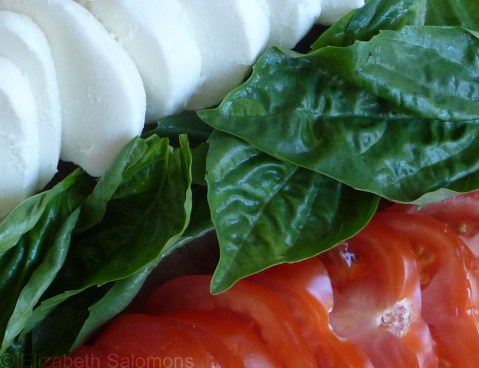
Insalata Caprese
vine-ripened tomatoes
buffalo mozzarella
fresh basil
extra virgin olive oil
salt and freshly ground black pepper (optional)
1. Cut the tomatoes and the buffalo mozzarella into slices about 1/4 inch thick.
2. Tear the larger basil leaves in half.
3. Arrange the tomato, cheese, and basil on individual plates, alternating between green, white, and red (which just happen to be the colours of the Italian flag!).
4. Drizzle with olive oil, and season with salt and pepper.

Jour du Macaron
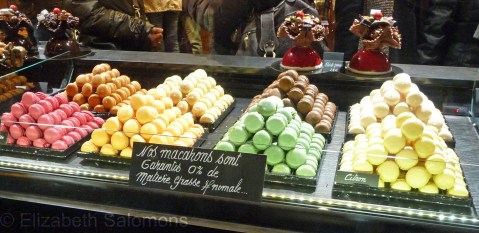
Today is Jour du Macaron (Macaron Day). The delightful French pastry is recognized every March 20 in Paris, New York, Toronto, and, for the first time this year, Vancouver.
If you’ve never enjoyed a macaron, I envy you, for there is nothing more wondrous than your first taste of this sweet meringue-based, ganoche-filled dessert. I discovered macarons for the first time two winters ago when I was in Paris. After my first bite, I moaned ― no lie ― and exclaimed, “Where have you been all my life?”
Dishing: Market
My second Dine Out outing of 2012 was to Market with my Book Club. Market is a Jean Georges restaurant at the Shangri-La Hotel, Vancouver’s newest luxury hotel and, since its completion in 2009, the tallest building in the city.
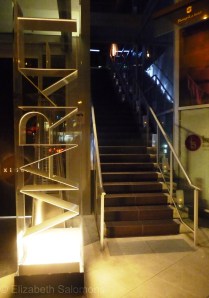
I first went to Market about a year ago with my sister. We were celebrating our birthdays and on that night enjoyed a sublime six-course tasting menu. It took us several hours to eat our way through the meal, but we enjoyed it immensely and appreciated the effort and time our server took to explain the rationale behind the wine pairing chosen to accompany each course.
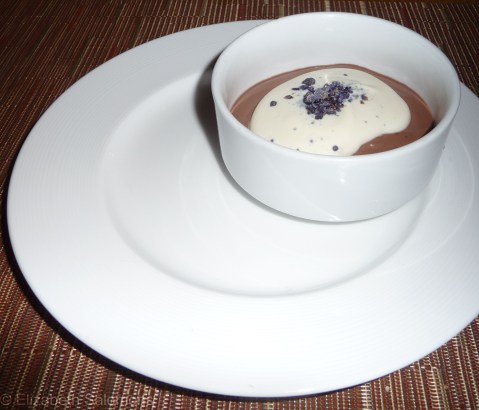
Market’s Dine Out menu offered a choice between two items for each course. I started with a roasted carrot and avocado salad with sour cream, citrus, and seeds. The carrots were slender and deliciously crunchy, cooked just long enough to not be raw. For my entrée, I choose the fish: slow-cooked snapper on a bed of sautéed spinach with a sweet garlic lemon broth. The lemongrass in the broth totally made this dish. Dessert was chocolate pudding with a light, foamy dollop of whipped cream, topped with candied violets. Can one ever go wrong with chocolate pudding? I think not.

Being Book Club, my friends and I chatted long after our coffees were gone about every topic under the sun except the book we had read. There was absolutely no rush on the part of our server to get us to leave, despite the crowded room, which was thanks to the draw of Dine Out. A most enjoyable evening; I highly recommend Market during Dine Out … or on any night of the year.

Dishing: L’Abattoir

Dine Out Vancouver, which just finished its tenth year, is an annual culinary celebration when Vancouverites get to, well, dine out. The deal is: you order from a three-course set menu for a set price. It’s incredibly good value and lets you try out higher-priced restaurants you might not get to otherwise. And the restaurants that participate benefit as well: they are booked solid for 17 days in the dead of winter.
This year, my friend and I decided to head down to L’Abattoir, rated by enRoute magazine as Canada’s third-best new restaurant of 2011.
L’Abattoir’s French name means “slaughterhouse.” The name is not in reference to its menu, however, but to Vancouver’s original meat-packing district. The restaurant is located in Gastown, just around the corner from Blood Alley, and the building itself stands on the site of Vancouver’s first jail.

The setting is more bistro than fine dining, but don’t let the decor fool you ― there is nothing casual about the food at L’Abattoir. Chef Lee Cooper’s menu is French-influenced West Coast ― a description heard frequently about Vancouver’s best restaurants.
I ordered a starter of poached egg over potato gnocchi with a leek, mushroom, and pecorino sabayan. The combination of egg and gnocchi was unique and a nice surprise upon first bite, although I would have preferred it if the yolk had been slightly softer. The sabayan was light and airy and not too cheesy. I really enjoyed the dish. To be honest, the country-style pork patê on toast ordered by my friend looked a bit dull in comparison.
Next was a spicy chorizo–crusted Pacific cod over white beans cooked in red wine. The cod was perfectly moist and the texture and flavor of the chorizo crust added a nice kick to the fish. My friend enjoyed her roast tenderloin with ravioli stuffed with braised lamb shoulder; the combination of red meats worked really well.
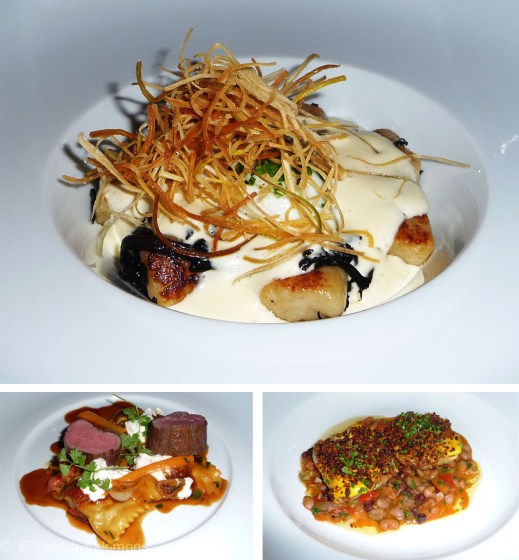
Each course was paired with an Okanagan wine ― a crisp cold Tantalus Riesling for the starter and the 2008 “Adieu,” a pinot noir from Le Vieux Pin, with the entrées. We both ordered the chocolate caramel bar with banana ice cream and chocolate yogurt ― the most popular dessert on the menu, according to our server.
Innovative décor + good wine + excellent food + impeccable service = a delightful evening. I’ll be back.
Recipe Box: Coq au Vin
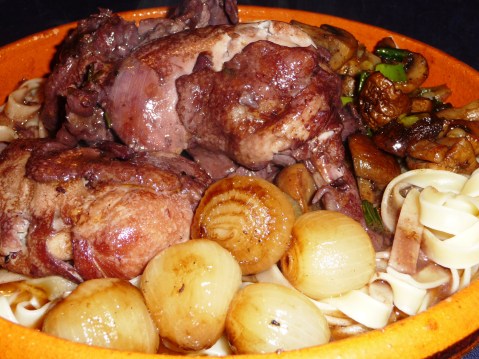
As is my custom, I indulged in a DVD marathon over the holidays. This year it was Julia Child’s “The Way to Cook.” I don’t know about you, but six hours of watching Julia create magic in her kitchen makes me want to attempt some magic in my own kitchen (albeit much more clumsily).
Which leads me to Julia’s coq au vin. I was first introduced to this king of stews by a friend of mine, who spent her two-week Christmas break with me last year in Paris. Since I had a (more or less) fully-equipped kitchen at my disposal, she got right into shopping at the French supermarkets and cooking up culinary masterpieces for me every night.
For the coq au vin, my friend wanted to use an entire chicken. I assured her the largest bird that would fit in my one, very small sauce pan was a coquelet ― a cockerel ― which are as common in French supermarkets as Cornish game hens are over here. I showed my friend how to cut up the coquelet, then left her to it. Scarcely an hour later, I was in heaven. For what is essentially chicken stew, coq au vin has amazing flavour.
Since returning to Canada, I’ve made coq au vin several times myself. My friend used carrots in her version, but I don’t care for them and, after reading in my copy of Mastering the Art of French Cooking that Julia didn’t use them either, I dropped them. I also have come to love the braised onions Julia recommends serving with the stew.
The flaming-cognac stage though ― that I dared not try. To be honest, setting a pan of chicken ablaze in my condo-sized kitchen intimidated me. However, getting back to my DVD marathon, when I watched Julia flame her chicken, I thought, “I can do that!” And so, I did. Truth is, it wasn’t as scary as I imagined. If you happen to have a bottle of cognac in your liquor cabinet, don’t skip this step. It will make you feel very French.
Bon appétit!
Coq au Vin
4 slices bacon
2 tablespoons butter
one chicken, cut into pieces
1/2 teaspoon salt
1/8 teaspoon pepper
1/4 cup cognac
one bottle red wine
1 to 2 cups chicken stock
1 tablespoon tomato paste
2 cloves mashed garlic
1/4 teaspoon thyme
1 bay leaf
brown-braised onions (see below)
sautéed mushrooms (see below)
salt and pepper
3 tablespoons flour
2 tablespoons softened butter
1. Cut the bacon into rectangles 1/4 inch wide and 1 inch long. (These are called lardons. You can buy them in French supermarkets, already precut. Most convenient.)
2. In a large sauce pan, Dutch oven, or cocotte, brown the lardons in butter. Remove from pan.
3. Dry the chicken thoroughly, then brown all sides in the hot fat.
4. Season the chicken with salt and pepper. Return the bacon to the pan. Cover and cook slowly for 10 minutes, turning the chicken once.
5. Pour in the cognac and light. Wait for the flames to subside, shaking the pan back and forth a few times.
6. Pour in the wine. (I like to use a full-bodied wine, such as a Côtes du Rhône, Malbec, or Shiraz. Make sure you have more than one bottle on hand because you will want to pour yourself a glass as soon as you open the first bottle.)
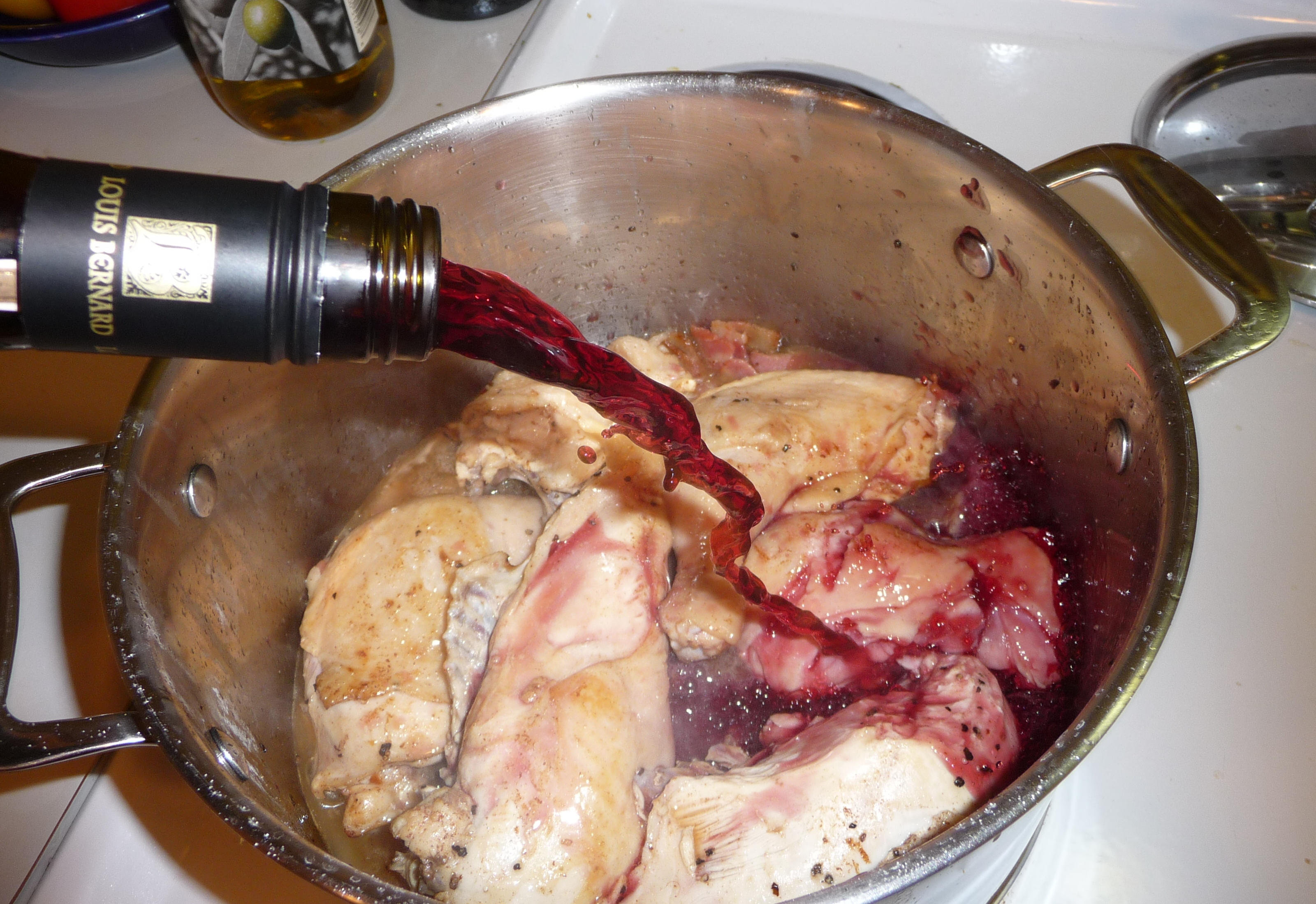
7. Add the tomato paste, garlic, herbs, and enough stock to cover the chicken. Bring to a simmer, then cover and continue simmering for 25 to 30 minutes until the chicken is tender. Remove the chicken from the pan.
8. Skim any fat from the liquid remaining in the pan, and simmer for a minute or two. Bring to a boil and reduce to 2 1/4 cups. Remove from heat and check seasoning.
9. Mix the butter and flour into a paste. (This is called beurre manié.) Use a whisk to mix the beurre manié into the liquid. Return to heat and simmer for a few minutes until sauce has thickened.
10. Return the chicken to the sauce to reheat. The onions and mushrooms can be added to the sauce or served on the side. I prefer to serve coq au vin over a pasta such as tagliatelle, but it would probably also go very well with mashed potatoes.
Brown-braised Onions
The small onions are a bit finicky to peel, but worth the effort because they are oh so good. Do not skip.
12 to 18 white onions about 1 inch in diameter, or 24 pearl onions
1 1/2 tablespoons butter
1 1/2 tablespoons oil
1/2 cup stock, dry white wine, red wine, or water
salt and pepper
one herb bouquet (4 parsley springs, 1 bay leaf, and 1/4 teaspoon thyme tied in cheesecloth)
1. Bring a pot of water to boil, immerse the onions for about a minute, drain, then cut off the root and peel.
2. Place a skillet over high heat with the butter and oil. When hot, turn the heat down to moderate and brown the onions.
3. Add the liquid, salt and pepper, and the herb bouquet. (You can buy herb bouquets in the spice aisle of French supermarkets. Also most convenient.)
4. Cover and simmer slowly for 40 to 50 minutes until the onions are tender and the liquid has evaporated. The onions should retain their shape. Remove the herb bouquet.
Sautéed Mushrooms
2 tablespoons butter
1 tablespoon oil
1/2 pound fresh mushrooms (cut into quarters if large)
1 to 2 tablespoons minced shallots or green onions (optional)
salt and pepper
1. Place a skillet over high heat with the butter and oil. When hot, turn the heat down to moderate and add the mushrooms. Remove from heat as soon as mushrooms are lightly browned.
2. If using shallots or green onions, add to the mushrooms, and sauté over moderate heat for 2 more minutes.


 There and Back Again