
Through My Lens: Église Saint-Eustache
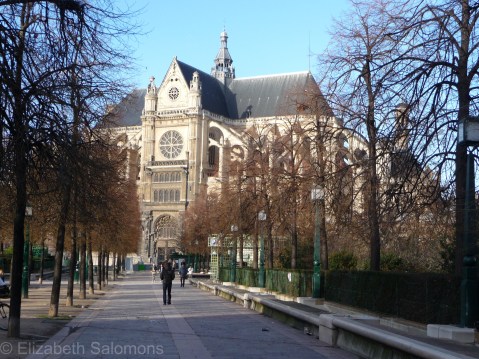
This being the Season of Lent, I think it’s appropriate that I troll through my collection of photos of European churches. For today, the First Sunday of Lent, I’m posting a photo of Saint-Eustache in Paris.
My sister and I discovered this church almost by accident in December 2010 when we set out for shopping and lunch in the 1er arrondissement. We were walking along Rue Montorgueil, somehow ended up on a tiny side street, which turned into an alley of sorts, saw a door, opened it, and suddenly were inside this immense church. Only upon leaving through another exit did we realize how massive it is. This photo was taken from Forum des Halles.
Through My Lens: Paris Sous la Neige
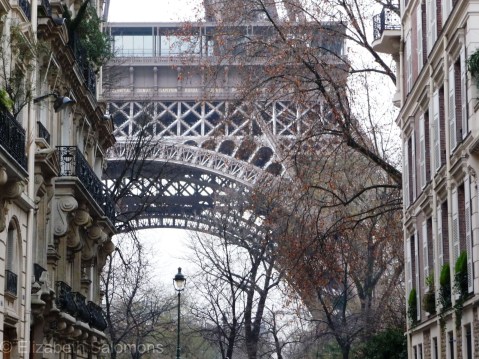
Europe’s Big Freeze continues, and yesterday, it snowed in Paris. “Paris sous la neige” means “Paris under the snow.” I took this photo last winter.
Recipe Box: Coq au Vin
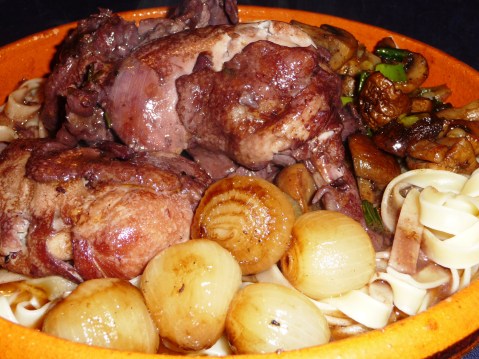
As is my custom, I indulged in a DVD marathon over the holidays. This year it was Julia Child’s “The Way to Cook.” I don’t know about you, but six hours of watching Julia create magic in her kitchen makes me want to attempt some magic in my own kitchen (albeit much more clumsily).
Which leads me to Julia’s coq au vin. I was first introduced to this king of stews by a friend of mine, who spent her two-week Christmas break with me last year in Paris. Since I had a (more or less) fully-equipped kitchen at my disposal, she got right into shopping at the French supermarkets and cooking up culinary masterpieces for me every night.
For the coq au vin, my friend wanted to use an entire chicken. I assured her the largest bird that would fit in my one, very small sauce pan was a coquelet ― a cockerel ― which are as common in French supermarkets as Cornish game hens are over here. I showed my friend how to cut up the coquelet, then left her to it. Scarcely an hour later, I was in heaven. For what is essentially chicken stew, coq au vin has amazing flavour.
Since returning to Canada, I’ve made coq au vin several times myself. My friend used carrots in her version, but I don’t care for them and, after reading in my copy of Mastering the Art of French Cooking that Julia didn’t use them either, I dropped them. I also have come to love the braised onions Julia recommends serving with the stew.
The flaming-cognac stage though ― that I dared not try. To be honest, setting a pan of chicken ablaze in my condo-sized kitchen intimidated me. However, getting back to my DVD marathon, when I watched Julia flame her chicken, I thought, “I can do that!” And so, I did. Truth is, it wasn’t as scary as I imagined. If you happen to have a bottle of cognac in your liquor cabinet, don’t skip this step. It will make you feel very French.
Bon appétit!
Coq au Vin
4 slices bacon
2 tablespoons butter
one chicken, cut into pieces
1/2 teaspoon salt
1/8 teaspoon pepper
1/4 cup cognac
one bottle red wine
1 to 2 cups chicken stock
1 tablespoon tomato paste
2 cloves mashed garlic
1/4 teaspoon thyme
1 bay leaf
brown-braised onions (see below)
sautéed mushrooms (see below)
salt and pepper
3 tablespoons flour
2 tablespoons softened butter
1. Cut the bacon into rectangles 1/4 inch wide and 1 inch long. (These are called lardons. You can buy them in French supermarkets, already precut. Most convenient.)
2. In a large sauce pan, Dutch oven, or cocotte, brown the lardons in butter. Remove from pan.
3. Dry the chicken thoroughly, then brown all sides in the hot fat.
4. Season the chicken with salt and pepper. Return the bacon to the pan. Cover and cook slowly for 10 minutes, turning the chicken once.
5. Pour in the cognac and light. Wait for the flames to subside, shaking the pan back and forth a few times.
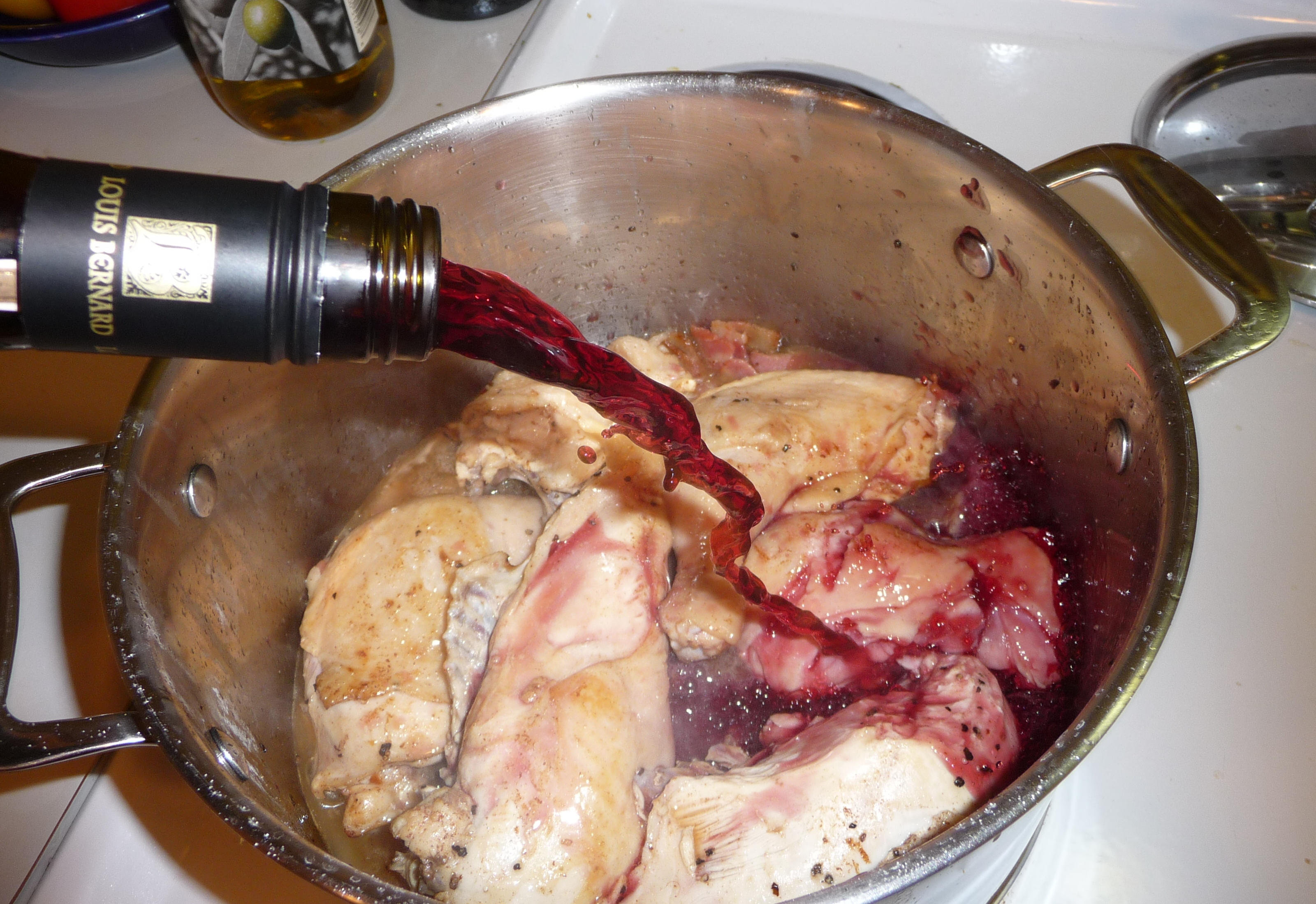
6. Pour in the wine. (I like to use a full-bodied wine, such as a Côtes du Rhône, Malbec, or Shiraz. Make sure you have more than one bottle on hand because you will want to pour yourself a glass as soon as you open the first bottle.)
7. Add the tomato paste, garlic, herbs, and enough stock to cover the chicken. Bring to a simmer, then cover and continue simmering for 25 to 30 minutes until the chicken is tender. Remove the chicken from the pan.
8. Skim any fat from the liquid remaining in the pan, and simmer for a minute or two. Bring to a boil and reduce to 2 1/4 cups. Remove from heat and check seasoning.
9. Mix the butter and flour into a paste. (This is called beurre manié.) Use a whisk to mix the beurre manié into the liquid. Return to heat and simmer for a few minutes until sauce has thickened.
10. Return the chicken to the sauce to reheat. The onions and mushrooms can be added to the sauce or served on the side. I prefer to serve coq au vin over a pasta such as tagliatelle, but it would probably also go very well with mashed potatoes.
Brown-braised Onions
The small onions are a bit finicky to peel, but worth the effort because they are oh so good. Do not skip.
12 to 18 white onions about 1 inch in diameter, or 24 pearl onions
1 1/2 tablespoons butter
1 1/2 tablespoons oil
1/2 cup stock, dry white wine, red wine, or water
salt and pepper
one herb bouquet (4 parsley springs, 1 bay leaf, and 1/4 teaspoon thyme tied in cheesecloth)
1. Bring a pot of water to boil, immerse the onions for about a minute, drain, then cut off the root and peel.
2. Place a skillet over high heat with the butter and oil. When hot, turn the heat down to moderate and brown the onions.
3. Add the liquid, salt and pepper, and the herb bouquet. (You can buy herb bouquets in the spice aisle of French supermarkets. Also most convenient.)
4. Cover and simmer slowly for 40 to 50 minutes until the onions are tender and the liquid has evaporated. The onions should retain their shape. Remove the herb bouquet.
Sautéed Mushrooms
2 tablespoons butter
1 tablespoon oil
1/2 pound fresh mushrooms (cut into quarters if large)
1 to 2 tablespoons minced shallots or green onions (optional)
salt and pepper
1. Place a skillet over high heat with the butter and oil. When hot, turn the heat down to moderate and add the mushrooms. Remove from heat as soon as mushrooms are lightly browned.
2. If using shallots or green onions, add to the mushrooms, and sauté over moderate heat for 2 more minutes.
Epiphany
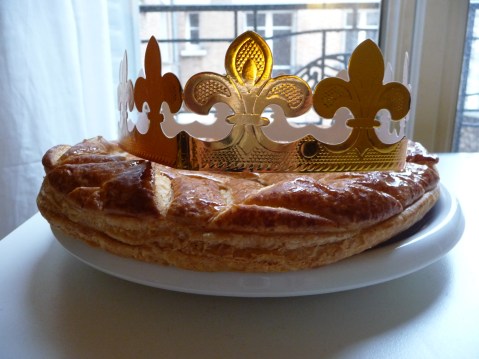
In France, Epiphany brings out the galettes des Rois, or king cakes. Every pâtisserie sells these. They are made of flaky layers of puff pastry. The centre is filled with a sweet almond paste. Hidden inside the galette is la fêve. Originally these were beans (fêve = broad bean), but nowadays, they consist of porcelain figurines. Whoever finds the fêve in their piece of galette gets to be “king” or “queen” for the day.
Christmas in Paris
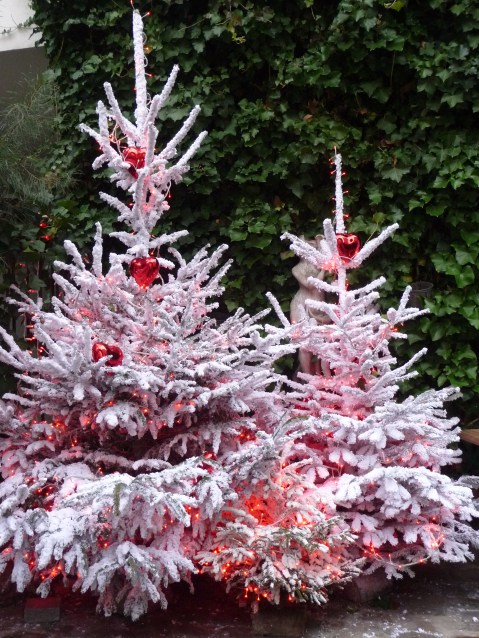
Christmas is making me so homesick for Paris.
Don’t get me wrong. After spending last winter travelling on two continents through two hemispheres, I’m very happy to be spending this holiday season in my own home with close friends and my family nearby.
But Paris at Christmas time is truly magical. Not a reindeer or Santa in sight, no muzak renditions of carols over store PA systems, no one staggering home loaded down with shopping bags stuffed with expensive presents.
Instead, Parisians turn their attention to food. Pâtisserie windows filled with elaborately decorated Yule logs that are more works of art than cake. Butcher shops with an assortment of poultry, feathers still attached, neatly lined up on beds of tinsel. People lined up three deep to buy oysters from make-shift stands set up night after night on street corners to meet the demand.
And the lights. Oh, I miss the lights! I used to think Vancouver looked so pretty in December with its light displays, but now…. Well, now I think it looks kinda … lame, actually, in comparison to Paris. The City of Light lives up to its name by stringing lights across streets, draping strands of them over trees, and running ropes of them up and down building facades. Cafés are tastefully wrapped in ribbon and baubles and evergreen boughs. We walked the length of the Champs-Élysées last Christmas Eve and not a building, not a tree, not a lamp post was bare. You could read a book by those lights.
And then there are the Christmas markets, which have their origins in Medieval Germany. We didn’t make it to all of the Marchés de Noël in Paris, but we explored the largest one along the Champs-Élysées, and smaller ones at Trocadéro and Saint-Germain-des-Prés. Vendors in wooden huts sell handcrafts and toys, but the emphasis is on the variety of food and drink available, including the biggest slabs of chocolate I’ve ever seen and piping hot cups of vin chaud.
There are also the outdoor ice skating rinks at Trocadéro and the Hôtel de Ville. And the carousels, one per arrondissement, which are free for kids the entire month of December….
Any time of year Paris glows. At Christmas time, it dazzles.


 There and Back Again