
The Cloisters
As you may have, um, noticed from this year’s Lenten series, I’m rather partial to cloisters. The simple truth is: I just can’t get enough of them.
So, given my love of cloisters, why were my expectations of The Cloisters ― a branch of New York’s Metropolitan Museum of Art ― so low? I didn’t bother to make the trek all the way to Fort Tryon Park until my fourth visit to New York; even then, I debated whether or not to make the effort. (Though, in the end, I was glad I did as I decided the park alone is worth a visit. As you can see here.)

The thing is, I’d always been under the impression that the buildings that make up The Cloisters are all reconstructions. Purist that I am, I figured since I’ve seen many a real cloister ― in France, and Spain, and Italy ― why would I want to see a mere imitation?
Turns out I was completely misinformed. The Cloisters aren’t reconstructions; they’re the real deal. (And let that be a lesson to me: I didn’t do my homework before dismissing The Cloisters and almost passed on what is a marvellous opportunity for anyone in the vicinity of New York who cannot get themselves over to Europe.)

The Cloisters had its origins in the private collection of American sculptor George Grey Barnard, who lived in Paris for more than a decade in the late nineteenth century. In the decade before World War I, he got into the habit of collecting and bringing home with him pieces of medieval architecture from French villages. John D. Rockefeller bought the collection from him in 1925, and later donated it to the Metropolitan Museum of Art. Rockefeller also donated to the city of New York the land that now makes up Fort Tryon Park.

Open to the public since 1938, the museum is a chronologically arranged ensemble of remnants from five French abbeys: Saint Michel de Cuxa, Saint Guilhem le Désert, Trie-sur-Baïse, Froville, and Bonnefont-en-Comminges. In addition to the buildings, there are more than 2000 works of art, including illuminated manuscripts, stained glass windows, and tapestries.
Here, take a look.


If medieval history is your thing, I highly recommend a visit to The Cloisters.
As for me, I can’t wait to go back.

Through My Lens: Cloister of Abbaye Saint Michel de Cuxa

For the Second Sunday of Lent, we’re hopping across the Channel to France. This photo is of the Cloister of Abbaye Saint Michel de Cuxa, a Benedictine abbey located in the French Pyrenees.
The abbey was built in 878, abandoned during the French Revolution, and restored to a monastic community in 1919. Its cloister dates back to the twelfth century, but many of the columns were removed in the early twentieth century by an American sculptor and are now on display at The Cloisters Museum and Gardens in New York.
I took this photo in November 2000. It was on this jaunt around southern France that I came to realize how much I value the beauty and the silence of monastic cloisters. I’ve been on a mission to photograph them ever since.
Through My Lens: Empire State Building
At a dinner party I was at last night, the conversation around the table turned to upcoming travel plans, both for work and for pleasure. For a small group, the list was impressive: Cuba … Jerusalem … Vietnam … Hawaii … Rwanda and Uganda … Scotland … a Rhine cruise.
And New York. One couple is headed to New York this week. As I was looking for a photo to post today, I was shocked to discover it’s been almost two years since my last post about New York.
That’s far too long. And so, here’s a view of the Empire State Building taken from Greenwich Village.

Through My Lens: Grand Central Terminal

For my 100th post: a photo of the main concourse of Grand Central Terminal in New York City, because this magnificent building is celebrating its 100th birthday today. The doors to the station ― which New Yorkers refer to as “Grand Central Station” or simply “Grand Central” ― were first opened to the public at 12:01 am on February 2, 1913.
Dishing: Jean-Georges
 Now that you’re all firmly resolved, and well and truly into your New Year’s diets, I thought I’d write a few posts about food. Any objections? I thought not.
And since I have at least eight friends and/or family members who are looking forward to visiting New York in 2013, I’m going to return to that city to talk about a fabulous meal I enjoyed there last summer.
It would not be a stretch to say that, once I knew I was going to New York, what I was most anticipating was eating at Jean-Georges. Ever since my first meal at Market here in Vancouver, after which I discovered Jean-Georges has no less than eight restaurants in New York, I was determined to one day eat at his flagship restaurant in the Trump Tower. Last summer, I had my chance. Before leaving Vancouver, I made reservations for Sunday lunch the weekend we would be in New York.
 The décor at Jean-Georges is lovely; very light and airy with floor-to-ceiling windows overlooking Columbus Circle. We had a great table at the far end of the room against the wall. The furnishings are almost identical to the Vancouver Market restaurant. I especially loved the silverware. Call me old-fashioned, but it’s such a treat to eat with real silver at a restaurant. Feels more like an occasion, in my mind.
 We perused the menu, made some tentative choices between ourselves, then asked for some tips about which wines to choose with the courses we were thinking of ordering. Our server offered to check with the sommelier, then came back with his recommendations. Wine at Jean-Georges is served by the glass, which I appreciated as I wanted to vary what I would drink with each course.
After we made our selections, we were offered a choice of four types of bread. Then came a trio of amuse-bouches: a small glass of carrot purée, sea urchin on a small piece of dark toast, and fried okra over a miso purée. These were amazing bites of wonderment. So much flavor in one tiny bite.

Carrot purée, sea urchin, and fried okra
For my first course, I had tomato gazpacho, which was poured from a silver pitcher overtop grated fresh, soft mozzarella and a bed of olive oil foam. The gazpacho had a nice spicy touch, and I could taste summer in the tomatoes. My friend ordered charred-corn ravioli, tomato salad, and basil fondue. This plate consisted of small, bite-sized ravioli, heirloom cherry tomatoes, and a basil-based sauce. It was very tasty, and I regretted not ordering it myself.
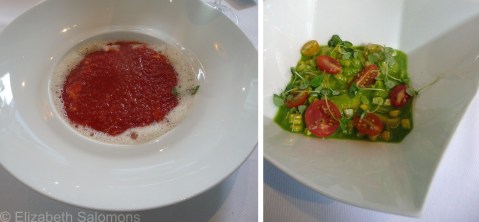
Tomato gazpacho and charred-corn ravioli
I wanted to taste one more course and so I ordered a second appetizer: a warm green asparagus salad, with Hollandaise sauce and a truffle vinaigrette, served on a bed of mesclan. This turned out to be my favourite course of the meal; I could eat asparagus every day for the rest of my life and never tire of it. The Hollandaise wasn’t too heavy, and the asparagus was perfectly steamed.

Asparagus salad
For my entrée, I selected the sesame-crusted salmon, which was served over a grilled eggplant purée and red chili butter. The butter provided a nice contrast, both in flavour and colour. It had a real kick, but was delicious with the salmon, which was perfectly cooked and a lovely pink colour.

Sesame-crusted salmon
My friend ordered the parmesan-crusted confit leg of organic chicken, with artichoke, basil, and lemon butter. She thought the lemon was too strong, but her chicken was moist and tender, just as a confit should be, and the parmesan crust was perfect. (Travel tip: Always travel with a friend who doesn’t mind you trying her food. You get to taste two meals for the price of one.)

Parmesan-crusted confit leg of chicken
Desserts at Jean-Georges are served as tastings: my friend ordered the cherry and I had the chocolate. She got sour cherry crème brûlée and marzipan, cherry sorbet, and deconstructed black forest ― the cream, cherries, and chocolate were served individually on a black slate slab.

Cherry dessert tasting
My chocolate tastings included white chocolate meringue with a layer of meyer lemon ice and cinnamon over top. I can’t say I tasted the cinnamon and, like my friend with her chicken, I found the lemon overpowering, almost to the point where I felt I was eating a dessert laced with household cleanser. However, Jean-Georges’ signature molten chocolate cake was delicious, with the vanilla bean ice cream on the side.
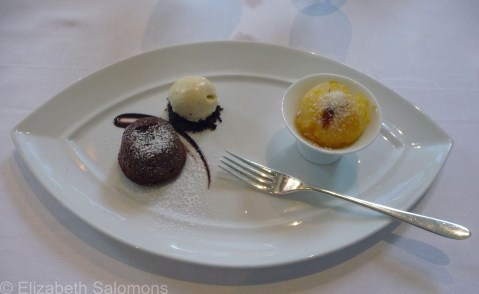
Chocolate dessert tasting
To go with our desserts, we each ordered a glass of Banyuls Reserva from Domaine La Tour Vieille in Roussillon. I know Banyuls from my visit to Roussillon many years ago, and it was the perfect accompaniment for both the chocolate- and cherry-based desserts.
But wait! There was more! We had scarcely made a start on our desserts when we were served a plate of homemade chocolates, another plate of miniature raspberry macaroons, and Jean-Georges’ homemade marshmallow, which is most definitely a step above the Kraft variety.
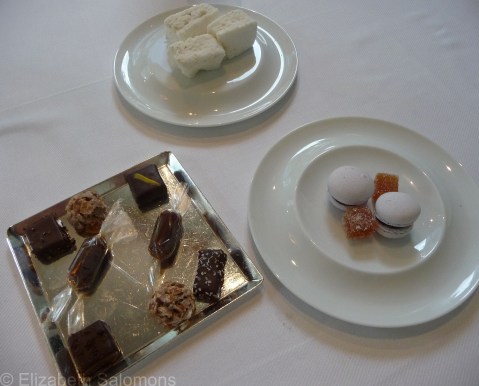
The finale
Although we had one server who seemed to be in charge of our table, we were waited on by several people throughout our lunch. The service was impeccably timed. Each dish was delivered in unison by two servers, and cleared the same way.
 After we had ordered our desserts, I asked to see the main menu once again, and when a server (not one of ours) noticed I was taking photos of the menu, he offered to give me a copy of both menus to take home. As he handed me the dark brown folder, he asked where we were from. He was very excited upon hearing I was from Vancouver, and told us he had a colleague from Vancouver. At this point, my friend jumped in and explained that I had eaten at Jean-Georges’ restaurant in Vancouver, and had been impressed, which was why we were here.
“That’s where my colleague worked!” he said. He then asked how the food compared and whether the meal I had just had was quite different from how food was served in the Vancouver restaurant.
“It’s very similar,” I said. “Just as delicious, but …” I paused as I thought for a second how to explain the difference, then said, “… but this is New York!”
He smiled knowingly and nodded. “Yeah,” he agreed. He reminded me of a young Woody Allen. Right down to his Noo Yawk accent and dark-rimmed glasses.
It was a delightful way to spend a Sunday afternoon in New York City. Lunch at Jean-Georges is a great deal as it’s prix fixe for two courses, with the option to order additional courses as I did. It was my first experience in a three-star Michelin restaurant, and now I have a new goal: to go back and try Jean-Georges’ seven other New York restaurants.
Staten Island Ferry
Looking at TV and Internet images of natural disasters is always tough, but never more so when you’re familiar with the region or you know people in the disaster zone. Such was the case for me this week. Hurricane Sandy ran right over the cities I visited last summer and I nervously waited to hear from people near and dear to me in Baltimore and New York City who both, thankfully, made it through to the other side of Sandy unscathed.
I was talking about the hurricane with a colleague on Tuesday morning, and I tried to explain to her the geography of New York City as she doesn’t know the city. That conversation made me think of the video I shot last summer from the Staten Island Ferry.
The Staten Island Ferry runs between the boroughs of Manhattan and Staten Island. It’s a free service, and I love ferry boats, so I hopped on one morning to get a good look at Lower Manhattan and the Statue of Liberty from the water. It’s about a 30-minute ride for the five-mile trip. On the Staten Island side, most tourists ― as did I ― turn around and hop right back on the ferry for the return trip to Manhattan.
The ferry connects with the subway on the Manhattan side. As you’ll see in the video, it was a bit of a blustery day when I took my ferry ride. After I disembarked, I stood at the subway entrance for a few minutes, debating whether to head Uptown on the train (much faster) or the bus (much better view). The subway station where I stood that morning (South Ferry – Whitehall Street) had water up to its ceiling on Monday night, and as far as I understand is still flooded.
I decided on the bus just as the skies opened up. It turned out to be a bit of a wild ride because of the weather. At each stop, New Yorkers poured onto the bus holding newspapers over their heads, and through the open bus doors I could see water gushing down the street.
But back to the video. The reason I wanted to show it to you is so you can see just how low Lower Manhattan is. Much of the southern tip of the island is, in fact, reclaimed land. (The Dutch were the first Europeans to settle on Manhattan, and they know a thing or two about reclaiming land.) You can see Battery Park in the video ― it’s those trees to the left. That’s the park I so enjoyed walking through last summer, and it too was badly flooded on Monday night. It’s not hard to imagine how much damage the record-breaking 13-foot storm surge could cause in this city. The East River is to the right, spanned by the Brooklyn Bridge, and the river to the far left is the Hudson.
Both ferry terminals of the Staten Island Ferry were damaged by Hurricane Sandy. As of this writing, partial service is expected to resume on Friday.
St. Paul’s Chapel

One of the most impressive buildings I saw during my recent visit to New York City was St. Paul’s Chapel in Lower Manhattan. The Twin Towers used to stand next door to this tiny church, and One World Trade Center is now under construction across the street from it.

St. Paul’s Chapel was built in 1766 and is the only Colonial-era church left in Manhattan. George Washington worshipped here on April 30, 1789, after he took the oath of office to become the first President of the United States.

The building survived the Great Fire of New York in 1776. It also survived the September 11 attacks, and suffered no damage at all other than being covered with dust and debris. It is now known as “the little chapel that stood.”

St. Paul’s became a place of refuge and rest in the days and months following the destruction of the Twin Towers, offering round-the-clock care for the thousands of volunteers working at Ground Zero. Massage therapists, podiatrists, and chiropractors, as well as parish staff, ministered to the firefighters, police, and construction workers. Today the chapel contains several memorials to those first responders and volunteers.
Central Park
I’m sure you are beginning to wonder if all I did in New York was explore its parks — and I assure you I did a whole lot more — but I have to finish this series of posts about New York parks with just one more. Then I will move on. Promise.
Central Park is the jewel of New York’s parks, and one of my favourite places in New York. Each time I visit the city, I make sure to save an afternoon to wander about the park.
At 843 acres and with a perimeter of six miles, it covers six percent of the island of Manhattan. There are 21 playgrounds, 36 bridges and arches, 9000 benches, and 24,000 trees. It opened in 1857, and is the most visited city park in the United States, with 38 million people visiting it every year. (That’s 38 million, folks. Every year.)
This year, I was one of them.
The High Line

The High Line is one of New York’s most unique parks. It’s an elevated park that runs along a former freight rail line. I missed its opening by a matter of weeks on my last visit to New York, and it was the park I was most excited to see on this visit to New York.
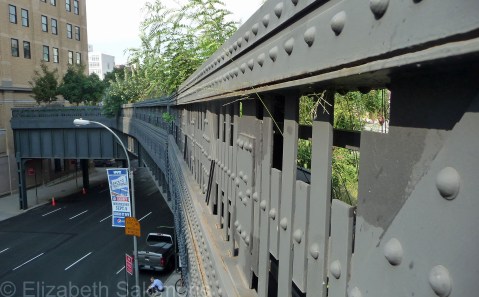
The original rail line was first built at street level, back in the 1850s, but as traffic increased, so did the number of accidents between street traffic and trains. It was made elevated in the 1930s to improve safety, and ran right through factories and warehouses to allow for easy delivery of the freight.

Rail traffic dropped after the 1950s, and stopped altogether in 1980. Part of the line was demolished.
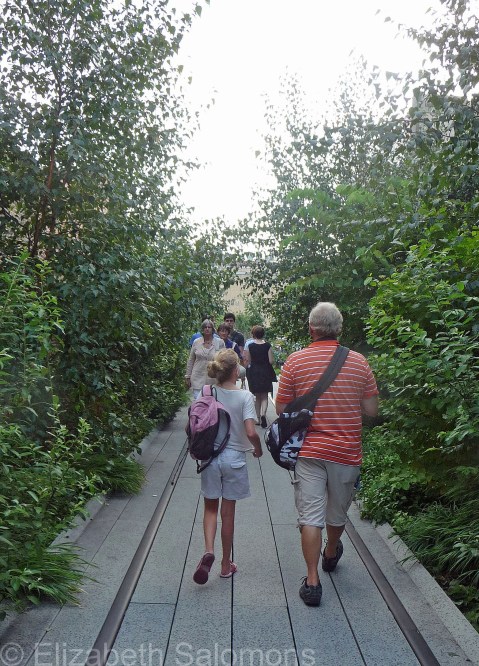
In 1999, Friends of the High Line was formed. The non-profit organization worked to prevent the demolition of the rest of the line and to turn it into a park. The first section opened in 2009.
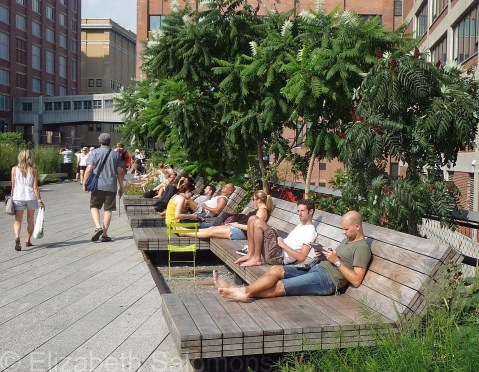
The High Line runs between 10th and 11th avenues from Gansevoort Street in the Meatpacking District, past Chelsea, up to West 30th Street, with stair and elevator access at various intervals.

There are plenty of places to sit.

And lots of interesting vegetation, including many species that grew naturally along the rail line before its transformation into a park.
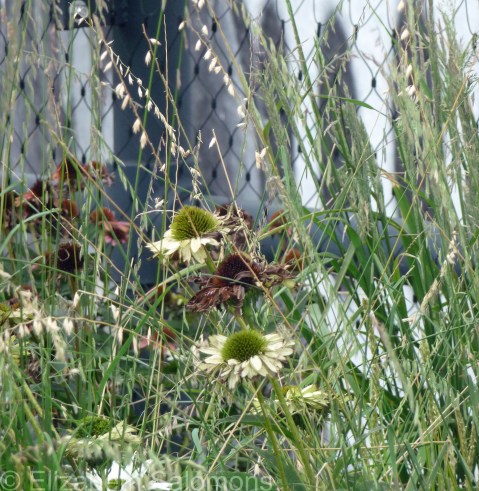
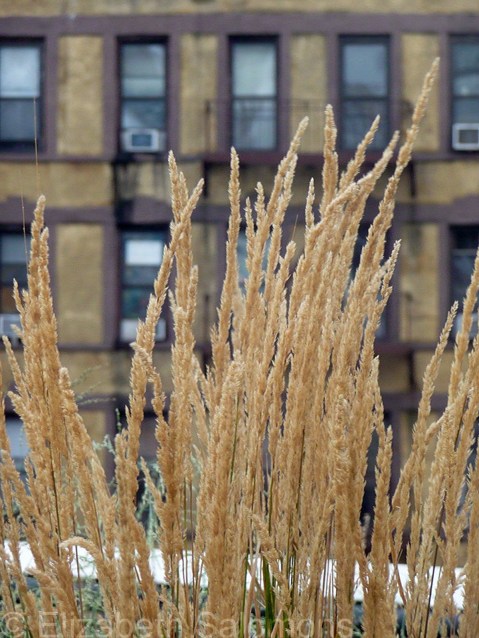
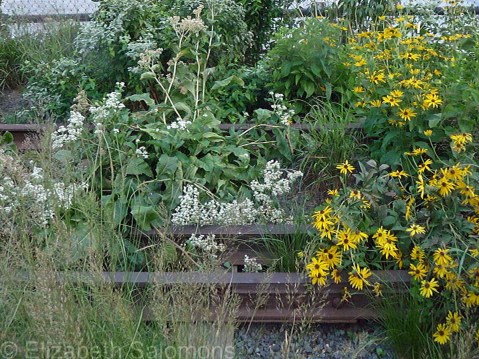
I spent two days exploring the High Line — one afternoon my friend and I met at the bottom end and worked our way north, and the second afternoon I started at the top end and walked to where we left off the previous time. And then we went back a third time to see it lit up at night. I know I will be back to visit next time I’m in New York.

Fort Tryon Park
On my third day in New York City, I discovered another of the city’s great parks: Fort Tryon Park. My friend and I went there to see The Cloisters (which I’ll write more about in another post), but also to meet up with some friends of my friend. They live near the park, which is in Washington Heights.
We enjoyed a picnic lunch and watched their children play. It was a lovely way to spend a summer afternoon in New York City.

New York dog walkers in Fort Tryon Park
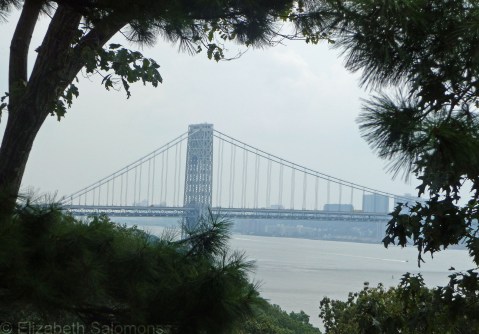
George Washington Bridge and the Hudson River from Fort Tryon Park


 There and Back Again