
Washington Monument
I have a whole whack of photos of the presidential monuments that surround the National Mall, which I will be doling out over the next few posts.
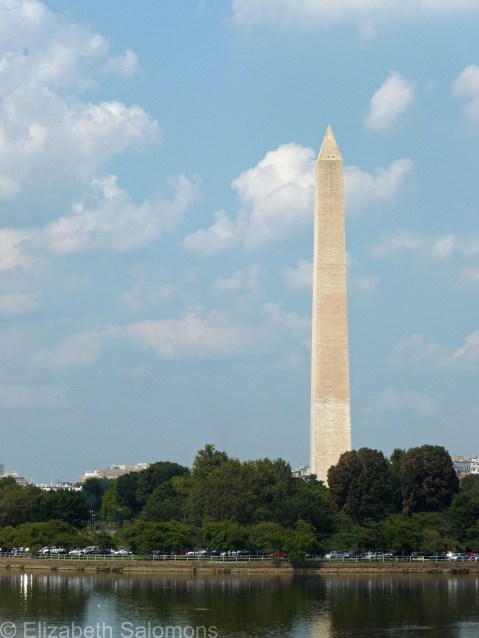
First up is the Washington Monument honouring George Washington, first President of the United States. He was in office from 1789 to 1797.
Made of marble, this obelisk stands at the mid-point of the National Mall, halfway between the Capitol and the Lincoln Memorial. Its construction was begun in 1848, but the Civil War and other squabbles interfered with its completion, and it wasn’t finished until 1884. For a few years, it held the record as the world’s tallest structure (it’s 555 feet high), until the Eiffel Tower overtook it. It still holds the record as the world’s tallest obelisk.
Normally you can go up inside the monument for what must be a nice view over DC, but an earthquake in 2011 damaged the structure, and it’s closed pending the necessary repairs. The scaffolding is scheduled to go up sometime this fall, but luckily I was able to take my photos sans scaffolding.
The Washington Monument doesn’t look like much in photographs, but when you get up close, it’s rather impressive.




Washington DC

Washington DC was a bit of a surprise to me. In some ways, it was exactly what I expected it would be. But in other ways, it was so much … more.

East Side of the Capitol
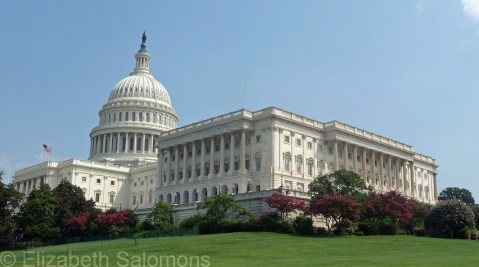
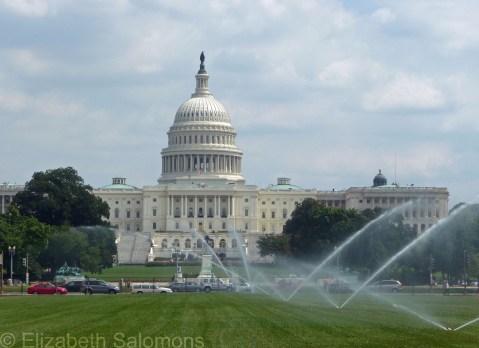
The landmarks were familiar, of course. We see them all the time on the news when TV reporters do their standups in front of the White House or the Capitol. Lots of white marble in those buildings. And columns. So many columns.
South Side of the Capitol
It was the scale of the place that took me by surprise. I thought it would be a short walk along the Mall from the Capitol to the Lincoln Memorial. But with all the stops I made along the way, it took me the better part of a day to make that walk.
As I walked, I kept muttering to myself, “So this is what a world capital looks like.” Later the word came to me: imperial. The place is rife with imperialism.
West Side of the Capitol
I kept comparing the buildings in DC to the ones in other world capitals I’ve been to (London, say, or Paris). The buildings in Europe are just as grand and just as impressive. But across the pond, there is far less open space, and the grand buildings often catch you by surprise as you turn a corner.

Washington Monument and the Mall as seen from the Capitol
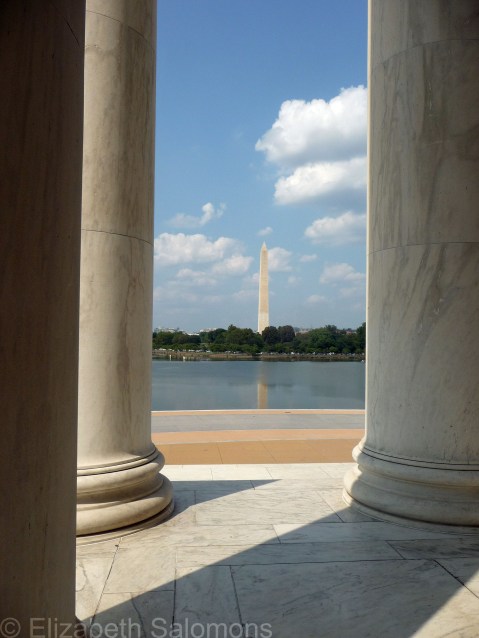
In DC, you have this massive front lawn they call the National Mall that lets you take in all the key sights in one glance. From the Capitol, you look down the Mall directly at the Washington Monument. Beyond that, there’s the Lincoln Memorial. When you stand at the Washington Monument, you turn one way and have an unobstructed view of the White House, but when you turn the other way, the Jefferson Memorial leaps out at you.
Washington Monument from the Jefferson Memorial
Washington DC is a city well-planned. Like other world capitals, DC was selected to be the capital of a young country some years after its founding. But what’s unique about DC among world capitals is that it was built from scratch. George Washington selected Pierre Charles L’Enfant, a French-born American, to design the city. L’Enfant envisioned a city centred around three points: the government house (which eventually came to be called the Capitol), the president’s house (what we now call the White House), and a monument to George Washington. Grand streets and avenues intersected at grand circles and squares. The Mall, in L’Enfant’s mind, would be the grandest avenue of them all. A narrower avenue (Pennsylvania Avenue) ran between the Capitol and the White House.

Pennsylvania Avenue
Visionary that he was, L’Enfant was no project manager, and he was soon fired by George Washington. He died in poverty, but eventually was honored with a re-internment in Arlington National Cemetery. His true epitaph, though, is the city he designed.

Arlington Memorial Bridge
I spent two days in DC and was able to check off most everything (but not quite everything) on my to-do list. It was the Smithsonian that caught me up; I was barely able to make a start on it.
For more on that, stay tuned.


 There and Back Again