
Panegyri on Serifos
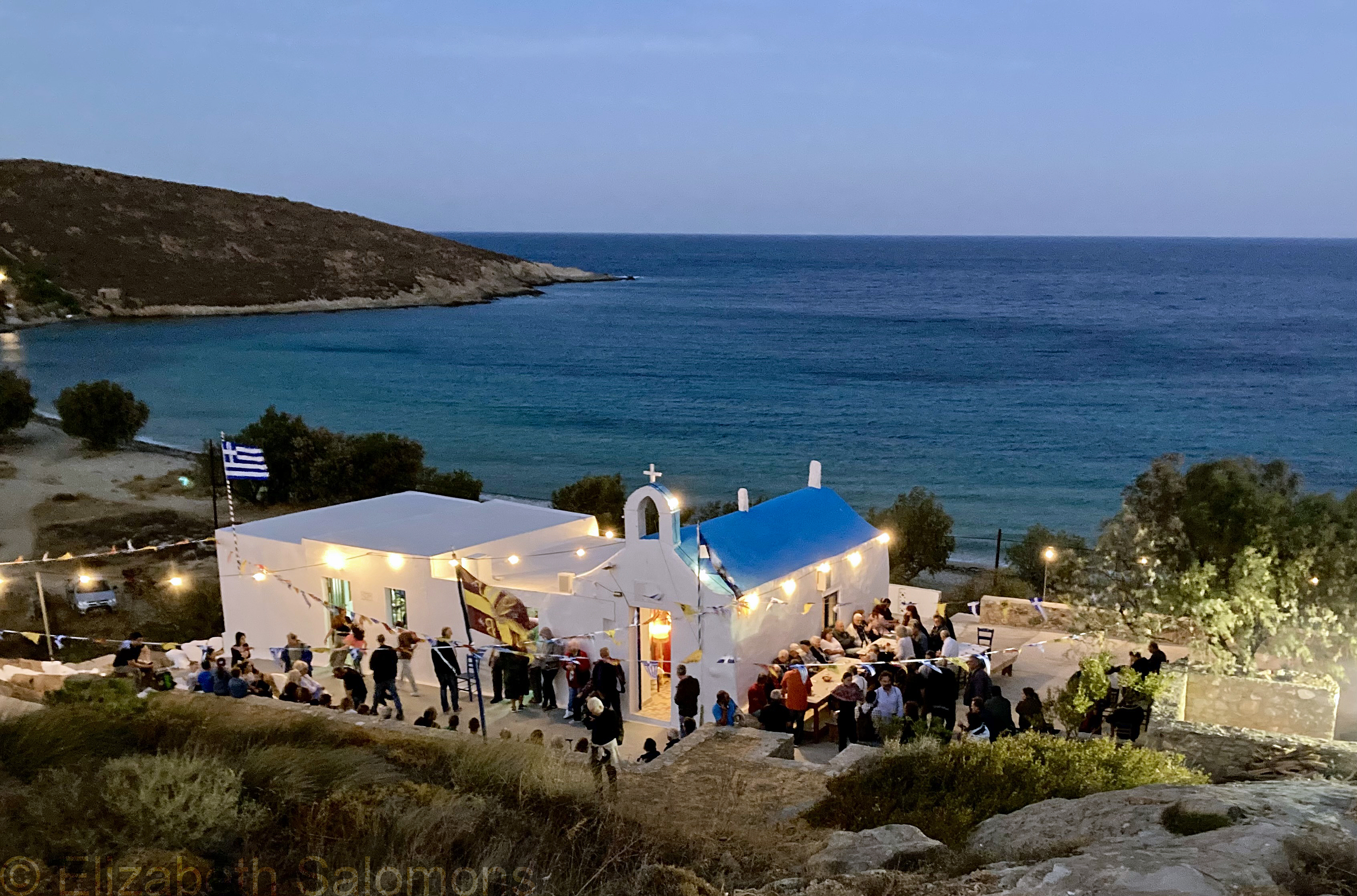
It hadn’t even been 24 hours since my arrival on Serifos and I was already on my way to a party. My home exchange partner had invited me to a panegyri.
Truth be told, I dithered about whether to go. Who would I talk to? How would I get home? That was the introvert in me talking. But the traveller in me was desperate to go. And in the end I went because I could hear in my head the voice of my dearest friend, saying, “What do you mean you didn’t go?”
Panegyria are a centuries-old tradition in Greece. The word comes from the Greek word pan (meaning all) + ageiro (meaning to gather). Originally, they were large gatherings dedicated to the worship of a deity, but, over time, they have shifted to celebrating Christian Orthodox saints.
Panegyria are especially common in rural communities and on the islands where local families take on the responsibility of maintaining and caring for the many small churches. As each saint’s day is celebrated, the family responsible for the church dedicated to that particular saint hosts a community feast, complete with live music and dancing.
Tourists are always welcome. On my first visit to a Greek island (decades ago, when I was travelling the European continent on a train pass), my friend and I ended up at three such festivals within four days.
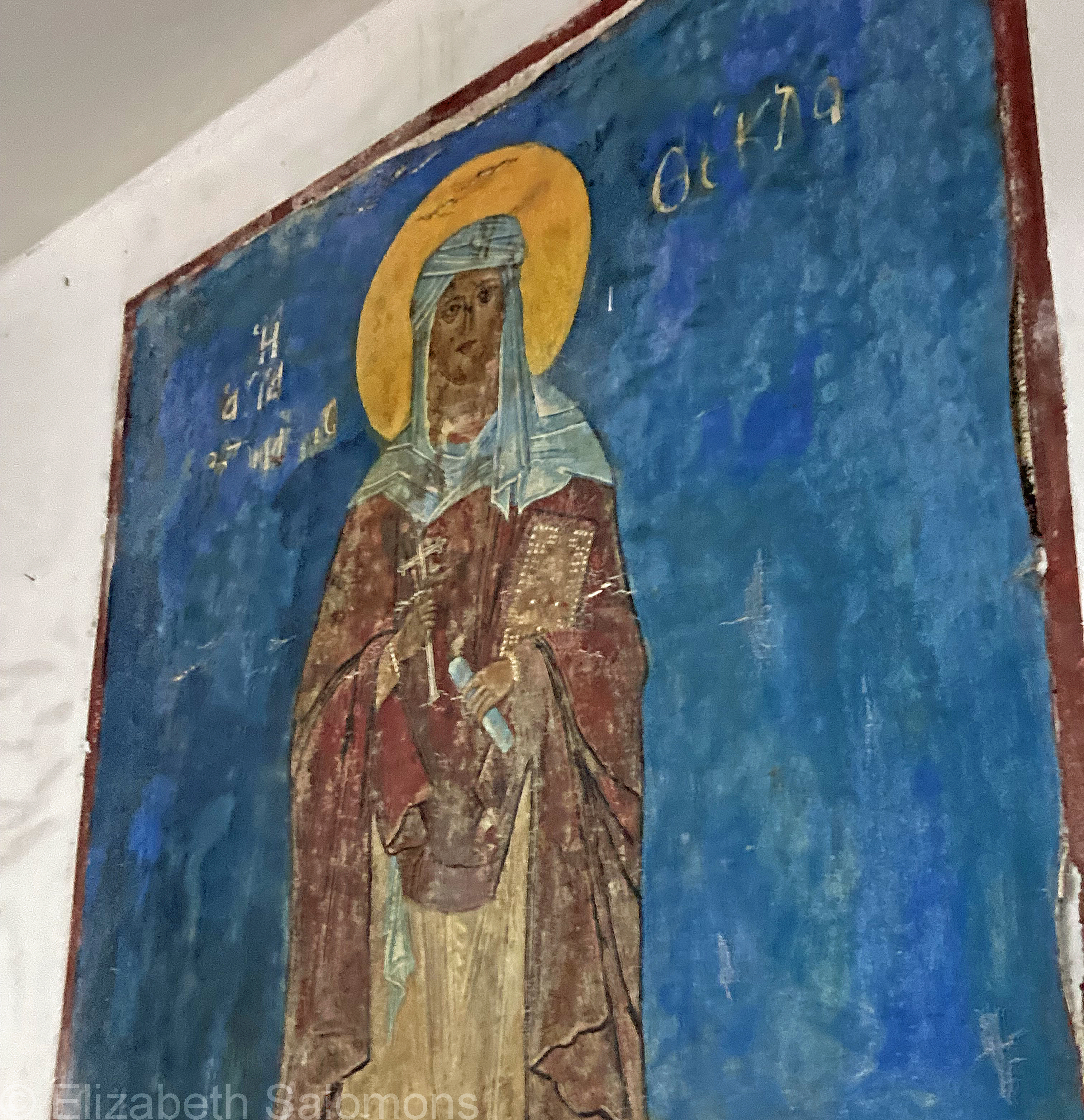
The panegyri I attended on Serifos was at the church of Agios Ioannis (Saint John the Apostle). We were too late for the religious service, but made our way into the chapel anyways, just for a moment, where we left a donation and my home exchange partner lit a candle.
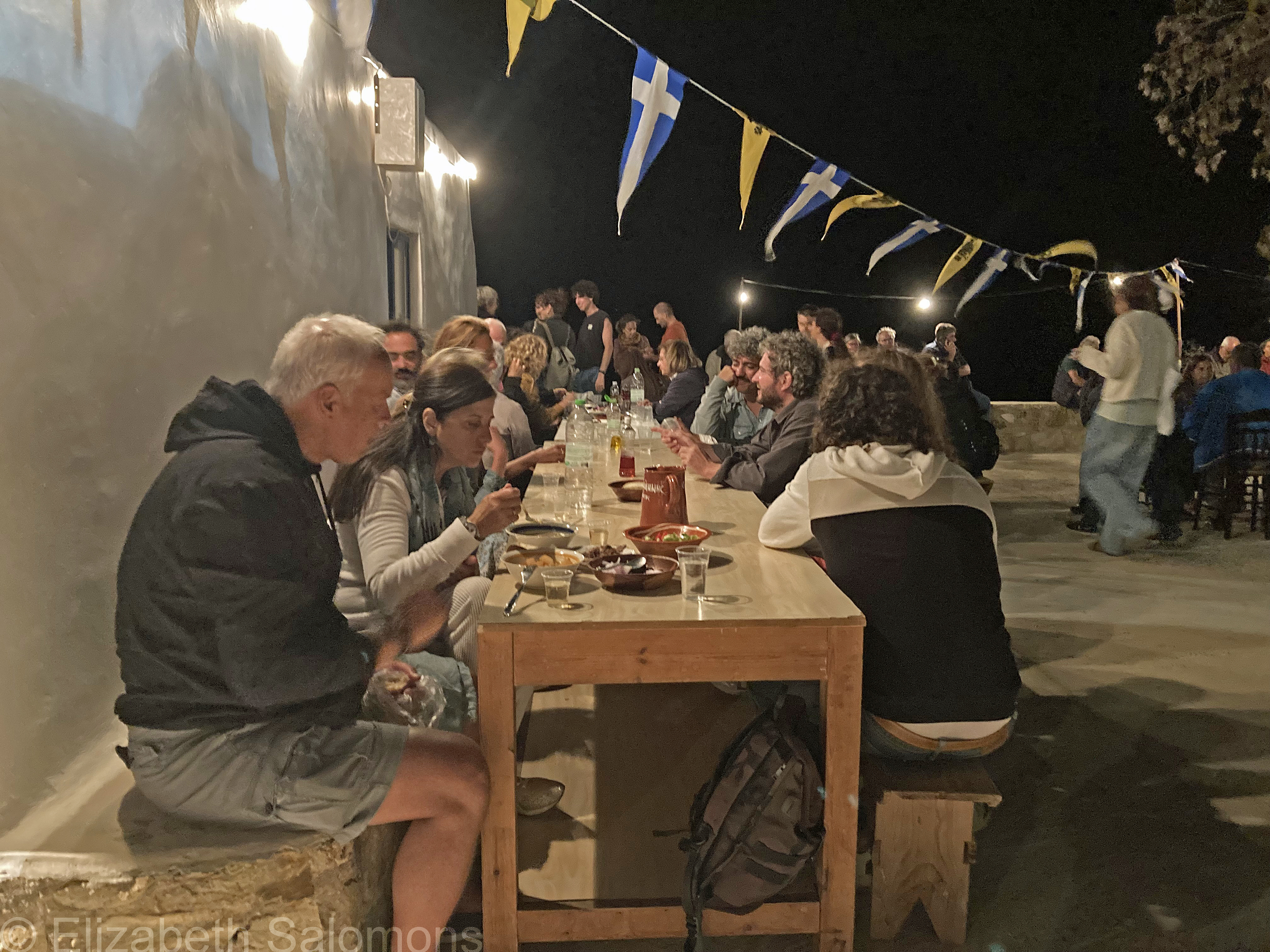
Outside was a table where everyone ate in shifts; my home exchange partner introduced me to her friends and we stood and chatted until it was our turn to eat. There was wine, potatoes, some kind of grilled meat, fava bean soup, and lots of bread. It was clearly a family affair with the men grilling the meat, the women running the kitchen, and the children serving the food.
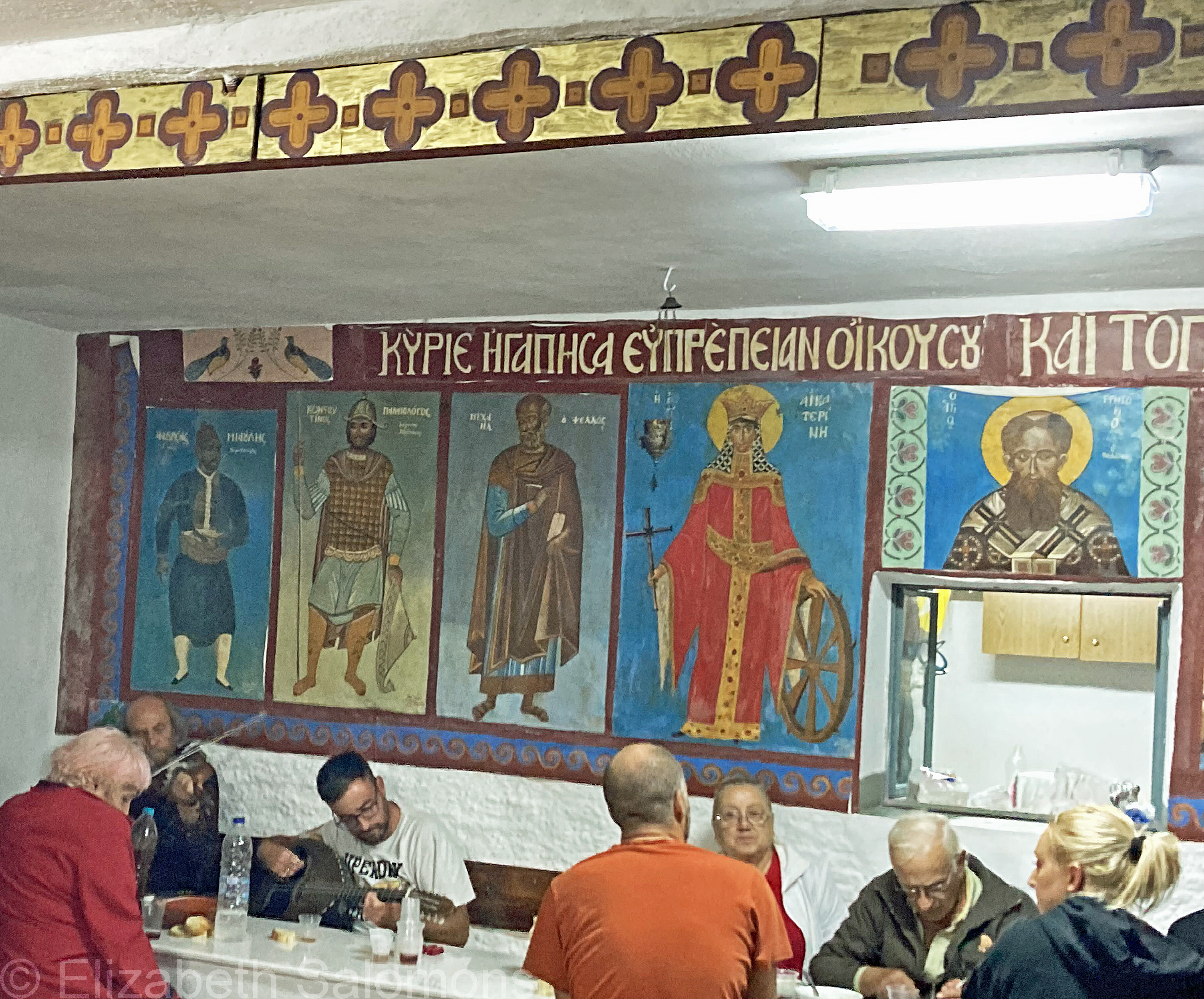
Eventually the music started up in the portion of the building next to the kitchen and we moved indoors to listen. Someone played a violin, another a bouzouki. The songs were long and when they ended, there was lots of applause. The musicians would rest for a bit, then the bouzouki player started picking out another tune and it would all start up again.
It was quite late when my home exchange partner turned to me and laughed at the fatigue she could clearly see on my face. She jumped up and said she would find me a ride home. And a few minutes later, as I walked up the hill to the main road with the Serbian couple who were willing to give me a lift (they were also staying in the Chora), a group of young women, clearly tourists, passed us on their way down. They thought they had missed the panegyri. I assured them they hadn’t, but they were alarmed that they couldn’t hear any music.
“The music is indoors,” I said. “Go on down, you can’t miss it.”
Nor had I — and I was so glad I hadn’t.
Beaches of Serifos
Serifos, I’m told, has 72 beaches. I made it to four of them.
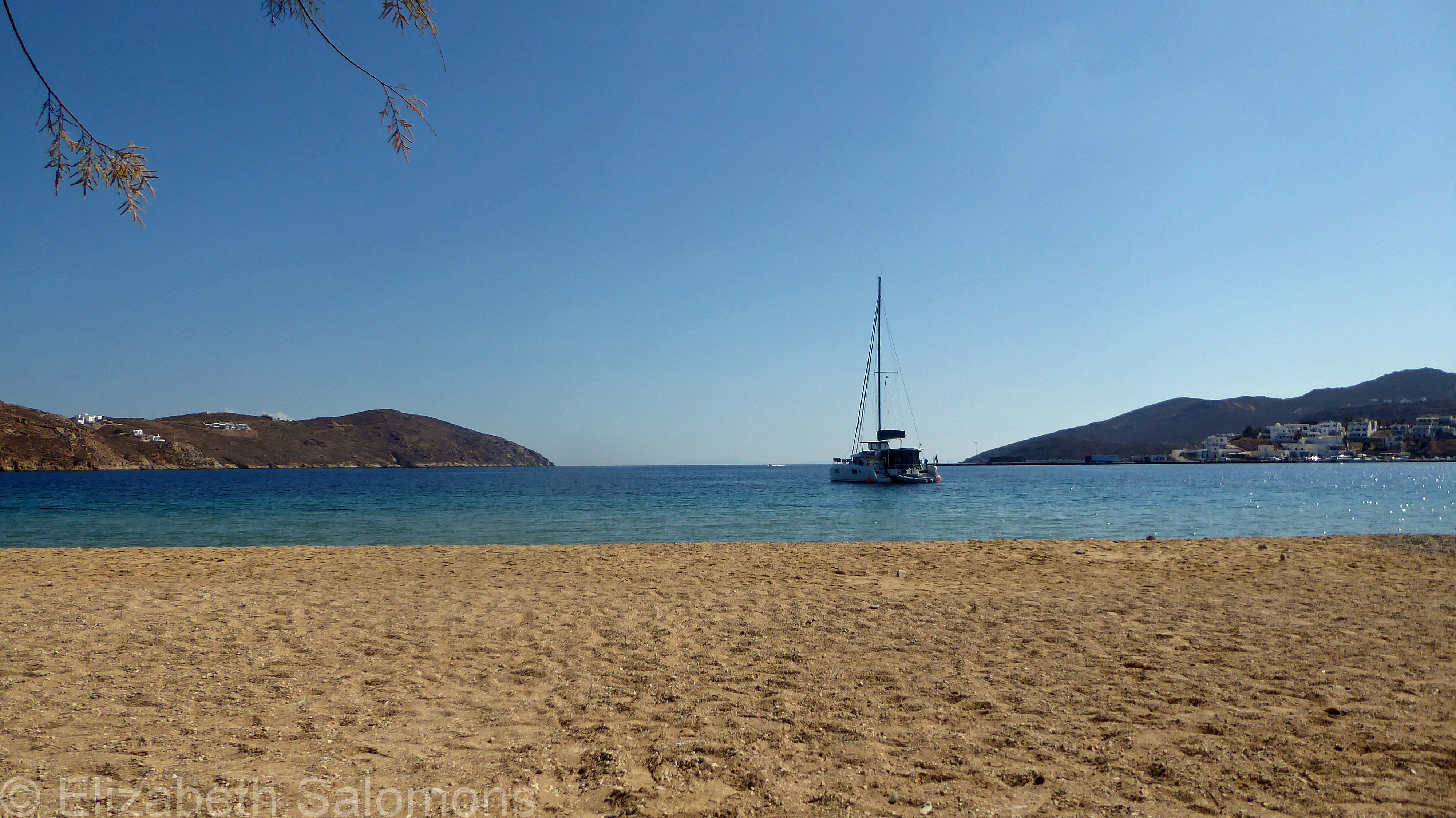
My first was Paralia Livadi (Livadi Beach). I didn’t swim here, but I was sitting on its sand within hours of my arrival, and I walked past it often during my two weeks on the island. It’s literally steps away from the tavernas and bars of Livadi.
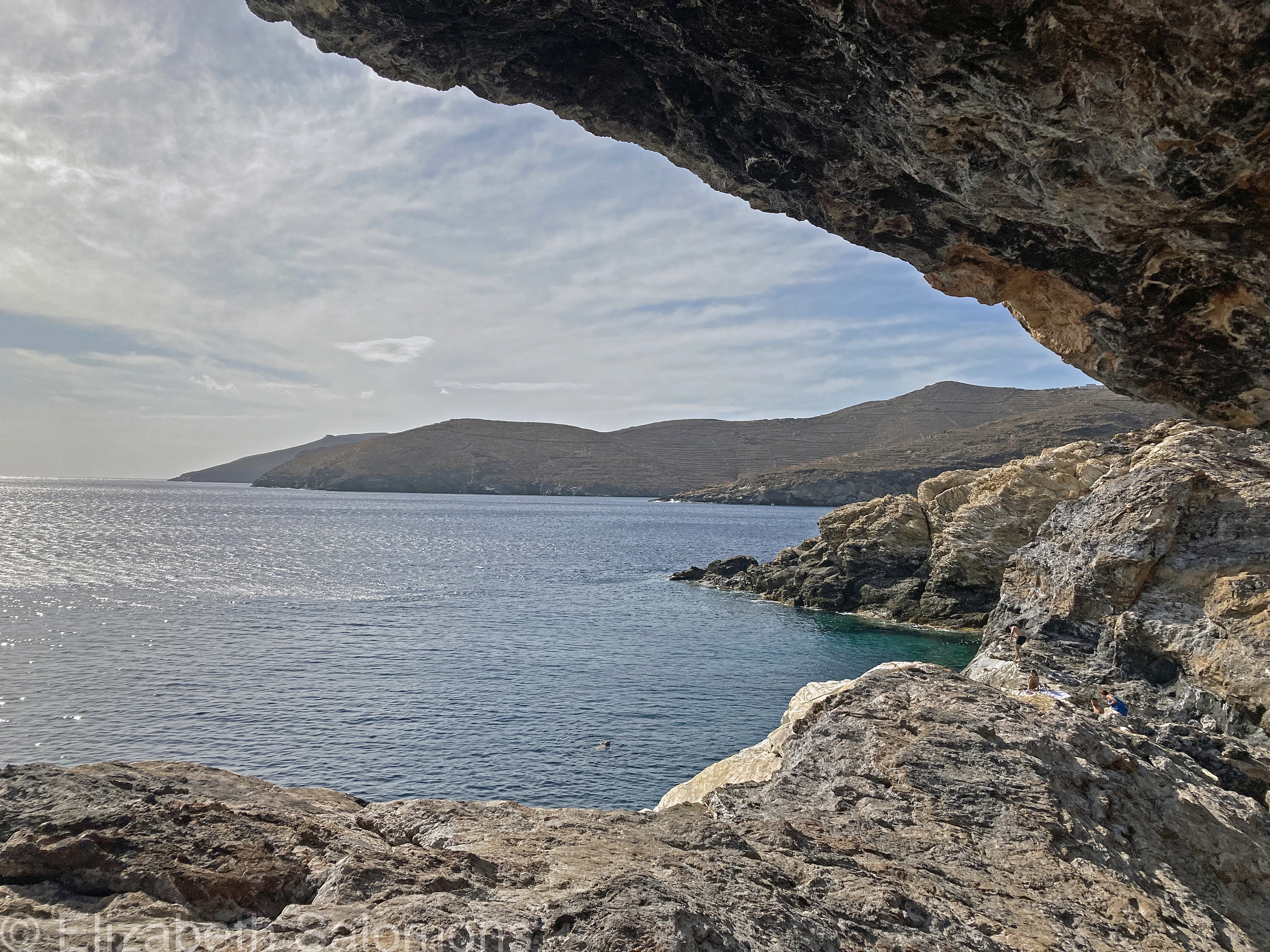
My first swim on Serifos was here. I know — it’s not a beach. This is on the southern shores of Serifos, about as far away from Livadi as I got during my two weeks on the island. My home exchange partner took me here late one afternoon, along with two other Canadians who were also visiting her. We parked along the side of the road, then walked through the shrubbery down a rather steep hill to the cliff edge where we sat on the rocks and sunbathed and talked. I suspect it is one of those spots known only to locals and I felt really lucky to be there.
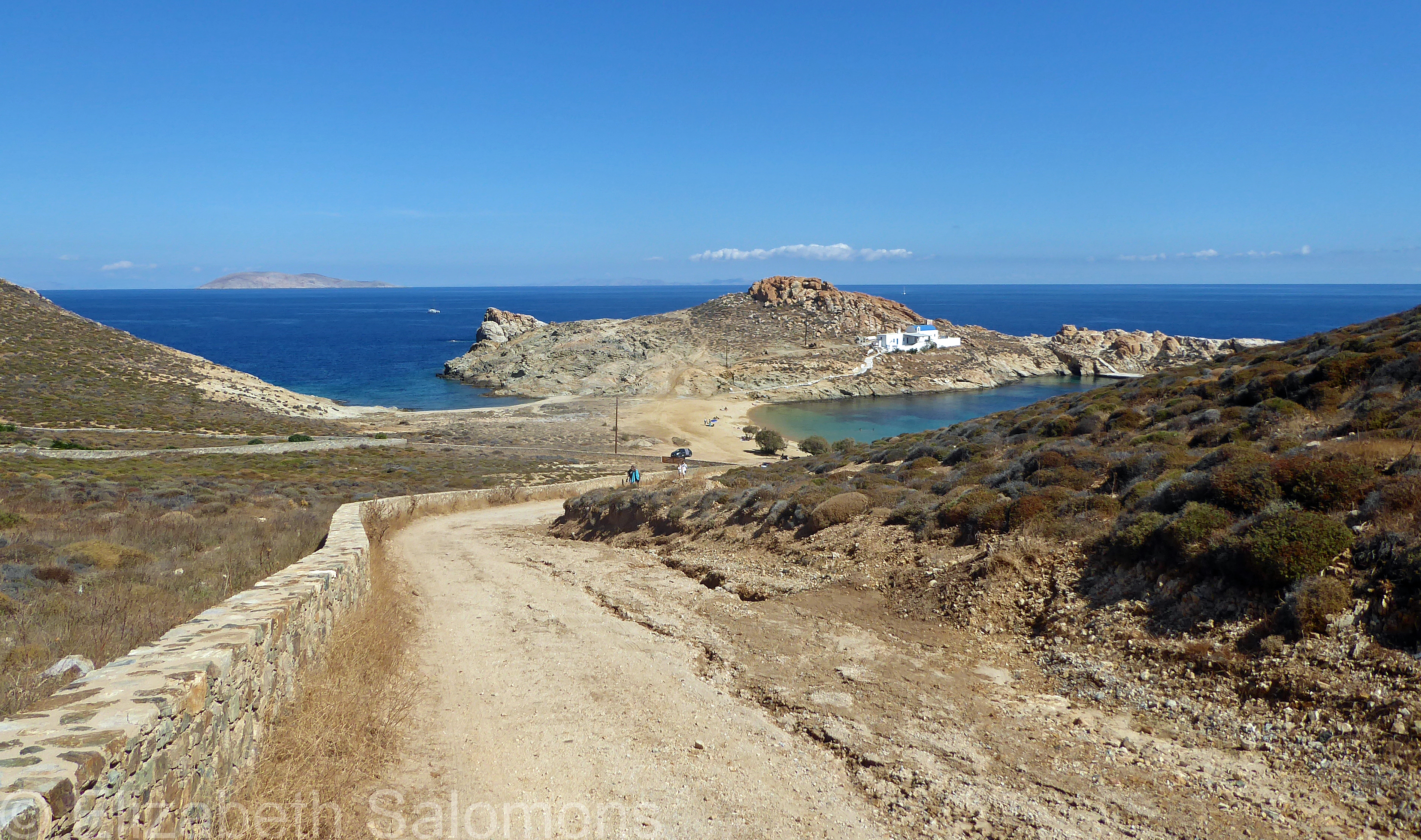
Paralia Agios Sostis (Agios Sostis Beach) is named after the church located beside it. (Agios is Greek for “saint.”) There are actually two beaches here as the headland gives you access to two coves.
The beach on this cove was deserted.
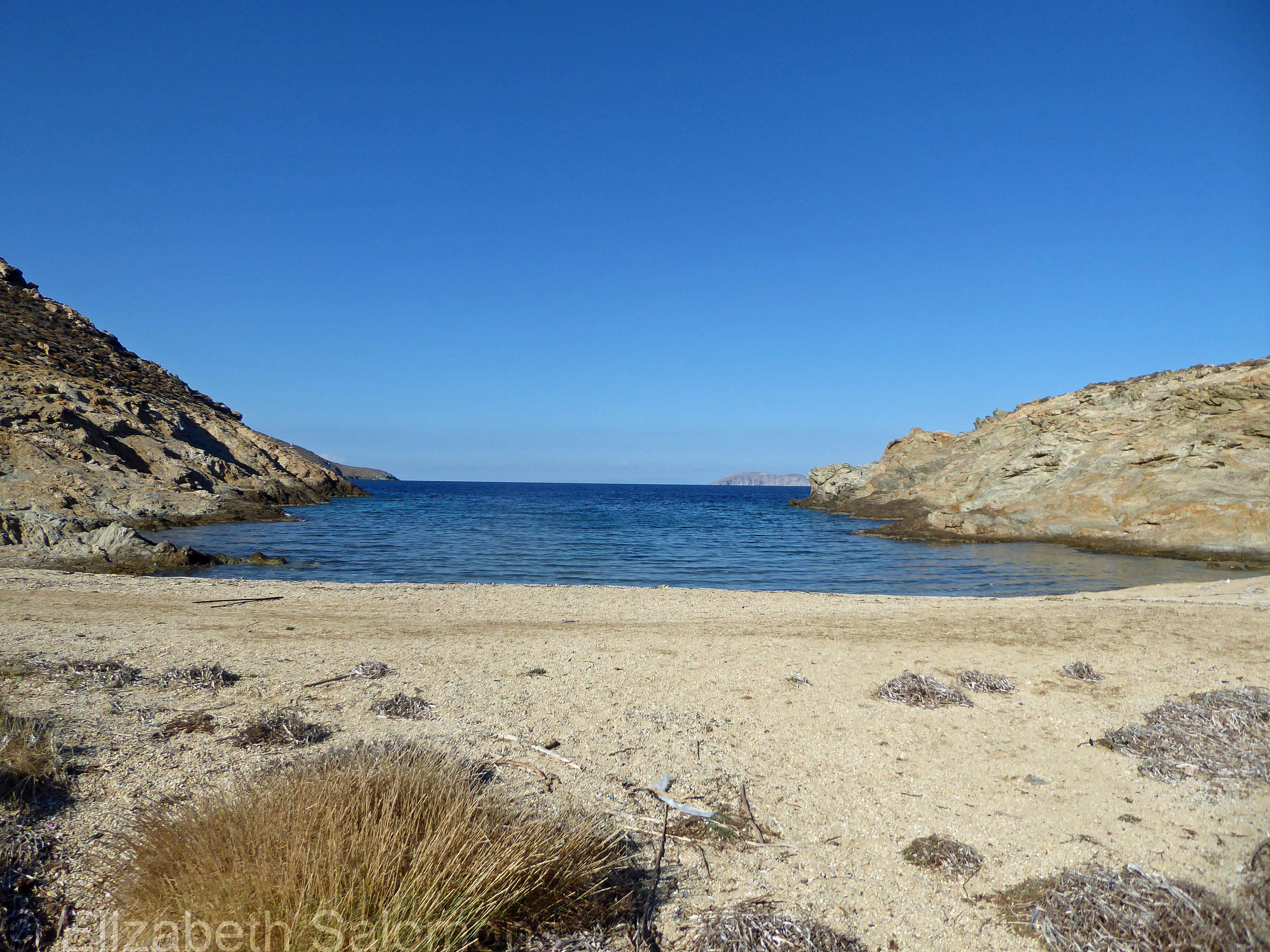
The beach on the other cove was where I spent my afternoons. There are no amenities at Agios Sostis and little shade. But the water is deliciously warm, even at the beginning of October.
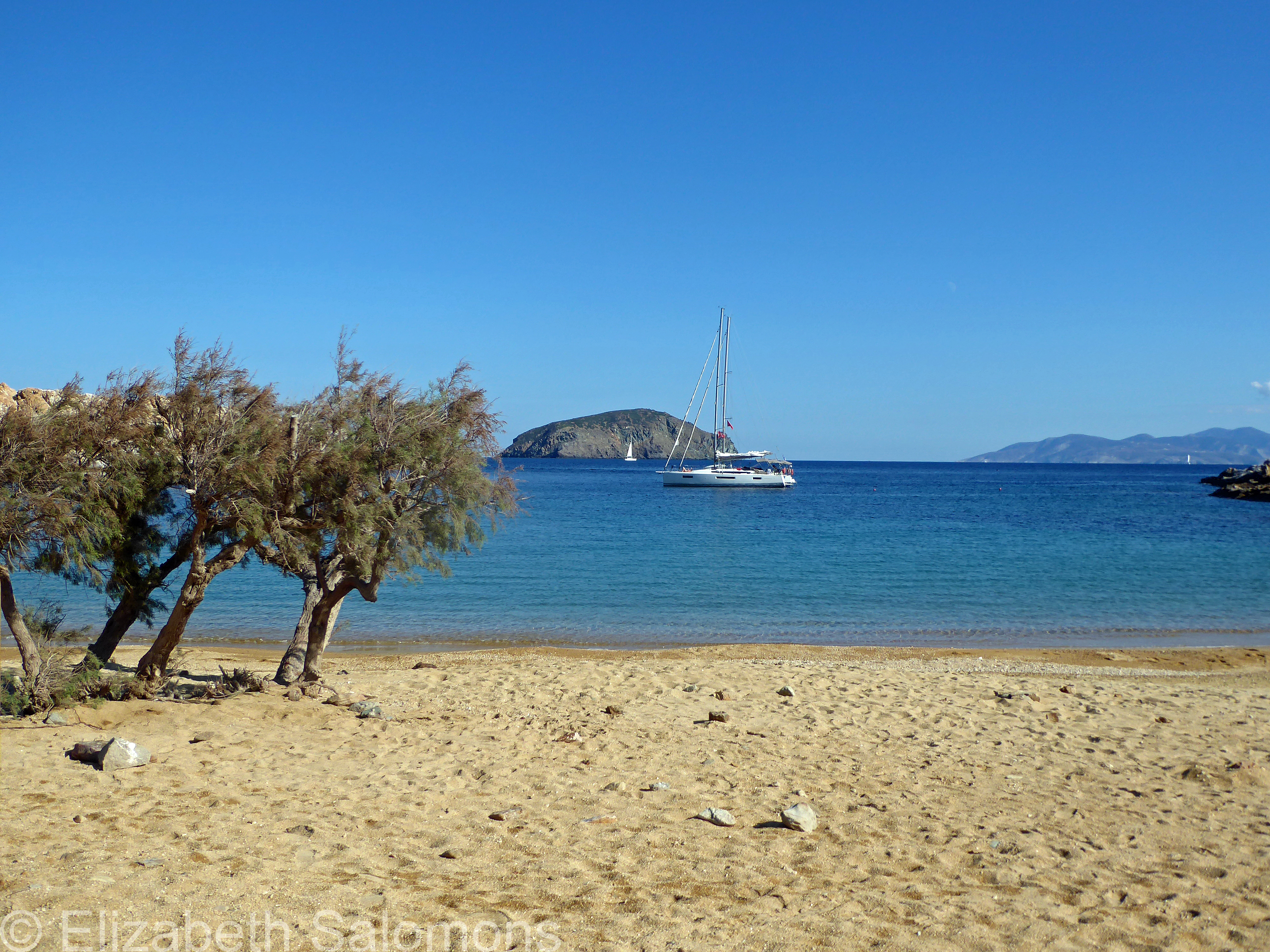
My first visit was by car, but when I realized Agios Sostis was walking distance from Livadi, I returned a few days later on foot. I’m told it’s so busy here in the summer, it’s difficult to find a parking spot.
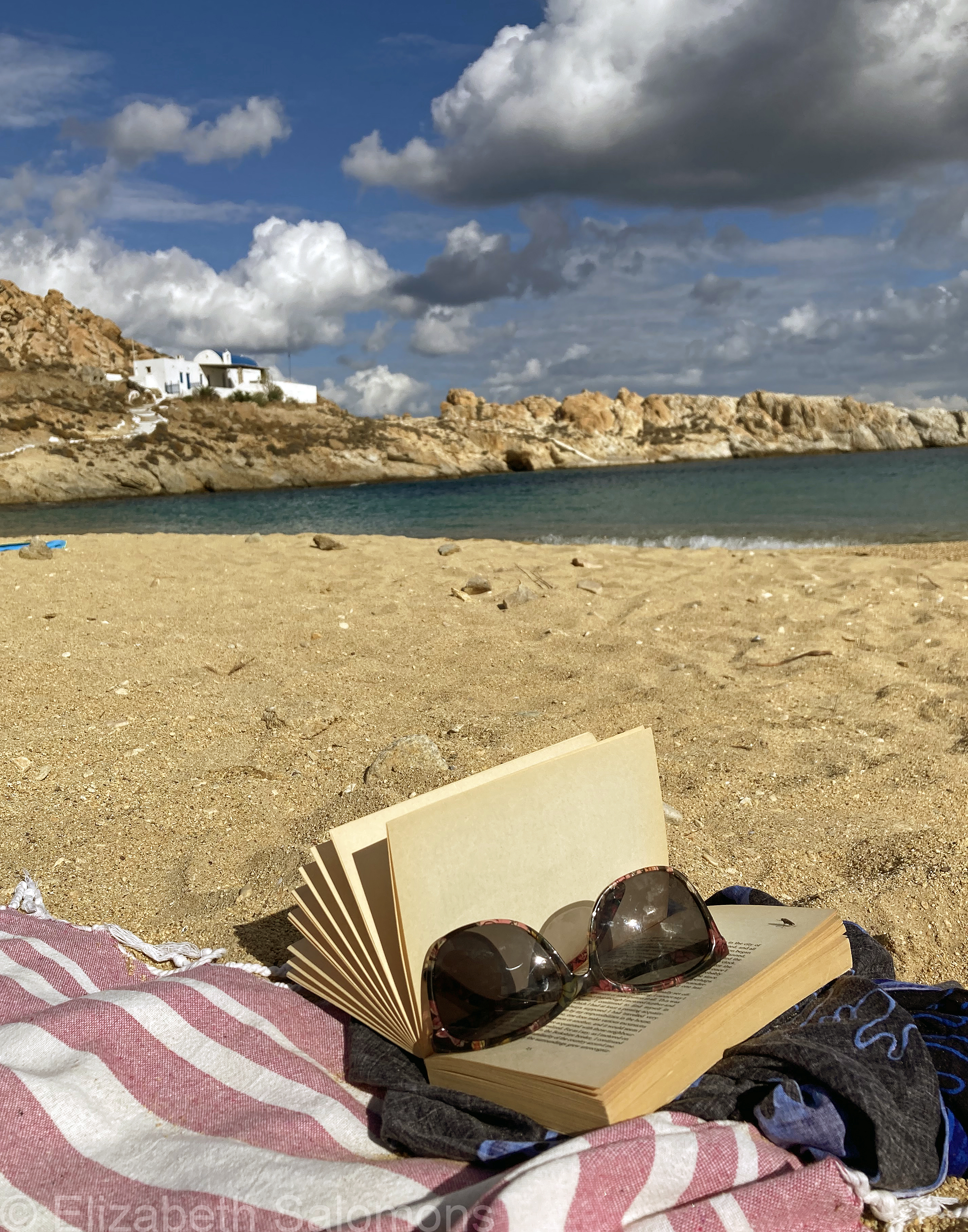
My favourite beach was this one, called Paralia Psili Ammos (Psili Ammos Beach).
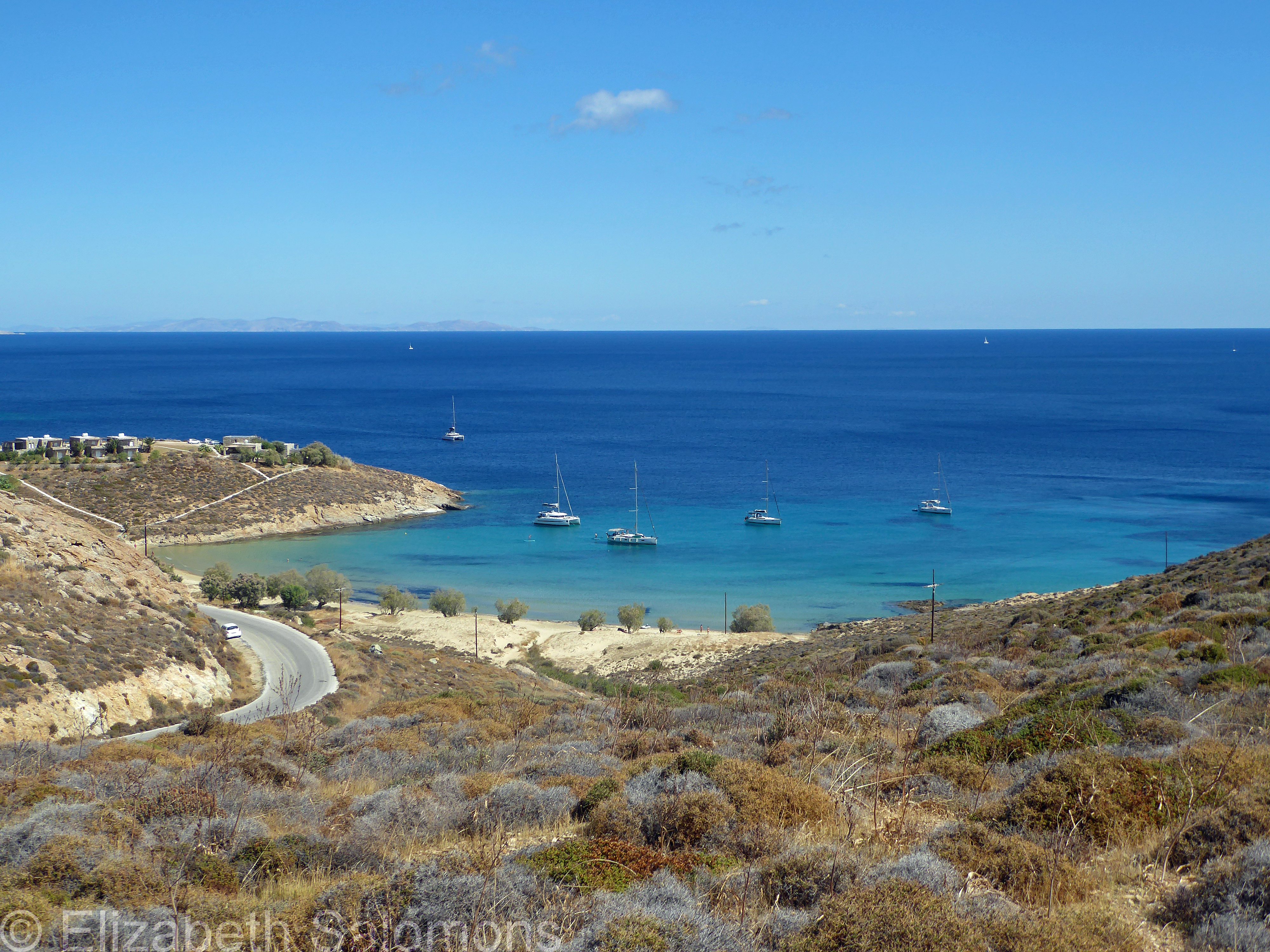
The beach, lined with shade-providing tamarisk trees, is much longer than the one at Agios Sostis and the sand is much finer. (Psilli Ammos means “fine sand.”) There are also two tavernas where you can buy a cold beverage or a meal.
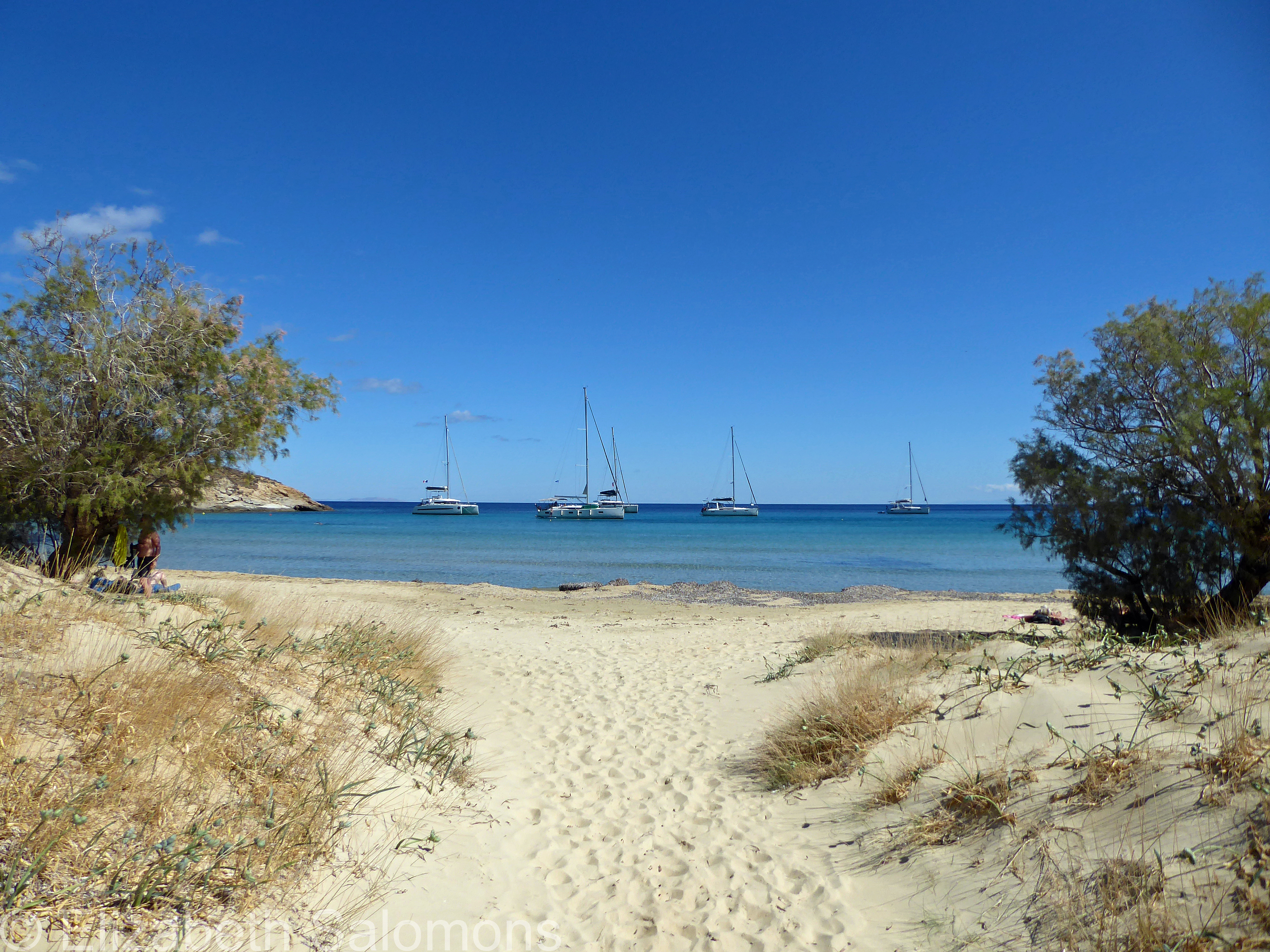
Because the cove is shallower than at Agios Sostis, the water was warmer. The bay is rather popular with the touring yachties — at one point, I counted eight sailboats anchored off shore.
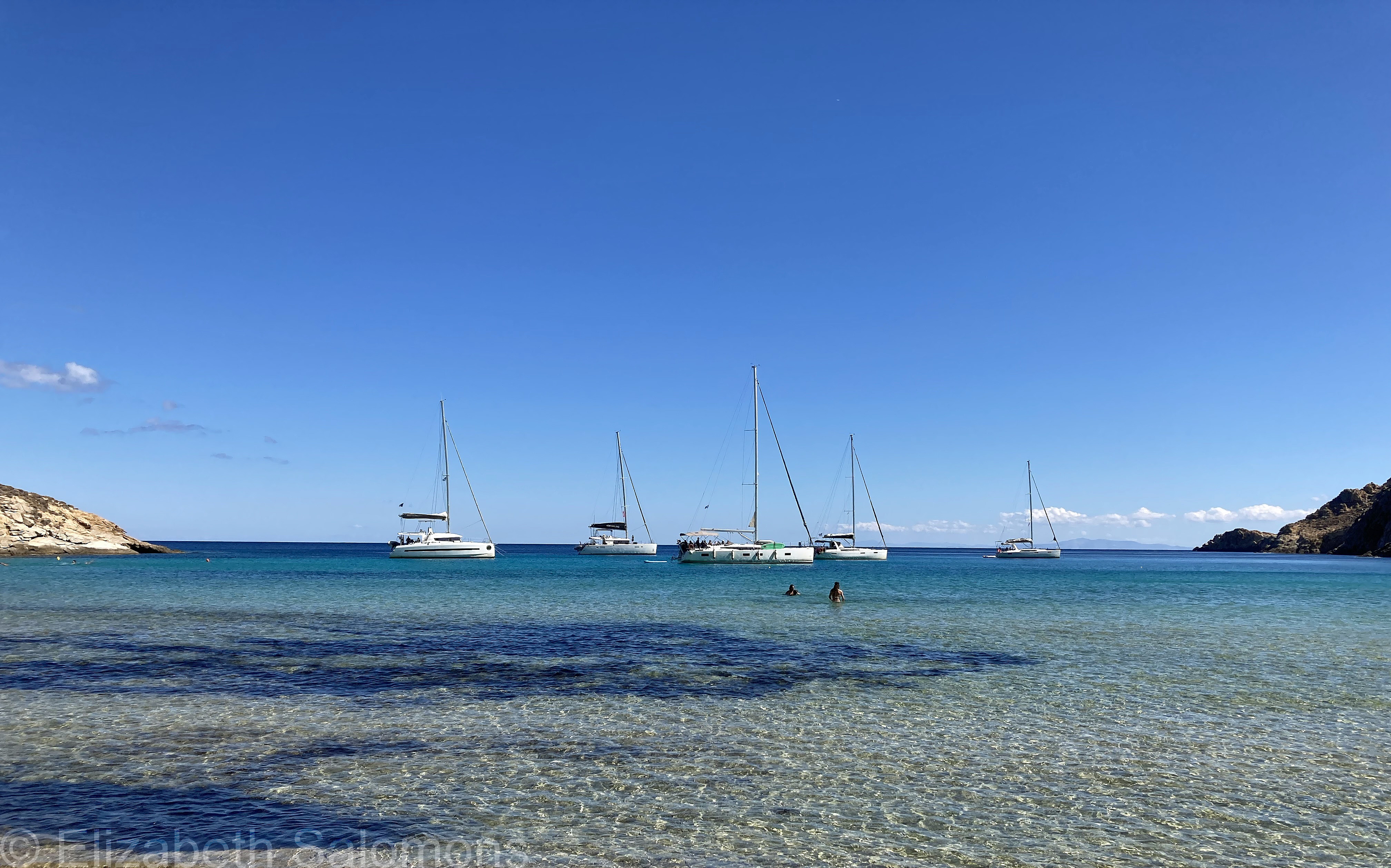
Again, my first visit to Psilli Ammos was by car, but for my return visit, I walked overland from my home in the Chora. When I was ready to head home, I walked to Livadi to catch the bus up to the Chora.
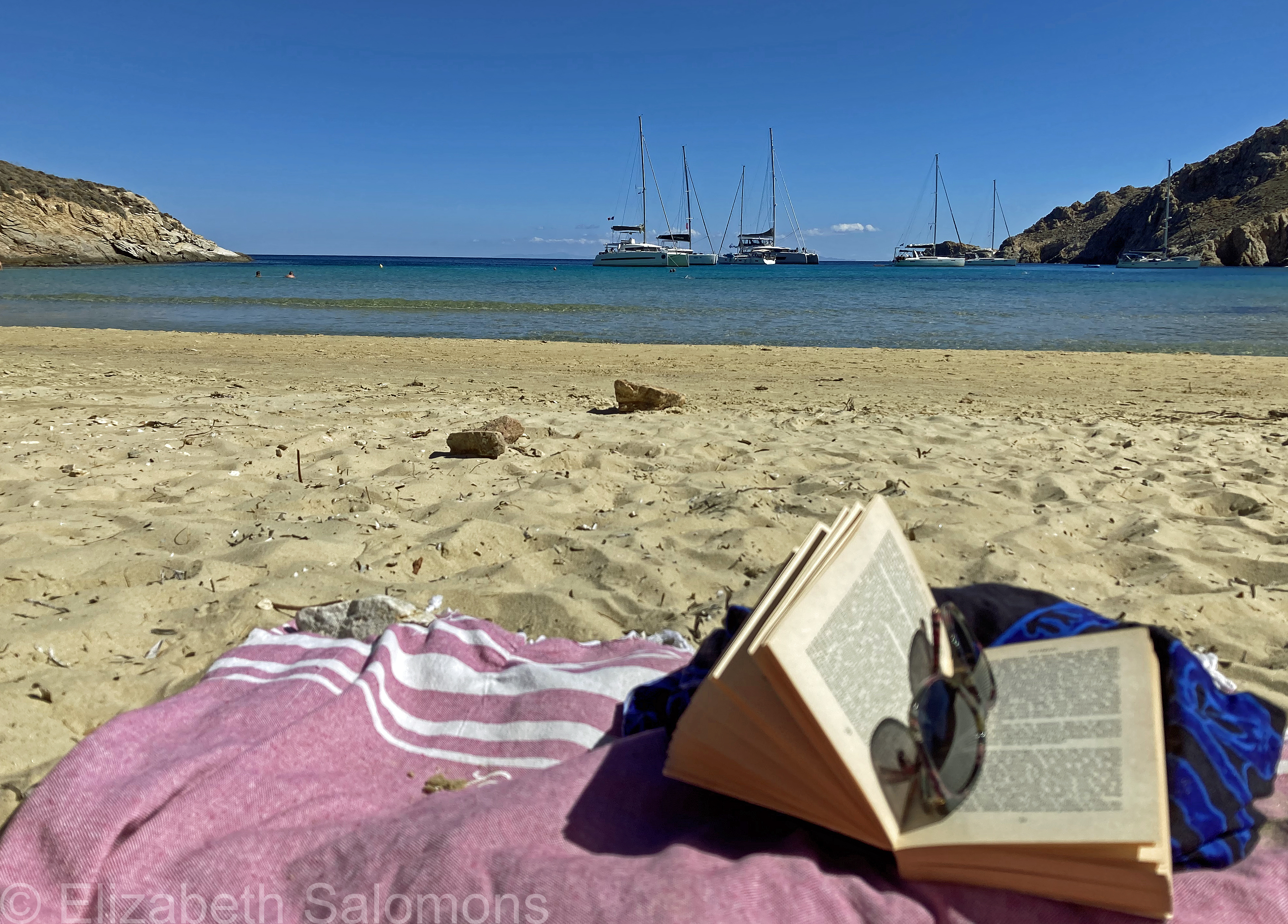
I don’t know when or if I’ll get back to Serifos, but I love that I have 68 more beaches to explore.
Livadi
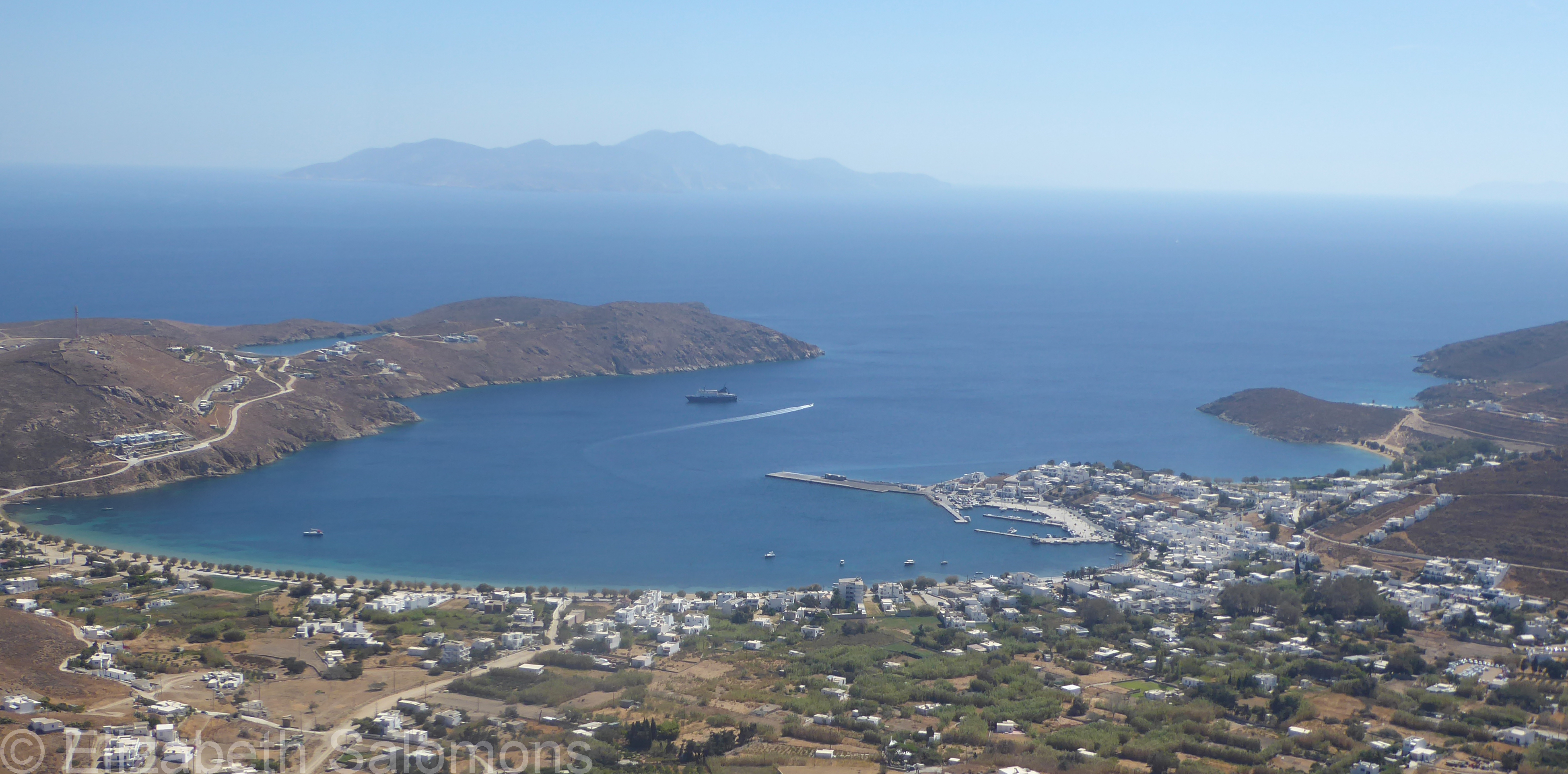
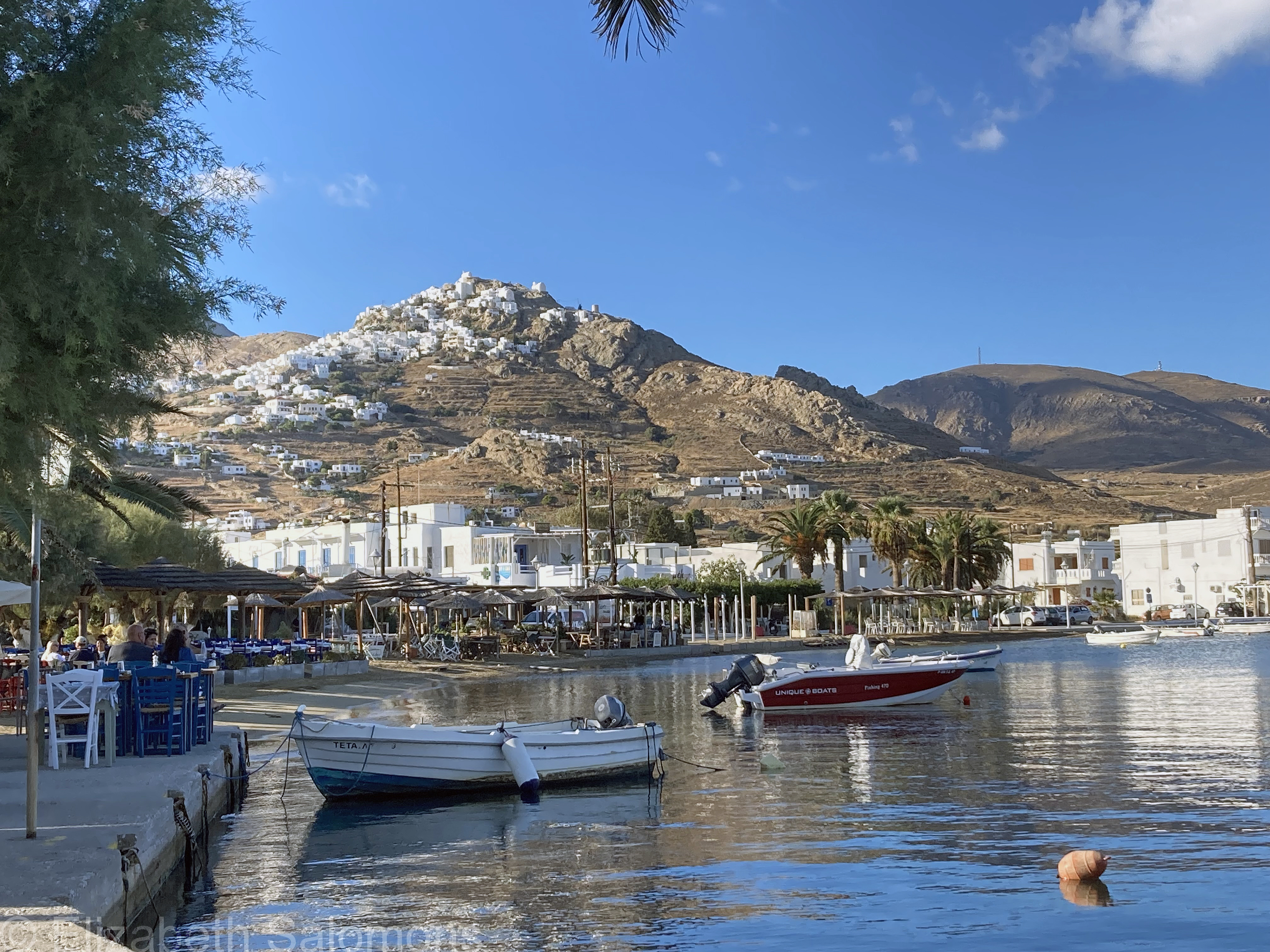
At one end, there’s the port, consisting of a simple concrete jetty. At the other end, there’s the beach.
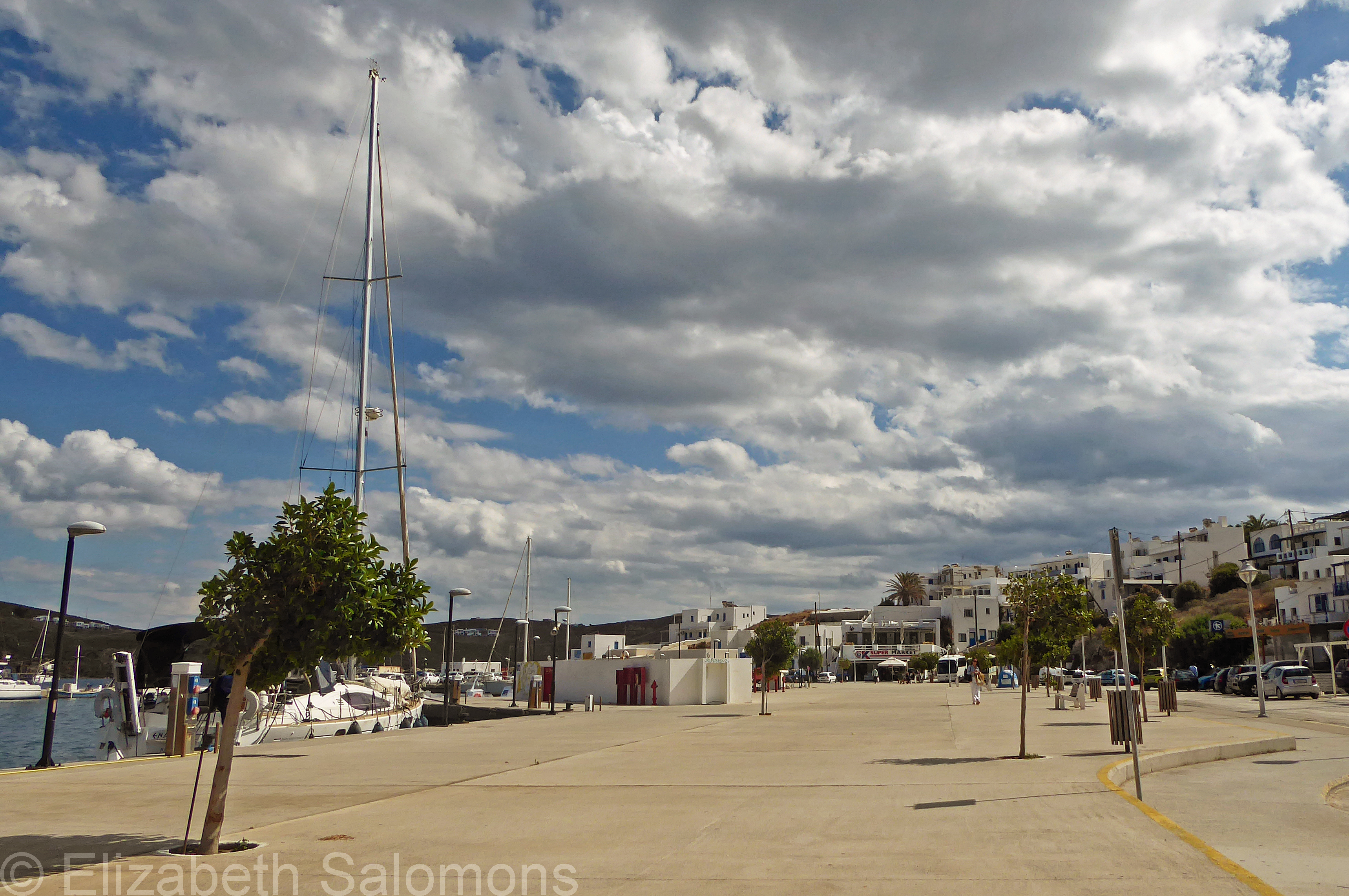
In between is a waterfront lined with shops, tavernas, and bars.
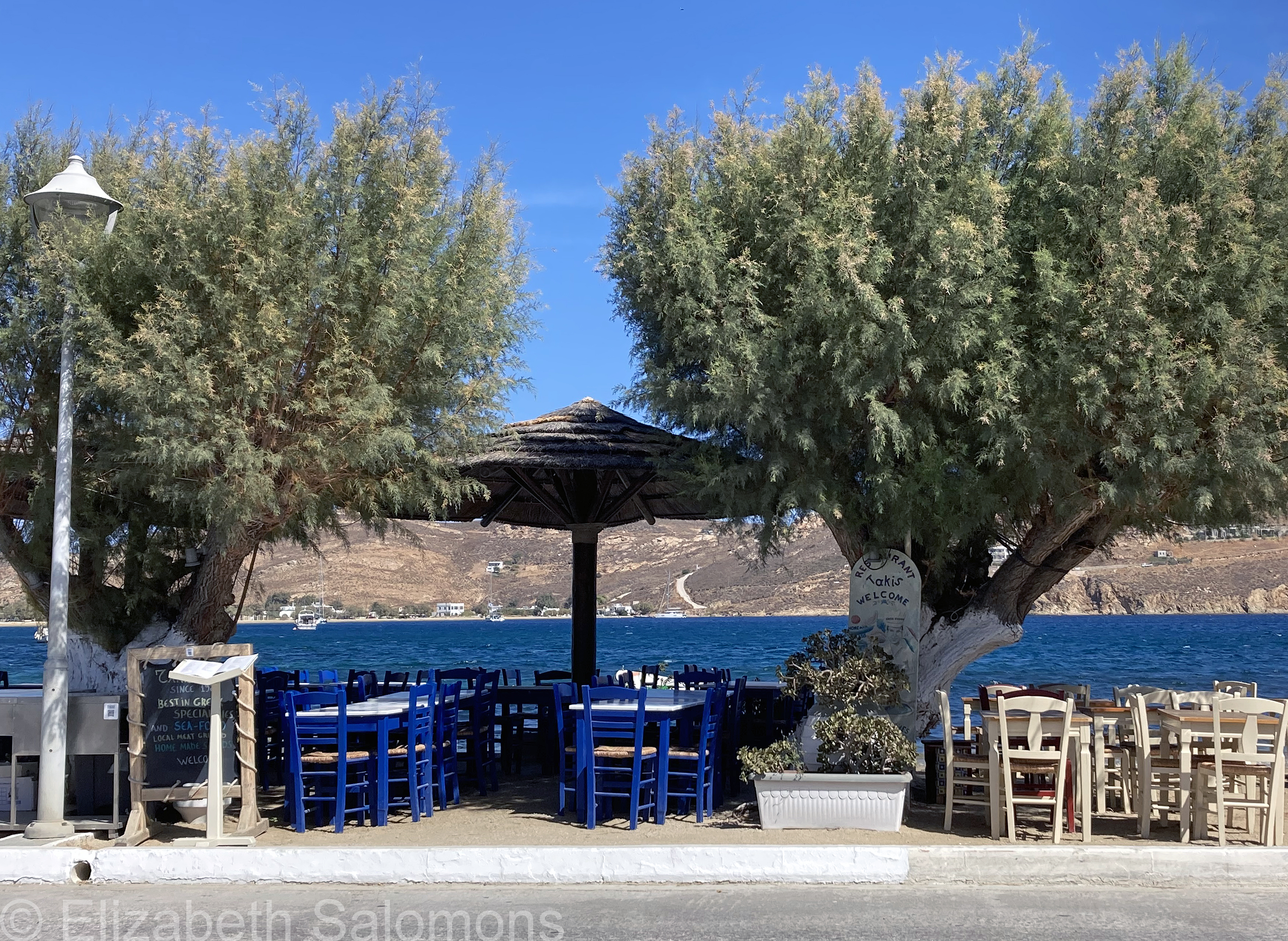
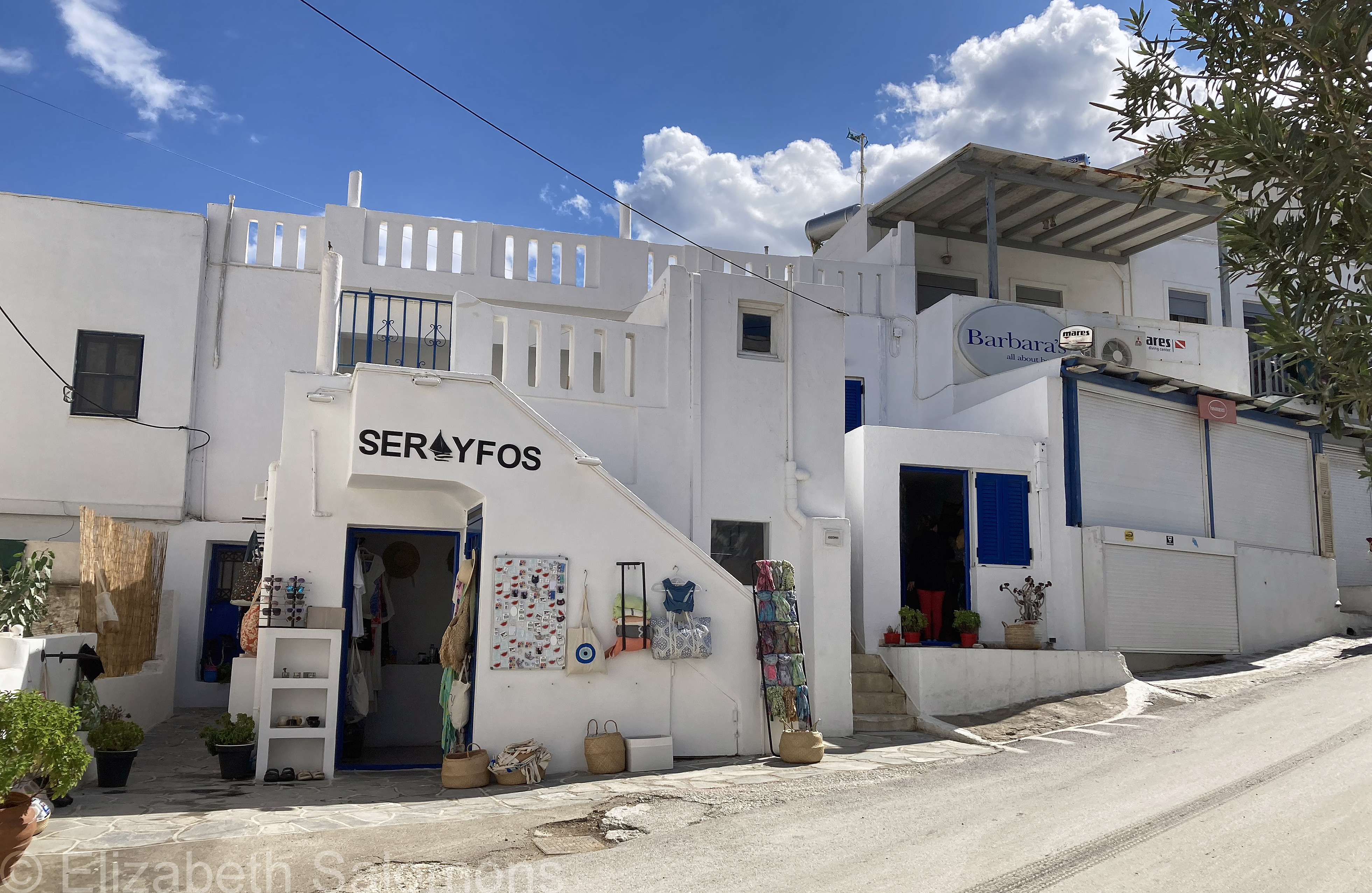
Much further down, a smattering of pensions and hotels. Beyond the waterfront, a few narrow streets lined with more stores and businesses.
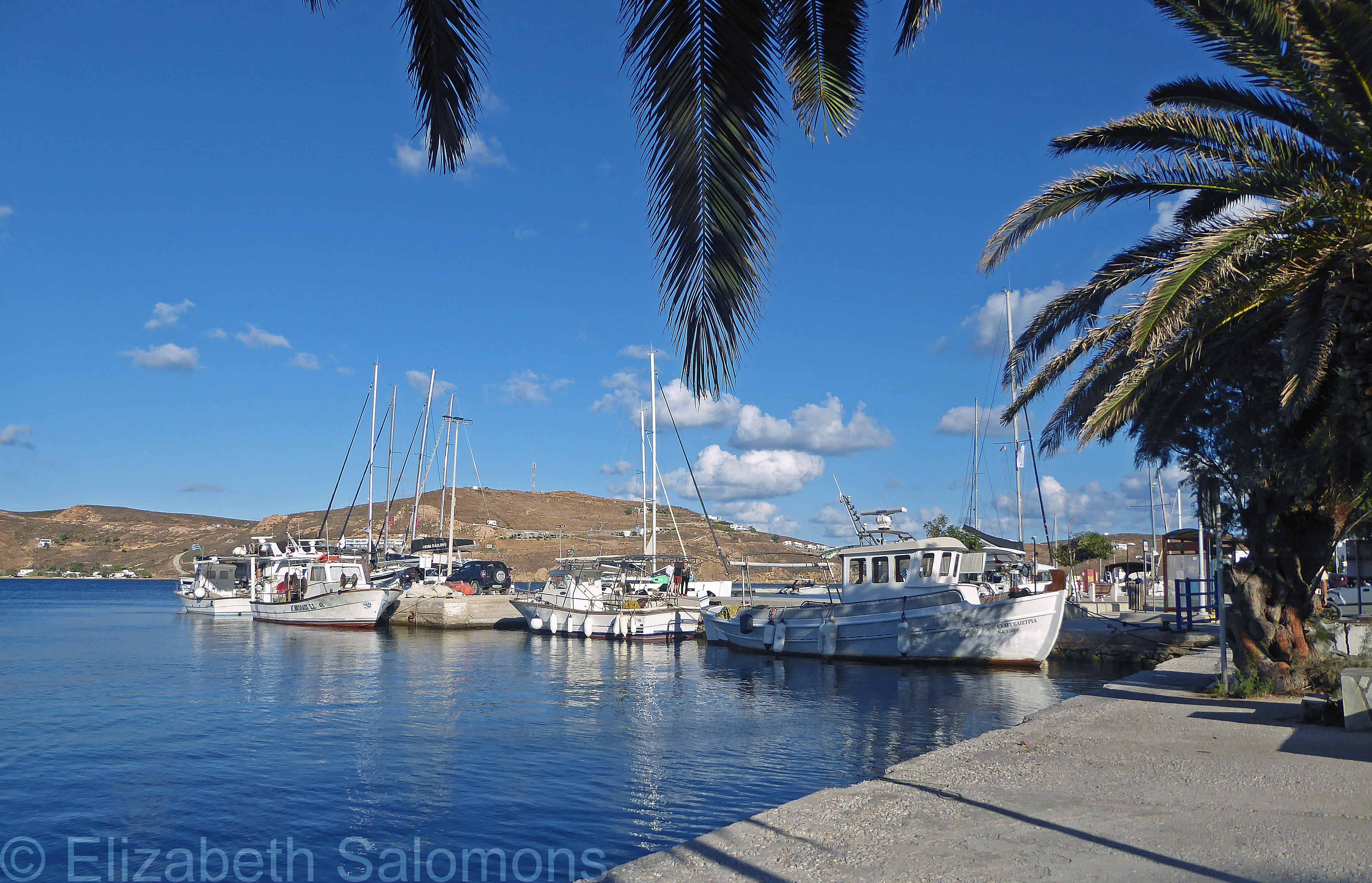
Oh, and a marina. It’s popular with live-aboard sailors cruising the Aegean; they spend their days exploring the bays of Serifos and moor their yachts at the marina overnight just in time to go find some dinner.
And that’s Livadi (lee-VAH-thee). It definitely feels more like a sleepy beach town than the largest town and economic hub of Serifos. I suspect it’s much busier at the height of summer, but I quite liked its pace in late September.
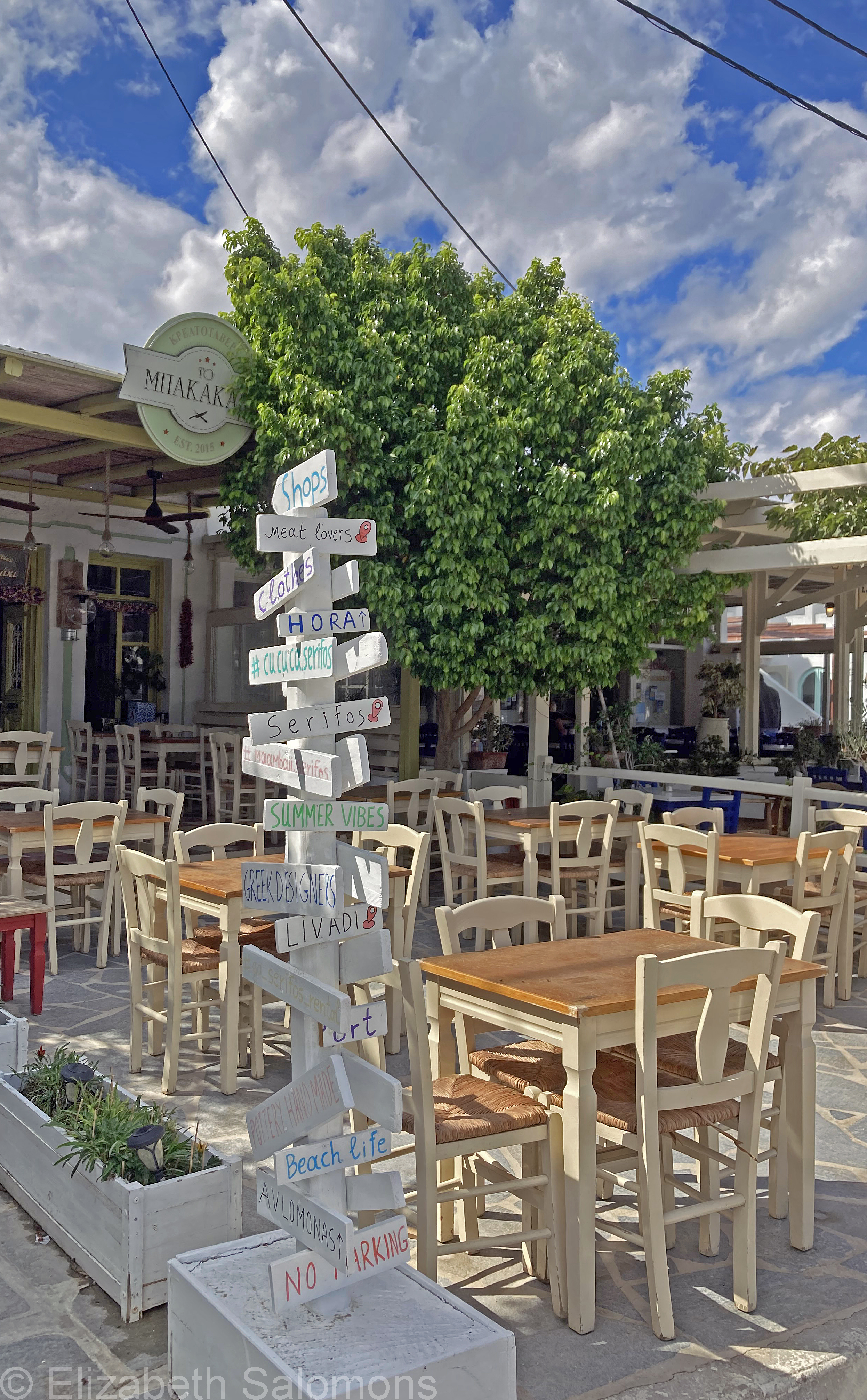
I didn’t come down to Livadi every day, but it was where I came to get my groceries and it has the island’s only ATM. I’d usually plan to have a meal while there, too.
Because there is nothing like eating seafood along a Cycladic waterfront to make you feel like you’re on holiday.
Following My Nose Through the Chora of Serifos
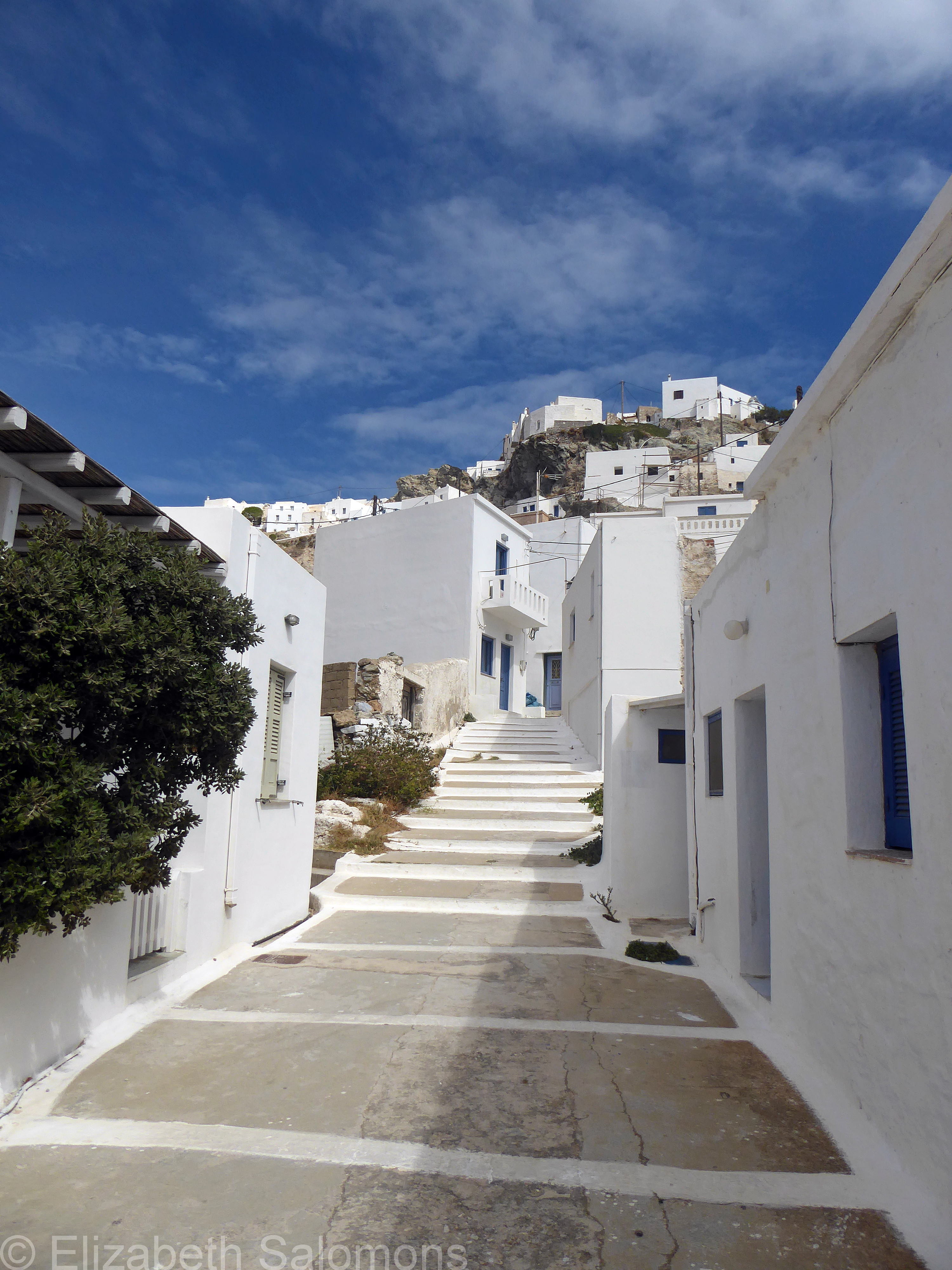
My first full day on Serifos, I walked out my door and followed my nose through the Chora. Did you know the word “labyrinth” comes from the Greek word laburinthos? Apparently Cycladic towns were traditionally built with meandering passageways to thwart the pirates that plied the Aegean back in medieval times.
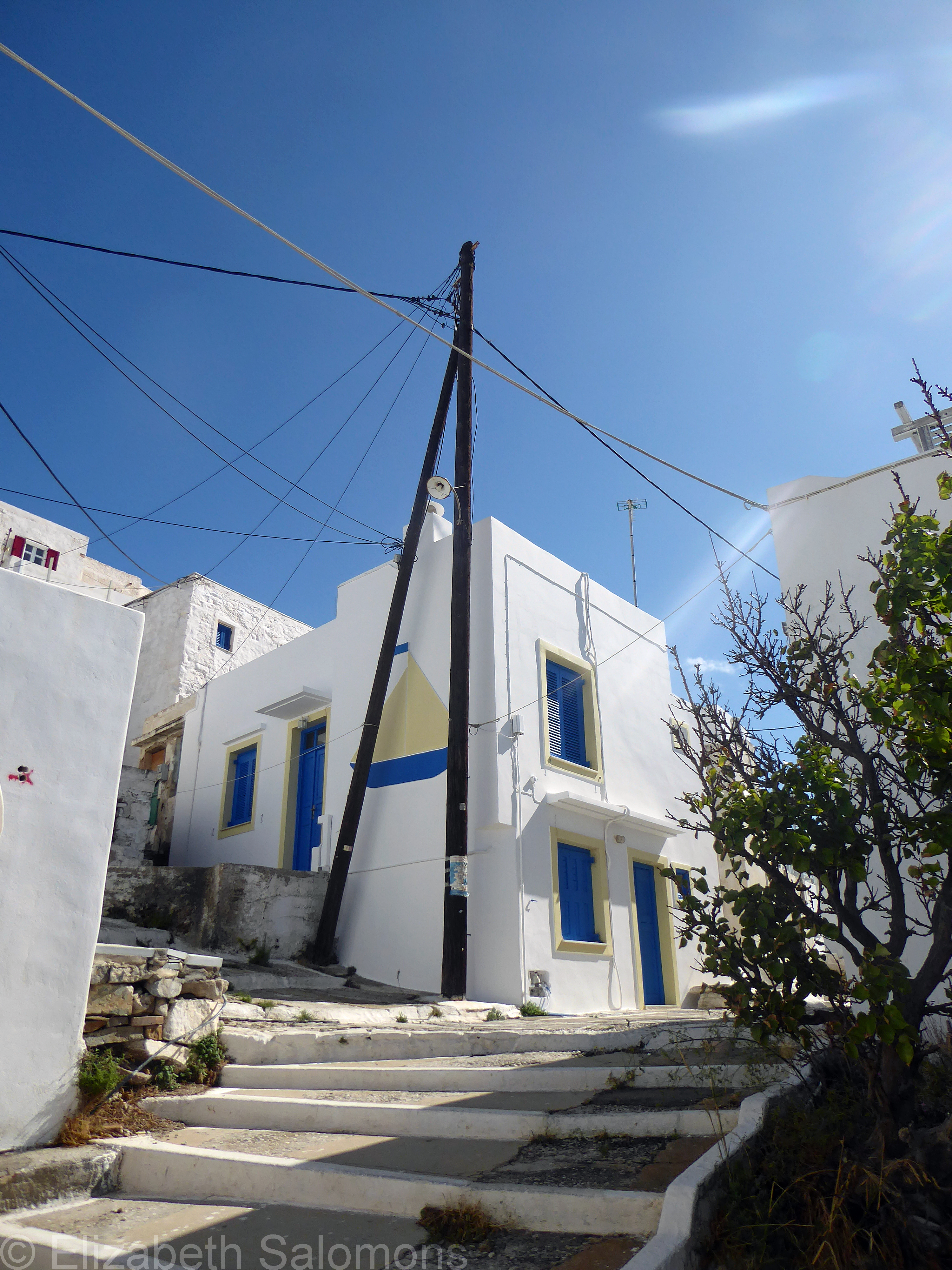
I can believe it. I never walked the same route twice in my wanderings through the Chora — and I promise you I couldn’t have if I tried.
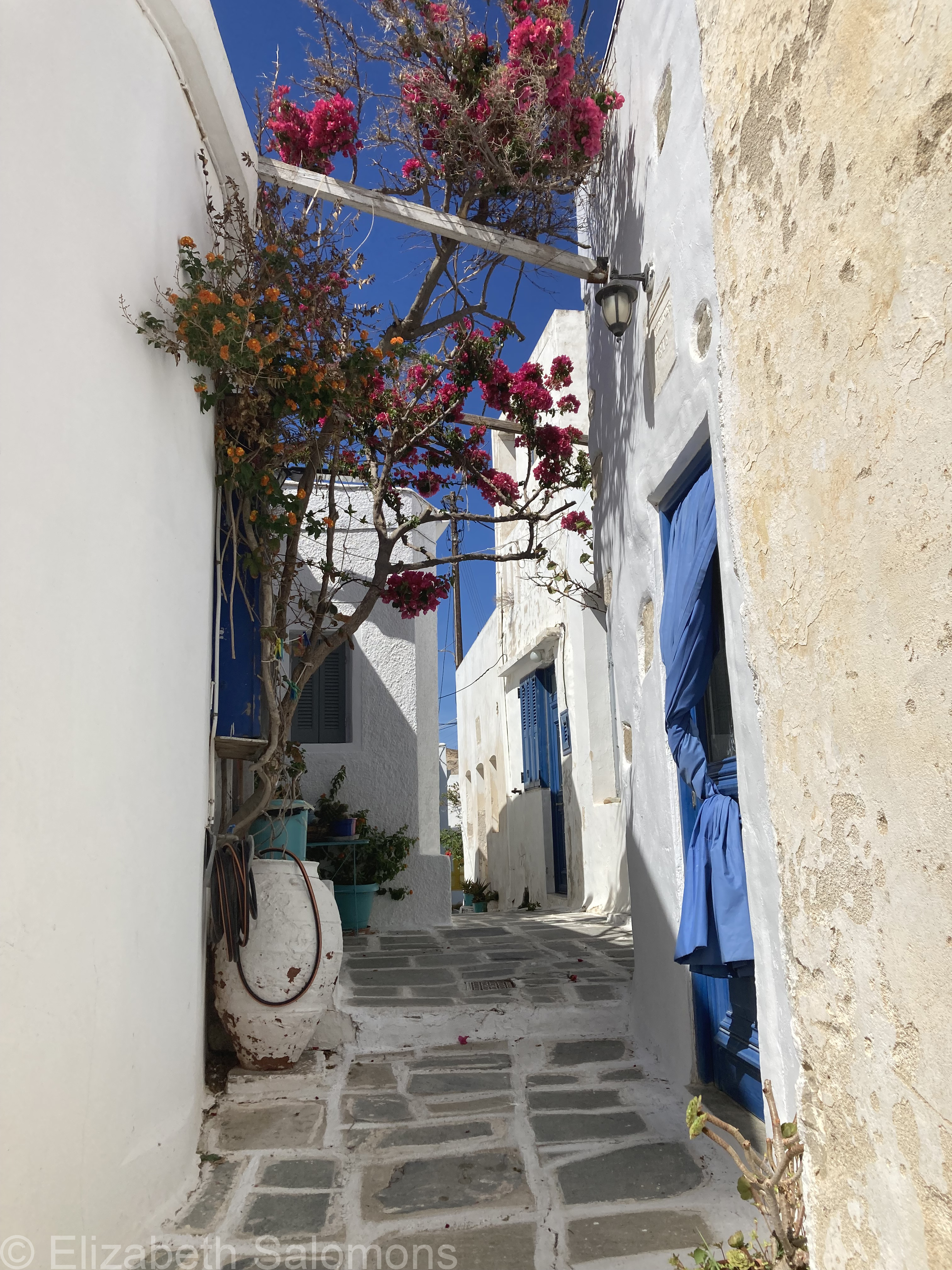
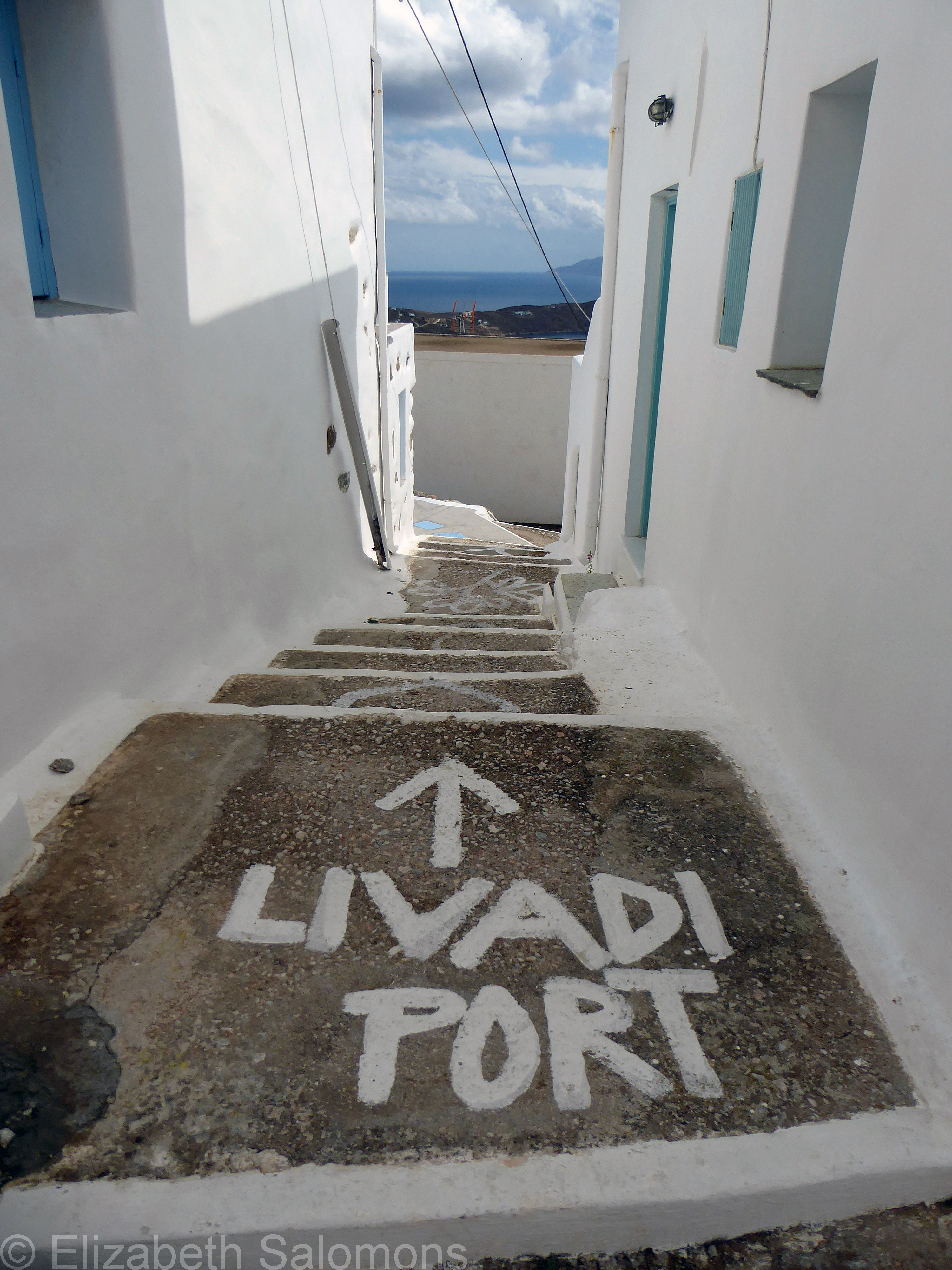
On this first day, I was looking for the main square I knew was up there somewhere. Signs scribbled on whitewashed walls with arrows that read “top” or “kastro” were helpful — I told myself if I kept walking up, I’d get there eventually.
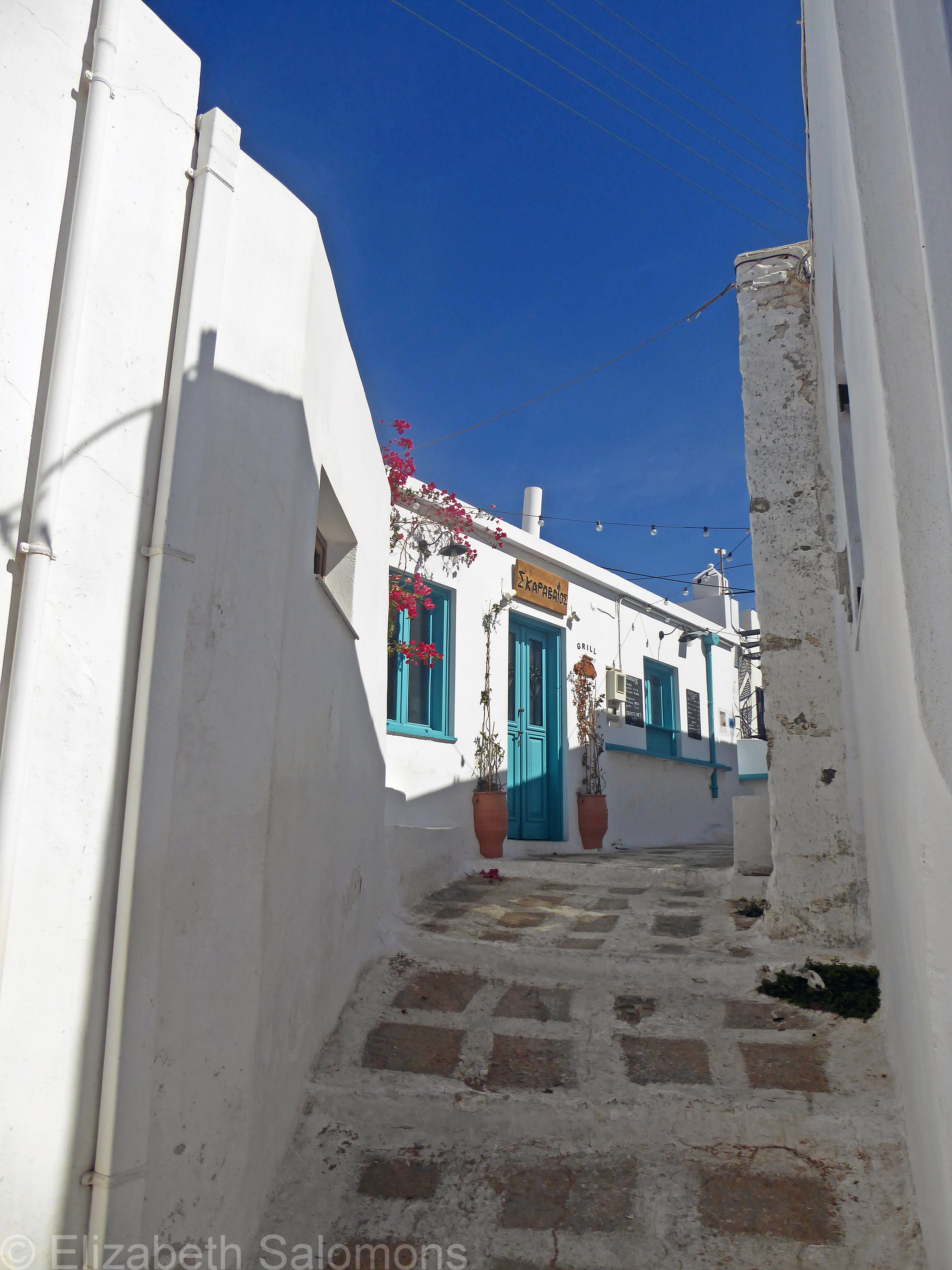
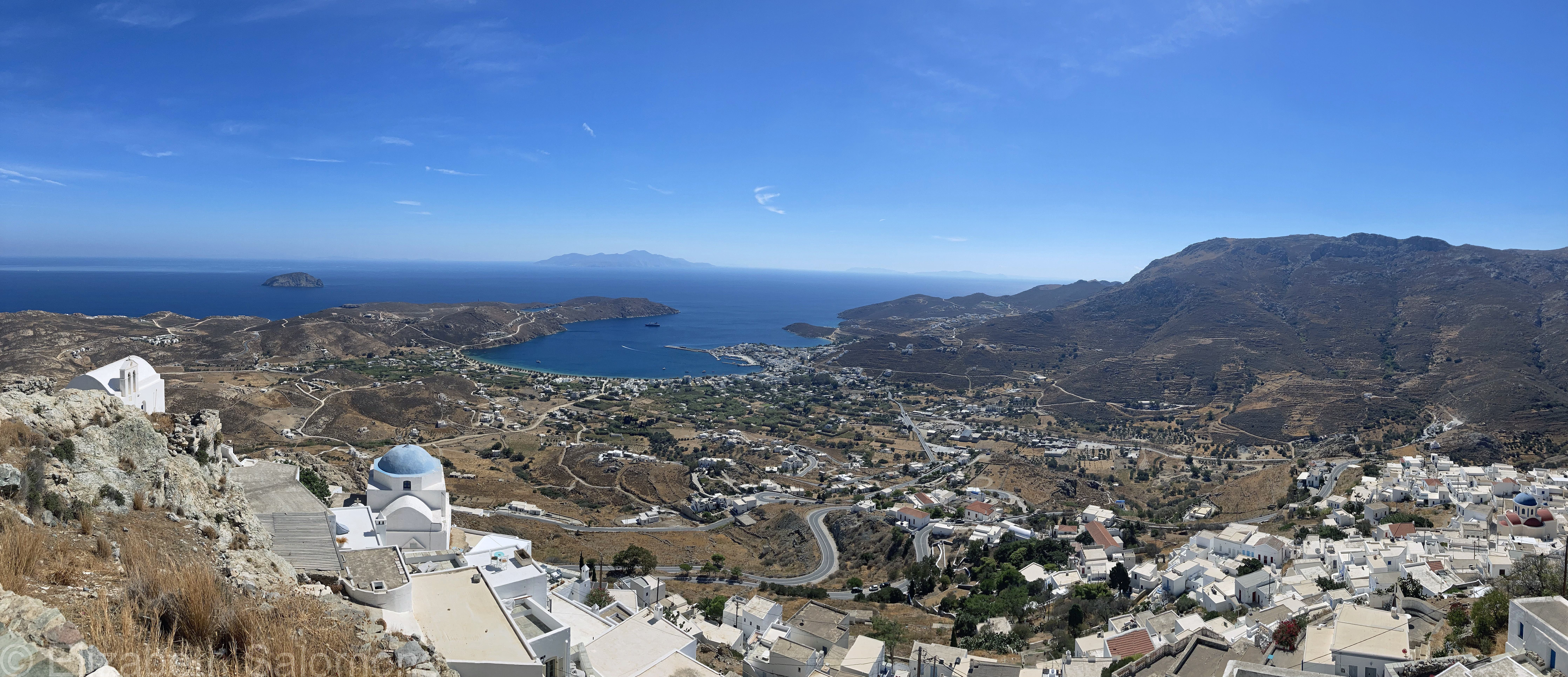
Turns out kastro is Greek for castle, which was built in 1434 by the Venetians (again, to protect the islanders from pirate raids). Only the ruins remain, but what a view!
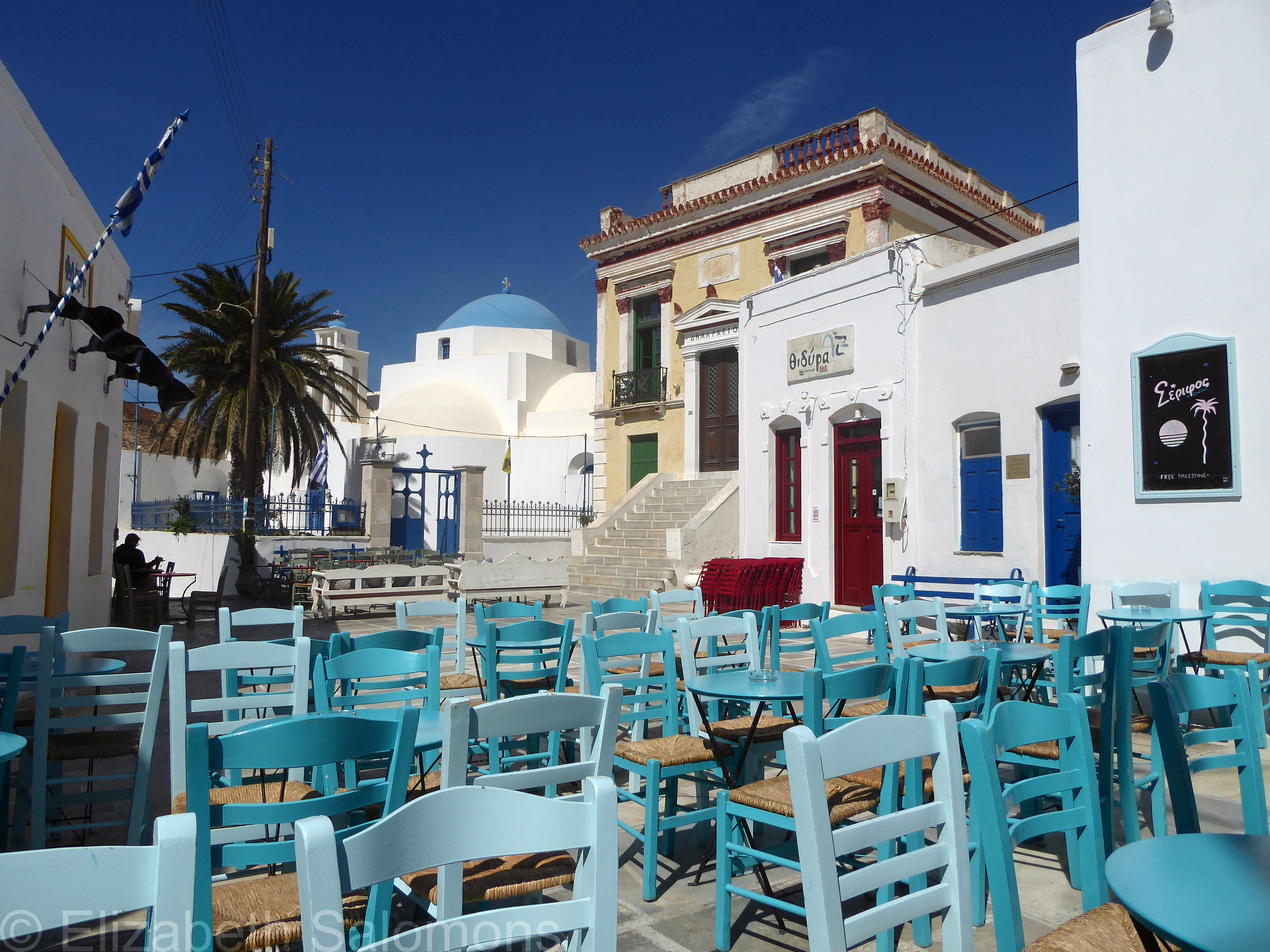
I had to backtrack a bit to find the main square I was looking for as it was not quite so high. Called Pano Piatsa, it was much smaller than I was expecting it to be. It’s also the only open public space in the Pano Chora (again, blame those pirates). The yellow building is the town hall and was built in 1908. There are a handful of restaurants and shops, but given the time of year I was there, every time I walked up to Pano Piatsa, another one had shut up for the season.
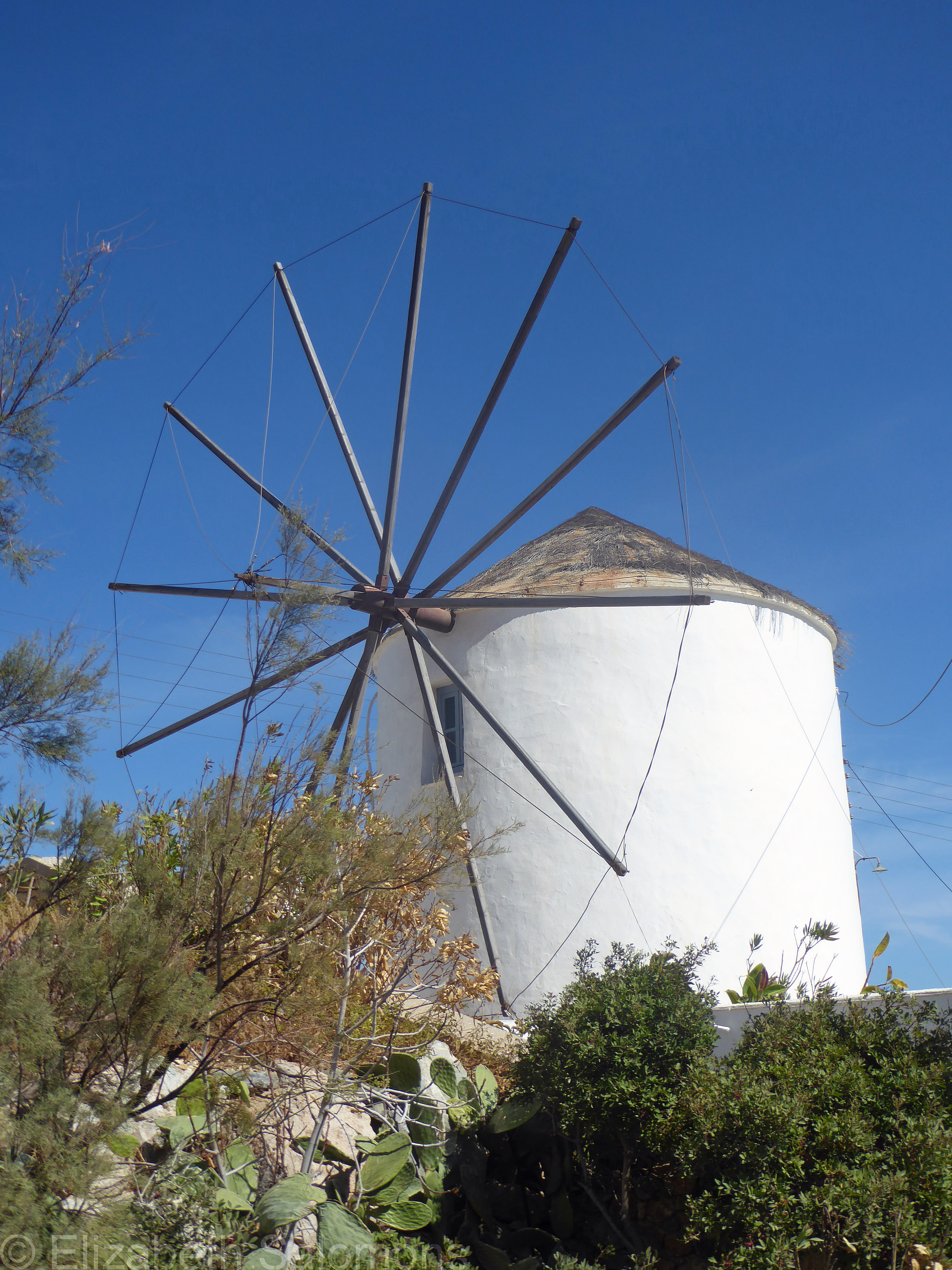
Further on from Pano Piatsa are three windmills still in pretty good shape.
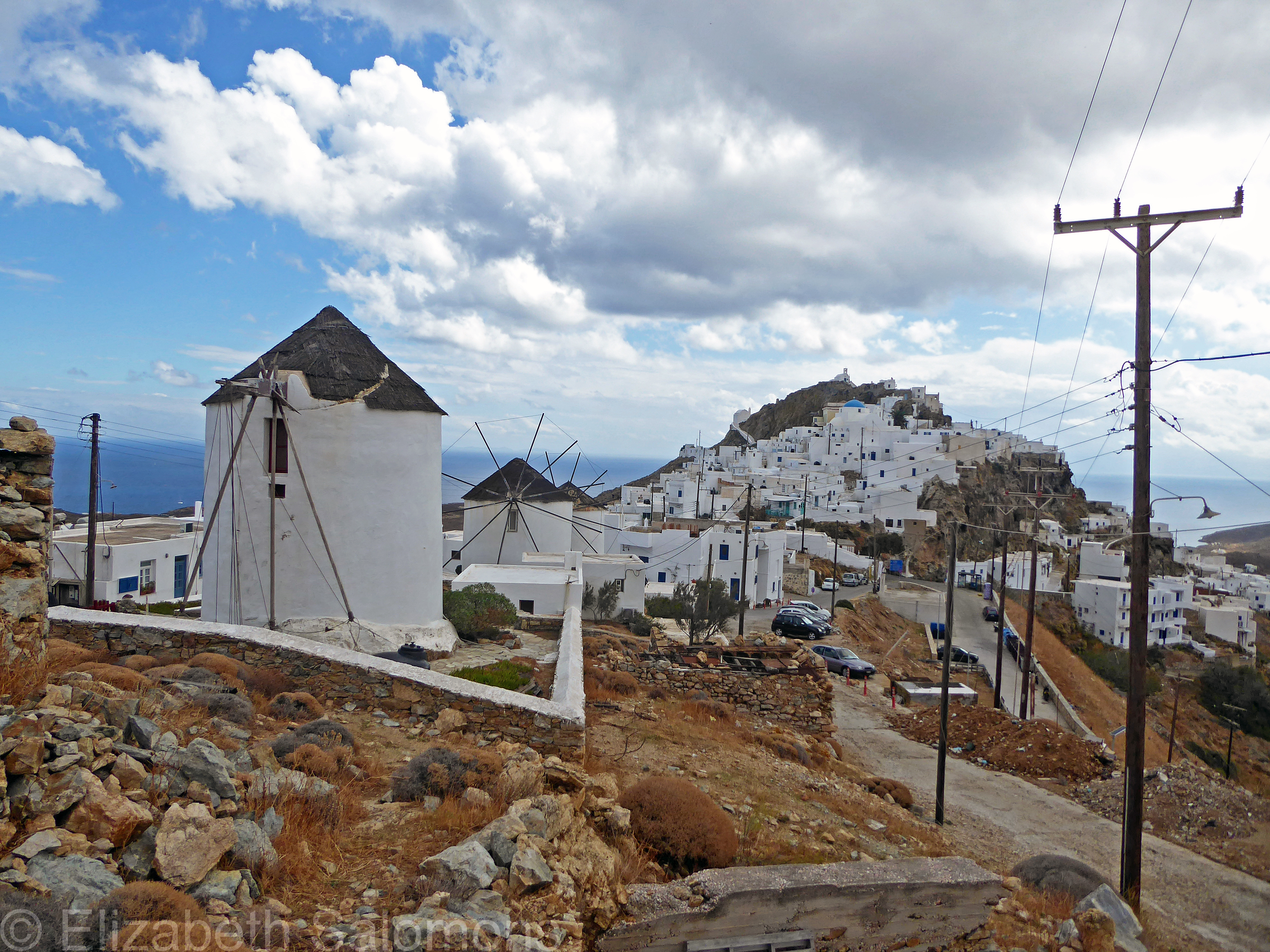
At one time, there were eight, all built to grind grain into flour.
Why are so many places in Greece named Chora, you may well wonder? It’s because it’s the Greek word for “town.” Typically, the first or biggest settlement on an island is referred to as the Chora.
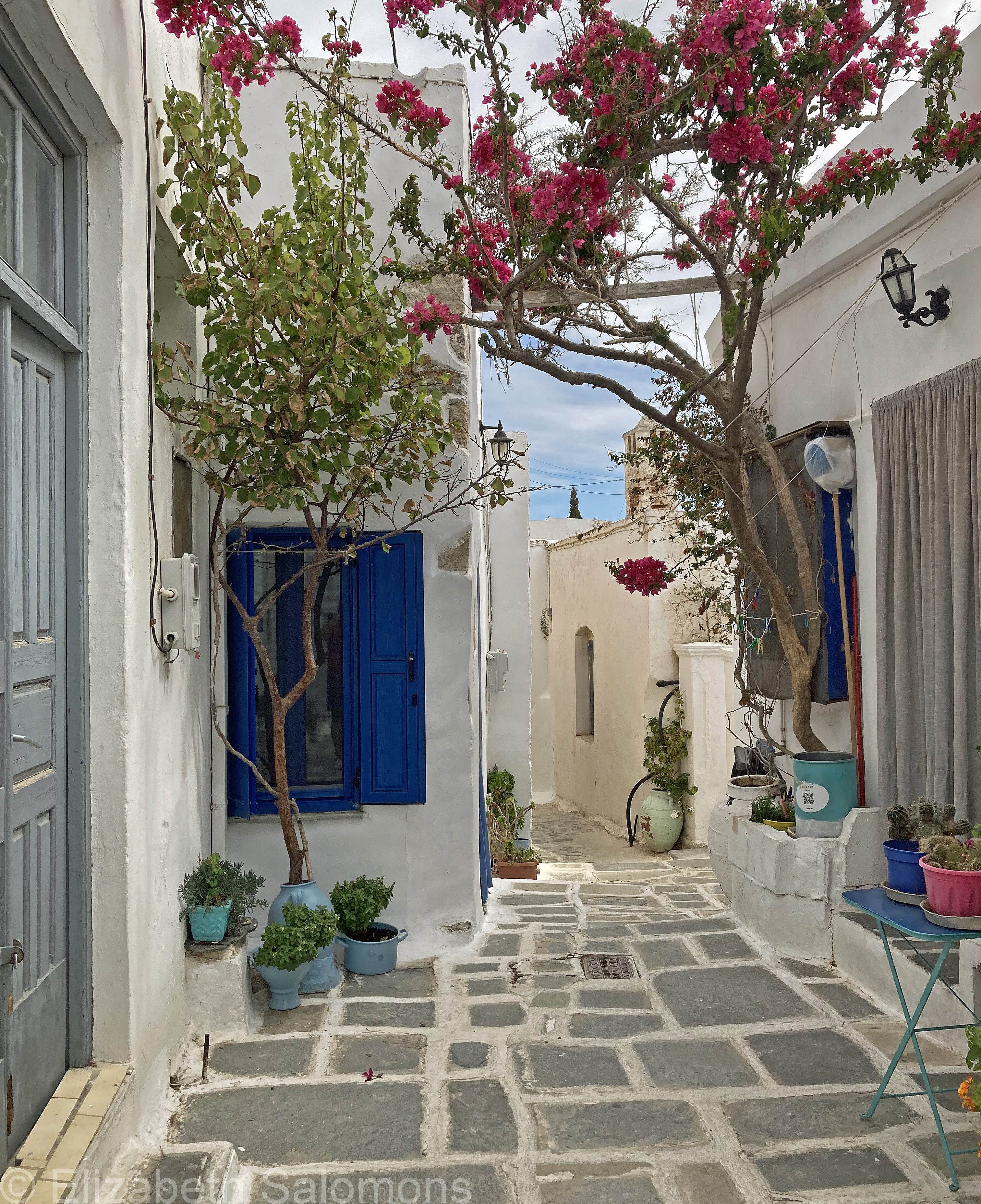
On Serifos, the Pano Chora (upper town) is the oldest part of the town; I was staying in the Kato Chora (lower town).

Some say the Chora of Serifos is the prettiest in the Cyclades. Who am I to argue?
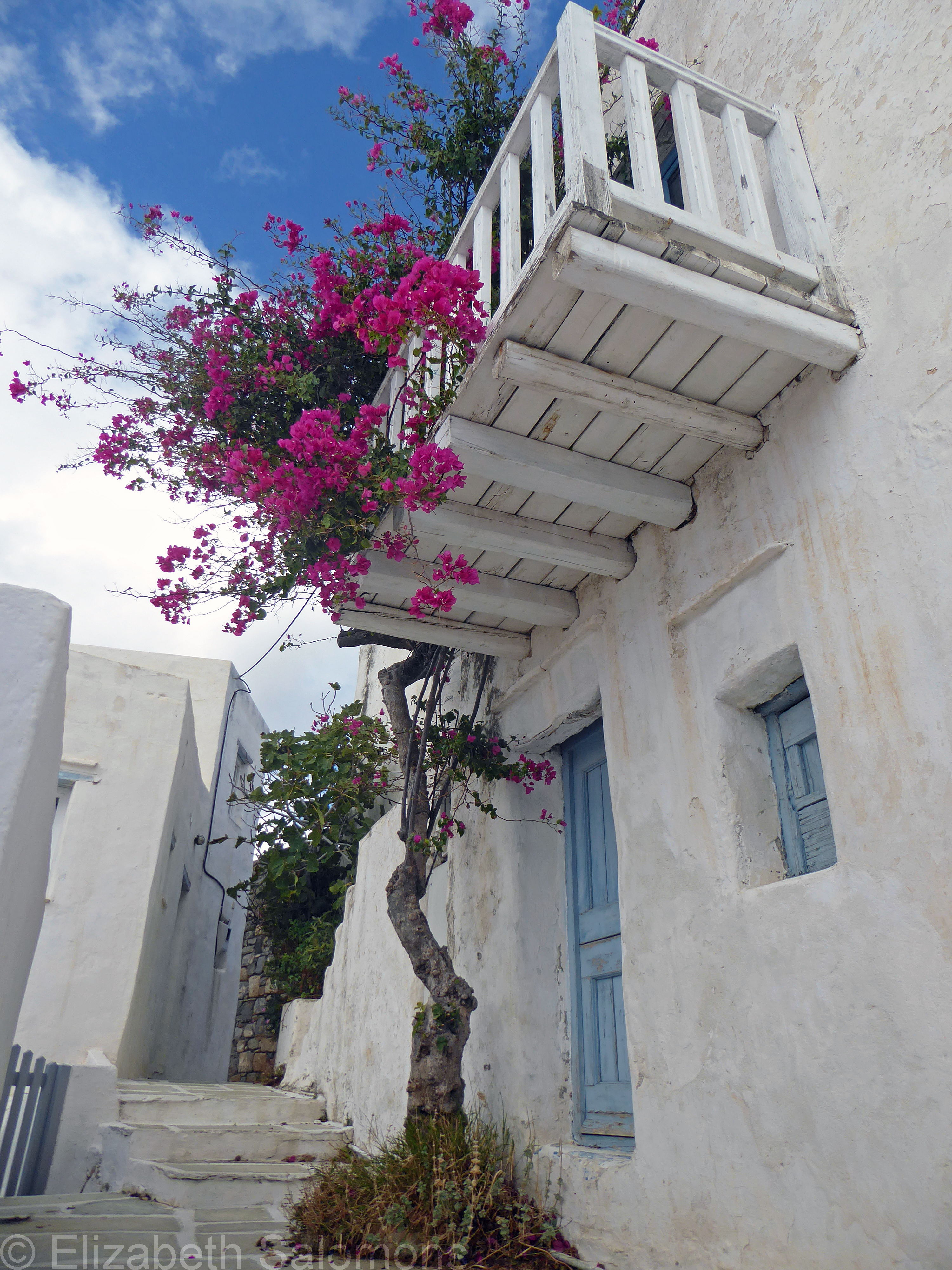
It felt special, living right in the Chora like I did. But most of the island life took place at Livadi. I was off to explore that next.
From Vancouver to Serifos
When I told people I was going to spend two weeks on a Greek island, their reaction was always, “Nice!” But when I told them I was going to Serifos, their reaction was always, “Where?”
Like most Canadians, they had never heard of the place. Nor had I, until I got a home exchange offer I couldn’t refuse.
Serifos is in the Cyclades, an island group in the Aegean Sea — the part of the Mediterranean that lies between Greece and Turkey.
It’s also a bit of a trek from here to there. First, a long-haul flight from Vancouver to Athens (via Heathrow), then a taxi ride from my Athens hotel to the Port of Piraeus, and, finally, a catamaran fast ferry to Serifos.
The fast ferries that ply the Aegean are nothing like our BC Ferries. Because they are fast ferries, there are no outer decks and my assigned seat was in the bowel of the vessel, nowhere near a window.

The port at Serifos, too, is nothing like the highly automated ferry docks that line the coast of BC. The ferry comes alongside the concrete pier for just a few minutes; there’s no dawdling when offboarding as a foot passenger.

But once I disembarked, it was a short walk to where my home exchange partner was waiting with her car. And not long after that, we were pulled over on the main road that goes between the port of Serifos to the Chora.
We got out of the car, I grabbed my bags, and she pointed up to a white house with green trim.
“See the solar panels on the roof?” she asked. I nodded. She had an appointment to get to, so we said goodbye and I made my way up the donkey path to my new (temporary) home.

It was a typical Cyclades house: small and square, white on the outside, cool on the inside, painted door and shutters.

I was delighted by the welcoming committee.

A couple of hours later, I had decompressed from my journey, unpacked, and was wondering what to do next when my home exchanger messaged me. She was on her way back to Livadi — that was the name of the town by the port. Did I want a ride?

Yes, please.
When she asked where she could drop me, I said I hadn’t eaten since breakfast. She stopped the car in front of a restaurant she liked.
“Go sit at one of the tables by the water,” she said. “They will come to you.”

And so I enjoyed my first meal of many on Serifos, overlooking an idyllic scene and marvelling at how long it had taken me to get here, literally and figuratively.
And relishing the thought that I had two whole weeks to explore the place.
Changing of the Guard
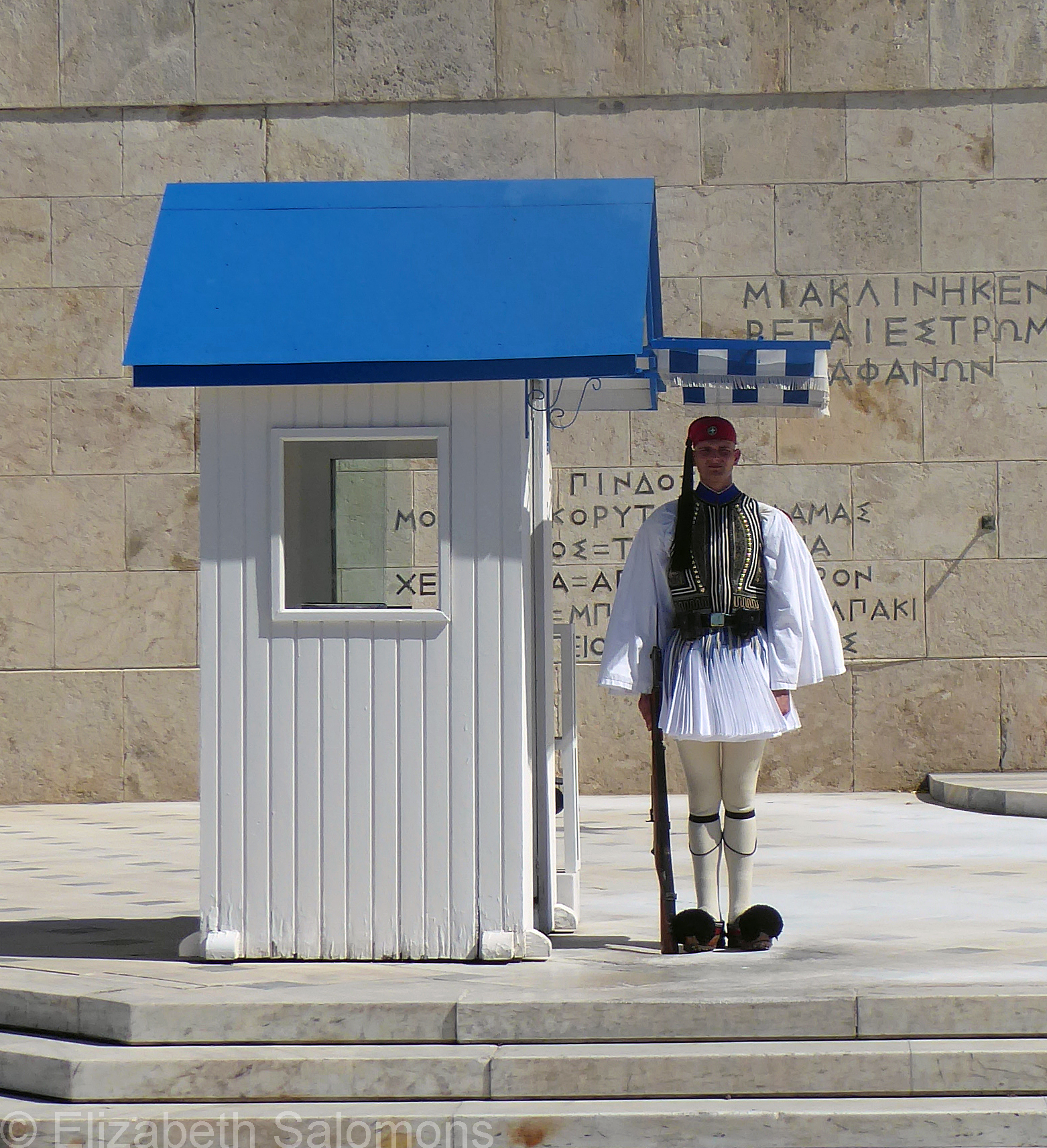
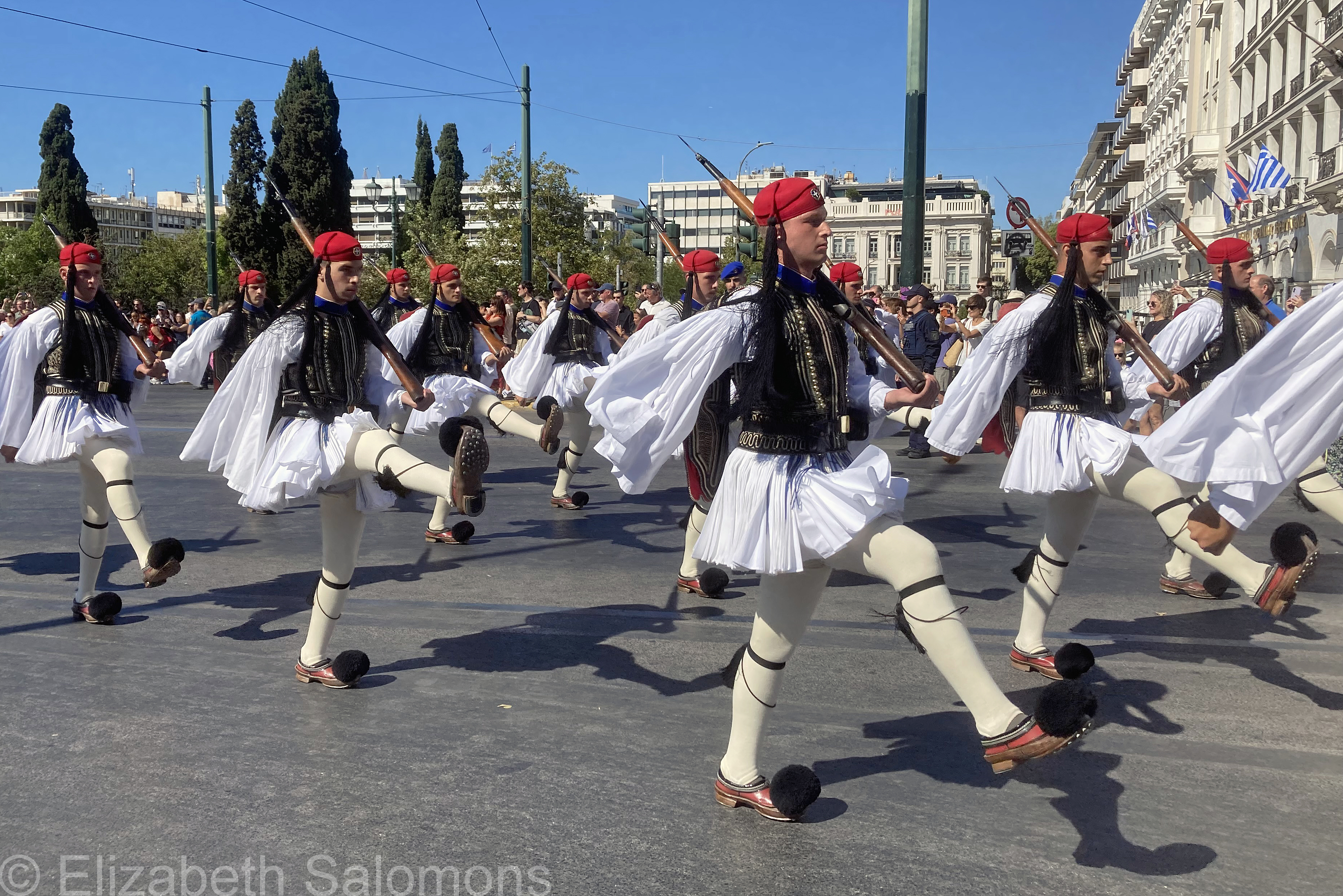
Despite a past-midnight arrival all the way from Vancouver the night before, on my first morning in Athens, I hoofed it up to Syntagma Square to see the changing of the guard outside the Greek Parliament. A small ceremony takes place hourly, but on Sunday mornings, there is a more elaborate ceremony with an entire platoon taking part and I was keen to see it.
Truth be told, I can’t resist a fine uniform. Or a marching band.

The unique uniform of the Greek Presidential Guard has its origin in those worn by the soldiers who liberated modern Greece from the Ottomans. Officially adopted in 1867, they take six months to make (stitched entirely by hand) and one hour to put on. The skirt has 400 pleats, representing the number of years that Greece was under Ottoman control. The white colour of both skirt and shirt symbolizes the purity of Greece’s struggle for independence.
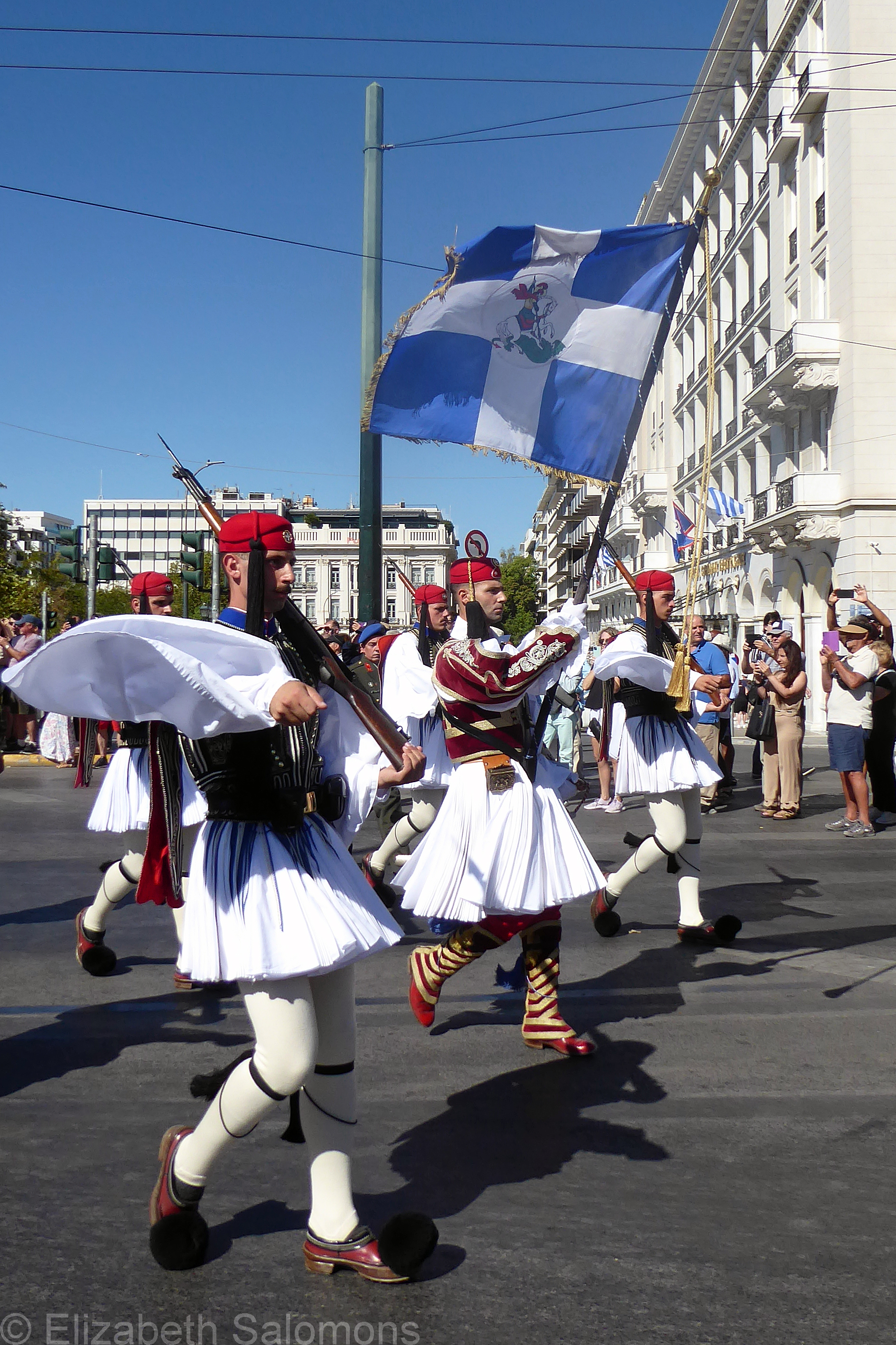
The vest takes the most time to make as it involves intricate embroidery. The red cap symbolizes the blood spilled by the soldiers, and the black tassel symbolizes the tears shed in mourning. The shoes are handmade and based on footwear worn since Byzantine times. The distinctive pompom was originally added to help make the toe waterproof.
A bit of Google research gave me tips as to where to stand to get the best photos. When the crowds got to be too much for me, I wiggled my out and found a spot alongside the street I knew the soldiers would leave by.
I got lucky. Right place, right time.
The Acropolis
Since every time I turned around in Athens, I saw the Acropolis, it was only a matter of time before I got up close and personal.
The Acropolis is a sprawling complex of ruins that sits up high on a rocky plateau overlooking the city. Its name says it all: the word comes from the Greek akron (high point) and polis (city).
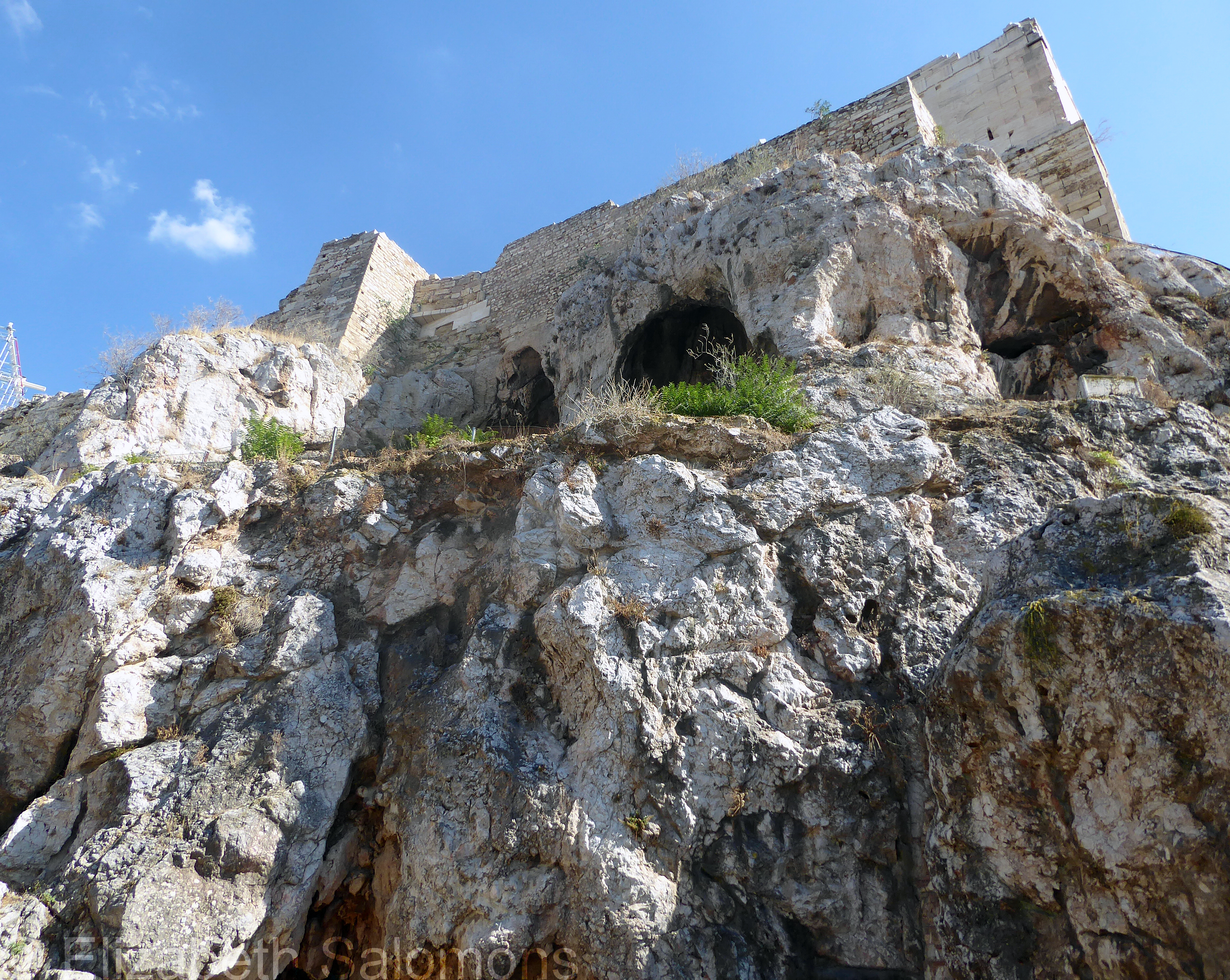
The first fortifications went up in the thirteenth century BCE and had a military purpose; around eighth century BCE, the site shifted to a religious focus dedicated to Athena, the goddess of Athens. A massive building program undertaken in the fifth century BCE resulted in the structures that have showcased ancient Greek’s architecture and art ever since.
I came in by the southeastern entrance, where a switchback trail leads you slowly up the hillside (called the “slopes”), past many ruins that serve as a teaser for the main event.


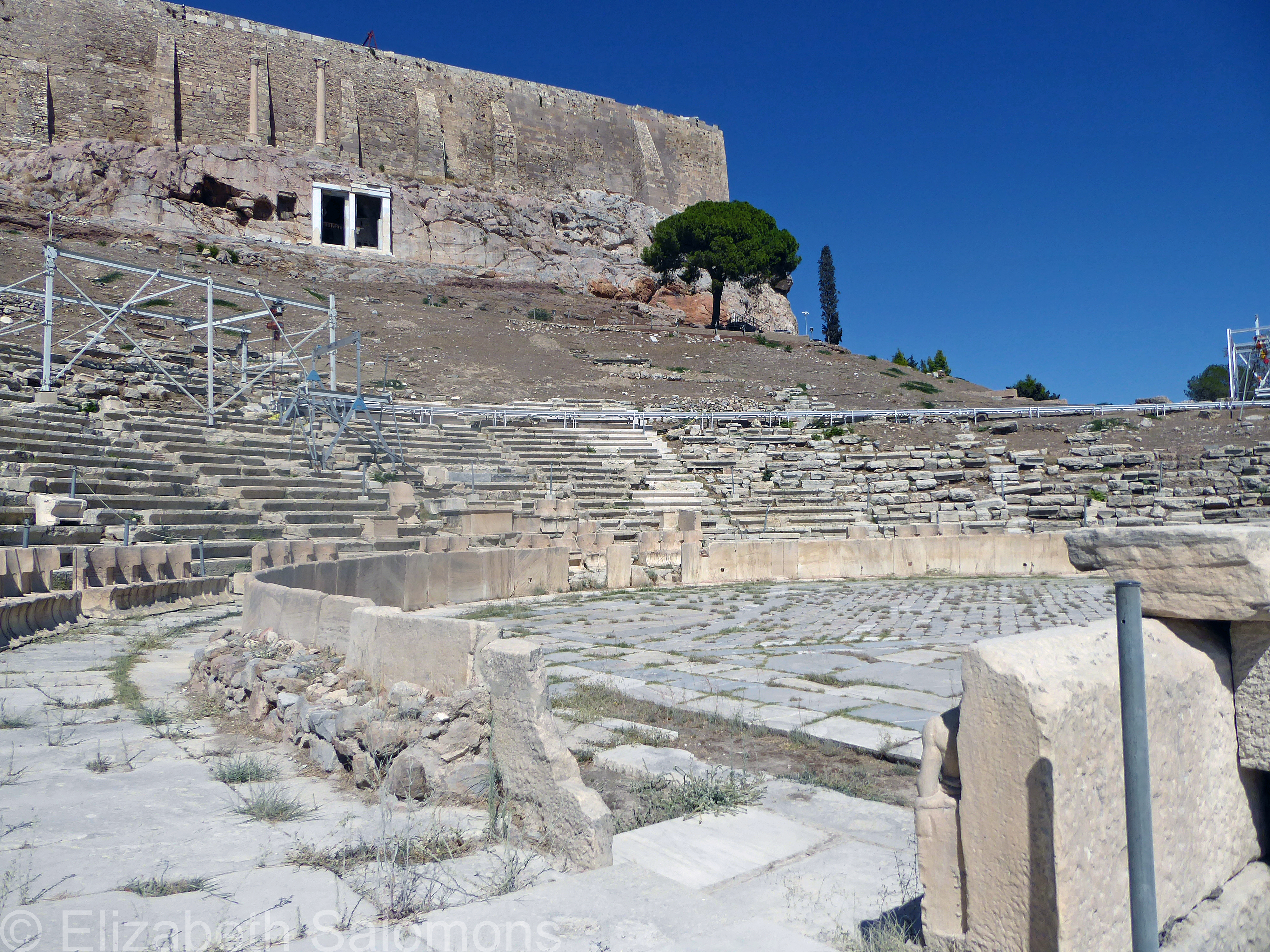
The Theatre of Dionysos is also located on the southern slopes. First built out of wood in the sixth century BCE, it was redone in stone and marble three hundred years later. It had room for 17,000 spectators seated in 64 tiers, of which 20 still survive.
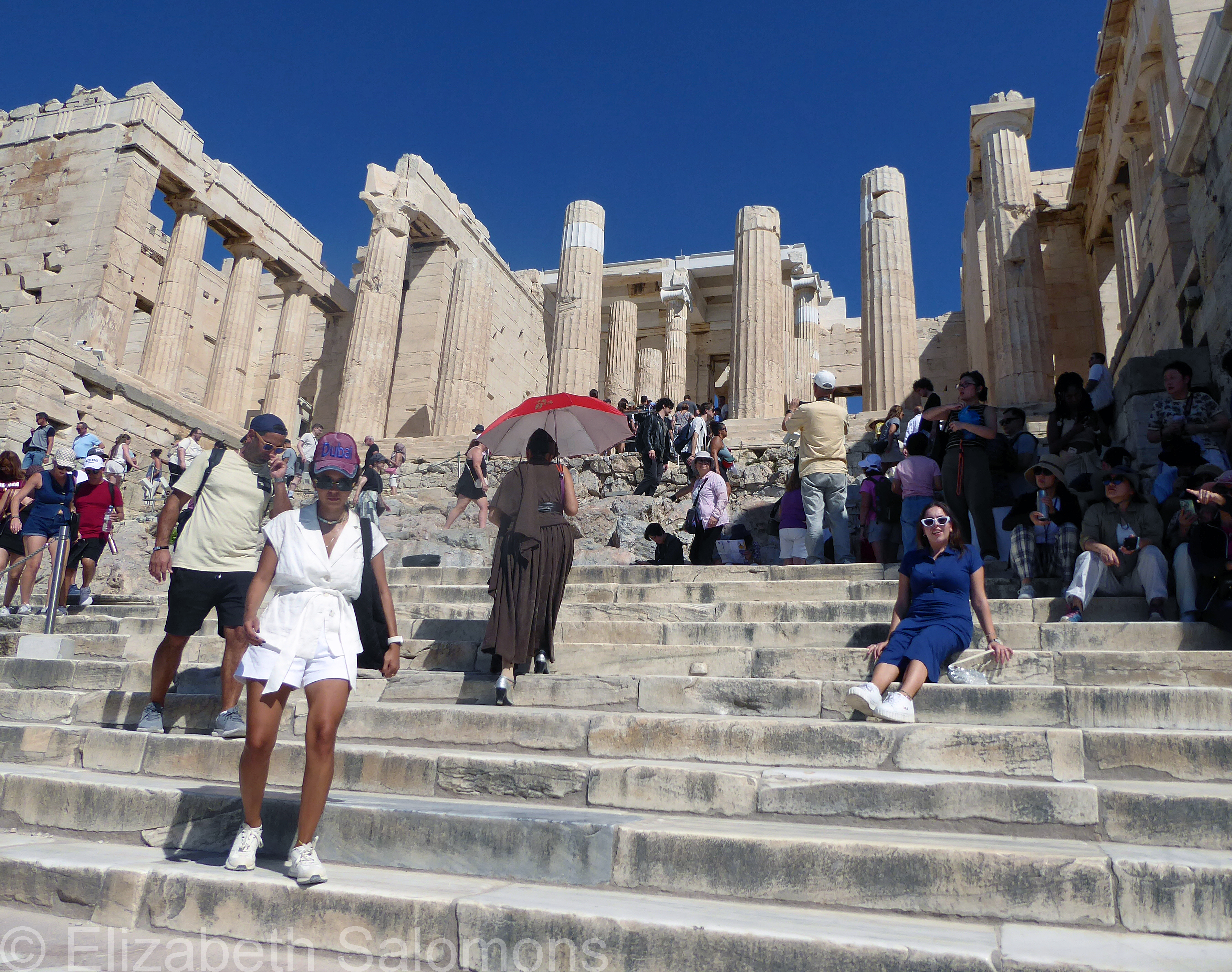
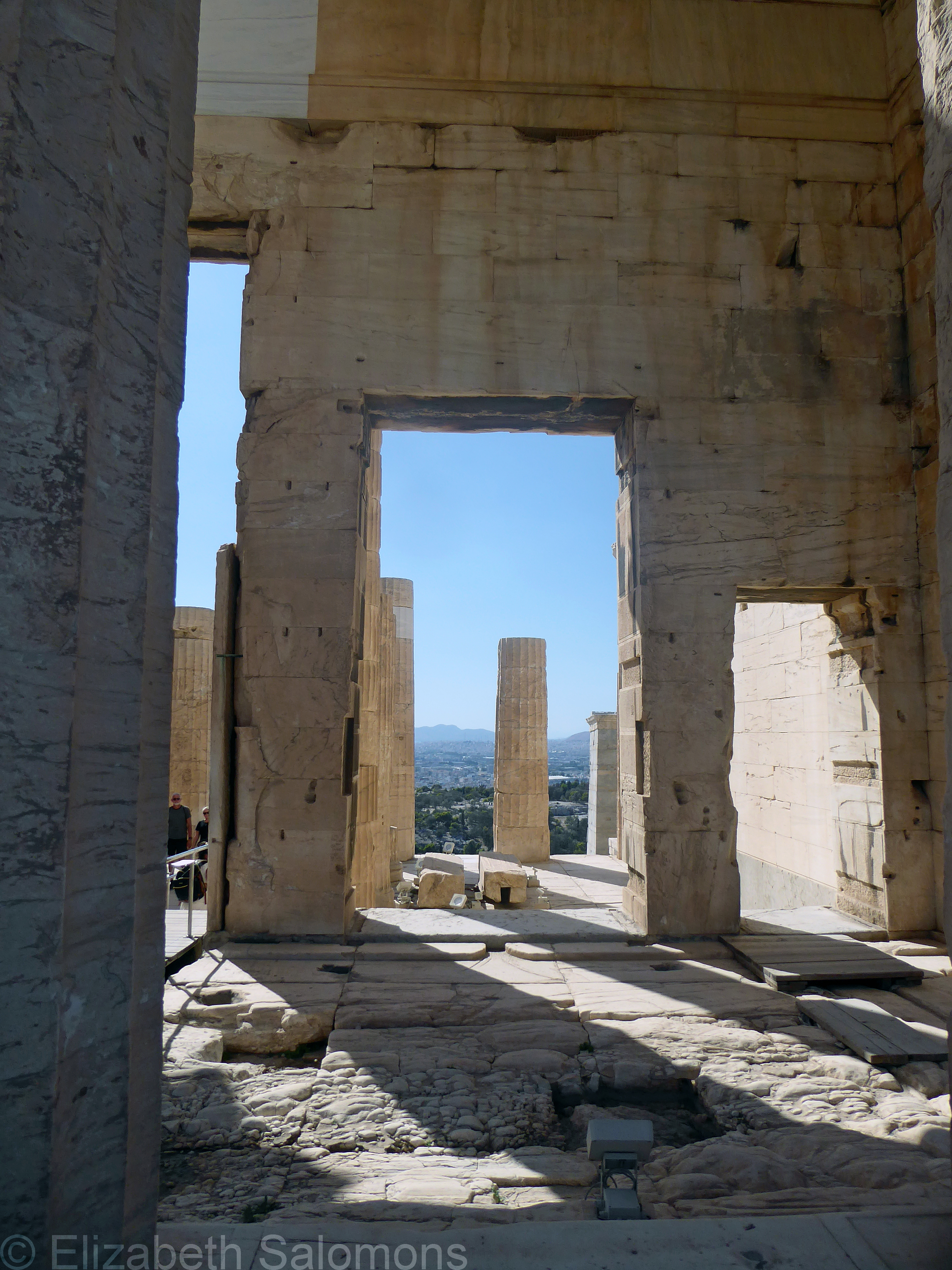
The Propylaea, built between 437 and 432 BCE, marks the entrance to the Acropolis. It was the only part of the Acropolis where I could not manage to get a photo without massive numbers of tourists.
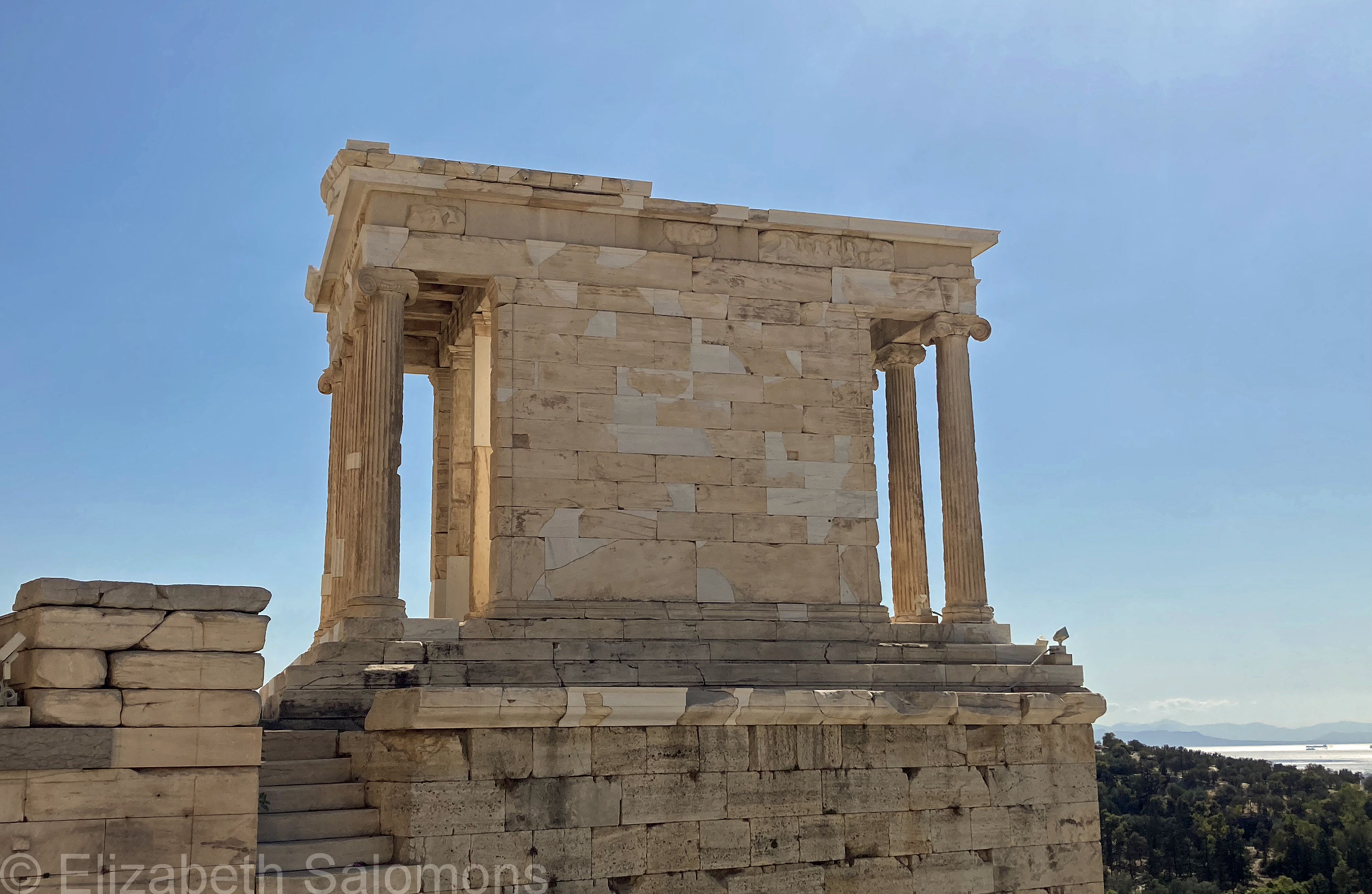
The Temple of Athena Nike (Athena as Victory) was completed in 425 BCE. It stands slightly before the Propylaea.
The Temple of Athena Polias (Athena of the City), or the Erechtheion, was finished in 406 BCE. This Ionic temple was built on the holiest part of the Acropolis, where Poseidon (god of the sea) struck the ground with his trident, creating a spring, and where Athena (goddess of wisdom) planted an olive tree.

(Quick aside: Athena and Poseidon were competing to see who would be patron of the newly founded city-state. The water in Poseidon’s spring was salty and so the citizens chose the olive tree, which would provide them with food, oil, and shade. This made Athena the winner and gave the city its name.)
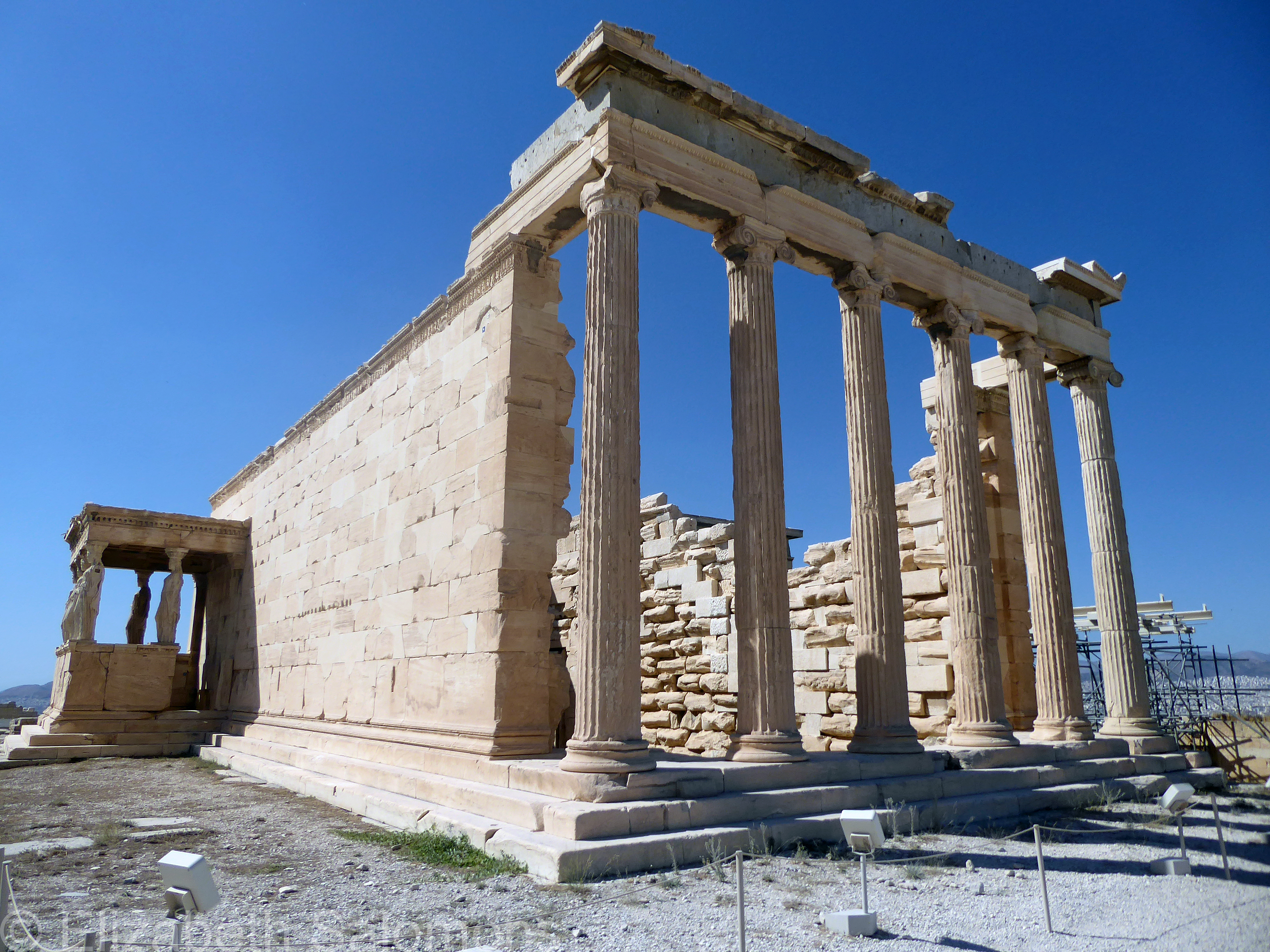
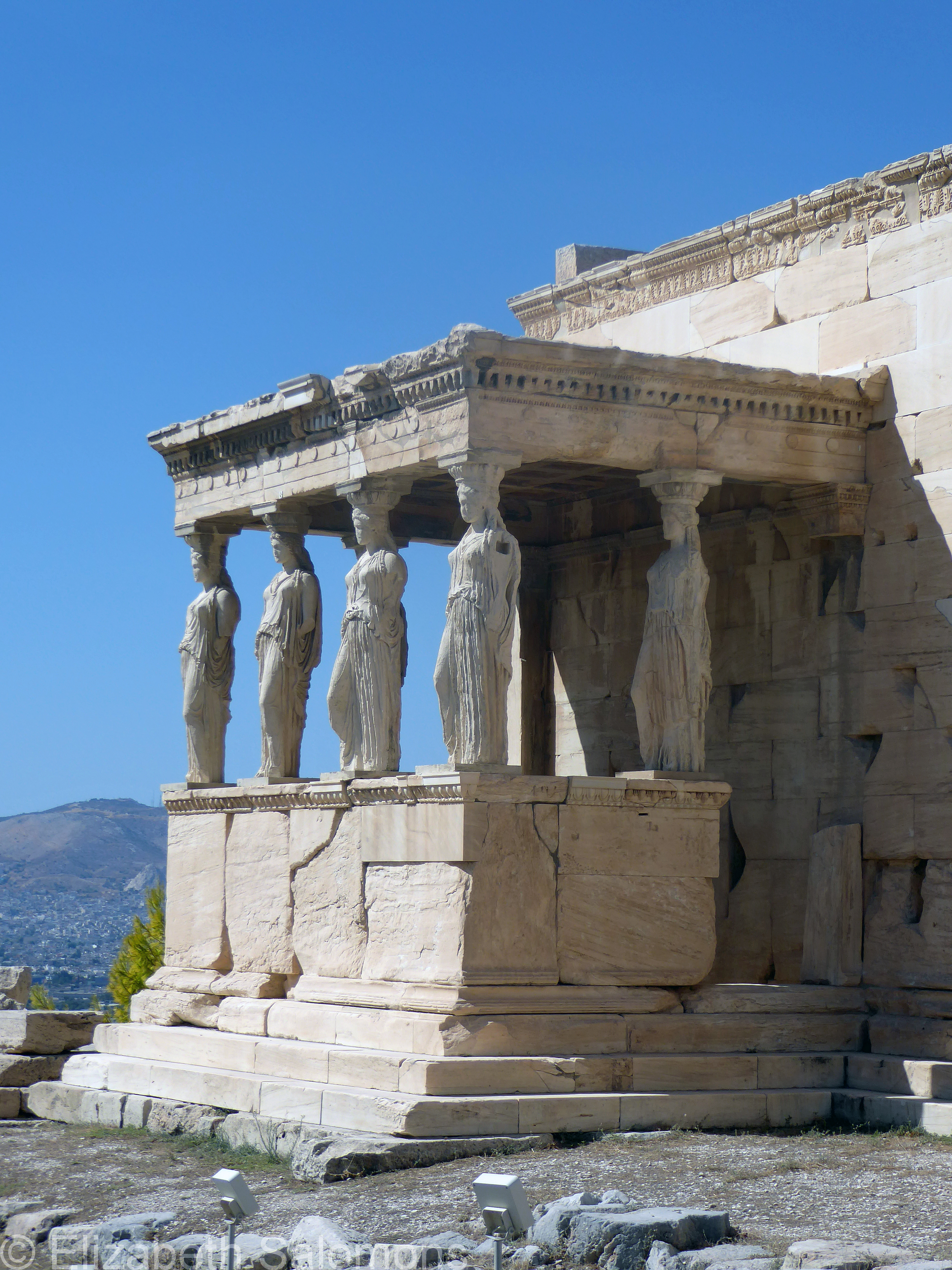
The six maiden columns of the Erechtheion, called the Caryatids, were completed in 415 BCE. The ones here are plaster replicas. Five of the originals are in the Acropolis Museum and the sixth is in the British Museum.
The largest structure on the Acropolis site is the Parthenon. This Doric temple, completed between 447 and 438 BCE, was dedicated to the goddess Athena Parthenos (Athena the Virgin). Its foundations are slightly concave and the columns slightly convex — an optical illusion that allows both to appear straight. When it was first built, its friezes were brightly painted.
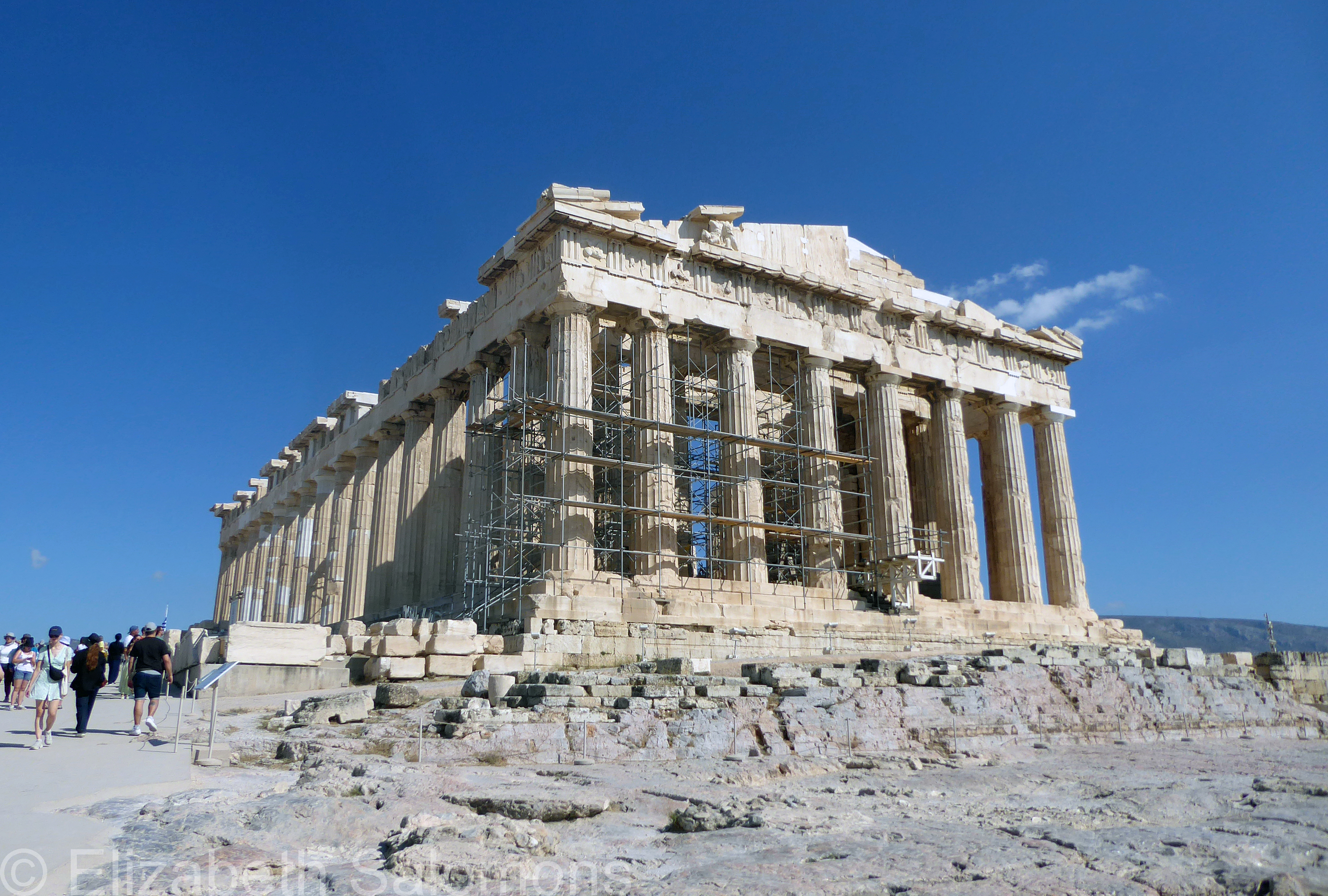
Sometime in the late third or fourth century CE, the interior of Pantheon was destroyed in a fire. In the sixth century CE, it was converted to an Orthodox church. In 1204, crusaders turned it into a Catholic church. When the Ottomans conquered Athens in 1458, it was converted to a mosque. And in 1687, when the Venetians held a siege of the Acropolis, a cannonball made a direct hit on the Parthenon. As it was being used as a powder magazine, the explosion destroyed the roof and much of its walls.
But the most severe damage to the Parthenon? That was between 1801 and 1812, when Lord Elgin carted half of its remaining sculptures off to England, along with sculptures from the Erechtheion, the Temple of Athena Nike, and the Propylaea. They remain there, displayed in the British Museum. The Greeks, naturally, want them back. The Elgin Marbles have been a source of tension between the two countries ever since.
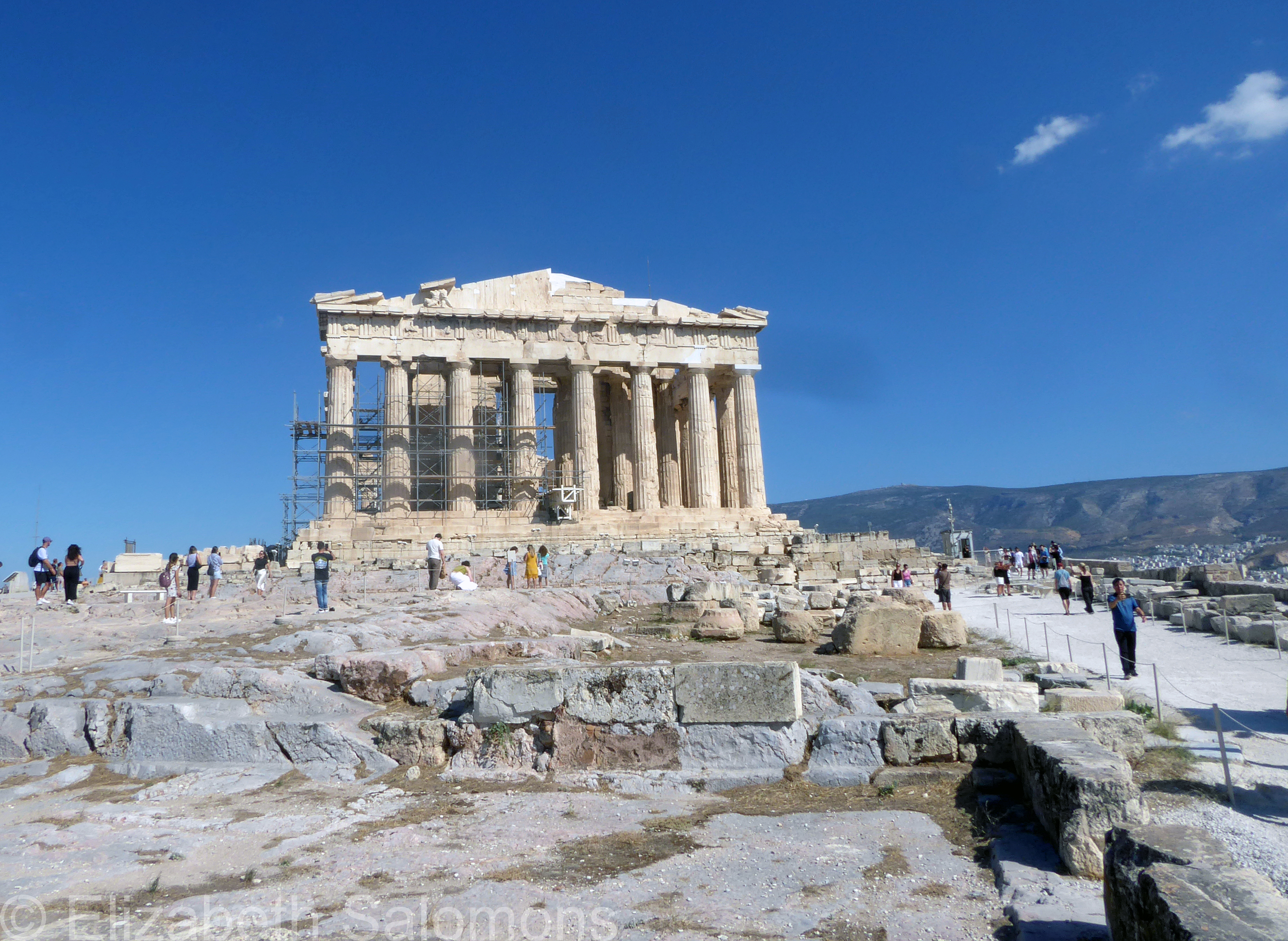
It doesn’t take long to walk through the Acropolis. I took my time, stretching my visit out to almost two hours (spent mostly waiting for people to move out of the frame as I took my photos), but you could speed through the entire complex in 30 minutes if you were in a rush. Bring plenty of water — it was hot, even in late September, and there’s no shade.
The Acropolis has been operating as an archaeological site since 1833, shortly after the establishment of the modern Greek state. It has always served as the religious and cultural centre of Athens, but it is also a symbol of the birthplace of democracy and the foundation of Western civilization. Yeah, no pressure there. Given the increasing fragility of democracies around the world (particularly noticeable this year, I might add), today seems like a good day to reflect on that legacy.
Merry Christmas!
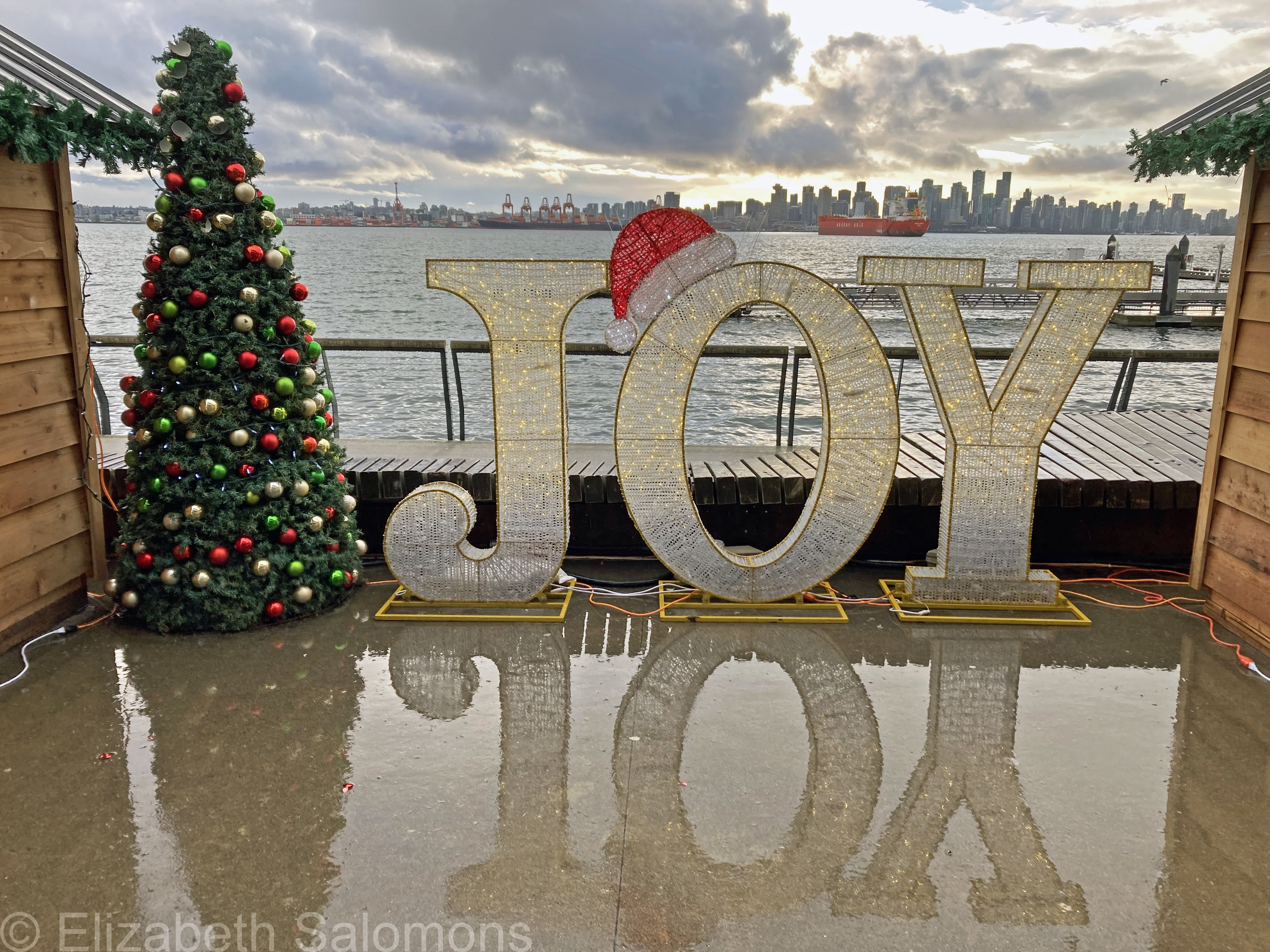
Shipyards Christmas Market, North Vancouver
Through My Lens: Shipyards Christmas Market
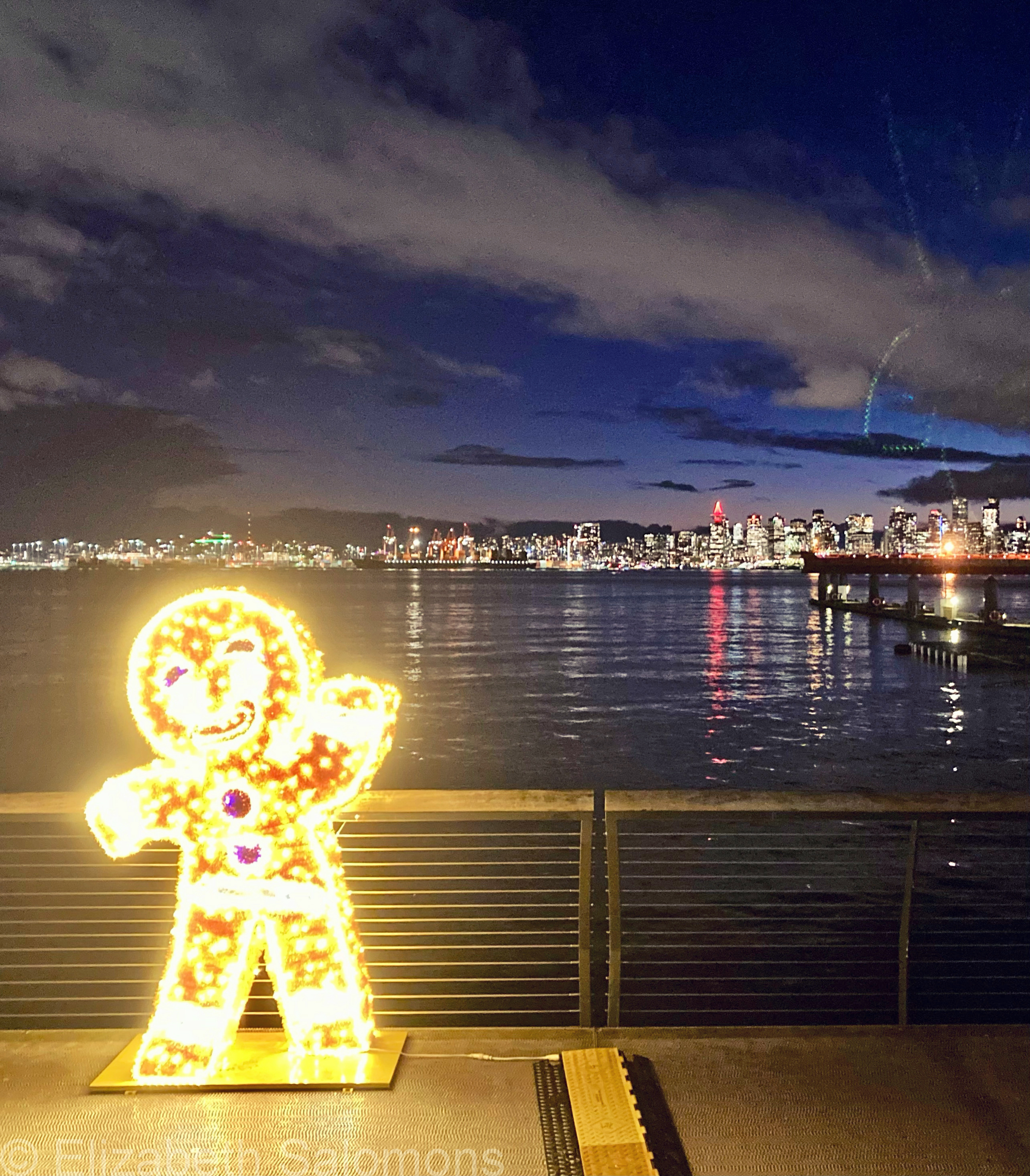
There’s a new Christmas market in town and I, for one, am beyond happy about it. Located at the Shipyards District in North Vancouver, it’s already two years old and this year’s market is even bigger and better than last year’s. In fact, it’s become so popular, they’ve put on extra sailings of the SeaBus to get you there.
And, bonus: that view of downtown Vancouver.
Happy Birthday, Jane Austen!
I wasn’t planning to write about the semiquincentennial of the birth of Jane Austen, born on this day in 1775. After all, I’d already written a post on the bicentennial of her death some years ago.
But when I woke up this morning, I thought, “C’mon. It’s Jane Austen! You need to post something.”
However, I’m a bit low on photos that represent Jane. The only place I’ve been to that connects with her life is Bath — and she didn’t much care for Bath. I was planning to visit Winchester, where she died and was buried, and where the house she lived the last eight years of her life has been turned into a museum.
In fact, I left Bath fully intending to go directly to Winchester. But after changing trains in Southampton, and realizing the train I had boarded was continuing on to London after it stopped in Winchester, I changed my mind. (You can do things like that with a BritRail Pass. I have to say: it’s very freeing, travelling that way.)
And so, I ended up in London that night. Winchester — and Jane Austen — would have to wait.
I always say, when travelling, that you should leave something undone to make sure you come back. One of these days (years?), I will return to Jane Austen country.
In the meantime, in honour of Jane Austen’s 250th birthday, here’s a photo of the Roman baths in Bath. I like the idea that Jane and I have both been to these baths — even though I missed her by almost 200 years.


 There and Back Again