
To the Far Side of the Moon and Back
Copy, Moon joy.” — Jacki Mahaffey, NASA
Like much of the planet, I have been fixated on the Artemis II space mission these past few weeks. At a particular tumultuous time in world history, it has been so life-affirming to focus on a positive news event instead of (waves hand) all this.
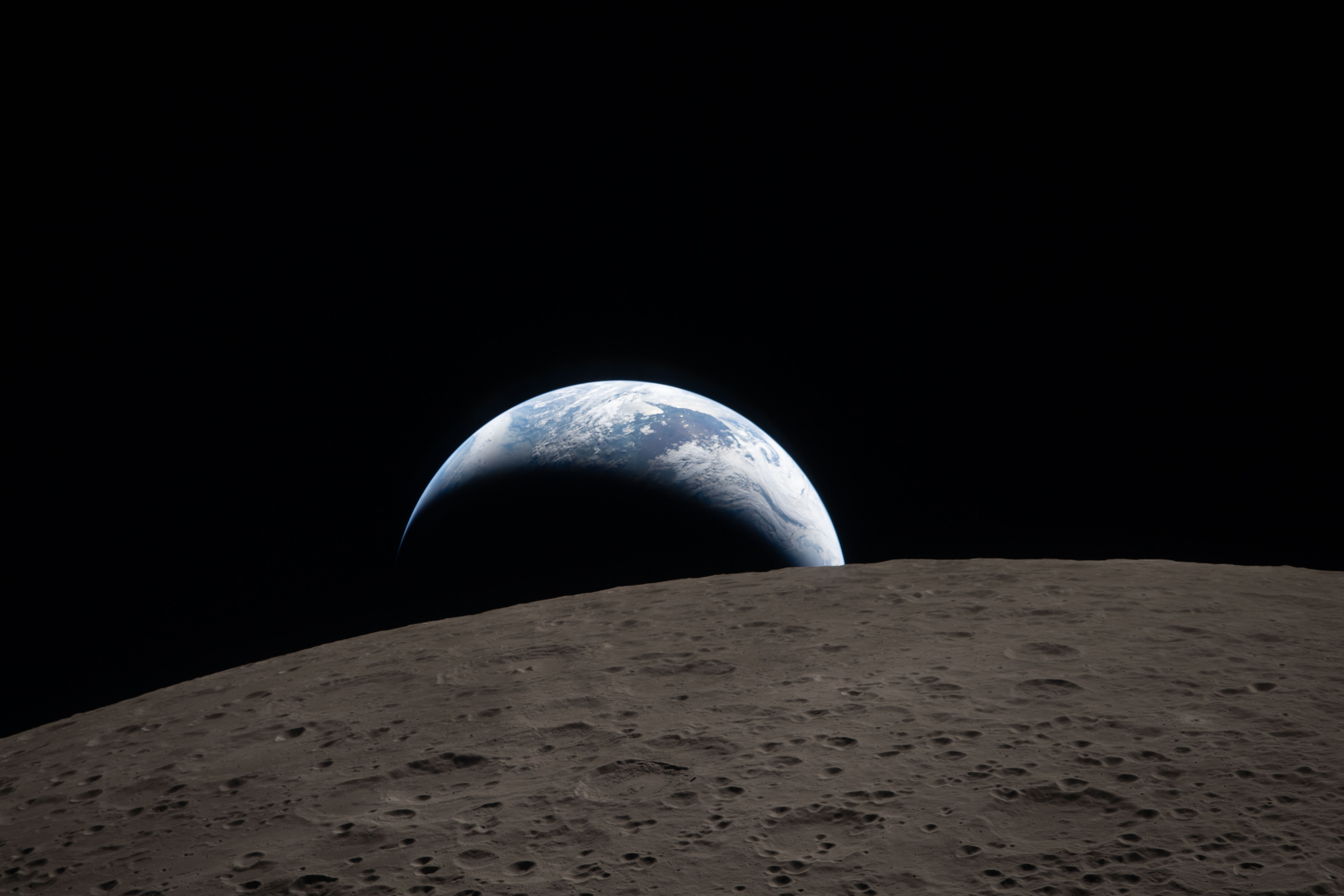
Earthset
Photo Credit: NASA
It’s also been so great to see Canadians and Americans getting along. No lie — Canada is feeling pretty beat up and bruised by the current political situation between our two countries. What Artemis II did was remind us that we don’t have to agree on everything in order to do big things together.
Canada punches above its weight when it comes to space travel. We were the fourth nation to launch a satellite. A Canadian company built the legs of the Lunar Modules that landed on the Moon in the Apollo program. And we built the Canadarm and Canadarm2 — the robotic arms used on the Space Shuttle and the International Space Station. In return for committing to build Canadarm3 for Gateway, the space station that will orbit the Moon, Canada was given two astronaut flights to the Moon.
And that is how a Canadian ended up being the first non-American to fly to the Moon.
I livestreamed all the significant parts of the mission: the launch, the lunar flyby, and the interview with our prime minister when the crew assured him that their choice of topping on pancakes was maple syrup, not Nutella.
The splashdown aired live on CBC, our public broadcaster, and the host spent a good amount of time talking with two retired Canadian astronauts, Roberta Bondar and Chris Hadfield, as we waited for the Artemis II astronauts to exit their spaceship. In addition to explaining what was happening as it was happening, both astronauts talked about the future of space travel.
Neither thought it would be a half century before we’d return to the Moon, but Chris Hadfield made an apt comparison between space travel and the early voyages between Europe and the Americas. John Cabot struggled to find funding to sail to Newfoundland in 1497, but he did, eventually. Yet it was another 100 years before any Europeans attempted a permanent settlement in what we now call Canada.
Commander Hadfield also pointed out that the first journeys to Antarctica were for exploration, then science, but now tourists are routinely travelling to that continent. He speculated the same will (one day) happen with the Moon.
I watched the first news conference with Reid Wiseman, Victor Glover, Christina Koch, and Jeremy Hansen after they returned to Earth. All four talked, not about the science (that will come, according to Jeremy), but about the very human moments they experienced. And what struck me as I listened is that very few of us have the kind of job where our colleagues’ survival depends on us doing our jobs right. What those four went through is almost unimaginable.
Jeremy talked about gratitude, joy, and love. While he said some incredibly moving and profound things about gratitude and love, I’m going to quote him on what he said about joy.
We have a term in our crew that we coined a long time ago, the Joy Train. And you saw, I think, … you saw a lot of joy up there. There was a lot of joy. We’re not always on the Joy Train, this crew. There are many times we’re not on the Joy Train, but we are committed to getting back on the Joy Train as soon as we can. And that is a useful life skill for any team trying to get something done.
His words hit home to me because, coincidentally, I’ve been thinking a lot about joy the past few months.
Few of us will ever travel to the Moon and get to experience Moon joy. Not all of us have jobs that make an out-of-this-world contribution to humanity. And some of us have jobs that don’t always give us joy.
But committing to finding the joy in what you do and how you live — that is a useful life skill. A life skill I am determined to work on for the remainder of my time here on Earth.


I’m all for the Joy Trai n as a life skill to get us through tricky times