
Through My Lens: Mission Abbey Bas Relief
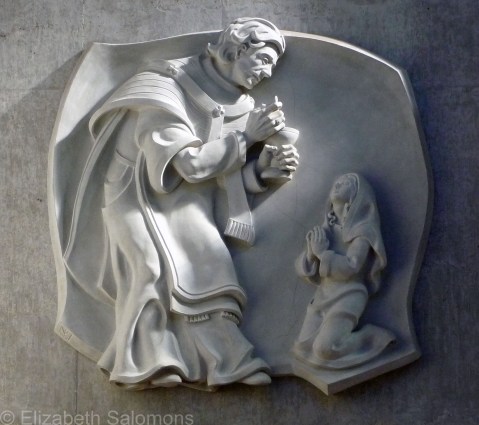
It’s the Fifth Sunday of Lent and today’s photo is of one of the bas reliefs that adorn the interior of the church of Mission Abbey. These bas reliefs were created by resident monk and artist Father Dunstan Massey.
Father Massey began his art studies at age 15 under Jack Shadbolt at the Vancouver School of Art. At 18, he began his journey towards the priesthood by entering the monastery at Mission Abbey. Although he was willing to give up his art to devote his life to God, the Abbot had other ideas and made him the Abbey’s resident artist.
In addition to these bas reliefs in the church, Father Massey’s sculptures, paintings, and frescoes are displayed throughout the Abbey’s buildings.
Art Talk: Embracing Canada
It is equally true, I should add, that as some countries have too much history, we have too much geography. ― W. L. Mackenzie King
When Prime Minister Mackenzie King was giving his geography lecture in the House of Commons way back in 1936, it was generally believed that he was referring to Canada’s youth (a mere 69 years at the time) in comparison to our vast size (second in the world only to Russia). In my opinion, based on my travels, his assessment was bang on. Just take a look around.
Which is what Canada’s landscape artists have a propensity for doing.
Which is why I had Mackenzie King’s statement running through my mind like an earworm when I went to see the Vancouver Art Gallery’s exhibition Embracing Canada: Landscapes from Krieghoff to the Group of Seven. The exhibition’s position is that Canada’s natural world and our relationship to it has often been a major subject for Canadian artists, particularly during the hundred years that bracketed Confederation.
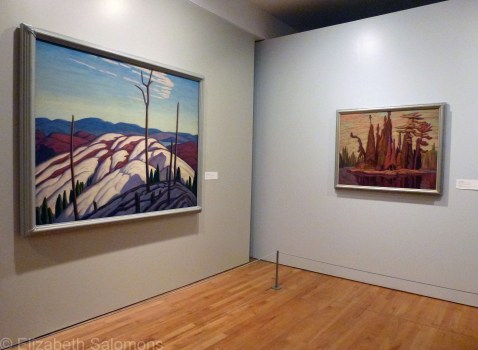
I finally got around to seeing this exhibition during the Christmas holidays. It’s a good exhibition; I was impressed with its depth and scale, and am intrigued by who could own such a collection. (Most of the pieces were loaned to the gallery specifically for the show and the lender wished to remain anonymous.)

I’ve written before that, even though Canada has a great tradition of landscape painting, most of us don’t get much beyond the Group of Seven when asked to name a Canadian landscape artist. So here’s a tip for my Vancouver readers: if your New Year’s resolution is to increase the amount of CanCon in your cultural life, get yourself down to the Vancouver Art Gallery before January 24 (the last day of the exhibition). You will learn something about the many (other) landscape artists who have lived and worked in this country of ours that has too much geography.
If only for that reason alone, the exhibition is worth the price of admission.
The Cloisters
As you may have, um, noticed from this year’s Lenten series, I’m rather partial to cloisters. The simple truth is: I just can’t get enough of them.
So, given my love of cloisters, why were my expectations of The Cloisters ― a branch of New York’s Metropolitan Museum of Art ― so low? I didn’t bother to make the trek all the way to Fort Tryon Park until my fourth visit to New York; even then, I debated whether or not to make the effort. (Though, in the end, I was glad I did as I decided the park alone is worth a visit. As you can see here.)

The thing is, I’d always been under the impression that the buildings that make up The Cloisters are all reconstructions. Purist that I am, I figured since I’ve seen many a real cloister ― in France, and Spain, and Italy ― why would I want to see a mere imitation?
Turns out I was completely misinformed. The Cloisters aren’t reconstructions; they’re the real deal. (And let that be a lesson to me: I didn’t do my homework before dismissing The Cloisters and almost passed on what is a marvellous opportunity for anyone in the vicinity of New York who cannot get themselves over to Europe.)

The Cloisters had its origins in the private collection of American sculptor George Grey Barnard, who lived in Paris for more than a decade in the late nineteenth century. In the decade before World War I, he got into the habit of collecting and bringing home with him pieces of medieval architecture from French villages. John D. Rockefeller bought the collection from him in 1925, and later donated it to the Metropolitan Museum of Art. Rockefeller also donated to the city of New York the land that now makes up Fort Tryon Park.

Open to the public since 1938, the museum is a chronologically arranged ensemble of remnants from five French abbeys: Saint Michel de Cuxa, Saint Guilhem le Désert, Trie-sur-Baïse, Froville, and Bonnefont-en-Comminges. In addition to the buildings, there are more than 2000 works of art, including illuminated manuscripts, stained glass windows, and tapestries.
Here, take a look.


If medieval history is your thing, I highly recommend a visit to The Cloisters.
As for me, I can’t wait to go back.

Through My Lens: Chihuly in Vancouver
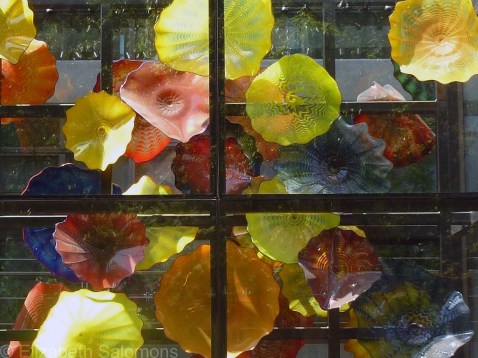
Remember Chihuly in Seattle? After I got back from my two days in Seattle, I was telling a friend here in Vancouver about Chihuly’s remarkable art work. And that friend then informed me one of Chihuly’s glass works is permanently on display at Bute and Alberni.
“Bute and Alberni?” I looked at him, puzzled. “I used to work at Bute and Alberni. Where ―?”
And then the penny dropped. The glass flowers in the glass box! I would stare at them from my seventh-floor office window whenever I was stuck editing a page, a paragraph, a sentence, … basically anything with words in it. It happened ― a lot.
This photo isn’t the best because, well, there was this massive, not very clean, glass box between my camera lens and the art work. But, there you have it, Vancouver readers. Know that we have our very own Chihuly glass work.
Art Talk: Grand Hotel

Yup, it’s another post about hotels, but this time I’m not recommending a place to stay. This post is about yet another art exhibition ― one that I stumbled upon when I was at the Vancouver Art Gallery to see Persuasive Visions.
The exhibition takes its name from the 1932 film Grand Hotel, winner of that year’s Oscar for Best Picture. One of the characters in the film keeps muttering, “Grand Hotel … always the same. People come, people go. Nothing ever happens.”
Huh. Yeah, right.
Grand Hotel: Redesigning Modern Life, seemingly an exhibition more appropriate for a museum than an art gallery, looks at the history of the hotel through the lens of four themes: travel, design, social, and culture. Displays include scale models of some of the world’s most architecturally impressive hotels, such as New York’s Waldorf Astoria and Singapore’s Marina Bay Sands. There are photos and memorabilia about the development of Canada’s tourist industry, thanks to the Canadian Pacific railway hotels (“If we can’t export the scenery, we’ll import the tourists”), and the development of the same in the United States, courtesy of Highway 66 and motor hotels. Did you know the InterContinental luxury hotel chain was founded by Pan Am? I didn’t.
The exhibition also looks at hotels as agents of change concerning race, class, and gender. The Algonquin Hotel in New York, host to the 1920s writers group known as the Algonquin Round Table, was one of the first hotels to accept solo female guests. Duke Ellington was known to prefer touring overseas because hotels outside of the United States weren’t segregated.
And, finally, hotels are explored as centres of culture: the aforementioned Algonquin Hotel in New York, gathering place of New York’s literati, the Chateau Marmont, home to film stars during Hollywood’s Golden Age, and Hotel Imperial Vienna, focal point of Vienna’s coffeehouse culture.
Grand Hotel: Redesigning Modern Life will appeal to anyone interested in travel, and is on display at the Vancouver Art Gallery until September 15.

Art Talk: Persuasive Visions

When my friend whispered to me that the art show we were viewing at the Seattle Art Museum put the Vancouver Art Gallery to shame, I had no idea I would have the chance to make a fair comparison within just a few weeks.
Persuasive Visions: 17th Century Dutch and Flemish Masterworks and Contemporary Reflections opened in Vancouver in June and I was quick to go see it. What an opportunity, I thought, to compare SAM’s exhibition of Dutch masters with VAG’s exhibition of Dutch masters.
Now, I should explain: I have a love–hate relationship with the Vancouver Art Gallery. I really, really want to support it, but …
For one thing, every time I step inside its doors, I always seem to have a run-in with gallery staff (no photography allowed in the atrium!! put that pen away!!) like I’m some errant school child. It gets really old really fast. When an overzealous security guard chose to skulk after me from room to room (to make sure I behaved, I’m assuming, after he caught me with my camera in the atrium), I felt violated. On that particular visit, I left the gallery only minutes after my arrival, and I didn’t go back for several years.
As for the exhibitions, I always leave the gallery thinking, “That could have been so much more.”
With Persuasive Visions, I was surprised, but also confused. I’ll get to my confusion in a minute.
I was surprised by how much seventeenth century Dutch art the exhibition did contain. When the Vancouver Art Gallery markets their exhibitions with the word “contemporary” in the title, it usually means about 90 percent of the modern stuff and 10 percent of the old (read: good) stuff. At least, this has been the case with many of its previous exhibitions. And so, with this exhibition, I was pleasantly surprised by the number of Dutch masters on display, and also by how many of them belong to the Vancouver Art Gallery.
(An aside: the Vancouver Art Gallery has a massive art collection, but, due to space limitations, can only exhibit about 3 percent of its collection at any one time. When a friend from Brooklyn, USA, visited me and I sent her off to the gallery, her first comment upon returning to my place was, “Don’t they show any of their own art? Or is it all only temporary exhibitions?” I explained to her the difficulty about the space limitations. The Vancouver Art Gallery has recently been granted a 99-year lease from the City of Vancouver and, if the fund-raising campaign goes well, will break ground sometime this century on a new building that will massively increase its exhibition space.)
Back to Persuasive Visions. Who knew the Vancouver Art Gallery had so much seventeenth century Dutch artwork? What a treat it would be to see these paintings on permanent display.
Now, on to my confusion. I was confused by the contemporary works the art gallery chose to display alongside the seventeenth century art. I’m a big fan of Jeff Wall’s photographs, but I didn’t see the connection to Dutch landscapes. I also appreciate contemporary portraits like those of Thomas Russ, but felt the juxtaposition of them alongside the portraits of Dutch sea captains and their wives a bit jarring.
So I called a friend. An artist friend, that is. “Help,” I said. “I don’t understand how this show was curated.”
My friend tells me the Art Gallery of Ontario is doing the same with its exhibitions, this mixing of old and new. “Then and Now,” she calls it. Jeff Wall is known for his use of light, as are the Dutch landscape artists, although she could understand my confusion. And the deadpan photography of Thomas Ruff is characteristic of the current school of German and Dutch photographers, so the Vancouver Art Gallery made a deliberate choice to compare seventeenth century Dutch portraiture to contemporary Dutch portraiture.
My friend’s explanation helped, and I decided to go see the show a second time and ponder her comments. The exhibition made more sense to me upon re-viewing, but, to be honest, I prefer the Seattle Art Museum’s curation to what the Vancouver Art Gallery is doing.
Persuasive Visions fills four gallery rooms, with each room focused on one type of painting: seascapes, still lifes, portraits, and landscapes. Many of the paintings from the Vancouver collection are covered in dark varnish, which requires you to step quite close to examine them in any detail. The Jeff Wall light boxes placed in the same room as the landscapes only makes the varnish-covered landscapes look even darker.
The last time the Vancouver Art Gallery showed an exhibition of Dutch Masters was back in 2009, when one Vermeer and a handful of Rembrandts on loan from the Rijksmuseum (then under renovation) went on a North American tour. That may have been the time I got chased out of the gallery by the overzealous security guard. This time? People were taking photos left, right, and centre with their iPhones, and nary a peep to be heard from any of the security guards.
Persuasive Visions: 17th Century Dutch and Flemish Masterworks and Contemporary Reflections is on display at the Vancouver Art Gallery until September 15.
Art Talk: Rembrandt, Van Dyk, Gainsborough
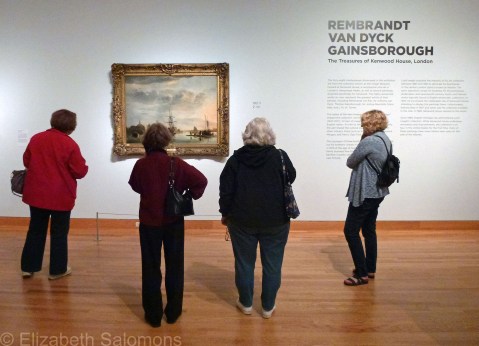
Kenwood House is one of those grand estate houses popular with tourists who want to see Downton Abbey–style houses. It’s currently closed while undergoing renovations. I’m sure that’s a huge disappointment for any tourists travelling to England this summer who were hoping to pay it a visit.
For me, not so much, because its closure gave Kenwood House a reason to send its artwork on tour to the United States. And ― talk about timing ― my friends and I got to see that artwork during our two days in Seattle, only days before the exhibition was due to close.
Rembrandt, Van Dyk, Gainsborough: The Treasures of the Kenwood House, London consists of 48 remarkable works of art. In addition to the Dutch masters and the paintings by Thomas Gainsborough, the exhibition also includes works by Joshua Reynolds and J.M.W. Turner.
“This show puts the Vancouver Art Gallery to shame,” one of my friends whispered to me as we bumped into each other in one of the gallery rooms. I nodded in agreement, awestruck. I don’t often get to see art of this calibre.
The Kenwood House exhibition was paired with a second exhibition entitled European Masters: The Treasures of Seattle, which included works by Eugène Delacroix, Frans Hals, and others, all borrowed from local private collections. I thought the two companion exhibitions complemented each other well.
Rembrandt, Van Dyk, Gainsborough: The Treasures of the Kenwood House, London has moved on to the Arkansas Art Center, my readers in Little Rock will be happy to hear. As for me, I’ve added Kenwood House to my list of art galleries to visit the next time in London. The collection is worth a second look.
Chihuly Garden and Glass
A couple of posts ago, I mentioned that the Chihuly Garden and Glass alone was worth a visit to Seattle. I did not exaggerate: it is one of the most distinctive art installations I have ever seen.
The artist, Dale Chihuly, was born in Tacoma, Washington, in 1941. He studied at the universities of Washington and Wisconsin and at the Rhode Island School of Design, and in Venice, Italy, on a Fulbright. His work is exhibited in more than 200 collections all over the world.
If you ever get to Seattle, do not miss this unique gallery.
And, if you are still not convinced, here are a few more photos. (Just a few.)
Art Talk: William Kurelek
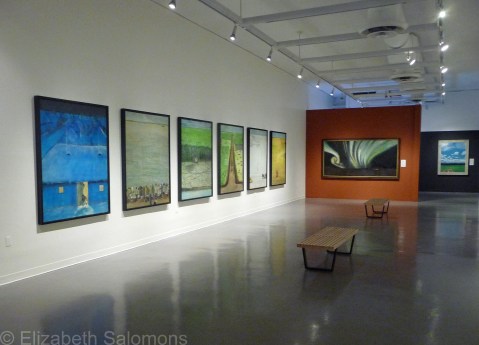
The other week when I was in Victoria, I went out of my way to stop in at the Art Gallery of Greater Victoria. I wanted to see William Kurelek: The Messenger.
I was expecting one room, maybe two, with a handful of paintings, but this exhibition completely exceeded my expectations. It is one of the largest-ever retrospectives of Kurelek’s work ― some 80 pieces ― and opened in Victoria earlier this summer after appearing at the Winnipeg Art Gallery and the Art Gallery of Hamilton.
William Kurelek was born in Alberta in 1927, moved to Manitoba as a child with his family, worked as a lumberjack as a young man to earn money for art studies, and eventually settled in Toronto, where he married, raised a family, and painted. He died there in 1977.
Before he settled in Toronto, Kurelek travelled to England because he had heard the English were doing interesting things with art therapy. He checked himself into a psychiatric hospital and spent the next seven years in and out of hospital. Some of the paintings he did as part of his therapy are included in this exhibition. They are disturbing images, filled with evidence of his illness. But in them you also see the influence of Bosch, Bruegel, and Vermeer ― artists whose work Kurelek studied while in Europe, and whose work would be life-long influences on his style.
While in England, Kurelek converted to Catholicism. At that point, he began painting Biblical scenes and subjects. Later, after his return to Canada, he took on apocalyptic themes as he reacted to world events such as the Cuban Missile Crisis. Kurelek saw himself as “the messenger,” tasked with spreading moral and Christian messages through his work. Although the prairies are a central theme in his artistic vision, even his pastoral landscapes have a mushroom cloud on the horizon, or a crucified Christ at the edge of a freshly plowed field.
Most of us know Kurelek’s artwork from his illustrated children’s books that are now Canadian classics. I don’t remember when I first was introduced to his work ― I suspect it was in grade school by one of my teachers ― but I appreciate it because I’m interested in the themes Kurelek explored: the prairies, landscape, place, memory, the immigrant experience, and Christianity. He was an avid photographer as well, and used his camera as a view finder to find subjects to paint.
Canada has a great tradition of landscape painting. Unfortunately, when asked to name a Canadian landscape artist, most of us don’t get much beyond the Group of Seven. Maybe Emily Carr. William Kurelek, I’m now convinced, is one of Canada most underrated artists. William Kurelek: The Messenger is at the Art Gallery of Greater Victoria until September 3.
Art Talk: Fred Herzog
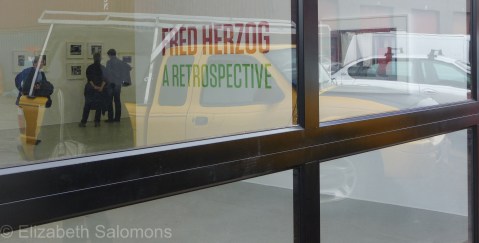
One of the most interesting photo exhibitions I’ve seen in a long, long while is the inaugural show at Vancouver’s Equinox Gallery Project Space. On display until March 31, Fred Herzog: A Retrospective showcases the work of a Vancouver-based street photographer who has become well-known only in the past five years or so.
Fred Herzog immigrated to Canada from Germany in 1952. He worked mainly with slide film (Kodachrome), which, until recently, was expensive and difficult to create prints from. He also shot in colour at a time when fine art photographers were shooting in black and white. As a result, his work wasn’t taken seriously for many years.
The first retrospective of Fred Herzog’s work was in 2007 at the Vancouver Art Gallery, which is when I first discovered his images. His body of work ― some 100,000 photos ― is an incredible photographic record of Vancouver’s social history from 1950s to the 1970s. Those of my readers who live in Vancouver: do not miss this exhibition.


 There and Back Again