
Happy Birthday, Jane Austen!
I wasn’t planning to write about the semiquincentennial of the birth of Jane Austen, born on this day in 1775. After all, I’d already written a post on the bicentennial of her death some years ago.
But when I woke up this morning, I thought, “C’mon. It’s Jane Austen! You need to post something.”
However, I’m a bit low on photos that represent Jane. The only place I’ve been to that connects with her life is Bath — and she didn’t much care for Bath. I was planning to visit Winchester, where she died and was buried, and where the house she lived the last eight years of her life has been turned into a museum.
In fact, I left Bath fully intending to go directly to Winchester. But after changing trains in Southampton, and realizing the train I had boarded was continuing on to London after it stopped in Winchester, I changed my mind. (You can do things like that with a BritRail Pass. I have to say: it’s very freeing, travelling that way.)
And so, I ended up in London that night. Winchester — and Jane Austen — would have to wait.
I always say, when travelling, that you should leave something undone to make sure you come back. One of these days (years?), I will return to Jane Austen country.
In the meantime, in honour of Jane Austen’s 250th birthday, here’s a photo of the Roman baths in Bath. I like the idea that Jane and I have both been to these baths — even though I missed her by almost 200 years.

Historical Hawaii
Remember James Michener? Author of super long books with super short titles that were on all the bestseller lists? Many years ago, I got about a third of the way through one of his books, Hawaii. It was a valiant effort, but ultimately I was defeated by its 1130 pages.
My mom finished the book, though. I have a distinct memory of her rant about the some of the characters in Michener’s novel — the American missionaries, to be precise. How stupid, she said, that they insisted on wearing fashions more suited to New England than the hot, tropical climate of Hawaii.
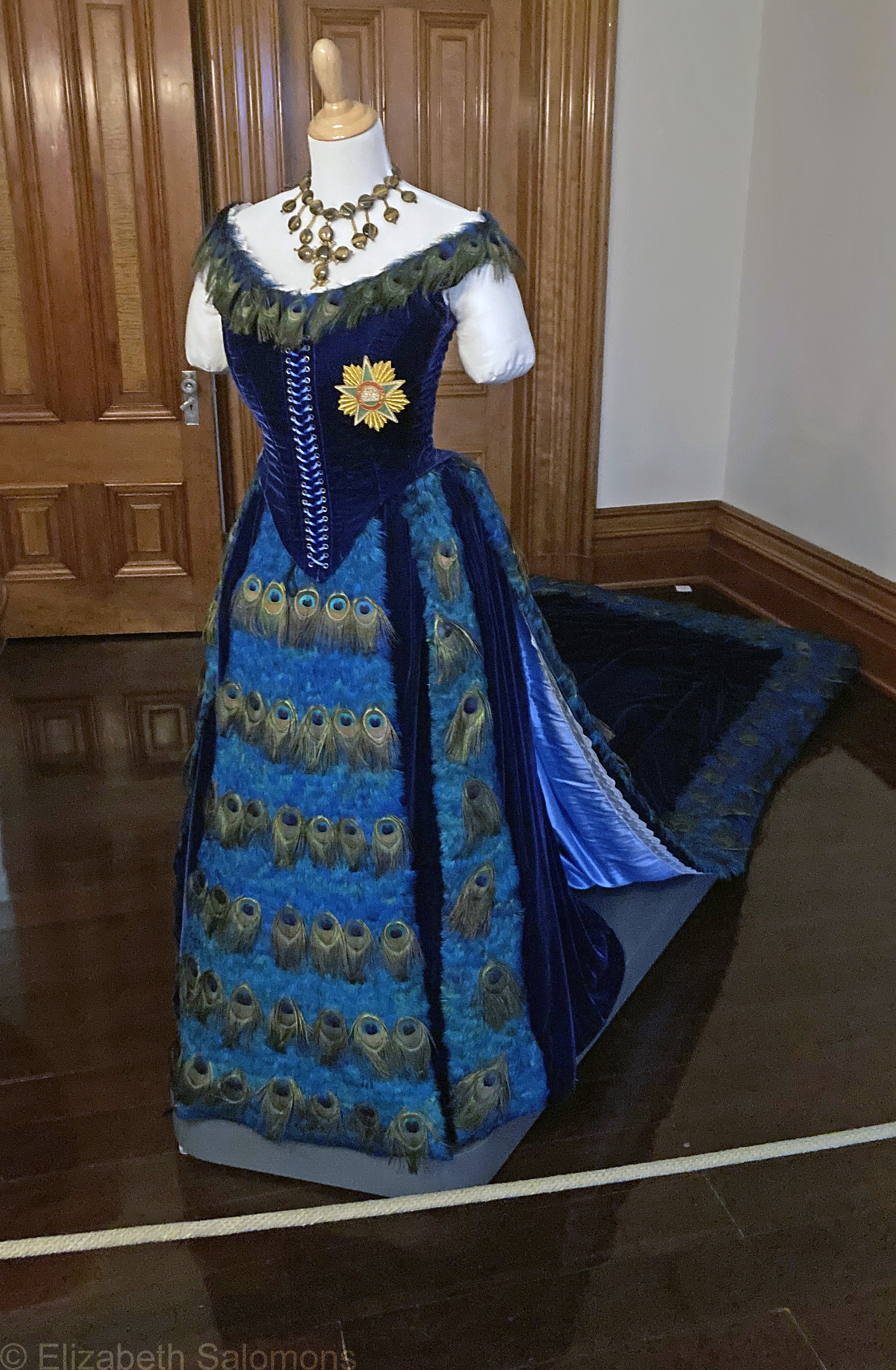
So imagine my surprise, as I took a deep dive into Hawaii’s colonial history last winter, when I learned that the Hawaiian royals also preferred Victorian fashion. This dress, for example. It’s a replica of the Peacock Gown that Queen Kapi‘olani wore to Queen Victoria’s Golden Jubilee in 1887.
I was also surprised to learn that Hawaii came this close to becoming a part of the British Empire. The first European to sail to the islands was the English explorer James Cook — he arrived in 1778. We’ll skip over the part where he was killed by the Hawaiians and jump ahead to George Vancouver, a member of Cook’s crew who returned with his own expedition in 1792, and again in 1793 and 1794. Vancouver became good friends with King Kamehameha I, and Hawaii became the base for British trade in the Pacific. It was Kamehameha who wanted the Union Jack as part of the Hawaiian flag that was adopted in 1816.
However, around this time, an assortment of missionaries was making advances in the Pacific. Amongst themselves, the British and American missionaries divided the Pacific between them: the British would restrict their evangelistic efforts to the south of the Equator, and the Americans went north. The Hawaiians would have preferred the reverse arrangement; Kamehameha II even went to England to arrange for a formal agreement with the King.
But as time went on, Hawaiian trade was increasingly linked to the US economy. Hawaiian independence suffered a fatal blow when a group of white planters and businessmen overthrew the last Hawaiian monarch, Queen Lili’uokalani, in January of 1893. She was held prisoner in her own palace for eight months. Formal annexation with the US took place in 1898 when the Spanish–American War made Hawaii a critical base for the American military while they were fighting in the Philippines, and the islands attained statehood in 1959.
About that deep dive into Hawaii’s colonial history: it took place here, at Honolulu’s Bishop Museum.

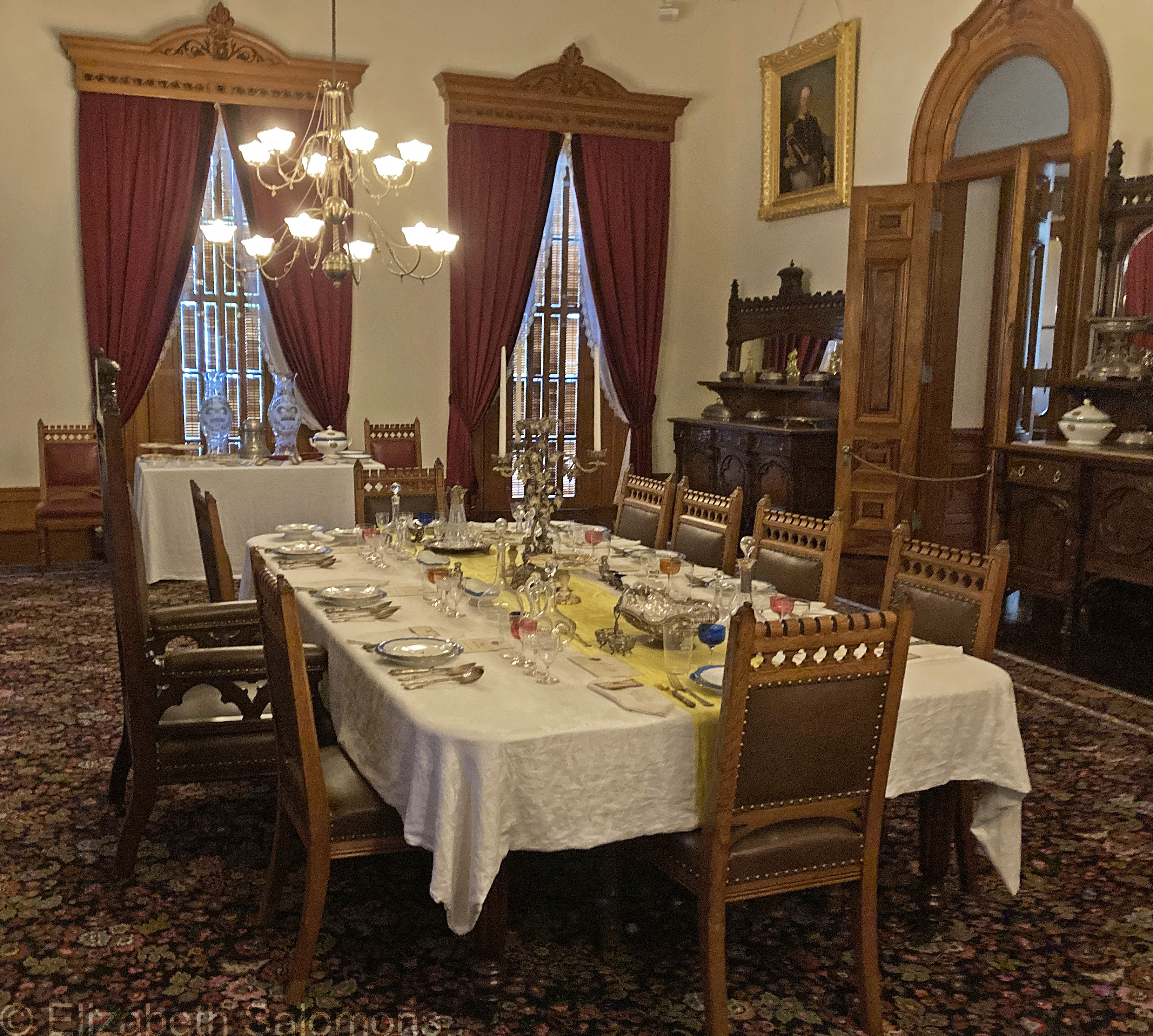
And also here, at Iolani Palace.

Bishop Museum was established in 1889 by Charles Reed Bishop to house objects and heirlooms of his wife, Princess Bernice Pauahi Bishop, last heir of the royal Kamehameha family. It is now considered the best collection of natural and cultural history in the Pacific, and it’s a great way to get a crash course in Hawaiian history in just a few hours.
Iolani Palace, located in downtown Honolulu, served as the State Capital until 1969. When it was built in the 1880s, it was fitted out with electric lights, indoor plumbing, and telephones — all modern conveniences far ahead of their time. It is the only official residence of royalty in the United States.
I still have my mother’s copy of Hawaii. And one of these days, I will finish the novel, now that I have a better and more complete understanding of the history of Hawaii.
Armchair Traveller: As I Walked Out One Midsummer Morning
The stooping figure of my mother, waist-deep in the grass and caught there like a piece of sheep’s wool, was the last I saw of my country home as I left it to discover the world. … At the end of the road I looked back again and saw the gold light die behind her; then I turned the corner, passed the village school, and closed that part of my life forever.
Laurie Lee’s memoir about his walk across Spain just prior to the start of the Spanish Civil War is a classic. If you are looking to read some quality travel writing about Spain, this is the book for you. I was a recent university grad when I first picked it up, the title catching my eye because I had a strong urge that summer to go on walkabout.
Exploring the world the way Laurie Lee did rarely takes place anymore, and reminds us all that whatever inconveniences we might experience on our travels are a cakewalk in comparison to his trek across Spain. Find the weather a tad uncomfortable? Laurie Lee endured heat stroke. Don’t like the food? Laurie Lee subsisted for days at a time on wild grapes and figs. Think travel is too expensive? Laurie Lee paid his way by playing his fiddle for pennies.
Don’t like going through multiple security checks? After a year in Spain, Laurie Lee finds himself in the middle of a war and has to leave the country, with just an hour’s notice, on a British destroyer sent out from Gibraltar to pick up stranded British citizens.
Laurie Lee didn’t gloss over the poverty he witnessed and described the people he met in a non-judgmental way that is refreshing. But as the months and the miles go by, with the rumours of war increasing, you know it’s a walk that might not end well.
At the end of the summer I first read As I Walked Out One Midsummer Morning, I did the sensible thing and found myself a job. But the job didn’t stick and within the year, I had bought myself a rusty, years-old Honda Civic, packed it up with everything I owned, and drove across the country to start a new life.
And as I said goodbye to my mother, it was the first and only time upon leaving home that she cried.
Remembering John Keats
When I have fears that I may cease to be
Before my pen has gleaned my teeming brain,
Before high-piled books, in charactery,
Hold like rich garners the full ripened grain;
When I behold, upon the night’s starred face,
Huge cloudy symbols of a high romance,
And think that I may never live to trace
Their shadows with the magic hand of chance;
And when I feel, fair creature of an hour,
That I shall never look upon thee more,
Never have relish in the faery power
Of unreflecting love; — then on the shore
Of the wide world I stand alone, and think
Till love and fame to nothingness do sink.
— John Keats
Back when I was a child (no, really — I was still in my teens), I took a course on the English Romantic poets. The first semester was all about William Blake and the Lake Poets (Coleridge and Wordsworth, among others). The poets known as the Late Romantics— Byron, Shelley, and Keats — took up the second semester.
It was a challenging course; in her feedback to a paper I wrote on Keats, my professor gently suggested I was perhaps more inclined towards studying history than literature. (She was right.)
But those young poets never left me, in their way, and so, less than a year later, I found myself wandering through a Roman cemetery looking for John Keats’ headstone. He died of consumption — what we now know as tuberculosis — on February 23, 1821. Like so many ex-pats in Rome, he was buried in the Protestant Cemetery. Unlike most people, he insisted his headstone not bear his name, but rather “Here lies One Whose Name was writ in Water.”

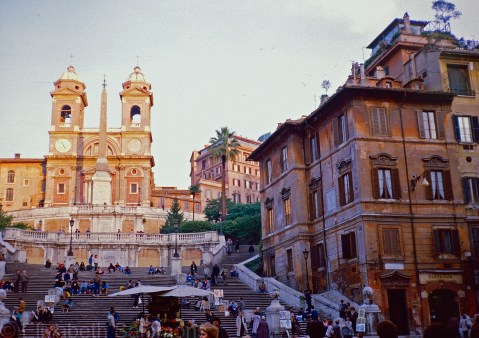
On that same visit to Rome, I also visited the Keats–Shelley Memorial House beside the Spanish Steps. It’s the house on the far right in the next photo. It was sobering to see where Keats died, but also thrilling to see the incarnation of my entire Romantic poetry course in three rooms.
I stopped by the Keats House in Hampstead, in the north part of London, on my next trip overseas. Hampstead Heath, a marvelous open space of almost 800 acres that beckons when you are museumed out, lies just behind the house.

Since I keep bumping into Keats on my travels, I thought it only right that I acknowledge the 200th anniversary of his death.
But back to the Romantic poetry course that started it all for me. One morning, my prof began class by asking who among us had life insurance. Her point was how unusual it was for someone as young as Keats to be so aware of his own mortality.
Unusual, but understandable. Keats lost both parents before he was grown and then watched his younger brother die of tuberculosis. He had also trained as a doctor. By his early twenties, Keats had seen far more death and dying than most of us will see in a lifetime. His sense of how fleeting life is inspired him to write poems like the sonnet I started this post with, which he wrote a month after his brother died.
More death and dying than most of us will see in a lifetime — that, of course, refers to those of us who will live through this pandemic more or less unscathed. And those of us who do, have far more privilege than most.
Happy Birthday, Vancouver Central Library!

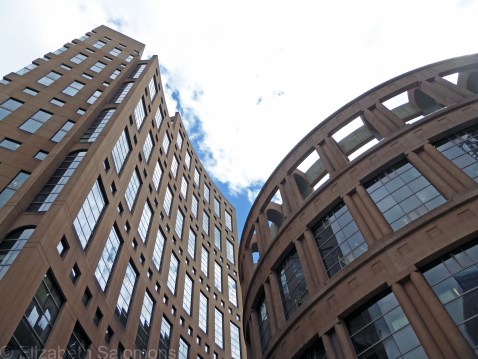
Twenty-five years ago today, the new central branch of the Vancouver Public Library opened to the public. Its iconic building is meant to resemble the Colosseum in Rome and was designed by Moshe Safdie, Richard Archambault and Barry Downs.
All public libraries in Vancouver have been closed since March 16 because of the pandemic. Demand for online content, including streaming services, has skyrocketed since. I have a handful of books I checked out months ago, none of which, I am happy to report, I’ve managed to read. The due dates have been extended three times already so there’s no pressure to return them and, had I known what was coming, I might have been far more careful in choosing my books. The books sitting on my bedside table aren’t exactly what you would call light reads.
One of the library books currently in my possession has turned out to be indispensable, however. It’s all about how to make artisan sourdough bread — rarely am I so prescient, but wasn’t that a happy choice?
As with all birthdays during these pandemic times, the celebrations for Vancouver Central Library have been muted. But one bit of celebratory news we heard today is that the library will begin curbside pickup at a few select branches next week. Patrons will be able to request books online and make an appointment for when to pick them up. And for parents, library staff will select a number of books suitable for each child’s age and interests and bag those up for the same curbside pickup.
Do you hear that? That is the sound of parents everywhere cheering at the news they will soon have a fresh selection of books to read to their toddlers.

Happy Birthday, William Wordsworth!
I wasn’t planning on writing a post to celebrate the birthday of the English poet William Wordsworth, but somewhere on the Interwebs today, I came across the last verse of his most famous poem. That would be “I Wandered Lonely as a Cloud” — or, as many people call it, “that daffodil poem.”
Here’s the verse I’m talking about:
For oft, when on my couch I lie
In vacant or in pensive mood,
They flash upon that inward eye
Which is the bliss of solitude;
And then my heart with pleasure fills,
And dances with the daffodils.
What hit home for me about this particular verse today is the realization that the one-time Poet Laureate of England was doing exactly what we are all being asked to do right now: living a virtual life. Long after he wandered through those daffodil fields, Wordsworth wrote about the feelings he experienced as he did so, and how those memories sustained him.
As our memories are sustaining all of us during this pandemic.
Here then, as a nod to Mr. Wordsworth and on the happy occasion of his 250th birthday, is a photo taken back in the time of before, when we could walk side-by-side without a care along a seawall adorned with daffodils.

The Chanteur of Montreal
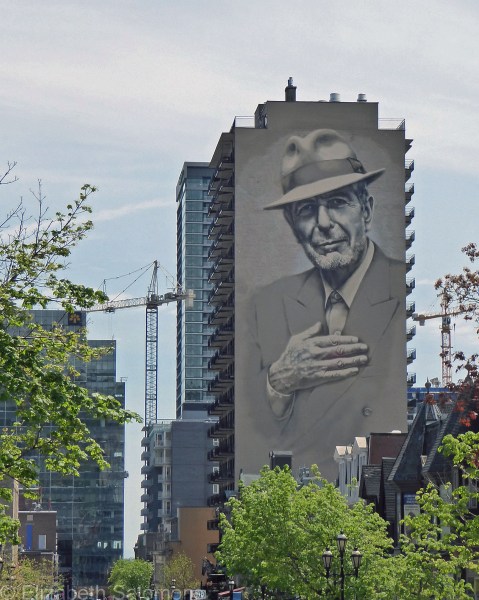
Some say that no one ever leaves Montreal, for that city, like Canada itself, is designed to preserve the past, a past that happened somewhere else.
— The Favourite Game, Leonard Cohen
I can’t leave Montreal behind without writing a word about Leonard Cohen. Because, even though the man spent much of his life living elsewhere, Leonard Cohen is Montreal.
You can’t avoid him when you are there. Stand on any street corner in the city centre and his face stares down at you. When the news broke of Leonard Cohen’s death in November 2016, an impromptu memorial sprang up on the doorstep of his Montreal home. Vigils took place in the square just opposite. Like a pilgrim, I visited both.
I also read The Favourite Game, his first novel, to prepare for my visit to Montreal last spring. The members of my book club were not happy — none of them enjoyed the thinly disguised autobiography. I thought it was laugh-out-loud hilarious.
I’m still making it up to them.
This was a rough year, on so many levels. Almost everyone I know is counting the hours until 2019 is over. All are hopeful that 2020 will be better. I myself had a pretty good year, more or less. But I find it tough to feel joy and gratitude when everyone around me is hurting and weary and sick. Some people call that empathy.
I call it exhausting.
And that’s before we even bring up the news cycle.
In times like these, some of us turn to prayer, some of us turn to poetry, and some of us turn to music. Leonard Cohen — poet, novelist, songwriter, chanteur — gives us all three.
To close out 2019 as well as my series of posts on Montreal, I’m going to finish with these words:
Ring the bells that still can ring
Forget your perfect offering
There is a crack in everything
That’s how the light gets in.
May we all see more of the light in 2020.

Dishing: Le Bernardin
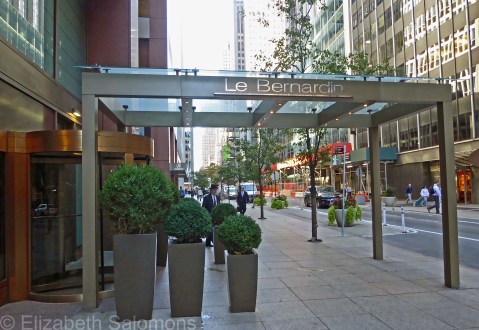
While in New York the other month, my sister and I treated ourselves to lunch at Le Bernardin. This New York institution has maintained its three Michelin stars for the past 14 years and, just last week, it was named the world’s best restaurant by La Liste, a Paris-based ratings organization.
The world’s best.
Hee. It was quite the lunch.
Le Bernardin specializes in seafood, which seems like a natural choice given that the restaurant’s founders, Gilbert and Maguy Le Coze, grew up in Brittany, on the French coast. This brother and sister opened their first restaurant in Paris in 1972, calling it Les Moines de St. Bernardin after a song their restaurateur father used to sing about an order of monks who loved to eat and drink. When Gilbert and Maguy moved to New York in 1986, they simplified the name of their new restaurant to Le Bernardin.
Eric Ripert, who was only 26 when he joined the restaurant in 1991 as Chef de Cuisine, took over as Executive Chef after Gilbert’s sudden death in 1994. He is now a partner in the restaurant. When I got home from New York, I read Eric Ripert’s book, On the Line, which describes the inner workings of the restaurant. Want to know what I learned?
Le Bernardin is a machine.
In order to serve some 1200 dishes every day, 800 pounds of fish are delivered first thing in the morning. All of it is butchered on site — a process that takes six hours. To make 240 sauces each week, the restaurant goes through, per day, 10 pounds of shallots, 5 pounds of garlic, 10 pounds of ginger, and 30 pounds of butter.
(Thirty pounds of butter!?!!)
One neat thing about Le Bernardin, by the way, is that the day’s leftover food is donated to City Harvest, an organization that feeds one million New Yorkers each year.
Le Bernardin is on the ground level of a non-descript office building in Midtown Manhattan with screens hiding the interior from the street. If you didn’t know where to go, you wouldn’t know it was there. But once you are inside, it’s as if you’ve entered another world.
The service was seamless. We lost count, but my sister and I think there were at least seven people waiting on us. And because all staff are full-time, there are no actors moonlighting as servers at Le Bernardin. Instead, you are surrounded by professionals.
The menu consists of three parts: Almost Raw, Barely Touched, and Lightly Cooked. For the three-course prix fixe that my sister and I ordered, we were instructed to order one dish from the left side of the menu (Almost Raw and Barely Touched) and one dish from the right side of the menu (Lightly Cooked). I had Barely Cooked Scallop with Sea Beans and Bonito Butter Sauce and Pan Roasted Merluza with Stuffed Zucchini Flowers and Brazilian Shrimp Moqueca Sauce.
I apologize for the lack of photos. I was too overwhelmed with what I was seeing and tasting to pull out my camera.
When it came to my third course, however, there was no question that I had to document the moment. This is a Golden Hazelnut Sphere with Frangelico Mousse and Praline Ice Cream.

Yes, that is gold leaf on the hazelnut sphere.
I don’t know if New York’s streets are paved with gold, but this I do know: its pastries sure are.
Munro’s Books

Today is International Literacy Day so I am going to make a plug for reading while also posting about the last island I hopped to this summer.
That would be Vancouver Island. I finished off my visit with a day in Victoria, and I spent a good part of that day browsing in what I consider to be two of the best bookstores in Western Canada.
Maybe all of Canada.
One of those stores, Munro’s Books, is celebrating its 55th birthday this year. If you love books, this store alone is worth the trek to BC’s capital city.
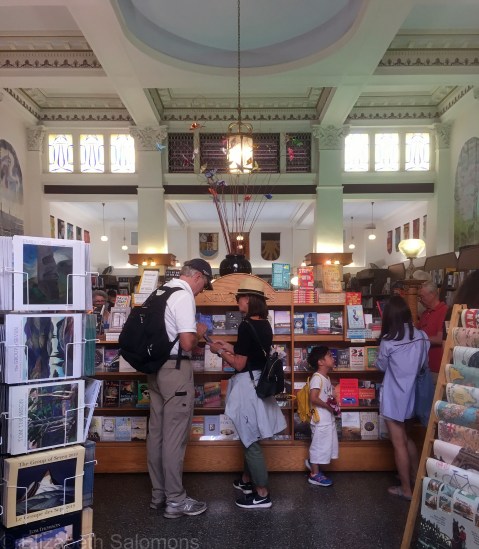
Munro’s was founded by Jim Munro, former husband of Alice Munro. As the store’s own website puts it, that would be that Alice Munro. It’s in an exquisite setting — a stunning heritage building built in 1909 to house a branch of the Royal Bank of Canada. Jim Munro bought the building in 1984. When he retired in 2014, he sold the business to four long-time staff members.
The store has a loyal clientele. As you can see, I went home happy.

Wandering Through the Lake District
I wandered lonely as a cloud
That floats on high o’er vales and hills,
When all at once I saw a crowd,
A host, of golden daffodils;
Beside the lake, beneath the trees,
Fluttering and dancing in the breeze.
—William Wordsworth
The photo of daffodils I posted the other week had me thinking back to my lovely ramble through the hills of England’s Lake District. It was a sunny, autumn afternoon a couple of decades ago, and although it had been many years since I had studied English romantic poetry, William Wordsworth’s poem, “I Wandered Lonely as a Cloud,” was firmly imprinted on my brain.
Likely because I was wandering. And alone. And in the middle of the Lake District (aka Wordsworth’s backyard). I believe I took this photo above Rydal Water on my walk from Dove Cottage to Rydal Mount.

I had arrived in Windermere around dusk the evening before and started off that morning intending to walk to Ambleside. All over England are public footpaths, known as right of ways, where anyone can walk, even if the land is private. The delightful thing about these footpaths is you can take a bus or train to the start of the trail, do your walk, and then hop on another bus or train to get to where you need to be.
To my memory, the paths are well marked. However, I was soon confused and turned around and, well, lost. I asked another walker for directions, showing him my tiny hand-drawn map bought that morning at the Windermere Tourist Information Centre for 20 pence. To his credit, he did not laugh, but he immediately pulled out his full-size Ordnance Survey map — at which point my map felt woefully inadequate and I felt like a silly tourist.
This gentleman set me straight, but it was not long before I was once again lost. I gave up on that path and made my way back to the road where I knew I could catch a bus to Ambleside.
After lunch, I tried another footpath and this time successfully found my way from one of Wordsworth’s former homes (Dove Cottage) to another (Rydal Mount). In the end, it all worked out for the better because by cutting short my morning walk I had more time for my afternoon walk — a walk so beautiful it turned out to be one of the most memorable walks of my life.
A walk so beautiful I started reciting poetry to myself. And, believe me, I’m not the reciting-poetry type.
Several of the English Romantic poets lived in the Lake District, so they are also known as the Lake poets. And the Lake District is truly one of the most spectacular parts of England.
Because I was there in autumn — a lovely time of year, for sure — I saw no daffodils. But someday, one day, I hope to go back in April and see me a crowd of golden daffodils.


 There and Back Again