
Armchair Traveller: C’est la Vie
 On my first-ever visit to Paris, I navigated the sidewalks as if I was playing a game of hopscotch. There was doggie-doo everywhere you looked (or, to be more precise, everywhere you stepped but didn’t look).
Fourteen years later, I was back in Paris, this time with my dad. The doggie-doo situation was much improved. But we chuckled together one night at dinner when we realized the incredibly stylish and well-manicured French matron dining alone at the table next to us had a small canine companion lying at her feet. We were most definitely not in Kansas anymore!
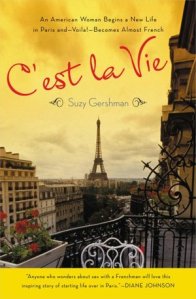
I thought about that dog the first time I read C’est la Vie by Suzy Gershman, which I read shortly before reading Almost French. C’est la Vie and Almost French nicely bookend each other because both are written by women who move to Paris at the urging of a man. And ― once each author is settled and starts to feel “almost French” ― each adopts a small dog (how French of them) that they take with them everywhere (how very French of them!). In Gershman’s case, this includes La Galerie at Hotel George V. Clearly a dog’s life in Paris is no hardship at all.
Other than that, however, the two authors are quite different from each other. One is young and Australian, the other is middle-aged and American. One is starting a relationship, the other is mourning the end of a relationship.
Suzy Gershman moves to Paris six weeks after the death of her husband, who has died only six weeks after being diagnosed with Stage IV lung cancer. She calls herself the Runaway Widow, and she lives in a hotel while searching for an apartment she can call home. This proves more difficult than she expects, but eventually she finds one in the 17e arrondissement. She then proceeds to set up house.
Gershman’s day job is writing shopping guides for cities all over the globe. Hence, she goes into incredible detail when describing the shopping she does to furnish her apartment. It’s natural she writes about what she knows, but the book is missing the in-depth analysis of French culture that I so enjoyed in Almost French. If Almost French is steak et frites, C’est la Vie is tarte tatin. Both add different elements to the meal, but, if I have to choose, I’m a meat-and-potatoes kinda gal.
However, I will be eternally grateful to Gershman for introducing me to Monoprix, the combination grocery-department chain store where I did most of my shopping when I was living in the 20e arrondissement. It was my favourite place to shop and I still miss it.
Armchair Traveller: Almost French
 One of the women in my Book Club is going to France with her family this summer. She knows I read a lot of travel memoirs, so at our last meeting she turned to me and asked, “Can you recommend some books about France?”
Can I recommend some books? About France? (Is the Queen English?)
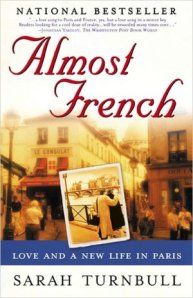
Almost French was my favourite of the shelfful of books I devoured before my last trip to Paris. The author, Sarah Turnbull, is an Australian journalist who meets a French lawyer when they are both in Bucharest for work-related reasons. A couple of months later, she takes him up on his invitation to visit him in Paris ― and never leaves.
Travel memoirs written by wealthy retirees who move to Provence (or Tuscany … or Greece … or …) and fix up old farmhouses are a dime a dozen. For that reason alone, I found Almost French refreshing because it was written by someone my own age living in a large city. I also enjoyed it because it was written by someone from a country with enough cultural and historical similarities to my own for me to relate to her observations about the differences between Australia and France.
But mostly, Turnbull’s memoir stands out from the dozens I’ve read because it is so painfully honest. She is open and frank about the daily grind and frustration and loneliness of adjusting to a new life in a new country. Travel memoirs are usually quite humourous ― often, I suspect, to deflect some of the pain that is always part of adjusting to life in a new and often confusing culture. And Turnbull’s book does have its funny moments. But she uses her stories of linguistic and cultural misunderstandings as an opportunity to write what amounts to a sociological study of the Parisian mind-set ― and she does so in a very real and down-to-earth manner.
For instance, her descriptions of various dinner parties are an obvious opportunity to talk about the French love and passion for food. But she uses these evenings as a window on everything French ― from politics to gender relationships to social habits to the proper way to present and serve a meal. Her weekend visits to the countryside with her French lawyer to visit his father lead to a treatise on how sentimental the French are about the countryside. And she becomes adept enough at reading the French psyché to understand that “Ce n’est pas possible” doesn’t always mean “It’s not possible.”
Another reason her memoir is so distinctive is that her experiences, although specific to Paris in the mid-1990s, are universal. Anyone who has picked up her life and started over in another country, or (dare I say it?) another region of Canada, will be able to relate to her book. Cultural differences between two regions of the same country might be subtle but significant enough to make you ask, “Where am I?” And although I lived in Paris for only three months, Turnbull’s descriptions of Parisians brought smiles of recognition to my face.
By the time she reaches the end of her book, Sarah Turnbull has lived in France for six years, and proves herself almost French by adopting one of the most clichéd of Parisian lifestyle choices ― she gets herself a little dog with as much personality as any French chien.
If you’ve ever contemplated moving to a foreign country, or have already done so, I highly recommend you read Almost French.


 There and Back Again