
Through My Lens: St. Andrew’s-Wesley United Church
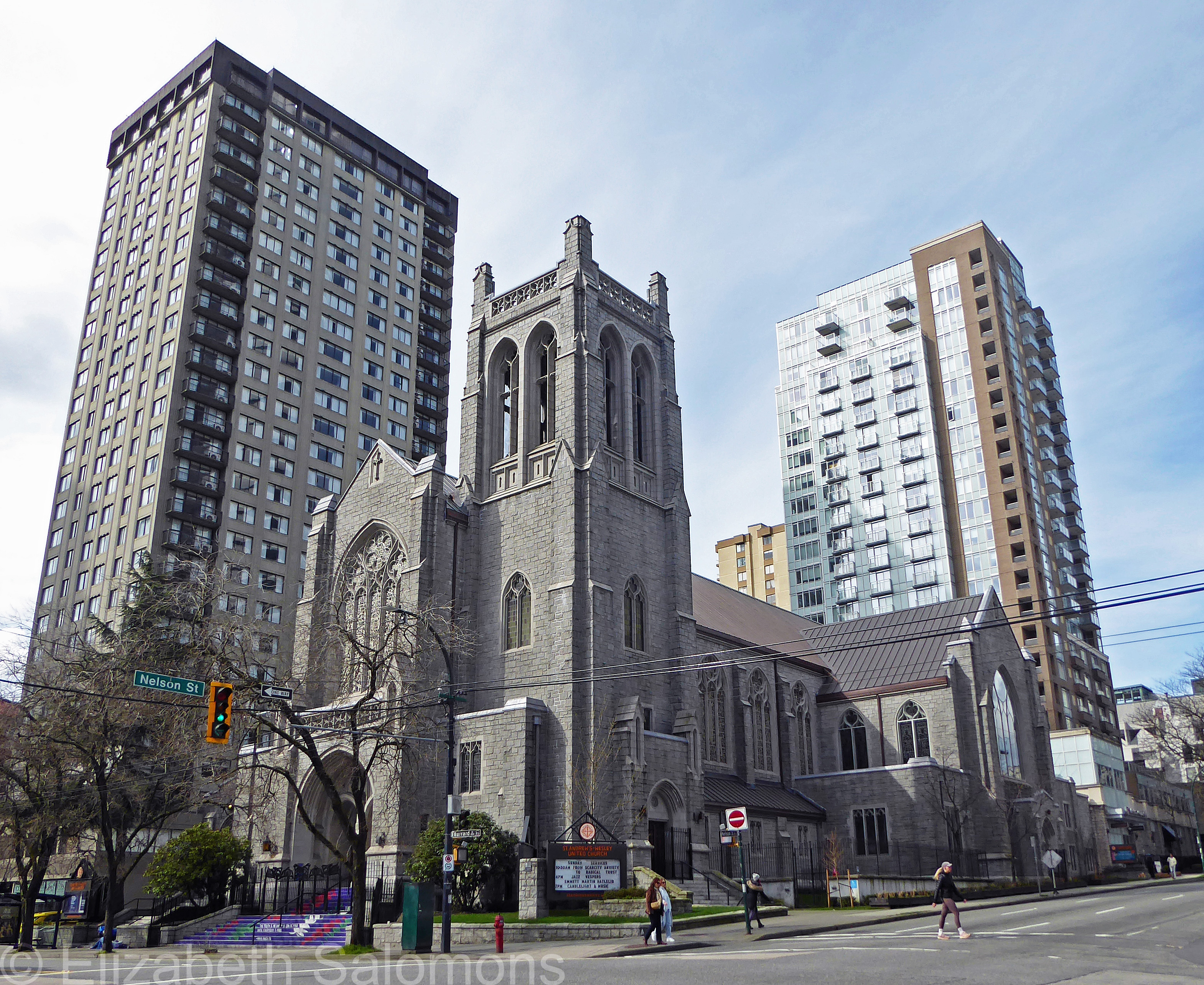
My photo choice for today, the Fourth Sunday of Lent, is St. Andrew’s-Wesley United Church. Located across the street from First Baptist Church, this building has been open for worship since 1933.
When the Methodists, the Presbyterians, and the Congregationalists came together in 1925 to form the United Church of Canada, two downtown congregations— Wesley Methodist on the southwest corner of Georgia and Burrard and St. Andrew’s Presbyterian on the northeast corner of Georgia and Richards—decided to come together as one congregation and jointly build a new church.
St. Andrew’s-Wesley is the result.
The late Gothic Revival building was built with Nelson Island granite and Haddington Island stone; inside, there is a vaulted timber ceiling. The first of the 27 Italian and French stained glass windows was commissioned by Prime Minister R. B. Bennett in memory of his sister, Evelyn Bennett Coats. Thanks to its excellent acoustics, the church is a popular venue for concerts. Jazz vespers takes place on Sunday afternoons and has done so for more than 30 years.
The 22-storey tower behind St. Andrew’s Wesley (at right in the photo) is St. Andrew’s Residence at Wesley Place. Income from the 200 rental units has funded various renovations of the main church building and provides income security for the dwindling congregation. The tower was completed in 2002 and was the largest development project ever taken on by the United Church anywhere in Canada.
Through My Lens: First Baptist Church

The origins of what became the First Baptist Church of Vancouver began with a Sunday School class of 30 children gathered at Blair’s Saloon on June 6, 1886. Exactly a week later, the saloon — and most of Vancouver — was destroyed in what became known as the Great Vancouver Fire.
The group picked itself up and built its first church on two lots purchased from the Canadian Pacific Railway. It soon outgrew that building, as well as the next, and so, in 1904, the congregation bought a lot at the corner of Burrard and Nelson for $4000.
This is where they built its current building, out of stone, in the Gothic Revival style. (The Toronto-based architects of Burke, Horwood, and White also designed the Hudson’s Bay buildings in Vancouver, Victoria, and Calgary.) The building was dedicated on June 9, 1911.
These days, Burrard Street is one of the busiest streets in downtown Vancouver, and condos abut the 114-year-old church. Until a few months ago, the building was surrounded by plywood construction fences due to restoration work of the main church building and construction of the 57-storey tower just behind it. The joint project between First Baptist and the developer provides market housing as well as a daycare, church office space, and a separate seven-storey building dedicated to social housing.
Joint projects between developers and old downtown churches have become something of a pattern in Vancouver — stay tuned to learn more.
First Baptist Church is my photo choice for today, the Third Sunday of Lent.
Through My Lens: St. Paul’s Anglican Church

For today, the Second Sunday of Lent, here is a photo of St. Paul’s Anglican Church, a small neighbourhood church in the heart of Vancouver’s West End. This parish first held services in 1889 in a building in what is now Yaletown. In 1898, that building was moved on skids to its current location to be much closer to where its parishioners lived. In 1905, a new, larger church was built in the Gothic Revival style, but out of wood instead of stone.
In 1973, the parish built an apartment high-rise for seniors on land they owned next door to the church. The income earned from this building, the Pendrellis, has become instrumental to funding the various ministries of St. Paul’s.
I love walking past this little wooden church in the heart of my neighbourhood. The building on the outside looks pretty much as it did in 1905. Standing on the church steps amidst those close-set trees, you could shut your eyes and imagine yourself in a rural country setting, but instead, you are in the heart of one of Canada’s densest neighbourhoods, surrounded by condo towers and apartment buildings, one block off the main commercial strip of Davie Village.
Just imagine being a witness to the transformation of that neighourhood, from home to Vancouver’s elite living in large mansions, to the bustling, diverse community it is today.
If only the walls of St. Paul’s could talk.
Through My Lens: Holy Rosary Cathedral
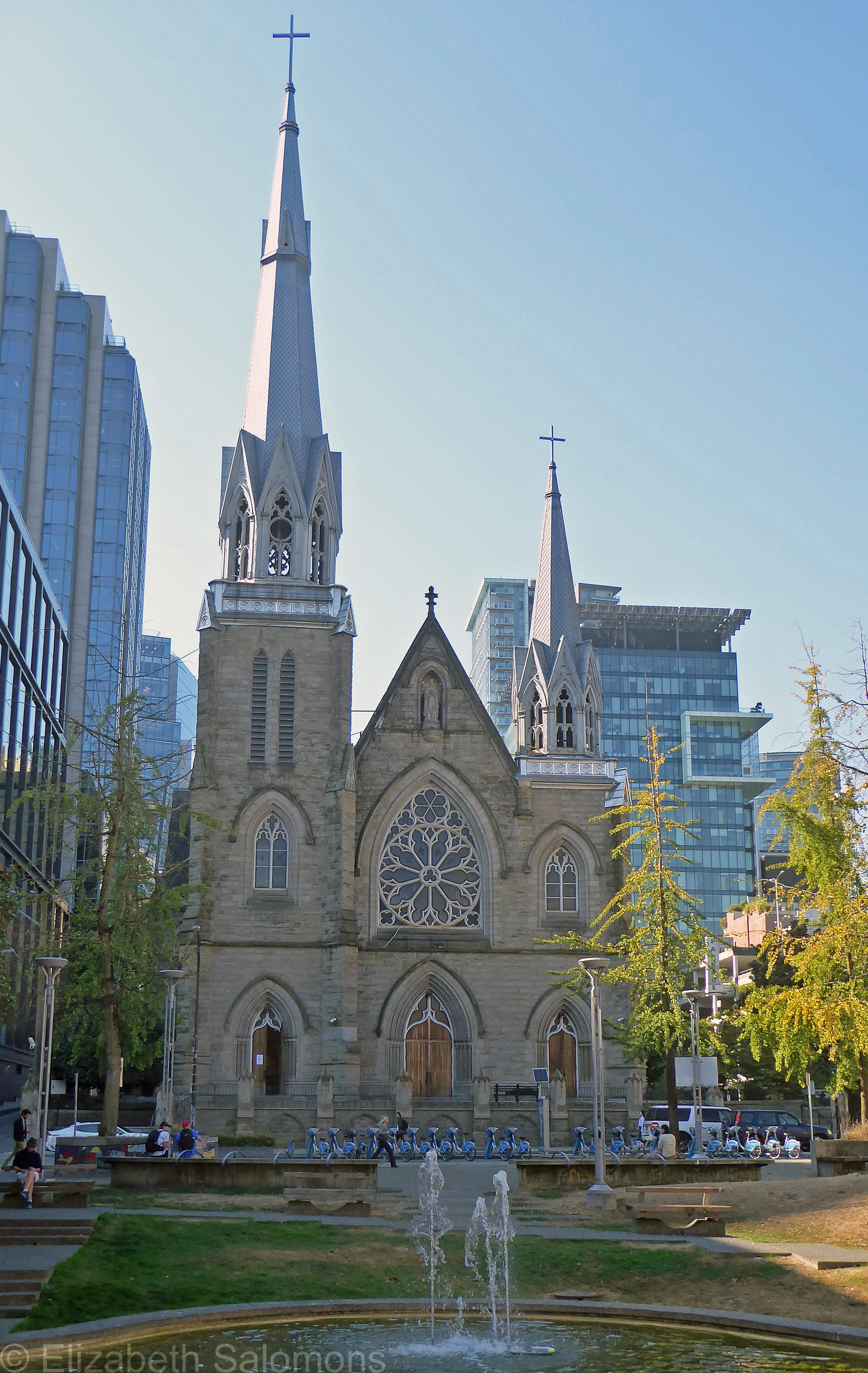
It seems like five minutes ago we were facing the start of winter and now, here we are, already back in the Season of Lent. For this year’s Lenten series, I’m going to take you on a tour of the churches of downtown Vancouver. My photo choice for today, the First Sunday of Lent, is Holy Rosary Cathedral. Its full name is the Metropolitan Cathedral of Our Lady of the Holy Rosary, and it serves as the cathedral for the Roman Catholic Archdiocese of Vancouver.
A church has stood on the site since 1885; construction on this building began in 1899 and was completed in just over a year. The architecture is late nineteenth-century French Gothic revival, a style common throughout Canada during the time period. Its walls are built from Gabriola Island sandstone.
These days, large building projects seem to take years to complete. What amazes me about the speed at which this church was built is that the population of Vancouver at the time was a mere 26,000 people.
Canada House

Here’s another Erickson design. This is Canada House, completed in 2009. It was built to house the Canadian athletes during the Vancouver 2010 Olympics, which ended 15 years ago today with another spectacular hockey win for Canada.
The condos have since been sold and an entirely new neighbourhood has sprung up on the south side of False Creek.
Waterfall Building

When I started researching the buildings designed by Arthur Erickson, I was surprised to learn that a concrete building I always walk past after seeing my hairdresser was one of his designs.

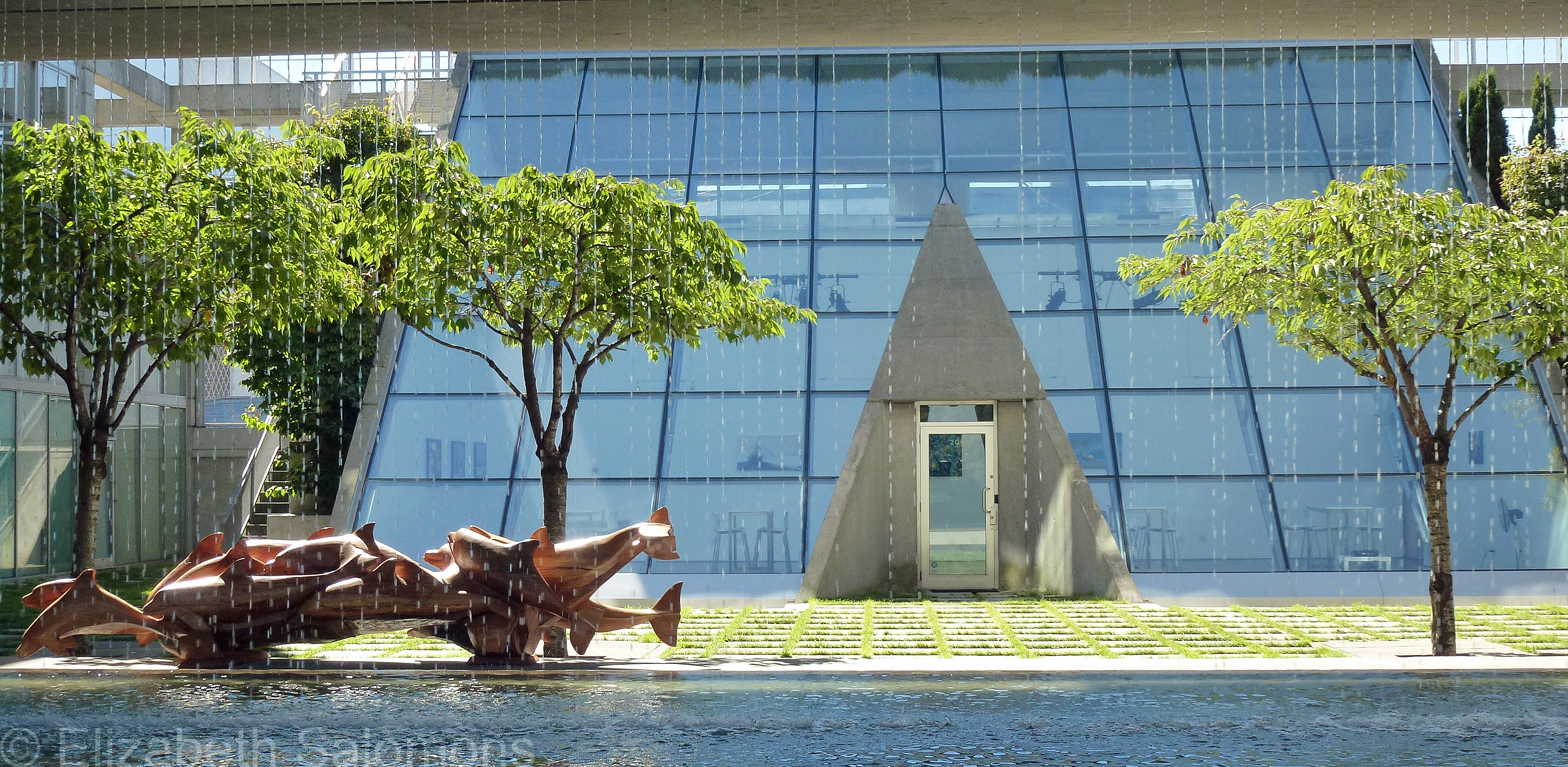
This is the Waterfall Building, named after the water feature that frames the entrance. Completed in 2001, it was intended as a live-work complex and is on a far smaller scale than the other Erickson buildings I have written about in this series.
Koerner Library

As someone who has worked with books most of her professional life, I appreciate a well-designed library. This is the Koerner Library at the University of British Columbia, designed by Arthur Erickson and completed in 1997. It is named after Walter C. Koerner, a forestry businessman and philanthropist long associated with the university.
Koerner Library is the largest of the 15 libraries at UBC’s Point Grey campus and home to the humanities and social sciences collections. What’s kind of neat, I think, is that it was built on top of the former Sedgewick Library, which was below ground level and used skylights to bring natural light into the stacks. That building is now the basement of the Koerner Library.

Robson Square

One could argue that the most iconic of Erickson designs in Vancouver is the Robson Square complex. Sprawled across three blocks in the centre of downtown, it is bookended by the Provincial Law Courts and the Vancouver Art Gallery.

Long before Erickson came on board, the plan was for a vertical building — the tallest in Vancouver. But the 1972 provincial election brought about a change in both government and architect. And when worries were expressed about the immense shadow that such a building would cast, the new architect, Arthur Erickson, declared, “Let’s turn it on its side.” His vision was for a public square that people could walk through, anchored by the law at one end and the arts at the other.
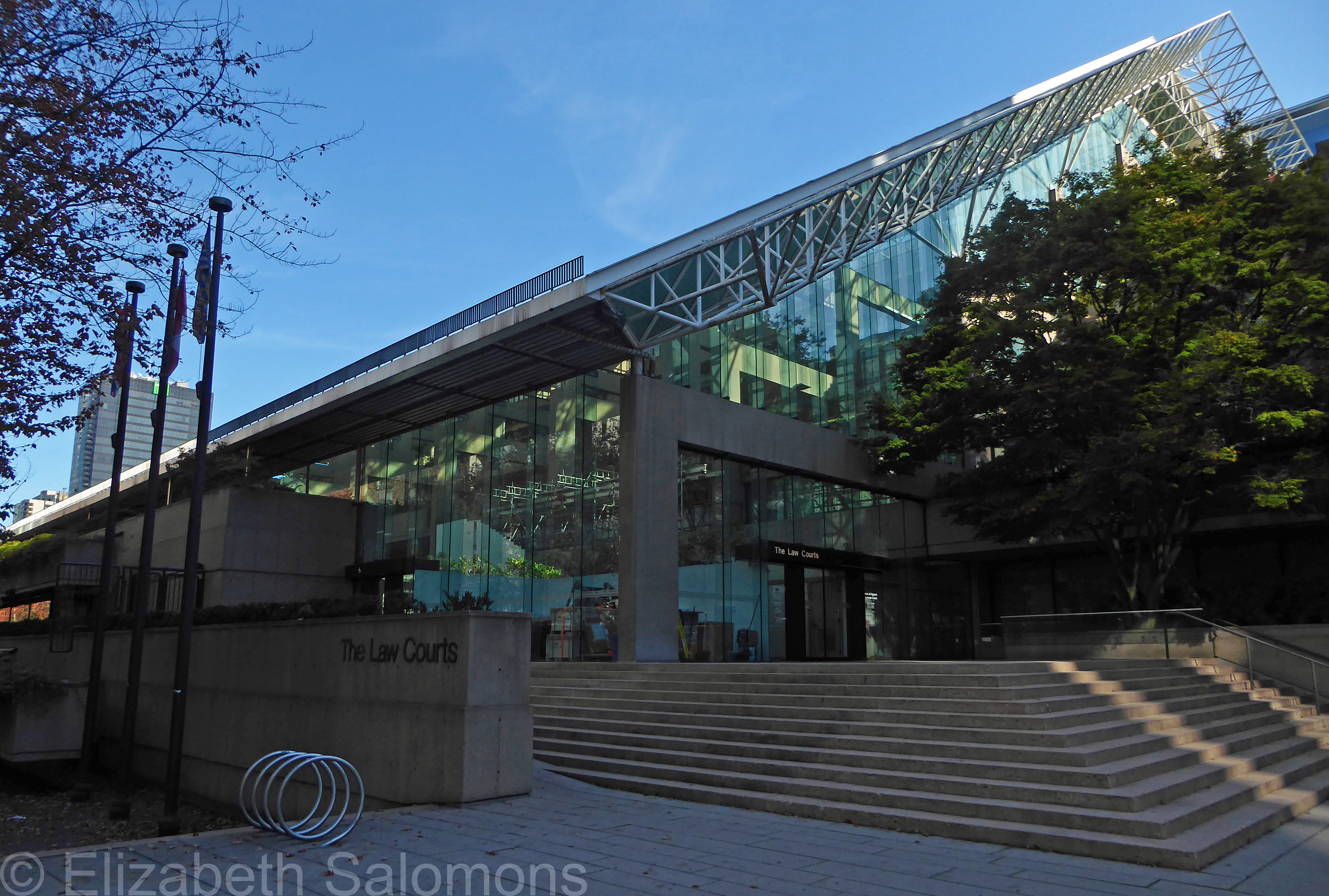
The Provincial Law Courts were completed in 1979.
The renovation of the Vancouver Art Gallery, formerly the provincial courthouse, was completed in 1983.

The result is what Vancouver considers to be its main civic square. Curiously, though, our City Hall is located some three kilometres away. Why not downtown like most cities?
Good question, but that’s a topic for another post.
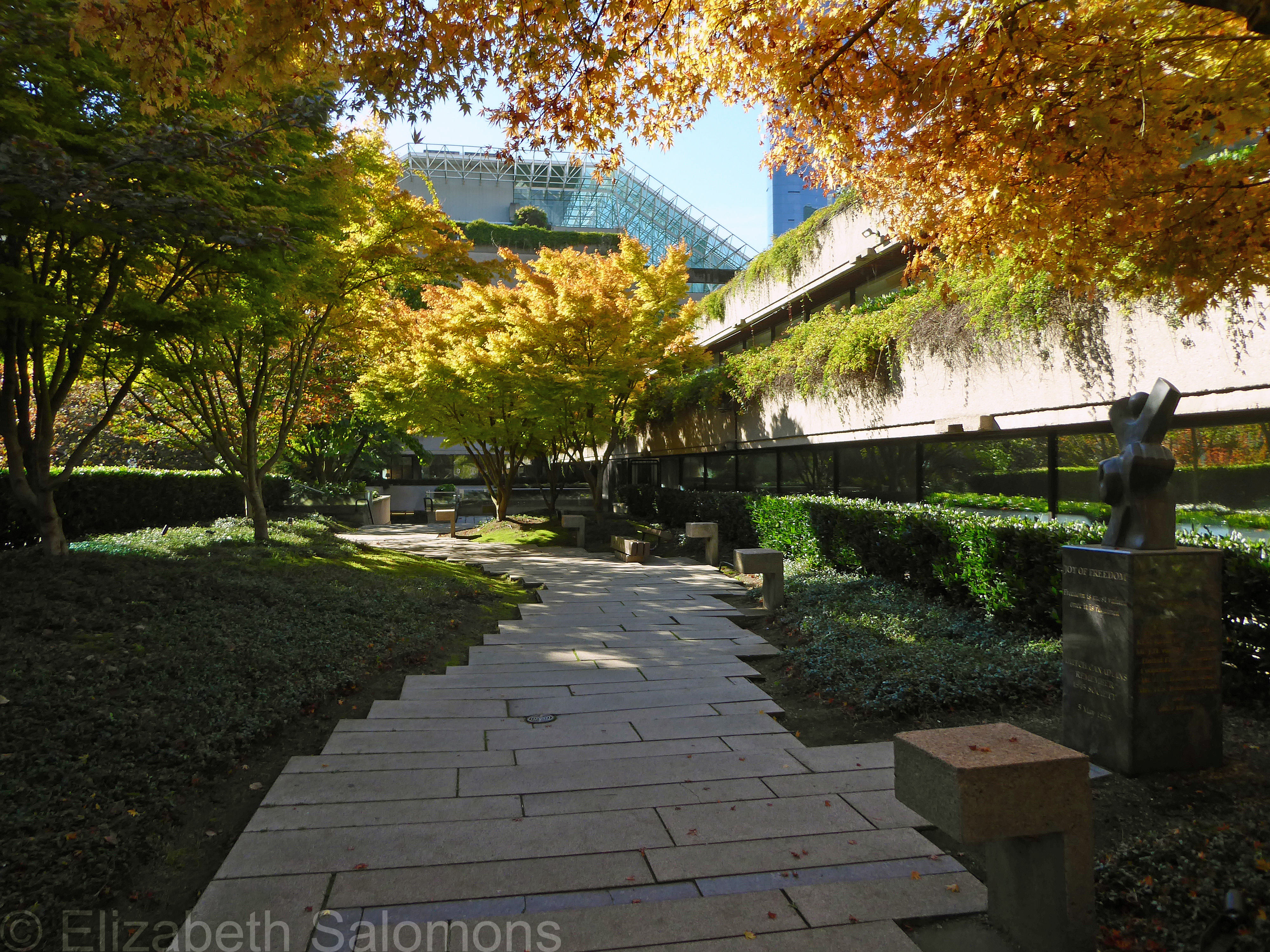
Cornelia Hahn Oberlander, the landscape architect who worked with Erickson on the Evergreen Building, designed the hanging gardens with its series of cascading waterfalls.
The law courts contain courtrooms, offices, and a law library. The entire complex is multi-level, with provincial government offices above ground and a sunken plaza with an ice rink below, offering free skating in the winter and salsa and ballroom dancing in the summer.

The buildings flanking the rink contain the classrooms and offices of the downtown campus of UBC.

Robson Square takes its name from downtown Vancouver’s main shopping street, which runs through the middle of the complex. That one-block stretch of Robson Street was first closed to vehicle traffic during the Vancouver Olympics, then every summer, and then permanently in 2017.
Robson Street is named after John Robson, a business man from Upper Canada who came west during the Fraser Canyon Gold Rush of 1859. He was a strong advocate for the Colony of British Columbia joining Confederation and eventually served as our ninth premier.

Dry January
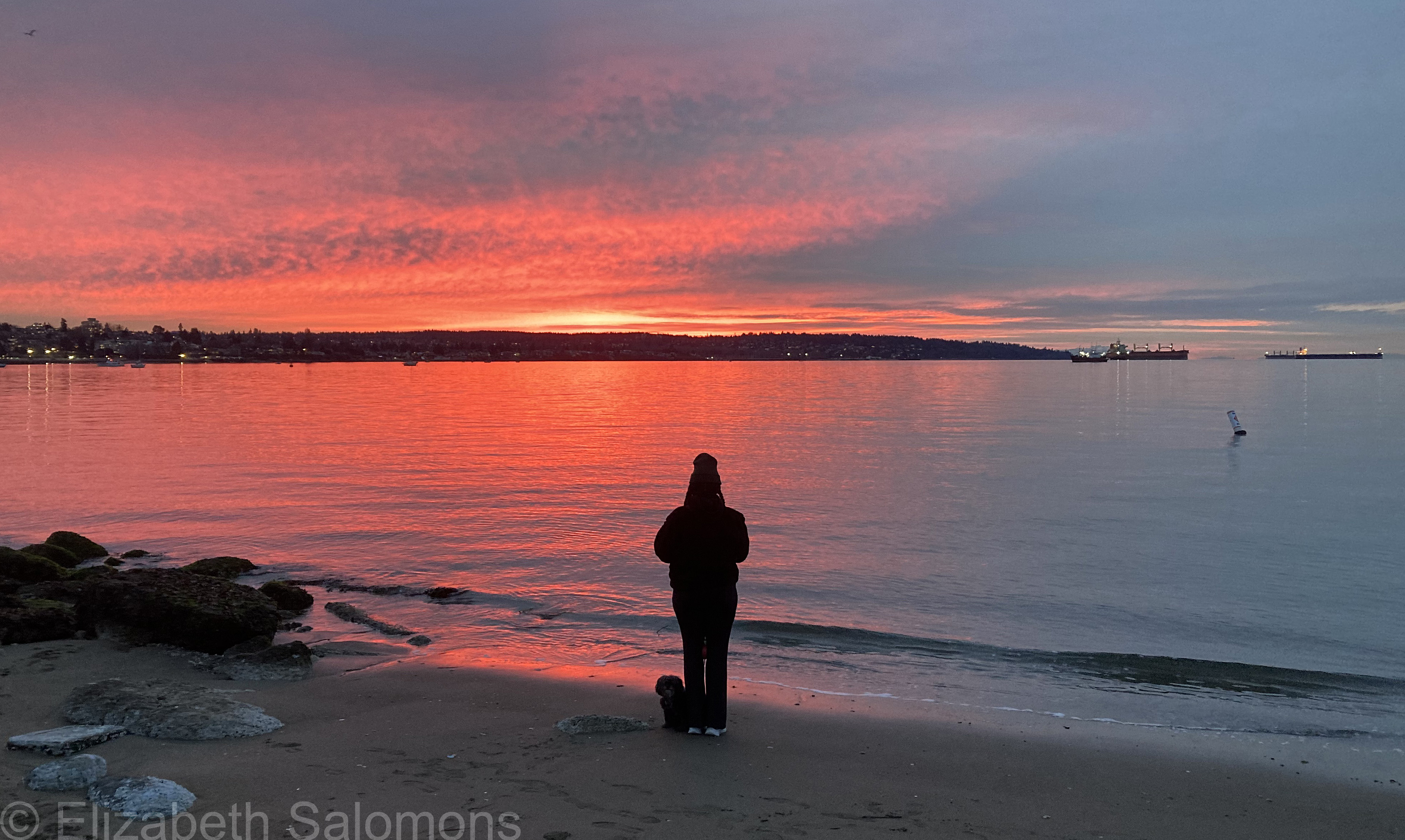
After a rather soggy December, we’ve enjoyed an unusually dry January. So dry that records were broken: this was our driest January in 40 years, and the third driest since 1897.
We’ve also had a steady streak of spectacular sunsets. There’s something about winter sunsets that creates magic.
Like this.
Evergreen Building

Yup. Still here, still working on my series on Arthur Erickson buildings that have shaped Vancouver.
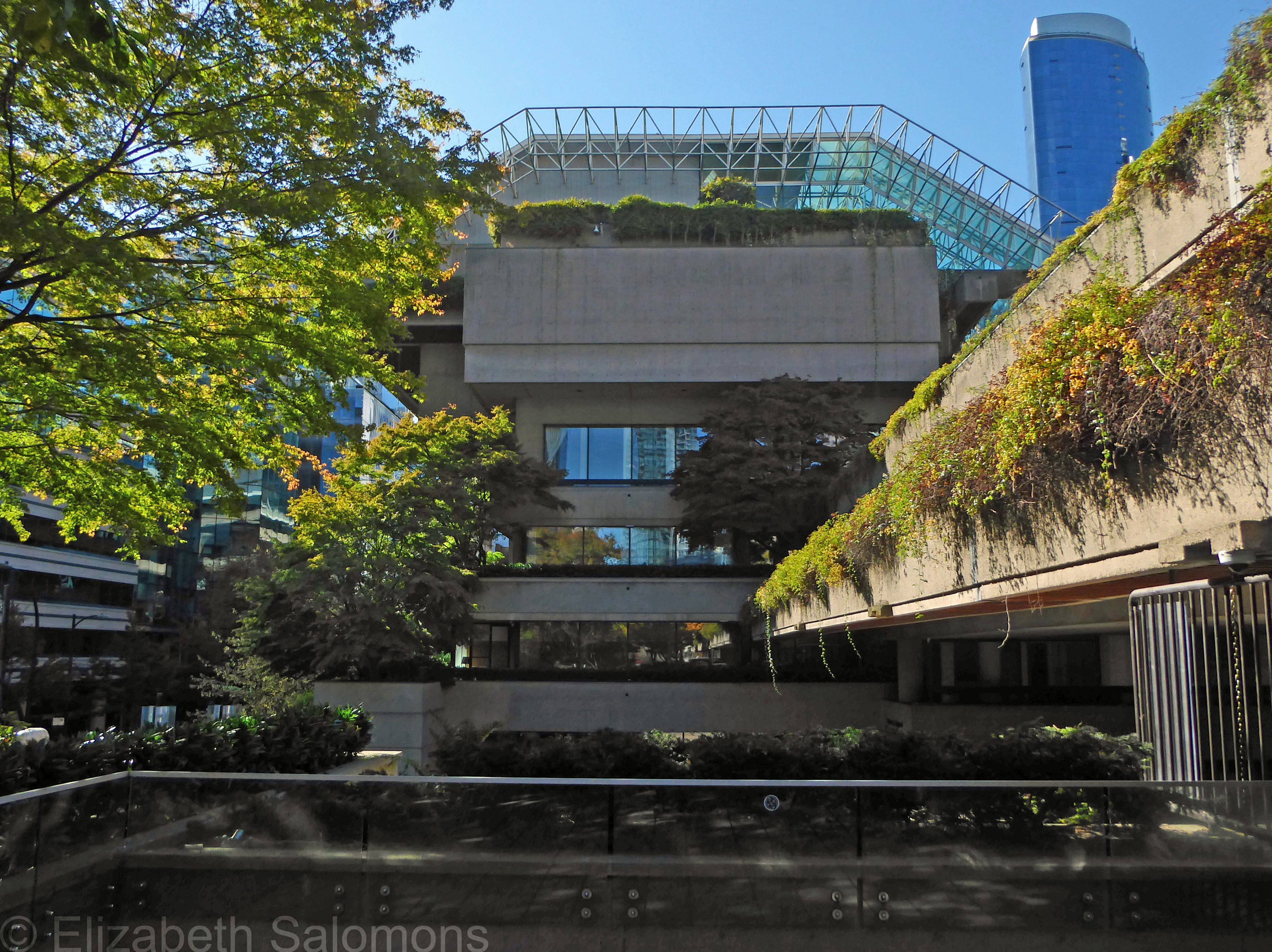
This one is easy to walk past without realizing its significance. Located on a quiet intersection in Coal Harbour, the building’s recessed terraces are meant to emulate a mountainside. Erickson collaborated with landscape architect Cornelia Hahn Oberlander when designing the building.
Its unique footprint came about for a practical reason: it was the space available where the two streets meet at an obtuse angle, instead of the usual 90 degrees. It is categorized as an office building, but also has some corporate residential suites.
The Evergreen Building was completed in 1980.


 There and Back Again