
Snow Day in Vancouver
Wait, what?
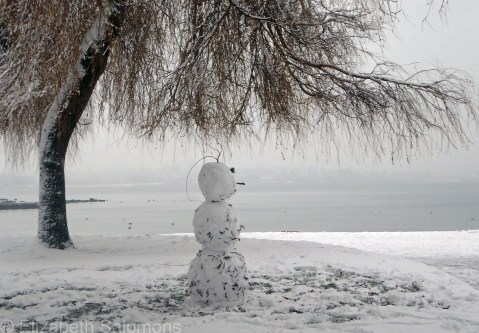
Yup. Snow Day in Vancouver. Normally in February, I’m posting photos of crocuses. Or gloating about how spring is right around the corner.
Not this year. We’ve had one of the snowiest, coldest winters I can remember, and I’ve lived here off and on for a good chunk of my life. This winter we had a white Christmas for the first time in almost a decade, and for the first time ever in my memory, the snow stuck around for an entire month. It arrived in early December and it didn’t leave until after New Year’s when the temperature finally warmed up and the rain washed it all away.
I expected we would have a normal winter going forward. But no.
We got another record dump of the white stuff this past weekend. Because we don’t usually get snow, what most Canadians take for granted, like snow plows and snow tires, we do not have enough of. And without plowed roads or snow tires, you are not going to get very far. Ever been in an articulated bus that was sliding backwards down a hill? I have. It was not pleasant.
So today was a snow day for a lot of people in this town.
And there is more snow in the forecast.
Stanley Park Windstorm
Ten years ago today, a massive windstorm devastated Stanley Park. Hurricane-force winds off English Bay levelled 41 hectares of forest, about 10,000 trees in all, some of which were more than 500 years old. It was the most violent windstorm to hit Stanley Park in 40 years.
Although it was overwhelming to see the devastation, the forest was long overdue for a regeneration. The wide open spaces changed the look of parts of the park and increased the diversity of both plant life and animals. Woodpeckers, for example, are now thriving. More than 15,000 trees and shrubs were planted by park staff and volunteers. I was walking near Prospect Point recently and it struck me how tall those young trees are already.
I was out of town on December 15, 2006, but I remember taking a walk through the park on Christmas Day — as much as it was possible to walk through the park since every trail was blocked by fallen trees — with my mouth open wide in shock. The seawall was also extensively damaged and remained closed for some 18 months until the repairs could be finished and the cliff tops above the seawall stabilized.
This photo is of a tree that came down near the Georgia Street entrance to Stanley Park. It lies near where it fell, trimmed of its foliage, and has been left as a memorial to that storm. It is now a popular photo stop for tourists, who I am sure have no idea why it is lying there.

Vancouver Biennale: Engagement
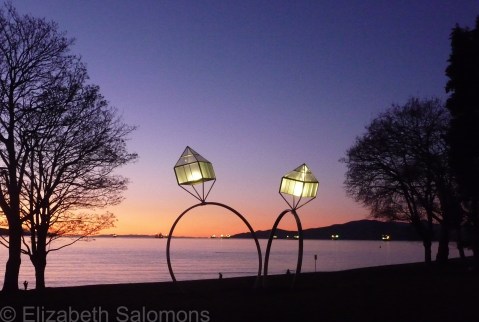
Here’s one more Vancouver Biennale photo, this one from the 2005 to 2007 exhibition. It’s called Engagement and was created by Dennis Oppenheim, an American. It overlooks English Bay at Sunset Beach Park.
Vancouver Biennale: A-maze-ing Laughter
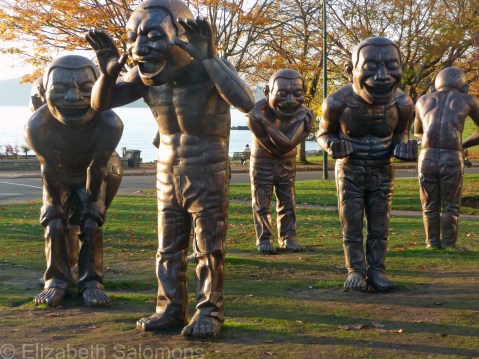
Speaking of cheerful, here are the guys from A-maze-ing Laughter, the hit installation of the second Vancouver Biennale. Fourteen supersize cast-bronze figures with smiling, happy faces completely transformed Morton Park in English Bay when they were installed in 2009.

The beauty of A-maze-ing Laughter is that it’s completely interactive in the best way possible. You can’t help but smile at the figures, touch them, imitate them, and, for some of us, climb on them.

The artist is Yue Minjun from China. That’s his face smiling back at us.
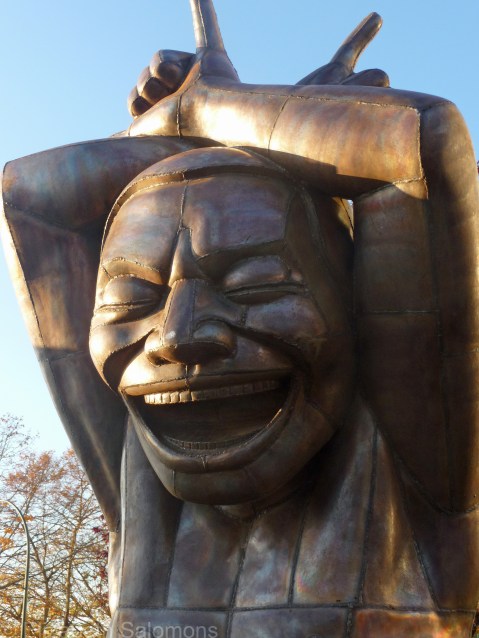
A-maze-ing Laughter is probably one of the most popular public art installations Vancouver has ever had. Like all of the Biennale pieces, it was for sale when the two-year exhibition was over. All of Vancouver wanted the figures to stay exactly where they were, but at first it seemed impossible, due to the hefty price tag of $5 million. But when Yue Minjun saw photos of people interacting with the sculptures, he dropped the price to $1.5 million with the condition that they remain in a public location. Thanks to a private donation by Chip Wilson, founder of lululemon, and his wife Shannon, the laughing men are here to stay.

Vancouver Biennale: Giants
Every city needs art and art has to be in the middle of the people.” — OSGEMEOS

The Vancouver Biennale is a two-year-long outdoor public art installation that takes place every two or three years. The first was from 2005 to 2007, the second from 2009 to 2011, and the latest, the third Biennale, began in the spring of 2014 and finishes up this year.

The installations by world-renown artists are scattered across Greater Vancouver. The most impressive piece of this latest Biennale is Giants by the twin Brazilian brothers, Gustavo and Otávio Pandolfo, who call themselves OSGEMEOS. (Os gemeos is Portuguese for “the twins.”)

Giants consists of murals painted on six concrete silos located at Ocean Concrete on Granville Island. (An aside: this concrete factory is the last vestige of False Creek’s industrial past.) The murals alternate between facing the water and facing inland. They are colourful, and they are cheerful, which seems to be a hallmark of the most successful installations of the Biennale. None are intended to be permanent, but sometimes we just can’t bear to let them go. Hopefully this one will be kept on as well.
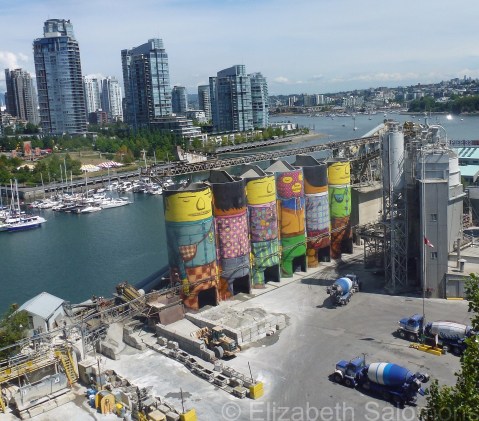
Oh, and any guesses as to how much paint was used?
A mere 1400 cans.
Expo Lands

When Expo 86 closed its gates 30 years ago today, it finished as a far more successful world’s fair than it ever expected to be. Sure, Vancouver had high hopes for the fair and saw it as a great way to celebrate its 100th birthday, as well as the 100th anniversary of the completion of the Canadian Pacific Railway that brought British Columbia into Confederation. A total of 38 countries participated, but it was getting the United States, the Soviet Union, China, and Cuba to all participate that was the real coup. And the number of visitors was far greater than predicted. Most British Columbians credit Expo with bringing the province out of one of its worst recessions.
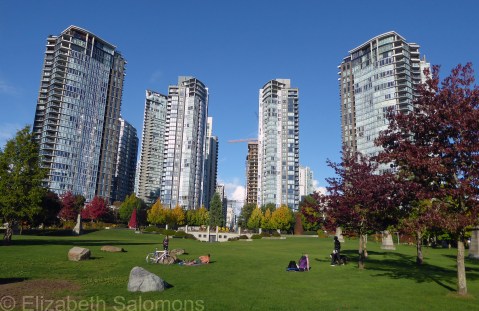
On October 14, 1986, the question on everyone’s mind was: what happens to the fairgrounds? Prior to Expo 86, the 90-hectare site was an industrial wasteland. Sawmills and railway lands had been expropriated to make room for the fairgrounds (it boggles my mind that Vancouver had working sawmills in its downtown core in my lifetime), but with rezoning came all sorts of possibilities.
In the end, what came to be known as the Expo lands was sold to a single Chinese developer. The price was controversial, but in return for a good deal on the land, the developer agreed to build child-care centres, playgrounds, a community centre, and a school. Furthermore, the condos had to include a certain percentage of family-size units and affordable housing.
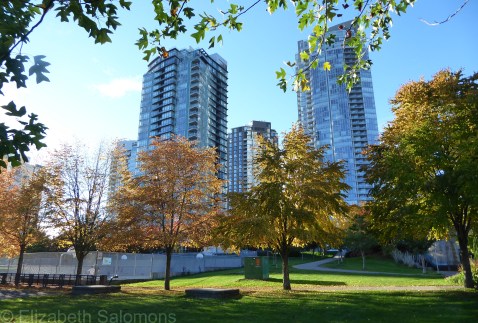
The result? A slow and careful development of a entirely new inner-city neighbourhood that, once populated, doubled the number of people living in Vancouver’s downtown core. It’s not completely finished; the last section still remains a parking lot while awaiting the demolishment of the Georgia and Dunsmuir Viaducts ― the remnants of the freeway into downtown Vancouver that never saw completion.
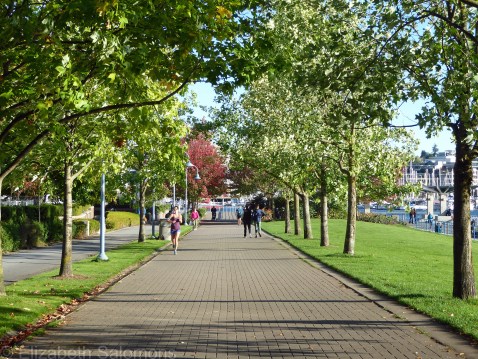
Vancouver is consistently rated as one of the most livable cities in the world and the development of the Expo lands has a lot to do with that rating. Today, the area is covered in condo towers. Agreed, they are not the most creative architecturally. But you only have to take a walk through the neighbourhood and marvel that, only 30 years ago, there was nothing there but a wide swath of empty land.
Northern Shoveller
One bonus about summer being over is that it means there are only a few more weeks to go until the return of the winter birds. I haven’t seen any sign of them yet, but they’ll be here soon and are most welcome.
This is a Northern Shoveller, one of the dabbling ducks that like to hang out at Lost Lagoon. I myself haven’t seen them that often, but that might be because I first mistook them for the much more common Mallards. From a distance, their colouring looks quite similar. Upon closer inspection, the beaks are longer than a mallard’s and are a noticeably different colour.

BC Place

If Canada Place transformed Vancouver’s look the most out of all the legacy landmarks left behind by Expo 86, then BC Place is a close second. It opened in 1983, has a capacity of 54,500, and is home to two of Vancouver’s professional sports teams: the BC Lions and the Vancouver Whitecaps. BC Place was also the venue for the opening and closing ceremonies of the 2010 Olympics. After the Olympics, it got a new roof. It is the largest cable-supported retractable roof in the world and ― in my opinion ― gives BC Place a much-needed update to the marshmallow look it had before.
Through My Lens: Float Planes

There was a wee bit of excitement in Vancouver today about a couple of visitors. The Duke and Duchess of Cambridge are in British Columbia for an eight-day visit and today was their whistle-stop tour of Vancouver.
What I find amusing about the media coverage of the Royal Tour is how every story highlights that the Royals are being flown around the province by float plane. Float planes are, to put it mildly, a way of life in coastal BC. For some communities, it’s the only way in or out.
I took this photo of the planes docked at the Vancouver Harbour Flight Centre (aka Downtown Vancouver’s seaplane terminal) last summer. The Duke and Duchess arrived here from Victoria this morning ― by float plane.
Inukshuk at English Bay
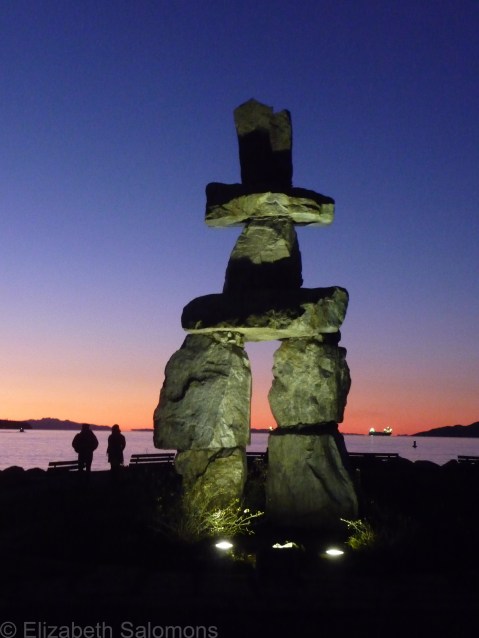
One of the most surprising discoveries from my research about the legacy landmarks of Expo 86 was when I learned about the origins of the inukshuk at English Bay. Turns out this iconic sculpture is the same one that stood in front of the Northwest Territories Pavilion at Expo. The territorial government commissioned Alvin Kanak of Rankin Inlet to create the sculpture made of grey granite. After Expo, it was given to the City of Vancouver, and it has stood in English Bay since 1987.


 There and Back Again