
Vieux-Montréal
I may have mentioned before (just once or twice) that my favourite way to get to know a city is by walking it.
I may have also mentioned (just, erm, once or twice) that I’m a history geek. And so, getting to know Vieux-Montréal (Old Montreal) last May by walking it was a real treat for me. Like a moth to a flame, I set out on my first day for the oldest part of Montreal.
I should make it clear that when I say “oldest part,” I am referring to the part of Montreal first settled by Europeans. Long before the first Frenchman arrived on what we now call the island of Montreal, Indigenous peoples were living there. They called their settlement Hochelaga. That first Frenchman was Jacques Cartier, and he in turn named the mountain near Hochelaga Mount Royal, or, in sixteenth-century French, Mont Réal. That was in 1535.
The first French settlers, about 50 of them, arrived in 1642. They were led by Paul de Chomedey de Maisonneuve and Jeanne Mance, who are considered the co-founders of Montreal. Their interest was evangelical; they intended to convert the Indigenous peoples to Christianity. However, the fur trade soon became the focus of the new colony. To protect the French interests, Louis XIV sent over 1200 French soldiers. The Filles du Roi (the King’s Daughters) followed, also sent out by Louis XIV, to provide wives for all those fur traders and soldiers. And with that, it could be said, the colony of New France was off to the races.
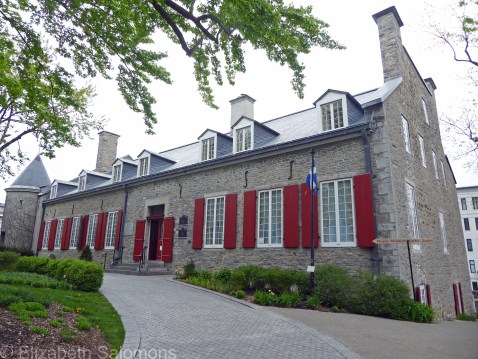
Colonies need governors, and the building in the above photo, Château Ramezay, was the home of one of the early governors of Montreal, a chap named Claude de Ramezay. Built in 1705, it is one of Montreal’s oldest buildings and is located on Place Jacques-Cartier, the centre of Vieux-Montréal. The house was sold by his descendants, and at one time served as the Canadian headquarters of the Continental Army (that would be the army of the American colonials who fought the British during the American Revolution). It is said that Benjamin Franklin was a one-time guest in this house in 1776 when he came looking for military help from New France in the way of soldiers.
Eventually, the château was turned into a museum, which it remains today. The restored gardens behind the château are particularly lovely.
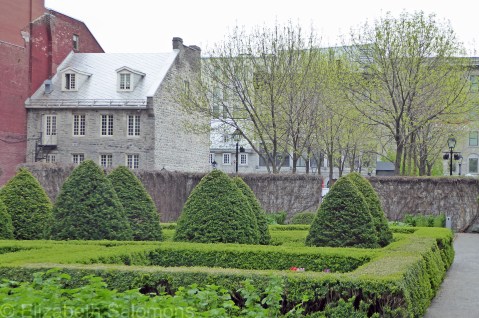
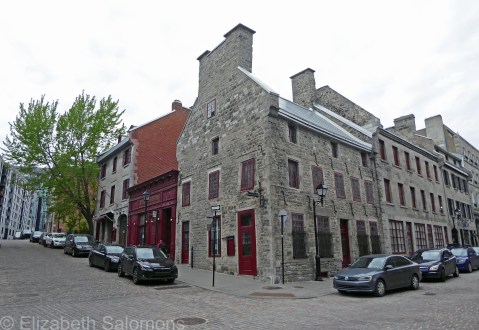
This next house, Maison du Calvet, was built in the 1700s. It looks like it was lifted right out of Brittany. Most recently, it’s been a hotel, but at one time it was the home of Pierre du Calvet, a supporter of the American Revolution. He also met with Benjamin Franklin when he came to New France.
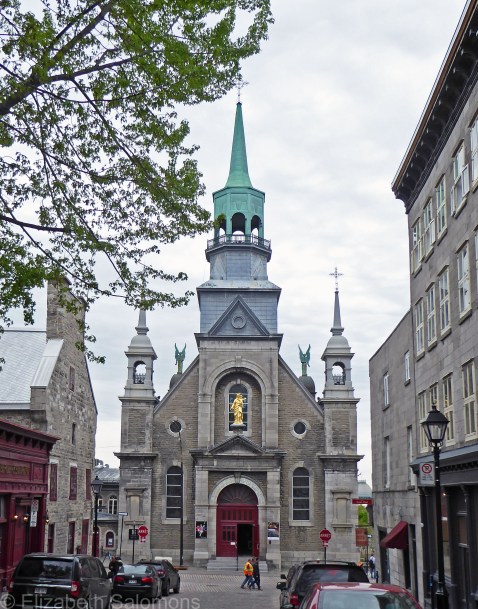
Across the street from Maison du Calvet is this church, Chapelle Notre-Dame-de-Bon-Secours (Our Lady of Good Help Chapel). Founded in 1655 by St. Marguerite Bourgeoys, it’s one of the oldest churches in Montreal. This building dates from 1771. The chapel became popular with the sailors who came through the port of Montreal.
Speaking of sailors, this next building is the Old Custom House, which served a significant function in the burgeoning Montreal trade. When the city was declared an official point of entry for Lower Canada in 1832, it needed some administrative buildings, and this one was completed in 1838. It has two facades; this side faces the Saint Lawrence River. The building is now part of Montreal’s Museum of Archaeology and History.

What I like about this photo is how it shows several centuries of architectural style: directly behind the customs house are the spires of Notre-Dame Basilica (completed shortly before the customs house), behind it to the right is the Aldred Building, built in the Art Deco style and finished in 1931, and behind it to the left is the nondescript bank tower that went up in the 1960s.
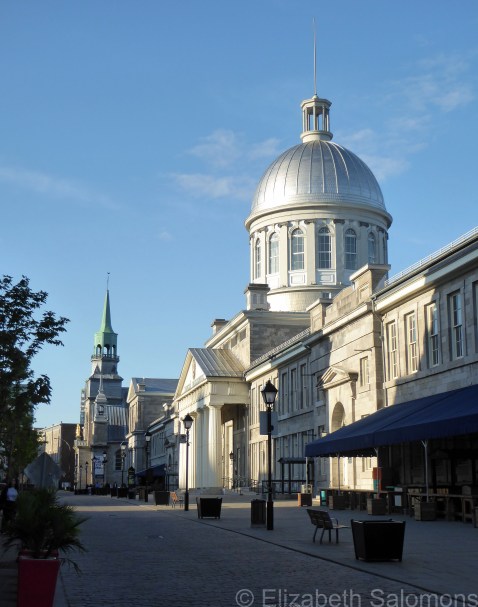
Marché Bonsecours (Bonsecours Market), below, was the public market of Montreal for more than 100 years after its completion in 1847. It also housed the Parliament of the Province of Canada in 1849 and served as Montreal’s City Hall from 1852 to 1878. It is said to have been modelled after the Custom House in Dublin, which speaks to the long history of the Irish in Montreal. The building is now home to restaurants and shops, banquet rooms, and offices.
Here is Montreal’s current Hôtel de Ville (City Hall). It was built in the Second Empire style between 1872 and 1878. For those of us who are familiar with Quebec history, it was from this building’s balcony that Charles de Gaulle, president of France, gave his infamous speech in 1967. He proclaimed “vive le Québec libre,” which then became a rallying cry for the Quebec separatist movement of the late twentieth century.

Thankfully, the movement did not succeed and Quebec is still part of Canada. And we are the richer for it.
Bienvenue à Montréal!
So. Montreal.
It had been a while since I had visited Montreal (over a quarter century, truth be told), and when you’re way out here on the western periphery of Canada, it can often feel (truth be told) as if the country stops at Toronto. My sincerest apologies to La Belle Province for my extended absence.
Having said that, I was so happy to have the chance last spring to renew my acquaintance with the second largest city in Canada. I learned a thing or two.
For one: I can’t wait to go back.
That’s in spite of the fact that my first impression of the city was this: There is an insane amount of road work going on over there. My taxi driver from the train station tried to warn me, but he used the word “construction.”
“Sure,” I nodded. “Lots of construction going on in Vancouver, too.”
But no. My taxi driver wasn’t talking about new condo developments. He meant road work. They say there are two seasons in Canada — winter and construction — and nowhere is that more true than in Montreal. Literally every street corner had a digger on it.
The other surprise for me about Montreal? That it isn’t bigger than it is. Somehow I was expecting it to be closer in size to Toronto than Vancouver, but that just isn’t so.
Here, have a look. This is the city’s skyline as seen from the top of Mont Royal.

Surf Scoter

Ever seen a Surf Scoter? In Vancouver, November is peak season to see these diving ducks. Large rafts of them hang out in English Bay where they feed on clams and mussels.

To see the ducks so close to the shore, however, is a bit unusual. I got lucky one afternoon about a week ago.

Steller’s Jay

I was beyond thrilled to see my first ever Steller’s Jay a couple of weeks ago while on a long walk through Stanley Park.
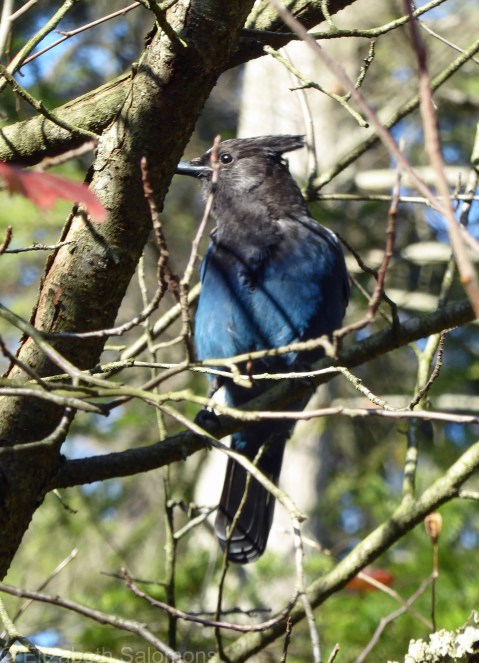
About six of them darted back and forth from the trees to the seeds put out by a fellow birder and back to the trees again.

With migration season upon us, you never know who you might bump into while out for a walk in the woods.
Through My Lens: Autumn Walk

After all my whinging about the rain, we’ve had some spectacular fall days these past couple of weeks.
And here’s a thing about Vancouver: when it stops raining, the entire city drops what they’re doing and goes for a walk.
Because, this time of year, we know it won’t last.
At the Nat

All right. It’s high time I post something to acknowledge the game often referred to as the “national pastime.”
And no, I’m not talking about Canadian federal elections — although, given our proclivity for minority governments (yesterday we elected our third fourth in 15 years), you would not be wrong in thinking so.
I’m talking about baseball. And yes, I know it’s our neighbours to the south who consider it a national pastime much more so than we Canadians do, but we do have some fans in this country. Basically, all of Toronto during the Blue Jays’ back-to-back World Series championships in 1992 and 1993. (I was one of them.)
Here in Vancouver, we don’t have a Major League Baseball team, but I know a few people who will be tuned in to the first game of the 2019 World Series, which got underway tonight.
Some of those people I’m related to, and they like to hang at the Nat every summer. I went along one night last August, just for something different to do (and to take a few photographs).
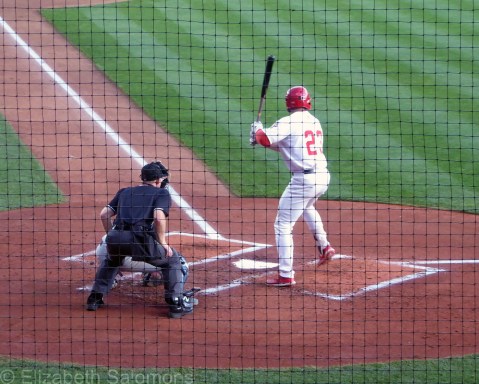
The full name of Vancouver’s ball park is Nat Bailey Stadium, named after the founder of White Spot (a popular Vancouver restaurant chain best known for their burgers). The home team is the Vancouver Canadians, the one Canadian team in the Northwest League of Minor League Baseball. They are also the Short Season A affiliate of the Toronto Blue Jays — and please don’t ask me what that means, as I have no idea. (Thanks, Wikipedia.)
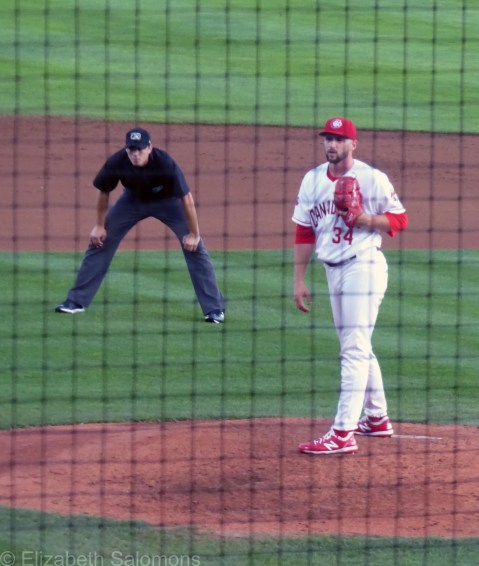
It turns out that the Nat is a really fun place to hang out on a summer’s evening — with all the emphasis on fun. Several of each season’s home games are followed by a fireworks display and one is designated Dog Day of Summer — you get to take your four-legged best friend with you to the Nat. If you’re thirsty, there is craft beer; if you’re hungry, there are three-foot long hot dogs. And for entertainment (in addition to the game, of course), there are the Sushi Mascot races — Ms. BC Roll, Mr. Kappa Maki, and Chef Wasabi race around the diamond. A winner is always declared, but if your appetite is whetted, be assured you can also get sushi at the concession stands.
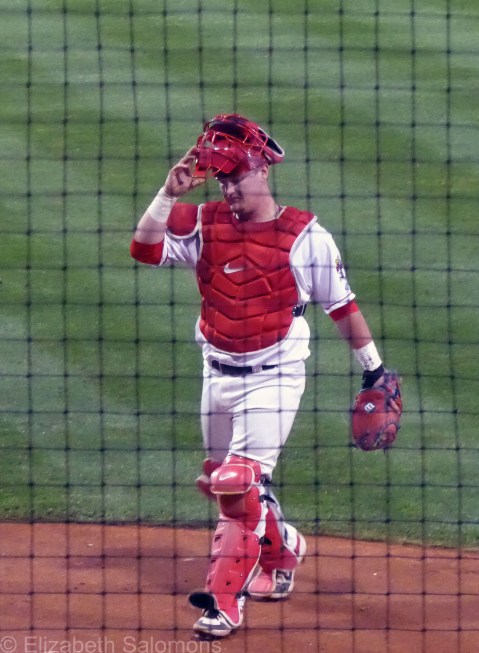
As it happens, the game I went to last August was a close one, finishing off with a walk-off single. But even if the Canadians hadn’t won, the night was winner.

Red Arrows Over Burrard Inlet

Every once in a while, I manage to be in the right place at the right time.
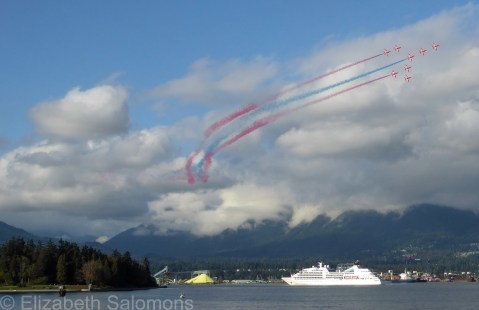
Such was the case this afternoon.
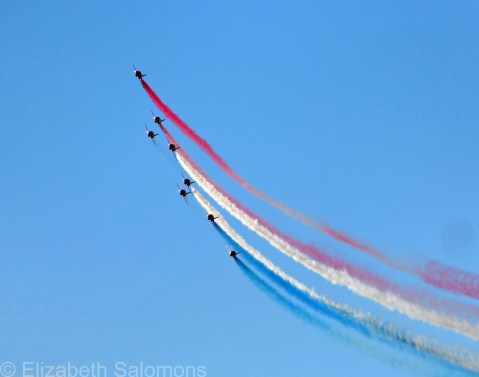
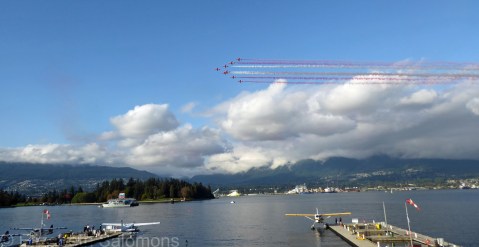
The Royal Air Force’s Red Arrows have been on a North American tour. This afternoon, they did several flypasts over Burrard Inlet.
I was there.
Return of the Wet

Enough already!!
Could this month be any wetter? Vancouver has already received more than twice the average rainfall for September — and we still have another week to get through.
Sigh.
Yes, it’s time for my annual kvetching about the transition from what was an absolutely spectacular, magnificent, fabulous summer (as far as the weather is concerned) to the annual Wet.
I know, I know. It’s inevitable. Unavoidable. What was I thinking would happen?
But did it have to happen overnight? And so close to Labour Day? This month’s quick change in seasons reminds me of Septembers in Alberta, where I grew up. The day before Labour Day always seemed like the heat of summer was still in full swing. The day after Labour Day? Out came the long pants, the woolly sweaters, and a coat thick enough to keep away the chill of the prairie wind.
When I lived in Toronto, I absolutely loved fall. Four months of humidity will do that to you. All I could think come September was, “Relief!” (Not to mention that the colour display by Toronto’s tree canopy is among the best in the world.)
But on the Wet Coast? Not such a fan. Earlier this month, I decided to put some effort into making a nice dinner one night to cheer myself up. A thought flashed through my mind — “Oh, this is cozy” — and I immediately felt betrayed by my own body for adapting much more quickly than my brain to our vanishing summer.
The truth, however, is that there is nothing for it but to get on with it. Buy a new umbrella, dig the gum boots and Gore-Tex out of the closet, and just … get on with it.
What else can I do?
Happy Autumnal Equinox, everyone!
Butchart Gardens
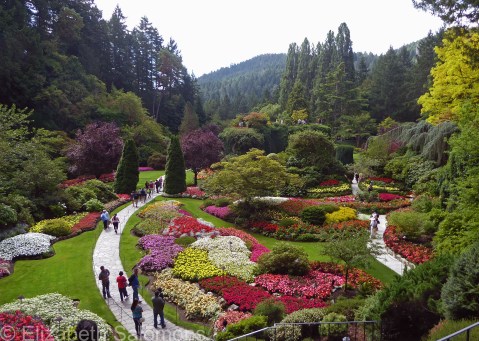
I’m so thankful there are people in this world who can see something in a whole lot of nothing.
Jennie Butchart was one of those people. She looked out over a dug-up limestone quarry and saw a garden.

Painstakingly planted and nurtured by Jennie and her descendants, the Butchart Gardens are the crown jewel of Victoria’s gardens — a city whose nickname is, appropriately, Garden City.
There are four gardens at Butchart, each one unique and each one remarkable. The Sunken Garden was the first to be developed, on the site of the old quarry. As the limestone was exhausted, Jennie began planning her garden. She had top soil brought in by horse and cart and the five-acre garden took nine years to build.

Next to be built were the Japanese Gardens. In the springtime, it is bursting with colour when the rhododendrons and azaleas are in full bloom. In the fall, the Japanese maples glow orange and red.

The Butchart family’s former tennis court was eventually transformed into the Italian Gardens.
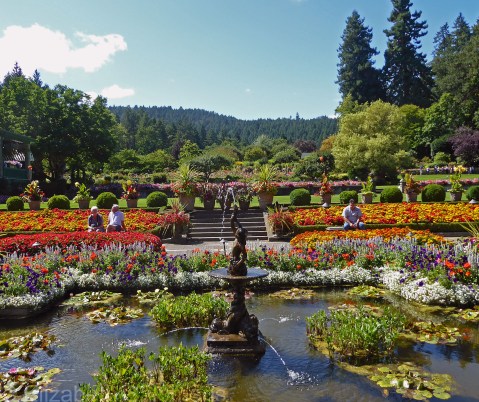
Last to be planted was the Rose Garden. Today, it has 30 rose arches and 280 varieties of roses.


New to me was the Mediterranean Garden — a fifth garden that has been added since my last visit.
My friends and I spent most of a Sunday marvelling at and photographing the flowers at Butchart Gardens. We wondered aloud whether the colour palette of the Sunken Garden changes from year to year. We enjoyed gelato in the Italian Gardens. And we all agreed that the one-year pass is an incredible deal (paid for in as few as two visits) because the gardens need to be seen in all four seasons.


I was a teenager the first time I went to Butchart Gardens, but regardless of whether you see it only once in your lifetime, or you return dozens of times, know this: each visit is as mind-blowing as your first visit.

Happy Birthday, Canada Line!

Ten years ago today, and three months ahead of schedule, the Canada Line came into service. Built for the Vancouver 2010 Olympics, it connects downtown Vancouver to the airport in 24 minutes. (That’s as fast as a taxi and a whole lot cheaper.) Right from the start, it exceeded ridership estimates and is already running nearly at capacity.
The Canada Line has forever changed how I travel to and from Vancouver. Being able to get from my downtown condo to the Vancouver International Airport (known as YVR around town — the name of the Canada Line station is YVR Airport) as quickly as I can for only $2.50 is a traveller’s dream.
It has also forever changed this city. High-density residences and retail spaces that weren’t even dreamed of ten years ago have been built at Marine Drive and are in the planning stages for Oakridge. I saw a quotation this week that pretty much summed up how the Canada Line has changed Vancouver: “you don’t build urban rail primarily for transit, but for shaping growth.”
And so … happy birthday, Canada Line!


 There and Back Again