
Queen of Canada

To you, she was your Queen.
To us, she was the Queen.
— Emmanuel Macron, President of France
I don’t remember how old I was when I became aware that I shared my name with Queen Elizabeth. But you can bet I thought it was pretty special.
I mean, what little girl wouldn’t? (Even though, in truth, I am named after my grandmother.)
My first trip overseas — the one where I caught the travel bug — included a stop in London. It was 1977, the year of the Queen’s Silver Jubilee. We were there in mid-August, long after the festivities were over, but while the Mall was still adorned in Union Jacks and silver beads. I remember those beads so vividly.

The Mall in 1977
My mother bought a tiny Silver Jubilee souvenir plate on that trip to London; somehow it ended up on my kitchen counter where it now holds my bottle of extra virgin olive oil (to keep the oil dribbles from ending up on my counter — as you do with jubilee souvenir plates).
On that trip, my first of many visits to London, I wallowed in all the pomp and ceremony that makes London unique among European capitals. I was dazzled by the Crown Jewels in the Tower of London, and I was mesmerized by the palace guards.
Last June, when I turned on my TV and watched the Trooping of the Colour and then, two days later, the Platinum Party at the Palace, I thought to myself, “Wow, I so prefer the under-stated British patriotism to the over-the-top American version.” I wondered what it must’ve been like for the Queen, grieving for her father while undertaking a massive job much earlier than she anticipated, and in a man’s world to boot. She was a young, working mother before society ever came up with the term (as if mothers are ever “non-working”). I marvelled at how the Queen found a way to make her mark so early on, surrounded by all those old men in suits.
I thought about how long seventy years is. Much has been made of the fact that Winston Churchill was her first prime minister, but I was shocked to realize she acceded the throne while Stalin was still ruling Russia. Twelve of Canada’s 23 prime ministers have served under Queen Elizabeth. She’s been our Queen for almost half of our existence as a country.
World War II and the Covid-19 pandemic bookend the second Elizabethan Age, which seems fitting. She made her first radio address in October 1940 to the children of the Commonwealth, many of them evacuees, while still a child herself. One of her last TV addresses (not counting her annual Christmas message) was in April 2020, where she referenced that 1940 radio broadcast and talked about the pain of separation from loved ones.
We’re told the Queen loved Canada. She visited us the first time as a princess, and then 22 times as Queen. I remember standing in front of Edmonton’s Government House for a chance to see her during one of those visits.
It was 1978, and the Queen, Prince Philip, Prince Andrew, and Prince Edward were in town for the Commonwealth Games. My dad rather spontaneously decided one evening that our entire family should go watch in person as the Royal Family arrived for a formal dinner. After a very long wait, we were ecstatic to see how close we were when the cars pulled up. Just feet away from us! Except, much to our disappointment, all we could see were the backs of the Royal Family as they turned away from us to be greeted by the premier and other dignitaries.
Those of us on the far side of the cars began hooting and hollering. We were noticed — the Queen and her family turned towards us and gave us that royal wave. And then — whoosh, they were swept indoors.
The crowd felt it was much too quick of a glimpse and we all began hollering again. “We want the Queen,” we yelled. And not long afterwards, the Royal Family obliged us and came out onto the balcony of Government House to give us another royal wave.
It wasn’t Buckingham Palace, but it was a balcony.
Like the rest of the country, I woke up on September 8 to news that the Queen was under medical supervision. I tried to work, but kept the live feeds of both BBC and CBC open on my computer, watching, listening, waiting. I was quite surprised at my reaction when the news came. Tears, yes, and shock. And I realized that I somewhat bizarrely thought she would live forever. How silly of me.
What hasn’t surprised me since is the outpouring of love and affection for her from all over the world. That people would queue overnight to see her lying-in-state? You only have to watch it online for a few minutes to realize what a moment that would be, walking past the Queen’s coffin in person.

Half-Mast Canadian Flags in English Bay
What has surprised me is all the ritual surrounding King Charles III’s accession. Who knew there would be so much ceremony, both in the United Kingdom and in the Commonwealth? It’s made me wonder about my monarchist tendencies for the first time ever. Yes, the rituals of accession go back thousands of years. Yes, tradition is important. But when you live in a time where change happens at lightning speed, it’s become commonplace, you might say traditional, not to hold on to traditions.
The notion of a hereditary head of state does seem pretty strange and out of date in today’s world. But when I look at countries like Japan, Norway, the Netherlands, … Canada … and then compare those democracies to republics with elected heads of state (especially the one to the south of us), well, I’m still all in when it comes to a constitutional monarchy. From where I’m standing, it looks like a stable and reasonably effective way to run a country.
I’ve always known that the Queen is Canada’s Queen, and Head of the Commonwealth, but it wasn’t until these past ten days that I clued in to what the realm is. That’s us — the fifteen countries that had Queen Elizabeth II as our Sovereign, and now have King Charles III.
I know there’s going to be a lot of rumbling about whether it’s time for Canada to become a republic, like Barbados did just over a year ago. Except for one little problem. When we patriated our constitution back in 1982 — that’s when the Queen made a special trip to Ottawa to sign what I always thought of as the divorce papers — we gave ourselves an impossible amending formula. Instead of having to go to the Parliament of the United Kingdom to amend our Constitution, we now have to sort it out ourselves. Dumping the monarch would require an amendment, and the chances of us ever coming to an agreement about how to do that are pretty much nil.
Canada is the largest realm, after the United Kingdom, and our delegation to the Queen’s funeral was also one of the largest. This morning’s procession from Westminster Abbey to Wellington Arch was led by four Royal Canadian Mounted Police on horses gifted by the RCMP to the Queen. In addition to the current and former prime ministers and the current and former governors general, the three main Indigenous leaders went along: the President of the Inuit Tapiriit Kanatami, the National Chief of the Assembly of First Nations, and the President of the Métis National Council. Their attendance goes far beyond symbolism. It’s a recognition that there is still much work to be done in terms of reconciling Canada’s colonial past. There are calls for King Charles to make a public apology to the Indigenous peoples who live in Canada. I expect it will come, eventually, because all institutions, even the British Monarchy, must adapt and change to stay relevant.
Near the end of our 1977 trip to London, I remember my dad asking each of us kids what we thought of when we heard the word “London.” I said Parliament Square.
My family was surprised. They expected me to say the Crown Jewels or the Changing of the Guard, knowing how enamoured I was with both, but Dad understood my thinking. At Parliament Square, you can see both the Palace of Westminster and Westminster Abbey — the monarchy, the parliament, and the church — in one sweeping glance.

There’s a portrait of the Queen that was taken after her coronation. You know the one: she’s wearing the Imperial State Crown, and holding the orb and sceptre, all of which adorned her coffin this past week. Behind her is a backdrop showing the Henry VII Chapel of Westminster Abbey. That’s the chapel where fifteen kings and queens, including Elizabeth I, are buried. It takes your breath away when you stand inside it.
If Parliament Square is what I think of when I think of London, then that portrait of the newly crowned Queen Elizabeth II is what I think of when I think of the Queen.
Our Queen.
Travels With My Friend
I was supposed to be travelling back from Nova Scotia today.
But I’m not. Instead, I went in early August. And instead of going to say good-bye to a close friend in person, I went to celebrate her life after she was gone, along with her family and friends.
These are hard words to write. You always think you’ll have more time. My friend thought she had more time — it was her suggestion I come see her in September, when all the tourists would be gone but the weather still like summer. She herself had a busy summer planned — travel, time with family, time with other visitors — and so I took the early-September slot.
I knew it wouldn’t be a normal visit. I knew she was much weaker than I’d ever seen her. I knew it would likely be the last time I could see and talk to her in person.
You always think you’ll have more time.
This is my travel blog. So why am I writing about the loss of my friend?
Because she was the best travel companion I’ve ever had.
I suppose that’s not a surprise. When you travel with your best friend, a person with whom you share so many of the interests that make travel so memorable — art, architecture, music, literature, good food — it makes travelling together so easy. Maybe it worked so well for us because we lived on opposite ends of the country, and so our periods of travel became our time to reconnect and to nurture our friendship.
After she was gone, I counted up how much of my travelling involved her.
Seventeen. Seventeen trips. Some of them as long as two weeks, others as short as a weekend.
It all started with a road trip. At that point, we were casual acquaintances, part of a crowd of thirtysomethings who hung out together in Toronto. One of my roommates was dating one of her roommates. We went to the same parties, had brunch together on Sunday mornings after church.
She told me about her upcoming trip to New Orleans. A mutual friend was driving her down for a job interview she had lined up with the New Orleans school board (she was a newly accredited teacher at the time, eager for a full-time teaching position when those were hard to come by). The two of them were also planning to go to the New Orleans Jazz Fest.
“I’ve always wanted to go to New Orleans,” I said.
“Why don’t you come with us?” she replied. It wasn’t an idle invitation — I could see she meant it. I had lots of flexibility with my time that year as I was finishing off a master’s degree while launching my freelance editing career. I was making slow progress on both at the time, so it wasn’t much of a decision for me.
“OK,” I said. “I’m in.”
I learned a lot about her on that trip. We enjoyed a memorable evening of live blues on Beale Street, saw Graceland, and had a bizarre three-hour tour of a Mississippi plantation where our tour guide looked old enough to have fought in the Civil War himself and we were the only tourists in sight.
What impressed me most about that trip was watching how my friend faced her fears. She was terrified of snakes, yet insisted we go for a long walk along creaky boardwalks through a Louisiana swamp. As we tramped along, she jumped at least a foot in the air at every little noise, convinced she would step on a snake before the walk was over. But she refused to turn back.
That road trip was the beginning of a friendship that lasted a quarter century. She introduced me to New York, a city she loved, and we went back several more times. The winter I spent in Paris, she joined me for Christmas and New Year’s. She couldn’t believe I had never tasted coq au vin, and so she insisted on teaching me how to make it. Chicken stewed in wine? Yes, please.
Another year she invited me to join her family in Florida for New Year’s. There were weeks in London and San Francisco, and a ski weekend in Whistler. We kayaked the Broken Group Islands (twice!) and Desolation Sound.
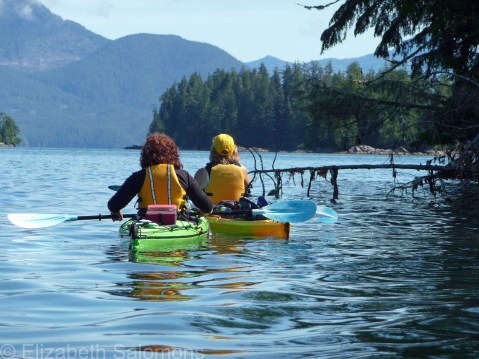
Kayaking in the Broken Group Islands, British Columbia
The summer she spent in Siena studying Italian art, I was in Prague on a writing course. We decided to meet up afterwards — or rather, I invited myself to stay in her dorm room for a few days before I had to travel on to Amsterdam to meet up with my father.
I tagged along when their entire class went to Padua to look at frescoes. We booked ourselves into a hotel room for two nights, along with some of the friends she had made on the course, intending to spend the next day in Venice. Being summer in Italy, it was hot, so we got an early start. By late afternoon, we were all knackered. There were five of us in total, and we decided to take a gondola ride. That led to beer and pasta with our gondolier. And that led to some of us sneaking out to smoke a joint along the canal with said gondolier. (You all know where this is going, right?)
To keep it short: we missed the last train to Padua. Five Canadian women looking for hotel rooms in Venice, at midnight in the height of tourist season. It wasn’t pretty.
But that mishap led to a lovely bonus day in Venice, and three of us decided to go to Murano, one of the islands adjacent to Venice, for lunch. My friend urged me to order the Caprese salad as I had never had it before. I was converted.
In addition to all of our, ahem, travel adventures, there were the numerous times she opened up her home to me whenever I was in Toronto. I would do my rounds of networking, as I called it, with clients, but I always had lots of catching up to do with my friends from when I lived there. She told me I was the perfect guest because I was never home, but, in truth, she was the perfect host.
Because of that hospitality, I always gave her first dibs whenever I lined up a home exchange, and she never said no. She joined me for 10 days the summer I was in Amsterdam — scheduling her time with me in between the chemo treatments for the disease that would eventually claim her life. I marvelled at how well she was doing. I could not keep up with her as we walked through the city’s streets. One day we cycled 20 kilometres to Haarlem and back. It was her idea to bike and that was the only day I could see she wasn’t 100 percent. She was close to collapsing when we pulled up to a café alongside a canal.
“You go sit,” I said, pointing to an empty table outside the café. “I’ll lock up the bikes.”
We spent another day in Delft, one of my favourite Dutch cities. It also happens to be where my friend’s father was born. She told me stories of childhood visits and we went looking for the house where he had lived. I’d met her father only once or twice, which is maybe why I could easily picture him as a small school boy running at top speed alongside the canals.
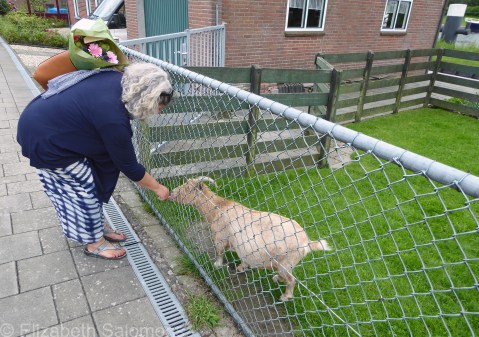
Interacting with the Dutch wildlife
In 2018, we spent a week together in San Francisco. We cycled across the Golden Gate Bridge to Sausalito — that time it was my turn to almost collapse at the end of our ride. And she joined me for a weekend in Montreal where I had another home exchange arranged. That was 2019. I had no idea at the time that it would be the last time I would see her. How could I? The pandemic kept us apart after that.
My friend was a high school photography teacher and she showed me the best places to catch that unique photo. Like the Eiffel Tower from a side street I would have never found on my own. We both loved taking photographs in old cemeteries, and so, on one of my visits to Toronto, she showed me the Necropolis, which has some of the city’s oldest graves. It was a warm summer evening, and we soon lost track of the time. Or maybe we didn’t know that the gates would be locked at 8 p.m.
Ever struggle to climb over a wrought iron fence in a short skirt? She had a good laugh that time — at my expense.
She never said a word about my photography skills until I asked her for feedback. “Well,” she said slowly. “Your horizons aren’t always level. And check your corners. You want to edit out any distractions.”
Needless to say, every time I edit my photos, I’m checking my corners. And thinking of her.

Photographing Gertrude Stein’s grave in Père Lachaise Cemetery, Paris
She was a far better friend to me than I was to her. There was one travel dream I had, a trip I haven’t yet taken and likely won’t, and years ago, when I first brought up the idea, she had mixed feelings about whether she wanted to join me. But later she told me about a conversation she had had with her mother. “You know,” she told her mom, “I really have no burning desire to make that trip. But it’s important to Elizabeth, so that’s enough of a reason to go.”
Who does that? Not me — that’s for sure.
I’m shattered I didn’t get one last visit with my friend and a chance to say good-bye in person. But I am so incredibly grateful she was able to spend her last years in Nova Scotia, surrounded by her family and by so much love. And I’m so grateful they shared her with me for so many years.
I will miss her more than I can say.
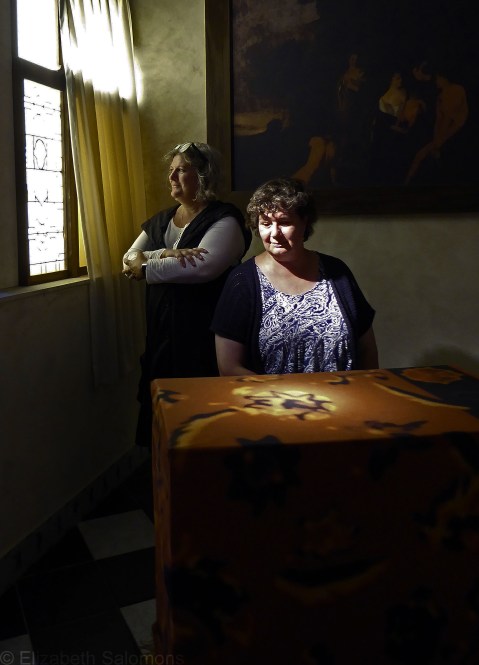
Having a bit of fun at the Vermeer Centrum Delft
Supply Chain Issues
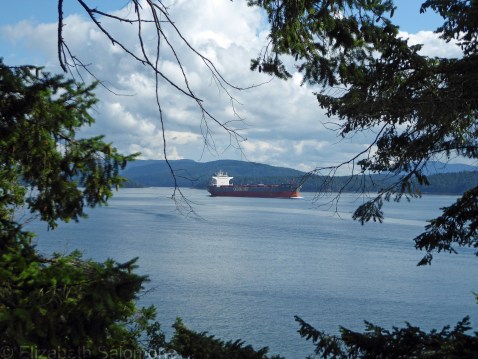
Supply chain issues seem to be a fact of life these days. Whether it was the lack of flour and eggs in our grocery stores back in March 2020, the recent shortage of infant formula in the United States, or (my latest issue) having to wait up to two months for a backorder of my preferred brand of cat food — all these things make us stop and think, “Wait a minute. What’s going on here?”
I learned on my last visit to Galiano Island that freighters like to park themselves just off the northern tip of the island while waiting for an empty berth at the Port of Vancouver. English Bay always has a number of waiting freighters as well, but when the bay is full, those ships have to look elsewhere for a place to anchor and wait. Vancouver is Canada’s largest and busiest port, with 3000 ships arriving every year. That’s a lot of ships and an awful lot of waiting time.
But while on Galiano again last weekend, I was surprised to learn that often these ships are waiting for what seems like an awfully long time. The container ship in this next photo? It was sitting off the north end of the island for three weeks.
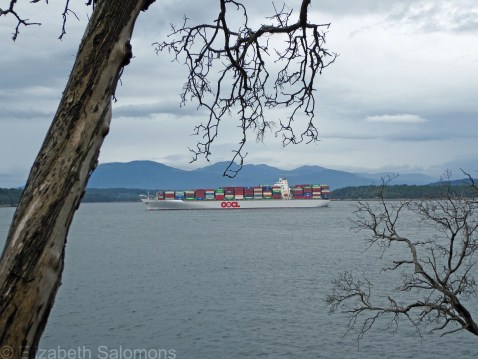
I can’t see any way that a three-week delay to offload a fully loaded container ship from Asia doesn’t add to our supply chain problems. Not to mention the cost of goods.
Or the seafarers stuck on board. Waiting.
Happy Canada Day!
It’s been a while since we’ve been able to celebrate our national holiday together. This year is the first in three years that we can gather in large crowds again. I went down to Canada Place this afternoon to have a look. It’s almost other-worldly to see so many people all together in one place.
Typically, on Canada Day, I post a photo of the Canadian flag. We call it the Maple Leaf, our flag, and we’re rather proud of it. Last year, however, I just couldn’t do it. It wasn’t the pandemic or the fact that we couldn’t celebrate together that made me reluctant to post about Canada Day.
No, it was because of the grief. And the horror.
The horror was learning, only a few weeks prior to Canada Day, that there were more than 200 unmarked graves at the former residential school at Tk’emlúps te Secwe̓pemc, near Kamloops, BC. In the year since, many more unmarked graves across Canada have been detected using ground-penetrating radar — and many more will be in the future.
Indigenous peoples have always known about these graves, but, sadly, it took other Canadians — those of us who chose to come to Canada or were brought here by others — a lot longer to accept that truth.
And that was the root of my grief. How is it our country went through an entire Truth and Reconciliation Commission and I still didn’t understand that children had died?
So that’s where I was a year ago. I wasn’t sure how or even if I should celebrate a country that exists because it colonized, exploited, and murdered other peoples.
A year on, our country is fumbling its way towards acknowledging the truth part of truth and reconciliation. And many communities across the country found ways to celebrate Canada Day while honouring that truth in our path towards reconciliation. Today’s festivities at Canada Place were planned with the Indigenous peoples of Vancouver on whose unceded and ancestral territory we live: the Squamish, the Musqueam, and the Tsleil-Waututh.
We have a long ways to go, but it’s a start.
I’ve been thinking today about that Canadian flag we’re all so proud of. It’s become a symbol of the so-called Freedom Convoy that occupied and terrorized Ottawa last winter for several weeks, and is trying to again this weekend. When I saw a car drive by me this morning with two small Canadian flags attached to each window, my initial reaction was to cringe. Because the flag in Canada has become a symbol of protest.
And so, this year again, I was wondering how to celebrate our flag and this day.
But then I listened to the Canada Day message of our Prime Minister. He made a point of talking about our Canadian flag, the Maple Leaf, and reminded us that it is more than a symbol. It is a promise: “a promise of opportunity, a promise of safety for those fleeing violence and war, and a promise of a better life.”
I thought about all those people who have come to Canada on the basis of the promise that they could be free. That includes the most recent refugees to arrive — from Ukraine, from Afghanistan, from Syria — as well as the many others that came before them, for generations.
A few years ago, I had the honour and privilege to witness 57 people from 18 countries take the oath of citizenship and become new Canadians, including a dear friend of mine. The citizenship judge had a lot to say, but these words I will remember forever:
Canada didn’t happy by accident.
Diversity is our strength.
If that judge’s words aren’t a much-needed antidote to current world events, I don’t know what is. And so I will once again proudly celebrate Canada Day, and our flag, while acknowledging that our country is a work-in-progress.
As all countries should be.

Through My Lens: Delphiniums

Summer has finally arrived in Vancouver. Better late than never, I say. We had our first hot stretch this past week and I tell you, it was glorious.
Two nights ago, I headed over to the Stanley Park Rose Garden because I knew the roses would be in full bloom. And they were. So beautiful.
But what really grabbed my attention were these delphiniums. I could not get over the vivid blues and purples.
Stunning.
Juneuary
I know, I know. I keep saying I won’t write about the weather. And then I do.
It’s just that … well, when you live in Vancouver and the weather is great, there is nowhere you’d rather be. But when you live in Vancouver and the weather is awful, there is literally anywhere you’d rather be.
Such has been the case these past few months as we endured the coldest spring in 77 years. That’s quite the record.
This month, we’ve been enjoying a typical “Juneuary.” Every June, a low pressure system moves in over the Lower Mainland and hangs around for most of the month. Cold days, colder nights, and rain, lots of rain. It’s been the wettest June in 30 years, and on June 9, the 26.3 mm of rain that fell made it the wettest June 9 since 1937.
We skipped Juneuary in 2019 and 2020, but it was back with a vengeance in 2021, although most of us quickly forgot about it as soon as the heat dome rolled in. Thankfully, it doesn’t look like we’ll have to endure one of those this summer.
The good news about the cool temperatures is that the unusually large snow pack is melting slowly. We don’t want — or need — any more flooding in this province.
And apparently summer temperatures are just around the corner. I cannot wait.
Here’s a photo of the barge that came ashore last November on the beach at the end of my street. It’s still here, seven months later — no longer an oddity, just an eyesore.
Not to mention a constant reminder that nothing is as it should be with our climate.

The Beginning of the End?

Look who’s back!
Yesterday, Vancouver welcomed its first cruise ship in 891 days. Holland America’s Koningsdam stopped for a day at Canada Place, after spending Saturday in Victoria. If ever there was a sign that we are past the pandemic, I’m thinking this is it.
Except we’re not past it. Not really. A sixth wave is on its way and those of us who are immune-compromised or work in health care or have friends or family who are immune-compromised or work in health care or are not yet eligible for vaccines (think babies) know there are still lots of risks. There has been an awful lot of talk about how we have to learn how to live with Covid, which doesn’t seem to give much consideration to those still at high risk of dying of Covid.
That aside, tourism is a billion-dollar industry in Vancouver, and those of us who work in tourism and hospitality welcome the news that our city is once again a safe destination for anyone who wants to visit. The Port of Vancouver has offered shore power to cruise ships since 2009, which means that 60 percent of the ships that dock here can run on lower-emission electrical power while in port instead of their diesel-powered auxiliary engines.
While I was taking this photo, a so-called Freedom Rally was gathering behind me to protest vaccines. I’m not sure what their issue is at this point since all of BC’s remaining restrictions concerning Covid-19 were lifted last week.
As I watched the protestors for a moment, a young man walked past me, wearing a black sweatshirt with the word “Ukraine” in large blue and yellow letters. The irony of the moment made my head spin.
Through My Lens: Burrard Bridge and the Blossoms

April is peak cherry blossom time in Vancouver, but it seems like most of the blossoms have popped in just the past week. I took this photo of Burrard Bridge from Sunset Beach two days ago.
Through My Lens: English Bay Sunset

Here’s what I absolutely love about my neighbourhood: when you walk out the door, you have no idea what awaits you.
This was our sunset two days ago — a welcome sight after many cloudy, rainy days.
Sister Cities, Sister Countries
Dr. Martin Luther King Jr. believed that the arc of the moral universe is long but that it bends toward justice. He also knew that there are evil men in the world, who seek to thwart that benign curve and push us all back into darkness. Because of those men, there are moments in history when the great struggle between freedom and tyranny comes down to one fight, in one place, which is waged for all of humanity. In 1863, that place was Gettysburg. In 1940, it was the skies above Britain. Today, in 2022, it is Kyiv. — The Honourable Chrystia Freeland, Deputy Prime Minister of Canada
As I am watching, reading, and doomscrolling these past three weeks, what has surprised me most is the resurfacing of long-buried fears. A lifetime ago, when I was in high school, the marches were about nuclear disarmament, not the climate crisis. We had long class discussions about the chances of a nuclear holocaust wiping out the human species. The last gasp of the Cold War was a fearful time to be a teenager.
Same song, different century.
The Russian invasion of Ukraine is reminiscent of another war waged in the last century, but recent enough to bring up familial memories for those of us who came to Canada from Europe. My mother was born in Nazi-occupied Holland. I often wonder what impact living through war the first five years of her life had on her psyche.
What memories of this war will Ukrainian children carry for the rest of their lives?
I have long known that my mother’s family had been forced out of their home by the Nazis for the last winter of World War II. But a month ago, I was shocked to learn that the neighbourhood where they spent that winter underwent an artillery bombardment by the Canadian army in its fight to liberate the city. Pamphlets were dropped from the sky to warn the residents of the upcoming shelling, which went on for hours. Nineteen people died. I was so floored by this revelation that I spent the next week wondering how it was I’d never heard about it.
Floored, because I had also long known that my thirteen-year-old uncle was killed the same day. A stray artillery shell had landed in the street and bits of shrapnel went flying. My mother remembers being thrown down the stairs into a cellar by an uncle after the explosion. But I was never told about a bombardment. How do you forget undergoing an hours-long artillery barrage?
Then I remembered the Sunday afternoon I spent with two cousins some months ago. As we looked through old family photographs, I came across a letter in which a relative of my mom’s described her memories of that day — the day my uncle died. She wrote how the extended family had been all together in one of their homes, but in the next town over. Several relatives were injured that day; the letter writer’s sister had a piece of shrapnel embedded in her leg for years afterwards. Perhaps my mother and her family were there not to celebrate their liberation (as my cousins had always been told), but to escape the shelling where they were living?
It still leaves unanswered questions. How did the family know when it was safe to return home? What was left of that home when they returned?
More than three million Ukrainians are wondering when it will be safe to return to their homes. Are wondering if they have homes to go back to.
When a girlfriend and I travelled around Europe in the mid-1980s, we spent a long, cold night on a Yugoslavian train filled with drunken conscripts on their way to boot camp. That’s how I learned that almost every European country had compulsory military service at the time. That’s when I realized only a simple accident of geography — and my gender — kept me from going through a similar rite of passage.
The NATO-aligned countries abandoned conscription after the end of the Cold War. Ukraine did too, in 2013, and then reinstated it in 2014. We’ve all heard how men aged 18 to 60 are not permitted to leave Ukraine right now. What isn’t getting anywhere near the same attention is that almost a quarter of Ukraine’s soldiers are women. Many of these women are bringing their children to the border, handing them over to distant relatives, and then going back to fight in a war they didn’t want, a war they didn’t ask for.
When you grow up on the Canadian prairies, you are deeply aware of the significance of the Ukrainian-Canadian community, so I was not surprised to learn that Canada has the second-largest diaspora of Ukrainians anywhere in the world. What I did not know is that Vancouver and Odesa have been sister cities since 1944. Like Vancouver, Odesa is a port city. Like Vancouver, it has beauty — its historic centre is a World Heritage site. But unlike Vancouver, it is piling sandbags in front of its monuments and lining its beaches with landmines in anticipation of a Russian attack. Half a million of Odesa’s residents have fled. What is remarkable is that the other half million have stayed.
As we watch the Ukrainian people suffer and die in real time, it is difficult to not feel despair. I fully expect the repercussions of this war to be as consequential as anything we have lived through in our lifetimes. As a teenager, I feared the outcome of a Cold War that had been going on for so long I never expected the Berlin Wall to ever come down. As a child, my mother fled her home and watched bombs rain down on her city right up until the day they danced in the streets to celebrate their liberation.
One day the people of Ukraine will rise up again to celebrate.
Because the alternative is unthinkable.

Vancouver City Hall


 There and Back Again