
Through My Lens: Holiday Orca

Here’s one more holiday photo to finish out the year. This magnificent orca whale is a new display for 2015. Made by hand in Slovakia, it contains 6000 LED bulbs and was put up in Morton Park at English Bay as part of this year’s Lumière Festival.
A rather spectacular addition to the neighbourhood, don’t you think?
Through My Lens: Robson Square Ice Rink

Robson Square Ice Rink was looking mighty festive tonight. I wasn’t the only one who thought so ― check out the line of people on the left side of the photo. They’re all waiting for their turn on the ice.
Merry Christmas!
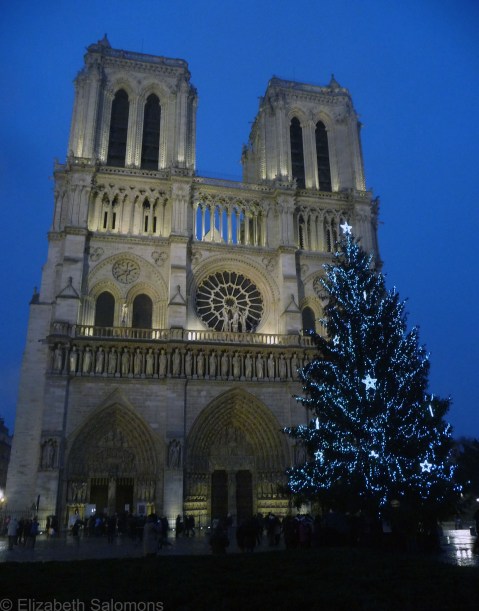
Cathédrale Notre-Dame de Paris
Canyon Lights

The Capilano Suspension Bridge has been a Vancouver attraction since 1889 when George Grant Mackay, the man who owned the land on either side of the Capilano River, built a footbridge out of cedar planks and suspended it over the canyon using hemp rope. The bridge and the park that has developed around it is still privately owned and, to my mind, far too commercialized and far too pricey for what it offers. There are heaps of forest walks and plenty of other bridges to be accessed for free on the North Shore as an alternative to the Capilano Suspension Bridge. It’s on those walks and to those bridges where I take my out-of-town visitors who want a taste of the region’s rainforest.
However, sometimes out-of-town visitors have an agenda of their own and you end up tagging along wherever they want to go. I’m easy. I mean, it’s their vacation, right? And who knows? I might learn something new or see something spectacular.
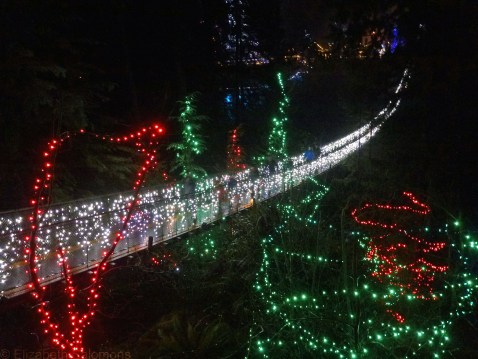
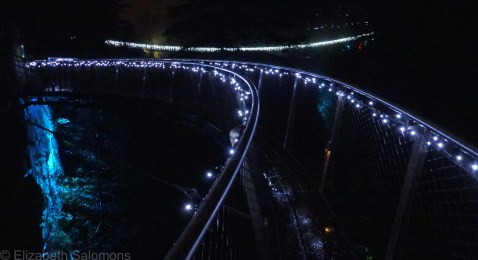
Such was the case when last week a friend of mine in town for the holidays wanted to see the Canyon Lights at the Capilano Suspension Bridge. In its tenth season, these light displays are part of the park’s massive efforts over the past decade to draw in more and more visitors.
And here was the surprise for me: the Canyon Lights are tasteful and magical, and I highly recommend them as a Vancouver tourist attraction if you happen to be visiting during the holiday season.
Here, take a look. (Click on any photo to open up the slide show.)


Capilano comes from Kia’palano, the name of a Squamish chief during the early 1800s. It means “beautiful river.”

One last note: if you have a fear of heights, Capilano Suspension Bridge might not be the place for you. But here’s a pro-tip: in the dark, you can’t see how high up you are!
Through My Lens: Prague Christmas Angel

Of course, the bonus about getting to spend the winter in Paris are mini-breaks on the European continent.
Which I experienced one December weekend five years ago when I easyJetted off to Prague for the weekend.
Which is when I took this photo.
Parisian Cafés
Every year around this time, I get homesick for Paris, but this year, my mind has been on Paris far more than usual.
I’m sure it’s obvious why: the media coverage on that city has been pretty much nonstop since the Paris attacks a month ago. Attention ramped up again this past weekend when 195 nations at the 2015 United Nations Climate Change Conference, or COP21, adopted what’s being called the Paris Agreement.
In short: all eyes ― not just mine ― are on Paris right now. And so, bear with me as I write (yet) another post on my second-favourite city in the world.

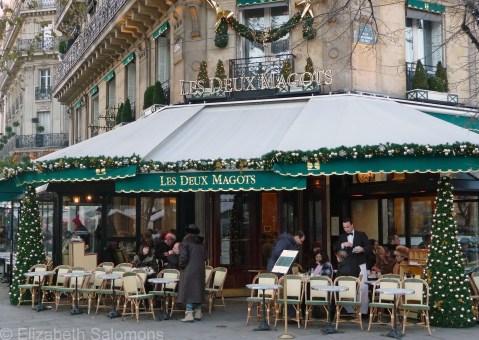
Whenever I think back to my winter in Paris, I think of the impressive light displays put up to celebrate the holiday season. The many elaborately decorated Parisian cafés were particularly impressive, with nothing ever done in half measures. (Is that a French thing? Or a “keeping up with the Joneses” thing? I dunno, but I sure enjoyed the results.)

Parisian cafés are special places. In the mind of most visitors to Paris, there is nothing more French than sitting down in a café and ordering un café or un verre de vin. One quickly learns ― and adapts to the idea ― that your one drink buys you the table for as long as you want it.

Which could be hours. Whether you sit there alone, reading or writing or people-watching, or sit there with your family or friends, it doesn’t matter. You will not be rushed. Time stops.

Because they serve beer and wine in addition to all manner of caffeine, Parisian cafés are, technically speaking, café-bars. They also have complete kitchens, which means you can get a three-course meal any time of day. (Cafés are open from morning until late at night, whereas Parisian restaurants generally close for the afternoon.)

As an oftentimes solo traveller, what I especially like about Parisian cafés is the lack of stigma to eating alone, which has not been my experience in other European countries.
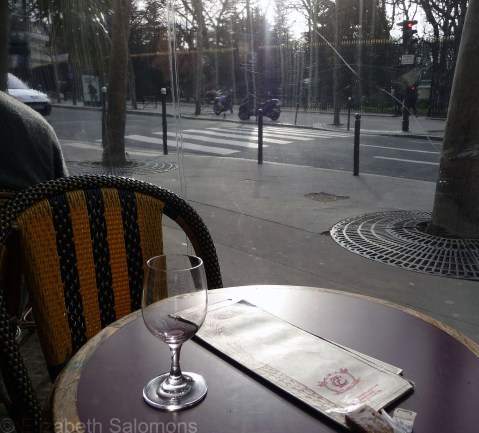
The oldest café in Paris is Le Procope in the 6e arrondissement. It opened for business in 1686, shortly after coffee was introduced to the French. My New World brain can’t quite fathom a restaurant that’s been around since a century before the French Revolution.

In time, Parisian cafés became the centre of French discourse and intellectual life, the place where politics and art and philosophy were discussed. Today, there are more than 12,000 cafés in Paris ― one on every corner, it seems, in some arrondissements.

The Paris attacks of last month were horrific and shocking. What was especially horrific and shocking is that Parisians were attacked while enjoying the very essence of what makes them Parisian: having a drink in a café.
Just as I cannot imagine Christmas in Paris without dazzling light displays, I cannot imagine a Paris where fear and trauma have overtaken the café experience. I hope and pray that the magic I felt five Decembers ago in the City of Light is still there. And my Christmas wish for all Parisians is simply this: that they spend the holiday eating and drinking and laughing and loving.
In other words, that they have a Joyeux Noël.

City of Light
My sister and I, along with one of my closest friends, were wandering the streets of Paris, admiring the lights of the season in the City of Light. It was magical. It was Christmas Eve, 2010.
We made our way to Notre-Dame Cathedral. The streets radiating away from the square in front of the cathedral were filled with French police officers sitting in well-lit white police vans, each one eating a rather fine-looking dinner from a take-out container. We approached the cathedral. A pair of cops eyed us carefully as we walked between them to enter the church.
It was unnerving, to say the least. The scene was repeated on New Year’s Eve when my friend and I crossed the Seine in front of the Eiffel Tower. We stopped to take photos of the tower, then I began taking photos of the police officers once again eating fancy dinners in white police vans parked along the bridge. I hadn’t taken more than one or two shots when the driver’s door of the van I was photographing opened. The officer got out and began to walk towards me, and I quickly tucked my camera into my pocket and turned away. Message delivered, the cop returned to the warmth of his van and his waiting dinner. My heart was pounding.
On Christmas Eve, after we exited Notre-Dame Cathedral, my friend marched up to one of the police officers standing nearby. These were big guys. They had big guns ― bigger than any I had ever seen up close. I had no idea what she was planning to do. But as soon as my friend asked (in French) for directions to the nearest Métro entrance, the cops smiled and laughed and showed us their friendly side. It was a welcome relief from the gravity of their security duties.
“I was beginning to feel so uptight,” my friend told me later. “I had to put a voice to the men with the guns.”
As it turned out, the officers sent us around in circles ― to be honest, I think they were less familiar with Paris than we were because they pointed us in the exact opposite direction that we needed to go ― but eventually we found the Métro and made our way home.
This was five years ago. It seemed to us like your usual Christmas Eve, but we were intimidated by the heavy police presence. Thinking about it later, I surmised that the high-level security must be routine near Parisian monuments on nights that attract large crowds. But because it was unlike anything I’d seen in my own country, the sense of intimidation I was experiencing made me feel like a naive Canadian who knew nothing of the real world.
If my heart was pounding then, what would it be doing now, in Paris’s current state of emergency?
Ten months ago, I wrote about how I was at a loss for words to express what I was feeling about horrific events in Paris. This week, once again, I am feeling just as lost. I contacted my Parisian friend who lives here in Vancouver, anxious about what he would tell me because I knew he, being of the same age and social stratum as most of the victims, would know someone affected by the attacks.
I was right. He did. Although all of his friends and family are safe, one of his friends lost someone at the Bataclan. What is that ― three degrees of separation? It feels closer.
The arrondissement that was attacked last Friday night is not one where tourists typically hang out ― it is where young Parisians of all backgrounds live and work and play. It was a neighbourhood not unlike the one where I spent three months ― what Parisians refer to as bobo (short for bourgeois–bohemian) ― and not unlike my own neighbourhood here in Vancouver. All weekend I wondered how I might have reacted had attacks of this nature occurred while I was living in Paris, while my friend and I enjoyed our glass of wine in a café in my arrondissement.
And, as I wondered, I thought again of how inadequate words can be at a time like this. This time, however, as soon as I heard about the attacks in Paris, I thought immediately of a photo I had taken that holiday season almost five years ago.
It was the one I took just before the French police officer frightened me into putting away my camera.

If you take anything away from the words I’ve written here, it’s this: Paris is, and always will be, my city of light.
And only light can overcome darkness.
Merry Christmas!

Morton Park, English Bay, Vancouver
Through My Lens: Kensington Place
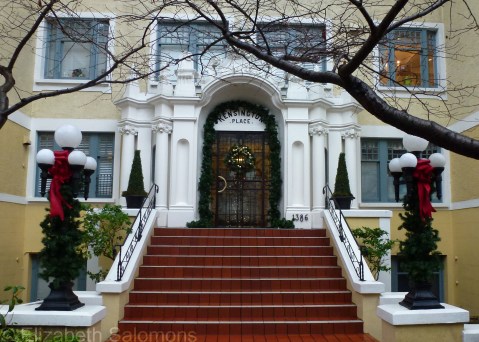
Just in case I am giving you the impression that only Europe knows how to dress for Christmas, here is a photo I took yesterday. This apartment building was built in 1912 and is a lovely piece of the West End’s historic past.
Through My Lens: Puerta del Sol
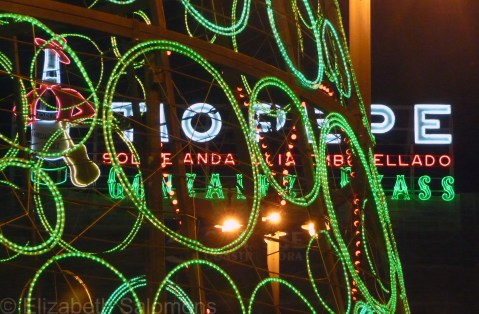
Just in case I am giving you the impression that only Paris knows how to dress for Christmas, here is a photo I took in Madrid’s Puerta del Sol in November 2010. This is the famous Tio Pepe neon sign framed by a towering Christmas tree of lights.


 There and Back Again