
Through My Lens: La Fontaine

Fountains say “summer” to me — even though I took this photo in the dead of winter. This particular fountain is called Fontaine de l’Observatoire. It’s in the Jardin Marco Polo, which is directly south of the Luxembourg Gardens in Paris.
Normandy Beaches
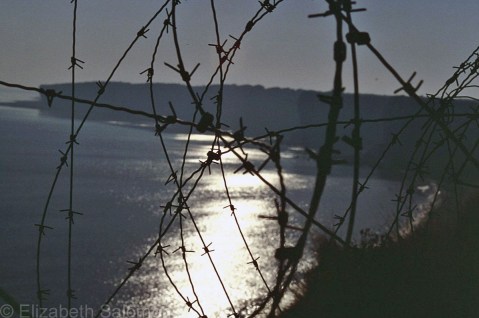
I don’t think I need to explain why I’m posting these photos.

But I will.
Today is the 70th anniversary of D-Day. On June 6, 1944, the Allied Forces launched the largest seaborne military invasion ever attempted. The invasion ― by no means guaranteed to succeed ― gave the Allies a toehold on the European continent, thereby opening up a Western front in the European theatre of World War II that eventually led to the defeat of Nazi Germany.

I’ve long had a keen interest in learning what happened in Europe during World War II ― I’ll explain the origins of that interest some other time. Today, I’m posting about my visit to the Normandy beaches on a sunny August morning many years ago.

I was backpacking through France and Germany with my dad ― if you’re going to visit military sites, be sure to go with someone who shares your interest in history. Dad was the perfect travel companion to take to Normandy, which is only three hours from Paris by car, slightly less by train. We based ourselves in Bayeux, a small city just 12 kilometres from the English Channel and the first to be liberated during the Battle of Normandy.
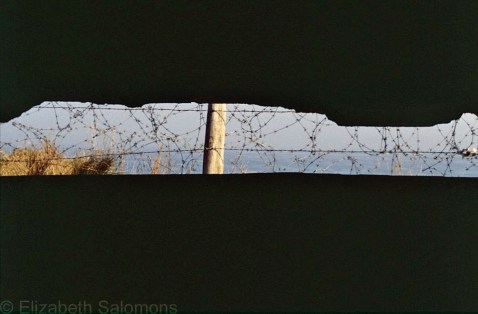
After settling into our hotel ― one so old I’m sure it was in the thick of it during the invasion ― we immediately marched ourselves down to the tourist information centre and booked a half-day tour of the Normandy Beaches.

Even if you have your own vehicle (which we did not), I highly recommend taking a guided tour of the Normandy Beaches. Without our guide navigating us from beach to beach, it would have been impossible for Dad and me to see as much as we did in one afternoon. And because there were only four of us on the tour, we had lots of time to pump our guide with questions and lots of time to explore at each stop.
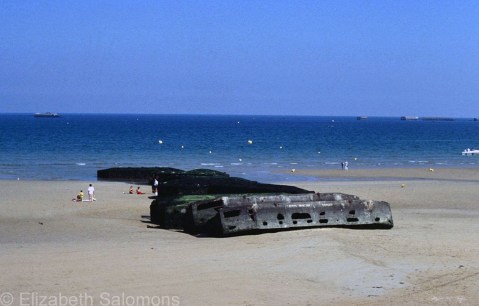
Our tour took us to Omaha Beach, the Normandy American Cemetery at Omaha, Pointe du Hoc, Longues-sur-Mer (where the remnants of a German battery still stand), and Arromanches (where the remnants of the Mulberry harbour built by the British forces still lie on the beach). My only complaint is that the tour we took was geared to Americans; next time I’m in Normandy, I will be sure to find a tour that caters to Canadians ― there are loads of them; we just didn’t think to ask ― so I can see Juno Beach.
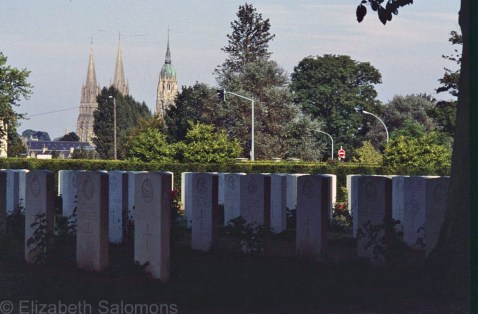
The Memorial Museum of the Battle of Normandy, which provides a good overview of the battle, is located in Bayeux, as is the largest British cemetery in France ― almost 4000 British servicemen are buried here. Dad and I visited both after our tour of the beaches.

Many years earlier, on my first backpacking trip to Europe, my girlfriend and I had bypassed Normandy completely except for an afternoon spent in Cherbourg. We were there to catch the boat to Ireland and ended up hanging out with an American guy who was waiting to catch the same boat. After exchanging stories and consuming many cups of coffee, we tagged along with him to the post office so he could make a collect call home. (This was way before Skype and email, kids.)
I didn’t mean to eavesdrop, but I overheard this guy telling his father how he had spent hours walking on the Normandy beaches — the same beaches, it turns out, where his father had landed on June 6, 1944. Although each of us has personal connections of all sorts to historical events, some of those connections seem just a little more meaningful. I was awestruck to think that someone not much older than me had a father who played a role in a significant battle in the war to liberate Europe. I promised myself then and there that I’d return one day to walk those same beaches — and I count myself blessed that I was able to take that walk with my own father.

Weeks after Dad and I returned to Canada, he phoned me one night. He’d just seen Saving Private Ryan, which was still playing in the theatres. The film begins and ends in the American cemetery above Omaha ― a cemetery he and I had walked through together only weeks before.
“We were right there!” he said with much enthusiasm.
“I know,” I said to him, with the same level of enthusiasm. “I know!”
I’ve mentioned several times before how I’m a bit of a history geek. Nothing gets my geekness going more than seeing places where history comes alive in a way that it never can in a book or a film. One small comment made by our guide, which has stuck with me all these years, illustrates what I mean. As we drove along, she pointed at the hedgerows that line the fields and roads in the Norman countryside. Those hedgerows, she explained, ended up providing highly effective protection for the German forces in defensive positions, resulting in high losses for the Allied forces even after they were safely off the beaches.
I could read a detail like that in a book, but it probably would not register. To see it in real life ― well, I’ve never forgotten it.
Palais Garnier
Here’s one last opera house before I turn the channel and move onto other topics. This is Opéra National de Paris, commonly known as Palais Garnier. “Garnier” was the name of its architect. “Palais” is for all the bling.

Palais Garnier is located at Place Opéra. Six major boulevards come together at Place Opéra, and there’s also a major metro station. In other words: there’s lots going on here.
And did I mention the bling on Palais Garnier? Here’s a closer look.

Armchair Traveller: On Rue Tatin
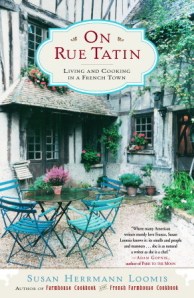 How many shopping days until Christmas? I think I have time to squeeze in another book recommendation.
This one is by another American cookbook author who transplants herself to France, but she doesn’t write about cooking in the World’s Most Glorious ― and Perplexing ― City. Instead, she and her family live (and cook and eat) in a small village in Normandy.
On Rue Tatin by Susan Herrmann Loomis is part travel memoir, part cookbook. There is one long tedious chapter to get through that describes her history with France and how she and her husband came to live in Normandy, but after that the book picks up its pace. Many pages are devoted to their struggles (and expenses) of renovating the house they bought beside the Romanesque/Gothic village church into a family home. The building was a convent for three hundred years, then an antique shop; I dread to think of what it looked like when she first set foot inside. It is in this convent-turned-home that she also teaches week-long classes at her cooking school, also named On Rue Tatin.
Although the first chapter of On Rue Tatin almost made me put the book down (what was her editor thinking?), Normandy is an underrated region of France and for that reason alone I recommend giving the book a read. I also have to ’fess up that Loomis’s assessment of the amount of rain Normandy is known for made me laugh: as a former Seattleite, she assured her readers it was nothing. That was enough to convince me that I would feel right at home in Normandy. And her recipes are enticing enough that I have already decided my next cooking class will be on Norman cuisine (here in Vancouver, alas, not in Normandy). But I can already smell the tarte tatin I will be baking.
Armchair Traveller: The Sweet Life in Paris
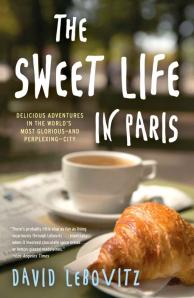 Are you still searching for the perfect Christmas gift for the armchair traveller in your life? Perhaps you could use a suggestion for your own holiday reading. Either way, here’s a book recommendation for you: The Sweet Life in Paris by David Lebovitz.
I discovered David Lebovitz’s writing through his blog called, appropriately enough, Living the Sweet Life in Paris. But even if I had never heard of the guy (or his blog), I would have grabbed the book off the store shelf on the merit of its subtitle alone: Delicious Adventures in the World’s Most Glorious ― and Perplexing ― City.
David Lebovitz is a San-Francisco-pastry-chef-turned-cookbook-writer who starts life over in Paris following the unexpected death of his long-time partner ― a move he describes as “an opportunity to flip over the Etch A Sketch” of his life. Once in Paris, his writing shifts and his books expand from simply recipes to an examination ― centred around food, of course ― of all the ups and downs of living in Paris.
The Sweet Life in Paris is the result. It’s a book of short essays about daily life in Paris, followed by an appropriate recipe. Some of the links are tenuous, like when Lebovitz follows a description of French plumbing woes with a recipe for a meringue dessert called Floating Island. (The connection between the two? He recommends not flushing the meringue down the toilet if it doesn’t turn out.) Others are bang on, like his recipes for Chocolate Mousse that accompany the story of how he discovered the secret to dealing with French bureaucrats is to bribe them with free copies of his cookbooks.
Lebovitz’s credibility shot up when I read his recommendation that, if you don’t like anchovies, be sure to try them fresh in Collioure on the Mediterranean coast. I’ve eaten fresh anchovies in Collioure ― they would convert any non-believer.
But while Lebovitz’s descriptions of food in The Sweet Life in Paris are mouth-watering, as are his recipes, what I appreciate most about this book is his ability to see the funny in the incredibly frustrating idiosyncrasies of Parisian life. I’m with him 100% as he puzzles over why European washing machines take two hours to wash a load of laundry that would take North American machines a mere 40 minutes. Most of all, I wish I’d known his system for navigating the aisles of a Parisian supermarket before I spent a winter in Paris:
I hold [my basket] in front of me as I walk, like the prow of a battleship, to clear the way. That doesn’t always work, as Parisians don’t like to move or back up for anyone, no matter what. So sometimes I hide my basket behind me, then heave it forward at the last moment; the element of surprise gives them no time to plan a counteroffensive, and when the coast is suddenly clear, I made a break for it.
I lost count of how many times I had to sidestep, trip over, or squeeze past Parisians who refused to budge an inch in the narrow aisles of Monoprix or Carrefour. Now I can’t wait to go back and try out Lebovitz’s technique.
Even if you’ve never been to Paris and don’t know the difference between a pastry brush and a pastry blender, pick up a copy of The Sweet Life in Paris. It’s good for the laughs.

Happy Canada Day!
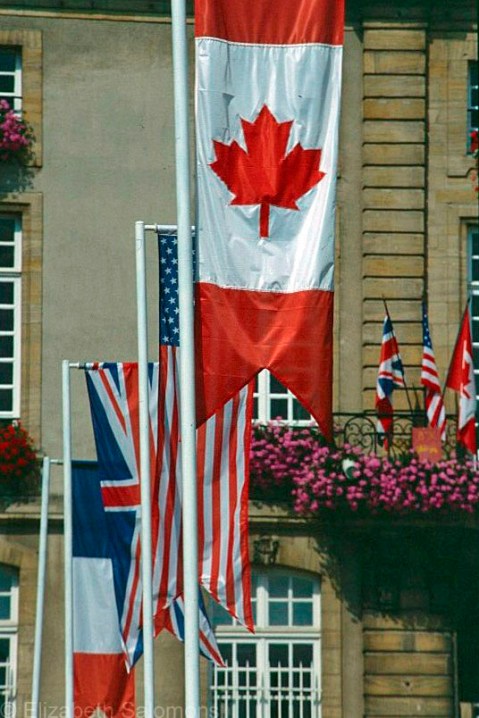
When I travel, nothing catches my eye like a Canadian flag ― whether it’s stitched to the backpack of a fellow traveller, or hanging in the streets, like this one in the Norman town of Bayeux, France.
Bonne Fête, Notre-Dame!

Cathédrale Notre-Dame de Paris is celebrating a pretty significant birthday this year, and, at 850 years old, I think she’s looking pretty good.
The cathedral began celebrating its Jubilee last December, and the party continues until next November. Special events have been going on all year long, including major renovations, the welcoming of pilgrims, and celebratory services. Nine new bells were commissioned, which were rung for the first time this past March, and today, on World Organ Day, the newly refurbished cathedral organ will join in on 850 organ concerts to be performed around the world within a 24-hour period.
I posted a photo of Notre-Dame’s Great Organ some time ago, so today I am posting a photo of the exterior of this grandest of cathedrals.
Christmas Markets
A co-worker of mine went to the Czech Republic earlier this month. When I found out where she was going for her holidays, my eyes lit up.
“The Czech Republic?!” I said. “Are you going to the Christmas markets?”
She smiled. “Of course!” she said.
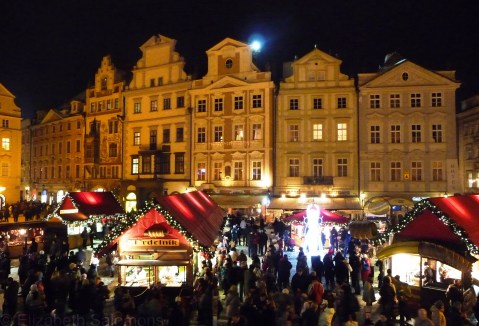
Christmas Market, Prague
She explained that the main purpose of the trip was to visit her grandmother who lived somewhere out in the Czech countryside, but her family also had plans to stop off in Prague, and were going to make a special trip to Nuremberg, Germany, just to see its Christmas market.
Christmas markets have been around since the Middle Ages. They are common throughout Western Europe and are especially prevalent in Central Europe. In recent years, they’ve been popping up all over England and North America, too. Common elements include chalet-like stalls set up in town squares, which sell handicrafts, toys, Christmas ornaments, lots of tasty treats, and the ubiquitous Glühwein (mulled wine).
I can’t remember when or where I first heard of Christmas markets, but a couple of years ago when I knew I would be spending the winter in Paris, I was determined to experience as many as I could.
The first Christmas market I came across that winter was unexpected, as it was mid-November and Christmas was far from my mind. I was in Seville, Spain. The market was in the square near the massive cathedral, and contained stall after stall selling wooden nativities. The nativities were works of art, truly. Each figure was sold separately and cost far more euros than I had to spend.
In Madrid, the Christmas market in Plaza Mayor dates back to 1860. It too was filled with stalls selling wooden nativity figures.

Plaza Mayor, Madrid
Steps away from Plaza Mayor, I stumbled across a smaller market in Plaza Santa Cruz with a more light-hearted carnival atmosphere. Its stalls were selling costumes, wigs, and accessories for Dia de los Santos Inocentes on December 28. (This is the Spanish equivalent to our April Fool’s Day, though its origins are rather sombre: the day commemorates the massacres of the “Holy Innocents” ― the children murdered by Herod in his search for the newborn king the wise men had told him about.)

Plaza Santa Cruz, Madrid
In Paris, there are Marchés de Noël in almost every arrondissement. I made it to three. The market at Trocadéro is probably the most picturesque as it’s situated across the Seine from the Eiffel Tower. It also has a popular skating rink.

Trocadéro, Paris
Saint-Germain-des-Prés is a much smaller market, with stalls nestled along Boulevard Saint-Germain and around the church of Saint-Germain-des- Prés.

Saint-Germain-des-Prés, Paris
The market along Avenue des Champs-Elysées is massive, and runs all the way from the giant Ferris wheel at Place de la Concorde to the Franklin D. Roosevelt métro station. It consists of several blocks of stalls selling vin chaud, crêpes, chocolate, sausages, and all sorts of handicrafts. Every block or so there was a heater where you could warm your hands. We walked the entire length of this market on Christmas Eve.

Christmas market stalls along the Champs-Elysées, Paris

All the chocolate you could wish for along the Champs-Elysées, Paris
Although Paris is a magical time to be in December, the Christmas markets I was most excited about seeing were in the Czech Republic. I was thrilled to see the Old Town Square of Prague once again, but I could never have imagined how pretty it would look at Christmastime.
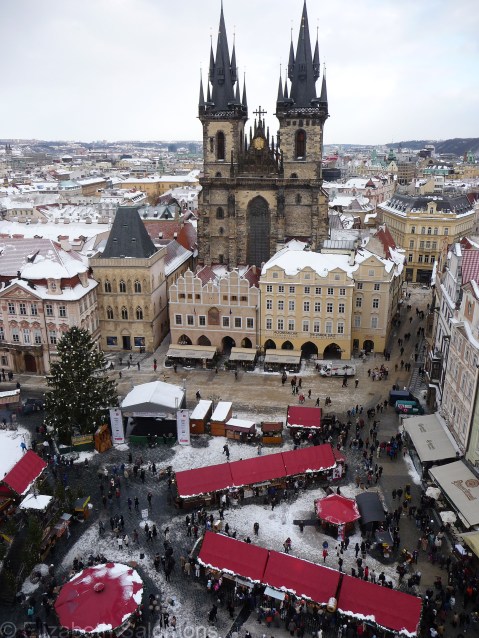
Christmas Market, Old Town Square, Prague
The lights were impressive, and there was an enormous Christmas tree as well as a nativity, a stage where children were singing Christmas carols, and hundreds of red-roofed stalls selling food and toys and ornaments.

Old Town Square with the Old Town Hall and St. Nicholas Church behind

Children singing carols
I enjoyed a trdelník ― a sweet pastry baked over hot coals and sprinkled with sugar and nuts ― and later a massive slab of spit-roasted ham. To keep warm, I bought mug after mug of Glühwein ― in Czech, it’s called svařené víno. There was another, smaller market in Prague’s Wenceslas Square with much of the same, although not as prettily lit.
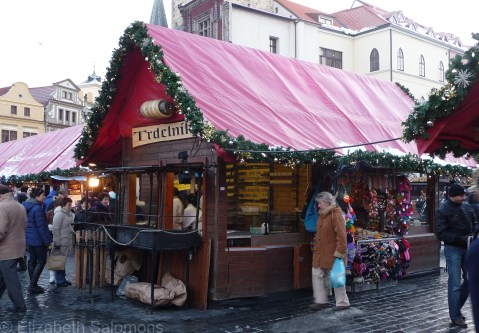
Trdelník stall
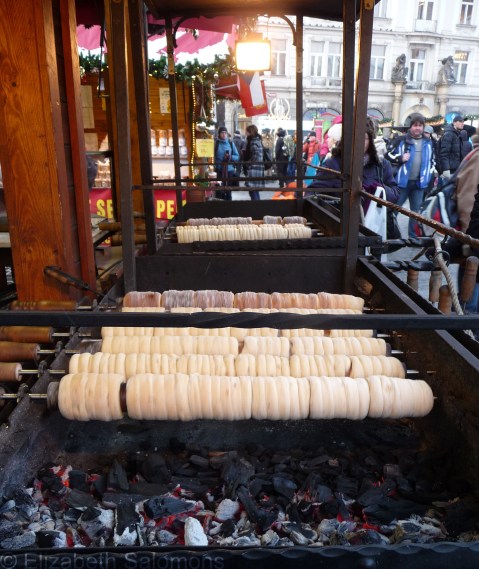
Trdelník baking over hot coals

Hams roasting on spits
The next day, I travelled to Český Krumlov. Its small, intimate Christmas market had the feeling of a neighbourhood bazaar, with local artisans selling their handiwork, and the local school putting on a Christmas concert after dark.

Old Town Square, Český Krumlov
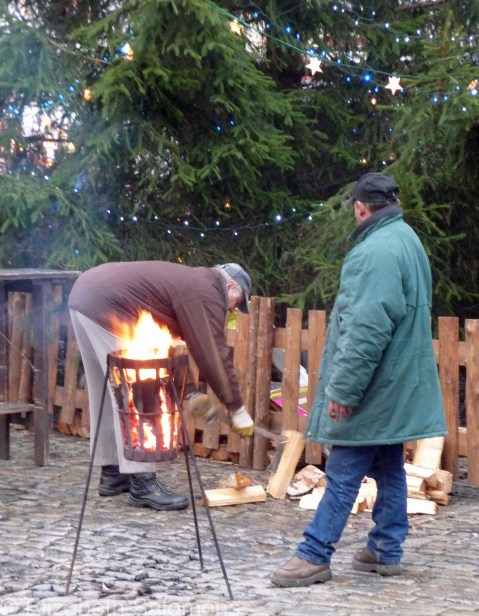
Keeping warm in Old Town Square, Český Krumlov
I don’t know if I will ever make it to Nuremberg, the granddaddy of all Christmas markets ― my co-worker said there were over 200 stalls there ― but, even so, seeing the Spanish, French, and Czech Christmas markets was something already. If you need an excuse to visit Europe in December (seriously? who ever needs an excuse to go to Europe?), I highly recommend going for the Christmas markets.

Christmas trees and Church of Our Lady before Týn, Prague
Through My Lens: Rainy Paris
After a beautiful, warm fall, the rainy season has descended on Vancouver. Although not the wettest October on record, we did get almost double the average rainfall — and it all fell in the past two weeks.
Wet fall weather makes me homesick for Paris, of all places. Two years ago today, I arrived in that city for an extended visit. It rained the first ten days I was there; I remember thinking at the time, “And they say Vancouver gets a lot of rain??”
I didn’t mind, though. I felt right at home.
Here’s the first photo I took on that visit.


 There and Back Again