
Through My Lens: Église Saint-Germain de Charonne

For the Third Sunday of Lent, here is a photo of Église Saint-Germain de Charonne, located in the former village of Charonne, which was annexed by Paris in 1860 and is now part of the 20e arrondissement.
It is believed that the first church on this site was built to commemorate a meeting that took place in 429 between Saint Germain, Bishop of Auxerre, and Saint Geneviève, the patron saint of Paris. Parts of the present structure date back to the twelfth century. The bell tower was added in the fifteenth century. What is most unusual for a church within Paris is that the parish cemetery remains intact, and was still in use as recently as fifty years ago.
Sister Cities, Sister Countries
Dr. Martin Luther King Jr. believed that the arc of the moral universe is long but that it bends toward justice. He also knew that there are evil men in the world, who seek to thwart that benign curve and push us all back into darkness. Because of those men, there are moments in history when the great struggle between freedom and tyranny comes down to one fight, in one place, which is waged for all of humanity. In 1863, that place was Gettysburg. In 1940, it was the skies above Britain. Today, in 2022, it is Kyiv. — The Honourable Chrystia Freeland, Deputy Prime Minister of Canada
As I am watching, reading, and doomscrolling these past three weeks, what has surprised me most is the resurfacing of long-buried fears. A lifetime ago, when I was in high school, the marches were about nuclear disarmament, not the climate crisis. We had long class discussions about the chances of a nuclear holocaust wiping out the human species. The last gasp of the Cold War was a fearful time to be a teenager.
Same song, different century.
The Russian invasion of Ukraine is reminiscent of another war waged in the last century, but recent enough to bring up familial memories for those of us who came to Canada from Europe. My mother was born in Nazi-occupied Holland. I often wonder what impact living through war the first five years of her life had on her psyche.
What memories of this war will Ukrainian children carry for the rest of their lives?
I have long known that my mother’s family had been forced out of their home by the Nazis for the last winter of World War II. But a month ago, I was shocked to learn that the neighbourhood where they spent that winter underwent an artillery bombardment by the Canadian army in its fight to liberate the city. Pamphlets were dropped from the sky to warn the residents of the upcoming shelling, which went on for hours. Nineteen people died. I was so floored by this revelation that I spent the next week wondering how it was I’d never heard about it.
Floored, because I had also long known that my thirteen-year-old uncle was killed the same day. A stray artillery shell had landed in the street and bits of shrapnel went flying. My mother remembers being thrown down the stairs into a cellar by an uncle after the explosion. But I was never told about a bombardment. How do you forget undergoing an hours-long artillery barrage?
Then I remembered the Sunday afternoon I spent with two cousins some months ago. As we looked through old family photographs, I came across a letter in which a relative of my mom’s described her memories of that day — the day my uncle died. She wrote how the extended family had been all together in one of their homes, but in the next town over. Several relatives were injured that day; the letter writer’s sister had a piece of shrapnel embedded in her leg for years afterwards. Perhaps my mother and her family were there not to celebrate their liberation (as my cousins had always been told), but to escape the shelling where they were living?
It still leaves unanswered questions. How did the family know when it was safe to return home? What was left of that home when they returned?
More than three million Ukrainians are wondering when it will be safe to return to their homes. Are wondering if they have homes to go back to.
When a girlfriend and I travelled around Europe in the mid-1980s, we spent a long, cold night on a Yugoslavian train filled with drunken conscripts on their way to boot camp. That’s how I learned that almost every European country had compulsory military service at the time. That’s when I realized only a simple accident of geography — and my gender — kept me from going through a similar rite of passage.
The NATO-aligned countries abandoned conscription after the end of the Cold War. Ukraine did too, in 2013, and then reinstated it in 2014. We’ve all heard how men aged 18 to 60 are not permitted to leave Ukraine right now. What isn’t getting anywhere near the same attention is that almost a quarter of Ukraine’s soldiers are women. Many of these women are bringing their children to the border, handing them over to distant relatives, and then going back to fight in a war they didn’t want, a war they didn’t ask for.
When you grow up on the Canadian prairies, you are deeply aware of the significance of the Ukrainian-Canadian community, so I was not surprised to learn that Canada has the second-largest diaspora of Ukrainians anywhere in the world. What I did not know is that Vancouver and Odesa have been sister cities since 1944. Like Vancouver, Odesa is a port city. Like Vancouver, it has beauty — its historic centre is a World Heritage site. But unlike Vancouver, it is piling sandbags in front of its monuments and lining its beaches with landmines in anticipation of a Russian attack. Half a million of Odesa’s residents have fled. What is remarkable is that the other half million have stayed.
As we watch the Ukrainian people suffer and die in real time, it is difficult to not feel despair. I fully expect the repercussions of this war to be as consequential as anything we have lived through in our lifetimes. As a teenager, I feared the outcome of a Cold War that had been going on for so long I never expected the Berlin Wall to ever come down. As a child, my mother fled her home and watched bombs rain down on her city right up until the day they danced in the streets to celebrate their liberation.
One day the people of Ukraine will rise up again to celebrate.
Because the alternative is unthinkable.

Vancouver City Hall
Through My Lens: Église Notre-Dame-de-la-Croix de Ménilmontant

One of the advantages of spending time well outside the centre of Paris, as I did one winter, is that on neighbourhood walks you sometimes come across surprises like this church. Église Notre-Dame-de-la-Croix de Ménilmontant is my photo choice for today, the Second Sunday of Lent.
This church was built to accommodate the population growth of Ménilmontant, a neighbourhood in the 20e arrondissement. Construction began in 1863, and was completed in 1880. Its architectural style is what’s known as the Second Empire style, which was popular in France during the reign of Napoleon III. It’s known for combining materials (such as iron and stone) and styles (such as Romanesque and Gothic) in one building.
Through My Lens: Basilique du Sacré-Cœur

Seeing as it is the tenth anniversary of my first-ever Lenten series, I thought that for this year’s series, I would return once again to Paris, whose churches were my inspiration a decade ago.
For today, the First Sunday of Lent, here’s a photo of the Basilique du Sacré-Cœur (Basilica of the Sacred Heart). Thanks to its location at the top of Montmartre in the 18e arrondissement, it’s one of the most recognized landmarks in all Paris. The basilica was built as spiritual reparations on behalf of France for its part in the Franco-Prussian War of 1870. Its unique Romano-Byzantine architectural style was influenced by Hagia Sophia in Istanbul and San Marco in Venice. Construction began in 1875, and the basilica was consecrated in 1919.


Through My Lens: Clouds on the Horizon
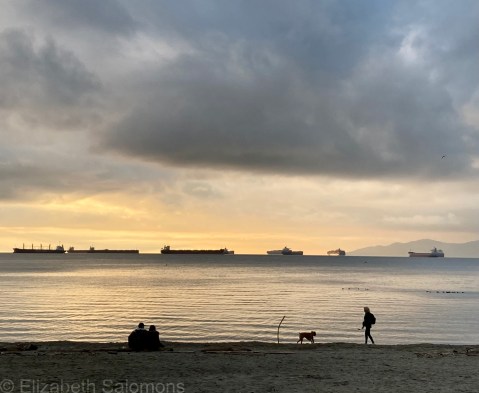
Welp. I have to say: not too impressed so far with Season 3 of 2020.
Canada has had a rough few weeks. I’m not going to offer a rant about how we got here or a sermon about where we need to go. Rather, I’ll just say that my way of coping has been to focus on my own self-care, which I think I’ve gotten pretty good at over the past two years. That means connecting with friends, cooking my favourite comfort foods, and taking some long walks to look for signs of spring.
Above is the view I had a few evenings ago, which, given the current state of affairs in our nation’s capital, struck me as rather allegorical.
I just hope the clouds are not an omen.
Bohemian Waxwing

One of the perks of my house-sitting stint in Alberta last fall was a backyard bird feeder that attracted all kinds of birds — most of which were new to me. Some species, like this Bohemian Waxwing, were much more interested in the mountain ash berries.
Through My Lens: Palm Trees on a Snowy Beach
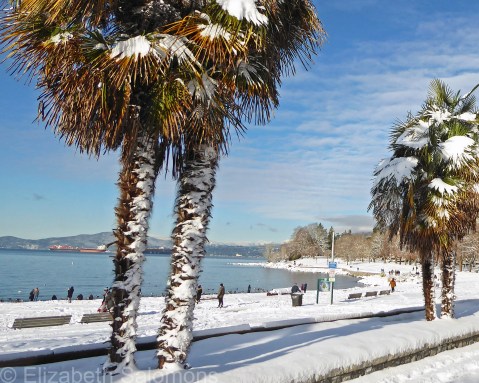
When feeling particularly smug (which, truth be told, can be far too often), residents of BC’s Lower Mainland like to call where we live “The Tropics of Canada.”
Which is pretty funny.
I took this photo after last month’s snowstorm.
BC’s Wacky Winter Weather
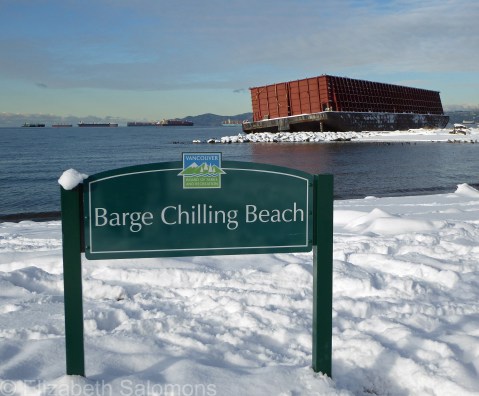
Yeah, that.
That is a wayward barge that was pushed onto the beach during last November’s atmospheric river — the storm that caused so many problems in our province. An atmospheric river is a band of heavy moisture up to several thousand kilometres long, but just a few hundred kilometres wide, that develops over tropical ocean areas before moving north and inland. (I’ve now added the term to my meteorological lexicon, along with heat dome.)
The atmospheric river that ran over southern BC last November dumped about a month’s worth of rain on the region in just 48 hours. Along with all that moisture came some strong winds, which is how this barge ended up on Sunset Beach in English Bay. It has its own Twitter account and is a constant reminder that not all is well, climatically speaking, in my home province.
(C’mon. You didn’t think I’d let a winter go by without talking about the weather, did you?)
That storm, the first of four atmospheric rivers to hit southern BC in one month, knocked out an unprecedented amount of BC’s infrastructure.
For starters, the Nooksack River in Washington State overflowed its banks and then flowed downhill into Canada, completely flooding the Sumas Prairie in the Fraser Valley for an entire month. Located about an hour east of Vancouver, the Sumas Prairie is on the other side of the mountain in this photo, but you get the idea from the photo of the geography involved.
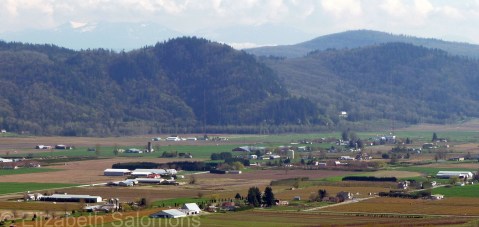
The first time I drove through the Fraser Valley was as a teenager when my family moved from Alberta to BC. After so many hours of driving through endless mountain passes, I could not believe how absolutely horizontal the landscape was.
“And they say the prairies are flat,” I remember thinking.
But that’s a river delta for you, and its rich soil is why the Fraser Valley is home to more than half of BC’s dairy and poultry production. Close to a million animals died during the floods, and thousands of acres of blueberry plants were also ruined. We’ll be feeling the effects of this flood for years to come as the farmers work to bring their fields and farms back into production.
Two other communities, Merritt and Princeton, were also flooded. To give you an idea of the scale involved, the area of BC under flood watch last November was equivalent to the size of Belgium.
Then, in addition to the floods, a series of mudslides and washouts extensively damaged all the railways and highways connecting Vancouver to the BC Interior and the rest of Canada. Five people died, and 275 people spent two days trapped between mudslides on one major highway until they were evacuated by helicopter.
With our transportation network knocked out, nothing from Canada’s largest port could get to the rest of the country and no shipments for export could get to the Port of Vancouver (including grain shipments at a most critical time of year).
The pipeline that brings fuel to the Lower Mainland was initially shut down as a precautionary measure but then remained shut for three weeks, which led to gas rationing in the Lower Mainland and on Vancouver Island. Fuel was brought in from the US by barge.
Talk about supply chain issues.
It was three weeks before the trains started running again. The largest and busiest highway in BC, the Coquihalla, reopened to commercial traffic only on December 20 and to all traffic last week. That it reopened as quickly as it did is quite the engineering feat: more than 130 kilometres of the highway in 20 different sections were extensively damaged, including five collapsed or heavily damaged bridges. It’s not business as usual — the highway will remain an active construction zone for the foreseeable future as all of the repairs are temporary.
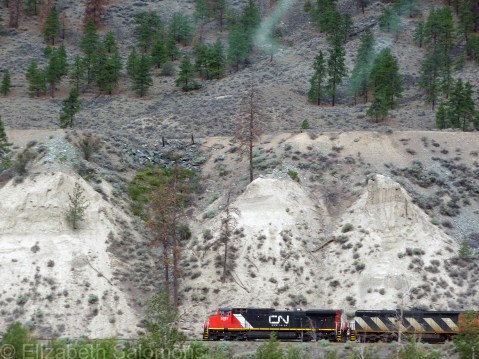
There is scarcely nothing left of Highway 8 between Merritt and Spences Bridge where the Nicola River changed course and took the road out with it. The Trans-Canada Highway through the Fraser Canyon reopened only this week. Just to give you a bit of an idea of what the engineers working on the repairs are faced with, this is what parts of the Fraser Canyon look like.
I missed out on all those atmospheric rivers while I was in Alberta. And although I also missed out on Vancouver’s first white Christmas in thirteen years, I did get back home in time for another spectacular dump of snow.
Which was … stunning.

But then, just over a week later, a king tide and wind storm pummelled the city and our world-famous Stanley Park seawall.
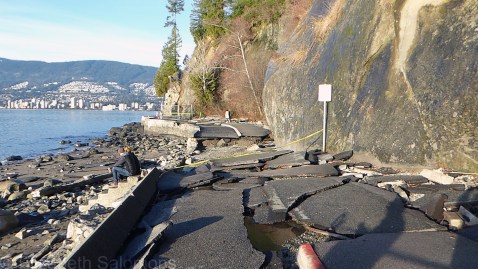
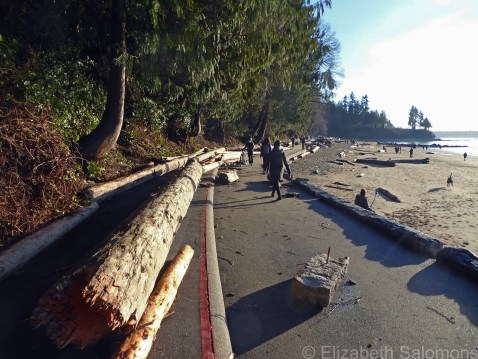
Some of the damage was caused by logs set free by the November floods that came down the Fraser River and have been in the water since.
Why am I writing all this? Well, last year was pretty tough on all of us, but, to be honest, I don’t have much hope that this year will be any easier. If it’s not the pandemic, it’s drought and wildfires. And if it’s not drought and wildfires, it’s flooding and mudslides. We call these events natural disasters, but there is nothing natural about once-in-a-century storms happening every year. Atmospheric rivers are not new to BC, and they aren’t all bad. (They play an important role in maintaining BC’s water supply.) But they are increasing in intensity and frequency, so much so that oceanographers are coming up with a rating system for them, like the ones used for tornadoes and hurricanes, to help us better understand their risks.
What I find most sobering is the realization that BC has climate refugees. Months later, people who had to evacuate because of the wildfires or the floods are still out of their homes. Many will never go back to their communities.
It’s a lot to take in about the place where you live.
One last note: Barge Chilling Beach is a bit of an inside joke for those of us who live in Vancouver. Google “Dude Chilling Park” if you want to know more. The sign is temporary and has since been taken down.
Merry Christmas!

Fish Creek Provincial Park, Calgary, Alberta


 There and Back Again