
Through My Lens: Kits Pool
It’s summer ― though you wouldn’t know it by the temperature outside. No, I’m not talking about today’s weather, but the date.
Today is the first day of the May Long Weekend, officially known as the Victoria Day weekend. It’s the weekend when Canadians traditionally open up the cottage or go off on their first camping weekend of the summer.
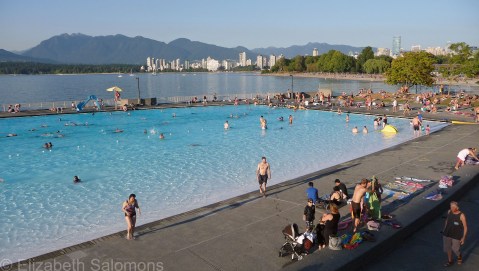
In Vancouver, it’s also opening weekend for our collection of outdoor swimming pools. Which is why I’m posting a photo of Kitsilano Pool.
Kits Pool is 137.5 m long, making it the longest pool in Canada, and is the only salt-water pool in Vancouver. It’s located alongside Kitsilano Beach.
Cruising Season
Yup, it’s that time of year. The cruising season is upon us here in Vancouver.
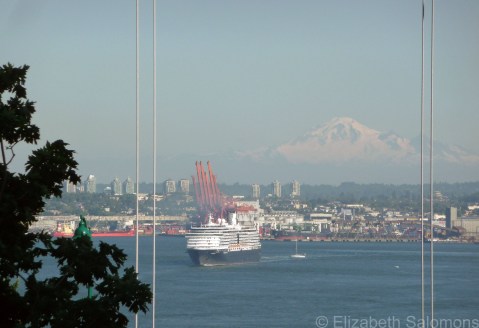
A cruise ship sails out of Vancouver’s Burrard Inlet, with Washington’s Mount Baker in the distance.
The first ship arrived on April 18, but the season didn’t really kick into high gear until this week with the arrival and departure of 13 ships in eight days. From now until the end of September, between five and seven ships will dock in Vancouver every week, with each ship staying just long enough to offload its passengers and get the next bunch safely on board.

It’s rush hour — three cruise ships leave Canada Place within an hour of each other.
A total of 17 cruise ships will be based in Vancouver this season, setting sail each week for Alaska. Their route takes them through the Inside Passage along BC’s coast. Later this afternoon, I’ll be boarding one of those ships, but my destination is nowhere near as exotic as Alaska. I’m headed south — to Seattle.

Holland America has five ships based in Vancouver this season.
Bonne Fête, Notre-Dame!

Cathédrale Notre-Dame de Paris is celebrating a pretty significant birthday this year, and, at 850 years old, I think she’s looking pretty good.
The cathedral began celebrating its Jubilee last December, and the party continues until next November. Special events have been going on all year long, including major renovations, the welcoming of pilgrims, and celebratory services. Nine new bells were commissioned, which were rung for the first time this past March, and today, on World Organ Day, the newly refurbished cathedral organ will join in on 850 organ concerts to be performed around the world within a 24-hour period.
I posted a photo of Notre-Dame’s Great Organ some time ago, so today I am posting a photo of the exterior of this grandest of cathedrals.
Dishing: Bitter Tasting Room
 Many years ago (too many to share with you), I was backpacking around Europe with a friend. One hot, sunny afternoon in late September, we climbed 509 stairs to the top of Cologne’s beautiful cathedral. Once back on terra firma, we headed straight to McDonald’s for some lunch. (I know, I know … but what can I say? We were students on a tight budget.)
When I saw beer on the menu, I ordered one, despite the fact that I didn’t actually like beer and had never managed to swallow more than a sip or two. But hey ― it was a really hot day and I had just climbed up and down the equivalent of a 30-storey building. And yeah, I did think it was pretty cool that I could buy a beer at McDonald’s.
You know what? It was the best beer I had ever tasted. I became an instant and committed convert to the beverage. My theory is that, until that point in my (then) young life, I had simply not been introduced to the right kind of beer. It took a German beer ― in McDonald’s no less, but German nonetheless ― to get me hooked on the stuff. I’ve enjoyed many a cold one since.

Why do I have beer on the brain, you ask? It’s because this past weekend was the first of the year that we Vancouverites enjoyed summer-like temperatures. And so, I thought, what better time to introduce my readers to one of the best craft beer taprooms in the city.
Bitter Tasting Room is located near the corner of Hastings and Carroll in what is actually more Downtown Eastside than Gastown. I’ve been here a couple of times ― the first time, ironically, at the suggestion of a friend who doesn’t herself drink much beer (so I knew it must be good if she was willing to go), and the last time with my sister just last night.
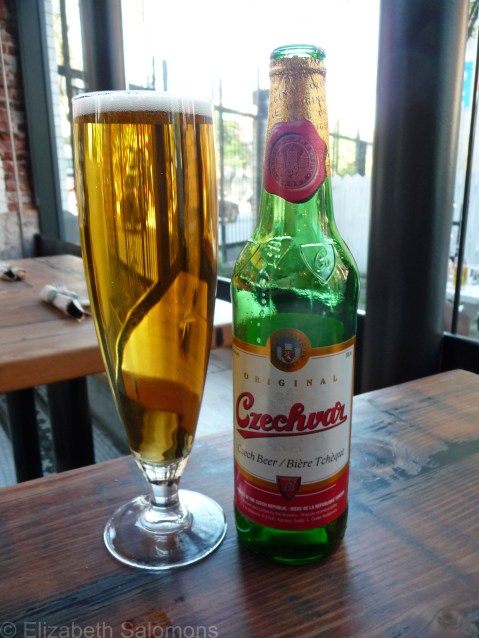
Bitter offers a selection of more than 60 bottled beers from North America or Europe, with a particularly strong selection of Belgium beers. 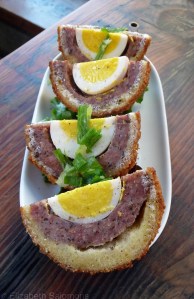 You can also order a pint of draught from a choice of about eight local craft beers. Or you can order a flight of beers, and sample three at once.
The food is typical German and English pub fare — sausages, Scotch eggs, and a killer kale Caesar salad are a few examples. In wintertime, I enjoyed a tasty dish of cassoulet, a slow-cooked stew made with duck confit, pork belly, sausage, and braised beans that comes from the Languedoc region of France.
Bitter is part of the Heather Hospitality Group and I have yet to be disappointed by an evening spent in one of their establishments.

Queen’s Day
Today is Queen’s Day in the Netherlands. The Dutch call it Koninginnedag. It’s their country’s equivalent of Canada Day or the Fourth of July ― the day when the Dutch celebrate their nation. They celebrate Queen’s Day on April 30 because that was the birthday of Queen Juliana, who was the mother of Queen Beatrix, who is the mother of King Willem-Alexander, who became king today.
The Dutch monarchs have a tradition of abdicating the throne to their children, and that’s what happened today. Queen Beatrix will now be known as Princess Beatrix, and her oldest son, Willem-Alexander, is, as of today, king of this tiny nation of 17 million people.
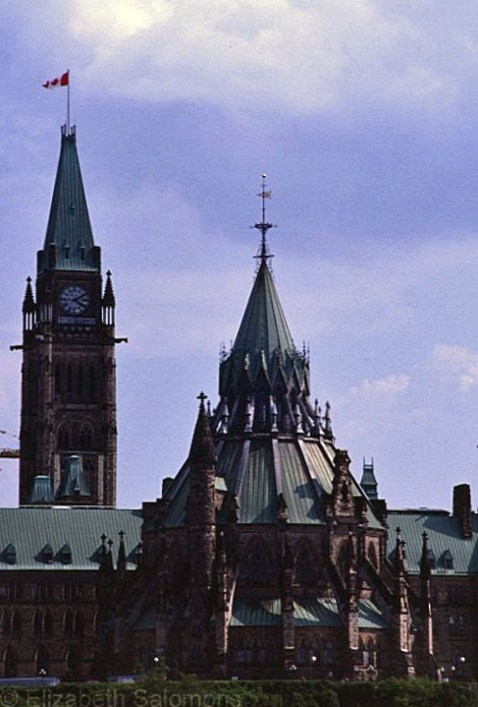
So why am I posting a photo of Canada’s Parliament Buildings on the Dutch national holiday? I’m glad you asked.
I posted this photo because the Dutch Royal family has a Canadian connection. Queen Beatrix spent part of her childhood in Ottawa, when Canada gave shelter to the Dutch Royals during World War II. After the war was over, the Dutch Royals sent 100,000 tulip bulbs to Ottawa as a sign of gratitude for the hospitality shown to then-Princess Juliana and her children during the war, and also as a thank you to the Canadian soldiers who played a key role in the liberation of the Netherlands from the Nazis in 1945.
Juliana sent more tulip bulbs the next year, and every year of her reign, which lasted from 1948 until 1980. Today, more than a million tulips bloom in Ottawa each spring, and its tulip festival, said to be one of the largest in the world, is celebrated every May.
Through My Lens: Nitobe Memorial Garden
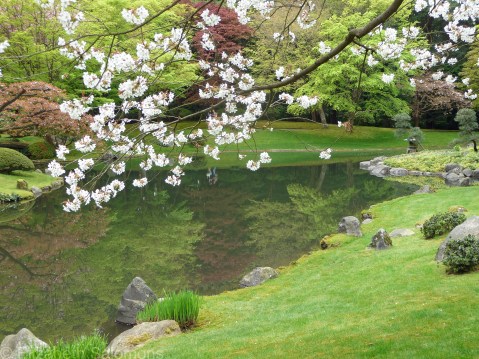
I took this photo last Friday in the beautiful Nitobe Memorial Garden. This garden is located at the opposite corner of the UBC campus from my office ― which makes for a nice walk when I’m on my lunch break. As I’ve noted before, I think UBC is a beautiful campus. The Nitobe Memorial Garden only reaffirms my belief.
Through My Lens: Bastion Square

One last look at Victoria, and then we’ll leave what a friend of mine who lives there likes to call “City of the Newlywed and Nearly Dead.”
This photo was taken in Bastion Square, a pedestrian-only street that begins at the corner of View and Government, where the North Bastion of Fort Victoria once stood, and ends at Wharf Street, overlooking the Inner Harbour.
Magnolia Hotel and Spa

When I travel, I try to arrange a home exchange, but when I’m not successful in finding one that suits my destination or my dates, I stay in hotels. I haven’t been blogging about the hotels I stay in because, to be quite frank, I usually bunk down in budget hotels that aren’t anything to write home about.
The other weekend I went to Victoria to visit a friend who was there on business, and I stayed with her as her guest at the Magnolia Hotel and Spa. This hotel is most definitely not a budget hotel and my two-night stay there was a real treat for me.
The Magnolia Hotel and Spa is rated by Tripadvisor.ca as the # 2 hotel in Victoria and # 11 of the Top 25 Luxury Hotels in Canada. The room my friend and I shared contained two queen-sized beds made up with fluffy white duvets and a mountain of soft and hard pillows to suit any preference. The ensuite bathroom was the size of my kitchen at home, with a soaker tub and separate spacious shower, and was fully stocked with Aveda bath and hair products.

Turn-down service included chocolates on the bedside table ― very good chocolate, I should add. I enjoyed the best sleep I’ve had in months and did not want to get out of bed come morning. My friend took advantage of the spa facilities and went for a massage to help her get over her jetlag.
The complementary breakfast was continental, but don’t think small when you read “continental.” Served buffet style, it included your choice of carb (croissants, toast, waffles, oatmeal, and a variety of cold cereals), yogurt or made-to-order smoothies, fresh fruit, cheese, boiled eggs, and cold cuts. After my arrival on Friday night, my friend and I caught up on each other’s lives over drinks and tapas in the hotel bar, the Catalano Restaurant & Cicchetti Bar, which sources its seafood and produce from local fishers and farmers.
The Magnolia Hotel and Spa is located one block from the Inner Harbour. I highly recommend it.

Afternoon Tea at the Empress
Most afternoons, I have a cup of tea. With milk. It’s such a part of my routine that this past week there was an “incident” (shall we say) at work when I discovered someone had used up the milk I keep for my tea in the office fridge, thinking it was hers. My co-workers laughed at my distress, but I can’t drink tea without milk. And I really enjoy my afternoon cup of tea.
So last weekend, while I was in Victoria visiting a friend there on business who told me she really wanted to someday, one day, have afternoon tea at the Empress, it didn’t take much for me to decide I liked that idea very much. “And what’s stopping us from having tea at the Empress this weekend?” I asked. Within minutes, we had a reservation in the hotel’s Tea Lobby for the next day.
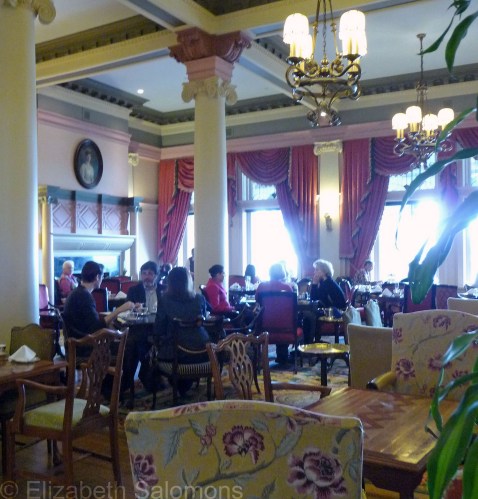
Victoria, BC, has been called the most English city in Canada, and the city definitely plays up that reputation for the tourists. Afternoon Tea at the Empress Hotel is a big part of that playing up, and there is no setting more lovely than the Empress Hotel. One of Canada’s iconic “railway hotels,” it has been a landmark on Victoria’s Inner Harbour since its opening in 1908.

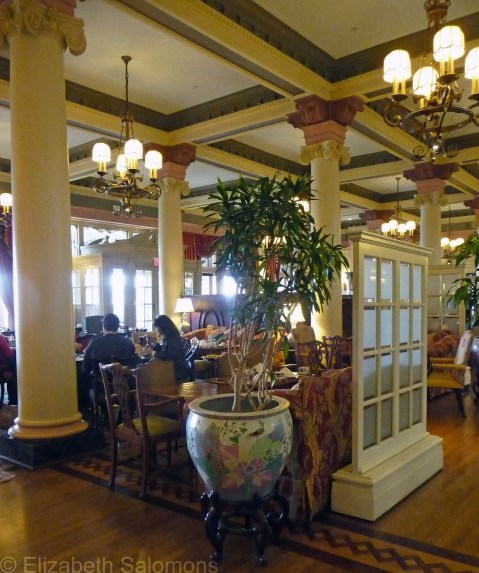
We both skipped breakfast and arrived at the hotel’s Tea Lobby appropriately famished. It’s located off the main lobby and its windows overlook the Inner Harbour. We were seated near those windows at a low table.
(And here’s an aside for you: I learned that high tea is actually the supper-type meal the English eat in the early evening, while afternoon tea or low tea is always taken in the afternoon. It’s called low tea because typically you sit at a low table.)
The meal began with cups of seasonal fruit served with cream ― in our case, strawberries. I’m a bit of a strawberry snob and unless the berries are grown locally and are in season, I really don’t think much of their taste. Such was the case with these strawberries, shipped in from California, I’m sure, but hey, what seasonal fruit would you find anywhere in Canada in mid-April?

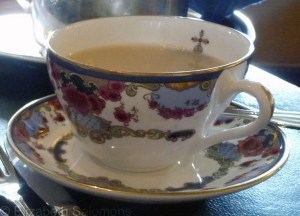
We were given a choice of eight teas ― I chose the Empress Blend, a tea that “boasts a bright coppery colour and takes milk exceedingly well.” My friend chose Margaret’s Hope Darjeeling, which offered “the distinctive character of Muscat grapes and hints of current.” Clearly tea can be as sophisticated as wine.
Along with our pots of tea came the three-tiered plate of … well … the main event. Our little table was packed, what with the silver teapots, china teacups and small plates, and the tower of savouries, scones, and sweets, but the server positioned everything on the table with expertise and, remarkably, it all fit. Then, after pouring our tea and ensuring we had everything we needed, he offered to take photos of us with our own cameras. He definitely had the routine down pat.
And then? And then we dug in!
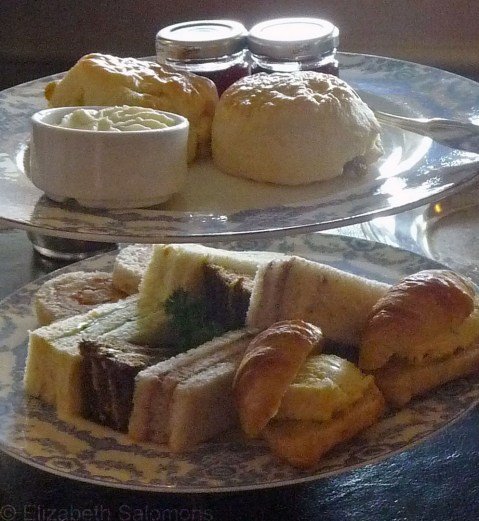
The savoury level of the tiered plate consisted of tiny sandwiches: smoked salmon pinwheels, cucumber sandwiches (of course!) with saffron loaf, mango & curried chicken sandwiches (my favourite), free-range egg salad croissants (also very tasty), and cognac pork pâté on sundried tomato bread.
Then we moved up a level to the fresh baked raisin scones with clotted cream and the Empress’s own strawberry jam.
On the final, upper-most tier were the pastries: lemon curd tartlets, cappuccino chocolate tea cups, rose petal shortbread, chocolate and pistachio Battenberg cakes, and the one I’d been waiting for: Parisian style macaroons.
Sigh.
It was heavenly. And when we were finished, our server presented each of us with a small box of the tea we had been drinking.
I didn’t eat dinner that night. Who knew afternoon tea could sustain your body for an entire day?
Muttart Conservatory
In my last post, I promised you more about what Edmonton has to offer.
One of Edmonton’s gems, in my humble opinion, is the Muttart Conservatory. These four pyramids have been a landmark in Edmonton’s river valley since 1976. They are an amazing oasis in the heart of the city, particularly in the middle of a harsh Alberta winter. Three of the pyramids focus on plant life from temperate, arid, and tropical climates; the fourth rotates through various seasonal plants. When I was there earlier this month, it was filled with tulips.
My favourite is the arid pyramid ― because I think the cactuses have the most personality.


 There and Back Again