
Through My Lens: Kölner Dom

A lifetime ago, when I was planning my first European walkabout, I went to a travel agent (remember those?) and came home with a bunch of pamphlets from those companies that offer multi-week tours of Europe. My travel partner and I were not in any way interested in joining an organized tour, but I did want to have in my head some kind of rough itinerary before we left Canada and started hopping on and off trains.
As I flipped through the pamphlets, I came across a photo of the Kölner Dom (Cologne Cathedral) from across the Rijn River, similar to the photo shown above. What a stunning cathedral, I thought. I have to see it in person. (This would not be the only time I made a choice regarding travel based solely on a single photo, but it may have been the first.)
It turned out that passing through Cologne was already in the works. My friend and I had agreed to plan our time in Germany around a two-day Rijn cruise included with our Eurail pass, and that cruise began in Cologne.
As you see, I got my photo.
Construction of the Kölner Dom began in 1248 but wasn’t completed until 1880, due to a several-centuries’ long stoppage of the building work. This Gothic cathedral is the tallest twin-spired church in the world. My friend and I climbed one of those spires and though my knees were protesting for days afterwards, I remember that the climb gave us a bird’s-eye view of some of the damage the cathedral suffered during World War II. I later learned that the city of Cologne was pretty much flattened; only the cathedral (miraculously) survived the bombardments. It is now on the UNESCO World Heritage List.
I took you on a tour of the Aachener Dom for last year’s Lenten series. This year, I’m staying in Germany, and the Kölner Dom is my photo choice for today, the First Sunday of Lent.
Danger: Thin Ice
We had our week of winter this past week and we got it all: polar vortex, Arctic outflow, and 28 centimetres of snow.
That’s the most snow we’ve had in one go since 1996, but the sad reality is any amount of snow pretty much shuts down the city and makes the national news.
And the rest of Canada laughs.
The sustained colder temperatures made for some thin ice conditions. This is Lost Lagoon. And yes, the kids were playing pond hockey at the other end of the lagoon the day before the snow fell. I like my ice a little thicker, but I’m sure it made for some lasting memories for those kids who did get out on the ice.

Merry Christmas!
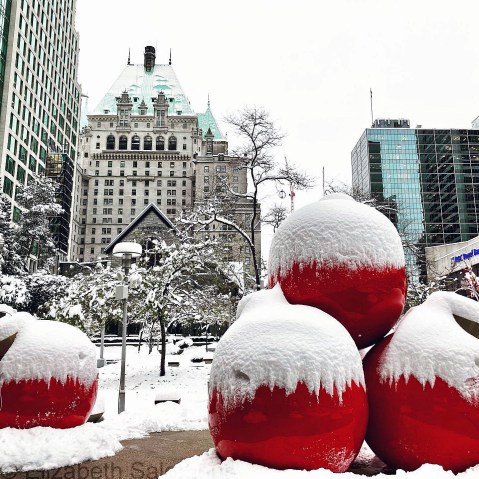
Burrard Street, Vancouver
Lights at Lafarge
There used to be a lovely light display in English Bay every winter. An orca, a heron, a tree. Also a bear and a beaver that I never got around to photographing.
But those beautiful lights did not come back last year, nor this year. I don’t know why they’re gone, but I sure do miss them.
Last year, feeling bereft, I went looking for an alternative light display. I found one, all the way out in Coquitlam. Lights at Lafarge is the largest free outdoor holiday light display in Metro Vancouver and is held every year at Lafarge Lake, a small pond created from an old quarry.
I convinced two friends to join me and one evening we rode the Skytrain all the way to the end of the line. The lake and its light display are located next to the station.
The trail forms a loop just over a kilometre long. Its flat and paved surface means it is both wheelchair- and stroller-friendly.

I didn’t get myself organized in time to post these photos last year, so I’m posting them for this month’s season of light. Although taking the Skytrain all the way to Coquitlam is a bit of a trek compared to walking down the street to my beach, Lights at Lafarge is definitely worth the trip.


Through My Lens: Golden Maple on Lost Lagoon

It’s been a while since I’ve posted a photo of our fall colours. And so, here’s one that I took a couple of weeks ago.
My West End
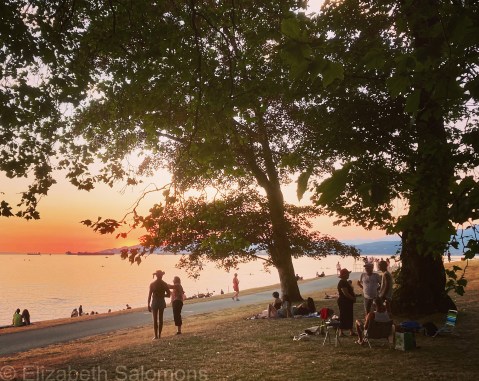
Last August, I had my cat-sitters over one evening for a picnic dinner to thank them for watching over my fur babies while I was away in Alberta. As soon as they arrived, we gathered up the dinner and some beach blankets and headed to the end of my street.
The end of my street is a grassy, treed spot between two beaches, never crowded but with a perfect view of the sunset. As a backyard, it’s great — even though I share it with the entire neighbourhood. At one point during the evening, I looked around at the dozens of people enjoying their own picnics, and marvelled at how much I love where I live, and that, even after living here for a quarter of a century, I have yet to tire of it.
Yup, you read that right. Twenty-five years ago today, I moved into my first apartment in the West End. And as long as I’ve been writing and posting on this blog, I’ve been sharing photos and stories about my home. It’s why I called the blog There and Back Again.
Because I always come back.
In honour of this momentous anniversary, here are some of my favourite, previously unposted, photos of my West End.


Through My Lens: English Bay Paddlers

When you live by English Bay, you never know what you’ll see on the water. Thanks to the power of my camera’s zoom lens, I was able to get this shot early yesterday morning.
Coulees Along the Crowsnest
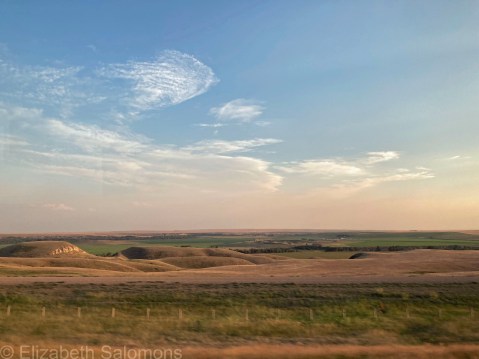
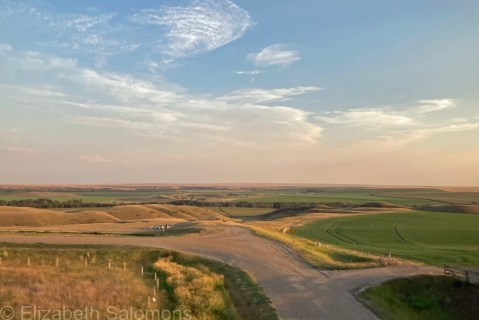
I was in Alberta last month to visit family, and one evening I took a bus from Calgary to Lethbridge — a journey I haven’t made in a very long time. I took this photo of the coulees as we drove along the Crowsnest Highway. I just love this landscape.
The coulees are ravines that formed when the glaciers retreated after the last Ice Age. Wind and water gave them their characteristic V-shape. They are everywhere in southern Alberta, but are especially prevalent along the Oldman River that flows through the middle of Lethbridge.
Coulee evolved from the French-Canadian word coulée, which in turn evolved from the French word couler, which means “to flow.”
Salish Eagle

My latest BC Ferry ride — and my third of the summer — was on this boat, the Salish Eagle, which took me to and from Galiano Island just over a month ago.
Three of these Salish-Class vessels came into service in 2017 and a fourth one last year. Built in Gdańsk, Poland, they are the first ships in BC Ferries’ fleet to run on liquefied natural gas, thereby reducing their emissions. Compact compared to the bigger boats that sail between Vancouver and Vancouver Island, the Salish-Class vessels go to and from the Southern Gulf Islands and between the Sunshine Coast and Vancouver Island. They carry up to 600 passengers and crew and 138 cars, and I absolutely love sailing on them.
Each Salish-Class vessel has original Coast Salish artwork adorning its interiors and exteriors. John Marston of the Stz’uminus First Nation is the one who designed the artwork you see on the Salish Eagle.
Little Qualicum Falls

There’s a gem of a campground on Vancouver Island I’ve been going to since forever. It’s called Little Qualicum Falls, and a family weekend there at the beginning of June was my second BC ferry trip of the summer.
Qualicum, or Quallchum, means “where the dog salmon run.” Dog salmon (also known as chum) is one of the five major species of the BC salmon fishery.
We lucked out with absolute picture-perfect weather for our Qualicum weekend, which we were all incredibly grateful for. A year ago, we were in the thick of a more typical Juneuary and our plans to go to Qualicum were scuttled before we even got into the car.
The provincial park sits alongside the Little Qualicum River and around Cameron Lake. It’s a great family campground with lots of trails to explore, lots of swimming holes to jump into, and then, of course, there are the falls.

As we often do, we took a quick side trip to Cathedral Grove on our last day before turning around to head to the ferry. Driving along Highway 4, we noticed a helicopter with a heli-bucket scooping water up from Cameron Lake. We rounded a bend in the road, and then we saw it — the wildfire on top of one of the mountains along the highway.

It was a small one, but it grew, as wildfires do, and a day or two later, that same highway we had driven on was closed for two weeks, completely shutting off the coastal communities of western Vancouver Island from the rest of the province. A detour over logging roads was put in place, but it was a rough route and not recommended for tourist traffic.
The highway reopened once the wildfire was no longer burning, but assessments of the mountain slopes above the highway have deemed them unstable. And so, beginning Monday, Highway 4 will be closed for most of the day between 9 and 5 to allow crews to do rock scaling above the highway. They figure the work will take at least a month, which is really going to mess up the tourist season for Tofino and Ucluelet.
I’m glad we got our Island weekend, but I feel for all those whose summer plans are being thwarted by a wildfire that has long been put out.


 There and Back Again