
Johns Hopkins University
Working on a university campus ― as I now do ― I’m much more in tune to the rhythms of the academic year than I have been for a long, long time. UBC has been delightfully (delightfully!) deserted these past four months, but then, all of a sudden, all at once, more than 50,000 students descended onto the campus this past week, and the place is now overrun (overrun!) with twentysomethings.
On my travels, I sometimes find myself wandering around university campuses. The architecture always fascinates me, as each school has its own unique look. And so, this being September, I thought I would take you on a tour of some of the schools I’ve photographed.
First up: Johns Hopkins University. It’s not the biggest of schools ― about 20,000 students ― but it certainly is a reputable school. I was shown around its Homewood campus by my sister just over a year ago, when I was in Baltimore to visit her.
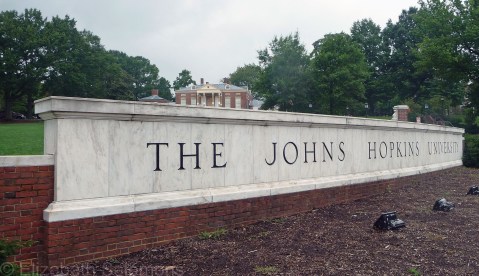
Hopkins was founded in 1876 through a bequest by Baltimore abolitionist, entrepreneur, and philanthropist Johns Hopkins. Here is a bust of the man himself.

Homewood House, seen in the next photo, was a private home built around 1800 that was eventually given to the university. It was built in the Federal Style ― a style of architecture you don’t see much in Canada ― and is said to be the inspiration for the look of the Homewood campus of JHU. It’s now a museum.

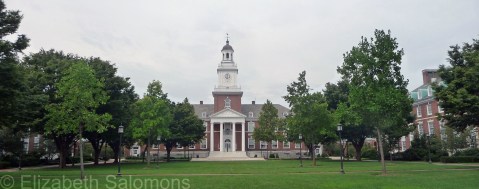
This is Gilman Hall, home to the humanities and social sciences departments.
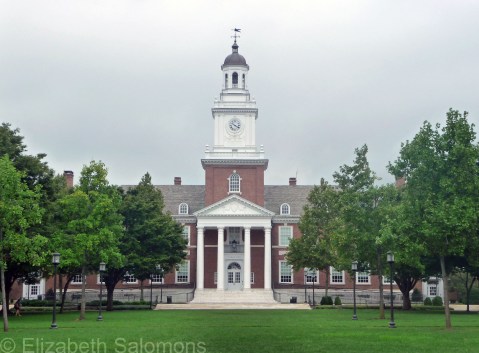
And this is what you see once you step inside Gilman Hall.
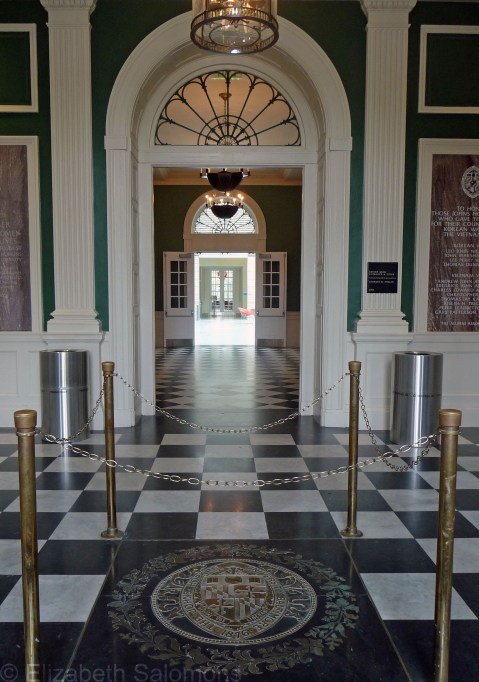
Keep on walking, and you’ll come to the Hutzler Reading Room.

It is such a beautiful room I couldn’t stop taking photos. Here’s another.

And another.

The imposing structure shown below is the Milton S. Eisenhower Library. As impressive as it is, it’s not quite as impressive as the George Peabody Library, located at the Peabody campus of JHU, which my sister took me to see after our tour of the Homewood campus. (Click here to see a photo of that library.)

On another day, while waiting for a bus, I realized we were standing in front the Johns Hopkins Hospital, so I took this photo. I quite like the three-storeyed porch, which I didn’t notice until I was editing these photos. Johns Hopkins Hospital is the top-rated hospital in the United States, and its School of Medicine is located on the East Baltimore campus of JHU.

So there it is: your look at Johns Hopkins University. My one regret is I didn’t get to see it in its fall glory, which I’m sure must be spectacular.
Art Talk: Grand Hotel

Yup, it’s another post about hotels, but this time I’m not recommending a place to stay. This post is about yet another art exhibition ― one that I stumbled upon when I was at the Vancouver Art Gallery to see Persuasive Visions.
The exhibition takes its name from the 1932 film Grand Hotel, winner of that year’s Oscar for Best Picture. One of the characters in the film keeps muttering, “Grand Hotel … always the same. People come, people go. Nothing ever happens.”
Huh. Yeah, right.
Grand Hotel: Redesigning Modern Life, seemingly an exhibition more appropriate for a museum than an art gallery, looks at the history of the hotel through the lens of four themes: travel, design, social, and culture. Displays include scale models of some of the world’s most architecturally impressive hotels, such as New York’s Waldorf Astoria and Singapore’s Marina Bay Sands. There are photos and memorabilia about the development of Canada’s tourist industry, thanks to the Canadian Pacific railway hotels (“If we can’t export the scenery, we’ll import the tourists”), and the development of the same in the United States, courtesy of Highway 66 and motor hotels. Did you know the InterContinental luxury hotel chain was founded by Pan Am? I didn’t.
The exhibition also looks at hotels as agents of change concerning race, class, and gender. The Algonquin Hotel in New York, host to the 1920s writers group known as the Algonquin Round Table, was one of the first hotels to accept solo female guests. Duke Ellington was known to prefer touring overseas because hotels outside of the United States weren’t segregated.
And, finally, hotels are explored as centres of culture: the aforementioned Algonquin Hotel in New York, gathering place of New York’s literati, the Chateau Marmont, home to film stars during Hollywood’s Golden Age, and Hotel Imperial Vienna, focal point of Vienna’s coffeehouse culture.
Grand Hotel: Redesigning Modern Life will appeal to anyone interested in travel, and is on display at the Vancouver Art Gallery until September 15.

Two Days in Seattle
 Now that I’ve told you how we got to Seattle, and how we got back from Seattle, you might be wondering what there is to do and see while in Seattle. The city, I was pleased to discover, is the perfect size for a weekend visit. It’s large enough that there’s something for everyone, but small enough that you don’t feel overwhelmed by all the choices.
Let’s start off with the architecture. Upon arrival, you can’t help but notice the Space Needle, a prominent landmark of Seattle’s skyline that was built for the 1962 World’s Fair. It’s impressive when you stand beneath it, but … well … not so impressive I wanted to pay money to go up it.

Never mind. At the base of the Space Needle is a building that did impress me enough to want to pay the admission fee. That would be the EMP Museum, designed by Toronto-born architect Frank Gehry. The building’s deconstructivist style is just so fun to look at, and so shiny and colourful and fluid that you can’t resist reaching out your hand to touch the building as you walk by.

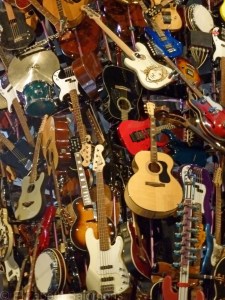 Inside the museum is even more fun, with exhibits more entertaining than I thought possible. Want to learn everything there is to know about Nirvana? It’s here. Jimi Hendrix? Him too.
The museum also has also some really cool artifacts from the world of fantasy and science fiction TV and film. As in: the Cowardly Lion’s costume, Susan Pevensie’s bow and quiver of arrows, Yoda’s staff, Darth Vader’s light sabre, Data’s uniform … they’re all here. Geekdom heaven, wouldn’t you say?
Seattle scored a second “starchitect”-designed building with the Seattle Central Library, designed by Dutch architect Rem Koolhaas. Don’t just walk around its exterior, though. Have a quick look inside too, taking the time to go all the way up to the top floor for a remarkable view over the atrium.
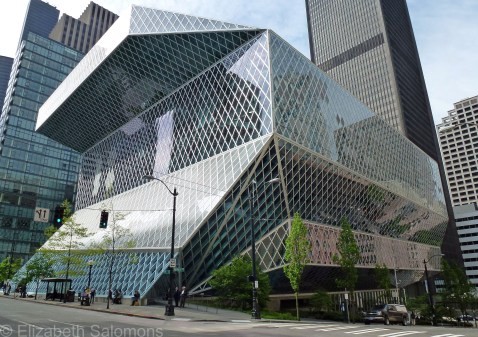
Once you’ve seen Seattle’s architectural highlights, I recommend checking out one of the most unique art installations I’ve seen anywhere: the Chihuly Garden and Glass. (It alone is worth a visit to Seattle.) The museum opened a year ago, so it’s rather new, and it’s rather extraordinary. Dale Chihuly is an American glass sculptor who creates exquisite works of blown glass. Photos don’t do his work justice, but, forgive me, I’ll post one anyways.
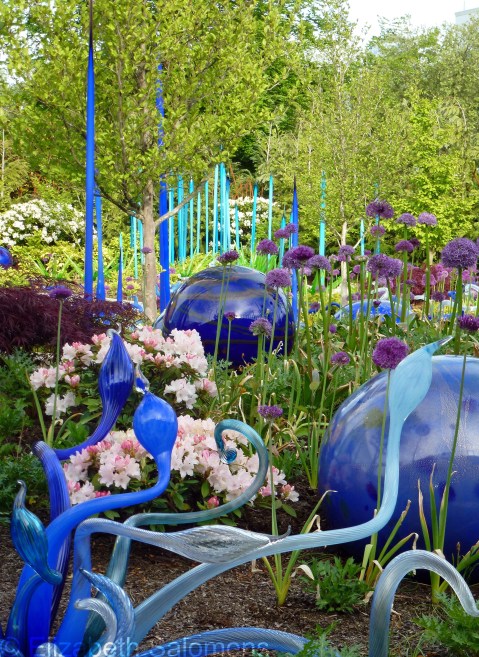
 A Seattle institution you shouldn’t miss is Pike Place Market, located near the downtown waterfront. In operation since 1907, it’s one of the oldest farmer’s market in the United States. Fresh local produce, seafood, and flowers are at street level, while the lower levels are filled with shops of all sorts, including bakeries, restaurants, clothing, and local crafts. Be sure to see the fishmongers in action as they throw the fish to each other before wrapping them up for the customer. Oh, and there’s a coffee shop in the market you may have heard of: Starbucks.
  Not just any Starbucks, though ― it’s the first ever one, which opened for business in 1971.
We stayed in Belltown, which turned out to be a great neighbourhood full of funky coffee shops, trendy restaurants, and lively bars. It is also conveniently located halfway between the downtown waterfront and Seattle Center (where the Space Needle, the EMP, and the Chihuly Garden and Glass are located).

One thing we didn’t have time for: a ferry ride across Elliott Bay. And there are dozens of other Seattle neighbourhoods I’m told are worth checking out. In other words? I plan to return for another weekend visit soon, because there’s lots more of Seattle to see.

Through My Lens: La Sagrada Família

For the Third Sunday of Lent, we’re moving on to Barcelona.
Most European cathedrals were built centuries ago. The cornerstone of this one, Basílica i Temple Expiatori de la Sagrada Família, was laid a mere 131 years ago in 1882. Except for a stoppage during the Spanish Civil War, construction has continued ever since. The basilica is the final work of Catalan architect Antoni Gaudi, the face of Modernisme, who spent the last decades of his life working on the structure.
When finished (estimated to be in about 15 years), La Sagrada Família will have 18 spires and will be the tallest cathedral in the world. There will be three facades, two of which have already been completed: the Nativity façade and the Passion façade. The Passion façade, which faces west, was sculpted by Josep Maria Subirachs and is particularly moving.
I visited La Sagrada Família with a friend in October 2001. After we left what is essentially the largest construction site either of us had ever seen, we took the metro back to our hotel. Sitting across from us was one of the cathedral’s stone workers, covered in white dust, heading home after his work day. I marvelled at the thought of spending your entire career working on one project. And I felt honoured to be riding the metro with an old-school master craftsman.
George Peabody Library
This week is Freedom to Read Week in Canada, so I thought it was high time I wrote another post about a book. Or, perhaps, many thousands of books. Like the ones in this library.
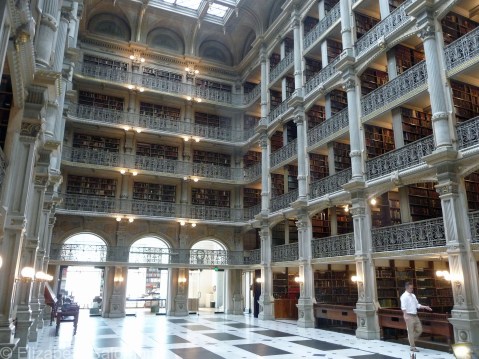
There are libraries. And then … well … and then there’s the George Peabody Library.
The George Peabody Library is one of the libraries of Johns Hopkins University in Baltimore, Maryland. It’s housed in a stunning building designed by architect Edmund Lind and has been open to the public since 1873. The library is named after George Peabody, the American–British financier and philanthropist who provided the funds for the library’s founding in 1857.
The collection consists of over 300,000 books, mostly from the eighteenth and nineteenth centuries, and specializes in all the good stuff: archaeology, British art and architecture, British and American history, English and American literature, Romance languages and literature, Greek and Latin classics, history of science, geography, and ― wait for it ― exploration and travel.
There are a lot of cool-looking libraries on this planet. As if I need another reason to travel, I plan to photograph as many of them as I can.
The National Museum of the American Indian
In my post the other week on the Smithsonian, I mentioned how splendid the building that houses the National Museum of the American Indian is.
And then didn’t bother to post a single photo of the building.
I didn’t post any photos because I think the building is so impressive its photos deserve a blog post all their own.
If you’ve ever been to the Canadian Museum of Civilization in Gatineau, Quebec, you’ll recognize the architect’s work. Both buildings were designed by Douglas Cardinal. Born in Calgary, Alberta, to a Blackfoot father and a mother of Métis and German origins, Cardinal’s designs are known for their curved lines and organic shapes.
I could photograph this building over and over again. Here, take a look.
Through My Lens: Grand Central Terminal

For my 100th post: a photo of the main concourse of Grand Central Terminal in New York City, because this magnificent building is celebrating its 100th birthday today. The doors to the station ― which New Yorkers refer to as “Grand Central Station” or simply “Grand Central” ― were first opened to the public at 12:01 am on February 2, 1913.
Washington DC

Washington DC was a bit of a surprise to me. In some ways, it was exactly what I expected it would be. But in other ways, it was so much … more.

East Side of the Capitol
The landmarks were familiar, of course. We see them all the time on the news when TV reporters do their standups in front of the White House or the Capitol. Lots of white marble in those buildings. And columns. So many columns.
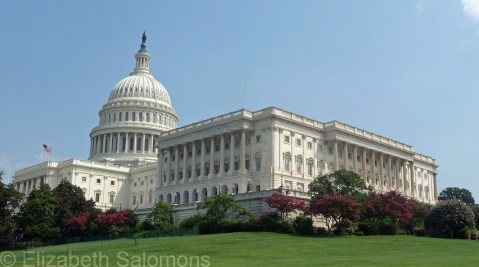
South Side of the Capitol
It was the scale of the place that took me by surprise. I thought it would be a short walk along the Mall from the Capitol to the Lincoln Memorial. But with all the stops I made along the way, it took me the better part of a day to make that walk.
As I walked, I kept muttering to myself, “So this is what a world capital looks like.” Later the word came to me: imperial. The place is rife with imperialism.
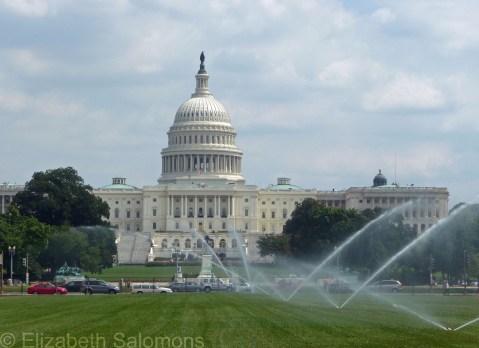
West Side of the Capitol
I kept comparing the buildings in DC to the ones in other world capitals I’ve been to (London, say, or Paris). The buildings in Europe are just as grand and just as impressive. But across the pond, there is far less open space, and the grand buildings often catch you by surprise as you turn a corner.

Washington Monument and the Mall as seen from the Capitol
In DC, you have this massive front lawn they call the National Mall that lets you take in all the key sights in one glance. From the Capitol, you look down the Mall directly at the Washington Monument. Beyond that, there’s the Lincoln Memorial. When you stand at the Washington Monument, you turn one way and have an unobstructed view of the White House, but when you turn the other way, the Jefferson Memorial leaps out at you.
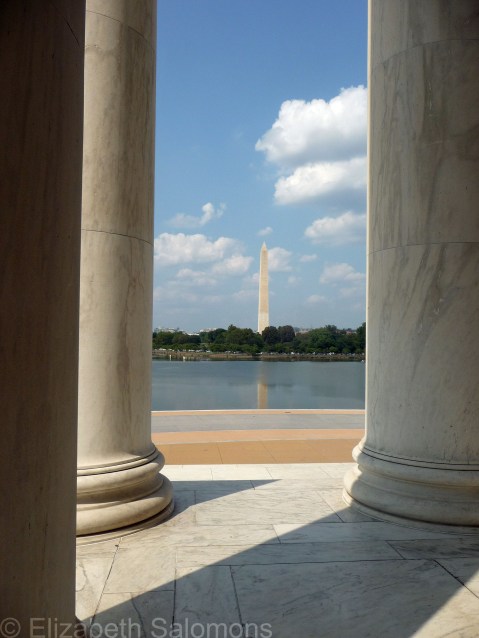
Washington Monument from the Jefferson Memorial
Washington DC is a city well-planned. Like other world capitals, DC was selected to be the capital of a young country some years after its founding. But what’s unique about DC among world capitals is that it was built from scratch. George Washington selected Pierre Charles L’Enfant, a French-born American, to design the city. L’Enfant envisioned a city centred around three points: the government house (which eventually came to be called the Capitol), the president’s house (what we now call the White House), and a monument to George Washington. Grand streets and avenues intersected at grand circles and squares. The Mall, in L’Enfant’s mind, would be the grandest avenue of them all. A narrower avenue (Pennsylvania Avenue) ran between the Capitol and the White House.

Pennsylvania Avenue
Visionary that he was, L’Enfant was no project manager, and he was soon fired by George Washington. He died in poverty, but eventually was honored with a re-internment in Arlington National Cemetery. His true epitaph, though, is the city he designed.

Arlington Memorial Bridge
I spent two days in DC and was able to check off most everything (but not quite everything) on my to-do list. It was the Smithsonian that caught me up; I was barely able to make a start on it.
For more on that, stay tuned.


 There and Back Again