
Salt Spring Island Fall Fair

Yup. It’s another cow.
And no, this hasn’t turned into a Bovine Blog.

I took these photos a couple of weeks ago at the Salt Spring Island Fall Fair. My friend had been urging me to come over for the island’s annual fair, which, she claims, is the social event of the year for Salt Spring Island.

“Will there be cows?” I asked.
“Yes,” she said.
“I’m there,” I said.

Salt Spring Island has a long history of farming ― the island was first known for its fruit harvests, then the dairy and poultry farmers arrived. These days, Salt Spring is famous for its lamb …

… and for its cheese made from goats’ milk.

In keeping with that history, the Salt Spring Island Fall Fair has been an island institution since 1896. This year’s theme was Celebrating Family Farming to coincide with the United Nations declaring 2014 the International Year of Family Farming. (I so wish I had made it to last year’s fair: its theme was Pirates of the Carrots and Beans.)
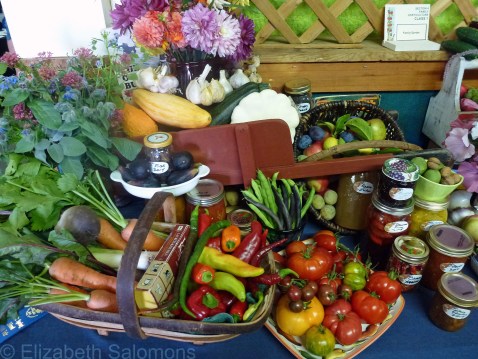
It seems like everyone on the island has something to exhibit at the Fall Fair ― from livestock to produce to baked goods to flowers to handcrafts.
Although the sheepdog demonstration was fascinating and the zucchini races were, um, unlike any race involving green vegetables I’ve ever seen, my favourite event was the sheep shearing.
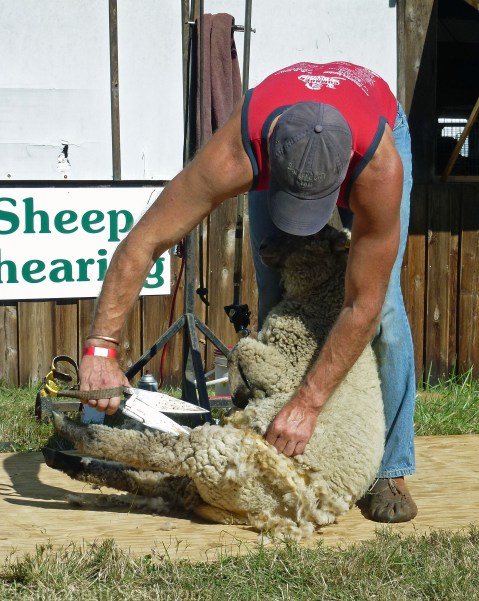
The shearer showed us how shearing used to be done ― with a big, shiny pair of blade shears …

… and then he showed us how it’s done today ― with powered machine shears.


The Salt Spring Island Fall Fair takes place every September. If I’m feeling in a year that my blog needs more cow photos, I now know where to go.

Happy Birthday, Bard on the Beach!

A few months ago, I posted a photo in honour of the Bard’s 450th birthday. Today, I’m posting in honour of Bard on the Beach’s 25th season, which concludes this week.
Every spring, the tents go up in Vanier Park at the south end of the Burrard Street Bridge, and every fall, they come down. As far as summer Shakespeare festivals go, Bard on the Beach isn’t bad. It is the most expensive summer Shakespeare festival in Canada after the Stratford Festival in Ontario, but then, with four productions a year from mid-June to mid-September, it’s also the largest Canadian Shakespeare festival after Stratford.
Perhaps it is too large. Three years ago, the popular festival premiered its new, much larger main stage tent, which now has a capacity of almost 750. But the larger canopy was acoustically challenged, and the festival now has its actors wear mics, which irks me to no end. (Maybe it’s just me, but I like to know who is speaking while I’m watching live theatre, and that’s no longer possible when the voices are coming from a speaker above you instead of from the stage in front of you.)

Bard on the Beach used to be general admission, so you had to show up really early to get a decent seat. This was no different from any of Canada’s other summer Shakespeare festivals. What was different is you were always made to stand for a good chunk of time in what’s called the Bard Village ― a lobby area of sorts where vendors are eager to sell you wine or beer, snacks, or merchandise ranging from T-shirts and tote bags to, um, beach towels.
One year I was standing in this line, waiting (waiting, waiting…), when Christopher Gaze, artistic director of the company, stopped to chat to the couple standing right in front of me. He obviously knew them as they talked for a quite while ― I don’t remember what about ― but then the couple asked Christopher why the festival tents didn’t have assigned seating and why we had to wait so long before we were permitted to be seated.
Christopher looked around him, then said thoughtfully, “We want to create atmosphere.” The idea behind the wait, he explained, was to encourage you to chat with the people in front of you, or with the people behind you, and to give you time to make friends.
Balderdash, I thought, grumpily. You just want us to buy stuff.
(What I find particularly galling is that the Bard Village also sells pre-packaged picnics ― aka sandwiches and salads ― which is a total rip-off of Toronto’s Shakespeare in High Park. That festival creates atmosphere by charging pay-what-you-can for its general admission seating on a hillside and by letting you bring your own food. And your own picnic blanket. It’s the perfect venue for a summer picnic.)
But I digress. On this particular evening, I had an entire conversation with Christopher in my head. Maybe he heard me because Bard on the Beach now has reserved seating.
As for its theatre productions, I’ll just say this: I’ve seen some of the worst performances ever at Bard on the Beach, but I have also seen some of the absolute best Shakespeare ― the kind where you want the play to go on and on and on. And it’s the latter productions that keep me coming back. I never know what I’ll get.
Happy birthday, Bard on the Beach. Here’s to another 25 years!
Recipe Box: Sockeye Salmon
A sure sign that summer is morphing into fall is when the salmon start running.
Four years ago, the Fraser River had the salmon run of the century. More than 30 million sockeye swam up river to spawn that year ― the highest number since 1913. This year, their offspring are returning to spawn in spades, and both the commercial and sports fisheries are expected to match their harvest of 2010. (Time for a quick biology lesson ― just in case it’s needed. Salmon are born in freshwater rivers, migrate to the ocean, then return to the rivers to spawn. They always return to the river where they were born; thus, it can be predicted that a good salmon run one year will result in another good run several years later.)
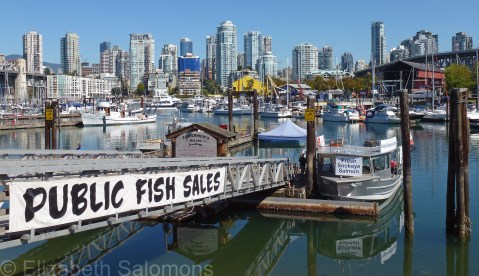
Now, if you live along the West Coast (as I do), you have the good fortune to be able to buy sockeye right off the boat (as they say). I bought a nice four-pounder last weekend. (I asked for the smallest one they had ― most were much bigger.) This year the sockeye are so prolific that the fishmonger up the street is matching the price I paid at the dock, and even my local big-chain grocery store is stocking whole salmon.

What to do with a whole salmon, you ask? Why, you fillet it. Or you cut it into steaks. (Trust me: YouTube is your friend on days like these.)
And then you grill it, bake it, pan fry it … the options are myriad.
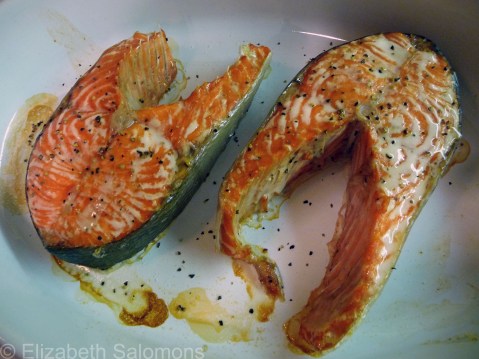
I’ve tried all kinds of recipes, but my favourite way to prepare sockeye salmon is to keep it simple: season with salt and pepper, then pop it into a preheated 450°F oven. Bake for about 12 minutes, no longer. The key when cooking salmon in the oven is to not overbake it or it will be too dry.
And then: enjoy!
Through My Lens: Fishing

Summer may be waning, but there are still photos to post.
I came across this woman fishing in Burrard Inlet early one morning several weeks ago.
Through My Lens: Second Beach Pool
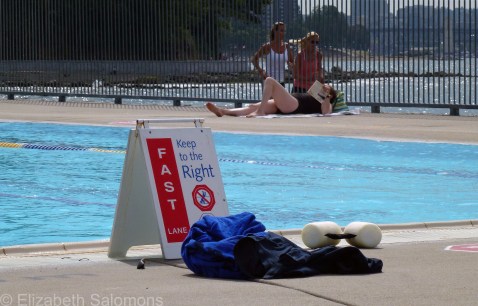
Today is the last day of summer. We might be able to fool ourselves for a few more weeks, weather permitting, but the truth is the days are getting shorter and the leaves are starting to turn.
This is Second Beach Pool in Stanley Park. It’s located at a lovely spot along the seawall overlooking English Bay. Like all of Vancouver’s outdoor pools, today was the last day of its season.
Tomorrow, it will be empty and lonely.
Vancouver Walking Tours

I was chatting at work this past week with my boss (who, like me, used to live in Toronto) about the differences between visiting Toronto and hosting friends from Toronto. Neither of us feel like tourists when we go to Toronto because we know the city; nobody needs to show us around or, for that matter, show us how to get around. But when our friends from Toronto come to Vancouver, we end up playing tour guide because it’s often their first time in Vancouver (or their first visit in many years) and they want to see and do everything.
Which is all good. I had a friend from Toronto visit me this month and we had a fabulous ten days together playing tourist in my home city. My conclusion? Staycations are highly underrated.
Which brings me to today’s post. Until now, I’ve always taken visitors on walking tours of my own design. For something different, I decided to take this particular friend on a “professional” walking tour. We went with the Tour Guys because they advertise free tours ― and they really are free. They ask only that you tip them if you like them (we did), and give them a favourable review on Trip Advisor.
The Tour Guys describe themselves as “history geeks.” As a history geek myself, I was pleasantly surprised by the value they offered in a 90-minute tour. I do a lot of research about Vancouver for this blog, but on both tours (we did one of Gastown and another of Chinatown) I learned something new. Did you know that the term “skid row” originated in the Pacific Northwest? (Both Seattle and Vancouver claim to have used it first.) The phrase originates from “skid road” ― the road used to skid logs through what is now the Downtown Eastside (often referred to as Canada’s poorest postal code) to the Hastings Mill on the shores of Burrard Inlet.
Most importantly, the Tour Guys do not gloss over some of the more shameful aspects of Vancouver’s history. Both guides talked about the riots that have taken place throughout the past century, from the race riots of 1907 all the way to the Stanley Cup riots of 1994 and 2011. Our guide on the Chinatown tour explained the federal government’s policies that deliberately targeted Asian immigration (namely, the Chinese Head Tax and the Chinese Exclusion Act), and also talked about the internment of Japanese-Canadians during World War II.
Affable with both children and adults alike, our Tour Guys were entertaining and kept our interest the entire time. There were a few careless mistakes with some facts ― the Millennium Gate in Chinatown went up in 1986 (Vancouver’s Centennial), not 1967 (Canada’s Centennial), and BC joined confederation in 1871, not 1886 ― my guess is those errors were simply slips of the tongue. But an egregious error was this one: environmentalist David Suzuki lives in Vancouver, not Toronto.
Having said that, here’s my recommendation: take a walk with the Tour Guys if (1) you have out-of-towners you want to impress (I’ve already recommended them to my boss) or (2) you want to learn more about your own city.
And if you’re a visitor to Vancouver, you most of all need to meet the Tour Guys. You won’t regret it. Promise.

A Forest in the City

After I wrote my post about Cathedral Grove, I started thinking about the forest I live next door to. I’m talking about the one in Stanley Park. (You know, the wee park Tripadvisor thinks is # 1 in the world.)
What makes Stanley Park so special is it is as much forest as it is park. I can’t think of another city with a forest in its centre that equals the area of its downtown business core. (If you know of one, please tell me. I would love to visit.)
The peninsula that is Stanley Park has been logged several times, but today it is as dense with trees as it was 150 years ago. There are about half a million of them, ranging in height up to 75 metres.
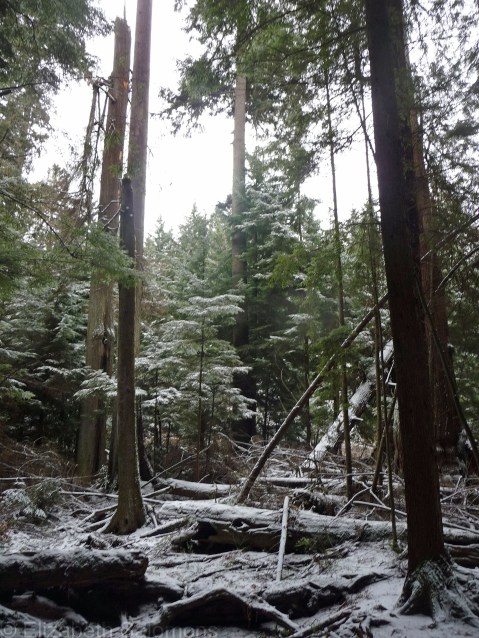
Truth is, windstorms have done more damage to the trees in Stanley Park than logging. There have been three notable storms: one in 1934, another in 1962, and the one I remember ― the windstorm of December 15, 2006. Winds of 115 kilometres per hour downed over 10,000 trees (total tree area lost was 41 hectares), with most of the damage to the western side of the peninsula, particularly around Prospect Point. I took a long walk through the park on Christmas Day 2006 with my sister and my heart sank when I saw the damage. All of the trails through the park were impassable; fallen trees lay across them like pick-up sticks. Imagine if Stanley Park had been picked up by its four corners, given a good shake, and then set down again. That is what it looked like from the ground.
From the air or the water, it looked like someone had come through the park with a scythe. Many of the trees still lie where they fell. I took this photo sometime during the winter of 2011, more than five years later.
But a few good things came out of that storm. Like a new and much safer parking lot at Prospect Point. There would have been a public outcry had the Park Board decided to cut down trees to make way for a much-needed parking lot, but once the trees were down ― well, there came an opportunity.
I benefitted from that storm, too. Because the seawall was closed for 18 months (so that it could be repaired and the cliffs above the seawall on the western edge of the park stabilized), I spent the summer of 2007 exploring the interior of the park ― something I had never bothered to do until then. Stanley Park’s seawall is so accessible ― and so beautiful ― that visitors to Vancouver (and one local blogger) rarely take the time to explore the interior trails. There are some 27 kilometres of them criss-crossing the park, most of which have their origins as skid roads used to skid out the cut logs. They all have names; one of them is called Cathedral Trail. (Which is why I started thinking of the forest in the city after writing my post about Cathedral Grove.)
A couple of years ago, Vancouver City Council enacted a smoking ban in the city’s parks. For good reason. It has been said that if a fire were to ever get out on control in Stanley Park during one of our hot, dry summers, the forest would be gone in less than an hour.
What a shame that would be.

Through My Lens: Departure Bay
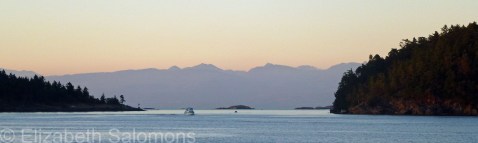
Here’s one last photo before we leave Vancouver Island. This is what you see from the ferry as it leaves Departure Bay on the Island for Horseshoe Bay in West Vancouver.
I never get tired of this view.
Cathedral Grove
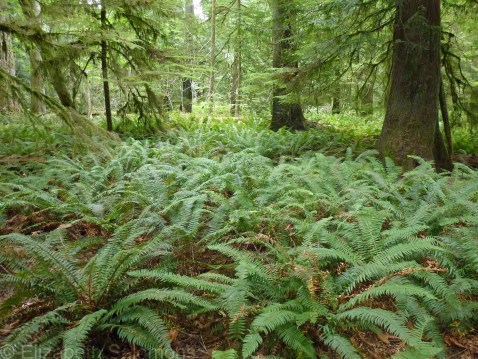
On the way to Tofino is a unique little park known as Cathedral Grove. It straddles Highway 4 ― the road that meanders from the east coast of Vancouver Island to its west coast ― and is the perfect place to stretch your legs on the long drive cross Island.
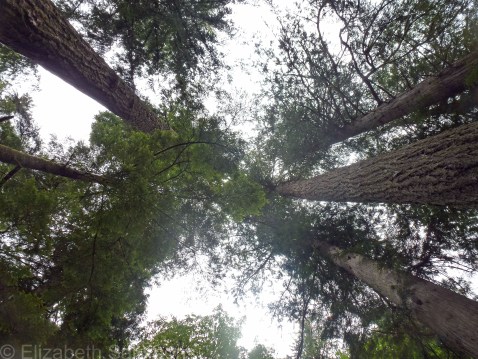
They say it first came to be called Cathedral Grove back in the 1920s, but it wasn’t made a provincial park until the 1940s after H.R. MacMillan, one of British Columbia’s lumber barons, donated the parcel of land to the province.

Short walking trails form loops on both sides of the highway. The north side of the highway is populated with Western red cedar. On the south side, you get up close and personal with the Douglas fir trees: some of them have a circumference of nine metres and are as old as 800 years.

As for the wow factor, this is as good as it gets in BC. I’ve been visiting this park since forever, and it never fails to impress.
Velella Velella
While my family and I were checking out the surf conditions at Long Beach the other weekend, we came across dozens of these.
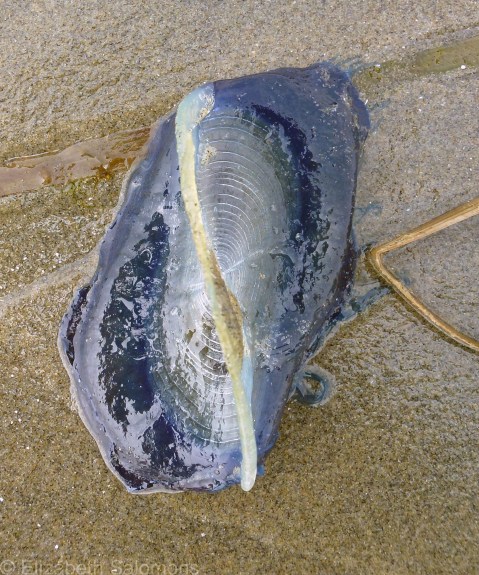
They’re velella velella ― a small animal about the length of my index finger. Related to the jelly fish, they are normally found hundreds of miles off shore. For some reason, they are sometimes washed ashore, which is what happened the other weekend on the beaches near Tofino. According to Tofino’s mayor, a marine biologist, it is a rare, but completely natural, event.
How cool that it happened the weekend we went to Tofino. (And how cool is it that Tofino’s mayor is a marine biologist?)


 There and Back Again