
Through My Lens: Biomed Building
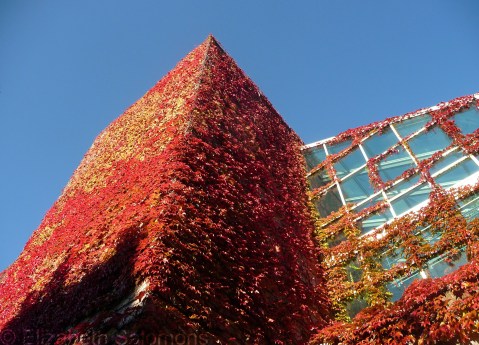
Since September, I’ve been spending most of my days at the University of British Columbia (UBC). It’s a beautiful campus located on the Point Grey peninsula of the west side of Vancouver. This is a photo I took in early October of the Biomedical Research Centre I walk by each day on my way from the bus loop to my office. I liked the contrast between the blue sky and the red ivy.
The Sylvia Hotel

The Sylvia Hotel is a small beachside hotel in Vancouver’s English Bay with a long and storied history. These photos were taken when the hotel is at its most colourful —in the fall, after the ivy has turned red.
The hotel has some other colour as well: Errol Flynn was a frequent guest and there is an urban legend that he died here. Team Russia, including (it was rumoured) the Russian hockey team, stayed at the Sylvia during the Vancouver 2010 Olympics.
The Sylvia Hotel has overlooked English Bay since 1912. Originally an apartment building, it was converted to an apartment hotel during the 1930s and to a full-service hotel after World War II. Its name is taken from the daughter of the building’s original owner. Until 1958, the Sylvia was the tallest building in Vancouver’s West End — hard to imagine today as the eight-storey building is dwarfed by the condo towers that surround it.
Two of my home exchangers came to Vancouver for family weddings and found the Sylvia most convenient for other members of their families to stay. It’s a lovely place to go for breakfast — I recommend the Beachside Benny — and the hotel is also the setting of two children’s books about a resident cat named Mister Got to Go.

Through My Lens: Canada Place
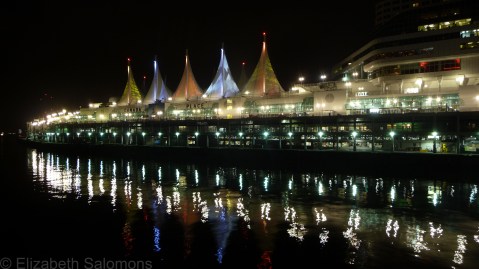
A friend was in town this week on business, so I met up with him one evening after work. We went for drinks and something to eat and a long catch-up at a bar near his hotel that overlooks Canada Place.
Afterwards, we took some photos. Here’s mine.
VIFF
Travelling to another country doesn’t always require that you get on a plane. One of the best alternatives to travelling (for me) is hanging out at an international film festival.
Vancouver International Film Festival (VIFF) is held every October and is one of the largest film festivals in North America. This year, I had a choice of 380 films from 75 countries. Which meant that this month, for the price of a movie ticket, I saw Serbia, Bosnia, South Africa, France, and the Czech Republic.
How cool is that?

Through My Lens: September
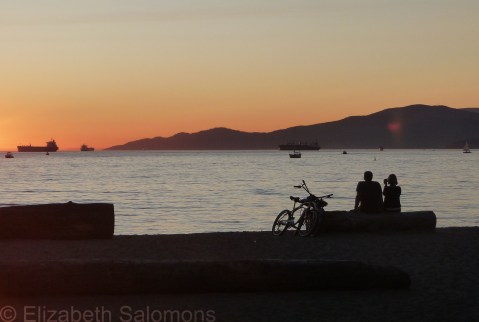
As much as I love to travel, I always love to be home again. Especially after a longer time away.
I was gone for six weeks this time, what with my house-sitting stint in Burnaby and my mad dash around the Eastern Time Zone. Now I’m back in my own space, in my own neighbourhood, enjoying all that I love about work and play in Vancouver.
Both this year and last, Vancouver endured a miserably cold, wet spring, but a fabulously long and hot summer. The highs this past week were an incredible 27°Celsius ― that’s warm for Vancouver at any time of the summer, but almost ten degrees above normal for late September. And so, everyone is spending as much time outdoors as possible; the beaches, the parks, and the seawall are filled with people enjoying the last gasp of summer. We all know it won’t last much longer.
Deer Lake Park
The other day I wrote that, during my time hanging out in Solo, I’ve discovered a few of Burnaby’s treasures ― delightful treasures that redeem some of the annoying and ugly aspects of suburban living. Deer Lake Park is one such treasure.
A friend introduced me to Deer Lake Park one afternoon about a week ago. Her townhouse complex backs onto the 500-acre park, so you could say the park is right in her backyard. We walked a loop around the park and I took some photos of the lake. Here are a few of them.
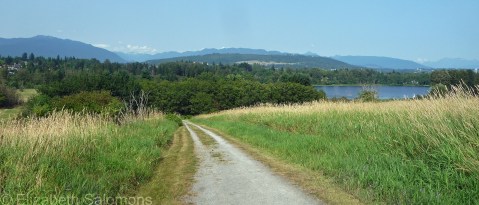
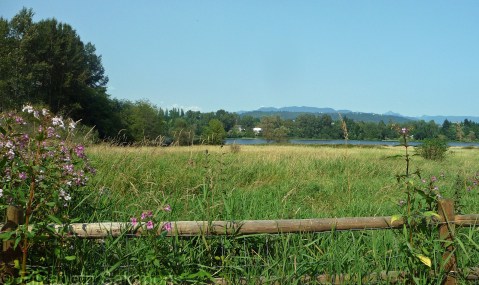

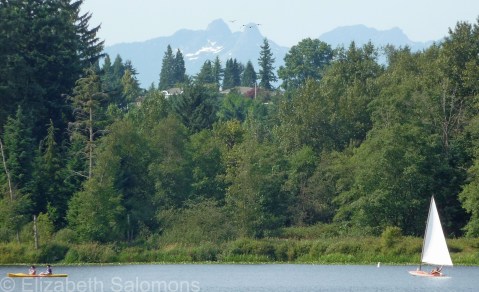
Deer Lake Park is a park for all seasons and I intend to come back to explore it some more.
Hanging Out in Solo
While my sister and her husband are busy eating, drinking, and loving their way around Italy, I’ve been on house-sitting duty. House sitting, I’m discovering, is an awful lot like home exchanging: it gives me a chance to enjoy the perks of someone else’s home for a while, and the opportunity to explore a new neighbourhood. The only difference between this round of house sitting and my previous home exchanges is that, if I need something from home, I can easily go get it.
The perks this time are pretty good. I have an enormous south-facing backyard all to myself, with a covered patio, a Rolls-Royce of barbecues, and an herb garden. Beyond that, there’s a back 40 filled with bushes dripping with almost-ripe blackberries. The herb garden has to be watered daily, as does a forest of small trees belonging to my brother-in-law. And then there are the six cats (two of them my own) who need to be fed and watered twice a day. I feel like I’m playing farmer, what with all these animals, crops, and chores, but hey, it’s summertime, and it’s pretty heavenly.
The neighbourhood, on the other hand? Not so heavenly. I’m in North Burnaby, in an area some developers are starting to call Solo ― that’s SOuth of LOugheed. (Go ahead, laugh. I did.) The subdivision where I am temporarily lodged is sandwiched between two highways: Lougheed (with the elevated SkyTrain running above it) and the Trans-Canada. That means I’m listening to the constant white noise of freeway traffic to the south, and the intermittent whirr of the SkyTrain to the north.
North Burnaby is not that attractive, in other words. It’s one mall after another, one industrial park after another, one arterial road after another. I loathe the whole car culture that is necessary here; I know it’s no different from any other North American suburb, but it’s what I hate most about suburbia and why I choose to live downtown. The other day I used a drive-through ATM for the first time in my life, and felt strangely defeated by doing so.
However, spend enough time in a neighbourhood and eventually, somewhere, somehow, you begin to discover its treasures. Burnaby has a few that are simply delightful, which I’ll write about in another post. For now, I will remind you (my faithful readers) and myself that the intent of this blog is to take a second look at our surroundings ― whether beautiful or mundane. And I’ll leave you with a photo of some marvellous engineering. After all, there is beauty in that, too, right?

SkyTrain tracks snaking their way east above Lougheed Highway
Dr. Sun Yat-Sen Park
In the heart of Chinatown is one of Vancouver’s hidden gems: Dr. Sun Yat-Sen Classical Chinese Garden and Dr. Sun Yat-Sen Park. The garden was named the 2011 Best City Garden by National Geographic. The park (where these photos were taken) is an extension of the garden and has no admission fee. If you’re in the vicinity, be sure to stop in. It’s a peaceful break from the noise and bustle of Chinatown.
Art Talk: William Kurelek
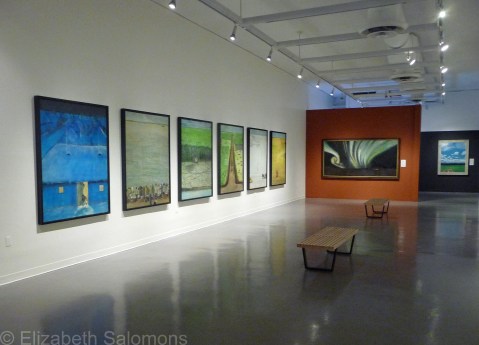
The other week when I was in Victoria, I went out of my way to stop in at the Art Gallery of Greater Victoria. I wanted to see William Kurelek: The Messenger.
I was expecting one room, maybe two, with a handful of paintings, but this exhibition completely exceeded my expectations. It is one of the largest-ever retrospectives of Kurelek’s work ― some 80 pieces ― and opened in Victoria earlier this summer after appearing at the Winnipeg Art Gallery and the Art Gallery of Hamilton.
William Kurelek was born in Alberta in 1927, moved to Manitoba as a child with his family, worked as a lumberjack as a young man to earn money for art studies, and eventually settled in Toronto, where he married, raised a family, and painted. He died there in 1977.
Before he settled in Toronto, Kurelek travelled to England because he had heard the English were doing interesting things with art therapy. He checked himself into a psychiatric hospital and spent the next seven years in and out of hospital. Some of the paintings he did as part of his therapy are included in this exhibition. They are disturbing images, filled with evidence of his illness. But in them you also see the influence of Bosch, Bruegel, and Vermeer ― artists whose work Kurelek studied while in Europe, and whose work would be life-long influences on his style.
While in England, Kurelek converted to Catholicism. At that point, he began painting Biblical scenes and subjects. Later, after his return to Canada, he took on apocalyptic themes as he reacted to world events such as the Cuban Missile Crisis. Kurelek saw himself as “the messenger,” tasked with spreading moral and Christian messages through his work. Although the prairies are a central theme in his artistic vision, even his pastoral landscapes have a mushroom cloud on the horizon, or a crucified Christ at the edge of a freshly plowed field.
Most of us know Kurelek’s artwork from his illustrated children’s books that are now Canadian classics. I don’t remember when I first was introduced to his work ― I suspect it was in grade school by one of my teachers ― but I appreciate it because I’m interested in the themes Kurelek explored: the prairies, landscape, place, memory, the immigrant experience, and Christianity. He was an avid photographer as well, and used his camera as a view finder to find subjects to paint.
Canada has a great tradition of landscape painting. Unfortunately, when asked to name a Canadian landscape artist, most of us don’t get much beyond the Group of Seven. Maybe Emily Carr. William Kurelek, I’m now convinced, is one of Canada most underrated artists. William Kurelek: The Messenger is at the Art Gallery of Greater Victoria until September 3.
London 2012
All eyes are once again on London as it’s the opening day of the 2012 Summer Olympics. Having lived in a host city, I can say from personal experience that the Olympic spirit is alive and well when you’re on the ground in the thick of it. When you’re watching the Olympics from afar, however, that spirit can be overshadowed by the politics and the commercialism and the media looking for a story. My hope is that Londoners will enjoy the party as much as I did here in Vancouver in 2010.
This time, not being in the thick of it, I will spend the next few weeks cheering for the athletes who proudly represent Canada, enjoying what glimpses of London I’ll see on my TV, and brushing up on my world geography. (Quick, everyone: Where’ s Comoros?)

Olympic Rings in Burrard Inlet, February 2010


 There and Back Again