
Vancouver Biennale: Engagement
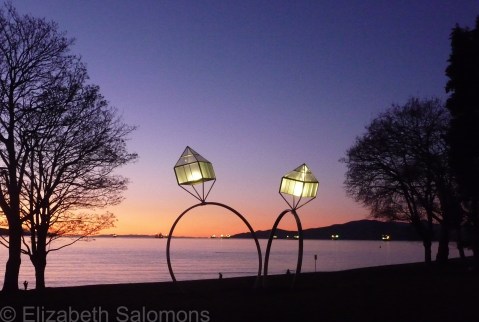
Here’s one more Vancouver Biennale photo, this one from the 2005 to 2007 exhibition. It’s called Engagement and was created by Dennis Oppenheim, an American. It overlooks English Bay at Sunset Beach Park.
Vancouver Biennale: A-maze-ing Laughter
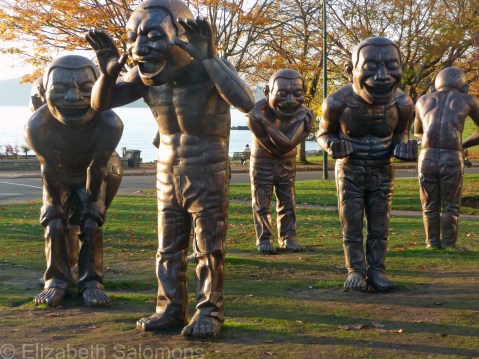
Speaking of cheerful, here are the guys from A-maze-ing Laughter, the hit installation of the second Vancouver Biennale. Fourteen supersize cast-bronze figures with smiling, happy faces completely transformed Morton Park in English Bay when they were installed in 2009.

The beauty of A-maze-ing Laughter is that it’s completely interactive in the best way possible. You can’t help but smile at the figures, touch them, imitate them, and, for some of us, climb on them.

The artist is Yue Minjun from China. That’s his face smiling back at us.
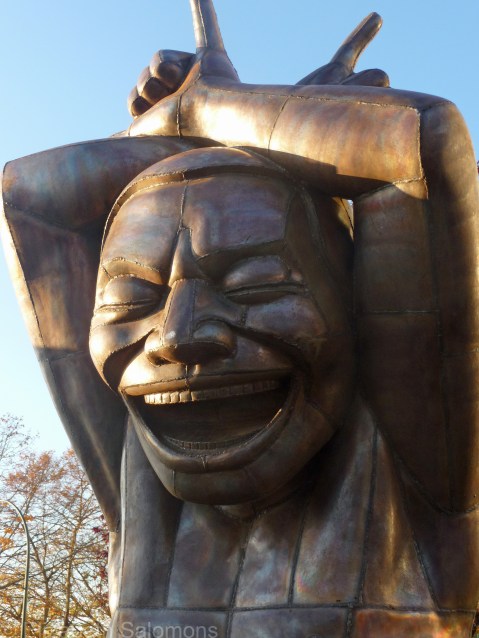
A-maze-ing Laughter is probably one of the most popular public art installations Vancouver has ever had. Like all of the Biennale pieces, it was for sale when the two-year exhibition was over. All of Vancouver wanted the figures to stay exactly where they were, but at first it seemed impossible, due to the hefty price tag of $5 million. But when Yue Minjun saw photos of people interacting with the sculptures, he dropped the price to $1.5 million with the condition that they remain in a public location. Thanks to a private donation by Chip Wilson, founder of lululemon, and his wife Shannon, the laughing men are here to stay.

Inukshuk at English Bay
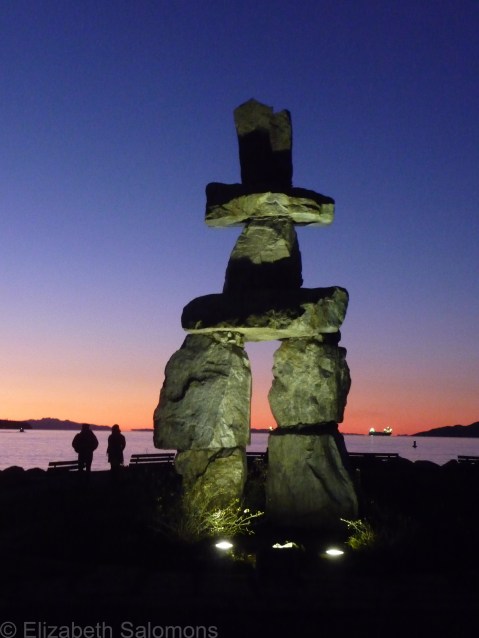
One of the most surprising discoveries from my research about the legacy landmarks of Expo 86 was when I learned about the origins of the inukshuk at English Bay. Turns out this iconic sculpture is the same one that stood in front of the Northwest Territories Pavilion at Expo. The territorial government commissioned Alvin Kanak of Rankin Inlet to create the sculpture made of grey granite. After Expo, it was given to the City of Vancouver, and it has stood in English Bay since 1987.
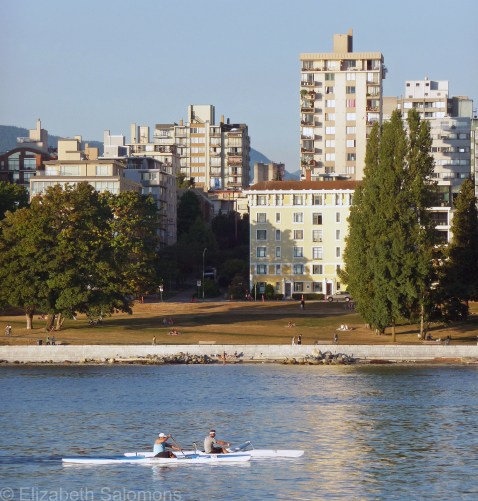
Through My Lens: Sunset Beach Paddlers

It’s the middle of August already. There are only a few weeks left of what has been a fabulous summer in Vancouver.
Sigh.
What else is there to say?
Through My Lens: Vancouver Sunset

Of course, I don’t have to go all the way to Africa to see a spectacular sunset. I took this photo exactly a week ago while walking the seawall with a friend.
Through My Lens: Holiday Orca

Here’s one more holiday photo to finish out the year. This magnificent orca whale is a new display for 2015. Made by hand in Slovakia, it contains 6000 LED bulbs and was put up in Morton Park at English Bay as part of this year’s Lumière Festival.
A rather spectacular addition to the neighbourhood, don’t you think?
The West End
I can’t let last month slip by without acknowledging that my neighbourhood, Vancouver’s West End, was awarded at the beginning of November the title of Great Neighbourhood in the fifth annual Great Places of Canada competition. (The contest is sponsored by the Canadian Institute of Planners, the same folks who bestowed the title of Great Street of Canada on Lacombe, Alberta, a couple of years ago.)
What makes the West End so great, according to the jurors of this year’s contest? They selected it because of its walkability and its diversity, and for the natural beauty that is its heart and soul: Stanley Park and the beaches of English Bay.
In short: it’s a community that rates high on the livability scale.
About that walkability: the main streets lining the edges of the neighbourhood allow easy access into and out of the West End for vehicles ― both public and private ― but what’s unique about the neighbourhood are the numerous parkettes, round-abouts, and one-way streets used to discourage traffic on residential streets. More than 40 percent of the population walks to work ― that’s a higher percentage than anywhere else in Vancouver. West Enders also typically walk to access their services, whether it’s their grocery or produce store, their butcher, fishmonger, or baker, the liquor store or pet store, or a doctor, dentist, or hairdresser. (Your every need met within a ten-minute walk!)
About that diversity: the West End, in particular Davie Village, is home to Western Canada’s largest LGBT community. Almost half of the neighbourhood’s 45,000 residents are between the ages of 20 and 39, a demographic reflected in the high number of residents (80 percent) who rent their homes. That, and a large concentration of Asian language students, makes for a high turnover in residents.
Despite being a transient population, the West End has more children than many areas of Vancouver traditionally considered family neighbourhoods. Those children are educated in two elementary schools and a high school that celebrated its 100th anniversary in 2014. The West End is also home to a large concentration of seniors (evident by the number of times I have almost been mowed down by one of them on a scooter). They have their own community centre at Barclay Manor, a heritage house in the centre of the West End.
Vancouver’s West End is bordered by West Georgia Street to the north, English Bay to the south, Burrard Street to the east, and Stanley Park to the west. As is all of Vancouver, the West End is unceded Coast Salish territory that was logged and developed after the arrival of the Canadian Pacific Railway. By the 1890s, it was home to Vancouver’s elite. When those elites crossed False Creek and began to settle in Shaugnessy, the West End became the transient community ― peopled with new arrivals to the city and the country ― that remains its defining characteristic to this day. Robson, Denman, and Davie streets became the business hubs, and apartments buildings were built: low-rise ones in the 1920s, ’30s, and ’40s, and multi-storey towers from the late 1950s on. Even so, many of the original houses from the late 1800s are still in use, creating an interesting architectural mix of heritage and modern buildings.
With everything it has to offer as a great place to live, work, and play, the West End is not without problems, however. Its housing is the least affordable in the city, yet the median annual income of its residents is far below that of Vancouver as a whole. St. Paul’s Hospital is being relocated some three kilometres away, leaving no acute care facility in the entire downtown peninsula. This is a worrisome issue in a city where a major earthquake that could happen at any time is likely to collapse all of the bridges that provide access to the downtown peninsula.
Development continues at lightning speed, and the buildings are becoming taller all the time. In a three-block stretch of Davie Street alone, three five residential condo towers are being proposed ― that’s a lot of construction in my near future only steps from my door.
But for all that, I wouldn’t live anywhere else. And so, here’s a photo that shows everything I love about my neighbourhood: natural beauty, architectural diversity ― and my own beach (that I, um, share with several thousand neighbours).
Through My Lens: Freezing Fog
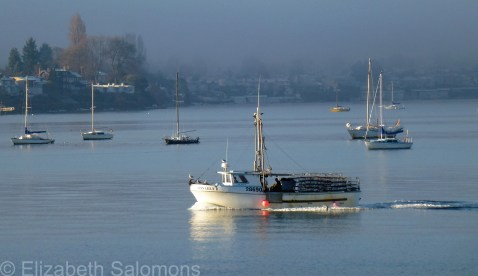
The meteorologists call it freezing fog.
I call it get outside and take some photos.
Through My Lens: English Bay

Of course, I don’t need to take a ferry ride to find an awesome view.
This photo was taken from the Stanley Park seawall a couple of Sundays ago. The wind (and the surf) was up, so I had a bracing walk.
My favourite kind of seawall walk.
Freighters in English Bay
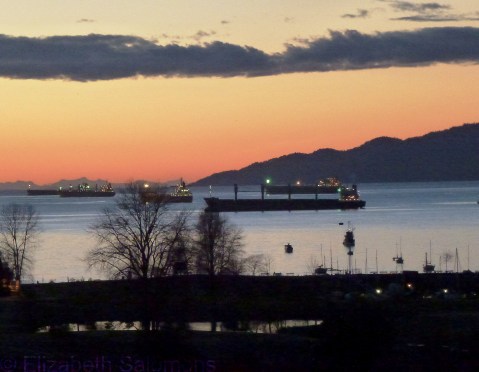
English Bay (aka the waiting room to Canada’s largest and busiest port) always has a dozen or more freighters anchored in it. The ships wait there, sometimes for days, until it’s their turn to load or unload their cargo.
Because they are always there, I think of the freighters in English Bay as part of my landscape. I don’t pay much attention to them other than sometimes using them to add interest to a photo.
Until this week. On Wednesday night the M/V Marthassa, a Greek-owned bulk carrier on its maiden voyage from Korea, was anchored in the bay waiting to take on a load of grain when it began leaking bunker fuel. More than two tonnes of the stuff would go into the water before the leak was stopped. Within hours, some of that oil had reached the beaches.
I took a long walk along those beaches today to get a closer look at what was going on and to reassure myself that everything was all right.
It’s not.
But it will be.
This week was a wake-up call for me. I will never again take my beach and my bay ― or the freighters in the bay ― for granted.


 There and Back Again