
Happy Birthday, Canada House!
Canada is a great country: alike in the literal sense of vast extent from sea to sea and great in achievement and in promise, and it is right and necessary that its official representatives here should be housed in a manner worthy of the Dominion and adequate to the discharge of their ever-growing and important duties.”
— King George V
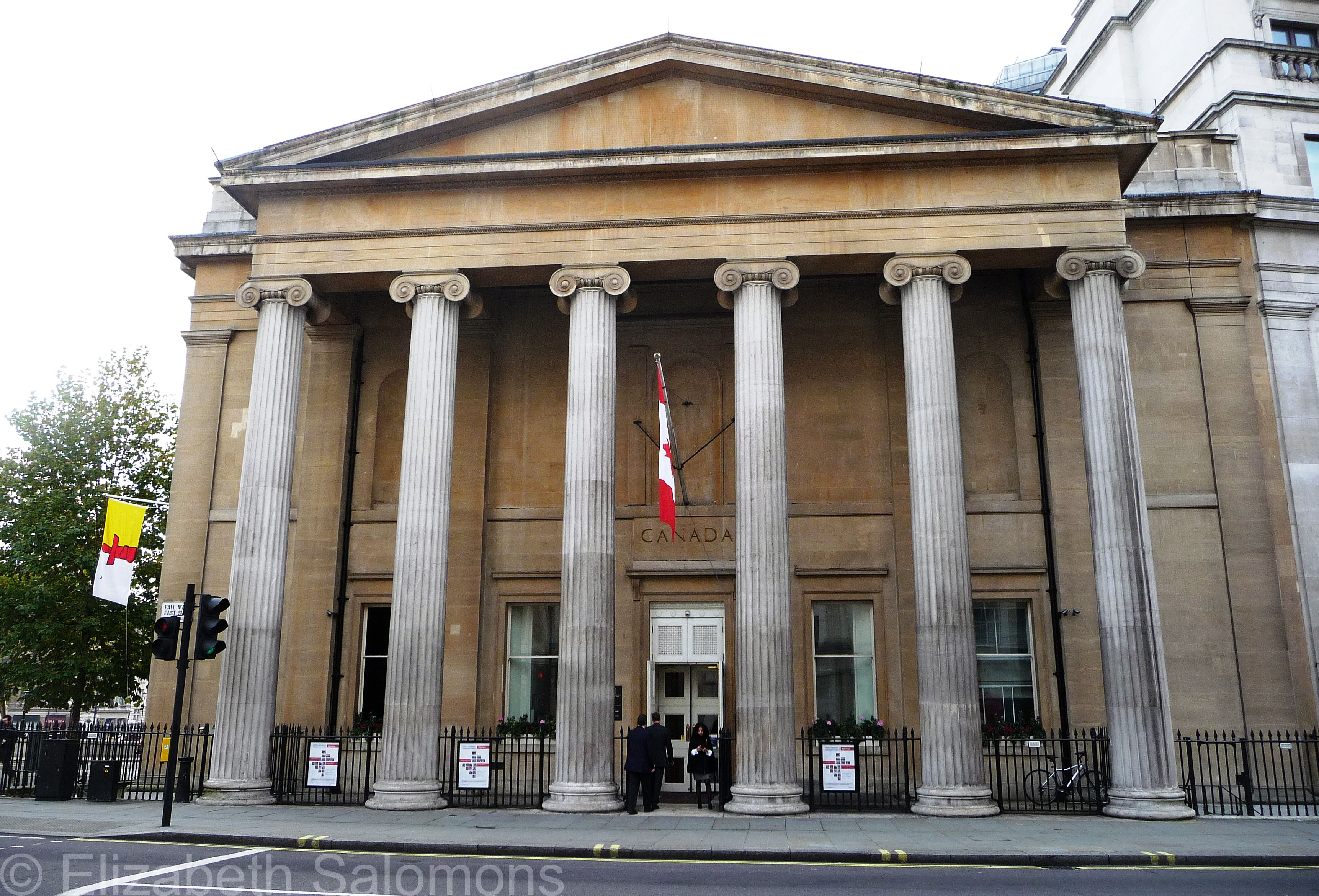
A hundred years ago today, King George V opened Canada House, also known as the High Commission of Canada in the United Kingdom, with these words. The building has a unique purpose in the relationship between Canada and the UK and a pretty cool address: Canada House, Trafalgar Square, London.
Completed in 1827, the building was purpose-built for a gentleman’s club known as the Union Club. Its architect was Sir Robert Smirke, designer of the British Museum and the Royal Opera House at Covent Garden. The Greek Revival style was a departure from the Regency era, and the style was adopted by many of the neighbours of Canada House, including the National Gallery, South Africa House, and St. Martin-in-the-Fields.
Canada bought the building in 1923. After extensive renovations, the High Commission moved in and has resided there ever since. London is Canada’s oldest diplomatic mission and its second largest, with a complement of 300 today. (In 1923, it numbered five.)
The reason Canada House is a High Commission, not an embassy, is because when it was established way back in 1880, Canada was still under colonial rule. (Fun fact: Canadians were considered British subjects until 1947.) Our first prime minister, Sir John A Macdonald, had a representative in London who acted on his behalf and whom Sir John A. wanted to call a resident minister. Britain said no to that idea and suggested the title of high commissioner instead. That title and the position became the standard for all members of the Commonwealth and is why Commonwealth nations send high commissioners, rather than ambassadors, to each other’s capitals.
As the Canadian diplomatic mission in London grew, it expanded into a second location on Grosvenor Square called Macdonald House, which was in use from 1961 to 2014.
In 2013, Canada bought the building next door to Canada House. Former home of the Sunlife Assurance Company of Canada, it was built at the same time as Canada House and in the same Greek Revival style. (Another fun fact: this building served as the overseas headquarters of the Canadian Army during World War II.) Renovation work converted the two buildings into one, Macdonald House was sold, and the High Commission has resided in one building since 2014.
I became aware of its centennial when I saw the coverage of King Charles and Queen Camilla’s visit to Canada House back in May. They dropped by to draw attention to their upcoming visit to Canada. That visit would be Charles’s 20th, but his first as Sovereign. The purpose of his visit was to attend the opening of Canada’s parliament and deliver the Speech from the Throne.
Given current world events, this was a pretty big deal. Indulge me as I take a moment to explain why. Some of my readers, especially the non-Commonwealth ones, might not understand.
Although Canada is an independent nation, we are a member of the Commonwealth, and one of 14 realms where, in addition to the United Kingdom, the Sovereign is also the Head of State. This means Charles III is also King of Canada.
The Throne Speech outlines the government’s agenda for the next session of parliament and is usually read by the Governor General, who is the King’s representative in Canada. But on just three occasions, the Sovereign has travelled to Canada to read the speech: King Charles last month, and his mother, Queen Elizabeth II, in 1957 and 1977.
After being sworn in as prime minister in March, Mark Carney made a quick overseas trip to Paris and London, stopping off in Iqaluit on his way back to Ottawa. Many saw this trip as symbolic; during his swearing-in ceremony, Carney pointed out that Canada was founded by three peoples: French, English, and Indigenous. While in London, he met with King Charles and asked him to open the next session of the Canadian parliament, should the Liberals be successful in the next election. Which they were.
Fast forward to May 27. Having the King open the 45th Parliament of Canada and deliver the Speech from the Throne highlighted to the world that we are a constitutional monarchy, and our system of government is much different than that of the republic to our south. Charles and Camilla were in Ottawa less than 24 hours, but were given a warm welcome by thousands of Canadians. Even anti-monarchists were heard to remark on the significance of the occasion.
About those current world events. Some people think Canada becoming the 51st state is a joke, but Canadians aren’t laughing. The Speech from the Throne reiterated Canada’s sovereignty and the need to rebuild our relationships with both the United States and the rest of the world.
The Throne Speech is always written by the government, but the Sovereign (or the Governor General, as the case may be) are expected to add a personal touch at the beginning. Charles did so with these words:
Every time I come to Canada, a little more of Canada seeps into my bloodstream — and from there straight to my heart.”
It was a bit surreal to hear King Charles speak about Canadian domestic issues such as building affordable homes and strengthening our border, but when he read the following words, his tone was heartfelt:
As the anthem reminds us: the True North is indeed strong and free.”
The entire chamber broke out in applause.
The monarchy has to remain apolitical, but they have been known to use symbols to express themselves. Canadians noticed when Charles wore his Canadian military honours while on a visit to a Royal Navy ship in early March, a day after meeting with Prime Minister Trudeau in London. The visit of Charles and Camilla to Canada House a week before their visit to Canada was another symbol.
I got up close and personal with Canada House over two days in the fall of 2010. The above photo is actually of the side entrance, not the main one by which the Royals and other distinguished guests enter. But it’s the entrance I used. See, when you’re a Canadian in London who has had her passport stolen while travelling on a crowded Tube train, you need to visit Canada House.
The wallet was stolen on a Saturday night, and I had to wait until Monday morning to get into the High Commission. By then it had been a long and stressful two nights for me, but the consular official who helped me was calming and reassuring. She had me sorted out in no time. I returned the next morning to pick up my temporary passport and was then able to leave for Paris, only one day later than scheduled.
So for me, Canada House isn’t just a symbol. And while I’m sure the people who helped me thought they were just doing their job, I needed them to do those jobs to get me home.
In the same way, asking the King of Canada to open our Parliament is more than a symbol. It’s his job. And this year, in these times, we needed him to do his job. It might not make any difference to the man sitting in the White House, but it sure reminded Canadians that we are strong and, indeed, free.
Through My Lens: Clouds on the Horizon

Welp. I have to say: not too impressed so far with Season 3 of 2020.
Canada has had a rough few weeks. I’m not going to offer a rant about how we got here or a sermon about where we need to go. Rather, I’ll just say that my way of coping has been to focus on my own self-care, which I think I’ve gotten pretty good at over the past two years. That means connecting with friends, cooking my favourite comfort foods, and taking some long walks to look for signs of spring.
Above is the view I had a few evenings ago, which, given the current state of affairs in our nation’s capital, struck me as rather allegorical.
I just hope the clouds are not an omen.
Happy Birthday, NHL!

It’s Grey Cup Sunday in Canada, a day when some of us go a little wacky over that game played with a pigskin. I only mention it because this year’s game (held in Ottawa) was the 105th Grey Cup and I like to acknowledge significant anniversaries on this blog.
Oh, and I also mention it because it is a game always played in late November. Most often outside. And this year, in a blizzard.
No, seriously. They couldn’t keep the field clear. Players were sliding all over the place. Camera operators, too. And the half-time show? Shania Twain was brought out to centre field by dog sled. And then escorted to the stage by a Mountie.
Canadian enough for you? Hee.
But now I am going to change the channel and talk about the other most Canadian professional sport.
I’m talking about hockey. Of course.
Another hee. I’ve been waiting a long time for an excuse to post these photos. And today I have one: it’s the 100th birthday of the National Hockey League.

For my non-Canadian readers, just know that Canada is a hockey-mad country. And if you visit Canada during playoff season — you know, what the rest of the world calls spring — you will see for yourself just how hockey mad we are. Sixteen NHL teams play four rounds of best-of-seven series … it goes on forever.
If you still don’t believe me, how about this? A hockey rink has been built on Parliament Hill for the upcoming holiday season as part of the Canada 150 celebrations. (Except, um, no hockey sticks or pucks allowed, so maybe not so much hockey rink as ice rink, despite the boards surrounding it.)

All of this is to say that it would be most un-Canadian of me to let today go by without acknowledging the date in some way. A hundred years ago today, the owners of the Montreal Canadiens, the Montreal Wanderers, the Ottawa Senators, and the Quebec Bulldogs got together and agreed to form a hockey association they named the National Hockey League. At that time, the best players earned $900 a season.
The league had a bit of a rough go at first. The Wanderers pulled out before the first season was over because their arena burned down and Quebec pulled out before the first season even started because they ran out of money. Enter a Toronto team that had no name (eventually known as the Toronto Maple Leafs).
The first games were played on December 19, 1917. Toronto lost to the Wanderers by a score of 10 to 9 and the Canadiens beat the Senators 7 to 4. Some of the rules then in place: no forward passing and no zones. It took less than a month for the first rule change: allowing goalies to drop to the ice when making a save. (Initially, they were instructed to remain upright. Yeah, good luck with that.)
The nameless Toronto team took home the Stanley Cup in 1918, beating the Vancouver Millionaires of the Pacific Coast Hockey Association in a best-of-five series, although Lord Stanley’s Cup didn’t become the official league trophy until the 1926–27 season.

Last summer, one of my German friends asked me about “ice hockey.” When I gave him a funny look, he corrected himself.
“You don’t call it ice hockey in Canada, do you?” he asked.
“Yeah, no,” I said. “There’s only one kind of hockey we care about in Canada. And it goes without saying which one we mean.”

Canada 150: Ottawa
So, here’s a thing. In putting together my Canada 150 series for this blog, I realized that I actually remember the last time Canada threw a big party for its birthday.
That would be Canada’s Centennial, way back in 1967. (I know, I know. I’m dating myself.)
I was in Ottawa, our nation’s capital, with my family, and I remember watching the Changing of the Guard at Parliament Hill while sitting on my dad’s shoulders. I remember crying, because I was frustrated that I could not see over other people’s heads.
(I don’t know what it says about me that my earliest memory is of being frustrated, but there it is.)
I took this photo of the Changing of the Guard at Parliament Hill many years later. Fully grown, at almost 5 feet 10 inches tall, I’m happy to say I no longer have any trouble seeing over other people’s heads.

Queen’s Day
Today is Queen’s Day in the Netherlands. The Dutch call it Koninginnedag. It’s their country’s equivalent of Canada Day or the Fourth of July ― the day when the Dutch celebrate their nation. They celebrate Queen’s Day on April 30 because that was the birthday of Queen Juliana, who was the mother of Queen Beatrix, who is the mother of King Willem-Alexander, who became king today.
The Dutch monarchs have a tradition of abdicating the throne to their children, and that’s what happened today. Queen Beatrix will now be known as Princess Beatrix, and her oldest son, Willem-Alexander, is, as of today, king of this tiny nation of 17 million people.
So why am I posting a photo of Canada’s Parliament Buildings on the Dutch national holiday? I’m glad you asked.
I posted this photo because the Dutch Royal family has a Canadian connection. Queen Beatrix spent part of her childhood in Ottawa, when Canada gave shelter to the Dutch Royals during World War II. After the war was over, the Dutch Royals sent 100,000 tulip bulbs to Ottawa as a sign of gratitude for the hospitality shown to then-Princess Juliana and her children during the war, and also as a thank you to the Canadian soldiers who played a key role in the liberation of the Netherlands from the Nazis in 1945.
Juliana sent more tulip bulbs the next year, and every year of her reign, which lasted from 1948 until 1980. Today, more than a million tulips bloom in Ottawa each spring, and its tulip festival, said to be one of the largest in the world, is celebrated every May.


 There and Back Again