
Through My Lens: Vancouver Clouds

OK, so I lied. Vancouver does get some spectacular clouds every once in a while. Just not very often.
I took this photo of Burrard Inlet from Stanley Park a few weeks ago.
Through My Lens: Prairie Clouds

So, yeah. I’ve been a little quiet lately on the blog front. What can I say? I did warn you.
Here’s a photo I took last weekend in Lacombe County, Alberta. I was there to visit family and get my landscape fix.
We don’t have clouds like these here in Vancouver. Not very often, at any rate. Which is why I think they are quite spectacular.
World’s Most Boring Place
The Internet is rife with rumours that Prince Harry and the Duchess of Sussex are honeymooning in Jasper National Park.
Yeah, right. And I’m the Queen of England.
What I find most remarkable is that one of the online tabloids’ headlines said the couple were honeymooning in “the world’s most boring place.”
Canadians are known around the world as polite folks, typically slow to anger. But mock our icons — like one of our oldest, most spectacular national parks — and we sit up and take notice.
That headline got noticed. And ridiculed.
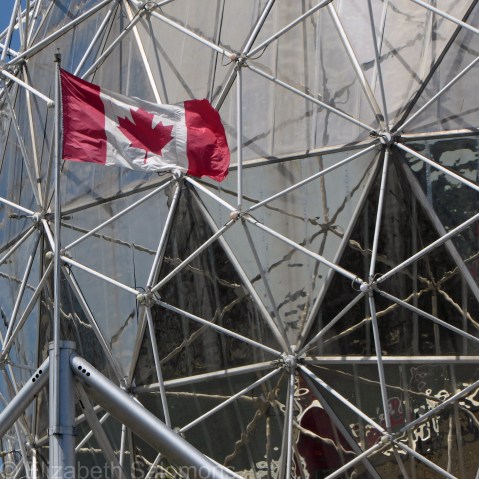
As for that most boring place? Here’s what it looks like.

Yellow-headed Blackbird
We’ve just finished a second consecutive weekend of summer temperatures, so I am starting to believe that, just maybe, summer has finally arrived.
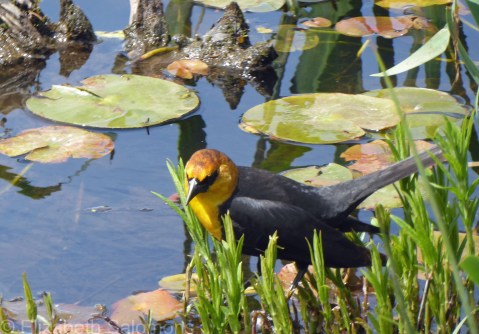
To celebrate, here is a photo of a Yellow-headed Blackbird — a new-to-me bird I saw the other day at Piper Spit on Burnaby Lake. These birds like freshwater wetlands, which is exactly where I found this fellow.
Through My Lens: Daffodils

Is this not the wettest, coldest spring ever?
I know, I know. I have no right to complain considering how many parts of the country are experiencing their longest winter in decades. Southern Ontario is in the grips of an ice storm as we speak, Edmonton has broken a 44-year record with 167 consecutive overnight lows below 0 °C, and Calgary’s forecast is for 10 to 20 centimetres of snow.
I have absolutely no right to complain.
And yet, I am. See the dark clouds in this photo? That’s what the skies in Vancouver have looked like for the better part of this winter and our oh-so-cold spring.
I’m posting this photo because these daffodils have been the one bright spot for me this spring. They appeared about a month ago along the seawall in English Bay, a new addition courtesy the Vancouver Parks Board. I love that they were planted in the middle of the grass, rather than set off in some flower bed somewhere.
Nothing says April like a crowd of daffodils.
Except in Canada, I suppose, where nothing says April like one last blast of winter.
Through My Lens: Snowy Rocks on the Beach

Typically, in February I am posting photos of crocuses. Instead, here’s a photo I took this morning of the snow-covered rocks along the beach at English Bay.
Which means it’s not a typical February. (Although … come to think of it, last year’s February wasn’t so typical either.)
Vancouver got dumped with about 25 centimetres of snow yesterday and last night. It’s not an unusual amount of snow for us — we often have one, maybe two good snowstorms every winter — but what is unusual is to get so much snow so late in the season. It’s almost March, folks.
The crocuses, I assure you, are in full bloom, but are well buried today. And tonight’s forecast is for rain, so tomorrow is going to be an unholy muddy mess.
Through My Lens: Winter Hay Bales
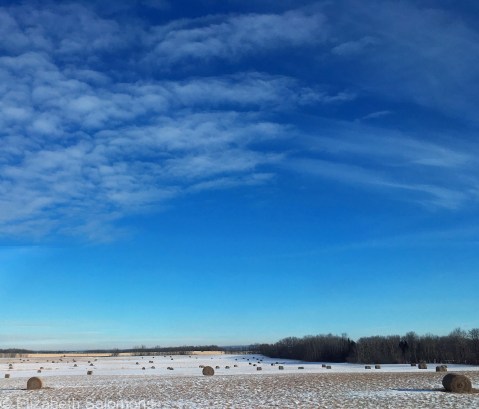
It actually doesn’t matter how I get around in Canada — the view is always spectacular. I took this from the Greyhound last week. It’s somewhere near Ponoka along Highway 2.
Through My Lens: Geese on Lost Lagoon
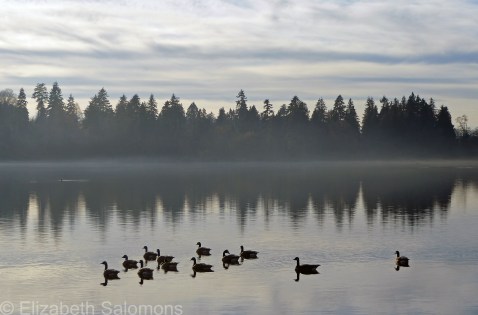
I have nothing to say about this photo, except that when I took it this afternoon, I was having another one of my “I can’t believe I get to live here” moments.
Canada 150: Cape Breton Island
Here we are … finally!
It’s the last day of the year and the last day of the Canada 150 celebrations. (Although, because of the extreme cold weather alert in our nation’s capital, many of the outdoor festivities that were supposed to take place tonight in Ottawa to celebrate both New Year’s Eve and Canada 150 had to be cancelled. Only in Canada, eh?)
For my last post of 2017 and the last post of my Canada 150 series, I am sharing a photo I took along the fog-enshrouded Cabot Trail on Cape Breton Island.
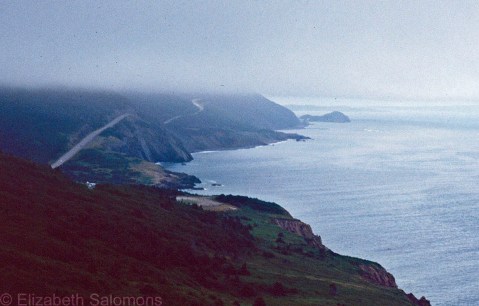
The Cabot Trail is 300 kilometres of winding highway that takes you through the Cape Breton Highlands. It’s named after John Cabot, the Italian explorer who bumped into Cape Breton (or maybe Newfoundland — no one knows for sure) while he was out looking for China way back in 1497.
Stunning scenery, isn’t it? The photo hardly does it justice.
I’ve been thinking a lot about Canada 150, and the year 2017 overall. That’s what we tend to do as the year winds down. What worries me is how smug we Canadians seem to be about ourselves at the moment. It’s easy to be smug, given everything that is going on in the Land of the Free and the Home of the Brave to the south of us. But smugness is a dangerous quality because it leads to complacency. And also the (misguided) belief that what is happening over there could never happen here.
Truth be told, we have no right to be smug. There are some awfully dark chapters in Canada’s history that have been glossed over throughout our Canada 150 celebrations.
On the east coast of Cape Breton Island is the Fortress of Louisbourg National Historic Site. It’s a reconstruction of the military fort built by the French in the eighteenth century, back when Cape Breton was part of New France and called Île Royale. Louisbourg was the first European settlement on Cape Breton and is a stark reminder that Canada’s origins are colonial.
Look up the word “colonize” — there is no way to soften its meaning. It is the process by which one group of people move in and take control of another group of people. And, no matter how many decades or centuries our ancestors have lived here, every Canadian is a colonist and a settler. Think about that when you next sing the national anthem. None of us — except our Indigenous peoples — can claim a “home and native land.”
If that doesn’t wipe away our smugness, I don’t know what will.
Any public event in Vancouver now begins with the acknowledgement that the land we are gathered on is the unceded territory of the Coast Salish peoples, including the Musqueam, Squamish, and Tsleil-Waututh Nations. I like hearing those words, but I do not want them to become so familiar that I hear them without thinking about what they mean.
Just like our national anthem.


 There and Back Again