
Through My Lens: Basilica de San Vicente
Here we are again in the Season of Lent. Last year for Lent, I took you on a tour of Parisian churches. This year, I’m going to post a few photos of some of the magnificent churches I’ve seen in Spain.
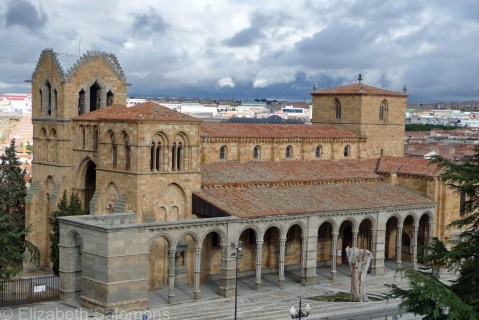
For today, the First Sunday of Lent, here’s a photo of Basilica de San Vicente in Ávila, a city in Castile and León, which is in northern Spain. This Romanesque–Gothic basilica dates back to the twelfth century.
The church was built to the memory of three martyrs: Saint Vincent and his sisters, Saint Sabina and Saint Cristela. They were killed in 303 by order of the Roman Emperor Diocletian. Inside the church is Saint Vincent’s tomb, which is covered with intricate and detailed bas-reliefs of the torture and execution of the three siblings. They’re rather, er, graphic, but incredibly fascinating.
St. Paul’s Chapel

One of the most impressive buildings I saw during my recent visit to New York City was St. Paul’s Chapel in Lower Manhattan. The Twin Towers used to stand next door to this tiny church, and One World Trade Center is now under construction across the street from it.

St. Paul’s Chapel was built in 1766 and is the only Colonial-era church left in Manhattan. George Washington worshipped here on April 30, 1789, after he took the oath of office to become the first President of the United States.

The building survived the Great Fire of New York in 1776. It also survived the September 11 attacks, and suffered no damage at all other than being covered with dust and debris. It is now known as “the little chapel that stood.”

St. Paul’s became a place of refuge and rest in the days and months following the destruction of the Twin Towers, offering round-the-clock care for the thousands of volunteers working at Ground Zero. Massage therapists, podiatrists, and chiropractors, as well as parish staff, ministered to the firefighters, police, and construction workers. Today the chapel contains several memorials to those first responders and volunteers.
The Pantheon
On one of my trips to Rome, I arrived 24 hours before my friends so I could have a day to wander around on my own. First thing that first morning, I set out from my hotel, eager and excited to begin exploring. Within minutes, I stumbled around a corner into Piazza della Rotunda and found myself staring up at the Pantheon in complete awe.
At that moment, it hit me with a massive thump. I was in Rome. And Rome is really, really old.
I’ve done a fair bit of wandering around Europe, in countries like England, France, and the Netherlands, and I am always struck by the amount of history. Compared to Canada, there is an awful lot of it in Europe.
But Rome! I know I’m stating the obvious, but Rome is in a category all its own. It’s not just old ― it’s ancient.
The Pantheon was built by Marcus Agrippa in 27 BC as a temple to all the gods of Rome, was rebuilt by Emperor Hadrian about 150 years later, and has been used as a church since the seventh century. It’s awesome inside ― a perfect circle ― and contains the tombs of Victor Emmanuel II, first king of a united Italy, and Raphael, Renaissance artist, among many others. The only daylight to enter the structure is from the oculus at the top of the dome.
The inscription on the pediment reads “M. AGRIPPA. L. F. COS. TERTIUM. FECIT.” Later that same visit, one of my friends, a linguist, translated the Latin for us: “M Agrippa, son of Lucius, consul for the third time, built this.” She burst into laughter when she reached “built this.” Agrippa, mighty Roman general, was no different than the child who writes their name on the schoolwork they take home to Mom or Dad.
Now, every time I return to Rome, the first thing I do is revisit the Pantheon to remind myself of where I am and how awesome a place it is. I don’t ever want to lose that feeling.

Happy Easter!

The Great Organ at Notre-Dame, Paris, January 2011
Through My Lens: Basilique Saint-Denis
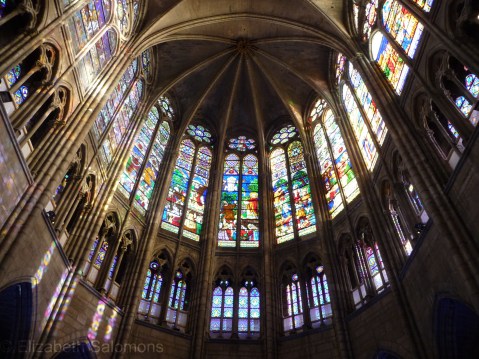
Today is Palm Sunday, and I’m posting a photo of the stained glass windows from the apse of Cathédrale royale de Saint-Denis, or Basilique Saint-Denis.
I first heard about Saint-Denis from my Dutch cousin in Amsterdam. After she showed me her photos and postcards, I decided I had to see this church for myself one day. Fast forward ten years, and I finally made it here on Boxing Day 2010.
Saint-Denis is a massive church located in the Parisian suburb of Saint-Denis, which you get to by travelling to the second-last stop of Métro Line 13. It was the first major structure to be built in the Gothic style of architecture and was made a cathedral in 1966.
What’s so unique about Saint-Denis is that most of France’s monarchs ― from Clovis I (died 511) to Louis XVIII (died 1824) ― are buried here, including the two who lost their heads during the French Revolution (Louis XVI and Marie Antoinette). A total of 42 kings, 32 queens, and 63 princes and princesses are entombed within the cathedral.
Through My Lens: Église Saint-Séverin

Saint-Séverin is a small church in the 5e arrondissement of Paris. Tucked away in a corner of the Latin Quarter, the building was almost destroyed by fire during the Hundred Years War, and was used to store gunpowder during the French Revolution. It’s one of my favourite Parisian churches, and is my photo choice for the Fifth Sunday of Lent.
Through My Lens: Église Saint-Sulpice
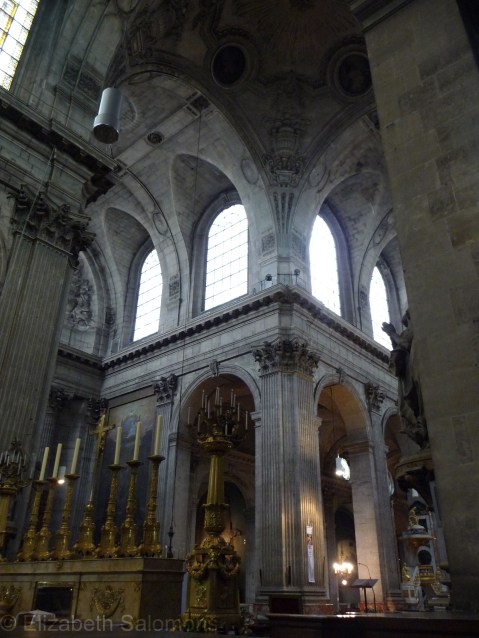
It’s the Fourth Sunday of Lent, and time for another church. This is the interior of Saint-Sulpice, located in the 6e arrondissement. Saint-Sulpice is the second-largest church in Paris ― second only to Notre-Dame ― and has one of the world’s largest pipe organs.
Through My Lens: Notre-Dame and the Basilica

For the Third Sunday of Lent, I give you not one, but two churches: Notre-Dame-de-Lorette and Basilique du Sacré-Cœur. I took this photo in January 2011 from Rue Lafitte near Boulevard Haussmann in the 9e arrondissement of Paris.
Seven Days in London

Last weekend I was out with friends who are busy planning a spring trip to England. I was pleased at how excited they are, and I had great fun answering their questions and throwing out suggestions of what I thought they had to see and do in London.
My brain kept churning after I said good-night to them, however, and by the time I arrived home I had another long list of must-sees and must-dos. At which point I said to myself, “Enough, already! There’s your next blog post half written.”
So, here it is: My ideal itinerary for a week in London.
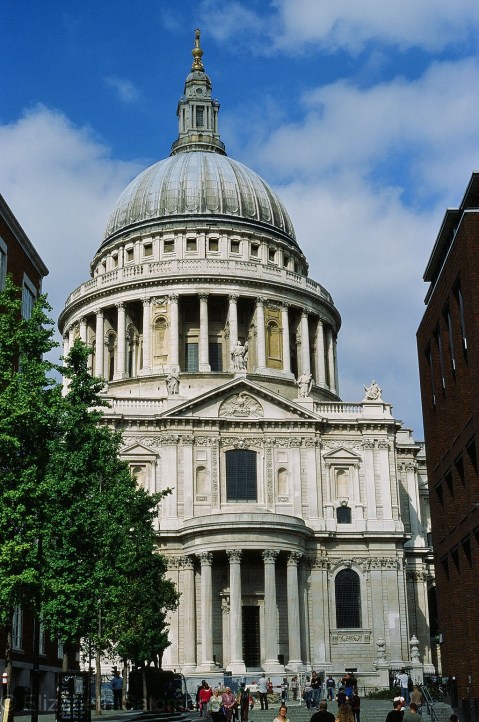
Day 1: Direct flights from Vancouver to London arrive mid-day. Buy your Oyster card (more on that later) and take the Tube into central London. After check-in and a shower to wash the detritus of air travel off your body, set off for a few hours of sight-seeing. You’re jet-lagged, so find something simulating enough to keep you awake, but nothing too strenuous or that takes too much thought. A couple of summers ago, a friend and I zipped over to St. Paul’s Cathedral and went to Choral Evensong on our arrival afternoon. The services are held daily at 5 p.m.; for me, personally, there’s nothing more English than choral music at St. Paul’s.
St. Paul’s Cathedral
Or, if the weather is cooperating, take a walk through one of London’s beautiful parks to stretch your legs after the long flight. St. James’s Park and Green Park are beautiful, and from either park you can catch your first glimpse of Buckingham Palace. By this point, the fact that you are in London should start to feel very real.
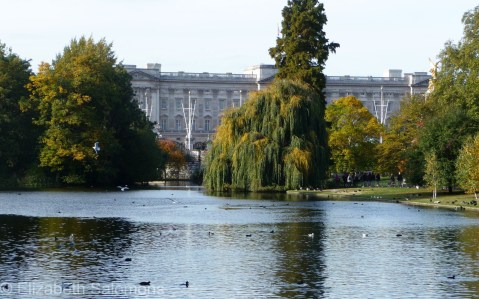
Buckingham Palace from St. James’s Park
Day 2: My friends will be in London too early to see Buckingham Palace as it’s open to the public in the summer months only. But Changing the Guard in the Palace’s forecourt takes place every second morning in the winter and daily in the summer. If you want to see this colourful ceremony, I have two words for you: Go Early. And if the crowds are too much for you, walk over to the Horse Guards Parade where you can watch a smaller change ceremony, or stake a spot anywhere along the Birdcage Walk to see the regiments as they pass by on their way to or from Buckingham Palace.
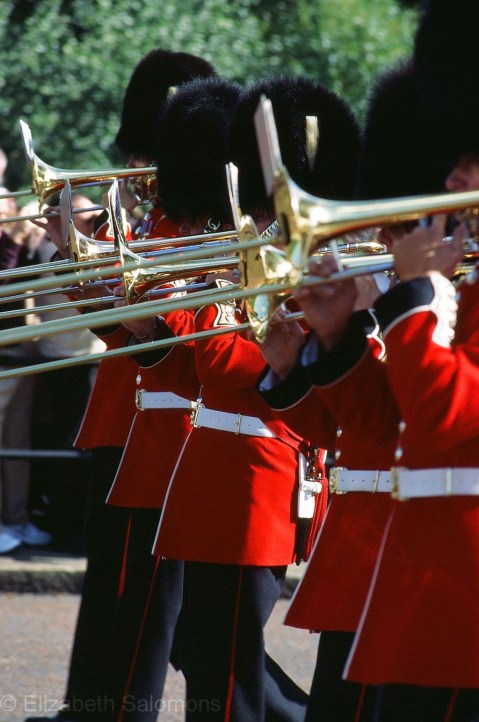
Changing the Guard at Buckingham Palace
In the afternoon, check out an art gallery. All of the major ones have free admission, so duck in and out of them throughout the week according to your mood. My advice, after you’ve decided on which gallery to go to (there are enough to suit any taste), is to choose a wing to focus on ― that’s plenty of viewing pleasure for one afternoon.
Bear with me now, as London has some heavyweights. The National Gallery houses Western European paintings from the 13th to early 20th centuries. The National Portrait Gallery is the British portrait collection from the 16th century to current day, and Tate Britain focuses on British art from the same period. (It has a particularly fine collection of works by J.M.W. Turner.) Tate Modern holds international modern and contemporary art.
If spending an afternoon looking at art is not your cup of tea, then I recommend the Churchill War Rooms located at the opposite end of St. James’s Park from Buckingham Palace. The museum is inside the actual bunker used by the British government during World War II.
Day 3: By now, your internal clock should be adjusted to Greenwich Mean Time, so you’re ready for a heavy day of sight-seeing. Buy your tickets online to avoid the long queues at the Tower of London, the highlight of which is the collection of Crown Jewels. I was 13 years old when I last saw the jewels, but I still remember how dazzling they were.
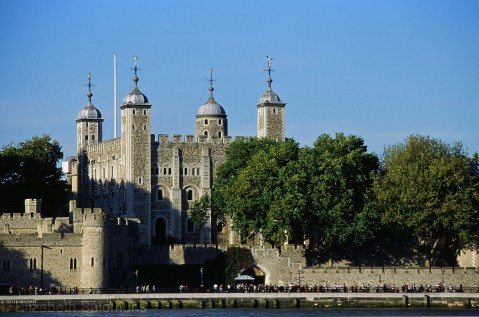
Tower of London
When you are finished touring the Tower, cross Tower Bridge and take a long walk along the South Bank of the Thames. You might stop for lunch at the many outdoor terraced restaurants. Or, treat yourself to a splendid meal at the top of the Tate Modern where you have a million-pound view of the Millennium Bridge and St. Paul’s.
Once fortified, continue walking until you reach the London Eye. If you are keen to get up high for a good view, this is the best there is. It’s pricey, but it will help you get your bearings if you’re still trying to orientate yourself in this massive city.
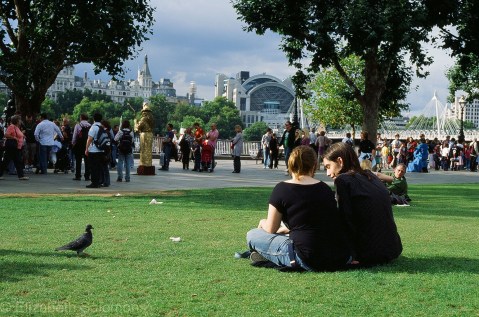
Charing Cross Station from the Jubilee Gardens on the South Bank
Day 4: If you enjoy museums, then the world’s your oyster in London. Again, they are all free admission. Head to the British Museum in the heart of Bloomsbury if history’s your thing, and don’t miss the Elgin Marbles on the main floor, just off the Great Court. When you are all mummied out, take a walking tour of what might be the most literary neighbourhood in the English-speaking world and see where Virginia Woolf lived and where T.S. Eliot worked as an editor.
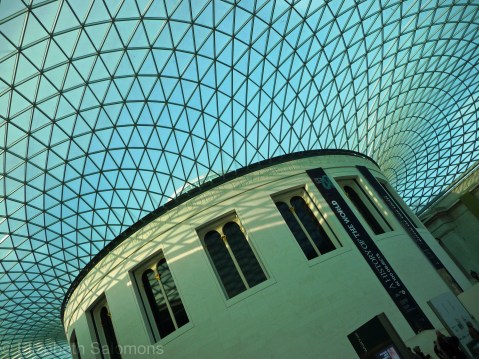
Great Court of the British Museum
For more recent history, go to the Imperial War Museum. Walk to the Thames afterwards for a photo op of the Houses of Parliament. Once there, you’re just around the corner from Westminster Abbey. Both are open to the public.

Houses of Parliament
And if art and design are where your interests lie, you need to be at the Victoria and Albert Museum. Post-V&A, enjoy everything Hyde Park has to offer: Speaker’s Corner, the Albert Memorial, and the Diana Memorial Fountain are all within this vast park.
Day 5: It’s time for an excursion. Windsor, home of Eton College and Windsor Castle, is an hour from London by coach or train. Greenwich is closer and also offers a full day of sightseeing including the Royal Observatory, the National Maritime Museum, and the Old Royal Naval College, all situated in beautiful Greenwich Park. The Royal Observatory is the home of Greenwich Mean Time and the Prime Meridian (longitude 0° ― for those readers interested in this sort of trivia).

Old Royal Naval College at Greenwich
Day 6: If you find the big museums and galleries too intimidating, then take a day to check out some of the smaller ones. I can recommend Keats House in Hampstead, where the Romantic poet John Keats lived from 1818 to 1820, after which you must take a turn on Hampstead Heath. There’s also the Handel House Museum, where the composer lived from 1723 until his death in 1759, or the Sherlock Holmes Museum at ― you guessed it ― 221B Baker Street.
These last two museums are near Oxford Street. If you’re interested in a bit of shopping, this is where you want to be, but be aware that Oxford Street on a Sunday afternoon is as busy as any North American mall in December. Charing Cross Road is the street for bookstores, Portobello Road for antiques, and Camden Market is where you’ll find that one-of-a-kind souvenir to bring home to your kids.

Shops on Portobello Road
Day 7: Your last day! I’m sure there’s something on your list you still haven’t gotten to, so this is your chance to squeeze it in.

Westminster Abbey
Wondering what to do in the evenings? If you’re into theatre, be sure to check out the board at the half-price ticket booth in Leicester Square. The deals are great, and the acting in London’s West End is the best I’ve ever seen. I still get goose bumps when I think of the mesmerizing performance I witnessed of Derek Jacobi, Trevor Eve, and Imogen Stubbs in Chekhov’s Uncle Vanya, which I watched from the front row of the Albery Theatre on St. Martin’s Lane. Or, bring back memories of your high-school English classes by taking in a play at Shakespeare’s Globe, the modern reconstruction of the original Globe Theatre.
My friend’s husband is a jazz musician, so they’ll be checking out some jazz clubs. Another option for live music is the opera; tickets to the Royal Opera House at Covent Garden are a bargain at £9 if you don’t mind sitting in the upper slips (and aren’t afraid of heights!). Book your tickets online before you leave home. Or find something you’re interested in hearing at Royal Albert Hall, if only to get a look at the inside of this magnificent concert hall.

More than 5000 Brits belting out “Land of Hope and Glory” in Royal Albert Hall
A suggestion to help you save money on transit: buy an Oyster Card to use on London’s Underground. They are valid on both the Tube and the buses, and are much cheaper than buying individual fares. And remember, although the Tube is faster, nothing beats seeing London from the top of a double-decker bus. The Heritage Routemaster service (Route 15) is a fun way to get from Trafalgar Square to the Tower of London.

One of London’s iconic double-decker buses
So there you have it: my ideal itinerary for a week in London. One last bit of advice: leave something on your to-do list to make sure you come back. Because London is a city that requires repeat visits.

Nelson’s Column and fountains in Trafalgar Square
Through My Lens: Inside Saint-Eustache
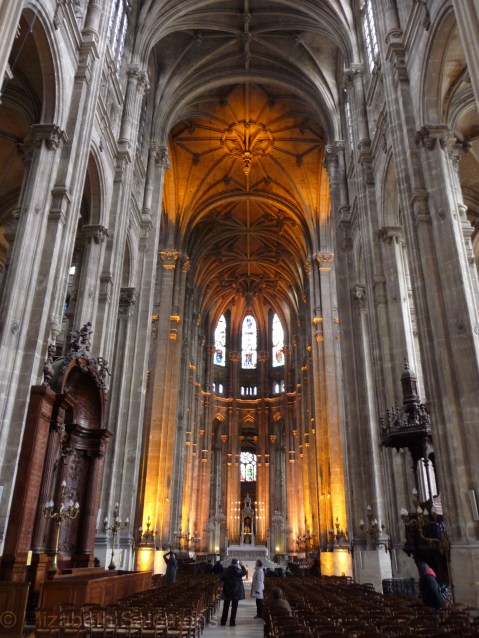
Last Sunday, I posted a photo of the exterior of Église Saint-Eustache. For the Second Sunday of Lent, here’s a look at what’s inside.


 There and Back Again