
University of Cambridge
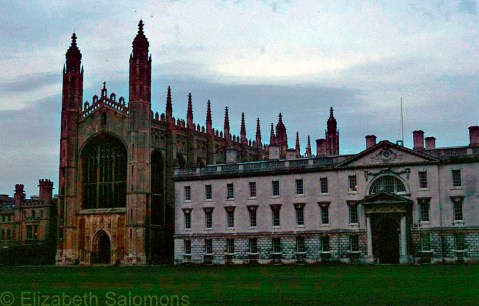
I went to Cambridge for one reason and one reason only: to hear the King’s College Choir.
I got to hear them sing a Choral Eucharist service in this chapel, the King’s College Chapel of King’s College of the University of Cambridge. Quite the chapel. Quite the choir.
I don’t remember much else of the University of Cambridge or the city of Cambridge. It was a quick one-night stop at the end of a three-week English walkabout and I was weary of sight-seeing.
But I’m never weary of choral music. It was worth the stop.
University of Oxford
When I applied to and was accepted at the University of Toronto, I enrolled as a student at Woodsworth College. I didn’t get the whole college-thing they had going at U of T, and didn’t much care what college they stuck me in, but eventually I discovered that all unclassified and part-time students (I was both) were lumped together at Woodsworth.
When I would introduce myself to my fellow undergrads, the first question after “What’s your major?” was always: “What college are you?” I quickly figured out that each college at U of T had its own personality, and prestige, and Woodsworth didn’t rank very high with respect to either.
This all seemed rather strange and unusual to me. In Western Canada, you applied to and enrolled in a faculty; in my case, I was a student in the Faculty of Arts at the University of Alberta. Colleges were independent entities, completely separate from the universities; I had attended one of those as well before transferring to U of A.
Like I said, I didn’t “get” the whole college-thing they had going at U of T.
Until I got to Oxford, that is.
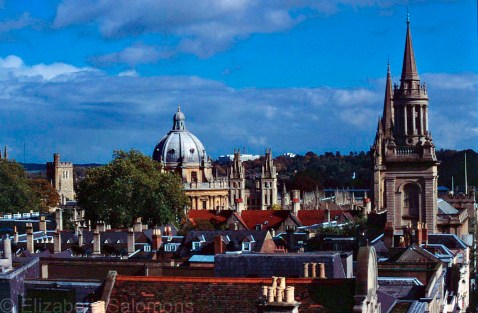
Oxford is chockfull of colleges ― 38 of them, in fact ― and as I wandered around the “city of dreaming spires,” I came to the realization that the University of Toronto is modelled after the University of Oxford. So that’s where U of T got the idea for all those colleges, I said to myself.
Many of the colleges of Oxford University are open to the public, and I walked reverently through several of them. I happened to walk by the entrance to the chapel of Magdalen College (where C.S. Lewis taught) and was warmly invited to attend the Choral Evensong service that was about to begin. In the Great Hall of Christ Church College, I was greeted by an elderly gent whose sole job seemed to be pointing out the “Alice” window to visitors. (That would be the stained glass window put in to commemorate the author Lewis Carroll, who had been a Christ Church scholar.)
Oxford is a beautiful town. I explored it while on walkabout in the English countryside some years ago, fell in love with it, and made a promise to one day return to it.


University of Toronto
Next up on my tour of schools I’ve photographed: the University of Toronto. I was a student here myself a long time ago, just for a year, and to this day I consider it the prettiest of all the schools I’ve attended (and there’ve been a few).
When I commented to my sister on the architectural style of the buildings at Johns Hopkins, she asked me what the buildings at U of T looked like.
“They’re neo-Gothic,” I said. Also called Gothic Revival, you see neo-Gothic buildings all over Canada ― our Parliament Buildings in Ottawa are probably the best-known example.
The University of Toronto has been around since 1827, has a dozen colleges on three campuses, and is the largest university in Canada with an enrollment of 75,000 students. I took these photos of the St. George campus when I was in Toronto exactly a year ago this week.


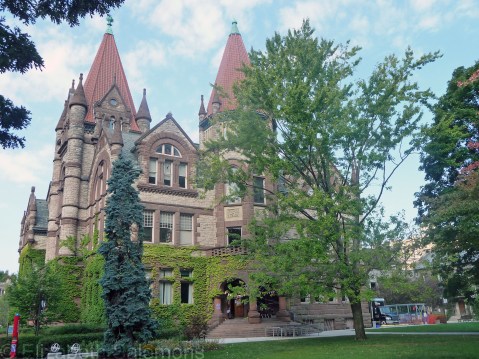
Not all of the buildings on the St. George campus are neo-Gothic. The main building of Victoria University, shown below, is called Richardsonian Romanesque, after its architect, Henry Hobson Richardson.
Trinity College is in the Jacobethan style.

And this monstrosity, Robarts Library, was built in the 1970s in what is known as Brutalist Architecture. Appropriate name for the look, I should think. It’s not-so-affectionately known as “the Turkey” by the students of U of T; I’m sure you can figure out why.

Johns Hopkins University
Working on a university campus ― as I now do ― I’m much more in tune to the rhythms of the academic year than I have been for a long, long time. UBC has been delightfully (delightfully!) deserted these past four months, but then, all of a sudden, all at once, more than 50,000 students descended onto the campus this past week, and the place is now overrun (overrun!) with twentysomethings.
On my travels, I sometimes find myself wandering around university campuses. The architecture always fascinates me, as each school has its own unique look. And so, this being September, I thought I would take you on a tour of some of the schools I’ve photographed.
First up: Johns Hopkins University. It’s not the biggest of schools ― about 20,000 students ― but it certainly is a reputable school. I was shown around its Homewood campus by my sister just over a year ago, when I was in Baltimore to visit her.
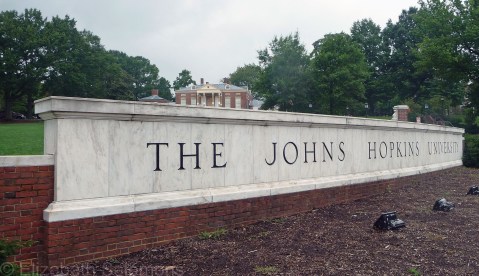
Hopkins was founded in 1876 through a bequest by Baltimore abolitionist, entrepreneur, and philanthropist Johns Hopkins. Here is a bust of the man himself.

Homewood House, seen in the next photo, was a private home built around 1800 that was eventually given to the university. It was built in the Federal Style ― a style of architecture you don’t see much in Canada ― and is said to be the inspiration for the look of the Homewood campus of JHU. It’s now a museum.

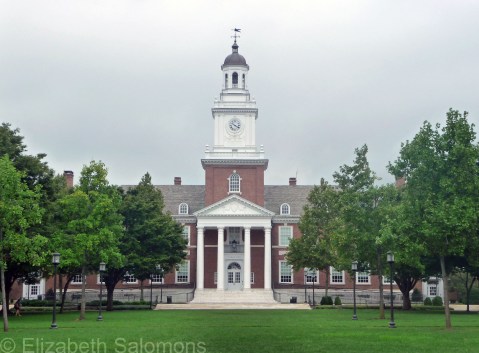
This is Gilman Hall, home to the humanities and social sciences departments.
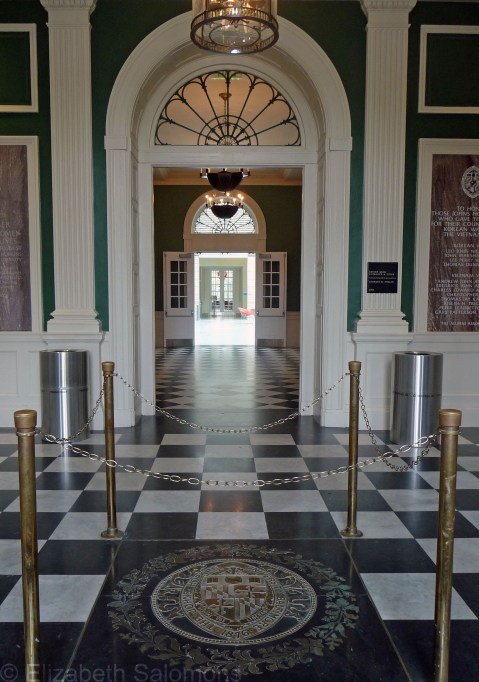
And this is what you see once you step inside Gilman Hall.
Keep on walking, and you’ll come to the Hutzler Reading Room.

It is such a beautiful room I couldn’t stop taking photos. Here’s another.

And another.

The imposing structure shown below is the Milton S. Eisenhower Library. As impressive as it is, it’s not quite as impressive as the George Peabody Library, located at the Peabody campus of JHU, which my sister took me to see after our tour of the Homewood campus. (Click here to see a photo of that library.)

On another day, while waiting for a bus, I realized we were standing in front the Johns Hopkins Hospital, so I took this photo. I quite like the three-storeyed porch, which I didn’t notice until I was editing these photos. Johns Hopkins Hospital is the top-rated hospital in the United States, and its School of Medicine is located on the East Baltimore campus of JHU.

So there it is: your look at Johns Hopkins University. My one regret is I didn’t get to see it in its fall glory, which I’m sure must be spectacular.
Through My Lens: Vancouver in Fall
Before the calendar flips over to December, and I have to finally, reluctantly, grudgingly admit that it really is winter, here’s one last photo showing Vancouver’s fall colours at their best. I took this photo from Burrard Bridge in mid-October 2011.

Through My Lens: Biomed Building
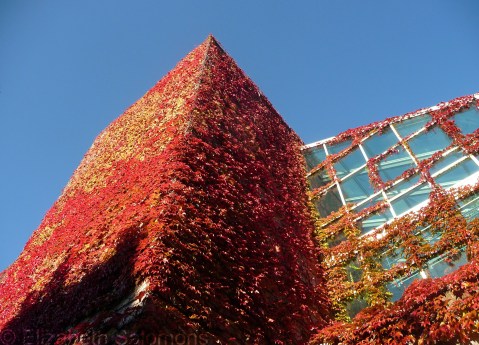
Since September, I’ve been spending most of my days at the University of British Columbia (UBC). It’s a beautiful campus located on the Point Grey peninsula of the west side of Vancouver. This is a photo I took in early October of the Biomedical Research Centre I walk by each day on my way from the bus loop to my office. I liked the contrast between the blue sky and the red ivy.
The Sylvia Hotel

The Sylvia Hotel is a small beachside hotel in Vancouver’s English Bay with a long and storied history. These photos were taken when the hotel is at its most colourful —in the fall, after the ivy has turned red.
The hotel has some other colour as well: Errol Flynn was a frequent guest and there is an urban legend that he died here. Team Russia, including (it was rumoured) the Russian hockey team, stayed at the Sylvia during the Vancouver 2010 Olympics.
The Sylvia Hotel has overlooked English Bay since 1912. Originally an apartment building, it was converted to an apartment hotel during the 1930s and to a full-service hotel after World War II. Its name is taken from the daughter of the building’s original owner. Until 1958, the Sylvia was the tallest building in Vancouver’s West End — hard to imagine today as the eight-storey building is dwarfed by the condo towers that surround it.
Two of my home exchangers came to Vancouver for family weddings and found the Sylvia most convenient for other members of their families to stay. It’s a lovely place to go for breakfast — I recommend the Beachside Benny — and the hotel is also the setting of two children’s books about a resident cat named Mister Got to Go.

Through My Lens: Rainy Paris
After a beautiful, warm fall, the rainy season has descended on Vancouver. Although not the wettest October on record, we did get almost double the average rainfall — and it all fell in the past two weeks.
Wet fall weather makes me homesick for Paris, of all places. Two years ago today, I arrived in that city for an extended visit. It rained the first ten days I was there; I remember thinking at the time, “And they say Vancouver gets a lot of rain??”
I didn’t mind, though. I felt right at home.
Here’s the first photo I took on that visit.


 There and Back Again