
Hollandse Kaas
Look what I got!
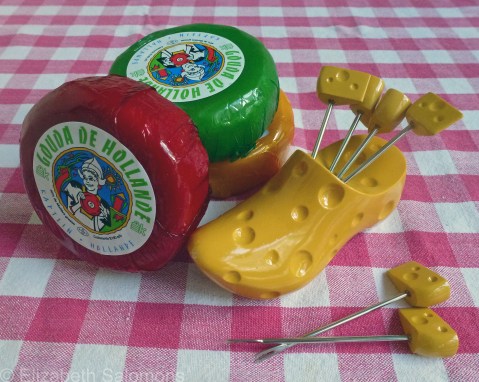
I was hanging out in Solo again these past few weeks taking care of a houseful of cats while my sister and her husband were gallivanting around northern Europe. I’m back home again, but as a thank-you gift for my hard work my sister brought a gift for me from the Netherlands: echte Hollandse kaas (real Dutch cheese)!
I thought the timing was too perfect to pass up, given my recent post about my love affair with Dutch cheese, and so I just had to post a photo. Now, if you’ll please excuse me, I’m going to go eat some cheese.
Salt Spring Island Cheese
Last month, I told you all about the beginnings of my life-long love affair with cheese.
This month, I’m going to tell you about a stop I make whenever I visit Salt Spring Island — a place that’s perfect for cheese addicts (like me) looking for their next fix.

It’s the Salt Spring Island Cheese Company.
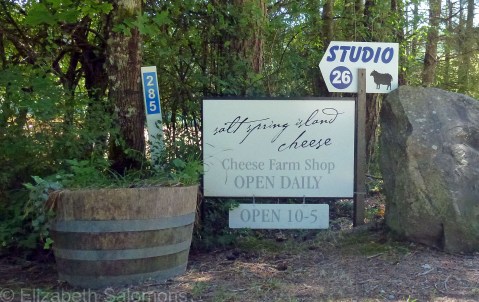
I’ve long been a fan of this cheesemaker’s dairy products ― they specialize in handmade goat and sheep cheeses that are available in grocery stores and at cheesemongers all across Greater Vancouver. What I did not know is how incredibly fresh the chèvres taste if you buy them straight from the source instead of waiting for them to be shipped to Vancouver. Who knew the difference a few days could make in the flavour and texture of fresh goat cheese?
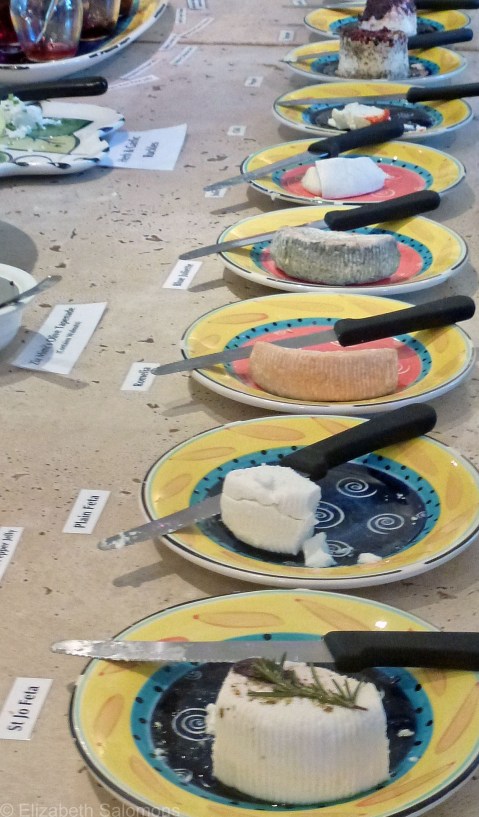
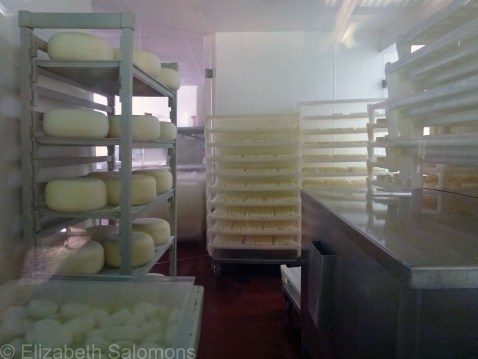
Salt Spring Island Cheese Company offers a self-guided tour of the cheese-making process from start to finish ― beginning with a walk through the barn where the goats are kept all the way to the final wrapping and display of the many varieties of cheese for sale in the shop.

If you’re as addicted to cheese as I am (is that even possible?), be sure to check out the Salt Spring Island Cheese Company the next time you’re on Salt Spring Island.
Alkmaar

I remember the exact moment I fell in love with cheese. The exact moment. Is that weird?
My family and I were enjoying a picnic lunch of sandwiches and fruit after a bike ride through the Amsterdamse Bos, a thousand-hectare park just south of Amsterdam. Mom handed me a sandwich, but I shook my head when I saw what was on it. I hated cheese.
“Taste it,” Mom said. “You’ll like this cheese.”
And ― whoa! That was the moment. I’d spent thirteen years pulling up my nose at fermented milk products, and all it took was a bit of Gouda cheese on bread to convert me to a wonderful new world. At that precise moment, cheese became my favourite food group. It seems, as was the case with me and beer, that I had to be in a country that knows how to properly make cheese (or beer) before I was able to appreciate its finer qualities. The discoveries you make when you travel.
And so, it was my love of Dutch cheese that brought me eventually (perhaps inevitably?) to the Alkmaar Cheese Market. (Dare I call it a pilgrimmage?)
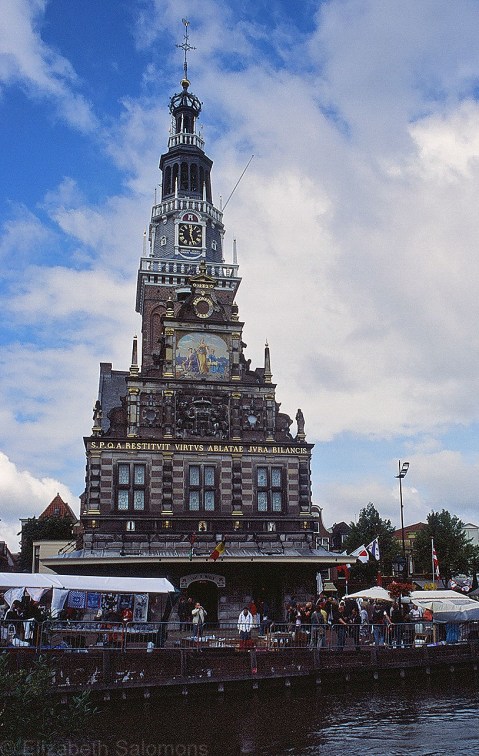
Alkmaar Weigh House
Alkmaar’s centuries-old cheese market is held on Friday mornings from April to September in the Waagplein (that’s Dutch for “weighing square”) located beside the Weigh House. Alkmaar is only a thirty-minute train ride north of Amsterdam, so a visit to the cheese market is easily done as a day trip if you are based in Amsterdam.

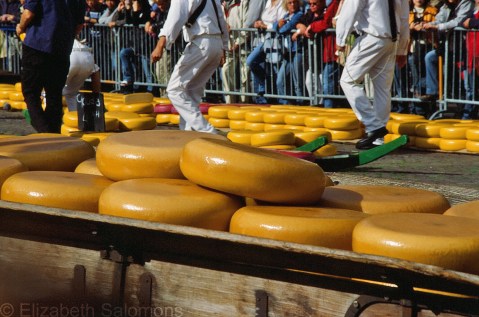
There are always crowds, so get here early if you want to be able to see everything that goes on. Essentially, what you are watching is a tradition that goes back hundreds of years: the cheese makers bring their cheese to the market, the traders and buyers inspect it, and then the deals are made. All the while, men dressed in white carry the cheese using special carriers from the Waagplein, where the wheels of cheese are laid out in neat rows, to the Weigh House to be weighed and back again.
The following is a photo tour of what I saw and learned in Alkmaar. (Click on the first photo at top left to open the slide show.)


Back to the cheese epiphany I had at age thirteen. A few weeks after that momentous picnic lunch, our family settled in at the small Dutch town where we would be living for a few months. We soon got into a routine of going to the weekly outdoor market along the canal. Our first stop was always the kaas stand (cheese stand) where Mom showed us how it was expected that you always taste the cheese before buying. We’d each of us get a nibble of cheese, and then Mom would make her selection.
Oh, for the love of cheese.
Armchair Traveller: On Rue Tatin
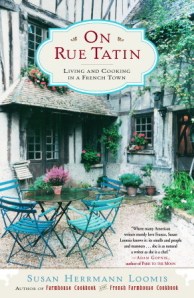 How many shopping days until Christmas? I think I have time to squeeze in another book recommendation.
This one is by another American cookbook author who transplants herself to France, but she doesn’t write about cooking in the World’s Most Glorious ― and Perplexing ― City. Instead, she and her family live (and cook and eat) in a small village in Normandy.
On Rue Tatin by Susan Herrmann Loomis is part travel memoir, part cookbook. There is one long tedious chapter to get through that describes her history with France and how she and her husband came to live in Normandy, but after that the book picks up its pace. Many pages are devoted to their struggles (and expenses) of renovating the house they bought beside the Romanesque/Gothic village church into a family home. The building was a convent for three hundred years, then an antique shop; I dread to think of what it looked like when she first set foot inside. It is in this convent-turned-home that she also teaches week-long classes at her cooking school, also named On Rue Tatin.
Although the first chapter of On Rue Tatin almost made me put the book down (what was her editor thinking?), Normandy is an underrated region of France and for that reason alone I recommend giving the book a read. I also have to ’fess up that Loomis’s assessment of the amount of rain Normandy is known for made me laugh: as a former Seattleite, she assured her readers it was nothing. That was enough to convince me that I would feel right at home in Normandy. And her recipes are enticing enough that I have already decided my next cooking class will be on Norman cuisine (here in Vancouver, alas, not in Normandy). But I can already smell the tarte tatin I will be baking.
Armchair Traveller: The Sweet Life in Paris
 Are you still searching for the perfect Christmas gift for the armchair traveller in your life? Perhaps you could use a suggestion for your own holiday reading. Either way, here’s a book recommendation for you: The Sweet Life in Paris by David Lebovitz.
I discovered David Lebovitz’s writing through his blog called, appropriately enough, Living the Sweet Life in Paris. But even if I had never heard of the guy (or his blog), I would have grabbed the book off the store shelf on the merit of its subtitle alone: Delicious Adventures in the World’s Most Glorious ― and Perplexing ― City.
David Lebovitz is a San-Francisco-pastry-chef-turned-cookbook-writer who starts life over in Paris following the unexpected death of his long-time partner ― a move he describes as “an opportunity to flip over the Etch A Sketch” of his life. Once in Paris, his writing shifts and his books expand from simply recipes to an examination ― centred around food, of course ― of all the ups and downs of living in Paris.
The Sweet Life in Paris is the result. It’s a book of short essays about daily life in Paris, followed by an appropriate recipe. Some of the links are tenuous, like when Lebovitz follows a description of French plumbing woes with a recipe for a meringue dessert called Floating Island. (The connection between the two? He recommends not flushing the meringue down the toilet if it doesn’t turn out.) Others are bang on, like his recipes for Chocolate Mousse that accompany the story of how he discovered the secret to dealing with French bureaucrats is to bribe them with free copies of his cookbooks.
Lebovitz’s credibility shot up when I read his recommendation that, if you don’t like anchovies, be sure to try them fresh in Collioure on the Mediterranean coast. I’ve eaten fresh anchovies in Collioure ― they would convert any non-believer.
But while Lebovitz’s descriptions of food in The Sweet Life in Paris are mouth-watering, as are his recipes, what I appreciate most about this book is his ability to see the funny in the incredibly frustrating idiosyncrasies of Parisian life. I’m with him 100% as he puzzles over why European washing machines take two hours to wash a load of laundry that would take North American machines a mere 40 minutes. Most of all, I wish I’d known his system for navigating the aisles of a Parisian supermarket before I spent a winter in Paris:
I hold [my basket] in front of me as I walk, like the prow of a battleship, to clear the way. That doesn’t always work, as Parisians don’t like to move or back up for anyone, no matter what. So sometimes I hide my basket behind me, then heave it forward at the last moment; the element of surprise gives them no time to plan a counteroffensive, and when the coast is suddenly clear, I made a break for it.
I lost count of how many times I had to sidestep, trip over, or squeeze past Parisians who refused to budge an inch in the narrow aisles of Monoprix or Carrefour. Now I can’t wait to go back and try out Lebovitz’s technique.
Even if you’ve never been to Paris and don’t know the difference between a pastry brush and a pastry blender, pick up a copy of The Sweet Life in Paris. It’s good for the laughs.
Recipe Box: Wild BC Spot Prawns

I first discovered wild BC spot prawns a couple of years ago when I noticed them popping up on restaurant menus around town.
“Spot prawns? What are spot prawns?” I asked my friends. They didn’t know either. I ordered them, tasted them, fell in love with them …
With a little research, I discovered that the wild BC spot prawn is the largest of seven species of commercially available BC shrimp. What’s unique about them is their distinctive white spots and naturally bright orange colour.
With a little more research, I learned that the spot prawn fishery is one of BC’s most sustainable fisheries. It’s limited to trap gear only, and the prawns are hand sorted upon removal from the ocean. Prawns too small for consumption are thrown back. About 90 percent of the commercial catch is shipped to Japan and the remainder is sold locally. But here’s the kicker: the season is short ― only six weeks from mid-May to June. In other words: get them while you can. (And if you don’t live in BC or Japan, well, too bad for you.)
Last year, I got up the courage to cook spot prawns myself. I had house guests ― my brother and his family were visiting from land-locked Alberta ― and when they told me they wanted to spend the day playing tourist at Granville Island, I decided to show off. I told them, casual like (as if I did it all the time), that I would pick up some spot prawns at the market for our dinner.
I was a bit taken aback when the fishmonger scooped a handful of live spot prawns from a water tank. “I didn’t know they were sold live,” I whispered to my brother, my bravado quickly disappearing. Gamely, I accepted the plastic bag of prawns wrapped in newspaper. I told the fishmonger I was planning to sauté them with garlic in butter.
“Excellent,” he said. “That’s the best way to prepare them.”
“But … do I have to … you know … kill them first?” I asked gingerly.
“Nope,” he said. “By the time you get them home, they’ll be dead.” Phew. I’m no vegetarian, but I draw the line at killing my own food.
He was right. When I unwrapped my package a few hours later, the shrimp were still bright orange, but most definitely in a non-living state. I cooked them up, and we devoured those garlicky spot prawns in record time. Their taste reminded me of lobster, and my only regret was that I didn’t buy more.
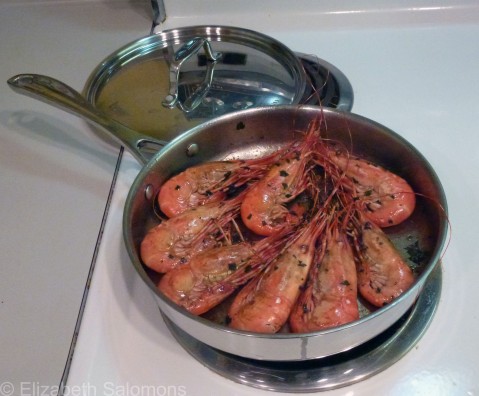
This year, I did buy more, and I cooked them the same way, relishing them as much as the first time. The very next evening, I went to my sister’s and her husband’s for a barbecue dinner, and was pleased to find out that grilled spot prawns were on the menu. But I was stunned when I saw the plate of prawns she had prepared for grilling.
“Where are the heads!?” I asked.
My sister looked at me, puzzled. “You have to take them off,” she insisted.
Lively debate ensues: do you eat spot prawns with the heads on or off? (And, while we’re at it, do you need to devein them?)
Back to Google. It turns out that deveining spot prawns is a matter of personal preference. (I have yet to taste the grittiness some claim is common if you don’t devein.) But what is critical is that you remove the heads immediately if you aren’t intending to cook the prawns the same day, because they release an enzyme after death that makes the tail meat turn mushy.
Here is the recipe I like to use (with heads on), but know that if you eat yours with heads off, they will be just as tasty.
Enjoy!
Wild BC Spot Prawns
1 pound whole spot prawns
2 tablespoons butter
2 cloves minced garlic
1 tablespoon chopped parsley
1/4 cup dry white wine
salt and pepper to taste
1. Melt butter in a large frying pan on medium high heat.
2. Add minced garlic and parsley and sauté for 1 to 2 minutes.
3. Add prawns and white wine, tossing to coat with the butter and parsley, then season with salt and pepper.
4. Cover and cook 4 to 5 minutes, no longer.
Serve with slices of crusty baguette and a chilled buttery chardonnay.

Dishing: Bitter Tasting Room
 Many years ago (too many to share with you), I was backpacking around Europe with a friend. One hot, sunny afternoon in late September, we climbed 509 stairs to the top of Cologne’s beautiful cathedral. Once back on terra firma, we headed straight to McDonald’s for some lunch. (I know, I know … but what can I say? We were students on a tight budget.)
When I saw beer on the menu, I ordered one, despite the fact that I didn’t actually like beer and had never managed to swallow more than a sip or two. But hey ― it was a really hot day and I had just climbed up and down the equivalent of a 30-storey building. And yeah, I did think it was pretty cool that I could buy a beer at McDonald’s.
You know what? It was the best beer I had ever tasted. I became an instant and committed convert to the beverage. My theory is that, until that point in my (then) young life, I had simply not been introduced to the right kind of beer. It took a German beer ― in McDonald’s no less, but German nonetheless ― to get me hooked on the stuff. I’ve enjoyed many a cold one since.

Why do I have beer on the brain, you ask? It’s because this past weekend was the first of the year that we Vancouverites enjoyed summer-like temperatures. And so, I thought, what better time to introduce my readers to one of the best craft beer taprooms in the city.
Bitter Tasting Room is located near the corner of Hastings and Carroll in what is actually more Downtown Eastside than Gastown. I’ve been here a couple of times ― the first time, ironically, at the suggestion of a friend who doesn’t herself drink much beer (so I knew it must be good if she was willing to go), and the last time with my sister just last night.
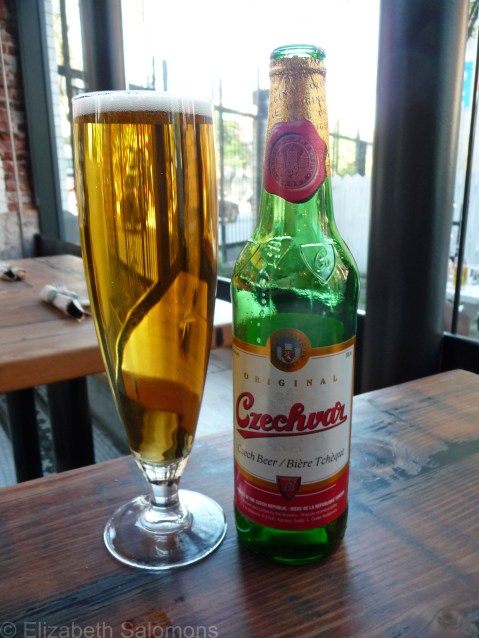
Bitter offers a selection of more than 60 bottled beers from North America or Europe, with a particularly strong selection of Belgium beers. 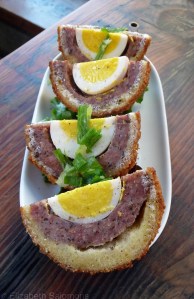 You can also order a pint of draught from a choice of about eight local craft beers. Or you can order a flight of beers, and sample three at once.
The food is typical German and English pub fare — sausages, Scotch eggs, and a killer kale Caesar salad are a few examples. In wintertime, I enjoyed a tasty dish of cassoulet, a slow-cooked stew made with duck confit, pork belly, sausage, and braised beans that comes from the Languedoc region of France.
Bitter is part of the Heather Hospitality Group and I have yet to be disappointed by an evening spent in one of their establishments.

Afternoon Tea at the Empress
Most afternoons, I have a cup of tea. With milk. It’s such a part of my routine that this past week there was an “incident” (shall we say) at work when I discovered someone had used up the milk I keep for my tea in the office fridge, thinking it was hers. My co-workers laughed at my distress, but I can’t drink tea without milk. And I really enjoy my afternoon cup of tea.
So last weekend, while I was in Victoria visiting a friend there on business who told me she really wanted to someday, one day, have afternoon tea at the Empress, it didn’t take much for me to decide I liked that idea very much. “And what’s stopping us from having tea at the Empress this weekend?” I asked. Within minutes, we had a reservation in the hotel’s Tea Lobby for the next day.
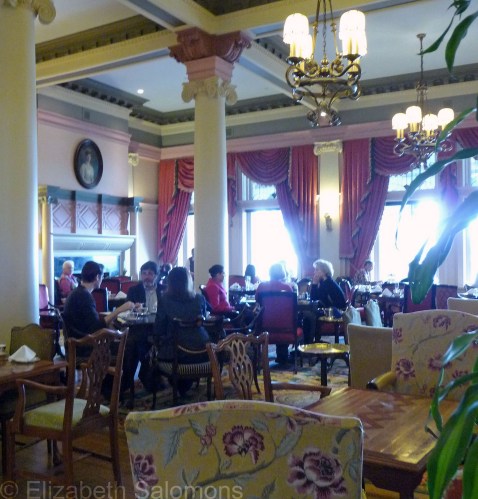
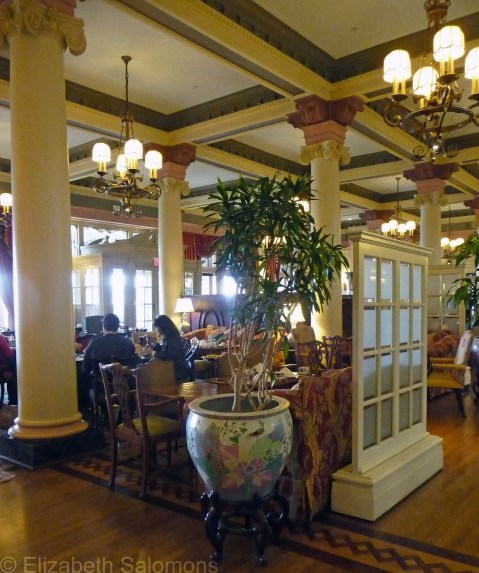
Victoria, BC, has been called the most English city in Canada, and the city definitely plays up that reputation for the tourists. Afternoon Tea at the Empress Hotel is a big part of that playing up, and there is no setting more lovely than the Empress Hotel. One of Canada’s iconic “railway hotels,” it has been a landmark on Victoria’s Inner Harbour since its opening in 1908.

We both skipped breakfast and arrived at the hotel’s Tea Lobby appropriately famished. It’s located off the main lobby and its windows overlook the Inner Harbour. We were seated near those windows at a low table.
(And here’s an aside for you: I learned that high tea is actually the supper-type meal the English eat in the early evening, while afternoon tea or low tea is always taken in the afternoon. It’s called low tea because typically you sit at a low table.)
The meal began with cups of seasonal fruit served with cream ― in our case, strawberries. I’m a bit of a strawberry snob and unless the berries are grown locally and are in season, I really don’t think much of their taste. Such was the case with these strawberries, shipped in from California, I’m sure, but hey, what seasonal fruit would you find anywhere in Canada in mid-April?

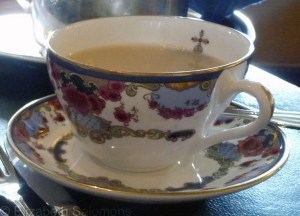
We were given a choice of eight teas ― I chose the Empress Blend, a tea that “boasts a bright coppery colour and takes milk exceedingly well.” My friend chose Margaret’s Hope Darjeeling, which offered “the distinctive character of Muscat grapes and hints of current.” Clearly tea can be as sophisticated as wine.
Along with our pots of tea came the three-tiered plate of … well … the main event. Our little table was packed, what with the silver teapots, china teacups and small plates, and the tower of savouries, scones, and sweets, but the server positioned everything on the table with expertise and, remarkably, it all fit. Then, after pouring our tea and ensuring we had everything we needed, he offered to take photos of us with our own cameras. He definitely had the routine down pat.
And then? And then we dug in!
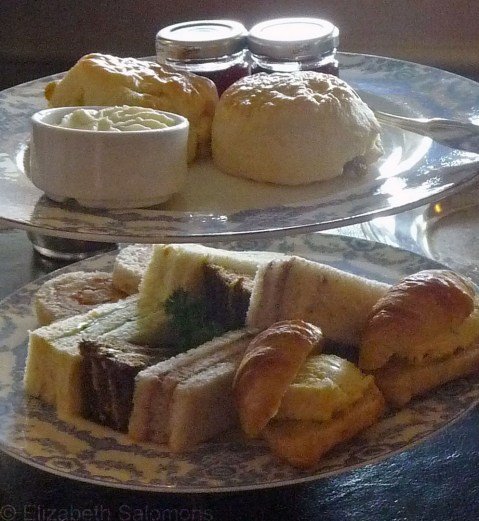
The savoury level of the tiered plate consisted of tiny sandwiches: smoked salmon pinwheels, cucumber sandwiches (of course!) with saffron loaf, mango & curried chicken sandwiches (my favourite), free-range egg salad croissants (also very tasty), and cognac pork pâté on sundried tomato bread.
Then we moved up a level to the fresh baked raisin scones with clotted cream and the Empress’s own strawberry jam.
On the final, upper-most tier were the pastries: lemon curd tartlets, cappuccino chocolate tea cups, rose petal shortbread, chocolate and pistachio Battenberg cakes, and the one I’d been waiting for: Parisian style macaroons.
Sigh.
It was heavenly. And when we were finished, our server presented each of us with a small box of the tea we had been drinking.
I didn’t eat dinner that night. Who knew afternoon tea could sustain your body for an entire day?
Dishing: Pizzeria Libretto
Here’s one last post on food, and then I’ll let you all go back to your New Year’s resolutions. (Which I know you’re following religiously.)
This post is about how I discovered Naples on the Danforth. The Danforth, for those of my readers unfamiliar with Toronto’s Greektown, is Souvlaki Central. A decade ago, there wasn’t much variety in the way of restaurants on the Danforth ― it was all Greek all the time. Every time I went back to Toronto for a visit, I made sure to get my fill of the best souvlaki in the country (in my humble opinion).
But during my most recent visit to the Centre of the Universe, I realized the Danforth is undergoing a transformation. There is still a heavy Greek influence, to be sure, but there’s a whole lot more as well.
Including Italian.
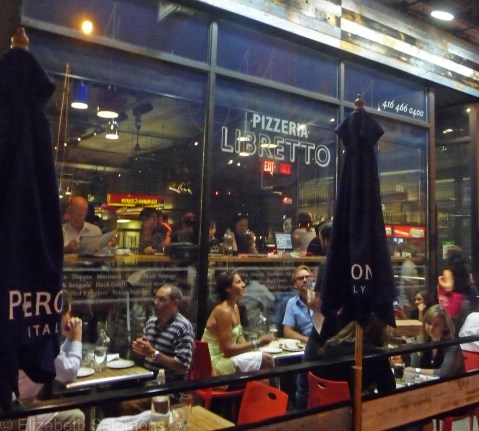
My friend insisted while I was in town that we eat at least one night at Pizzeria Libretto, a neighbourhood pizzeria that serves Real Neapolitan Pizza certified by VPN. (Verace Pizza Napoletana is a non-profit association that protects and promotes real Neapolitan pizza around the world.) She promised me I wouldn’t regret it.
I didn’t.
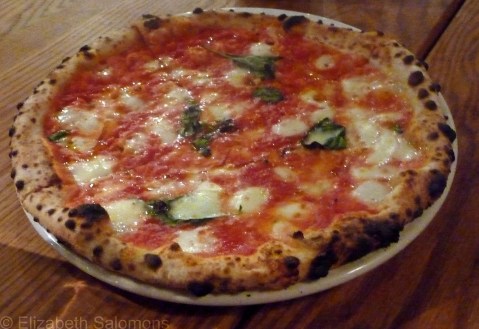
Pizzeria Libretto is about the closest I’ve been to Italian pizza outside of Italy. Libretto is Italian for “booklet.” You fold the pizza at Pizzeria Libretto like a booklet ― that’s the only way you’ll get it in your mouth, unless you deign to eat your pizza with a knife and fork. Pizza crust that soft and that thin ― that’s a true Neapolitan pizza. Our pizza Margherita had a super thin, soft crust, the thinnest layer of tomato sauce, the freshest basil, dollops of fresh mozzarella cheese … and it was baked in a wood-fired oven. Heaven on earth, truly, for pizza lovers.
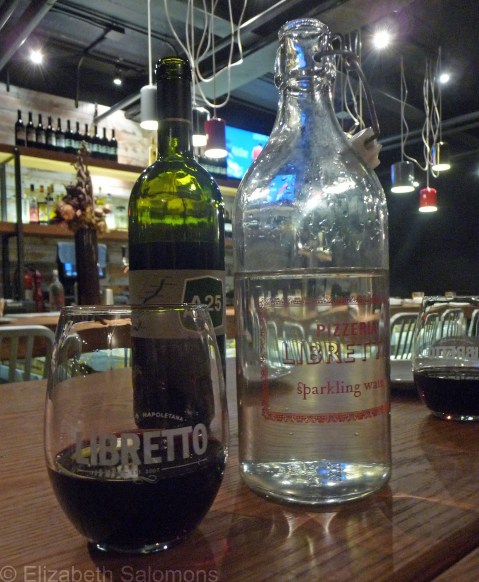
There was no room upstairs when we arrived (we didn’t have a reservation), but lots of room downstairs and the attentive service was excellent. Pizzeria Libretto has a stylish but down-to-earth décor ― I went dressed in a T-shirt, shorts, and Birkenstocks. I really liked the water bottles they used, with the name Pizzeria Libretto stamped on the side, and asked to buy one to take home with me. Our server said he was sure it wouldn’t be a problem, but then someone with a higher pay grade vetoed his decision. To help me get over my disappointment (I’m thinking), our server brought us complimentary after-dinner digestifs.
Before my evening at Pizzeria Libretto, I would tell people that the best souvlaki outside of Greece is made on the Danforth. Now I will tell everyone that the Danforth also has the best pizza outside of Italy. It was so good, in fact, I went back the next week with another friend for lunch. I never did get my souvlaki fix.
Dishing: Acadia
Update: Acadia closed in December 2013.
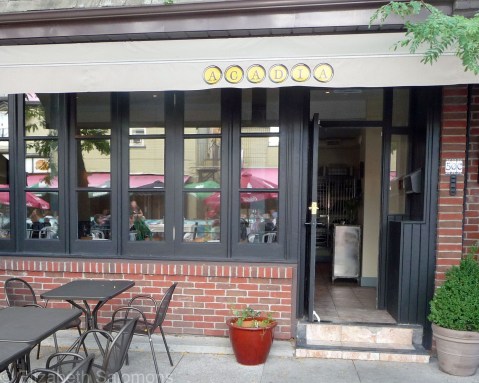
My friend was so impressed with our experience at Jean-Georges in New York City last summer that she decided we should check out some fine dining options in Toronto as long as I was in town. We decided on Acadia, which features the “flavors and techniques of Acadian and Lowcountry cuisine” and was rated by enRoute magazine as Canada’s fourth-best new restaurant of 2012. My friend (“C”) spends part of every summer in modern-day Acadia (aka Nova Scotia), she and I had travelled together many years ago to Louisiana, and I once spent a month in South Carolina, so we were both rather curious to see what Acadia had to offer on its menu.
Plus, a friend of C’s (“J”) ― also from Nova Scotia and in town for TIFF ― would be joining us. There was no debate. Acadia was our #1 choice.
(And we pause here momentarily for a brief history and geography lesson: Acadia, as I’m sure you all know, is that part of North America (present-day Maine, New Brunswick, Nova Scotia, and Prince Edward Island) settled by the French in the early seventeenth century. Its connection to Louisiana is that, when the British deported most of the Acadians between 1755 and 1763, many of them ended up in Louisiana, which at that time was still a colony of New France. Their descendents are known as Cajuns.
Not so well known (OK, yes, I admit it: I looked this up on Wikipedia) is the Lowcountry region. It’s the South Carolinian coast, and food typical to the area is known as Lowcountry cuisine.
That’s it for today’s lesson ― we now return to our regular programming.)
C and I arrived early, so we each ordered a bourbon-based cocktail to start. As we waited for J to arrive, we devoured an order of chicken cracklin’ with hot sauce and blue cheese. The cracklin’ are like thin, smooth potato chips, but they’re made from stretched chicken skin, not potatoes. I know, I know … it sounds disgusting, but trust me ― these are addictive. The blue cheese was foamy and light, and we scooped it up with each cracklin’ like dip.
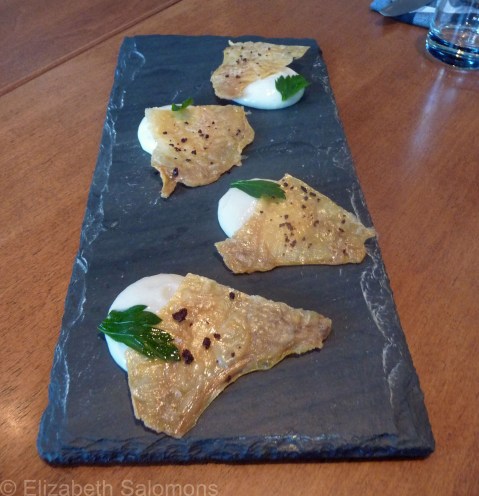
Chicken cracklin’ with hot sauce and blue cheese
When J arrived, appropriately famished as well, he ordered a beer and we ordered another round of the chicken cracklin’, as well as the spiced beer nuts, flavoured with brown butter and paprika, and Acadia’s cornbread, which is served with whipped pork butter and mesquite.
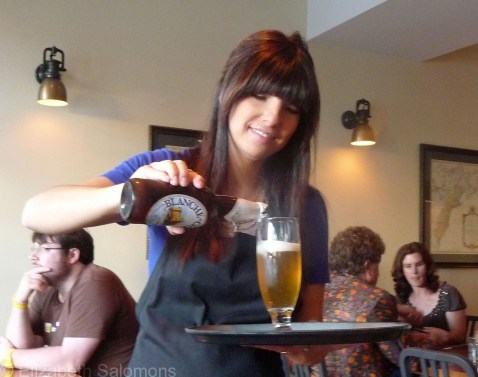

Acadia’s cornbread, with whipped pork butter and mesquite
After the nibblies and drinks were gone, we were ready for the serious stuff. We each ordered a different starter. C choose Anson Mills grits with Gulf prawn, oyster mushroom, pimento cheese, and ham hock consommé. Anson Mills is located in South Carolina, so these were the authentic southern grits I remember. I came to like grits mixed with scrambled eggs during my month of South Carolinian breakfasts. I like grits with eggs; I like grits for breakfast. But as a starter? With prawns? Never mind — C was happy. She gave me a taste, but I’ll be honest: not my favourite and I found it a curious dish.
J ordered the charred octopus served with crispy pork belly, tomatillo, new potato, spicy collards, and a black vinaigrette. He summed it up as simply the best octopus he’d ever eaten. I’ll admit I had some regrets on not ordering it when I saw his plate.
I had chilled corn soup with andouille, yellow plum, smoked cream, and tarragon. All the texture was in the andouille and plum that lay at the bottom of the bowl because the soup was as smooth as consommé. I soon got over my octopus-regret; my soup was delicious.

Chilled corn soup with andouille, yellow plum, smoked cream, and tarragon
Before the arrival of our main courses, our server came by with the most sincerest of warnings. We needed to prepare ourselves. More accurately, I needed to prepare myself, because, in her words, I was about to experience “some serious food envy.”
She wasn’t kidding. C and J had ordered the special of the night: an entire braised veal shank to share. It left all three of us speechless. It was encircled by chanterelle mushrooms and tomatoes of a variety of colours.
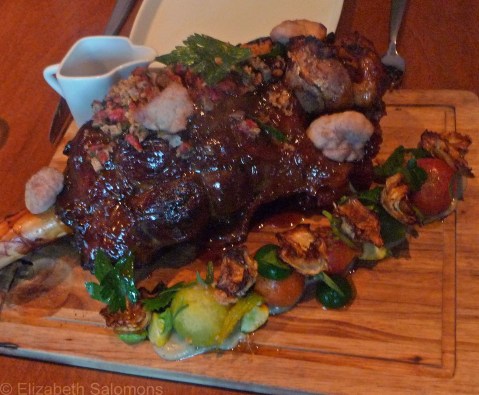
The magnificent veal shank
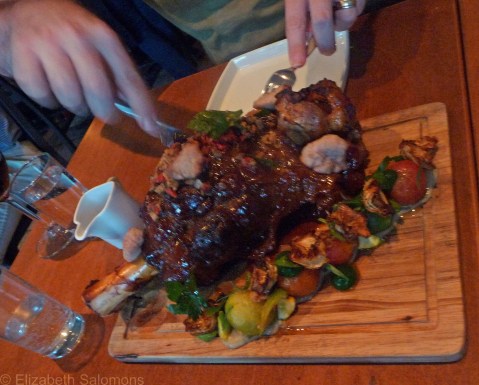
So magnificent it deserves a second photo
I had scallops (miniscule, our server teased me, compared to the veal shank), with shaved foie gras, celery purée, pecan, Concord grape, and scuppernong mustard. Scallop is one of my favourite types of sea food, so I can be quite forgiving, but no need this time. They were excellent. But I also had a few bites of the veal shank, and had to admit that it too was delicious.

Scallops with shaved foie gras, celery purée, pecan, Concord grape, and scuppernong mustard
It didn’t take long before J and C admitted they were defeated. Truthfully, that hunk of meat was enough for four people. Our server grinned. “Oh, so it’s going to be lunch tomorrow?” she asked.
C piped up that she would appreciate some suggestions on what to do with the veal in the way of leftovers. “I don’t want to ruin it,” she said. We were surprised and delighted to see Acadia’s chef, Patrick Kriss, come to our table after we had been served our desserts, speaking most earnestly, and advising C to braise the leftover meat in chicken stock to retain the moisture. “Don’t put it in the microwave,” he warned. “That will dry the meat out.” We were all impressed by the attention he gave us ― although, if I think about it, it was probably the veal shank he was most concerned about.
For dessert, I had wild blueberry sorbet with peaches, lavender, and ricotta, while J and C shared a dark chocolate cremeaux with milk sorbet, pistachio, and cherries. Espresso to finish, and we were sated. My Toronto readers: if you’re interested in a medley of cuisines and a lesson in geography, check out Acadia. I highly recommend it.
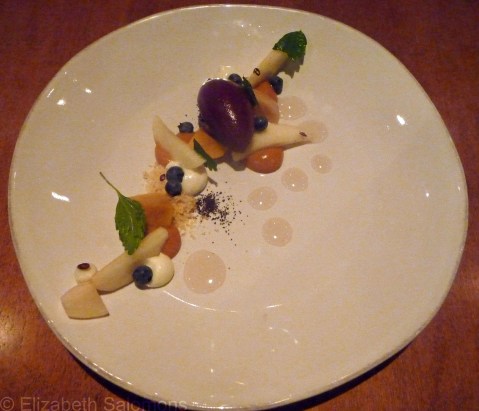
Wild blueberry sorbet with peaches, lavender, and ricotta


 There and Back Again