
Christmas Markets
A co-worker of mine went to the Czech Republic earlier this month. When I found out where she was going for her holidays, my eyes lit up.
“The Czech Republic?!” I said. “Are you going to the Christmas markets?”
She smiled. “Of course!” she said.
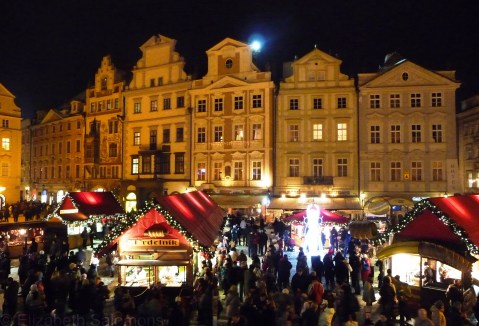
Christmas Market, Prague
She explained that the main purpose of the trip was to visit her grandmother who lived somewhere out in the Czech countryside, but her family also had plans to stop off in Prague, and were going to make a special trip to Nuremberg, Germany, just to see its Christmas market.
Christmas markets have been around since the Middle Ages. They are common throughout Western Europe and are especially prevalent in Central Europe. In recent years, they’ve been popping up all over England and North America, too. Common elements include chalet-like stalls set up in town squares, which sell handicrafts, toys, Christmas ornaments, lots of tasty treats, and the ubiquitous Glühwein (mulled wine).
I can’t remember when or where I first heard of Christmas markets, but a couple of years ago when I knew I would be spending the winter in Paris, I was determined to experience as many as I could.
The first Christmas market I came across that winter was unexpected, as it was mid-November and Christmas was far from my mind. I was in Seville, Spain. The market was in the square near the massive cathedral, and contained stall after stall selling wooden nativities. The nativities were works of art, truly. Each figure was sold separately and cost far more euros than I had to spend.
In Madrid, the Christmas market in Plaza Mayor dates back to 1860. It too was filled with stalls selling wooden nativity figures.

Plaza Mayor, Madrid
Steps away from Plaza Mayor, I stumbled across a smaller market in Plaza Santa Cruz with a more light-hearted carnival atmosphere. Its stalls were selling costumes, wigs, and accessories for Dia de los Santos Inocentes on December 28. (This is the Spanish equivalent to our April Fool’s Day, though its origins are rather sombre: the day commemorates the massacres of the “Holy Innocents” ― the children murdered by Herod in his search for the newborn king the wise men had told him about.)

Plaza Santa Cruz, Madrid
In Paris, there are Marchés de Noël in almost every arrondissement. I made it to three. The market at Trocadéro is probably the most picturesque as it’s situated across the Seine from the Eiffel Tower. It also has a popular skating rink.

Trocadéro, Paris
Saint-Germain-des-Prés is a much smaller market, with stalls nestled along Boulevard Saint-Germain and around the church of Saint-Germain-des- Prés.

Saint-Germain-des-Prés, Paris
The market along Avenue des Champs-Elysées is massive, and runs all the way from the giant Ferris wheel at Place de la Concorde to the Franklin D. Roosevelt métro station. It consists of several blocks of stalls selling vin chaud, crêpes, chocolate, sausages, and all sorts of handicrafts. Every block or so there was a heater where you could warm your hands. We walked the entire length of this market on Christmas Eve.

Christmas market stalls along the Champs-Elysées, Paris

All the chocolate you could wish for along the Champs-Elysées, Paris
Although Paris is a magical time to be in December, the Christmas markets I was most excited about seeing were in the Czech Republic. I was thrilled to see the Old Town Square of Prague once again, but I could never have imagined how pretty it would look at Christmastime.
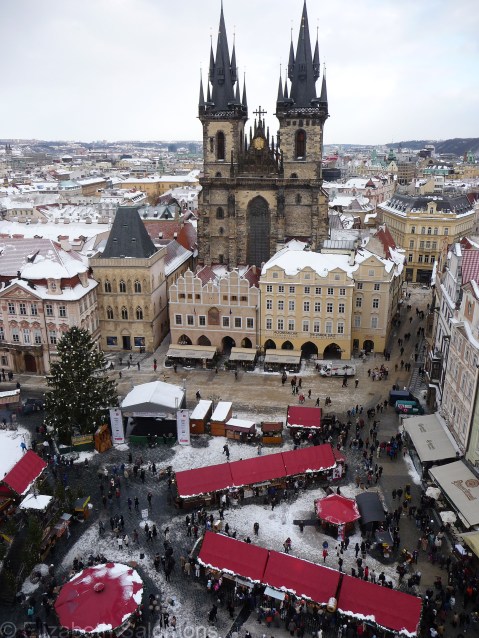
Christmas Market, Old Town Square, Prague
The lights were impressive, and there was an enormous Christmas tree as well as a nativity, a stage where children were singing Christmas carols, and hundreds of red-roofed stalls selling food and toys and ornaments.

Old Town Square with the Old Town Hall and St. Nicholas Church behind

Children singing carols
I enjoyed a trdelník ― a sweet pastry baked over hot coals and sprinkled with sugar and nuts ― and later a massive slab of spit-roasted ham. To keep warm, I bought mug after mug of Glühwein ― in Czech, it’s called svařené víno. There was another, smaller market in Prague’s Wenceslas Square with much of the same, although not as prettily lit.
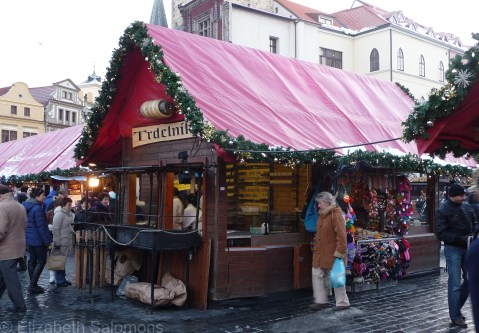
Trdelník stall
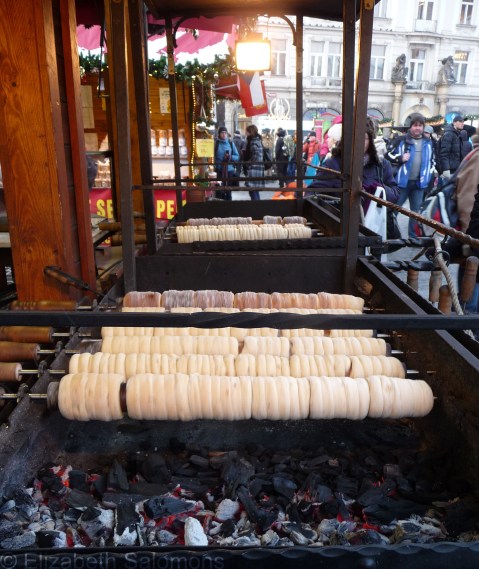
Trdelník baking over hot coals

Hams roasting on spits
The next day, I travelled to Český Krumlov. Its small, intimate Christmas market had the feeling of a neighbourhood bazaar, with local artisans selling their handiwork, and the local school putting on a Christmas concert after dark.

Old Town Square, Český Krumlov
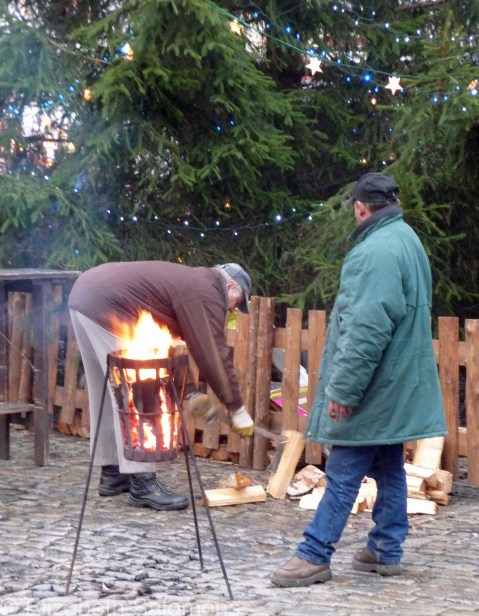
Keeping warm in Old Town Square, Český Krumlov
I don’t know if I will ever make it to Nuremberg, the granddaddy of all Christmas markets ― my co-worker said there were over 200 stalls there ― but, even so, seeing the Spanish, French, and Czech Christmas markets was something already. If you need an excuse to visit Europe in December (seriously? who ever needs an excuse to go to Europe?), I highly recommend going for the Christmas markets.

Christmas trees and Church of Our Lady before Týn, Prague
Through My Lens: Rainy Paris
After a beautiful, warm fall, the rainy season has descended on Vancouver. Although not the wettest October on record, we did get almost double the average rainfall — and it all fell in the past two weeks.
Wet fall weather makes me homesick for Paris, of all places. Two years ago today, I arrived in that city for an extended visit. It rained the first ten days I was there; I remember thinking at the time, “And they say Vancouver gets a lot of rain??”
I didn’t mind, though. I felt right at home.
Here’s the first photo I took on that visit.

Happy Birthday, Julia Child!
I could not let today go by without posting something about Julia Child. Today would have been her 100th birthday.
The piece of cake in this photo was my birthday treat to myself, one sunny wintry afternoon in Paris some eighteen months ago.
Happy birthday, Julia. And thank you.

Gâteau au chocolat fondant et crème anglaise
Armchair Traveller: C’est la Vie
 On my first-ever visit to Paris, I navigated the sidewalks as if I was playing a game of hopscotch. There was doggie-doo everywhere you looked (or, to be more precise, everywhere you stepped but didn’t look).
Fourteen years later, I was back in Paris, this time with my dad. The doggie-doo situation was much improved. But we chuckled together one night at dinner when we realized the incredibly stylish and well-manicured French matron dining alone at the table next to us had a small canine companion lying at her feet. We were most definitely not in Kansas anymore!
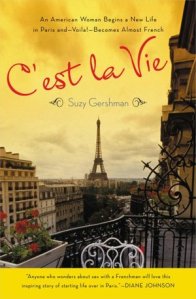
I thought about that dog the first time I read C’est la Vie by Suzy Gershman, which I read shortly before reading Almost French. C’est la Vie and Almost French nicely bookend each other because both are written by women who move to Paris at the urging of a man. And ― once each author is settled and starts to feel “almost French” ― each adopts a small dog (how French of them) that they take with them everywhere (how very French of them!). In Gershman’s case, this includes La Galerie at Hotel George V. Clearly a dog’s life in Paris is no hardship at all.
Other than that, however, the two authors are quite different from each other. One is young and Australian, the other is middle-aged and American. One is starting a relationship, the other is mourning the end of a relationship.
Suzy Gershman moves to Paris six weeks after the death of her husband, who has died only six weeks after being diagnosed with Stage IV lung cancer. She calls herself the Runaway Widow, and she lives in a hotel while searching for an apartment she can call home. This proves more difficult than she expects, but eventually she finds one in the 17e arrondissement. She then proceeds to set up house.
Gershman’s day job is writing shopping guides for cities all over the globe. Hence, she goes into incredible detail when describing the shopping she does to furnish her apartment. It’s natural she writes about what she knows, but the book is missing the in-depth analysis of French culture that I so enjoyed in Almost French. If Almost French is steak et frites, C’est la Vie is tarte tatin. Both add different elements to the meal, but, if I have to choose, I’m a meat-and-potatoes kinda gal.
However, I will be eternally grateful to Gershman for introducing me to Monoprix, the combination grocery-department chain store where I did most of my shopping when I was living in the 20e arrondissement. It was my favourite place to shop and I still miss it.
Armchair Traveller: Almost French
 One of the women in my Book Club is going to France with her family this summer. She knows I read a lot of travel memoirs, so at our last meeting she turned to me and asked, “Can you recommend some books about France?”
Can I recommend some books? About France? (Is the Queen English?)
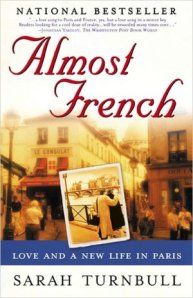
Almost French was my favourite of the shelfful of books I devoured before my last trip to Paris. The author, Sarah Turnbull, is an Australian journalist who meets a French lawyer when they are both in Bucharest for work-related reasons. A couple of months later, she takes him up on his invitation to visit him in Paris ― and never leaves.
Travel memoirs written by wealthy retirees who move to Provence (or Tuscany … or Greece … or …) and fix up old farmhouses are a dime a dozen. For that reason alone, I found Almost French refreshing because it was written by someone my own age living in a large city. I also enjoyed it because it was written by someone from a country with enough cultural and historical similarities to my own for me to relate to her observations about the differences between Australia and France.
But mostly, Turnbull’s memoir stands out from the dozens I’ve read because it is so painfully honest. She is open and frank about the daily grind and frustration and loneliness of adjusting to a new life in a new country. Travel memoirs are usually quite humourous ― often, I suspect, to deflect some of the pain that is always part of adjusting to life in a new and often confusing culture. And Turnbull’s book does have its funny moments. But she uses her stories of linguistic and cultural misunderstandings as an opportunity to write what amounts to a sociological study of the Parisian mind-set ― and she does so in a very real and down-to-earth manner.
For instance, her descriptions of various dinner parties are an obvious opportunity to talk about the French love and passion for food. But she uses these evenings as a window on everything French ― from politics to gender relationships to social habits to the proper way to present and serve a meal. Her weekend visits to the countryside with her French lawyer to visit his father lead to a treatise on how sentimental the French are about the countryside. And she becomes adept enough at reading the French psyché to understand that “Ce n’est pas possible” doesn’t always mean “It’s not possible.”
Another reason her memoir is so distinctive is that her experiences, although specific to Paris in the mid-1990s, are universal. Anyone who has picked up her life and started over in another country, or (dare I say it?) another region of Canada, will be able to relate to her book. Cultural differences between two regions of the same country might be subtle but significant enough to make you ask, “Where am I?” And although I lived in Paris for only three months, Turnbull’s descriptions of Parisians brought smiles of recognition to my face.
By the time she reaches the end of her book, Sarah Turnbull has lived in France for six years, and proves herself almost French by adopting one of the most clichéd of Parisian lifestyle choices ― she gets herself a little dog with as much personality as any French chien.
If you’ve ever contemplated moving to a foreign country, or have already done so, I highly recommend you read Almost French.
Happy Easter!

The Great Organ at Notre-Dame, Paris, January 2011
Through My Lens: Basilique Saint-Denis
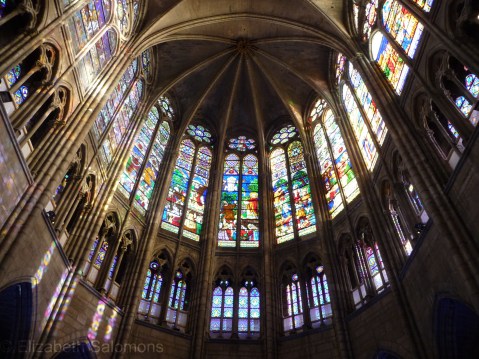
Today is Palm Sunday, and I’m posting a photo of the stained glass windows from the apse of Cathédrale royale de Saint-Denis, or Basilique Saint-Denis.
I first heard about Saint-Denis from my Dutch cousin in Amsterdam. After she showed me her photos and postcards, I decided I had to see this church for myself one day. Fast forward ten years, and I finally made it here on Boxing Day 2010.
Saint-Denis is a massive church located in the Parisian suburb of Saint-Denis, which you get to by travelling to the second-last stop of Métro Line 13. It was the first major structure to be built in the Gothic style of architecture and was made a cathedral in 1966.
What’s so unique about Saint-Denis is that most of France’s monarchs ― from Clovis I (died 511) to Louis XVIII (died 1824) ― are buried here, including the two who lost their heads during the French Revolution (Louis XVI and Marie Antoinette). A total of 42 kings, 32 queens, and 63 princes and princesses are entombed within the cathedral.
Through My Lens: Église Saint-Séverin

Saint-Séverin is a small church in the 5e arrondissement of Paris. Tucked away in a corner of the Latin Quarter, the building was almost destroyed by fire during the Hundred Years War, and was used to store gunpowder during the French Revolution. It’s one of my favourite Parisian churches, and is my photo choice for the Fifth Sunday of Lent.
Through My Lens: Église Saint-Sulpice
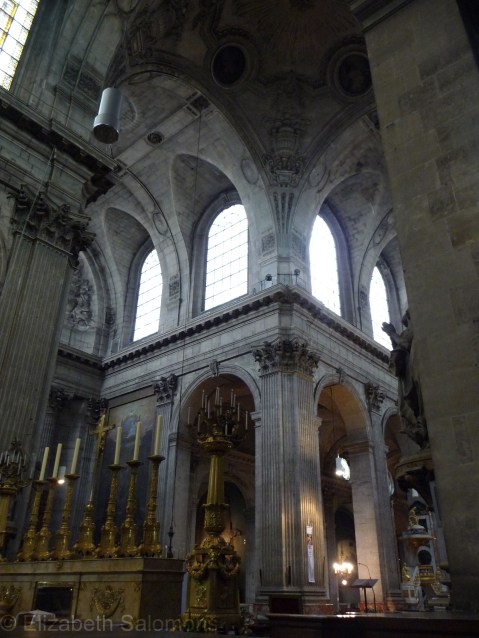
It’s the Fourth Sunday of Lent, and time for another church. This is the interior of Saint-Sulpice, located in the 6e arrondissement. Saint-Sulpice is the second-largest church in Paris ― second only to Notre-Dame ― and has one of the world’s largest pipe organs.
Through My Lens: Notre-Dame and the Basilica

For the Third Sunday of Lent, I give you not one, but two churches: Notre-Dame-de-Lorette and Basilique du Sacré-Cœur. I took this photo in January 2011 from Rue Lafitte near Boulevard Haussmann in the 9e arrondissement of Paris.


 There and Back Again