
Happy Canada Day!

I was looking through my photos for an appropriate one to post for Canada Day when I came across this one. It’s a bit dated, but I’m thinking it works, this year in particular.
Why, you might ask?
Because our country has been hockey mad for the past two months.
Just over a week ago (why does it feel so much longer?), a German friend and I were chatting back and forth by email. He mentioned that Euro 2024 (which Germany is hosting this summer) was dominating their lives at the moment — had I heard about it?
I had, I replied, and then I invited him to visit me in 2026, when Vancouver will be hosting seven games of the FIFA World Cup.
Then I wrote this:
The big game that Canada is focused on happens tomorrow. Hockey (or ice hockey, as you call it). The Stanley Cup playoffs involve four rounds of best-of-seven games. Tomorrow is Game 7 of the final round, with the team from Edmonton playing a team from Florida. Canada has not won the Stanley Cup in 31 years. If Edmonton is able to win tomorrow, this country will lose its mind.
Sadly, our email chat ends with this brief message from me the following morning:
HEARTBREAK ACROSS CANADA. ☹
I’m never sure if my non-Canadian friends understand how much hockey is part of our national identify. It was certainly clear to me last week. The entire country had hopped on the bandwagon — even people who don’t care about hockey were making plans to watch the game.
It reminded me of another hockey game that once gripped the country’s attention: the Men’s Hockey Gold Medal game during the Vancouver 2010 Olympics. When Canada pulled off a win against the United States, the biggest-ever block party took over Vancouver’s downtown core.
I took this photo during those same Olympics. It’s from a hockey game between Germany and Canada, which could in no way be considered a nail-biter — Canada trounced Germany 8 to 2 — but it was still electric inside the arena and so much fun to be there.
If Edmonton had won the Stanley Cup this year, you can be sure it would be part of the Canada Day celebrations somehow somewhere today. But, even without the Cup, we can still celebrate the fact that we got to watch some really good hockey.
And, of course, there’s always next year.
Happy Easter!
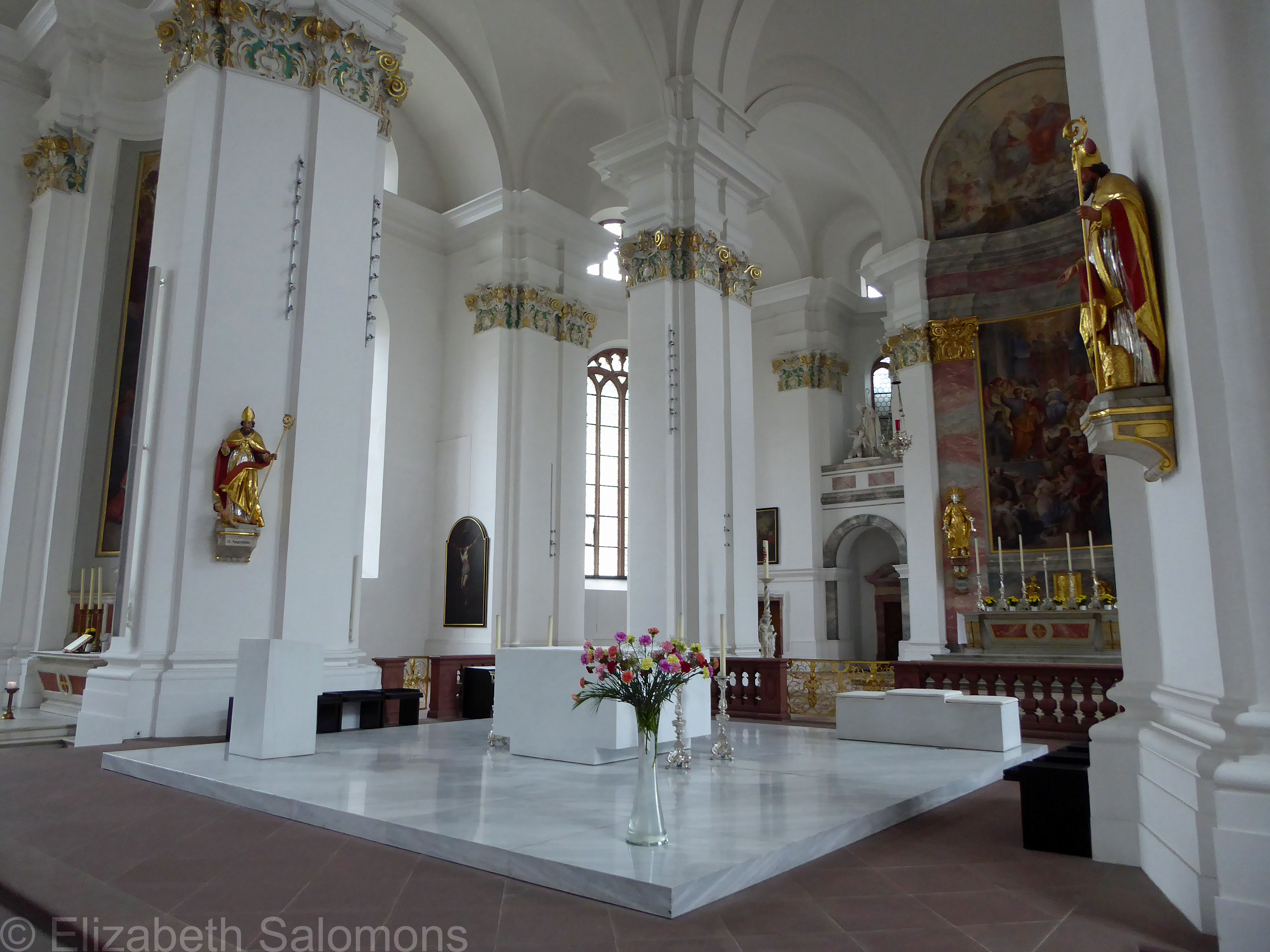
Jesuitenkirche, Heidelberg, September 2017
Through My Lens: Jesuitenkirche

For the past two Sundays, I posted photos of the Protestant Church that stands over the Old Town of Heidelberg. For today, Palm Sunday, I’m posting a photo of the Catholic Church that stands in the centre of Heidelberg’s Old Town. That would be the Jesuitenkirche (Jesuit Church).
This church, built in the Baroque style, was constructed in fits and starts throughout the eighteenth century. The Jesuits began the process in 1712, with the Elector Palatine at the time, Johann Wilhelm II, donating the land. The stone came from the Heidelberg Castle and the lumber from nearby forests. A bell tower (not seen in this photo) was added at the end of the nineteenth century.
After the Jesuit order was abolished in 1773, the church was taken over by the Lazarists. It later served as a hospital before eventually becoming the parish church of the local Catholic community in 1809.
Through My Lens: Inside the Heiliggeistkirche
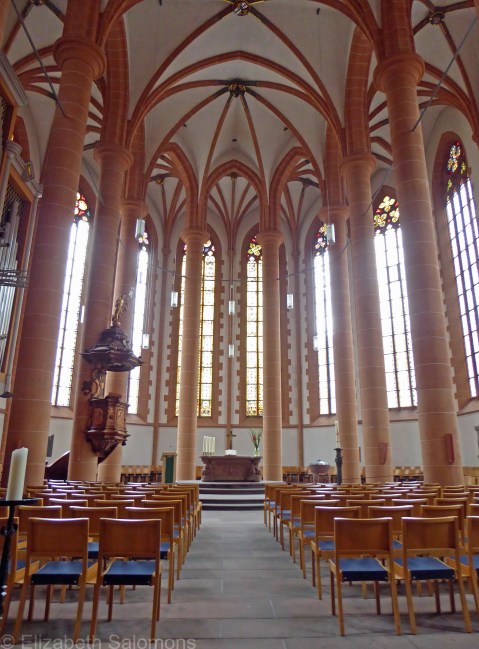
Last week I posted a photo of the Heiliggeistkirche in Heidelberg and today, for the Fifth Sunday of Lent, I’m posting a photo of what it looks like on the inside. That pink sandstone you see is from the Neckar Valley; it was used to build much of Heidelberg’s Old Town.
Like many churches in northern Europe, the Heiliggeistkirche was originally Roman Catholic. Today it is Protestant, but for much of its history, a wall divided the nave from the chancel and a second altar was built in the centre of the church. That way, the church could accommodate both Catholic and Protestant worshippers. The wall was not removed until 1936.
Through My Lens: Heiliggeistkirche

It’s the Fourth Sunday of Lent, and we’re moving on to Heidelberg. The skyline of this city in the Neckar Valley would not be the same without the Heiliggeistkirche (Church of the Holy Spirit). Built in the fifteenth century, this Romanesque and Gothic church is the largest in Heidelberg and stands high above the Old Town. It is one of the most-visited churches in Germany.
Through My Lens: Schlosskirche

For the Third Sunday of Lent, I’m posting a photo from inside the Schlosskirche (Castle Church) in Wittenberg. I’ve written about this church before, in connection with that revolutionary–reformer, Martin Luther.
A chapel has stood on this site since 1340. Between 1490 and 1511, a church in the Late Gothic style was built, attached to the castle just beside it. (Hence, the name.) That castle was the home of Frederick III, Elector of Saxony at the time. Both Frederick (also known as Frederick the Wise) and Martin Luther are buried in the church.
The Schlosskirche was destroyed during the Seven Years’ War in 1760, but later rebuilt. The doors that memorialize Martin Luther’s 95 theses were dedicated in 1858 and the church has been on the UNESCO World Heritage List since 1996.
Through My Lens: Kaiser-Wilhelm-Gedächtniskirche

Fourteen years after my first visit to Germany, I was back. Once again, I was hopping on and off trains, but this time I was on a European walkabout with my dad.
Two significant events took place between my first two trips to Germany. The first was the fall of the Berlin Wall and the second was the reunification of Germany. My dad and I stopped for just two nights in Berlin, so my impressions of the city are fleeting, but one image stayed with me. That would be the long line of construction cranes where a string of building projects were madly underway to fill the space where the Wall used to exist.
Another image that struck me was the Kaiser-Wilhelm-Gedächtniskirche (Kaiser Wilhelm Memorial Church), located in the centre of what used to be West Berlin. A church was first built on this site in the late nineteenth century. The kaiser at the time, Wilhelm II, named the Neo-Romanesque building after his grandfather, Kaiser Wilhelm I.
After being badly damaged during World War II, a new church was constructed, but the remnants of the original building were left as a memorial to the devastation of war. The photo above shows the original spire behind the bell tower of the new church.
The Kaiser-Wilhelm-Gedächtniskirche is my photo choice for today, the Second Sunday of Lent.
Through My Lens: Kölner Dom

A lifetime ago, when I was planning my first European walkabout, I went to a travel agent (remember those?) and came home with a bunch of pamphlets from those companies that offer multi-week tours of Europe. My travel partner and I were not in any way interested in joining an organized tour, but I did want to have in my head some kind of rough itinerary before we left Canada and started hopping on and off trains.
As I flipped through the pamphlets, I came across a photo of the Kölner Dom (Cologne Cathedral) from across the Rijn River, similar to the photo shown above. What a stunning cathedral, I thought. I have to see it in person. (This would not be the only time I made a choice regarding travel based solely on a single photo, but it may have been the first.)
It turned out that passing through Cologne was already in the works. My friend and I had agreed to plan our time in Germany around a two-day Rijn cruise included with our Eurail pass, and that cruise began in Cologne.
As you see, I got my photo.
Construction of the Kölner Dom began in 1248 but wasn’t completed until 1880, due to a several-centuries’ long stoppage of the building work. This Gothic cathedral is the tallest twin-spired church in the world. My friend and I climbed one of those spires and though my knees were protesting for days afterwards, I remember that the climb gave us a bird’s-eye view of some of the damage the cathedral suffered during World War II. I later learned that the city of Cologne was pretty much flattened; only the cathedral (miraculously) survived the bombardments. It is now on the UNESCO World Heritage List.
I took you on a tour of the Aachener Dom for last year’s Lenten series. This year, I’m staying in Germany, and the Kölner Dom is my photo choice for today, the First Sunday of Lent.
Happy Easter!

Aachener Dom, Aachen, September 2017
Through My Lens: Aachener Dom Pulpit

I’m by no means a short person, so judging by the angle from which I took this photo, my best guess is this pulpit is at least ten feet off the floor of the Aachener Dom. Quite an imposing perch from which to preach a sermon or read from the gospels.
The pulpit is sometimes referred to as the Ambon of Henry II. Ambon simply means pulpit. Henry II was another of the Holy Roman Emperors, who ruled from 1014 to 1024, some two hundred years after Charlemagne.
The pulpit is just to the right of the altar of the Aachener Dom and is my photo choice for today, Palm Sunday.


 There and Back Again