
The Glenbow
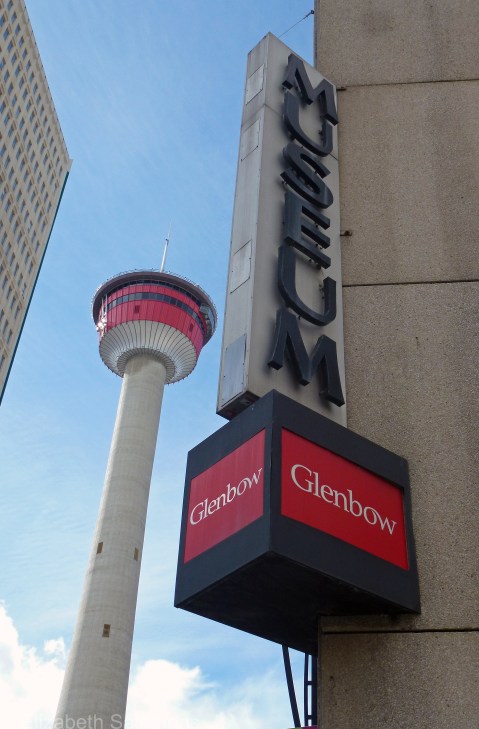
Calgary’s got yet another thing going for it, and that’s the Glenbow. The Glenbow is an art and history museum I’ve long heard about because it’s not just a museum, it’s also a library and archive. Archives are like crack for historians, and the Glenbow is Canada’s largest non-governmental archive.

Those archives contain unpublished diaries, letters, and minute books of thousands of Alberta families, organizations, and businesses. Its library has more than 100,000 books, pamphlets, journals, newspapers, and government documents related to the history of Western Canada. And its image collection includes photographs, posters, and cartoons that tell the story of the Canadian West from the 1870s to the 1990s.
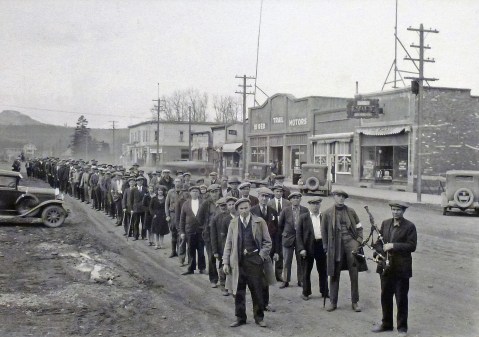
Whew! Makes me want to go research a book!
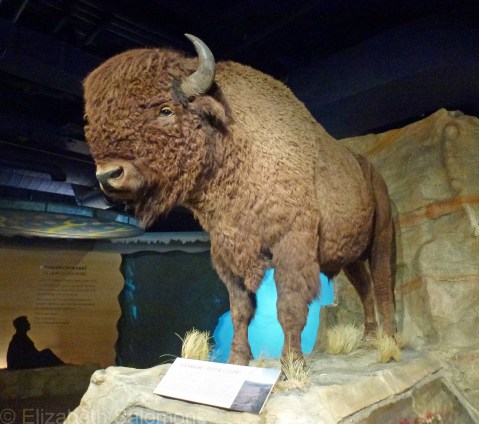
What the Glenbow Museum does particularly well is tell the story of southern Alberta, including its first peoples.

It also has a permanent exhibit with the unlikely title of Mavericks: An Incorrigible History of Alberta. It’s about some of the famous (and infamous) Albertans who shaped the province’s history over the past 150 years. Did you know the fellow who discovered oil in Leduc in 1947 ― that would be Ted Link who worked for Imperial Oil ― was told by his head office in Toronto to stop drilling? Head office had given up on the search for oil. Mr. Link, convinced that the entire province was lying on a bed of sedimentary rock (a possible source of hydrocarbons), pretended he hadn’t received the order. Two days later, Leduc No. 2 blew in and changed the course of the province’s history.
Want to learn about more stories like this? Be sure to stop in at the Glenbow the next time you’re in Calgary.
The Cloisters
As you may have, um, noticed from this year’s Lenten series, I’m rather partial to cloisters. The simple truth is: I just can’t get enough of them.
So, given my love of cloisters, why were my expectations of The Cloisters ― a branch of New York’s Metropolitan Museum of Art ― so low? I didn’t bother to make the trek all the way to Fort Tryon Park until my fourth visit to New York; even then, I debated whether or not to make the effort. (Though, in the end, I was glad I did as I decided the park alone is worth a visit. As you can see here.)

The thing is, I’d always been under the impression that the buildings that make up The Cloisters are all reconstructions. Purist that I am, I figured since I’ve seen many a real cloister ― in France, and Spain, and Italy ― why would I want to see a mere imitation?
Turns out I was completely misinformed. The Cloisters aren’t reconstructions; they’re the real deal. (And let that be a lesson to me: I didn’t do my homework before dismissing The Cloisters and almost passed on what is a marvellous opportunity for anyone in the vicinity of New York who cannot get themselves over to Europe.)

The Cloisters had its origins in the private collection of American sculptor George Grey Barnard, who lived in Paris for more than a decade in the late nineteenth century. In the decade before World War I, he got into the habit of collecting and bringing home with him pieces of medieval architecture from French villages. John D. Rockefeller bought the collection from him in 1925, and later donated it to the Metropolitan Museum of Art. Rockefeller also donated to the city of New York the land that now makes up Fort Tryon Park.

Open to the public since 1938, the museum is a chronologically arranged ensemble of remnants from five French abbeys: Saint Michel de Cuxa, Saint Guilhem le Désert, Trie-sur-Baïse, Froville, and Bonnefont-en-Comminges. In addition to the buildings, there are more than 2000 works of art, including illuminated manuscripts, stained glass windows, and tapestries.
Here, take a look.


If medieval history is your thing, I highly recommend a visit to The Cloisters.
As for me, I can’t wait to go back.

Happy Birthday, Ringstrasse!
I’ve had Vienna on my mind for much of the past few months ― and not only because I recently posted about Salzburg.
It all began with Frederic Morton’s A Nervous Splendor: Vienna, 1888–1889. The book was required reading for my Modern Europe history course a couple of decades ago, and I enjoyed it so much that I later bought Morton’s other book about Vienna: Thunder at Twilight: Vienna 1913–1914.
And then promptly packed both books in a box for one of my (many) moves.
This winter I finally got around to pulling both books off the shelf. I reread A Nervous Splendor and then, for the first time, I read Thunder at Twilight. (I’m about three-quarters of the way through the latter at the moment.) A Nervous Splendor tells the story of the last few months of Crown Prince Rudolph’s life and his suicide, while Thunder at Twilight tells the story of the last few months of Archduke Franz Ferdinand’s life and his murder. Both men were heirs to the Austrian-Hungarian throne until their untimely deaths. The suicide of Rudolph was the beginning of the end for the Austrian-Hungarian empire, and the assassination of Franz Ferdinand in Sarajevo on June 28, 1914 ― we all know what happened after that ― was the nail in the empire’s coffin.
Both non-fiction books read like novels, and both are useful if you want to learn something about the waning decades of nineteenth-century Vienna and the city’s role in the build-up to World War I.
(Coincidentally, I found out just a few days ago that Frederic Morton, an Austrian-American writer, died two weeks ago in Vienna.)
In addition to my Viennese reading, I recently enjoyed Vancouver Opera’s performance of Johann Strauss’s Die Fledermaus, which transported me to 1870s Vienna, if only for a few hours.
And a couple of weekends ago, I saw Woman in Gold, a Hollywood film that far surpassed my expectations, which tells the story of an Austrian-Jew who took the Austrian government to court to get back the paintings stolen from her family by the Nazis.
All of this adds up to an awful lot of Viennese armchair travel. And, except for my reading of the Morton books, all of it was unintentional.
But unintentional armchair travel is a good excuse for posting about Vienna.
Vienna was one of the cities I hit on my first European walkabout by Eurail. Initially I found it rather overwhelming; my travelling companion was ready to leave almost as soon as we arrived.
But there is a spectacular majesty to Vienna that I came to respect before we moved on a few days later and I now think the city is too often overlooked. The seventh largest city in the European Union, sandwiched between Bucharest and Budapest, it gets far less attention from tourists than London, Berlin, Madrid, Rome, and Paris (aka Europe’s Big Five).
At the heart of Vienna’s majesty is the Ringstrasse ― a 5 km ring of boulevards that forms a semicircle through the heart of Vienna. Emperor Franz Joseph I, father of the above-mentioned Crown Prince Rudolph and uncle of the above-mentioned Franz Ferdinand, was much influenced by Napoleon III’s demand that Paris be transformed by Baron Haussmann. In 1857, Franz Joseph ordered that Vienna’s decaying walls be torn down and replaced with a series of grand new buildings.

The Burgtheater was completed in 1888.
And so began one of the largest construction projects ever completed in Viennese history: neo-Gothic, Renaissance, Baroque, and Neoclassical buildings sprouted up along on the Ringstrasse over the next several decades. These include the Vienna State Opera, or Wiener Staatsoper (1869), the Votive Church, or Votivkirche (1879), the Palace of Justice (1881), the Austrian Parliament (1883), the Town Hall, or Rathaus (1883), the University of Vienna (1884), the Imperial Court Theatre, or Burgtheater (1888), and the twin museums of Natural History, or Naturhistorisches Museum (1889) and Fine Arts, or Kunsthistoriches Museum (1891). Only the imperial palace, the Hofburg, is older than the Ringstrasse.
I initially started writing this post about Vienna because of all the recent happy coincidences I described above, but while doing my research, I discovered another happy coincidence: it was 150 years ago today, in 1865, that Emperor Franz Joseph I officially opened the Ringstrasse. Hence, the title of this post.
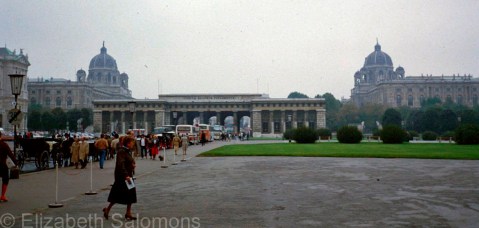
The Naturhistorisches Museum and the Kunsthistoriches Museum are mirror images of each other.
I think Franz Joseph was perhaps a tad premature in opening the Ringstrasse ― it would be some years before the construction of all those grand buildings would be complete and who wants to promenade past a noisy, dusty construction site? Not me and I speak from personal experience. But eventually the “Ring” was to become an enjoyable city promenade for Viennese and tourist alike ― as I learned during my first visit to the city ― and has remained so for 150 years.
All of the world’s large cities have ring roads, but only Vienna has a Ringstrasse.
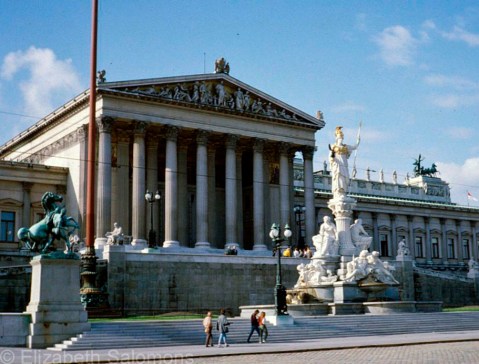
The Austrian Parliament Building is one of the largest buildings on the Ringstrasse.
Through My Lens: Cloister of Abbaye Saint Michel de Cuxa

For the Second Sunday of Lent, we’re hopping across the Channel to France. This photo is of the Cloister of Abbaye Saint Michel de Cuxa, a Benedictine abbey located in the French Pyrenees.
The abbey was built in 878, abandoned during the French Revolution, and restored to a monastic community in 1919. Its cloister dates back to the twelfth century, but many of the columns were removed in the early twentieth century by an American sculptor and are now on display at The Cloisters Museum and Gardens in New York.
I took this photo in November 2000. It was on this jaunt around southern France that I came to realize how much I value the beauty and the silence of monastic cloisters. I’ve been on a mission to photograph them ever since.
Chihuly Garden and Glass
A couple of posts ago, I mentioned that the Chihuly Garden and Glass alone was worth a visit to Seattle. I did not exaggerate: it is one of the most distinctive art installations I have ever seen.
The artist, Dale Chihuly, was born in Tacoma, Washington, in 1941. He studied at the universities of Washington and Wisconsin and at the Rhode Island School of Design, and in Venice, Italy, on a Fulbright. His work is exhibited in more than 200 collections all over the world.
If you ever get to Seattle, do not miss this unique gallery.
And, if you are still not convinced, here are a few more photos. (Just a few.)
Two Days in Seattle
 Now that I’ve told you how we got to Seattle, and how we got back from Seattle, you might be wondering what there is to do and see while in Seattle. The city, I was pleased to discover, is the perfect size for a weekend visit. It’s large enough that there’s something for everyone, but small enough that you don’t feel overwhelmed by all the choices.
Let’s start off with the architecture. Upon arrival, you can’t help but notice the Space Needle, a prominent landmark of Seattle’s skyline that was built for the 1962 World’s Fair. It’s impressive when you stand beneath it, but … well … not so impressive I wanted to pay money to go up it.

Never mind. At the base of the Space Needle is a building that did impress me enough to want to pay the admission fee. That would be the EMP Museum, designed by Toronto-born architect Frank Gehry. The building’s deconstructivist style is just so fun to look at, and so shiny and colourful and fluid that you can’t resist reaching out your hand to touch the building as you walk by.

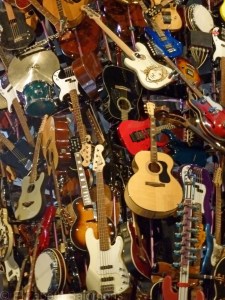 Inside the museum is even more fun, with exhibits more entertaining than I thought possible. Want to learn everything there is to know about Nirvana? It’s here. Jimi Hendrix? Him too.
The museum also has also some really cool artifacts from the world of fantasy and science fiction TV and film. As in: the Cowardly Lion’s costume, Susan Pevensie’s bow and quiver of arrows, Yoda’s staff, Darth Vader’s light sabre, Data’s uniform … they’re all here. Geekdom heaven, wouldn’t you say?
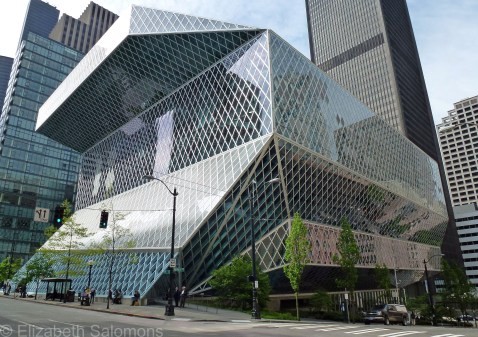
Seattle scored a second “starchitect”-designed building with the Seattle Central Library, designed by Dutch architect Rem Koolhaas. Don’t just walk around its exterior, though. Have a quick look inside too, taking the time to go all the way up to the top floor for a remarkable view over the atrium.
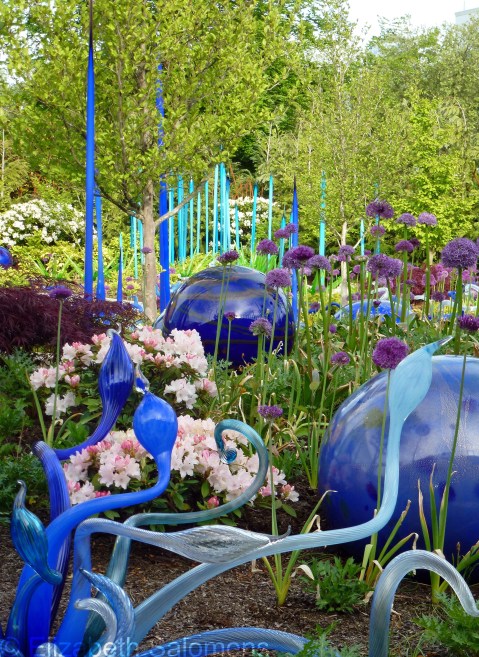
Once you’ve seen Seattle’s architectural highlights, I recommend checking out one of the most unique art installations I’ve seen anywhere: the Chihuly Garden and Glass. (It alone is worth a visit to Seattle.) The museum opened a year ago, so it’s rather new, and it’s rather extraordinary. Dale Chihuly is an American glass sculptor who creates exquisite works of blown glass. Photos don’t do his work justice, but, forgive me, I’ll post one anyways.
 A Seattle institution you shouldn’t miss is Pike Place Market, located near the downtown waterfront. In operation since 1907, it’s one of the oldest farmer’s market in the United States. Fresh local produce, seafood, and flowers are at street level, while the lower levels are filled with shops of all sorts, including bakeries, restaurants, clothing, and local crafts. Be sure to see the fishmongers in action as they throw the fish to each other before wrapping them up for the customer. Oh, and there’s a coffee shop in the market you may have heard of: Starbucks.
  Not just any Starbucks, though ― it’s the first ever one, which opened for business in 1971.
We stayed in Belltown, which turned out to be a great neighbourhood full of funky coffee shops, trendy restaurants, and lively bars. It is also conveniently located halfway between the downtown waterfront and Seattle Center (where the Space Needle, the EMP, and the Chihuly Garden and Glass are located).

One thing we didn’t have time for: a ferry ride across Elliott Bay. And there are dozens of other Seattle neighbourhoods I’m told are worth checking out. In other words? I plan to return for another weekend visit soon, because there’s lots more of Seattle to see.

The National Museum of the American Indian
In my post the other week on the Smithsonian, I mentioned how splendid the building that houses the National Museum of the American Indian is.
And then didn’t bother to post a single photo of the building.
I didn’t post any photos because I think the building is so impressive its photos deserve a blog post all their own.
If you’ve ever been to the Canadian Museum of Civilization in Gatineau, Quebec, you’ll recognize the architect’s work. Both buildings were designed by Douglas Cardinal. Born in Calgary, Alberta, to a Blackfoot father and a mother of Métis and German origins, Cardinal’s designs are known for their curved lines and organic shapes.
I could photograph this building over and over again. Here, take a look.
The Smithsonian
I’m sure there are a lot of perks to being First Lady of the United States of America, but there are also (in my opinion) a few downsides as well. For one thing, they don’t let you keep your clothes.
This, I discovered last summer when I spent a couple of days exploring the Smithsonian. That beautiful ivory silk chiffon gown designed by Jason Wu that Michelle Obama wore to the 2009 inaugural balls? It’s sitting in the National Museum of American History. And the ruby-red velvet and chiffon gown (also by Jason Wu) that she wore exactly a week ago today is designated for the National Archives. (How is it I know the name of Michelle Obama’s designer, you ask? Let’s just call it an occupational hazard of my day job.)
The National Museum of American History is just one small part of the Smithsonian. James Smithson, a British scientist, bequeathed his estate to the United States for the founding at Washington DC of the Smithsonian Institution, which he envisioned as “an Establishment for the increase & diffusion of knowledge.” After much discussion by politicians as to what such an Establishment might look like (a museum? a library? a university?), they settled on a museum, and the Smithsonian was established in 1846.
The Smithsonian Institute Building, commonly referred to as “The Castle,” was completed in 1855. The earliest collections, many of them donated by wealthy philanthropists, were first displayed here, but today it contains all of the administrative offices of the Smithsonian.

The Smithsonian Castle on the National Mall
I imagine it takes quite a bit of administrating. That’s because the Smithsonian isn’t your average museum ― it’s nineteen museums and galleries, and a zoo. Two are located in New York City, and the rest are in the DC area, with eleven of them scattered along the National Mall. And the best part? Admission to all of them is free. I managed to hit a grand total of three museums in two days. Even that was pushing it.
The National Museum of the American Indian is located in a splendid-looking building designed by Douglas Cardinal. It opened in 2004, and is the first American museum dedicated exclusively to the history of Native Americans. The exhibits are divided into four areas: Our Universes (Native beliefs), Our Peoples (Native history), Our Lives (contemporary Native life), and Return to a Native Place (Native peoples of the Chesapeake region). My time here was short, and I limited myself to a temporary exhibition entitled A Song for the Horse Nation ― an exhibit about how horses changed the lives of Native peoples. I’d like to go back and explore this museum some more.

My next stop was the National Museum of American History.

My goal here was simple: to see Julia Child’s kitchen. I succeeded by the skin of my teeth. The exhibit was in the process of moving and had been closed for months, but the museum opened up a temporary display for two weeks just for the 100th anniversary of Julia Child’s birth. Those two weeks overlapped with my visit ― did I luck out or what?

Julia Child’s kitchen

Julia Child’s pots and pans
Also on display at this museum is the original Star-Spangled Banner ― the one that inspired Francis Scott Key to write the American national anthem after witnessing the bombardment at Fort McHenry by the British during the War of 1812. It’s massive, very old, and looks its age.

Entrance to the Star-Spangled Banner exhibit
The exhibit on the American Presidency exhibit was particularly popular.

The Smithsonian has a nickname: “the nation’s attic.” Judging by some of the artifacts passed on to the museum by former US presidents, it’s easy to see why.

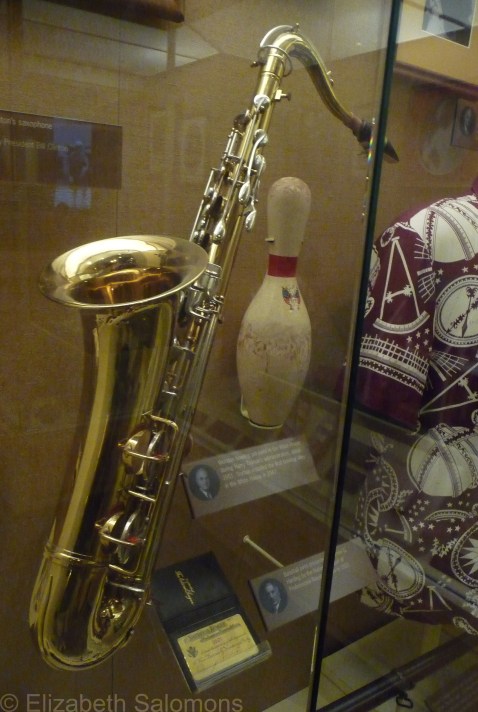
Bill Clinton’s saxophone
I was a bit creeped out by the top hat Abraham Lincoln was wearing the night he died, until it occurred to me that he probably wasn’t actually wearing it when he was shot, since he was indoors at the time.
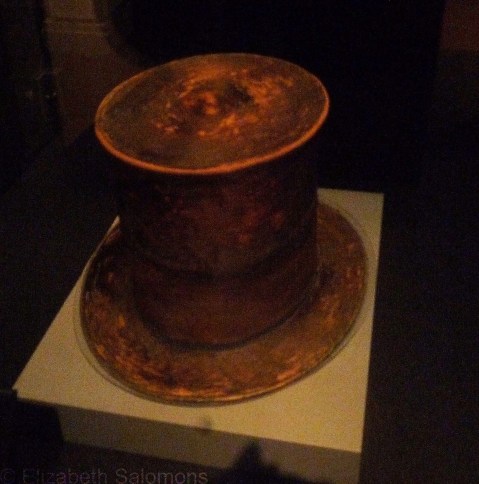
The hat worn by Abraham Lincoln the night he was assassinated
But the most popular exhibit? It was the one called, simply, The First Ladies. It included an impressive display of White House china, and display case after display case of gowns and dresses worn by the first ladies, including that Jason Wu gown worn by Michelle Obama I was talking about earlier.

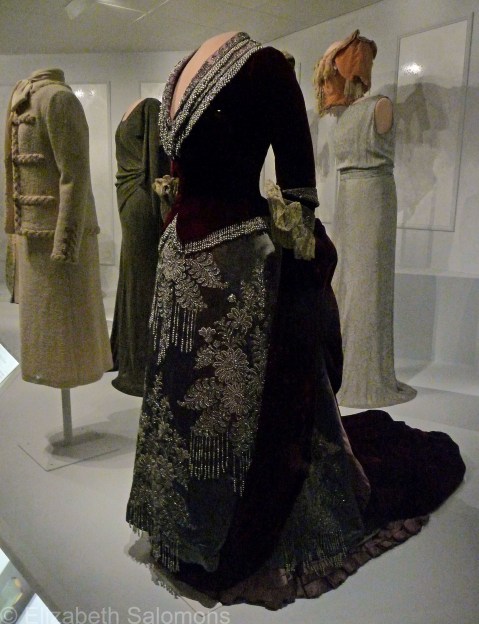
From left to right: suit worn by Nancy Reagan at the 1980 Republican National Convention, evening gown worn by Lou Hoover, evening gown worn by Caroline Harrison, and Eleanor Roosevelt’s 1933 inaugural ball gown

Michelle Obama’s 2009 inaugural ball gown

Mary Todd Lincoln’s china

A charred piece of wood from the White House, burned in 1814 by the British, and a painting of George Washington saved by Dolley Madison from the invading British soldiers
My last stop was the National Air and Space Museum.
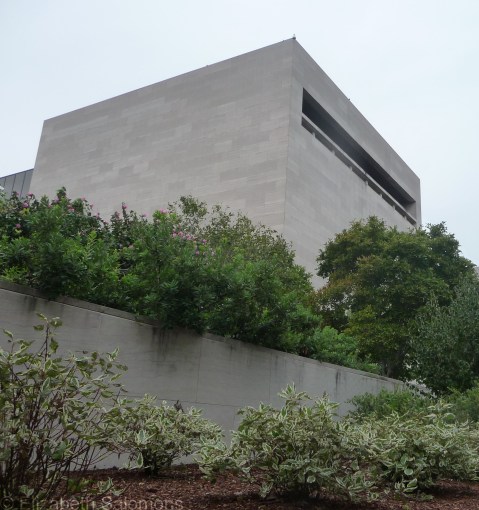
I lasted barely an hour here as it was extremely crowded and filled with screaming children. But I saw everything I wanted to see, including the 1903 Wright Flyer, the Spirit of St. Louis, and the Apollo 11 command module, Columbia. If you have even a middling interest in either aviation or space travel, check this one out.
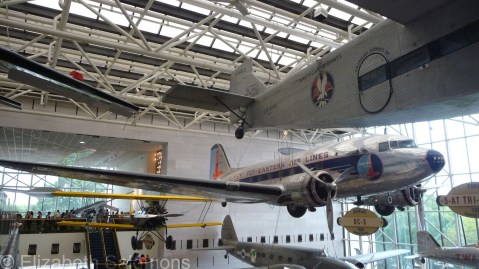
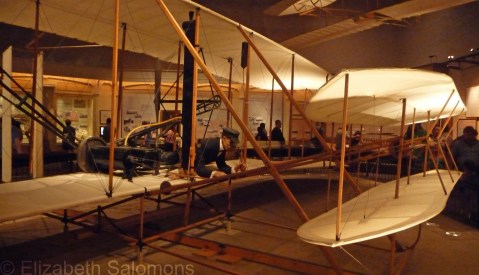


I didn’t get to any of the art galleries (there are seven), nor the Natural History Museum. I’d like to check out that zoo some day as well. The National Museum of African American History and Culture is under construction and is scheduled to open in 2015; I expect it will be fascinating.
The Smithsonian is included on most Top 10 Lists of the world’s best museums. No wonder ― it has something for everyone.
Seven Days in London

Last weekend I was out with friends who are busy planning a spring trip to England. I was pleased at how excited they are, and I had great fun answering their questions and throwing out suggestions of what I thought they had to see and do in London.
My brain kept churning after I said good-night to them, however, and by the time I arrived home I had another long list of must-sees and must-dos. At which point I said to myself, “Enough, already! There’s your next blog post half written.”
So, here it is: My ideal itinerary for a week in London.
Day 1: Direct flights from Vancouver to London arrive mid-day. Buy your Oyster card (more on that later) and take the Tube into central London. After check-in and a shower to wash the detritus of air travel off your body, set off for a few hours of sight-seeing. You’re jet-lagged, so find something simulating enough to keep you awake, but nothing too strenuous or that takes too much thought. A couple of summers ago, a friend and I zipped over to St. Paul’s Cathedral and went to Choral Evensong on our arrival afternoon. The services are held daily at 5 p.m.; for me, personally, there’s nothing more English than choral music at St. Paul’s.
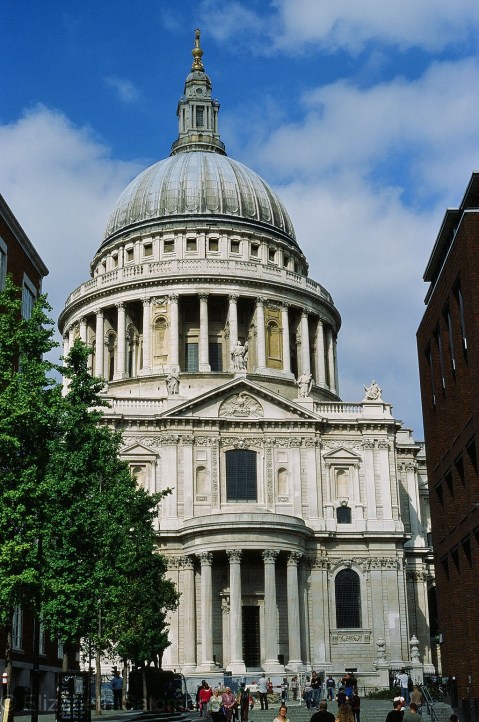
St. Paul’s Cathedral
Or, if the weather is cooperating, take a walk through one of London’s beautiful parks to stretch your legs after the long flight. St. James’s Park and Green Park are beautiful, and from either park you can catch your first glimpse of Buckingham Palace. By this point, the fact that you are in London should start to feel very real.
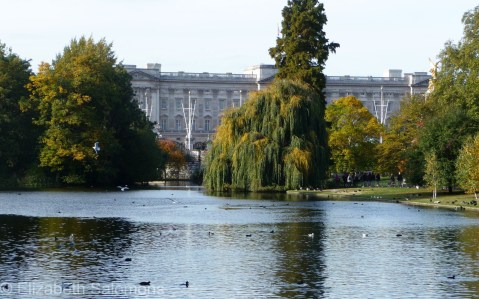
Buckingham Palace from St. James’s Park
Day 2: My friends will be in London too early to see Buckingham Palace as it’s open to the public in the summer months only. But Changing the Guard in the Palace’s forecourt takes place every second morning in the winter and daily in the summer. If you want to see this colourful ceremony, I have two words for you: Go Early. And if the crowds are too much for you, walk over to the Horse Guards Parade where you can watch a smaller change ceremony, or stake a spot anywhere along the Birdcage Walk to see the regiments as they pass by on their way to or from Buckingham Palace.
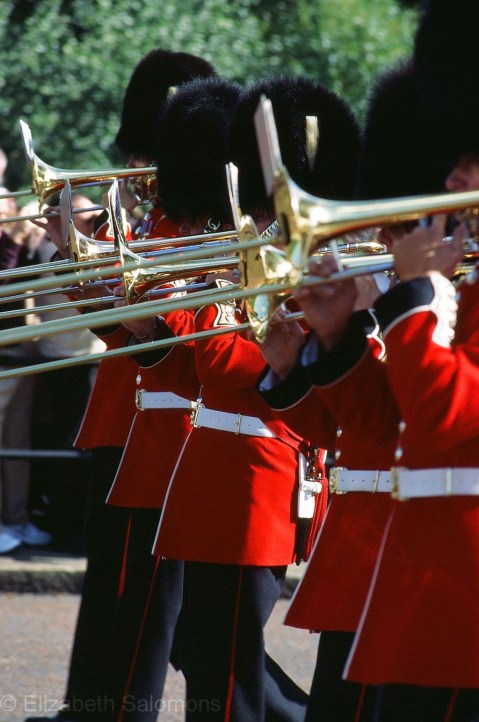
Changing the Guard at Buckingham Palace
In the afternoon, check out an art gallery. All of the major ones have free admission, so duck in and out of them throughout the week according to your mood. My advice, after you’ve decided on which gallery to go to (there are enough to suit any taste), is to choose a wing to focus on ― that’s plenty of viewing pleasure for one afternoon.
Bear with me now, as London has some heavyweights. The National Gallery houses Western European paintings from the 13th to early 20th centuries. The National Portrait Gallery is the British portrait collection from the 16th century to current day, and Tate Britain focuses on British art from the same period. (It has a particularly fine collection of works by J.M.W. Turner.) Tate Modern holds international modern and contemporary art.
If spending an afternoon looking at art is not your cup of tea, then I recommend the Churchill War Rooms located at the opposite end of St. James’s Park from Buckingham Palace. The museum is inside the actual bunker used by the British government during World War II.
Day 3: By now, your internal clock should be adjusted to Greenwich Mean Time, so you’re ready for a heavy day of sight-seeing. Buy your tickets online to avoid the long queues at the Tower of London, the highlight of which is the collection of Crown Jewels. I was 13 years old when I last saw the jewels, but I still remember how dazzling they were.
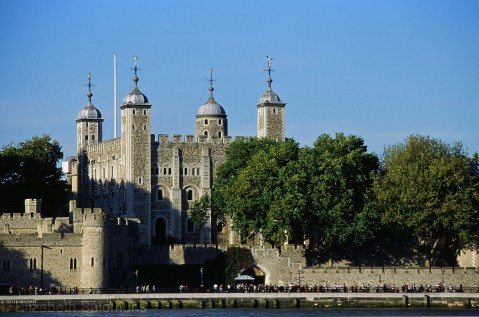
Tower of London
When you are finished touring the Tower, cross Tower Bridge and take a long walk along the South Bank of the Thames. You might stop for lunch at the many outdoor terraced restaurants. Or, treat yourself to a splendid meal at the top of the Tate Modern where you have a million-pound view of the Millennium Bridge and St. Paul’s.
Once fortified, continue walking until you reach the London Eye. If you are keen to get up high for a good view, this is the best there is. It’s pricey, but it will help you get your bearings if you’re still trying to orientate yourself in this massive city.
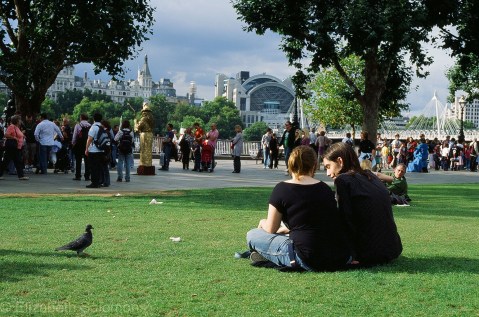
Charing Cross Station from the Jubilee Gardens on the South Bank
Day 4: If you enjoy museums, then the world’s your oyster in London. Again, they are all free admission. Head to the British Museum in the heart of Bloomsbury if history’s your thing, and don’t miss the Elgin Marbles on the main floor, just off the Great Court. When you are all mummied out, take a walking tour of what might be the most literary neighbourhood in the English-speaking world and see where Virginia Woolf lived and where T.S. Eliot worked as an editor.
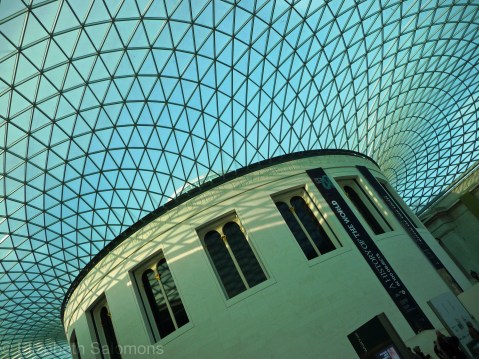
Great Court of the British Museum
For more recent history, go to the Imperial War Museum. Walk to the Thames afterwards for a photo op of the Houses of Parliament. Once there, you’re just around the corner from Westminster Abbey. Both are open to the public.

Houses of Parliament
And if art and design are where your interests lie, you need to be at the Victoria and Albert Museum. Post-V&A, enjoy everything Hyde Park has to offer: Speaker’s Corner, the Albert Memorial, and the Diana Memorial Fountain are all within this vast park.
Day 5: It’s time for an excursion. Windsor, home of Eton College and Windsor Castle, is an hour from London by coach or train. Greenwich is closer and also offers a full day of sightseeing including the Royal Observatory, the National Maritime Museum, and the Old Royal Naval College, all situated in beautiful Greenwich Park. The Royal Observatory is the home of Greenwich Mean Time and the Prime Meridian (longitude 0° ― for those readers interested in this sort of trivia).

Old Royal Naval College at Greenwich
Day 6: If you find the big museums and galleries too intimidating, then take a day to check out some of the smaller ones. I can recommend Keats House in Hampstead, where the Romantic poet John Keats lived from 1818 to 1820, after which you must take a turn on Hampstead Heath. There’s also the Handel House Museum, where the composer lived from 1723 until his death in 1759, or the Sherlock Holmes Museum at ― you guessed it ― 221B Baker Street.
These last two museums are near Oxford Street. If you’re interested in a bit of shopping, this is where you want to be, but be aware that Oxford Street on a Sunday afternoon is as busy as any North American mall in December. Charing Cross Road is the street for bookstores, Portobello Road for antiques, and Camden Market is where you’ll find that one-of-a-kind souvenir to bring home to your kids.

Shops on Portobello Road
Day 7: Your last day! I’m sure there’s something on your list you still haven’t gotten to, so this is your chance to squeeze it in.

Westminster Abbey
Wondering what to do in the evenings? If you’re into theatre, be sure to check out the board at the half-price ticket booth in Leicester Square. The deals are great, and the acting in London’s West End is the best I’ve ever seen. I still get goose bumps when I think of the mesmerizing performance I witnessed of Derek Jacobi, Trevor Eve, and Imogen Stubbs in Chekhov’s Uncle Vanya, which I watched from the front row of the Albery Theatre on St. Martin’s Lane. Or, bring back memories of your high-school English classes by taking in a play at Shakespeare’s Globe, the modern reconstruction of the original Globe Theatre.
My friend’s husband is a jazz musician, so they’ll be checking out some jazz clubs. Another option for live music is the opera; tickets to the Royal Opera House at Covent Garden are a bargain at £9 if you don’t mind sitting in the upper slips (and aren’t afraid of heights!). Book your tickets online before you leave home. Or find something you’re interested in hearing at Royal Albert Hall, if only to get a look at the inside of this magnificent concert hall.

More than 5000 Brits belting out “Land of Hope and Glory” in Royal Albert Hall
A suggestion to help you save money on transit: buy an Oyster Card to use on London’s Underground. They are valid on both the Tube and the buses, and are much cheaper than buying individual fares. And remember, although the Tube is faster, nothing beats seeing London from the top of a double-decker bus. The Heritage Routemaster service (Route 15) is a fun way to get from Trafalgar Square to the Tower of London.

One of London’s iconic double-decker buses
So there you have it: my ideal itinerary for a week in London. One last bit of advice: leave something on your to-do list to make sure you come back. Because London is a city that requires repeat visits.

Nelson’s Column and fountains in Trafalgar Square


 There and Back Again