
Live at the Met

One of the reasons I wanted to spend a long weekend in New York last December was so I could strike one off my bucket list.
That one would be attending the Metropolitan Opera at the Lincoln Center for the Performing Arts.
Here’s a pro-tip: If you’re going to go see the Metropolitan Opera at Lincoln Center, take along a native New Yorker. And here’s another: If you’re going to go see Nabucco by Verdi, take along an Italian.
I was lucky enough to get to do both.
My New Yorker friend and I made plans to meet for dinner across the street from Lincoln Center. And so, after a long day of sight-seeing, I made my way uptown, making sure to leave myself plenty of time to pick up our tickets from the Will Call window, and so I could take some photos. But I was taken aback when I saw the playbills outside Lincoln Center.

“Plácido Domingo is singing tonight,” I told my friend when she arrived at the restaurant. I had paid absolutely no attention to who was performing when I had purchased the tickets online some months before.
“He’s directing,” she told me. “He doesn’t sing anymore.”
“Oh,” I said. Well, that made sense. Slightly deflated, I gave myself a shake. What did it matter who was performing? I was in New York City and I going to the opera.
But after we made our way across the street to Lincoln Center, walked up the grand staircase, found our seats, and opened our programs, we soon realized our mistake. Plácido Domingo was performing, in the title role. And conducting was the legendary James Levine. We were in for a memorable, you might even say, historic evening.

Over dinner, my friend had told me about the political significance of Nabucco for Italians. Composed in 1841, it was Giuseppe Verdi’s third opera and his first big hit. But he almost never wrote it.
While Verdi was composing his second opera, his wife died, only a few years after their two young children had died. The opera bombed. Devastated, Verdi declared he was done composing.

But a friend persisted in showing Verdi a libretto he thought was worth a look. It was about the Jews after they were conquered and subjugated by the Babylonian King Nebuchadnezzar II (in Italian, Nabucco). Verdi’s attention was caught by a single line of text in the libretto, “Va pensiero, sull’ ali dorate” (“Fly, thought, on golden wings”). This line, inspired by Psalm 137 (“By the rivers of Babylon we sat and wept”), became the Chorus of the Hebrew Slaves.
And that chorus, my friend told me, became a rallying call for the oppressed Italians during the unification of Italy. Many consider the chorus to be an unofficial Italian anthem that lamented how the Italian people were occupied by other forces (namely, the Austrians) on Italian land. The Italian audiences would cheer and holler until the opera companies repeated the chorus as an encore.

Which is also what happened that night not four weeks ago when my friend and I heard Nabucco performed live by the Metropolitan Opera. In post-election America, the significance of the encore was not lost on us.
Nabucco was first performed by the Metropolitan Opera in 1960. The performance we saw was the 329th time that James Levine and Plácido Domingo had performed together, over a period 45 years. (And here’s a fun bit of trivia: none of the other soloists performing that night had been born when those two began their professional relationship.)
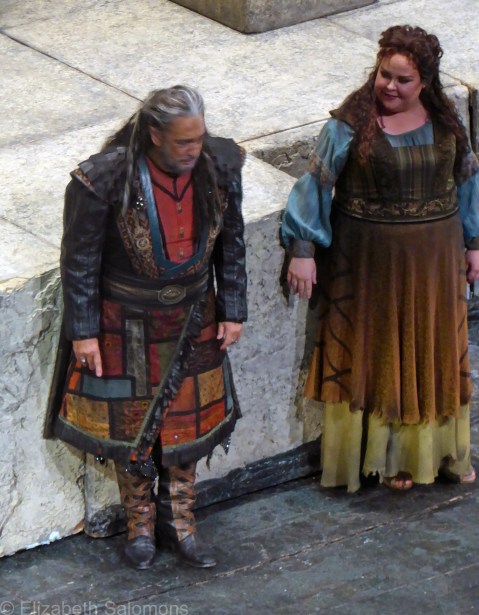
I’ve written before about how my love of opera intersects with my love of travel. What I had forgotten until I started writing this post was how it had been my mother who had introduced me to opera. She had an album of opera choruses and would play it, full volume, on our brand new component stereo. That album was my introduction to “Va pensiero, sull’ ali dorate,” and the tune has stuck in my head ever since.
Long before I began attending live opera performances, I used to listen to CBC Radio Two’s Saturday Afternoon at the Opera, which is a live broadcast of the Saturday matinee performances at Lincoln Center. I don’t know why I stopped listening to them, but today I made a point of tuning in.
This afternoon’s broadcast was Nabucco. Live from the Met. I closed my eyes as I listened to “Va pensiero, sull’ ali dorate” and was instantly transported back to New York. Not in body, obviously, but certainly in spirit.
I expect it will be that way every time I hear the chorus from now on. As I told a friend after I got back from New York, seeing Nabucco live at the Met was pretty much a religious experience for me. I don’t want that feeling to ever go away.

Happy Birthday, Ringstrasse!
I’ve had Vienna on my mind for much of the past few months ― and not only because I recently posted about Salzburg.
It all began with Frederic Morton’s A Nervous Splendor: Vienna, 1888–1889. The book was required reading for my Modern Europe history course a couple of decades ago, and I enjoyed it so much that I later bought Morton’s other book about Vienna: Thunder at Twilight: Vienna 1913–1914.
And then promptly packed both books in a box for one of my (many) moves.
This winter I finally got around to pulling both books off the shelf. I reread A Nervous Splendor and then, for the first time, I read Thunder at Twilight. (I’m about three-quarters of the way through the latter at the moment.) A Nervous Splendor tells the story of the last few months of Crown Prince Rudolph’s life and his suicide, while Thunder at Twilight tells the story of the last few months of Archduke Franz Ferdinand’s life and his murder. Both men were heirs to the Austrian-Hungarian throne until their untimely deaths. The suicide of Rudolph was the beginning of the end for the Austrian-Hungarian empire, and the assassination of Franz Ferdinand in Sarajevo on June 28, 1914 ― we all know what happened after that ― was the nail in the empire’s coffin.
Both non-fiction books read like novels, and both are useful if you want to learn something about the waning decades of nineteenth-century Vienna and the city’s role in the build-up to World War I.
(Coincidentally, I found out just a few days ago that Frederic Morton, an Austrian-American writer, died two weeks ago in Vienna.)
In addition to my Viennese reading, I recently enjoyed Vancouver Opera’s performance of Johann Strauss’s Die Fledermaus, which transported me to 1870s Vienna, if only for a few hours.
And a couple of weekends ago, I saw Woman in Gold, a Hollywood film that far surpassed my expectations, which tells the story of an Austrian-Jew who took the Austrian government to court to get back the paintings stolen from her family by the Nazis.
All of this adds up to an awful lot of Viennese armchair travel. And, except for my reading of the Morton books, all of it was unintentional.
But unintentional armchair travel is a good excuse for posting about Vienna.
Vienna was one of the cities I hit on my first European walkabout by Eurail. Initially I found it rather overwhelming; my travelling companion was ready to leave almost as soon as we arrived.
But there is a spectacular majesty to Vienna that I came to respect before we moved on a few days later and I now think the city is too often overlooked. The seventh largest city in the European Union, sandwiched between Bucharest and Budapest, it gets far less attention from tourists than London, Berlin, Madrid, Rome, and Paris (aka Europe’s Big Five).
At the heart of Vienna’s majesty is the Ringstrasse ― a 5 km ring of boulevards that forms a semicircle through the heart of Vienna. Emperor Franz Joseph I, father of the above-mentioned Crown Prince Rudolph and uncle of the above-mentioned Franz Ferdinand, was much influenced by Napoleon III’s demand that Paris be transformed by Baron Haussmann. In 1857, Franz Joseph ordered that Vienna’s decaying walls be torn down and replaced with a series of grand new buildings.

The Burgtheater was completed in 1888.
And so began one of the largest construction projects ever completed in Viennese history: neo-Gothic, Renaissance, Baroque, and Neoclassical buildings sprouted up along on the Ringstrasse over the next several decades. These include the Vienna State Opera, or Wiener Staatsoper (1869), the Votive Church, or Votivkirche (1879), the Palace of Justice (1881), the Austrian Parliament (1883), the Town Hall, or Rathaus (1883), the University of Vienna (1884), the Imperial Court Theatre, or Burgtheater (1888), and the twin museums of Natural History, or Naturhistorisches Museum (1889) and Fine Arts, or Kunsthistoriches Museum (1891). Only the imperial palace, the Hofburg, is older than the Ringstrasse.
I initially started writing this post about Vienna because of all the recent happy coincidences I described above, but while doing my research, I discovered another happy coincidence: it was 150 years ago today, in 1865, that Emperor Franz Joseph I officially opened the Ringstrasse. Hence, the title of this post.
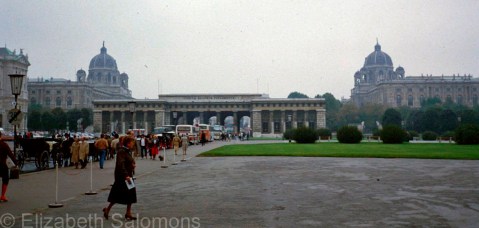
The Naturhistorisches Museum and the Kunsthistoriches Museum are mirror images of each other.
I think Franz Joseph was perhaps a tad premature in opening the Ringstrasse ― it would be some years before the construction of all those grand buildings would be complete and who wants to promenade past a noisy, dusty construction site? Not me and I speak from personal experience. But eventually the “Ring” was to become an enjoyable city promenade for Viennese and tourist alike ― as I learned during my first visit to the city ― and has remained so for 150 years.
All of the world’s large cities have ring roads, but only Vienna has a Ringstrasse.
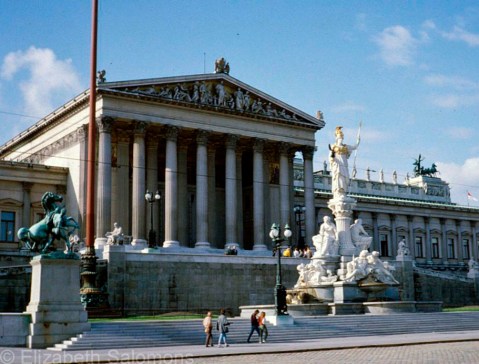
The Austrian Parliament Building is one of the largest buildings on the Ringstrasse.
Happy Birthday to The Sound of Music!

Fifty years ago last month, The Sound of Music had its cinematic release ― and “How Do You Solve a Problem Like Maria?” has been an earworm plaguing moviegoers ever since. I’ve lost count of how many times I’ve watched the film, but I have strong memories about a handful of viewings.
My first memorable viewing was, of course, the first one. It was on our small colour TV in our small family living room with my not-so-small family. I had to be coaxed into watching it ― for some reason, a movie about a not-so-small family in 1930s Austria did not interest me in the least.
My dad promised me I would love it.
Of course, I became an instant fan, besotted, as most kids are, by all those children in funny clothes and by all those catchy tunes.
Another memorable viewing of The Sound of Music was just last fall, when I had the privilege of introducing the film to my then three-year-old niece. She was captivated (if a bit confused) by the sight and sound of Mary Poppins singing “Do-Re-Mi” and her response when the last “So-Do” sounded was instantaneous.
“Again!” she commanded from her perch on my couch. I dutifully obeyed and rewound the film to the start of the song. When it was finished, she again called out, “again!”
You get the picture.
It took my sister, who arrived halfway through the movie, to do what I wasn’t able to ― convince my niece to continue watching past “Do-Re-Mi.” (Note that, being responsible aunts, we turned the TV off after the wedding scene and told her that was the end of the movie ― no need to traumatize a young child with scenes of goose-stepping Nazis.)
“The Lonely Goatherd” and “So Long, Farewell” proved to be big hits as well and that afternoon made me realize how timeless The Sound of Music is. My niece was just as enthralled with the film as I had been all those decades earlier.
My most recent viewing of The Sound of Music was a couple of weeks ago when I saw it for the first time ever on the big screen. I was shocked at the packed movie theatre ― as full as if the film were a new release ― and at how compelling I found the nearly three-hour film ― as if I were watching it for the first time. The entire audience burst into applause at the end.
But my most memorable viewing was in the city of Salzburg, where much of The Sound of Music was filmed. My friend and I were backpacking around Europe, making all the usual stops ― including Salzburg ― and doing all the usual touristy things ― including the obligatory “Sound of Music” tour of the filming locations. After the tour, we were dropped off at the youth hostel that hosted a daily screening of the film and we watched and laughed along with the rest of our tour group when all of the Salzburg locations we had just visited showed up on screen.
I live in Vancouver (aka Hollywood North) and am used to seeing my town turned upside down by film crews. For the past two weeks, one of the main routes out of the downtown core was closed to vehicle traffic during business hours to allow for the shooting of a scene from Ryan Reynold’s next action flick. Vancouverites put up with this kind of nonsense because we know how lucrative a successful film industry can be.
I suspect that the residents of Salzburg are just as OK with the tourist dollars that The Sound of Music has brought them. But my best guess is that none of them had any idea that the film would turn out to be one most commercially successful motion pictures of all time ― or that the hoards of pop-culture tourists such as myself would still be beating a path to their door some 50 years later.


Happy Birthday, Johann Sebastian Bach!
The Germans threw a party today in Eisenach, the birthplace of my favourite composer, Johann Sebastian Bach. That’s because today is Johann Sebastian’s 330th birthday. This house ― known as Bachhaus ― is a museum dedicated to the man; at one point, it was thought he was born here, although now it is believed that his birth house is no longer standing.

I visited this museum in 1998 with my dad. We were on walkabout through Germany and France and came to Eisenach because of the Martin Luther connection; the Bach connection was a bonus (for me).
What we didn’t realize until we arrived and were looking for a place to stay is that Eisenach is in the former German Democratic Republic (aka East Germany). Which meant no one in the town spoke English. I managed to get us a room by telling the woman at the tourist information centre that we wanted ein Zimmer, zwei Nächte (one room, two nights). She congratulated me on my, ahem, German.
But it got really comical the next morning when the owner at the pension where we stayed insisted on chatting to us throughout breakfast in German ― even after we told him we could not understand him. Dad had studied German a bit in college, but it wasn’t enough to help us out. The pension owner offered to speak to us in Russian, but we assured him that we understood even less Russian than German.
And so, Dad and I nodded politely at our host while we drank our coffee and ate our bread and cheese. He was a compulsive talker ― that much was obvious ― and eventually he resorted to sign language. We kept nodding.
By the time Dad and I left for our day of sightseeing, we were exhausted. Even so, it was the loveliest and friendliest of introductions to Eisenach.
The Chan Centre
When I was blogging about spectacular European opera houses last spring, it occurred to me that spectacular Canadian opera houses are few and far between.
No matter. We do have some spectacular concert halls.
This is a photo of the Chan Centre. Located on the Point Grey campus of the University of British Columbia, it was designed by the Vancouver-based architect Bing Thom. Its main concert hall is shaped like a cello and the acoustics are state of the art.
This time of year, the Chan looks particularly spectacular.

Through My Lens: Music in the Piazza

Shooting a memorable photo is often a matter of being in the right place at the right time. A good zoom lens doesn’t hurt either.
I took this photo in Venice’s Piazza San Marco in October 2007.
Palais Garnier
Here’s one last opera house before I turn the channel and move onto other topics. This is Opéra National de Paris, commonly known as Palais Garnier. “Garnier” was the name of its architect. “Palais” is for all the bling.

Palais Garnier is located at Place Opéra. Six major boulevards come together at Place Opéra, and there’s also a major metro station. In other words: there’s lots going on here.
And did I mention the bling on Palais Garnier? Here’s a closer look.

Vienna State Opera
Since I’ve been writing about some rather tenuous links between my travels and opera for the past month, I thought I’d rifle through my photos of opera houses.
And hey! Look what I found. This is the Vienna State Opera. (That’s “Wiener Staatsoper” in Austrian.)
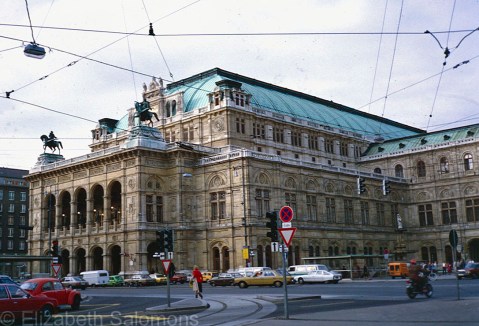
I’ve been debating with myself whether or not to post this photo as I don’t have a lot to say about this particular opera house. Other than I once took a tour of it. A very long time ago.
I like the photo, though. And I like the intersecting wires at the top of the photo. Usually I don’t like power lines in my photos, but they look all right here. I like the geometrical touch they add to the opera house. Appropriate, I think, since music is all about math.
Right. Enough with the tenuous links.
I read somewhere once that Vienna is London meets Paris. I can see it. Like London, Vienna was once the capital of a monarchy-ruled empire. It has that aura of imperialism that capital cities of empires tend to have. And, like Paris, it’s got those grand boulevards, which, I’d hazard a guess, were modelled after the ones that Haussmann built.
Royal Opera House
Regular readers of this blog may have figured out by now how much I enjoy listening to live music. And that I especially enjoy seeking out opportunities to hear live music whenever I travel.
I have my mother to thank for that. She took my sister and me at the tender ages of twelve and thirteen to hear a recital of Bach organ music in the Bovenkerk of Kampen, the Dutch town where we happened to be living at the time. The sounds of the organ’s principal pipes reverberating in the centuries-old Gothic arches high above us made quite an impression on me (as did how cold we got sitting in an unheated stone church on a crisp evening in late November).
Something about that night stuck with me and, to this day, Bach remains my favourite composer. So much of a favourite that I even named my cat after him. Upon our family’s return to Canada, I was motivated enough to continue my music studies for another six years, soon switching from piano to pipe organ. I doubt my mother had any idea what a couple hours of Bach organ music could do to me.
But enough about Bach. Let’s get back to the other guy. You know, Mozart. My post the other week on Mozart in Prague reminded me of another memorable opera experience I’ve had, this one of hearing Rossini’s The Barber of Seville at London’s Royal Opera House (aka Covent Garden).
I’ve written before how the opera at Covent Garden is completely within reach of the budget traveller, so, unless you really cannot stand opera (and I won’t hold that against you), there is no reason not to go. The website for the Royal Opera House is easy to use and the nifty thing about ordering tickets online is that you see the view of the stage you will have from the exact seat you’ve selected before you commit to your purchase. How cool is that?
What’s particularly fun about the cheap seats (once you’ve caught your breath from climbing waaaaaay up into the rafters of the building) is what a terrific view you have of a truly remarkable building. And ― bonus ― you have a bird’s-eye view of the performance. I witnessed the dramatic entrance of the barber (that would be the Barber of Seville) as he ran all the way down the aisle from the back of the auditorium to the stage ― something the people sitting at the front of the orchestra level missed because all the action took place behind them.
Sadly, I have no photos of the interior of Covent Garden ― that will have to wait until my next visit to London. Here, though, is a picture of its exterior, which dates back to 1858. I took this photo after stopping by the box office to pick up my ticket that I had purchased weeks earlier before leaving home. It was the last time I saw the beautiful, Italian-made leather wallet I had bought a few years earlier in Rome ― less than a half hour later, I would reach into my bag to realize it was gone.
But that’s a story for another post.

Through My Lens: Basilica di San Miniato al Monte

My experience visiting this church, the Basilica di San Miniato al Monte, was probably the most unique of any visit I have ever made to a European church. It was late in the afternoon, and my friend and I stumbled upon the basilica almost by accident after taking dozens of photos of the amazing view over the city of Florence from Piazzale Michelangelo. (Go back to the First Sunday of Lent if you want to see one of those photos.)
Basilica di San Miniato al Monte is located just a few steps further up the hill from Piazzale Michelangelo. We wandered in and were immediately overwhelmed by the music. Gregorian chant, to be precise. It was mesmerizing, and took all of our attention during our entire visit. The monks were singing in the crypt, located below the raised choir, and there were maybe a dozen tourists scattered about, listening to them.
I had read how the monks who live in the monastery next door sing each afternoon during Vespers, but had completely forgotten about it until we just happened to enter the church at precisely the right hour. If you’re wandering about Florence in the late afternoon and want a once-in-a-lifetime musical experience, go listen to these monks.
Basilica di San Miniato al Monte is my photo choice for today, the Third Sunday of Lent.


 There and Back Again