
Happy Birthday, Amsterdam!
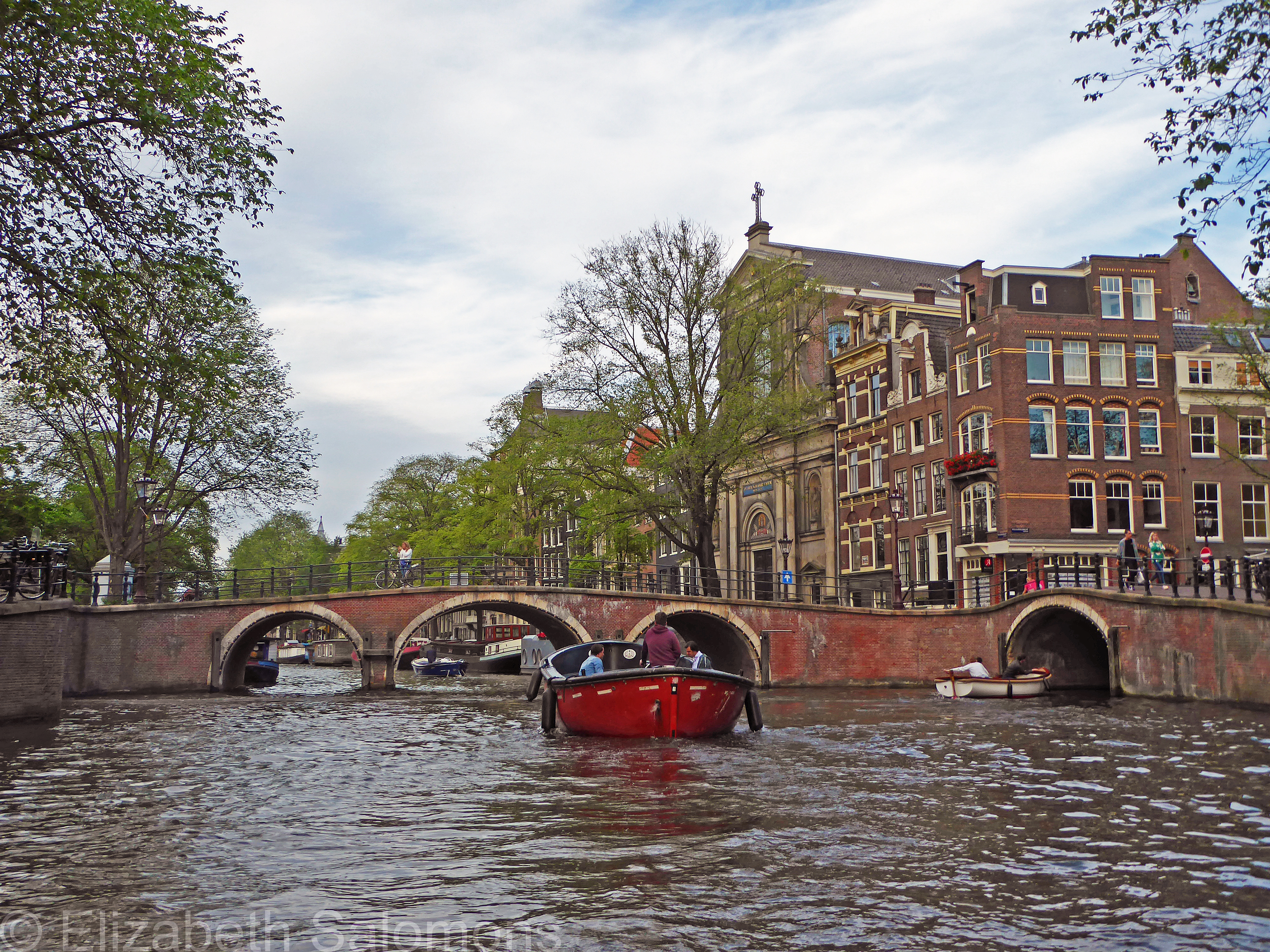
As far as European cities go, 750 years is rather young, but that’s how old Amsterdam is. And today marks the final day of a year-long celebration of the city’s milestone birthday.
The reason Amsterdam was settled later than other parts of the country and the continent is because it simply was not possible to build on the land until its water issues were resolved. After the Amstel River was dammed (hence the name: Amstel + dam), a fishing village was established. The first documents to register Amsterdam’s existence date back to 1275. By the seventeenth century, it was an economic powerhouse and centre of trade and finance — what’s known as the Dutch Golden Age.
I really came to know and appreciate the city during my summer in Amsterdam. Here’s hoping I get to repeat the experience again someday.
Farewell to the Hudson’s Bay Company
It has come time to say goodbye to the oldest joint-stock merchandise company in the English-speaking world. As of today, all of the Hudson’s Bay Company retail stores have closed their doors — forever.

I’m sad it’s come to this. I keep telling myself that the demise of a department store should probably be the least of my concerns in light of everything that’s going on in the world right now. But Canadians are feeling bruised, battered, and betrayed by the current American administration. Given the sense of patriotism and nationalism that is rising up in this country, at this moment in time, the loss of The Bay hits hard. The company holds a claim on Canada’s origin story in a way no other Canadian corporation does.
The Hudson’s Bay Company came into being on May 2, 1670, when King Charles II gave a Royal Charter to the Governor and Company of Adventurers of England Trading into Hudson’s Bay. It was set up as a commercial enterprise, but the company became the de facto government in many parts of Western Canada. James Douglas, first governor of the colonies of British Columbia and Vancouver Island, was also Chief Factor of the Hudson’s Bay Company. Most cities in Western Canada started out as HBC trading posts. I have vivid memories of school trips to Fort Edmonton Park with its full-sized replica of the HBC fort established on the banks of the North Saskatchewan River in 1795. The origin of the Métis Nation, one of three Indigenous peoples given legal recognition by Canada’s Constitution, is closely tied to the fur trade. Some of the first treaties with Indigenous peoples were signed by employees of the Hudson’s Bay Company.
The HBC coat of arms consists of two elks supporting a shield with a red cross and a beaver in each quarter. Above the shield sits a fox. The motto is Pro pelle cutem, which is Latin for “a pelt for a skin.” The beaver is now Canada’s national animal. The iconic point blanket, introduced in 1779, is called that because of its points — short black lines woven into the edge of the blanket just above the coloured stripes. The number of points indicates the size of the blanket.

A replica of an HBC trading post at the Glenbow in Calgary
After Confederation, the Canadian government negotiated with the Hudson’s Bay Company to purchase the vast land mass draining into Hudson’s Bay. Known as Rupert’s Land, it covered about a third of present-day Canada — what is now Manitoba, Saskatchewan, and Alberta, southern Nunavut and the northern parts of Ontario and Quebec. The company received payment as well as title to a portion of the land, including its trading posts. As such, Hudson’s Bay became a land developer in addition to being a fur trader.
The trade in furs lasted until 1987 when the northern trading posts were sold or closed. But over time, as the west was populated with European settlers, the company’s focus shifted from trading for furs to supplying settlers with the goods and tools they needed to homestead. It restructured itself into three divisions — land sales, fur trade, and retail — and opened the first of six stores in Calgary in 1913. Edmonton, Saskatoon, Vancouver, Victoria, and Winnipeg soon followed; the original six stores all have similar architecture.
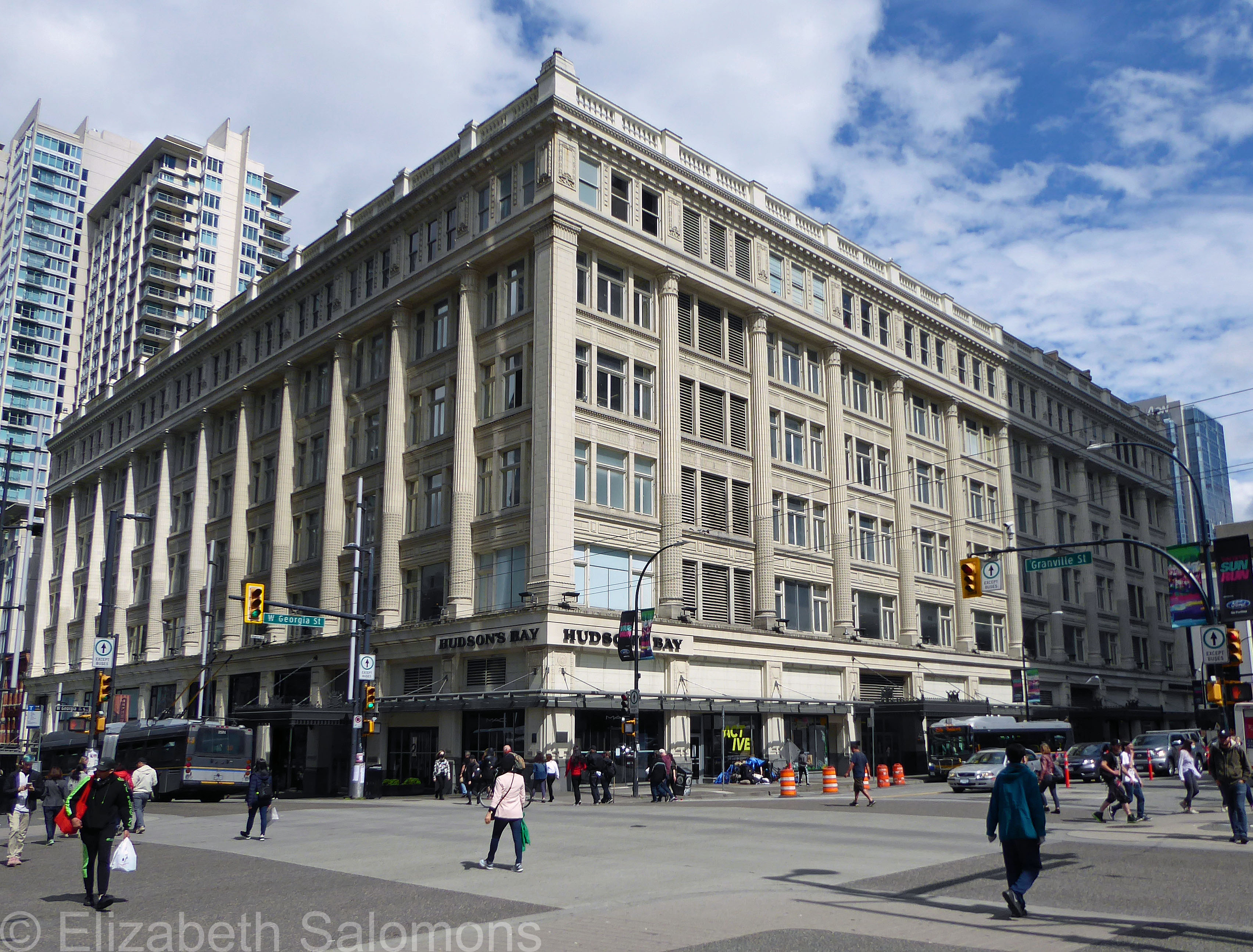
The Hudson’s Bay store in downtown Vancouver was built in 1914.
The company didn’t expand into eastern Canada until 1960, when it purchased Henry Morgan & Company, a Montreal-based department store chain. In 1970, a new Royal Charter, granted by Queen Elizabeth II, formally transferred the company’s headquarters from London to Winnipeg. The headquarters moved again in 1974, this time to Toronto, the same year Hudson’s Bay opened its first Toronto store at Yonge and Bloor. This was a store I knew well, as I worked across the street for a couple of years and would often pop over to The Bay on my lunch breaks.
Hudson’s Bay continued to expand, swallowing up Simpsons, Woodward’s, and K-Mart. In 2005, it partnered with the Canadian Olympic Committee and became the official merchandiser for the 2010 and 2012 Olympics. Those iconic red mittens that were sold out everywhere? I grabbed a pair as a last-minute impulse purchase, months before the Vancouver 2010 Olympics, with no inkling they would become such a hot commodity.

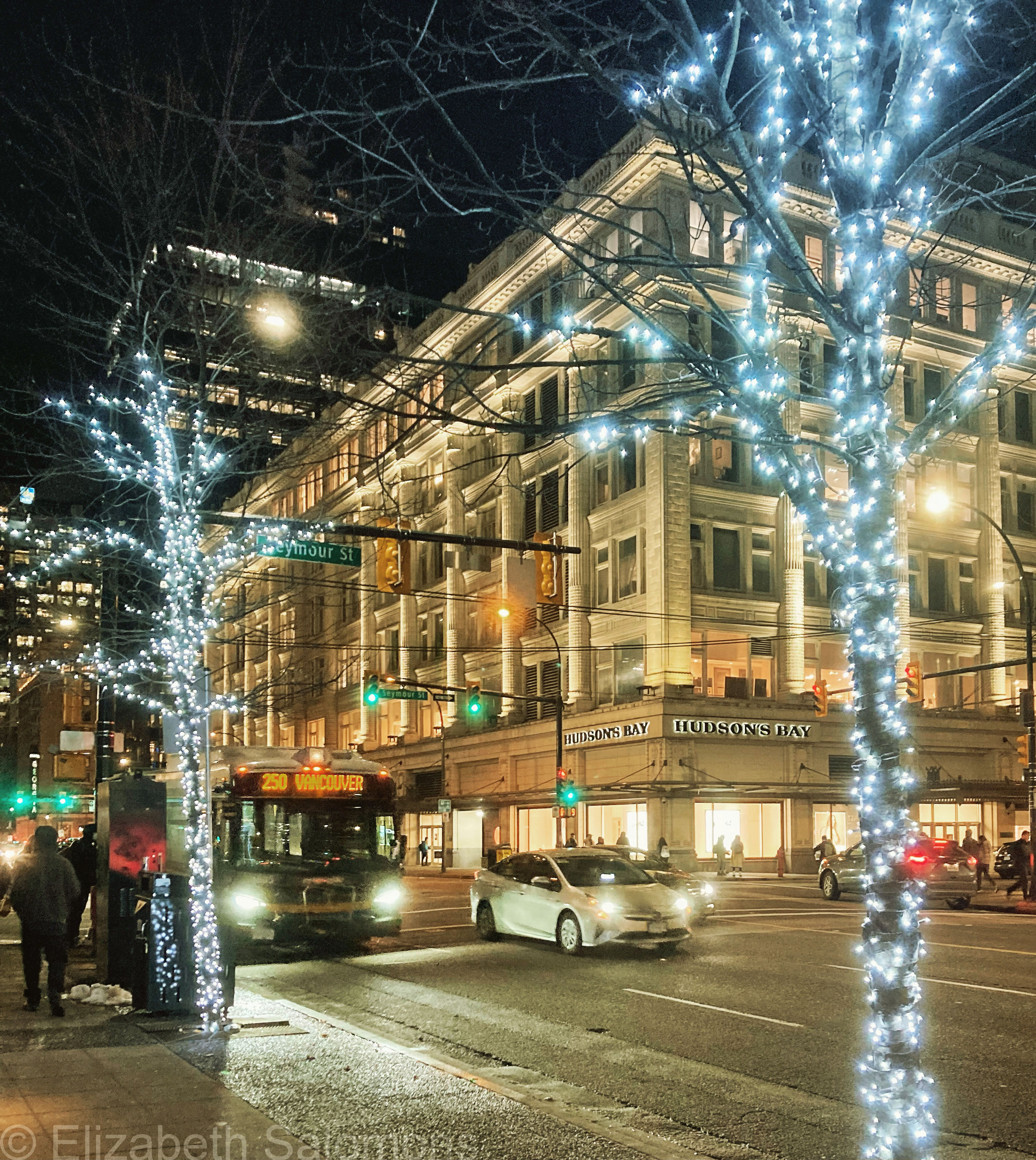
Wal-Mart began operations in Canada in the mid-1990s, around the same time that online shopping became a thing. The business model that had sustained the Hudson’s Bay throughout the twentieth century began to shift. In 2006, the company was sold to an American businessman and then, two years later, to an American equity company. There was a brief foray into Europe — I happened to be in Amsterdam the day that store open. Talk about worlds colliding.


The Bay began its long slow decline over the last six years or so. Many blame its demise on the failure of its American owners to understand the Canadian marketplace. In 2019, it sold off 400 stores and closed the Home Outfitter stores it had been operating for 20 years. When the company applied for creditor protection two months ago, it had just 80 retail stores left, along with its online store.
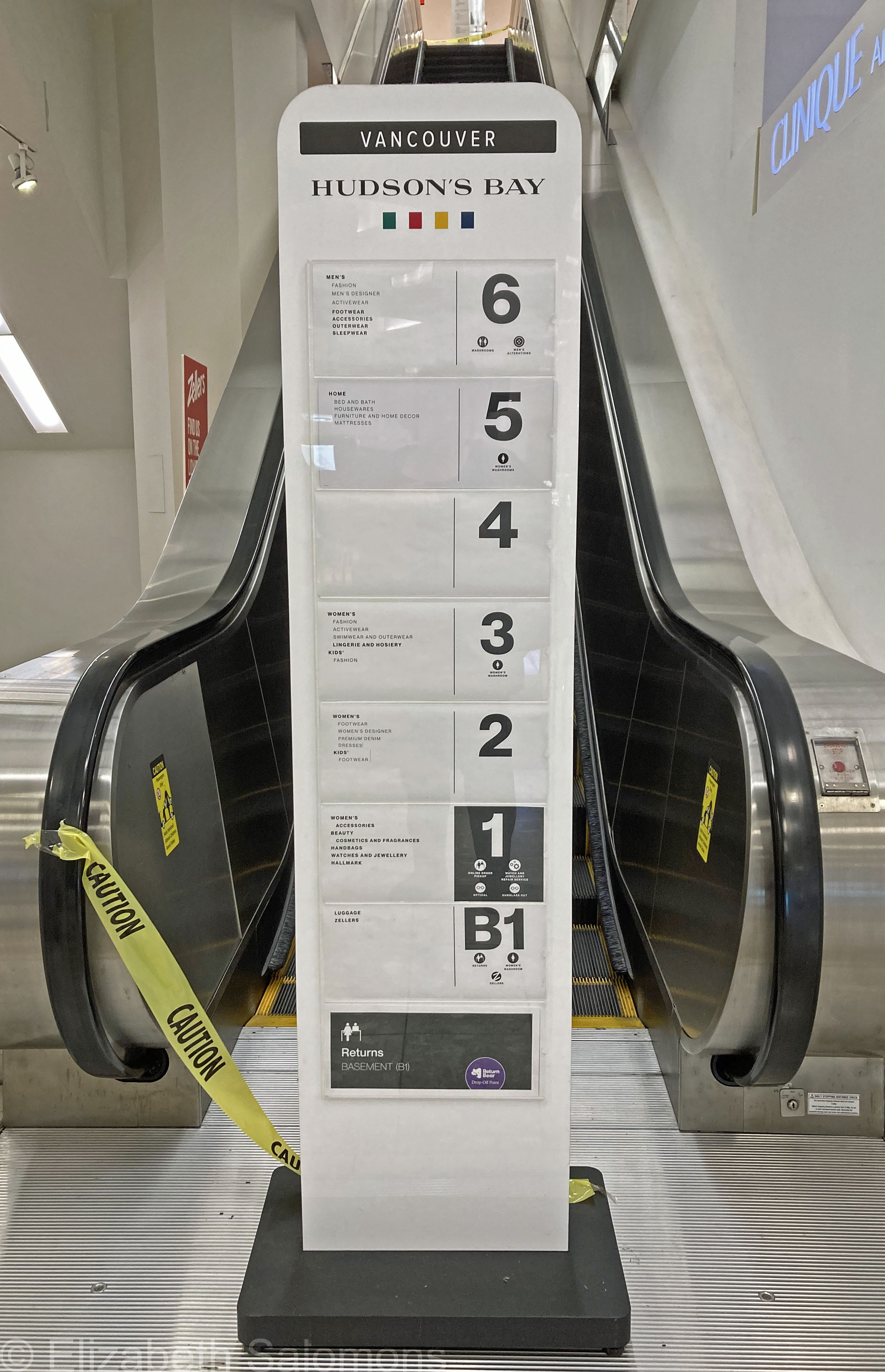
I have shopped at The Bay my entire life. Much of my kitchen was stocked at The Bay. It’s my go-to store for linens and socks and a fair-sized chunk of my office wardrobe. I even had a chance encounter with John Bishop, chef and former owner of Bishop’s Restaurant, in the housewares department while I deliberated over a choice of paring knives. But since the pandemic, I have struggled to find the items I want. When the elevators at the downtown Vancouver store were put out of service because the company couldn’t afford to maintain them, it was clear that Hudson’s Bay was on a downward trend that seemed unstoppable.
And so, while everyone was shocked, no one was surprised when the company went into receivership last March. I popped in to the downtown store on my way home from work shortly afterwards, looking for a point blanket. They had sold their last one just that morning, but I managed to snag the last cotton throw in stock. It has the signature stripes I was looking for.
I surprised myself when I choked up talking to the cashier who took my payment. He had only recently started working there, but said he felt bad for the women who had been working there for some 20 years. More than 8000 employees are out of a job as of today. In an economic climate that’s as unstable as Irish weather at the moment, I also feel for them.

With no working elevators, the stairs were the only way to the top in the Hudson’s Bay store in downtown Vancouver.
There is lots to still sort out. The HBC archives, consisting of thousands of business documents, personal journals, photographs, maps, artwork, and artifacts, are held in the Archives of Manitoba. But the company still has ownership of the Royal Charter, the one signed in 1670. Although it is a corporate document, it created a colonial government and is one of a handful of fundamental documents in Canada’s history, along with the British North American Act of 1867 and the Proclamation of the Constitution Act of 1982. Some have compared its significance to that of the American Declaration of Independence. It’s being auctioned off, will likely fetch millions, but I, like most historians, know it belongs in the archives, not a private collection.
I’m big on historical artifacts. I had always meant to get myself a point blanket and was kicking myself for having missed my chance. When my sister learned this, she offered me hers, which was sitting in a closet, unused. That blanket now sits in pride of place at the foot of my bed.
The role of the Hudson’s Bay Company in colonizing Western Canada is a complicated history that goes back 355 years and a month less a day. But, as I have written before, it is our history. And while department stores may not be the way we shop in this century, we can celebrate the history of the one where Canadians shopped for the past three and a half.
Remembering Rembrandt
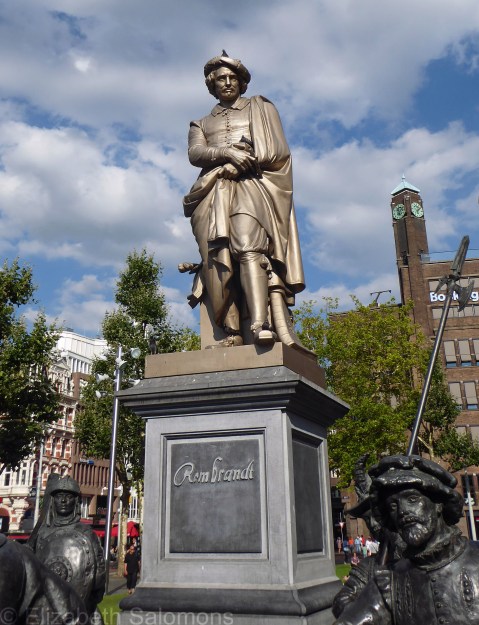
Today marks the 350th anniversary of the death of the Dutch artist Rembrandt van Rijn. He died in Amsterdam in 1669, and was buried in an unmarked grave in the Westerkerk. I want to acknowledge the anniversary of his death for one simple reason: Rembrandt is one of my favourite artists.
You don’t really get a sense of what Rembrandt means to the Dutch until you see how his most famous painting, The Night Watch (in Dutch: De Nachtwacht), is displayed in the country’s national museum, the Rijksmuseum. The painting is the focal point of the immense Gallery of Honour and your eyes are immediately drawn to it as soon as you enter the gallery.
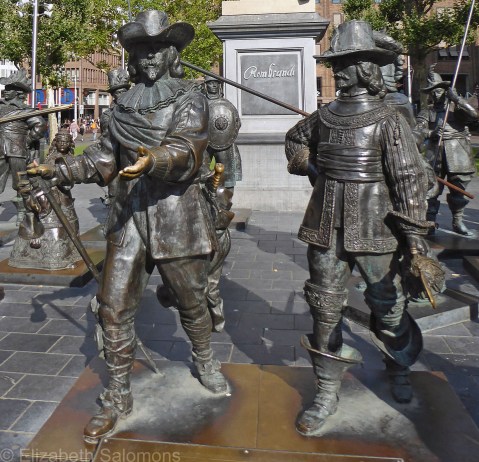
About a kilometre away from the Rijksmuseum is Rembrandtplein (Rembrandt Square), one of Amsterdam’s busiest squares. Now the centre of the city’s infamous nightlife, its origins were as a butter and dairy market. In the centre of the square is a cast iron statue of Rembrandt that dates back to 1852. That’s a photo of the statue up above. At the artist’s feet are life-size bronze cast statues of the some of the subjects depicted in The Night Watch, which were created to celebrate Rembrandt’s 400th birthday back in 2006. In the photo below are the two central figures: Captain Frans Banninck Cocq (on the left) and Willem van Ruytenburch (on the right).
The Rijksmuseum is calling 2019 “The Year of Rembrandt,” and it is celebrating with a variety of special events and exhibitions. The museum has also begun a year-long study and restoration of The Night Watch in full view of museum visitors.
Who could have known when Rembrandt died, alone and penniless, that 350 years later so many people from all over the world would be so enthralled with his work?
Vansterdam
O Cannabis!
Recreational marijuana, as of this month, is now legal in Canada. This has caused a flurry of media attention and a raft of bad puns.
The sentiment in Vancouver seems to be that October 17, 2018, was a non-event. Because, well, this is Vansterdam, after all.
It took a mix-up about a long-haul flight from Amsterdam to wake me up to the fact that Vancouver has a thriving underground drug scene. The mix-up started with me wandering up and down Schiphol’s cavernous terminal one morning, many years ago, looking in vain for the Air Canada check-in counter. As I retraced my steps, I noticed an information desk with a small Air Canada sign above it in an out-of-the-way corner.
“Hi,” I said, handing the agent my ticket. “I’m booked to fly to Vancouver today through Toronto. Where do I check in?”
The agent looked at my ticket, then he looked at me, then he looked again at my ticket.
“We don’t fly to Toronto today,” he said. “Weren’t you contacted about the new timetable?”
“No…,” I said, slowly. “Nor did anyone say anything about a timetable change when I checked in for my outbound flight two weeks ago.”
He started tapping his keyboard.
“I need to get back to Canada today,” I added. “I have to be at work tomorrow.”
“We’ll get you on another flight,” he said as he typed.
True to his word, in no time at all, he handed me a new ticket and a boarding pass. I was now booked on a KLM flight direct to Vancouver. And by the time he was finished with me, there was a line-up of people behind me, no doubt all of them wondering what had happened to their flights back to Canada.
Some ten hours later, I was going through the usual routine that seems to take forever when you’re jet-lagged: the long walk through the international terminal, the long wait at customs, the brief chat with the customs officer, the long wait at the baggage carousel, the handing of my customs form to the customs officer at the exit doors….
Which is exactly where the routine stopped being routine.
“Please go through there,” he said. That woke me up. He was pointing to the room where they send you when they want to search your luggage. Groan. Why me?
A customs officer waved me over and told me to set my suitcase on the table in front of her. She looked at my customs form and asked to see my plane ticket, then opened my suitcase and proceeded to look through my belongings.
She looked at my ticket again.
“You bought this ticket this morning?” she said.
“No,” I said. “I bought it months ago.”
She continued looking through my suitcase and asked me about every non-clothing item.
She’s being awfully thorough, I thought.
“You bought a one-way ticket this morning?” she asked me again.
And then the penny dropped. She was looking for drugs.
“Oh!” I said. “No! I bought the ticket months ago, but Air Canada changed its timetable and didn’t think to let me know, so they booked me on the KLM flight to get me home,” I explained. “There were a whole bunch of us.” (Except it wasn’t until later that I remembered the “whole bunch” was put on a flight to Toronto, whereas I was likely the only traveller flying all the way to Vancouver.)
My story seemed to satisfy the customs officer. She told me I could close up my suitcase and go on my way.
(As an aside: I don’t know how Canada Customs knew that my ticket had been issued only that morning — this was pre-9/11 — but that incident made realize that my government watches me in many more ways than I will ever know.)
Back to the beginning of my post. Pot is simply so not part of my world. Yes, I occasionally notice a pungent odour when walking along one of the beaches in this city. Sometimes I see people smoking up on the street. Whatever. But for me to be suspected of being a drug courier? That’s a laugh.
However, in the past few years, Vancouver’s status as the Cannabis Capital of Canada has become too obvious for even head-in-the-clouds me to not notice. That’s because of a federal program allowing the production and sale of marijuana for medical use that went into effect in 2013. The number of pot dispensaries in Vancouver jumped from about a dozen to almost a hundred. But only a quarter of them were approved by Health Canada and so, in 2015, the city council passed a bylaw to regulate and license the dispensaries, much to the disapproval of our beloved federal government. The city’s response was that it was taking action because the federal government had failed to do so.
The bylaw requires dispensaries to pay $30,000 for a business licence, and they are not allowed to operate within 300 metres of a school or community centre or another marijuana dispensary. And so, Vancouver became the first city in Canada to regulate the sale and distribution of a drug that was illegal under federal law except for medicinal use.
Fast forward to this month. Canada is only the second country in the world to legalize marijuana for recreational use. (The other is Uruguay. Contrary to popular belief, marijuana consumption in the Netherlands is tolerated, but not legal. Kinda like Vancouver before now.) Smoking laws must still be obeyed, so you can only smoke up where it’s legal to smoke cigarettes. In Vancouver, that rules out the beaches and parks. And, erm, the building I currently live in.
As of today, 19 of Vancouver’s medical marijuana dispensaries are licensed, 46 have land-use approval but no licence, and 75 are operating illegally. The illegal ones have been advised to shut down until they are provincially licensed to avoid prosecution — and I noticed the other day that my closest medical pot dispensary is shuttered.
Incidentally, I went through customs at Vancouver Airport on October 17, exactly an hour after recreational pot became legal in the province of British Columbia. Lo and behold, there was a new question on the declaration form: Was I bringing cannabis into Canada?
Nope.
Just as I wasn’t all those years ago when I flew from Amsterdam to Vancouver.
I can’t imagine pot tourism coming to Vancouver anytime soon, but with recreational marijuana still a budding industry, who knows what the future holds? The tourists might come for our scenery, but stick around for the unnatural high.

The New Amsterdam Cafe advertises itself as “North America’s premier smoke friendly cafe.” It has been operating on Vancouver’s Pot Block since 2000.
Through My Lens: Stork on a Red House
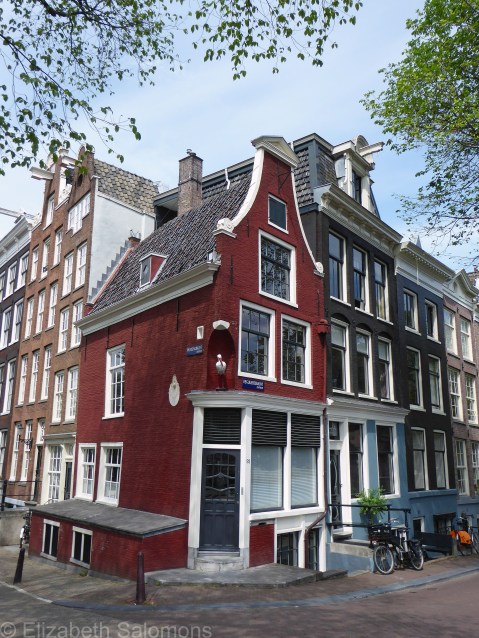
Hee.
It was late this afternoon before I was reminded that a year ago today I arrived in Amsterdam for the summer.
That kind of anniversary certainly calls for a photo.
This Amsterdam house was the home of a midwife back in the seventeenth century. If you look closely, you can see a statue of a stork perched on the corner right above the door. That stork was the midwife’s business sign, so to speak.
Through My Lens: Inside the Oude Kerk

I chose this photo for today, the Fifth Sunday of Lent, because I love how the different features of Amsterdam’s Oude Kerk are visible in one shot.
There are the tall pillars, of course, And the pointed Gothic arches and windows.
What’s unique to the Oude Kerk is its wooden ceiling, which miraculously survived fires that swept through Amsterdam in 1421 and again in 1452 (after which wooden buildings were banned from the city). If you look closely, you can see the remains of the paintings commissioned by wealthy patrons.
And then there are the miniature ships. The Oude Kerk is steps away from the IJ and was traditionally a port church where the seamen came to pray for safety. The little ships are a testament to that history.
Through My Lens: Oude Kerk

My photo choice for the Fourth Sunday of Lent is Amsterdam’s Oude Kerk.
With Oude Kerk being Dutch for “old church,” this church is, as you’d expect, Amsterdam’s oldest. At 800 years, it is also the city’s oldest building. I wish I had thought to cross the canal to get enough distance for a proper photo because this one shows only a small part of the building, which has been extended many times since it was consecrated in 1306. Those are houses attached to the church — houses attached to the outer walls of a church seems to have been a common practice in the Netherlands.
The Oude Kerk stands in the heart of De Wallen — Amsterdam’s red-light district — which can take you by surprise if you’re not expecting it. Every tourist has a story about their first encounter with the red-lit windows in which the prostitutes stand. Mine was many years ago while on a walking tour of old Amsterdam with my much older, much more conservative Dutch cousin. She wanted to show me the Oude Kerk, but all I was noticing were the windows of women facing the church.
Which I pretended I hadn’t noticed. As difficult as that was.
Through My Lens: Inside the Westerkerk
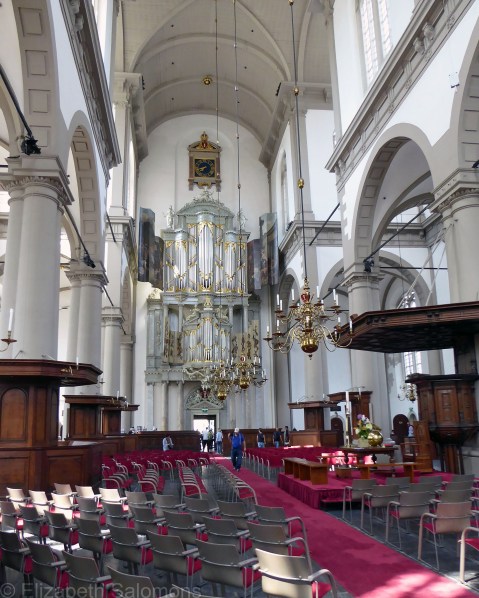
Last week I showed you the Westerkerk, and for today, the Third Sunday of Lent, here is what it looks like on the inside.
European Protestant churches have quite a different feel on the inside than their Catholic counterparts, with the most noticeable difference being how much lighter they are. It’s refreshing in one way, but with fewer stained glass windows and no artwork, some might consider them a bit dull.
Initially there was no organ in the Westerkerk — the Calvinists frowned on musical instruments of any kind — but some 50 years later one was commissioned and installed in the church. In the summers, the Westerkerk offers free lunchtime organ concerts on Fridays, and for one week in August a concert series they call Geen dag zonder Bach (“No day without Bach”), consisting of a daily concert of music by my go-to organ guy: J. S. Bach.
Through My Lens: Westerkerk

For the Second Sunday of Lent, here is a photo of what is probably the best-known church in all of Amsterdam: the Westerkerk. (Westerkerk is Dutch for “western church.”) Built between 1620 and 1631 in the Dutch Renaissance style, it too, like the Noorderkerk, was built as a Protestant church and in the shape of the Greek cross, except its design consists of two crosses placed side by side. Because of this, it has a long rectangular shape similar to a Catholic basilica, but its transepts are wider than in a Catholic church, and there are two of them.
The Westerkerk is about a five-minute walk from the Noorderkerk. It too is situated on the Prinsengracht, and is right across the canal from the Jordaan neighbourhood. Like the Noorderkerk, the Westerkerk was built to fulfill the pastoral needs of that fast-growing neighbourhood, but it ended up being the church of the upper and middle classes, whereas the Noorderkerk was where the working classes tended to go.
The reason the Westerkerk is likely the best-known church in all Amsterdam? Because Anne Frank wrote in her diary how its bells used to reassure her, especially at night. The carillon chimes every quarter hour and today is the only carillon in the city to do so 24/7 (at the request of the residents of the Jordaan).
I listened to those same bells chime through the night my first week in Amsterdam, as I tossed and turned, trying to get adjusted to the time zone. I could see the tower of the Westerkerk from my bedroom window, and when you climb that tower, your guide will point out the Achterhuis (where Anne Frank and her family hid for two years during World War II) and the window from which Anne could see the church tower.
Through My Lens: Noorderkerk

Last summer was about a lot of things, but one thing I made sure to do was take lots of photos of the dozen or so European churches I was able to visit. And now that it’s once again the Season of Lent, I am so happy I get to share those photos with you.
For today, the First Sunday of Lent, here is a photo of the Noorderkerk. (Noorderkerk is Dutch for “northern church”). This church was built in the early 1620s in the Jordaan neighbourhood, right on the Prinsengracht, the outermost canal of Amsterdam’s Canal Belt. The Jordaan was growing fast at the time, and its residents were in need of another place of worship.
The Noorderkerk was purpose-built as a Protestant church (unlike older church buildings throughout the Netherlands that were originally Catholic, but were transformed into Protestant churches after the Reformation.) As such, its shape looks quite different from the traditional long nave of a Catholic church. It was instead built in the shape of the Greek cross, with four naves of equal length, and a small tower at the centre. The idea was that the building was centred around the pulpit, a type of church design that eventually become quite common throughout Calvinist Holland.
I have a lot of affection for the Noorderkerk as it was only a ten-minute walk from where I was living, and I passed it regularly, often daily, on my walks around Amsterdam. To my regret, I didn’t have a chance to see it on the inside — the church is still in use as a congregation and the hours it is open to the public are limited. But though it might look like a quiet, sleepy church, there was always a lot going on outside. On the square surrounding the church are the twice-weekly markets: a flea market on Mondays and a food market on Saturdays. There is nothing like a weekly market to give a church square a sense of being the heart of the neighbourhood.
Which to my mind is kinda cool.


 There and Back Again