
Happy Birthday, Queen Victoria!
Are you tired of all the royal baby talk? There’s been an awful lot of it this month. Bear with me though, because we should all take a moment to mark a significant anniversary of yet another royal birth.
Two hundred years ago today, Princess Alexandrina Victoria of Kent was born in Kensington Palace. With her birth, she became fifth in the line of succession to the British throne.
Fifth seems a long ways away from the throne these days. (Archie Mountbatten-Windsor is seventh at present.) But due to a series of monarchs and heirs to the throne dying without legitimate heirs, Princess Alexandrina Victoria ended up becoming Queen of the United Kingdom in 1837. She had just turned 18.
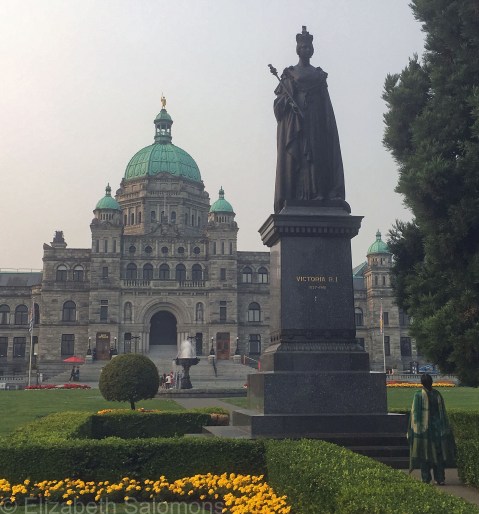
This statue of Queen Victoria stands in front of the Parliament Buildings in Victoria, British Columbia. Many places in the Commonwealth are named after Queen Victoria; Canada is the only country to honour her birthday with a statutory holiday. It falls on the Monday before May 24. I grew up referring to Victoria Day as the “May long weekend.” It wasn’t until I moved to Toronto that I first heard it called the “May two-four weekend.” For a long time, I thought that was because Queen Victoria’s birthday is actually on May 24.
But, no. It’s because beer is sold in cases of 24. I had never heard a case of beer called a “two-four” — that’s not a common term in Western Canada — and was completely oblivious to its link with beer.
And why is beer on the mind of patriotic Canadians during this particular weekend in May, you ask? It’s because the May long weekend is the unofficial start of Cottage Season in Ontario. (Don’t get me started on the whole cottage vs. cabin debate.)
Regional differences. Long may they reign. Just like British queens.
Through My Lens: Dunluce Castle (aka Pyke Castle)
Well.
It’s finally over. After months of build-up and hype, the series finale of Game of Thrones has aired. I can’t remember the last time a TV show was talked about as much as this one has been.
I’m not going to get into the what-ifs and wherefores of the finale — this is a travel blog, after all. But much of the series was filmed in Northern Ireland, where I have been to a handful of times.
Although my last trip to that part of the world predates Game of Thrones, it did occur to me that I may have inadvertently visited some of the filming locations long before anyone was talking about the show.
Turns out I have.
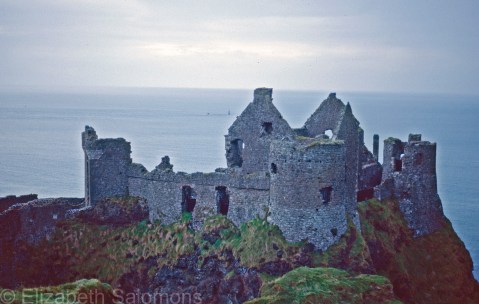
And so, this being a travel blog, here is a photo of Dunluce Castle in County Antrim, which dates back to the 1500s. It’s mostly ruins now, and to get to the rocky outcrop on which it stands, you have to walk across a narrow bridge.
On the show, with some help from CGI, Dunluce Castle served as the location for Pyke Castle, seat of House Greyjoy, rulers of the Iron Islands.
Northern Pintail

This elegant fellow is a Northern Pintail. I came across him while walking the seawall along Burrard Inlet about six weeks ago.
The Northern Pintail is rarely seen in my neighbourhood — this was my first-ever encounter — but Vancouver is on the Pacific Flyway and they are a migrating duck. And so, in honour of World Migratory Bird Day (that would be today), I’m happy to post this photo.
Walking and Drinking Our Way Through San Francisco
San Francisco …
Bridges, fog, food …
It’s crunchy granola, but it’s also double martinis and thick slabs of beef.
A city of towns, neighbourhoods …
A tough town for a stick shift. — Anthony Bourdain
So. What to do when you don’t know what to say about a new-to-you city?
Me? I turn to Anthony Bourdain. And as I did so, I had to laugh.
I laughed because he seemed particularly fixated on martinis while he was filming his San Francisco episode.
And I laughed because as my friend and I spent our week climbing the hills of San Francisco (hence, “a tough town for a stick shift”), we finished each day with an adult beverage. Or two.
Double martinis indeed.
This was my first one, which I sipped as we listened to jazz in a bar that time forgot at Haight and Ashbury.

Haight and Ashbury, of course, was the epicentre for the Summer of Love. With a little imagination, it seems like the entire strip is one that time forgot.
See what I mean?
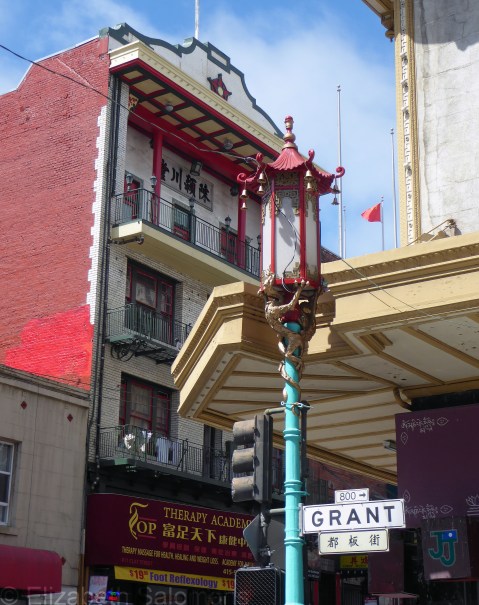
We spent a morning strolling through Chinatown — one of the largest in North America, and certainly the oldest.
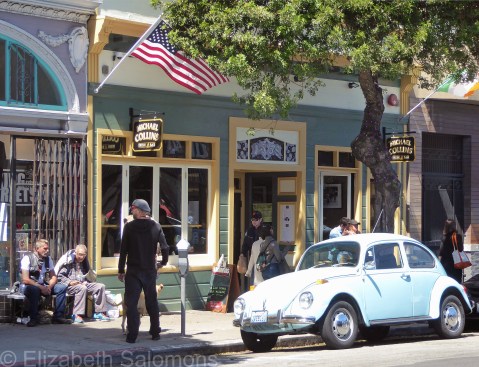
Then we hit the Castro, San Francisco’s gay village.
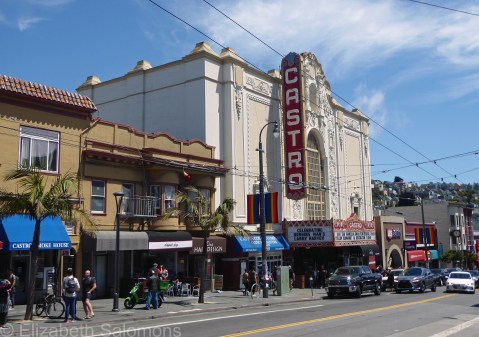
We finished our day in the Mission, enjoying cold beers in another bar that time forgot.
The Mission got its name from Mission San Francisco de Asis, one of the 21 Catholic missions established in California to convert Indigenous peoples. From Dolores Park, in the heart of the Mission, you have a great view of the entire city.

We also spent time in the Embarcadero, which is where my home exchange condo was located.
We bought fresh produce at the Ferry Building Farmers Market. (Being a ferry building, this is also where you catch any one of several ferries to get across the bay.)

And we ate sushi overlooking Alcatraz in the middle of San Francisco Bay.
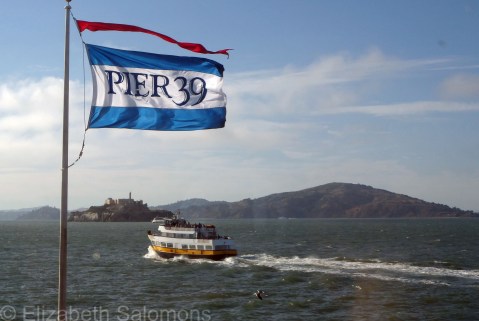
We finished up our last day in North Beach, the Little Italy of San Francisco and home to the Beat Movement. We rested our aching feet at Francis Ford Coppola’s bar in the Sentinel Building (the green building) …

… and imbibed in yet another late afternoon cocktail.

San Francisco is known to be a foodie town (be sure to try the tacos), but during our short week, it was definitely the adult beverages that sustained us.
Through My Lens: Pretty Pink Parasols
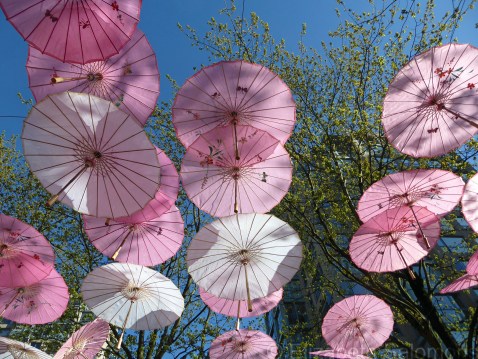
It was another weird and wacky winter in Vancouver. Daffodils in January. The coldest February ever (since they started to keep records in 1937). The driest March since 1992 (which does not bode well for wildfire season).
Hello, climate change.
April, thank goodness, was blessedly normal.
April is cherry blossom season in Vancouver. The last of the blossoms are still in bloom, but they will be gone in a few days, I’m sure.
To celebrate the season this year, another public art installation was put up in the same square as last year’s Underbrellas. I don’t know what this year’s umbrellas are called, but I’m calling them the pretty pink parasols.
Happy Easter!
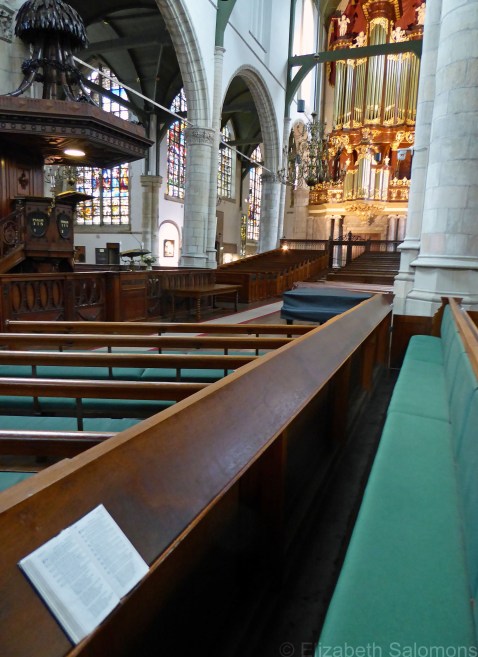
Sint Janskerk, Gouda, August 2017
Notre-Dame Is Burning

Four days ago, the world was stunned by the sight of Notre-Dame Cathedral in flames, and in tears at the possibility that it might collapse. Its salvation came down to a matter of minutes as the firefighters fought to keep the fire from spreading to the wooden frames of the bell towers. Had that happened, it would have been game over. The bells would have come crashing down, taking the two towers with them.
Since then, we’ve learned that Notre-Dame has fire monitors who inspected the wooden frame that held up the roof — known as la forêt (the Forest) — three times a day. We’ve also learned that just last year the Parisian firefighters carried out training exercises in how to rescue Notre-Dame’s artwork and relics. At the height of the fire, when it was thought the Cathedral was at risk of collapse, 100 of the 500 firefighters were busy moving those works of art to safety. They were following the protocol set in place long ago: first save the people, then save the art, then save the building.
But we’ve also since learned that Notre-Dame’s wooden roof structure had no sprinklers or firewalls, which contributed to how quickly the fire spread. And there has been a years-long battle between church and state as to who should pay for the overdue and badly needed restoration work that was underway. (All cathedrals in France are owned by the French state and leased to the Catholic church.)
One doesn’t need to be a person of faith to be impressed by Notre-Dame for its architectural beauty and its historical significance. Gothic architecture originated in France and Notre-Dame was among the first of the great cathedrals to be built. Construction began in 1163 and took 200 years to complete. Stained glass and flying buttresses were new ideas back then, and Victor Hugo called the result a “vast symphony in stone.”

There is probably no symbol of France and French culture equal to Notre-Dame. It sits on the Île de la Cité, the heart of Paris, known as Lutetia some 2000 years ago when humans first settled along the Seine. The “snail” of the famous arrondissements of Paris begins directly in front of the Cathedral. Napoleon Bonaparte was crowned emperor in Notre-Dame in 1804; its bells toll at times of national significance, such as the end of Nazi occupation in 1944. Heavily damaged during the French Revolution, Notre-Dame has since survived other revolutions and uprisings as well as two world wars. That endurance is likely why, as a building, it is so close to the hearts of so many people.
That endurance is also likely why we take Notre-Dame for granted. On my last visit to Paris, I didn’t even bother to go inside. To be honest, I’ve never been much impressed by its interior. I find it dark and grimy compared to other European cathedrals and the crowds are unbearable. My nieces took one look at the long line of people snaking across the square in front and emphatically declared they were not waiting in line to see a church, even if it was Notre-Dame. I didn’t push it.
Instead, I took them around the back to show them where Notre-Dame’s real beauty lies: in its intricate exterior and its symphony of flying buttresses.

I get why people talk of Notre-Dame as if it were a sentient being. And if you think of it like that — as a living, breathing building — then this week’s fire is simply one more event in its long and sometimes turbulent life.
And therein lies hope for its future. All great cathedrals have been nearly destroyed and then restored. England’s York Minster suffered a devastating fire in 1984 — something I only learned about this week despite having visited that church several times. Its roof was rebuilt with English oak. Chartres Cathedral, just outside of Paris, lost its medieval roof in 1836. It was rebuilt with iron and copper. And because of restorations like these and others, the know-how needed to rebuild Notre-Dame exists, despite media reports that those skills are long gone.
This week happens to be Holy Week — one of the most significant weeks in the Christian calendar. Regular readers of this blog know how enamoured I am with ecclesiastical architecture, as evident by my annual Lenten series. I’m sure I am not alone. The most awe-inspiring architecture has always been built for the gods we worship. Think of the Pyramids at Giza, the temples of Angkor Wat, the Acropolis in Athens …
Think of Notre-Dame …
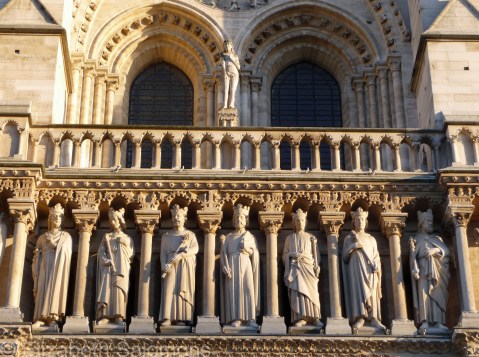
Today is Good Friday, the most solemn day of Holy Week that commemorates the crucifixion of Christ. As I looked up at the brand-new wooden roof of the cathedral in which I was worshipping, I found myself wondering how quickly it might burn if it were to ever catch on fire.
I pray I will never know.
Through My Lens: Pieterskerk of Leiden

Today is Palm Sunday, and I’m posting a photo of the Pieterskerk in Leiden. Dedicated to Saint Peter, this church dates back to the early fifteenth century.
Pieterskerk has an American connection; it’s where the Pilgrims worshipped for over a decade before they sailed away on the Mayflower in 1620. Some years before that, the Spanish lay siege to Leiden from May to October of 1574. When the siege was over, the citizens of Leiden held a service of thanksgiving, where they ate herring, white bread, and hutspot (a mash of potato, carrot, and onion). Some think that elements of this thanksgiving celebration, which became an annual affair, were carried to North America by the Pilgrims.
Which means we have the Dutch to thank for our custom of eating mashed potatoes at Thanksgiving.
Through My Lens: Sint Janskerk and Sint Servaas of Maastricht

For the Fifth Sunday of Lent, I’m posting a photo of the two churches that border the Vrijthof, which is the main square of Maastricht.
The church on the left is Sint Janskerk, a Gothic church dating back to the seventeenth century. Dedicated to John the Baptist, the distinctive red tower of this Protestant church was originally painted with ox blood (ugh), but these days, they just use regular paint.
On the right is Sint Servaas, a Romanesque church dating back to the eleventh century. The basilica is dedicated to Saint Servatius, first bishop of Maastricht and its patron saint. He died in 384 and is buried in the crypt. Sint Servaas is the Netherlands’ oldest church.
Through My Lens: Inside the Bovenkerk of Kampen

Today is the Fourth Sunday of Lent. I’m posting this photo from inside Kampen’s Bovenkerk for a couple of reasons.
Reason # 1 is because it was inside this church, listening to this organ, where I first fell in love with the music of Johann Sebastian Bach.
And Reason # 2? Because today is one of Bach’s birthdays. I say “one of” because apparently the man had two depending on whether you are looking at a calendar in the Old (Julian) Style or the New (Gregorian) Style.
This organ is one of three in the Bovenkerk. It has four manuals and 3200 pipes, the oldest of which date back to the early seventeenth century.
There was a music lesson was going on just before I took this photo. The student was up above at the console behind the pipes, while the teacher was down below, chowing down on a sandwich as he hollered out his feedback. I felt sorry for the student, but was so happy I got to hear the music.


 There and Back Again