
Canada 150: Quebec City
At the start of my Canada 150 series, way back when, I said that a cross-Canada train trip should be on the Travel Bucket List of every Canadian. I myself haven’t quite completed that, but I came pretty close when I took the train from Vancouver to Quebec City.
It took me four days to cross five provinces. I was a student, so I had more time than money and back in those days taking the train was cheaper than flying. But still, it was the cheap seats for me, which meant I did not have a sleeping berth at night. When I finally disembarked, the conductor joked that I was starting to look like part of the furniture.
But travelling slowly across three-quarters of the country was so worth it. It gives you a sense of the scale of our country, and an appreciation for the regional differences.
Another way to appreciate regional differences is to spend a good chunk of time in other parts of the country. I travelled to Quebec City that summer to study French. The French didn’t much stick, but my perception of Quebec was changed forever.
It was the 1980s, the height of the Quebec sovereignty movement and the middle of a decade of constitutional conferences and accords that were the aftermath of the federal government repatriating Canada’s Constitution without Quebec. Yes, that’s a mouthful and I won’t get into explaining it here because if you’re old enough, you lived through it, and if you’re too young to remember, there are books you can read. But I mention it to explain the context for my summer.
My goal that summer, besides learning French, was to get to know the province of Quebec, so to speak. As a history major, I knew all about Canada’s two solitudes, but history doesn’t really, truly come alive until you walk its streets. And here’s what I learned: the difference between Quebec and the rest of Canada isn’t just its language, but also its culture and its history.
Language is obvious, of course. But it’s because of that language difference that Quebec has its own music scene, its own TV and film stars, and its own literature. I read a lot, but I can’t remember the last time I picked up a novel by a Québécois author. I think we English-speaking Canadians could do a lot better in appreciating and acknowledging Quebec culture.
And then there’s the history. What I most remember about that summer is realizing exactly what je me souviens means to Quebeckers. Its literal translation is “I remember” and it is the province’s motto. It’s said to refer to how Quebeckers will always remember their culture, their traditions, and their history. But when I saw one of those sound and light shows for tourists of a model-sized re-enactment of the Battle of the Plains of Abraham, the penny dropped for me. Je me souviens means “I remember 1759.”
The Battle of the Plains of Abraham took place on September 13, 1759. The British soldiers, led by General James Wolfe, climbed up the cliffs from the Saint Lawrence River to the Plains of Abraham at Quebec City, taking the French troops, led by the Marquis de Montcalm, completely by surprise. It was all over within an hour. The French loss marked the turning point of the Seven Years’ War. France gave up control of its colony in New France, but was allowed to keep two small islands off the coast of Newfoundland (Saint Pierre and Miquelon) and its holdings in the West Indies (the islands of Guadeloupe and Martinique).
Keep in mind that New France at that time consisted of present-day Labrador, Quebec, Ontario, Manitoba, and what is now the American Mid-West from the Great Lakes south to Louisiana. It was a far larger land mass than Britain’s Thirteen Colonies. Some historians like to draw a straight line between France losing New France and the American Revolution a few years later.
I’m getting lost in the history here, I know. But the point I want to make is this: if Montcalm had not lost the Battle of the Plains of Abraham, if France had not ceded its holdings in New France to the British, if the American Revolution had not been fought, if the Loyalists had not moved north into Canada, there is a pretty good chance that Canada would be a French-speaking nation. So when someone in Quebec says “je me souviens,” they are remembering all that.
I put all these thoughts into a short essay I read aloud to my French class on our last day of classes that summer. We met on the Plains of Abraham, of all places, for a class picnic and after I finished reading my essay, my teacher said to me, “Tu pense comme une Québécoise.”
You think like a Quebecker.
I don’t know about that, but I do know that my summer in Quebec City gave me a better understanding of how Quebeckers see their place in Canada.
I don’t have a photo of the Plains of Abraham, but here’s one of Notre-Dame-des-Victoires, a small church in the Lower Town of Quebec City. It is less than two kilometres from the Plains of Abraham and was almost completely destroyed by the British bombardment that preceded the battle in 1759.

Canada 150: Montreal
I wasn’t going to include Montreal in my Canada 150 series. Truth is, I haven’t spent a lot of time there and I don’t know the city well at all. But as I was thinking about my infrequent visits, it suddenly dawned on me. The last time I was in Montreal was on a May long weekend, and the city was deep into its 350th birthday celebrations. And this year, on May 17, Montreal celebrated its 375th birthday.
Gulp. It’s been 25 years since I’ve visited the home of my first love. (That would be the Montreal Canadiens.)
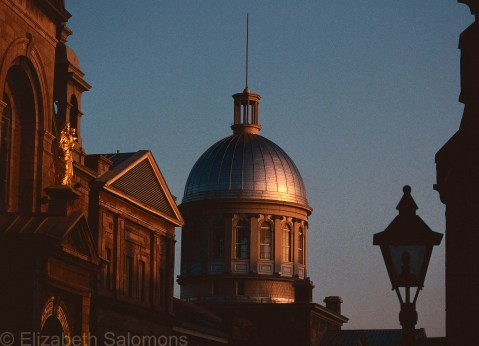
This photo is of the Marché Bonsecours (Bonsecours Market). Opened in 1847, it was the main public market of Montreal for more than a century. Today it houses restaurants and shops and a reception hall.
Kampen
I started off my summer in Amsterdam by hanging out with my nieces for a couple of weeks. If you are ever jaded about travel (and I’m not, but, I dunno, some of you might be … ), go travelling with a couple of teenagers. It lets you look at a foreign country with fresh eyes. I felt privileged to be able to introduce those two to Europe and I am pretty sure they went home with the travel bug firmly planted.
My own travel bug was also firmly planted on a trip to Europe while a teenager. Coincidentally, I ended my summer in Amsterdam with a day trip to where it all began.
That would be Kampen.

Kampen is a small city in the province of Overijssel, about 90 minutes from Amsterdam by train. Overijssel means “over the IJssel” — the IJssel being the river that runs beside Kampen. Because of that river, and its proximity to the Zuiderzee, Kampen became an important trading town and it joined the Hanseatic League (a loose union of towns that controlled the maritime trade of Northern Europe during the Middle Ages).
 Which means Kampen is just one more well-preserved medieval Dutch town.
Well, not exactly. Kampen is more than that. It’s where I first learned how to live in a foreign country.
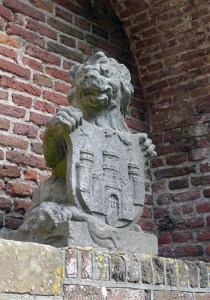
Kampen is not quite as pretty as Leiden or Delft — it doesn’t have as many cute canals and bridges that those other cities have. What it does have are three poorten, which is Dutch for “gates.” They are what’s left of the city’s walls.
Kampen also has a bunch of churches. The Bovenkerk stands out because of its height (boven means “above”) and it makes for a pretty picture from across the IJssel River. Below is the view you have when you arrive in Kampen by train.

Once you cross the IJssel, you are immediately immersed in the historic centre of Kampen. This is the stadhuis or town hall.
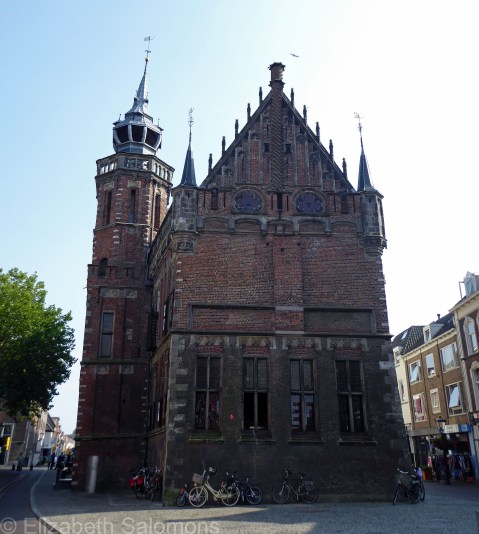
And this is Oudestraat (Old Street), the main shopping street. When we lived in Kampen, cars and delivery trucks were still allowed to drive up and down Oudestraat. Total chaos, it was.

The tower at the end of Oudestraat is the Nieuwe Toren (New Tower). If you look closely, you see a cow hanging from the tower. (Not real, I assure you.) The story goes that the fine people of Kampen wanted to get rid of the grass growing on the roof of the tower. Someone had the bright idea of putting a cow up there (to eat the grass), but she died on the way up. They hang a replica every summer to remind themselves of how clever they were.
And yes, that is probably the weirdest story I can tell you about any place I have ever lived.
About those city gates. Facing the IJssel River is the Koornmaarktpoort. It is the oldest of the three gates.

This is the Cellebroederspoort.
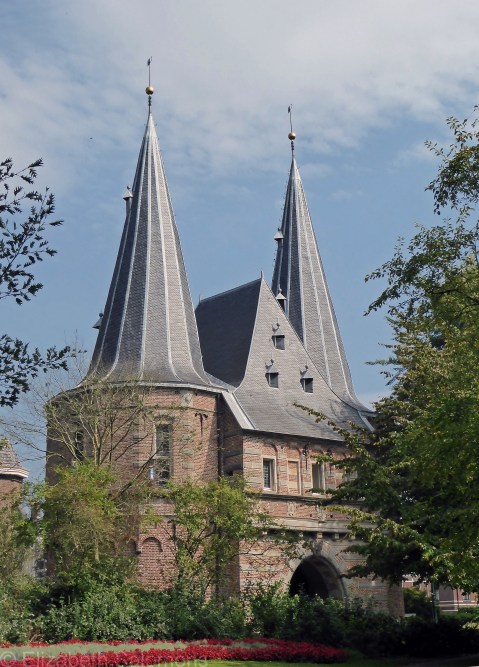
And this is the Broederspoort.

Here it is from the other side.

On the one side of the Cellebroederspoort and the Broederspoort is a rather large and lush park, full of geese and ducks and rather large trees. I have always thought that the Netherlands made such an impression on my first visit not so much because it was a foreign country (though there was that, too), but because I had grown up on the North American prairies where large, leafy trees are few and far between.
We kids spent a lot of time in that park, if I am remembering correctly. Our mornings were spent studying, our books spread across the dining room table with the French doors wide open to the garden behind the house. But in the afternoons, we were free. We had our bikes and we had that park and we had an entire town to explore. We also went to the weekly market with our mother, and on drives through the Dutch countryside with both of our parents.
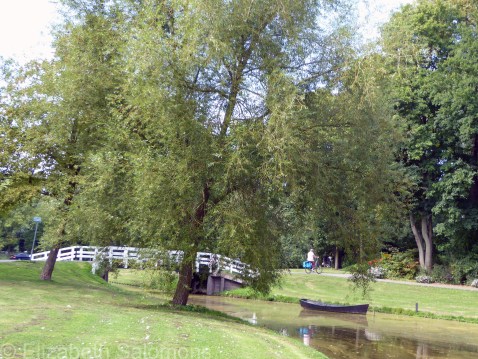
I am sure my memories are romanticizing the experience. I do remember feeling homesick for Canada, and I am sure we drove our mother around the bend, not going off to school every morning. But even so, I feel blessed that our family had that time together.
There is a lot to be said for visiting the European capitals when you go to that continent for the first time — and I’m so glad my nieces had their chance this summer. But I also know they found the traffic and the people (and the bikes!!) a little overwhelming. And so, there is also a lot to be said for exploring a small, Dutch medieval town on your own when you’re just a kid, as an introduction to Europe.
On your own on a bike.
Amsterdam’s Canal Houses
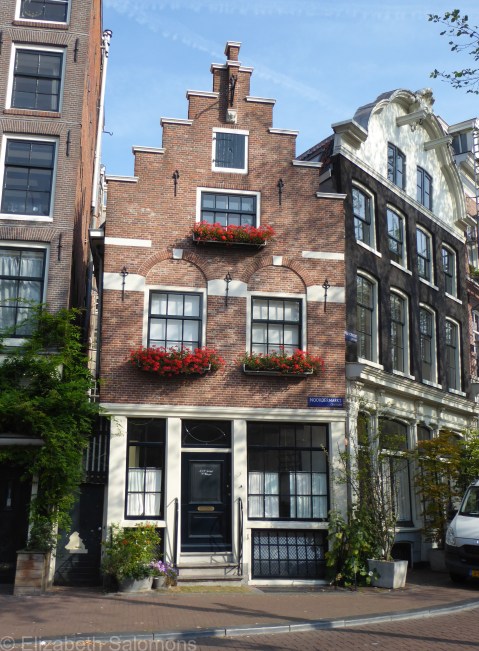
And then there are the canal houses.

Google “unique European architecture” and Amsterdam is sure to be on the list. That’s because of its unique canal houses.
Amsterdam’s canal houses are narrow, they are tall, and they are deep. Although the place where I stayed in Amsterdam is a modern house by Dutch standards (a mere 125 years old) and doesn’t face a canal, it too was built in the Dutch canal house style. And let me tell you: you don’t appreciate how narrow, tall, and deep these houses are until you’ve climbed a narrow, vertigo-inducing staircase all the way up to the fifth floor.
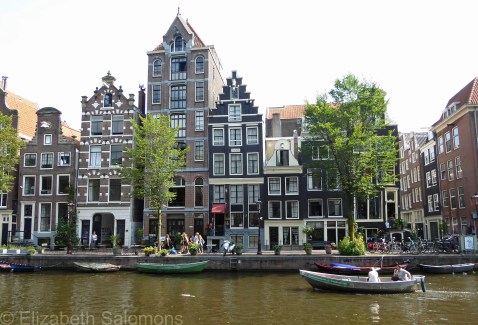
A typical canal house is only six metres wide. The reason why they are so narrow? It’s because canal houses were taxed on their width. The city governors needed money to pay for the massive canal expansion of the seventeenth century (when most of the canal houses were built), and knew they could raise the money by taxing the most desirable properties, which the canal houses were.
The Dutch are notoriously thrifty, shall we say, and anything they can do to save a cent, they will do. So they built narrow houses.
Many canal houses were multi-functional: they served as both family home and warehouse for the merchants who lived in them. The first storey was where the company’s office was located (at front) and where the family lived (at back). The upper storeys were the warehouse. At the top of each house was a beam with a hook. When the merchant needed to haul his trade goods into the warehouse, he attached a pulley and rope to the hook. Those same hooks are still used today when moving furniture or during renovations when building materials need to be brought into a house.
Amsterdam’s canal houses are still in use as family homes, but also as restaurants, hotels, museums, and offices. I lost count of how many times I walked past a canal house, its doors open wide to the street so I could look right in on an open-concept office, with rows of white computer-laden tables or groups of people gathered around a long meeting table. The offices all looked like remarkably relaxed work environments.
Although the canal houses follow a pretty similar cookie-cutter style from one to the next, where they do differ is in the style of their gables.
There’s the step gable.
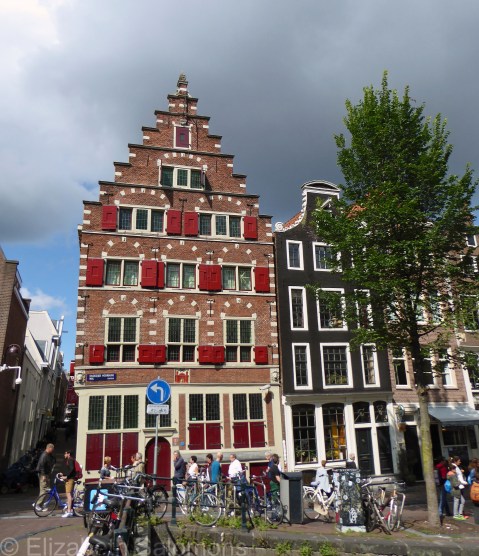
And there is the spout gable. It looks like an inverted funnel, and indicated that the canal house was a warehouse rather than a residence.
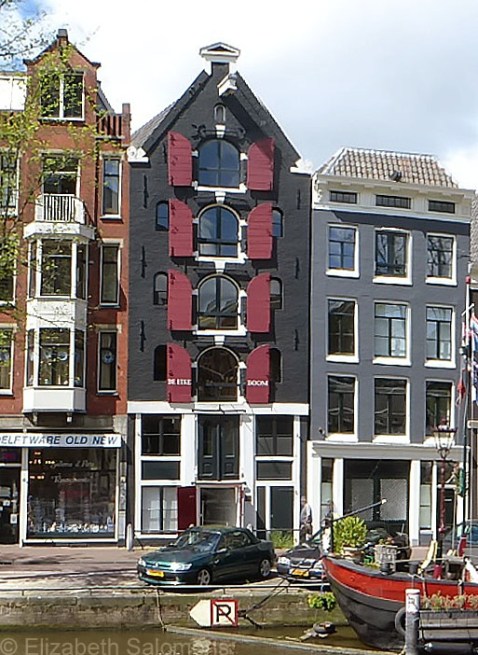
The neck gables allowed for the most individualization. The corners created by the 90-degree angle of the facade were filled in with ornate decoration that reflected the Baroque style of the time.

Sometimes the neck gables were built in identical pairs.
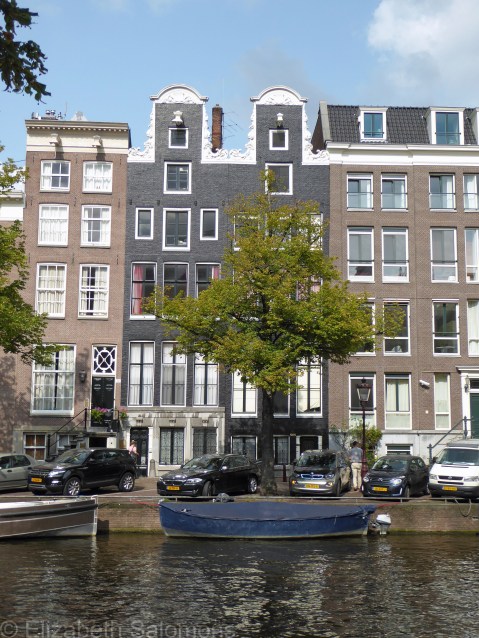
But often you see a row of canal houses with each gable different from the next. In this photo, from left to right, is a neck gable, a spout gable, and a bell gable. The bell gables are called that because the shape of the top of the gable resembles a church bell.
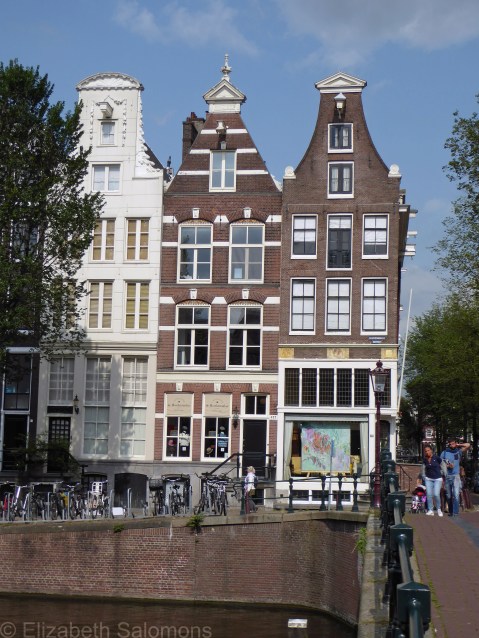
Here is a row of mostly bell gables. Note how the houses are tilted. Amsterdam’s canal houses are built on top of wooden piles that were pounded into the swampy peat bog until solid sand was reached. But as the land shifts through the centuries, so too do the houses. This particular row is known as the Dancing Houses.
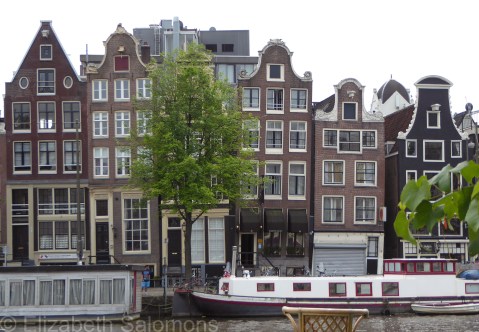
Here’s another thing I learned last summer. Marvelling at the Amsterdam canal houses is a whole lot more fun when you have a house builder along with you. My brother would shake his head, chuckle, and say, “There are no straight lines.” I don’t know if he was unsettled by the lack of straight lines, or merely fascinated, but after he left, for the rest of the summer, I walked around the city looking for straight lines.
I didn’t find many.
Amsterdam’s Canals
Today’s reminder of Amsterdam came from an umbrella I saw someone carrying: it was bright red with the three white Xs on black of the Amsterdam flag running along four of its ribs. Funnily enough, as much rain as there was in Amsterdam this past summer, I never once saw one of those umbrellas over there.
But I did here, in Vancouver’s West End.
And yes, that means our rainy season has officially started. To keep myself cheerful during these dark and dreary months, I’m going to finish off the series of posts about my summer travels that I haven’t gotten around to writing.
Staring with this one about Amsterdam’s canals.

Amsterdam has a lot of canals. A lot. And a lot of bridges. Far more canals and bridges than Venice, which is why some people call Amsterdam “Venice of the North.” But Amsterdam looks nothing like Venice. And when an Italian-American friend of mine once asked me what people did with their bikes in Amsterdam, I looked at her, puzzled.
“What do you mean ‘do with them’? They ride them, of course.”
“But how do you ride a bike in a city with so many canals?”
Oh, right. She’s Italian. She’s thinking of Venice. I told her how Amsterdam’s canals are all lined with streets — one on each side — and the streets had plenty of room for bikes. That’s also when I told her about my first-ever visit to Venice.
It was a holiday weekend in three countries (Italy, Yugoslavia, and Austria) and the youth hostel was completely full. The guy at the check-in counter told my friend and me that our best option was to try the convent down the street. He gave us precise directions: exit the hostel, turn left, and walk three bridges down.
“Do we walk over the bridges or beside them?” I asked in all seriousness. He looked at me like I was an idiot and asked, dryly, “If you don’t walk over the bridge, how will you cross the canal?”
Smart-ass, I thought, but as soon as my friend and I headed down the street, I saw what he meant. In Venice, there are no streets beside the canals and there is no way to get across a canal except by — you guessed it — walking over a bridge.
In Amsterdam, it’s entirely possible to walk the length of a canal without crossing it once. Where it intersects with another canal, you have the option of making a sharp turn left or right to start walking alongside that other canal. And at each one of those intersections, the bridges (there some 1500 of them in Amsterdam) go both over a canal while also going beside the other, intersecting, canal.
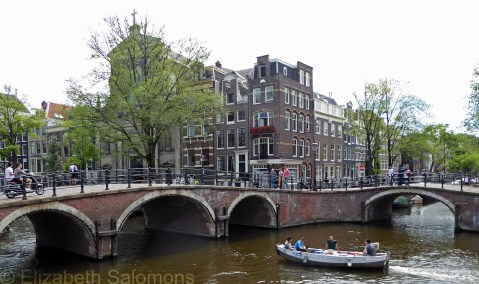
Last summer, I decided to get to know Amsterdam’s canals better and the best way to do that is to walk them. Off I went: down the Prinsengracht one day, back home along the Keizergracht, and then the next morning all the way along the Herengracht and back along the Singel.
The Singel is Amsterdam’s innermost canal, built way back in the Middle Ages and initially the city’s moat. In the seventeenth century, the city planners decided to add three more concentric canals parallel to the Singel. This expansion made Amsterdam four times larger than it was before and was desperately needed — by the end of the seventeenth century, the city’s population was four times greater than it had been when they first began building the new canals. (This was the Dutch Golden Age, when the Netherlands was the world’s maritime power and Amsterdam one of the world’s largest cities.)
The new canals all ended at the Amstel River, and were designed for both defense and transport and, yes, to manage all that water. (Remember, Amsterdam is below sea level.) The entire area became known as the Grachtengordel (canal belt) and was declared a UNESCO heritage site in 2010.
The first canal past the Singel is the Herengracht (Gentlemen’s Canal). It’s named after the men who governed Amsterdam during the Dutch Golden Age, many of whom lived along the Herengracht. One stretch, called the Golden Bend, was developed a little later than the rest of the canal, and its mansions were built on double-wide lots. Many of these are now consulates, banks, or museums.

The next canal is the Keizergracht (Emperor’s Canal). It’s the widest of the three canals and was named after the Holy Roman Emperor, Maximilian I.
And finally, there’s the Prinsengracht (Prince’s Canal), named after the Prince of Orange. It is Amsterdam’s longest canal and is the dividing line between the Grachtengordel and the Jordaan.
These three major canals are connected to each other by dozens of smaller canals. The Leidsegracht is the widest of these and used to be the main transportation connection between Amsterdam and Leiden (hence its name). The Reguliersgracht (regulator’s canal) is probably the most photographed canal in all of Amsterdam. It is also where, if you are at water level, you can look through seven bridges at one time — a fact you learn when you take your canal boat tour. And the Brouwersgracht (brewer’s canal) way down at the other end of the Grachtengordel is where a lot of breweries were located (hence its name).

Eventually, my Italian-American friend spent a weekend in Amsterdam with me and saw for herself how different Amsterdam’s canals are from Venice’s. And shortly after our arrival in Amsterdam last July, I told my nieces the story of how I expected Venice’s canals to be just like Amsterdam’s. My youngest niece has since told me, now that she has seen Amsterdam’s canals, that she wants to go to Venice to see for herself how the Italian canals compare.
That’s what it’s all about folks: cross-cultural awareness and understanding.
About those bikes: just because the streets alongside the canals are wide enough to bike on doesn’t mean that bikes don’t end up in the canal. It’s been said that Amsterdam’s canals are one-third mud, one-third water, and one-third bikes and that more than 15,000 bikes are pulled out of the canals every year.
Jordaan
This past weekend, I had dinner with a friend who wanted to know all about my summer in Amsterdam. I admitted that I was a wee bit homesick for the place. When he asked for details about my home exchange, I told him that the best thing about it was its location right next door to the Jordaan.

Developed in the seventeenth century, the Jordaan was originally a working-class district of artisans and builders. Some say its name comes from jardin, the French word for “garden.” I would believe it, as so many of the canals are flower-laden, although it is more likely those flowers are a recent phenomenon. My favourite was the Bloemgracht and I made a point of walking along it every chance I had.


By the nineteenth century, the Jordaan was overcrowded and could no longer sustain the 80,000 people living there. (By comparison, its population today is a much more reasonable 20,000.) The houses were little more than tenements. Running water and a sewage system were not installed until the 1930s. Prior to that, the canals were — well, you can imagine. After World War II, there was talk of demolishing the dilapidated houses and replacing them with modern flats, but, thanks to the many protests, that never happened.

The area gentrified and today is home to young families, artists, and students, as well as many of the original residents. Cafés and bars and restaurants dot the streets, along with trendy shops and four weekly street markets: a flea market at the Noordermarkt on Mondays, a textile market along the Westerstraat, also on Mondays, and food markets at the Noordermarkt and along the Lindengracht on Saturdays.

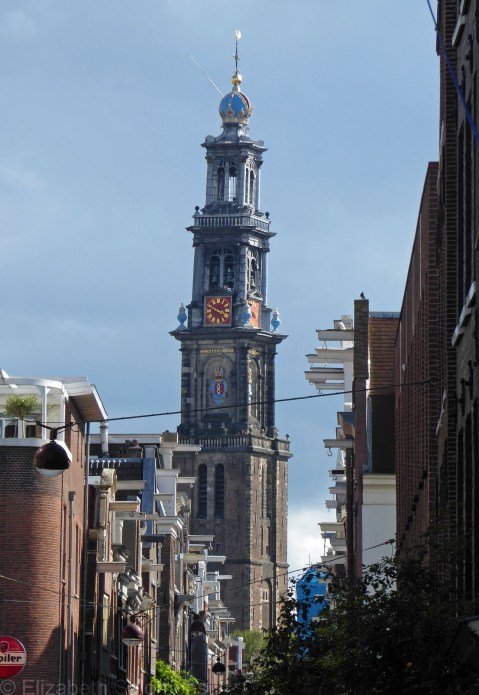
And then there are the churches. The Noorderkerk was the church for the working class and the Westerkerk, technically across the canal from the Jordaan, was the church for the upper classes. (It is also the church where Rembrandt is buried. He moved to the Jordaan after his bankruptcy.)
The bells of the Westerkerk are the only church bells in Amsterdam to ring 24/7, which is done at the specific request of the Jordaan’s residents. Amsterdam’s most famous resident, Anne Frank, wrote in her diary about the comfort the bells gave her and how she and her family told time by them until the Nazis hauled them away to be melted down.
It was those same bells that taunted me on one of my first nights in Amsterdam — thanks to them I knew I was still wide awake at 4 a.m. But by then I was already in love with the view of the Westerkerk from the streets of the Jordaan.
The other night, after I said goodbye to my friend and began the short walk home, I came across two people enthralled by a skunk sniffing around in the grass. The couple told me that they have never seen a skunk before, not even in a zoo. I could tell from their accent they were not from Vancouver and so, due to my recent resolution to be friendlier with the tourists, I stopped to explain that it’s “skunk season” in Vancouver — the time of year when baby skunks leave their mothers and go off on their own — and that is why you see so many of them.
“Really?” they said. “You see them every night?”
“Well, no,” I said. “But often enough.” I asked them where they were from.
“Holland,” they said.
“Oh!” I replied. “I just spent the summer in Amsterdam.” They asked me how I liked it (they were from Amsterdam) and I told them I loved it. We chatted about Holland for a bit, and then, after warning them not to get too close to the skunk, I said good night.
As I am still settling back into my life here in Vancouver (and let’s be honest: it takes a while when you’ve been a way for a while), I thought it was a happy accident that a skunk drew me into conversation with a Dutch couple only minutes after I left my friend, with whom I’d been regaling with stories about my summer in Amsterdam.
And about how lovely the Jordaan is.

Canada 150: Ottawa
So, here’s a thing. In putting together my Canada 150 series for this blog, I realized that I actually remember the last time Canada threw a big party for its birthday.
That would be Canada’s Centennial, way back in 1967. (I know, I know. I’m dating myself.)
I was in Ottawa, our nation’s capital, with my family, and I remember watching the Changing of the Guard at Parliament Hill while sitting on my dad’s shoulders. I remember crying, because I was frustrated that I could not see over other people’s heads.
(I don’t know what it says about me that my earliest memory is of being frustrated, but there it is.)
I took this photo of the Changing of the Guard at Parliament Hill many years later. Fully grown, at almost 5 feet 10 inches tall, I’m happy to say I no longer have any trouble seeing over other people’s heads.

A Summer in Amsterdam

As I settle back into life in Vancouver once again, I am also reflecting on the summer I’ve had. For those of you who are wondering, I won’t keep you in suspense: I eventually did reach what I call the fourth and final phase of adjustment to living in another country and culture.
It happened on my last Saturday in Amsterdam. Taking advantage of the gloriously warm, sunny weather, I was enjoying a long walk through the city’s centre. My mind was preoccupied with everything I had to do before leaving Amsterdam (a not insubstantial list). At the same time, I was feeling slightly sentimental about the sights and sounds around me, knowing it might be a long time before I would once again walk along this canal or across that bridge or hear the ding of a tram.
As I made my way past a tour group outside the Oude Kerk that was blocking my way, the guide’s voice caught my attention. She was holding up a laminated map of the Netherlands and explaining how much of the country lies below sea level.
And that was the moment when it hit me: I was actually going to miss the place. This overrun-with-tourists, charming-to-the-point-of-kitschy, historical-but-oh-so-modern city had completely captured my heart in a way I did not expect it to. And in acknowledging that, I knew I was — finally — feeling completely at home in a city that was not my home.
I don’t think it was a coincidence that I came to this realization on the same day I learned the mystery of Amsterdam’s traffic rules. I’d been puzzling over them all summer long.
There are no yield or stop signs in the centre of Amsterdam and no cyclist slows down — ever — at intersections. And so, within a day or two or my arrival in Amsterdam, I had learned that the bike is king. Pedestrians may walk on the road (indeed you often have to because your path is blocked by the many bikes parked haphazardly on the sidewalks), but as you walk, you always, always keep an ear tuned for the ding-ding of a bicycle bell — which is not a toy in Amsterdam. If you don’t immediately jump out of the way, the inevitable “pas op!” (watch out!) is hollered by the cyclist bearing down on you. At intersections, even when you have the green light, you make like an owl and spin your head 360 degrees to check for bikes. Because the bikes are everywhere.
All of which makes walking in the centre of Amsterdam rather stressful. You can’t not pay attention.
But even knowing all that, I could not figure out how the cyclists did not ride into each other. Finally, on my last weekend in Amsterdam, the mystery was revealed to me.
Yield to the right.
Suddenly everything fell into place. So, so simple. But then, the Dutch are masters at simple.
Some other, not insignificant, observations from my summer in Amsterdam:
- There are two Amsterdams: one for the tourists and one for the Amsterdammers. You’ll have a much better time if you try to avoid the first as much as possible.
- The Dutch know how to have an awful lot of fun with minimal fuss. There’s an important lesson here: keep it simple. (See above.)
- Travelling by train is by far the most civilized way to get around.
- There is far too much water in the Netherlands, but the Dutch — out of necessity — have been so creative at finding ways to live with it, beside it, and on it, they hardly seem to notice.
- Amsterdam is a twenty-first century city in a sixteenth-century setting and the only reason that is possible is because, unlike Canadians, the Dutch aren’t compelled to pull down any building older than, oh, 50 years.
I also learned not to bat an eye at the massive amounts of alcohol consumed in the streets during festivals such as Amsterdam Pride or the Prinsengracht Concert, at male cleaners in women’s public bathrooms while in use by the women, or at people setting a table on their front stoep, complete with cloth napkins and long-stemmed wine glasses, to enjoy their dinner on a warm summer’s evening.
One lesson I wrestled with all summer long was coming to an understanding of the Dutch notion of tolerance, which they call gedogen. I finally clued in that gedogen is nowhere close to Canada’s notion of tolerance. (We like to define it as acceptance of or openness to diversity.) In the Netherlands, something might be illegal (say, smoking weed), but if it doesn’t bother anyone, the law is not enforced. That’s gedogen. It has nothing to do with acceptance; rather, it is all about pragmatism, which is a personality trait all Dutch people possess. (And pragmatism, I should think, is fundamental to living easily and comfortably in one of the most densely populated countries in the world.)
My most important lesson of my Amsterdam summer came to me from the girl in the phone shop, however. I had popped in to find out why my mobile phone had stopped receiving data, and she went totally out of her way to walk me to the grocery store down the street where she said I could buy a new SIM card for a few euros less than what she was selling them for. To make conversation as we walked back to the phone shop, I asked whether she gets a lot of dumb questions from tourists.
“Well, yes,” she said in that way the Dutch have of not mincing their words. “But I always am happy to help because when I am somewhere on holiday (she pronounced it hol-LEE-day), I always hope that someone will help me.”
Gulp. I realized I could do far better in being a kinder host to the tourists who overwhelm my Vancouver neighbourhood every summer.
It would be a shame if I spent a summer in another country and did not come home a little poorer and a little wiser. So I am happy to say that was not the case for me this summer. And as I looked through my collection of photos, trying to decide which one to include with this post, a wave of homesickness for Amsterdam came over me.
It was the best feeling.
Through My Lens: English Bay Morning

Now I’m really back.
Back in Vancouver, that is. After three months away, I’m so happy to see my English Bay again.
Isn’t it beautiful?
Don Valley Brick Works

And … I’m back.
Back in Canada, that is.
After 10 days on walkabout in southern Germany and Belgium, I have my feet firmly planted once again on Canadian soil. It’s good to be here.
My week in Toronto is mostly about work, and I have to remind myself I’m still allowed to play tourist in a city I know so well.
Which is why I’m posting this photo. The friend whose home is my home when I’m in Toronto has been telling me about her new favourite place for months now, and she showed it to me last Saturday afternoon. The Don Valley Brick Works is an old quarry and brick factory that provided most of the bricks for Toronto’s oldest and finest buildings for over a hundred years. It ceased production in the 1980s and has been converted into a park and cultural centre since my last visit to Toronto.
I love city parks, and this one’s a gem.


 There and Back Again