Canada 150: Peggy’s Cove

Oh, look!
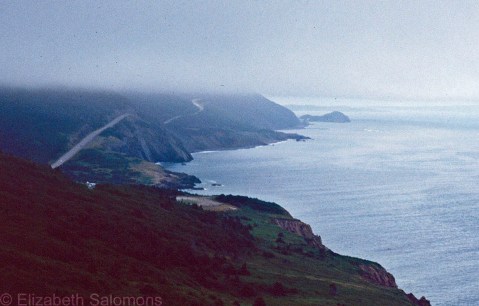
It’s the last month of 2017 and I’ve reached the last province on my Canada 150 tour (with apologies to Nunavut and to Newfoundland and Labrador — both are on my bucket list, but I have yet to visit either). I took this photo in Peggy’s Cove, a small community on the coast of Nova Scotia just outside of Halifax.
I’m still on leg two of my cross-Canada road trip. It was a pretty memorable road trip, as far as road trips go, as I was travelling with four siblings and two parental units. Anyone who has ever travelled in large familial groups knows of what I speak.
There were a lot of personal firsts for me on this family vacation, like travelling in convoy (when we were little, we could fit in one vehicle — not so much as adults) and getting up at the crack of dawn so I could photograph an East Coast sunrise. And my first ever lobster, bought fresh off the dock, and cooked on a camp stove.
At this particular point in my family’s history, our respective places of residences were scattered across three provinces, so we were about as pan-Canadian a family as we could be. It was rare for us to be in one place all together, so there were lots of family photos taken, to the delight of some and the annoyance of others, including a whole whack on the rocks at Peggy’s Cove.
Peggy’s Cove is a pretty photogenic place to take a family photo. It has lots of rocks and some fishing shacks and a picturesque lighthouse.
And lots of tourists. By the busload. It was pretty crazy.
I’m just happy they didn’t get in the way of my photo.
The Begijnhofs
So here’s another cool feature about the Low Countries that I want to share with you.
Those would be the Begijnhofs. Until the eighteenth century, most cities and large towns throughout Holland, Belgium, and northern France had a least one begijnhof. The Beguines (the French word for begijnhof is béguinage) were lay religious orders of the Late Middle Ages and Renaissance. These women were not nuns, and the communities they lived in were not convents. They did not take vows of poverty — some of them had servants. They did not marry while they lived in community, but were free to leave at any time. They supported themselves by teaching or by working as labourers. And they lived in houses surrounded by a walled courtyard (hof is Dutch for “court”). The gates were locked at night, and the community usually included a church and sometimes an infirmary.
One of the reasons these communities came about was simply due to the demographics in Europe at that time: there were more women than men. But also, living in community like this offered these women freedom and independence and choice in how they lived — basic rights that today we all take for granted.
I was introduced to the Amsterdam Begijnhof a long time ago by my Dutch cousin. Amsterdam is full of hofjes, most of which are private, but this one — one of the city’s oldest, dating back to the fourteenth century — is open to the public.
The Begijnhof was allowed to continue to exist as a Catholic institution during Calvinist rule because the homes were private property. The Beguines lost their chapel, however, and today it is the English Reformed Church. Later, they built a “hidden church.” (For the period of time when Catholic churches were banned in Protestant Amsterdam, Catholics built their churches behind the façades of regular houses. From the outside, they look like ordinary houses, but on the inside, they look just like a church.)

One curious fact about the Begijnhof: it is at medieval street level, which is about a metre below the rest of the city. What I also find particularly curious is how its entrance backs onto the Kalverstraat, one of the city’s busiest shopping streets. The last Beguine died in 1971, but the Begijnhof continues to be occupied by about 100 women.

It was my familiarity with the Amsterdam Begijnhof that led me to explore the ones in Belgium. The Prinselijk Begijnhof Ten Wijngaerde (Princely Beguinage of the Vineyard) is located next to Brugge’s Minnewater. Dating back to the mid-thirteenth century, it is one of the best-preserved begijnhofs in the country. You enter it through this gate.

It contains a church and about 30 white painted houses.

For the last 90 years, it has been the residence of a community of Benedictine nuns.

The Oude Begijnhof in Gent, also built during the mid-thirteenth century, is no longer walled. During the French Revolution, the city acquired property rights to the Begijnhof and then, in the eighteenth century, it wanted to take it over to use as housing for labourers. The Beguines moved to a new purpose-built begijnhof in the suburbs. The houses in the original begijnhof became worn and run-down, but were eventually restored in the twentieth century.

None of the original medieval houses are still standing in any of the begijnhofs throughout Belgium and Holland, although the layout of the communities remains essentially the same. Wooden houses were rebuilt in brick or stone from the sixteenth century onward. An exception is the single wooden house in the Amsterdam Begijnhof (the oldest wooden house in the centre of Amsterdam and one of only two still standing).
What I find fascinating about the begijnhofs is the witness they bear to a long tradition of women living independently in times when few were permitted to do so. As communities, they developed an architectural style of their own, which fortunately has been preserved.
And for the tourist overwhelmed by the chaos of central Amsterdam or on a whistle-stop tour of Belgium, they are a welcome oasis from the hustle and bustle of a tourist-overrun city.
A Tale of Three Cities
When you hear the word “Belgium,” what comes to mind? Waffles? Chocolate? Maybe a good beer?
My first visit to Belgium was on that long-ago European trip with my family, when I first got hooked on travelling. I remember liking this wee country a lot. Yes, the waffles were pretty awesome, but so was the architecture. And the artwork. Everything I saw and tasted in Belgium instilled in me my lifelong interest in architecture, art, and regional cuisine.
But I haven’t been back to Belgium since. Because, truth be told, Belgium is one of those countries you fly over or travel through on your way to some more exciting place, like, um, Paris. (Guilty.)
Which is why, after spending two months in Amsterdam, I decided to finish my European summer with a return visit to Belgium.

But here was my dilemma when I started planning my trip to Belgium: I wanted to visit three different cities, but had only five days in which to do it.
Three cities in five days? Was I crazy? We North Americans are fond — at our peril — of overestimating how small European countries are, and even though Belgium is one of the smallest of Europe’s many small countries, it seemed a bit of a foolish plan to me.
Hee.
What’s the point of travelling if you don’t challenge yourself? I decided to give it a go, and resolved to hit the ground running as soon as I arrived in the country.
Which I did. I skipped the overpriced hotel breakfasts and began each morning in a café. Over my latte and croissant each morning, I planned my attack. This was my only time to dawdle and got me up and out the door early since I can only wait so long for coffee. Which meant I was able to cram a lot into each day.

Brugge was my first stop. This small, medieval city of almost 120,000 people is located just a few miles from the North Sea. And before I go any further, let’s get something out of the way. Brugge (pronounced BRU-huh) is in Flanders, the Dutch-speaking part of the country. It’s become popular with English-speakers to call the city by its French name (Bruges), which makes no sense to either me or the Belgians — I can only assume it’s because of a certain Hollywood movie.
Brugge means “bridge,” of which there are lots in this medieval town. Canals, too.

Despite my strong memories of Brugge from my first visit, what surprised me this time was how medieval the place is. No idea why I was surprised by that, but it was delightful. And so this photographer spent a happy two days here, clicking away to her heart’s content.
I started off here, at the Markt, or market square, the centre of Brugge’s medieval centre.

The Markt is dominated by the Belfort. There are a lot of belfries in Belgium and northern France. (In fact, the Belfries of Belgium and France, more than 50 towers in total, are designated as a UNESCO World Heritage Site.) Originally built as watch towers, they all house bells. This one was built in the thirteenth century and has a 47-bell carillon.

Then I was off to the Minnewater, also known as the Lake of Love. Yeah, it’s romantic, but really, just so peaceful and beautiful. And you actually can’t avoid it as it’s right on the way from the train station to the centre of the Old Town. I could have easily spent an entire afternoon here, but I had to move on.

I had more canals to photograph.

Turn around from the above spot, and you see this, the Onze-Lieve-Vrouwekerk (Church of Our Lady).

And this church was the main event for me during my visit to Brugge, because of this.

That would be Michelangelo’s Madonna and Child. My lifelong love affair with Michelangelo’s work began when I first saw this piece, oh so many years ago. My second viewing was no less mesmerizing. It is the only artwork by Michelangelo to leave Italy in his lifetime.

Brugge is full of tiny alleys and medieval buildings. On the other side of the above alley is the Oude Civiele Griffie (Old Civic Registry, below, at left). To its right is the Stadhuis or Town Hall. Built in the fourteenth century, it’s one of the oldest town halls in the Low Countries. Both of these buildings are located in the Burg, another square in the Old Town that is just around the corner from the Markt. And with that, I had come full circle and it was time to move on.

My next stop was Gent. I’m still in Flanders, but I’ve travelled east and am now about midway between Brugge and Brussels. Gent is about double the size of Brugge and proof that there are other lovely medieval cities in Belgium besides Brugge. It too has a belfry.

Also many lovely canals.

And … a castle!

I didn’t have enough time to check out the Gravensteen (Castle of the Counts) on the inside, because this is what I came to Gent to see.

It’s another stunning piece of art. The Adoration of the Mystic Lamb by the Van Eyck brothers is located in the Sint-Baafskathedraal (Saint Bavo’s Cathedral), which is behind the Belfort in the photo up above.
Of all my stops in Europe last summer, Gent was where I spent the least amount of time, but did the most walking in one day. (Now that’s hitting the ground running.)

My last stop was Brussels. I had one goal here: to do some night photography in the Grand Place, one of the most impressive squares in all Europe. Sadly, my plans were thwarted by some miserable weather and dozens of market stalls in the centre of the square, which were empty, so I have no idea why they were there, but they certainly ruined any chance of a decent photo.
Brussels is an interesting mix of old and new. It’s the capital of the European Union and has shopping streets that wouldn’t be out of place in Canada. But then you turn a corner and see a street scene that reminds you of Paris. Also like Paris, security was noticeable but not obtrusive, and completely expected given recent events in both those cities.

Brussels also has a couple of iconic characters. First, there’s this guy.

That would be Mannekin Pis. He’s not very tall. A bronze statue and fountain have stood on this street corner for some 400 years, and there are all sorts of urban legends as to who he is and why he has been memorialized in this way.
And then there’s this fellow.

The Adventures of Tintin by Hergé first appeared in 1929 and has been translated into 100 languages. Did you know that Belgium has more comic strip artists per square kilometer than anywhere else in the world? And Brussels has an entire trail of comic strip murals, which I did not get to see, thanks to the heavy rain that kept up for the entire day. As it was, I had to scurry from coffee shop to church to restaurant in an effort to keep somewhat dry, which only worked so well.
Eventually, though, it was time for me to head to the airport to fly back to Canada. If I could have, I would have added at least one more night to my stay in each city, but, even so, my whistle-stop tour through Belgium was so worth the effort.
Because, as far as I’m concerned, Belgium is highly overlooked and underrated.
And has far more to offer the world than just waffles and chocolate.

Canada 150: Prince Edward Island
We ARE rich,” said Anne staunchly. “Why, we have sixteen years to our credit, and we’re happy as queens, and we’ve all got imaginations, more or less. Look at that sea, girls — all silver and shadow and vision of things not seen. We couldn’t enjoy its loveliness any more if we had millions of dollars and ropes of diamonds. — Anne of Green Gables, Lucy Maud Montgomery
Everything I know about Prince Edward Island I learned from Anne of Green Gables, so it’s only natural that I start this post off with a quote from the book.
My time on Prince Edward Island (while on leg two of my cross-Canada trip) was short (way too short), but I remember that the Island was beautiful and green and red and … so very, very small. (It is the smallest Canadian province in both population and area — five PEIs would fit inside Vancouver Island. So yeah … small.)
I really hope I get back there some day.
Another claim to fame (besides Anne) for Prince Edward Island: it hosted the Charlottetown Conference of 1864. Delegates from Prince Edward Island, New Brunswick, and Nova Scotia came together to discuss forming a union of their three colonies. But the Canadians crashed the party and got them to consider making it a foursome (the colony of Canada being the fourth). The 1864 conference was followed by more meetings and, eventually, Confederation in 1867, although PEI ended up backing out and waited until 1873 to become a province of Canada. Even so, Charlottetown is called the Birthplace of Confederation.
This photo was taken (I think) somewhere on the Island’s north shore, which faces the Gulf of Saint Lawrence. Prince Edward Island is famous for its red soil, which is caused by a high concentration of iron oxide.

Happy Birthday, NHL!

It’s Grey Cup Sunday in Canada, a day when some of us go a little wacky over that game played with a pigskin. I only mention it because this year’s game (held in Ottawa) was the 105th Grey Cup and I like to acknowledge significant anniversaries on this blog.
Oh, and I also mention it because it is a game always played in late November. Most often outside. And this year, in a blizzard.
No, seriously. They couldn’t keep the field clear. Players were sliding all over the place. Camera operators, too. And the half-time show? Shania Twain was brought out to centre field by dog sled. And then escorted to the stage by a Mountie.
Canadian enough for you? Hee.
But now I am going to change the channel and talk about the other most Canadian professional sport.
I’m talking about hockey. Of course.
Another hee. I’ve been waiting a long time for an excuse to post these photos. And today I have one: it’s the 100th birthday of the National Hockey League.

For my non-Canadian readers, just know that Canada is a hockey-mad country. And if you visit Canada during playoff season — you know, what the rest of the world calls spring — you will see for yourself just how hockey mad we are. Sixteen NHL teams play four rounds of best-of-seven series … it goes on forever.
If you still don’t believe me, how about this? A hockey rink has been built on Parliament Hill for the upcoming holiday season as part of the Canada 150 celebrations. (Except, um, no hockey sticks or pucks allowed, so maybe not so much hockey rink as ice rink, despite the boards surrounding it.)

All of this is to say that it would be most un-Canadian of me to let today go by without acknowledging the date in some way. A hundred years ago today, the owners of the Montreal Canadiens, the Montreal Wanderers, the Ottawa Senators, and the Quebec Bulldogs got together and agreed to form a hockey association they named the National Hockey League. At that time, the best players earned $900 a season.
The league had a bit of a rough go at first. The Wanderers pulled out before the first season was over because their arena burned down and Quebec pulled out before the first season even started because they ran out of money. Enter a Toronto team that had no name (eventually known as the Toronto Maple Leafs).
The first games were played on December 19, 1917. Toronto lost to the Wanderers by a score of 10 to 9 and the Canadiens beat the Senators 7 to 4. Some of the rules then in place: no forward passing and no zones. It took less than a month for the first rule change: allowing goalies to drop to the ice when making a save. (Initially, they were instructed to remain upright. Yeah, good luck with that.)
The nameless Toronto team took home the Stanley Cup in 1918, beating the Vancouver Millionaires of the Pacific Coast Hockey Association in a best-of-five series, although Lord Stanley’s Cup didn’t become the official league trophy until the 1926–27 season.

Last summer, one of my German friends asked me about “ice hockey.” When I gave him a funny look, he corrected himself.
“You don’t call it ice hockey in Canada, do you?” he asked.
“Yeah, no,” I said. “There’s only one kind of hockey we care about in Canada. And it goes without saying which one we mean.”

Maastricht
OK, trick question. Look at this photo and tell me where it was taken.

Nope, not France.
Not Belgium either.
It’s Holland!
This cup of coffee was my way of saying good-bye to the Netherlands (within an hour of drinking it, I was on my way to Belgium by train), although ironically it looks less like a Dutch cup of coffee than any I had all last summer. And that’s because I was in Maastricht.

When it came time to say good-bye to my German friends, I headed west, and decided to break my journey, so to speak, in Maastricht. I wanted to spend one last night in Holland. And I had just enough time for a long, exploratory walk in the late summer evening, and a whirlwind tour the next morning of three churches, two of which are still in use, and one which has been converted into the most beautiful bookstore I have ever seen.

Maastricht has a distinct look that sets it apart from the rest of the Netherlands. It is next door to Aachen, in that same tiny little corner of Europe where three countries come together. This part of Holland has been occupied by the Romans, the Spanish, the Prussians, the Austrians, and the French. The last time the French were here, a little general by the name of Napoleon was in control of the region.

I knew even before I arrived in Maastricht that 24 hours would not do the city justice, but I stopped in anyways. Next time, I will be sure to stay long enough for a proper visit.

Oh, and a bit of trivia that you might find interesting, given all the speculation about the future of the European Union: it was 25 years ago this year that the Maastricht Treaty was signed (in Maastricht, of course) by 12 European nations to indicate their intent to create an economic and monetary union.

Canada 150: Hopewell Rocks

I’m nearing the end of my Canada 150 series, but it’s only now that I’ve reached leg two of my cross-Canada road trip. (Remember, I’m the one who doesn’t think it’s cheating if you break a cross-Canada road trip down into manageable chunks. Leg one of my road trip was from Vancouver to Toronto; a few years later I did Toronto to Cape Breton (that would be leg two); and a year after that was leg three, when I drove from Edmonton to Inuvik.)
On the way from Toronto to Cape Breton, we stopped off at Hopewell Rocks. These sea stacks are on the New Brunswick side of the Bay of Fundy. The Bay of Fundy is known for its tidal ranges, which are the highest anywhere in the world — sometimes as much as 16 metres or the height of a four-storey building. Those powerful tides have eroded the soft sandstone along the shoreline of the bay and created these rock formations.
We didn’t stick around long enough to watch the tide to come in, but if we had, we would have seen how only the tops of these rocks are visible at high tide.
Canadian National Vimy Memorial

I’m going to start this post off with a bunch of numbers.
Here’s one: 11.
Every year, at the eleventh hour of the eleventh day of the eleventh month, we remember.
Here’s another number: 3598.
That’s the number of Canadian soldiers who lost their lives at Vimy Ridge, a battle that was commemorated with 100th anniversary ceremonies last April. Another 7000 soldiers were wounded.

And here’s one more number: 1.
That’s the number of graves my nieces and I set out to look for last summer when we visited Canadian Cemetery No. 2 at the Canadian National Vimy Memorial. It’s a big cemetery, but we found the grave in minutes.
The grave we were looking for was this one.

This Cape Breton soldier was the great-grand-uncle of the wife of a friend of a friend of mine. How many degrees of separation between that soldier and me? I told my nieces it was five and they were all over the idea that they were the sixth degree. More numbers. Whatever the degree of separation, knowing that I knew someone who knew someone who was related to a Canadian soldier buried at Vimy Ridge gave all of us a personal connection to those horrific events of 100 years ago.
I have more numbers. The Vimy Monument stands at the highest point of Vimy Ridge — the piece of land that was fought over by 200,000 soldiers — and the 100 hectares surrounding the ridge were given to Canada by a grateful France in 1922 so that the monument could be built.

On the Vimy Monument are carved the names of 11,285 Canadian soldiers who died in France, but have no known grave.

Because many of the soldiers’ bodies at Vimy were never recovered (it was and still is too dangerous to walk over No Man’s Land because of the unexploded ordnance), the entire memorial site is considered a cemetery.

Here’s a surprising number: 25. That’s the number of metres between the Canadian and German lines — about the width of a NHL hockey rink. You can see for yourself how short that distance is when you stand in one of the reconstructed trenches.

The guides who take you into the underground tunnels at the Canadian National Vimy Memorial are all Canadian university students. Those tunnels served two purposes: they protected the Canadian soldiers as they moved ever closer to the German lines, and they allowed the soldiers to plant the underground mines that were set off just before the battle began.

Not all of the mines exploded, which is why there is so much unexploded ordnance. The grass is kept short by grazing sheep that are too lightweight to set off the mines.

It is believed there are 10 miles of tunnels at Vimy, dug by miners who had the necessary experience in tunneling underground. Although you can’t go into the tunnels without a guide, you are free to wander about the rest of the memorial site as you will.

The Vimy Monument itself is striking. Designed by Canadian sculptor Walter Seymour Allward, it took 11 years to build and was dedicated in 1936. Allward said the image of the twin pylons, which represent Canada and France, came to him in a dream.

On the monument itself are 20 allegorical sculptures so poignant and moving that I’m going to let the pictures speak for themselves.
And here is one final number: 2.
That’s the number of hours it takes to get from Paris to the Canadian National Vimy Memorial by car (about the same by train and taxi).
As to the value of a visit to Vimy Ridge, I have no more numbers.
That is immeasurable.

The Gardens of Schloss Schwetzingen
Remember Karl Theodor? The fellow I kept bumping into in Heidelberg? Turns out he had a summer home. (And was quarrying stone from Heidelberg Castle to build it. Tsk, tsk.)
That home would be this one, Schloss Schwetzingen or Schwetzingen Castle.

Karl Theodor spent a great deal of effort and expense on designing some rather splendid gardens behind the castle.

Which is what my friends and I came to see. There are several of them, all exquisitely landscaped.

There were also lots of ponds, along with the requisite ducks and geese.

More than 100 sculptures.

A few “follies,” as they call them in formal gardens, such as this mosque.

And a temple to Apollo.

There were so many gardens, in fact, that we didn’t even get to them all.

Oh, and guess what? Just outside the castle is Karl Theodor himself. I think this likeness has something to do with the fact that he fathered seven illegitimate children by three different women.

Who says Germans don’t have a sense of humour?
Heidelberg
After our lunch stop in Aachen, my German friends and I continued our journey to the south of Germany.
Here’s a question: What happens when you put a Canadian in the passenger seat of a German-made car driven by a car-mad German down the German Autobahn?
And here’s the answer: She giggles hysterically when it hits her how impossibly fast 214 km/h is after sneaking a glance at the speedometer.
Happily, the hysteria lasted only for a moment. And even at those speeds, it still took us much longer than I expected to reach our destination just outside of Heidelberg. (Remember, I’m the Canadian who thinks all European countries are tiny.)
Which meant we arrived after dark. But that made the end of the journey the most magical part of the day. After turning off the Autobahn, we drove through the countryside on what in Canada we call secondary roads. Suddenly, we were driving through the centre of Heidelberg. I’d been to Heidelberg before and knew, even in the darkness, roughly where we were. I looked up.
Yup, there it was. High above us, illuminated with floodlights, was the Heidelberg Schloss, or Heidelberg Castle.
It was quite the view on my first night in Germany.
Heidelberg straddles the Neckar River. From the hillsides on either side of the river valley, you have a pretty awesome view of the city. This is the view of the Old Town from the Philosophenweg, or Philosopher’s Walk. That’s the Castle behind the Old Town, up the hill a ways.

Here is the view of the Old Town from the Castle.

And here’s a better look at the Castle from the Castle Terrace.

The Castle is built out of Neckar Valley sandstone. The first structure on the site went up around 1300, and the prince-electors began to use it as a palace about a hundred years later. They added more buildings, all facing an inner courtyard and all representing different time periods and different styles of architecture from Renaissance to Rococo.

This wall is all that remains of the Renaissance Palace.

The castle was destroyed and rebuilt several times during the Thirty Years’ War (1618–48), and then completely destroyed by lightning in 1764, after which it lay in ruins for many years. People began hauling away its stone to build their houses, a custom that was stopped in 1800 by a Frenchman named Count Charles de Graimberg, who began restoring and preserving the castle.
Here’s a closer look at the bridge that crosses the Neckar.

It’s known simply as the Alte Brücke or Old Bridge, but its official name is Karl-Theodor Brücke after the fellow who arranged to have it built (this version, that is, which went up in 1788). Karl Theodor was a prince-elector. (Fun fact: The Holy Roman Emperor was not a hereditary title, but an elected one, and he was elected to that office by the prince-electors. The things I learn doing research for this blog.)
It seemed like every time I turned around in Heidelberg, I bumped into Karl Theodor. Not literally, of course, but figuratively as his likeness is everywhere. Here he is on the bridge he had built.

This is the view of the Bridge Gate from the bridge. The gate dates back to the Middle Ages, making it much older than the bridge itself, except for its Baroque spires, which were added in 1788.

The Old Town of Heidelberg is a lovely place to wander through. Its buildings are mostly in the Baroque style.

This house was built in 1592 in the Late Renaissance style, and is now a hotel.

Heidelberg is very much a college town. Heidelberg University is Germany’s oldest (founded in 1386) and most prestigious. A quarter of the city’s population are students. A fun place to visit is the Studentenkarzer or Student Prison, which was in use until 1914. Students were detained for unseemly conduct like public drunkenness (or what we call a typical Saturday night on campus), but were allowed out to go to class. While locked up, they took out their pens. Here’s some of their graffiti.

Heidelberg is one of Germany’s most visited cities and I’m not surprised. This was my third visit and I keep going back as it’s quite lovely.
On the flip side, Germany is the top source of tourists to BC from continental Europe by quite a margin. This too does not surprise me — I keep bumping into them in our parks. I think they like our mountains.
But what surprised me as my friends and I flew down the Autobahn is how much forest cover there is in the country. The Autobahn is bordered on either side by woodland. Heidelberg is surrounded by timbered hilltops. My friend’s house backs onto a forest.
And here’s another fun fact I learned while doing research for this post: the Brothers Grimm lived not far from Heidelberg.
Romantic castles and enchanted forests indeed.