
Expo Lands

When Expo 86 closed its gates 30 years ago today, it finished as a far more successful world’s fair than it ever expected to be. Sure, Vancouver had high hopes for the fair and saw it as a great way to celebrate its 100th birthday, as well as the 100th anniversary of the completion of the Canadian Pacific Railway that brought British Columbia into Confederation. A total of 38 countries participated, but it was getting the United States, the Soviet Union, China, and Cuba to all participate that was the real coup. And the number of visitors was far greater than predicted. Most British Columbians credit Expo with bringing the province out of one of its worst recessions.
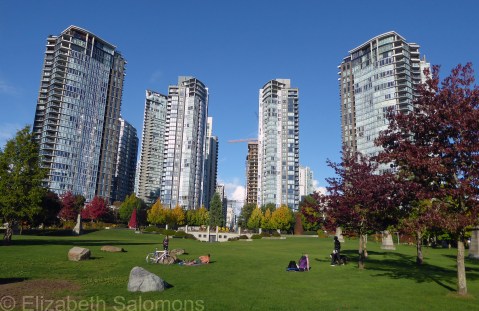
On October 14, 1986, the question on everyone’s mind was: what happens to the fairgrounds? Prior to Expo 86, the 90-hectare site was an industrial wasteland. Sawmills and railway lands had been expropriated to make room for the fairgrounds (it boggles my mind that Vancouver had working sawmills in its downtown core in my lifetime), but with rezoning came all sorts of possibilities.
In the end, what came to be known as the Expo lands was sold to a single Chinese developer. The price was controversial, but in return for a good deal on the land, the developer agreed to build child-care centres, playgrounds, a community centre, and a school. Furthermore, the condos had to include a certain percentage of family-size units and affordable housing.
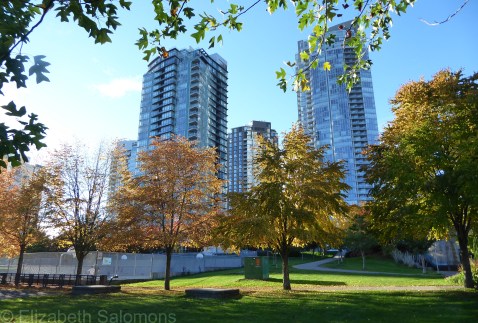
The result? A slow and careful development of a entirely new inner-city neighbourhood that, once populated, doubled the number of people living in Vancouver’s downtown core. It’s not completely finished; the last section still remains a parking lot while awaiting the demolishment of the Georgia and Dunsmuir Viaducts ― the remnants of the freeway into downtown Vancouver that never saw completion.
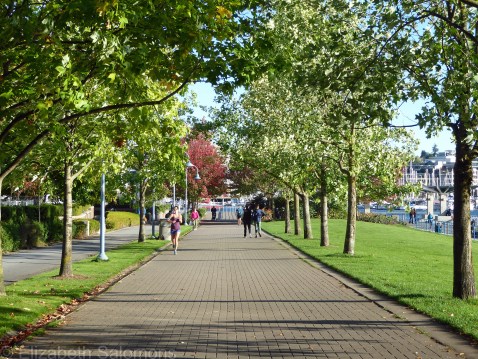
Vancouver is consistently rated as one of the most livable cities in the world and the development of the Expo lands has a lot to do with that rating. Today, the area is covered in condo towers. Agreed, they are not the most creative architecturally. But you only have to take a walk through the neighbourhood and marvel that, only 30 years ago, there was nothing there but a wide swath of empty land.
Northern Shoveller
One bonus about summer being over is that it means there are only a few more weeks to go until the return of the winter birds. I haven’t seen any sign of them yet, but they’ll be here soon and are most welcome.
This is a Northern Shoveller, one of the dabbling ducks that like to hang out at Lost Lagoon. I myself haven’t seen them that often, but that might be because I first mistook them for the much more common Mallards. From a distance, their colouring looks quite similar. Upon closer inspection, the beaks are longer than a mallard’s and are a noticeably different colour.

BC Place

If Canada Place transformed Vancouver’s look the most out of all the legacy landmarks left behind by Expo 86, then BC Place is a close second. It opened in 1983, has a capacity of 54,500, and is home to two of Vancouver’s professional sports teams: the BC Lions and the Vancouver Whitecaps. BC Place was also the venue for the opening and closing ceremonies of the 2010 Olympics. After the Olympics, it got a new roof. It is the largest cable-supported retractable roof in the world and ― in my opinion ― gives BC Place a much-needed update to the marshmallow look it had before.
Through My Lens: Pender Island Sailboat
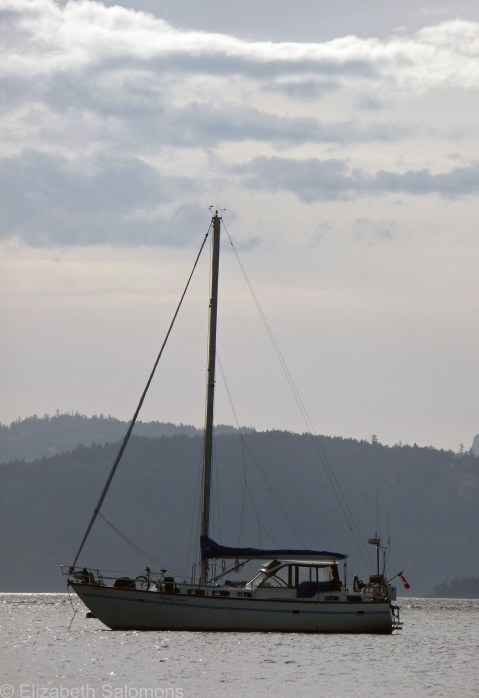
Yeah, I know. Summer’s over. I can no longer deny it.
But here’s a summer photo anyways. Just to say “until next year.” I took this from Pender Island a few years ago.
Through My Lens: Float Planes

There was a wee bit of excitement in Vancouver today about a couple of visitors. The Duke and Duchess of Cambridge are in British Columbia for an eight-day visit and today was their whistle-stop tour of Vancouver.
What I find amusing about the media coverage of the Royal Tour is how every story highlights that the Royals are being flown around the province by float plane. Float planes are, to put it mildly, a way of life in coastal BC. For some communities, it’s the only way in or out.
I took this photo of the planes docked at the Vancouver Harbour Flight Centre (aka Downtown Vancouver’s seaplane terminal) last summer. The Duke and Duchess arrived here from Victoria this morning ― by float plane.
Through My Lens: Trincomali Channel

Another mini-break on Salt Spring Island means another photo of a spectacular view. I took this from Channel Ridge where my friend and I went to walk her dog. We’re looking east over Trincomali Channel towards Galiano Island.
And here’s a cool bit of trivia: Trincomali Channel is named after HMS Trincomali, a British warship built in 1816 that is now docked in Hartlepool, England. What’s the connection between HMS Trincomali and BC? The ship was stationed at the Esquimalt Royal Naval Dockyard near Victoria in the 1850s. The dockyard was an important station of the British Royal Navy from 1842 to 1905 and is now home to the Royal Canadian Navy’s Pacific Fleet.
Through My Lens: Herbs, Herbs, and More Herbs
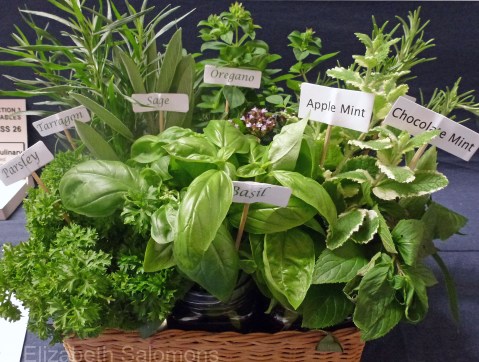
And … it’s that time of year again. Tomorrow I head off to Salt Spring Island for my “island fix” ― and it just so happens that it’s also the weekend of the Salt Spring Island Fall Fair. It was during my visit to the fair two years ago that I snapped this photo.
I don’t know if my friend and I will make it to the fair this year, but I do know I am looking forward to some island time.
Imagine
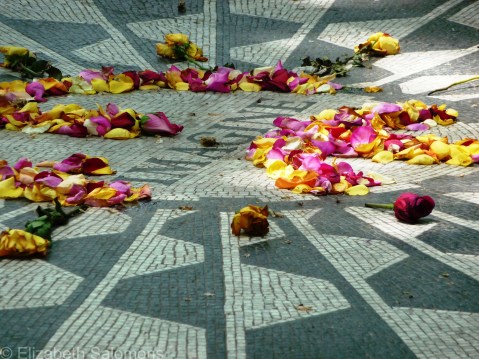
Imagine there’s no countries
It isn’t hard to do
Nothing to kill or die for
And no religion too
Imagine all the people living life in peace, youYou may say I’m a dreamer
But I’m not the only one
I hope someday you’ll join us
And the world will be as one
― John Lennon
Inukshuk at English Bay
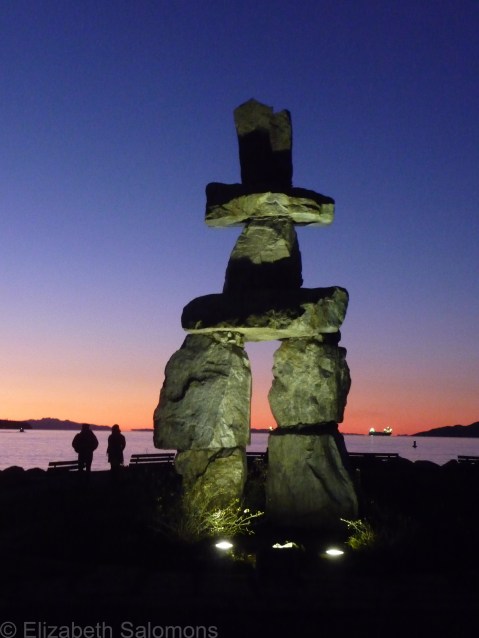
One of the most surprising discoveries from my research about the legacy landmarks of Expo 86 was when I learned about the origins of the inukshuk at English Bay. Turns out this iconic sculpture is the same one that stood in front of the Northwest Territories Pavilion at Expo. The territorial government commissioned Alvin Kanak of Rankin Inlet to create the sculpture made of grey granite. After Expo, it was given to the City of Vancouver, and it has stood in English Bay since 1987.
Pileated Woodpecker
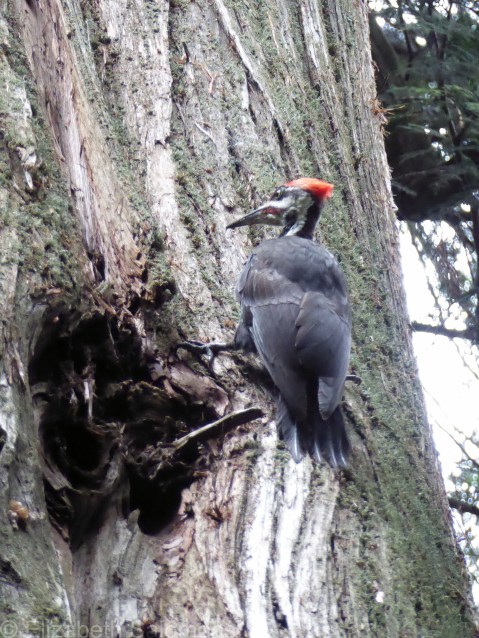
Here’s someone I met on one of my walks through Stanley Park this month.
This is a Pileated Woodpecker, the largest (about the size of a crow) of the four species of woodpeckers found in the park. This particular woodpecker loves forests and the best way to find him is to look up.
Way up.
Check out that grip.


