
University of British Columbia
The last school I want to show you on my tour of schools I’ve photographed is the University of British Columbia. Like Simon Fraser University, UBC is situated a ways away from the hustle and bustle of the city centre ― its main campus is located at the western tip of Point Grey, a peninsula to the west of Vancouver’s toniest neighbourhoods.
UBC is a hodge-podge of architectural styles. For one, it’s got your neo-Gothic. This is the Chemistry Building, one of the first three buildings constructed on the Point Grey campus. That was back in 1925.

For another, it’s got your Brutalism. The Buchanan Tower was built in 1972.

And it’s got your postmodernism. This is the Koerner Library, which was designed by Arthur Erickson and completed in 1997.

UBC is fond of combining architectural styles when it builds additions to existing buildings. The Main Library, another of the three buildings constructed in 1925, morphed into the Irving K. Barber Learning Centre in 2008. The neo-Gothic centre is the original building, now surrounded by a postmodern glass structure.
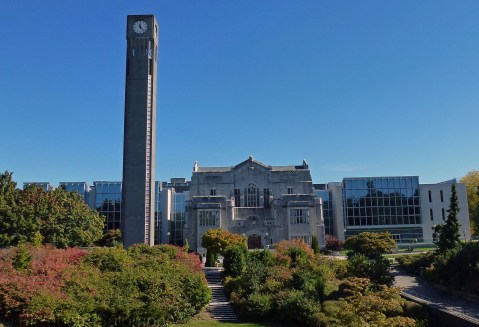
Here’s a look at it from another angle.

Four wings were added to the Chemistry Building between 1959 and 1989. This is a corner of one of those wings, built in the Brutalist style.
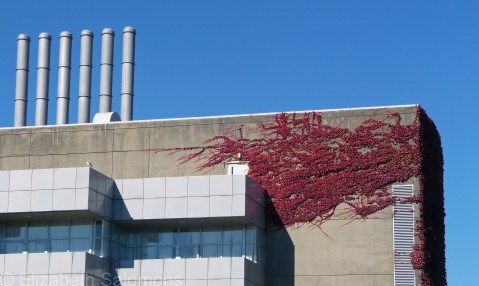
And this postmodern structure is an addition to the Henry Angus Building, which houses the Sauder School of Business. The addition, which opened in 2012, is wrapped around the original building, which was built in 1965 and expanded in 1976.

With 50,000 students, UBC is Canada’s fourth largest university and the largest in Western Canada. These days, the Point Grey campus is one massive construction site. In the past year, work was completed on a new trolley bus loop, upgrades to primary pedestrian corridors (which for some reason I have yet to figure out are called “malls” here), and a new fountain in Martha Piper Plaza. Building construction currently underway includes a new Student Union Building, the new Centre for Brain Health at UBC Hospital, and expansion of the UBC Bookstore. A new building that will house the Faculty of Education is scheduled to break ground this winter.
UBC’s Class of 2016 fittingly calls itself the Class of Construction.
Simon Fraser University
And now, for something completely different.

Unlike the universities I wrote about in the previous four posts, whose campuses are all situated smack in the middle of a city, Simon Fraser University sits above the city, on top of a mountain. (Which, in my humble opinion, takes the notion of an Ivory Tower a tad too literally.)
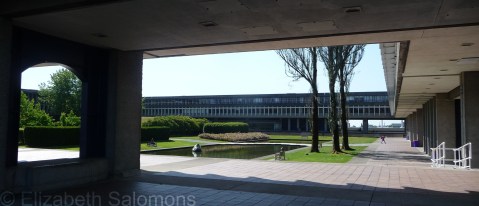
Construction of SFU’s Burnaby campus was begun in the spring of 1964, and the university welcomed its first 2500 students in September 1965.

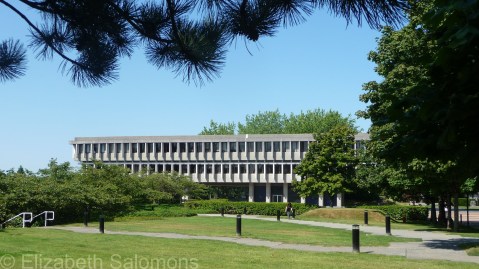
The architects were Arthur Erickson ― probably Vancouver’s best-known and most influential architect ― and Geoffrey Massey. The campus atop Burnaby Mountain is in the Brutalist style of architecture, and won the 2007 Prix du XXe siècle from the Royal Architectural Institute of Canada, which recognizes buildings of significance to Canada’s architectural history.
University of Cambridge
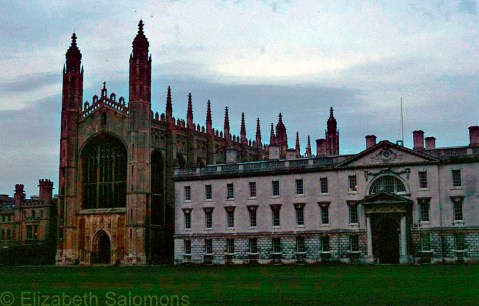
I went to Cambridge for one reason and one reason only: to hear the King’s College Choir.
I got to hear them sing a Choral Eucharist service in this chapel, the King’s College Chapel of King’s College of the University of Cambridge. Quite the chapel. Quite the choir.
I don’t remember much else of the University of Cambridge or the city of Cambridge. It was a quick one-night stop at the end of a three-week English walkabout and I was weary of sight-seeing.
But I’m never weary of choral music. It was worth the stop.
University of Oxford
When I applied to and was accepted at the University of Toronto, I enrolled as a student at Woodsworth College. I didn’t get the whole college-thing they had going at U of T, and didn’t much care what college they stuck me in, but eventually I discovered that all unclassified and part-time students (I was both) were lumped together at Woodsworth.
When I would introduce myself to my fellow undergrads, the first question after “What’s your major?” was always: “What college are you?” I quickly figured out that each college at U of T had its own personality, and prestige, and Woodsworth didn’t rank very high with respect to either.
This all seemed rather strange and unusual to me. In Western Canada, you applied to and enrolled in a faculty; in my case, I was a student in the Faculty of Arts at the University of Alberta. Colleges were independent entities, completely separate from the universities; I had attended one of those as well before transferring to U of A.
Like I said, I didn’t “get” the whole college-thing they had going at U of T.
Until I got to Oxford, that is.
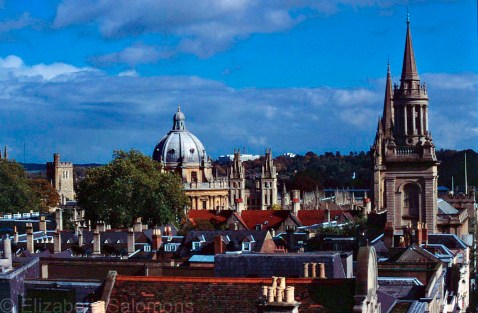
Oxford is chockfull of colleges ― 38 of them, in fact ― and as I wandered around the “city of dreaming spires,” I came to the realization that the University of Toronto is modelled after the University of Oxford. So that’s where U of T got the idea for all those colleges, I said to myself.
Many of the colleges of Oxford University are open to the public, and I walked reverently through several of them. I happened to walk by the entrance to the chapel of Magdalen College (where C.S. Lewis taught) and was warmly invited to attend the Choral Evensong service that was about to begin. In the Great Hall of Christ Church College, I was greeted by an elderly gent whose sole job seemed to be pointing out the “Alice” window to visitors. (That would be the stained glass window put in to commemorate the author Lewis Carroll, who had been a Christ Church scholar.)
Oxford is a beautiful town. I explored it while on walkabout in the English countryside some years ago, fell in love with it, and made a promise to one day return to it.


University of Toronto
Next up on my tour of schools I’ve photographed: the University of Toronto. I was a student here myself a long time ago, just for a year, and to this day I consider it the prettiest of all the schools I’ve attended (and there’ve been a few).
When I commented to my sister on the architectural style of the buildings at Johns Hopkins, she asked me what the buildings at U of T looked like.
“They’re neo-Gothic,” I said. Also called Gothic Revival, you see neo-Gothic buildings all over Canada ― our Parliament Buildings in Ottawa are probably the best-known example.
The University of Toronto has been around since 1827, has a dozen colleges on three campuses, and is the largest university in Canada with an enrollment of 75,000 students. I took these photos of the St. George campus when I was in Toronto exactly a year ago this week.


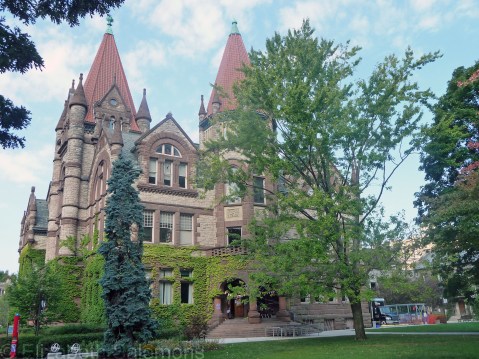
Not all of the buildings on the St. George campus are neo-Gothic. The main building of Victoria University, shown below, is called Richardsonian Romanesque, after its architect, Henry Hobson Richardson.
Trinity College is in the Jacobethan style.

And this monstrosity, Robarts Library, was built in the 1970s in what is known as Brutalist Architecture. Appropriate name for the look, I should think. It’s not-so-affectionately known as “the Turkey” by the students of U of T; I’m sure you can figure out why.

Johns Hopkins University
Working on a university campus ― as I now do ― I’m much more in tune to the rhythms of the academic year than I have been for a long, long time. UBC has been delightfully (delightfully!) deserted these past four months, but then, all of a sudden, all at once, more than 50,000 students descended onto the campus this past week, and the place is now overrun (overrun!) with twentysomethings.
On my travels, I sometimes find myself wandering around university campuses. The architecture always fascinates me, as each school has its own unique look. And so, this being September, I thought I would take you on a tour of some of the schools I’ve photographed.
First up: Johns Hopkins University. It’s not the biggest of schools ― about 20,000 students ― but it certainly is a reputable school. I was shown around its Homewood campus by my sister just over a year ago, when I was in Baltimore to visit her.
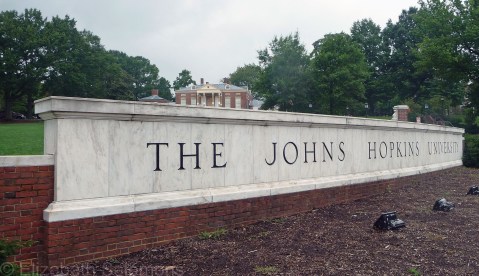
Hopkins was founded in 1876 through a bequest by Baltimore abolitionist, entrepreneur, and philanthropist Johns Hopkins. Here is a bust of the man himself.

Homewood House, seen in the next photo, was a private home built around 1800 that was eventually given to the university. It was built in the Federal Style ― a style of architecture you don’t see much in Canada ― and is said to be the inspiration for the look of the Homewood campus of JHU. It’s now a museum.

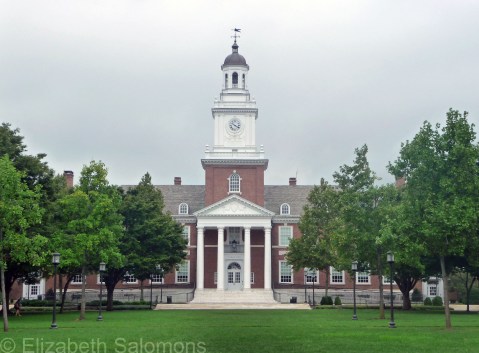
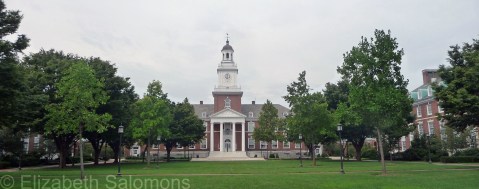
This is Gilman Hall, home to the humanities and social sciences departments.
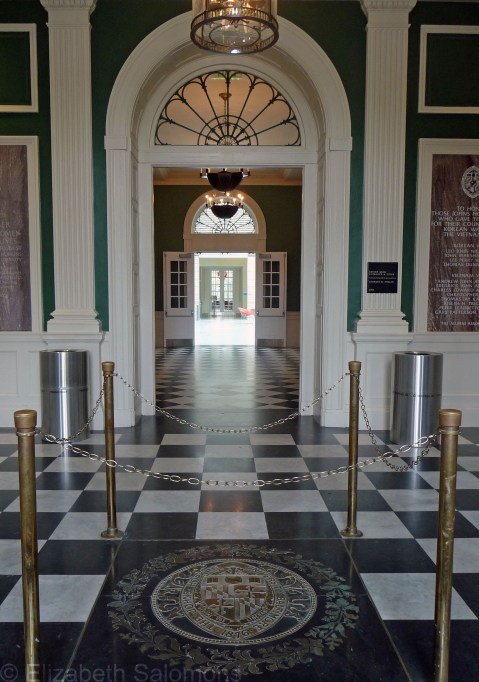
And this is what you see once you step inside Gilman Hall.
Keep on walking, and you’ll come to the Hutzler Reading Room.

It is such a beautiful room I couldn’t stop taking photos. Here’s another.

And another.

The imposing structure shown below is the Milton S. Eisenhower Library. As impressive as it is, it’s not quite as impressive as the George Peabody Library, located at the Peabody campus of JHU, which my sister took me to see after our tour of the Homewood campus. (Click here to see a photo of that library.)

On another day, while waiting for a bus, I realized we were standing in front the Johns Hopkins Hospital, so I took this photo. I quite like the three-storeyed porch, which I didn’t notice until I was editing these photos. Johns Hopkins Hospital is the top-rated hospital in the United States, and its School of Medicine is located on the East Baltimore campus of JHU.

So there it is: your look at Johns Hopkins University. My one regret is I didn’t get to see it in its fall glory, which I’m sure must be spectacular.
Through My Lens: Chihuly in Vancouver
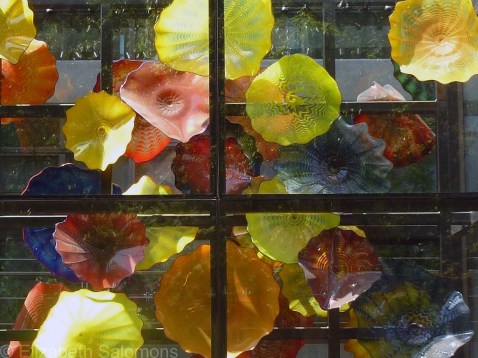
Remember Chihuly in Seattle? After I got back from my two days in Seattle, I was telling a friend here in Vancouver about Chihuly’s remarkable art work. And that friend then informed me one of Chihuly’s glass works is permanently on display at Bute and Alberni.
“Bute and Alberni?” I looked at him, puzzled. “I used to work at Bute and Alberni. Where ―?”
And then the penny dropped. The glass flowers in the glass box! I would stare at them from my seventh-floor office window whenever I was stuck editing a page, a paragraph, a sentence, … basically anything with words in it. It happened ― a lot.
This photo isn’t the best because, well, there was this massive, not very clean, glass box between my camera lens and the art work. But, there you have it, Vancouver readers. Know that we have our very own Chihuly glass work.
Through My Lens: Sails

Last week, I posted a photo of the giant pillows made from the sails at Canada Place. I took this photo — of those same sails when they were still hanging in their original home — back in 2009.
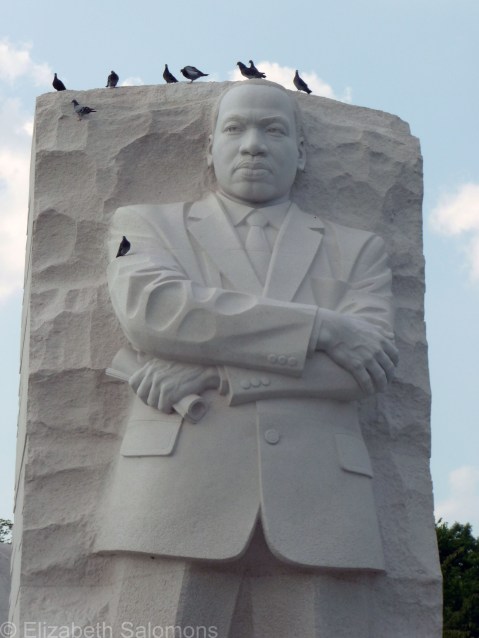
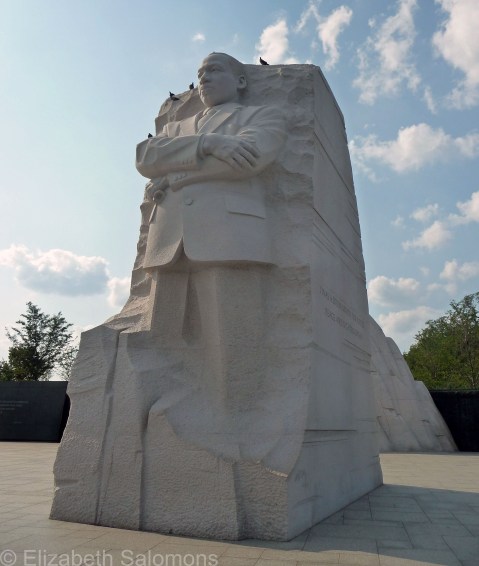
Martin Luther King Jr. Memorial
I have a dream that one day this nation will rise up and live out the true meaning of its creed: ‘We hold these truths to be self-evident, that all men are created equal.’
I have a dream that one day on the red hills of Georgia the sons of former slaves and the sons of former slave-owners will be able to sit down together at a table of brotherhood.
I have a dream that one day even the state of Mississippi, a state sweltering with the heat of injustice, sweltering with the heat of oppression, will be transformed into an oasis of freedom and justice.
I have a dream that my four little children will one day live in a nation where they will not be judged by the color of their skin but by the content of their character.
I have a dream today.
I have a dream that one day down in Alabama, with its vicious racists, with its governor having his lips dripping with the words of “interposition” and “nullification” ― one day right there in Alabama, little black boys and black girls will be able to join hands with little white boys and white girls as sisters and brothers.
I have a dream today.
I have a dream that one day every valley shall be exalted, every hill and mountain shall be made low, the rough places will be made plain, and the crooked places will be made straight, and the glory of the Lord shall be revealed, and all flesh shall see it together.
This is our hope.
This is the faith that I will go back to the South with.
With this faith we will be able to hew out of the mountain of despair a stone of hope.
With this faith, we will be able to transform the jangling discords of our nation into a beautiful symphony of brotherhood.
With this faith, we will be able to work together, to pray together, to struggle together, to go to jail together, to stand up for freedom together, knowing that we will be free one day. — Martin Luther King Jr.


Through My Lens: Lunch Break

Last summer, these delightful giant pillows lay on Robson Street, directly in front of the Vancouver Art Gallery. This summer, they found a new home in front of UBC’s Koerner Library. They’re called Pop Rocks. Their fabric was recycled from the old sails at Canada Place (which were replaced in 2010), and they were stitched together by a local sail maker.
I wonder how many lunch-time naps they’ve witnessed?


 There and Back Again