
Happy Birthday, Madiba!
As I walked out the door toward the gate that would lead to my freedom, I knew if I didn’t leave my bitterness and hatred behind I would still be in prison. ― Nelson Mandela
Today is Nelson Mandela’s 95th birthday. The world was worried he would not see this day, given his current state of health, but, here it is, he is here, and South Africa is celebrating.
When I visited Robben Island (the prison where Mandela spent 18 of the 27 years he served behind bars), what struck me most was how incredibly close it is to Cape Town ― and what a beautiful view of Table Mountain you have from the island. I imagine the prisoners would have been haunted by that view.
Mandela was allowed one visitor a year for 30 minutes, and could write and receive one letter every six months. The grace he has displayed since his release in 1990 is a testament to the healing power of forgiveness.

Table Mountain as seen from Robben Island
Reel Life: Gettysburg
 One last post about Gettysburg, and then I’ll stop. Promise.
If you’re keen to see the battlefields of Gettysburg, but can’t make it to Pennsylvania in person, you might consider watching the 1993 film Gettysburg. I recommend the film only because it was shot on location at Gettysburg, so it gives you an accurate look at the landscape and physical layout of the two battle scenes featured in the film: the defense of Little Round Top and Pickett’s Charge.
The film was made pre-CGI, using real cannons to reenact the artillery barrage that took place on the morning of July 3, 1863. Even when using only quarter rounds, the cannons in that scene are far more impressive than any blow-’em-up scene I’ve seen in recent years.
Other than the principal actors, the cast consists entirely of Civil War reenactors ― some 13,000 of them. These guys take their roles pretty seriously, living and sleeping as Civil War soldiers did, wearing the same type of wool uniforms, and carrying the same type of weapons.
I saw the film Gettysburg in the theatre the year it was released and it motivated me to one day visit Gettysburg for myself. However, I recommend the film only if you’re really, really interested in the story of the battle. At four and a half hours, it taxes the attention span of most casual viewers.
Armchair Traveller: Hallowed Ground
But, in a larger sense, we can not dedicate — we can not consecrate — we can not hallow — this ground. The brave men, living and dead, who struggled here, have consecrated it, far above our power to add or detract. — President Abraham Lincoln
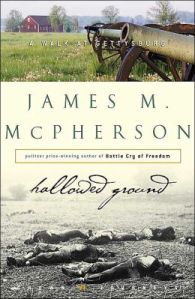 Last post I wrote that you couldn’t tour the Gettysburg battlefields on foot ― not in an afternoon, that is. But should you be motivated to attempt it, I highly recommend taking along James M. McPherson’s book, Hallowed Ground: A Walk at Gettysburg.
Professor emeritus of Princeton University and author of the Pulitzer Prize–winning book Battle Cry of Freedom, McPherson is considered the finest Civil War historian in the world (according to his book’s flap copy). Hallowed Ground takes its title from the words Abraham Lincoln spoke in his Gettysburg Address (quoted at the top of this blog post).
As a guidebook on its own, Hallowed Ground lacks maps and precise details about how to navigate the park. But as a means of providing context, I found Hallowed Ground invaluable reading prior to my tour of Gettysburg. McPherson explains in simple lay language how the battle changed the course of the Civil War, and its significance in American history. The book includes anecdotes of the author’s walks around key positions of the battle, such as Seminary Ridge, the Peach Orchard, and Little Round Top, as well as stories about the various monuments and statues.
McPherson has led countless tours for students and others at Gettysburg; with a little imagination, reading his book is like being on one of his tours.
Gettysburg

As I was planning my trip around the Eastern Time Zone last summer, I knew that one of my must-sees was going to be Gettysburg. I’m a history geek, and my pre-trip research quickly led me to the conclusion that it would be worth the drive from Baltimore, where I was planning to spend the better part of a week.
And so, I booked a car rental, enlisted my sister as navigator, and off we went for a drive through the Pennsylvania countryside. Both of us came away rather impressed with what we saw and learned. Since this week was the 150th anniversary of the Battle of Gettysburg, I thought it would be a timely blog post for the Fourth of July.
There are a number of ways to tour Gettysburg National Military Park. We opted for the Self-Guiding Auto Tour, where you are supplied with a map showing the location of more than a dozen stops throughout the park, each one of which has a viewpoint and a marker explaining its significance. If you lack a capable navigator such as I had, the Visitor Center sells CDs you can pop into your car’s stereo system while you drive, or you can take a guided bus tour.
What you can’t do ― not in an afternoon, that is ― is tour the battlegrounds on foot. At 6000 acres, the park is massive and completely surrounds the town of Gettysburg.
Now, if history isn’t your thing, you should skip on to the photos at the end of this post. But if you want a little background, read on.
In June 1863, General Robert E. Lee was the commander of the Confederate Army of Northern Virginia. He’d spent most of the month moving his 93,000 soldiers north into Pennsylvania so they’d be in a position to push the Union forces out into the open and into battle. Once he decimated them (so he figured, based on his recent successes), it would bring about the end of the war.
The 75,000-strong Union Army of the Potomac shadowed Lee’s movements, but at a slower pace to make sure they were always in position to protect Washington DC from the Confederate forces. On June 28, 1863, General George G. Meade took command of the Army of the Potomac.
Both generals were angling for a favourable spot for a battle ― what is ironic about when they finally met is that the Confederate Army was moving south and the Union Army was moving north. Neither army was aiming for Gettysburg, either. But when Confederate soldiers chanced upon and were attacked by Union soldiers on July 1 ― an attack the Confederates successfully defended ― Lee realized if he acted fast he could fight the Union forces before they had finished assembling. He decided to use the chance meeting as an excuse to start a major battle.
By the morning of July 2, the Union forces had retreated from the northwest of Gettysburg, where the previous day’s fighting had occurred, to the southwest of Gettysburg. Despite their retreat, their position was good ― they occupied a series of hills and ridges in a semicircular position. The Confederate forces had no choice but to attack from below, which they did at both ends of the Union line. The Confederate forces gained a bit of ground, but losses were high and on the evening of July 2, the Union forces still occupied the high ground.
Because the Union forces had successfully repelled the Confederate attacks at either end of their line, Lee was convinced that Meade had concentrated his forces on his flanks. On July 3, Lee ordered an attack on the centre of the Union line, which he thought would be the weakest point.
The Confederate artillery fired on the Union position for several hours. The Union artillery answered back with its own volley, but eventually went quiet. Lee assumed the Union guns been knocked out. He ordered the advance of some 12,000 Confederate soldiers toward the 7000 waiting Union soldiers. This attack, which came to be known as Pickett’s Charge, required the Confederate forces to march across almost a mile of open ground. While they were in the open, Union artillery ― which had not been destroyed after all ― again took up their firing.
Union losses that day were about 1500 killed or wounded, but the Confederate casualty rate was much higher ― almost 50 percent. Total losses from both armies over the three-day battle was more than 50,000. Lee admitted defeat and began his retreat from Pennsylvania the next day. By the time Meade realized Lee was retreating all the way to Virginia, not merely heading back into the mountains, it was too late for him to catch up.
Most historians consider Gettysburg to be the turning point of the Civil War ― and the battle that saved the Union. Pickett’s Charge is called the High Water Mark of the Confederacy because it was the furthest line of advance made by the Confederate Army, but the Union victory at Gettysburg ensured that Lee’s invasion of the North was over.
If you’re still with me, all I want you to take from what I’ve written above is that it immediately becomes clear as you drive around Gettysburg Park what role the terrain this corner of Pennsylvania played in the outcome of the battle. The establishment of the park in 1895 (initially maintained by the War Department, now by the National Park Service) means that the entire battleground still looks, for the most part, as it did in 1863.
And so, you can see (just barely through the trees) the cupola of the Old Dorm of the Lutheran Theological Seminary, which provided a crucial observation post on the night of June 30 as the Union generals surveyed the landscape and chose where to place their troops. You can stand at the rocky summit of Little Round Top and imagine the fierce battle that took place on its slopes as Confederate soldiers tried to overtake it on July 2. You can survey from various viewpoints the hilly terrain that frames either side of the fields the Confederate soldiers marched across during Pickett’s Charge on the afternoon of July 3. And you can stand where the Confederate soldiers stood, and look across the same fields they looked across, and see the copse of trees where the Union soldiers were waiting for them.
And now, as promised, here is a photo tour of Gettysburg National Military Park. (Click on the first photo at top left to open the slide show.)


Happy Canada Day!
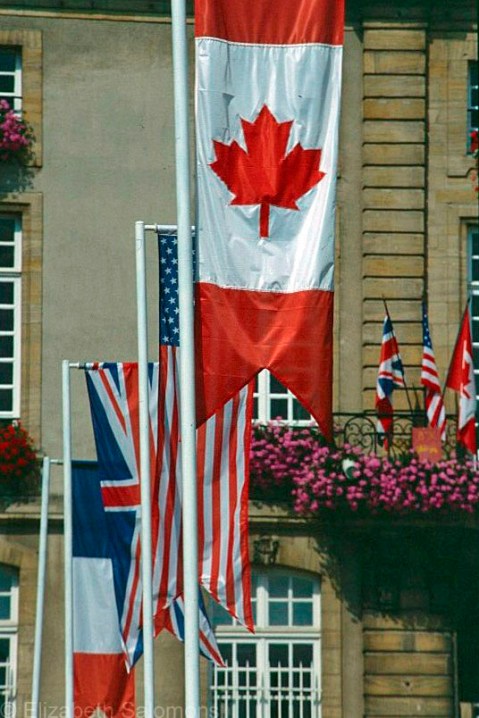
When I travel, nothing catches my eye like a Canadian flag ― whether it’s stitched to the backpack of a fellow traveller, or hanging in the streets, like this one in the Norman town of Bayeux, France.
Vancouver International Jazz Festival

I once had a home exchange offer from a couple in San Francisco who wanted to attend the Vancouver International Jazz Festival. The timing didn’t work for me so I had to turn down the offer, but I was so pleased to find out that our Jazz Fest attracts people all the way from California.
The festival got its start during Expo 86, and has been held every year since. It’s now Canada’s second-largest jazz festival (second only to Montreal). Some 300 performances (half are free), some 1800 performers, and almost half a million spectators enjoy some of the best music to be heard in Vancouver.
Jazz Fest is always held the last ten days of June ― just in case you want to put it on your calendar for next year.

Room With a View
A dear friend of mine flew across the Atlantic Ocean last night to begin her summer in Italy. Tonight, she is in Siena.
Nope, not jealous.
No, really! (I’m thinking the more often I repeat that mantra, the sooner I’ll believe it.)
What’s great about having friends who like to travel is that you’re never short of travelling companions. And what I love about this particular friend is how comfortable we both feel at inviting ourselves along when the other is making travel plans. Case in point: when I told her last summer that I had arranged a week-long home exchange in New York City, and then asked her what she was doing the third week of August, she didn’t hesitate.
“It looks like I’m spending the third week of August in New York,” she said.
I’ve never spent a summer in Italy (someday!), but I once spent a week in Siena. I invited myself to visit this same friend (do we see a pattern here?) while she was studying art through the University of Toronto’s Summer Program in Siena.
After spending a sleepless night on a train from Vienna to Florence and a hot day wandering Florence feeling slightly ill, I boarded the bus to Siena and promptly fell asleep. When I woke, I thought I’d died and gone to heaven. The Tuscan countryside I was looking at through my window was more beautiful than I ever imagined it could be.
I waited for my friend on the steps of the Basilica of San Domenico, which, back in those days, was where the buses from Florence dropped you off. I was far too early, but I happily spent the next few hours relaxing and people-watching in the shade of the cathedral.
My friend showed up at the hour we agreed to meet, and in no time at all we had deposited my bag in her room and were seated at an outside table of the nearest trattoria, sharing a bottle of Chianti and digging into two heaping plates of pasta, Tuscan style. Italian teenagers whizzed by us on scooters. Through the course of the evening, my friend’s classmates, one after the other, joined us at our table. It was the best arrival I’ve ever experienced in a foreign city.
This photo was the view from her room in the student residence of the University of Siena. Can you imagine waking up to that vista every morning for five weeks? I sure can.

Through My Lens: Bow River
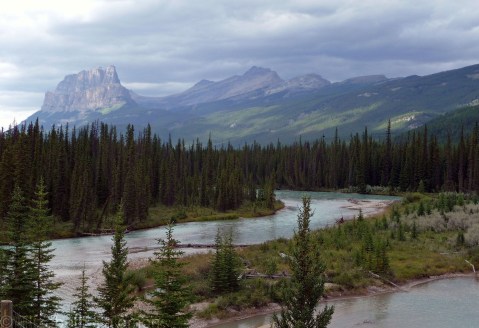
As someone who considers herself an Albertan at heart (having been raised there), I can’t help but be affected by the images coming out of the southern part of that province today. What’s so shocking is how quickly the rivers rose (in about 36 hours) and how many people have been affected (more than 100,000 evacuated). Flooding from spring run-off is common on the Prairies, but the effects of this rainstorm took everyone by surprise.
One of the flooded rivers is the Bow River. It’s completely overflowed its banks in the community of Canmore and in the city of Calgary, Alberta’s largest city. I took this photo of the mighty Bow looking mighty placid some miles upstream from Banff a few years ago while travelling from Edmonton to Vancouver by car.
Recipe Box: Wild BC Spot Prawns

I first discovered wild BC spot prawns a couple of years ago when I noticed them popping up on restaurant menus around town.
“Spot prawns? What are spot prawns?” I asked my friends. They didn’t know either. I ordered them, tasted them, fell in love with them …
With a little research, I discovered that the wild BC spot prawn is the largest of seven species of commercially available BC shrimp. What’s unique about them is their distinctive white spots and naturally bright orange colour.
With a little more research, I learned that the spot prawn fishery is one of BC’s most sustainable fisheries. It’s limited to trap gear only, and the prawns are hand sorted upon removal from the ocean. Prawns too small for consumption are thrown back. About 90 percent of the commercial catch is shipped to Japan and the remainder is sold locally. But here’s the kicker: the season is short ― only six weeks from mid-May to June. In other words: get them while you can. (And if you don’t live in BC or Japan, well, too bad for you.)
Last year, I got up the courage to cook spot prawns myself. I had house guests ― my brother and his family were visiting from land-locked Alberta ― and when they told me they wanted to spend the day playing tourist at Granville Island, I decided to show off. I told them, casual like (as if I did it all the time), that I would pick up some spot prawns at the market for our dinner.
I was a bit taken aback when the fishmonger scooped a handful of live spot prawns from a water tank. “I didn’t know they were sold live,” I whispered to my brother, my bravado quickly disappearing. Gamely, I accepted the plastic bag of prawns wrapped in newspaper. I told the fishmonger I was planning to sauté them with garlic in butter.
“Excellent,” he said. “That’s the best way to prepare them.”
“But … do I have to … you know … kill them first?” I asked gingerly.
“Nope,” he said. “By the time you get them home, they’ll be dead.” Phew. I’m no vegetarian, but I draw the line at killing my own food.
He was right. When I unwrapped my package a few hours later, the shrimp were still bright orange, but most definitely in a non-living state. I cooked them up, and we devoured those garlicky spot prawns in record time. Their taste reminded me of lobster, and my only regret was that I didn’t buy more.
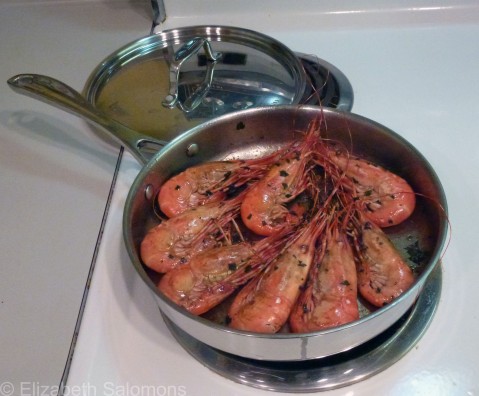
This year, I did buy more, and I cooked them the same way, relishing them as much as the first time. The very next evening, I went to my sister’s and her husband’s for a barbecue dinner, and was pleased to find out that grilled spot prawns were on the menu. But I was stunned when I saw the plate of prawns she had prepared for grilling.
“Where are the heads!?” I asked.
My sister looked at me, puzzled. “You have to take them off,” she insisted.
Lively debate ensues: do you eat spot prawns with the heads on or off? (And, while we’re at it, do you need to devein them?)
Back to Google. It turns out that deveining spot prawns is a matter of personal preference. (I have yet to taste the grittiness some claim is common if you don’t devein.) But what is critical is that you remove the heads immediately if you aren’t intending to cook the prawns the same day, because they release an enzyme after death that makes the tail meat turn mushy.
Here is the recipe I like to use (with heads on), but know that if you eat yours with heads off, they will be just as tasty.
Enjoy!
Wild BC Spot Prawns
1 pound whole spot prawns
2 tablespoons butter
2 cloves minced garlic
1 tablespoon chopped parsley
1/4 cup dry white wine
salt and pepper to taste
1. Melt butter in a large frying pan on medium high heat.
2. Add minced garlic and parsley and sauté for 1 to 2 minutes.
3. Add prawns and white wine, tossing to coat with the butter and parsley, then season with salt and pepper.
4. Cover and cook 4 to 5 minutes, no longer.
Serve with slices of crusty baguette and a chilled buttery chardonnay.

Chihuly Garden and Glass
A couple of posts ago, I mentioned that the Chihuly Garden and Glass alone was worth a visit to Seattle. I did not exaggerate: it is one of the most distinctive art installations I have ever seen.
The artist, Dale Chihuly, was born in Tacoma, Washington, in 1941. He studied at the universities of Washington and Wisconsin and at the Rhode Island School of Design, and in Venice, Italy, on a Fulbright. His work is exhibited in more than 200 collections all over the world.
If you ever get to Seattle, do not miss this unique gallery.
And, if you are still not convinced, here are a few more photos. (Just a few.)


 There and Back Again