
Through My Lens: Mosque–Cathedral of Córdoba

Last Sunday, I promised you a photo of the nave of Córdoba’s Mezquita. Here it is, for the Fifth Sunday of Lent.
A Papal Conclave
All eyes will be on Rome tomorrow as the 75th papal conclave begins. Papal conclaves have been conducted to elect popes after it took two years, nine months, and two days to elect a successor to Pope Clement IV in the thirteenth century. To avoid a repeat of that nonsense, Pope Clement IV’s successor, Pope Gregory X, decreed that all future papal elections would take place with the voting cardinals locked in a room until they came to a decision. Cum clave (conclave) is Latin for “with a key.” And so began the papal conclaves that, for the most part, have been used to elect new popes ever since.
I think posting a photo of St. Peter’s Basilica (aka Basilica Papale di San Pietro in Vaticano) is appropriate, given the occasion. By the time I wake up tomorrow, the 115 cardinals will be getting ready to process into the Sistine Chapel. The first puffs of smoke should follow a few hours later. The conclave that elected Pope Benedict XVI in 2005 took less than 24 hours.

Through My Lens: Mezquita de Córdoba

For the Fourth Sunday of Lent, I’m posting a photo of the interior of the Mezquita de Córdoba. The Mezquita is a cathedral built inside a mosque built on top of a church. Given that back-and-forth heritage, it’s often called the Mezquita–catedral de Córdoba (the Mosque–Cathedral of Córdoba).
The original church, the Basilica of Saint Vincent, was built by the Visigoths in the sixth century. When the Moors arrived in Córdoba in the late eighth century, they built a mosque on top of that basilica. The main prayer hall of the Mezquita (shown in this photo) is filled with an impressive forest of columns supporting 400 red-and-white double arches. Even today, it is one of the largest mosques in the world.
After the Reconquista (reconquest) of Córdoba in 1236 by the northern Christian kingdoms, the mosque was reconsecrated as a Christian church. Eventually, the minaret was turned into a bell tower and a Renaissance cathedral nave was built in the middle of the mosque. Stay tuned ― next Sunday I’ll post a photo of that nave.
Joe Fortes
I wanted to publish this post last month, but I had to wait for a break in the rain so I could take the photo. And … well … I had to wait quite awhile. I finally got my chance last weekend.
This photo is of a fountain in Alexandra Park that stands facing English Bay Beach. The fountain was erected in honour of Joe Fortes. There’s also a popular downtown restaurant named after Joe Fortes, and the local branch of the Vancouver Public Library is named after him. If you live in Vancouver’s West End, eventually you’re going to ask (as I did), “Who’s this Joe Fortes guy they keep naming things after?”
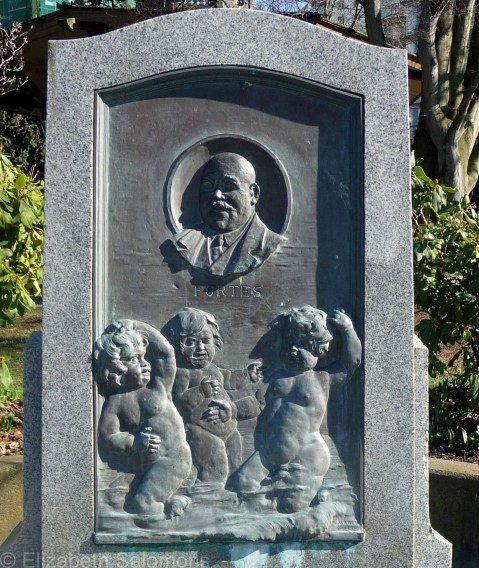
Joe Fortes was born in Trinidad and Tobago in 1863, and he arrived in Vancouver, via England, in 1885. He first started up a shoeshine business, then worked as a bartender and a porter.
When he wasn’t working, he hung out at English Bay, acting as a volunteer lifeguard. In 1897, the city of Vancouver made his volunteer position official when he was put on the payroll as the city’s first lifeguard. He lived in a little cottage just above the beach on Bidwell Street, and is credited with saving more than a hundred people from drowning, and with teaching thousands of children how to swim.
When Joe Fortes died in 1922, his funeral was attended by the mayor, the chief of police, and thousands of Vancouver citizens ― the largest public funeral Vancouver had ever seen. There was also a moment of silence held in the city’s schools.
On February 1, 2013 (which is why I wanted to publish this post a month ago), Canada Post issued a stamp featuring Joe Fortes to commemorate Black History Month. Joe Fortes is an appropriate choice for this year’s stamp as 2013 is the 150th anniversary of the year of his birth.
Through My Lens: La Sagrada Família

For the Third Sunday of Lent, we’re moving on to Barcelona.
Most European cathedrals were built centuries ago. The cornerstone of this one, Basílica i Temple Expiatori de la Sagrada Família, was laid a mere 131 years ago in 1882. Except for a stoppage during the Spanish Civil War, construction has continued ever since. The basilica is the final work of Catalan architect Antoni Gaudi, the face of Modernisme, who spent the last decades of his life working on the structure.
When finished (estimated to be in about 15 years), La Sagrada Família will have 18 spires and will be the tallest cathedral in the world. There will be three facades, two of which have already been completed: the Nativity façade and the Passion façade. The Passion façade, which faces west, was sculpted by Josep Maria Subirachs and is particularly moving.
I visited La Sagrada Família with a friend in October 2001. After we left what is essentially the largest construction site either of us had ever seen, we took the metro back to our hotel. Sitting across from us was one of the cathedral’s stone workers, covered in white dust, heading home after his work day. I marvelled at the thought of spending your entire career working on one project. And I felt honoured to be riding the metro with an old-school master craftsman.
George Peabody Library
This week is Freedom to Read Week in Canada, so I thought it was high time I wrote another post about a book. Or, perhaps, many thousands of books. Like the ones in this library.
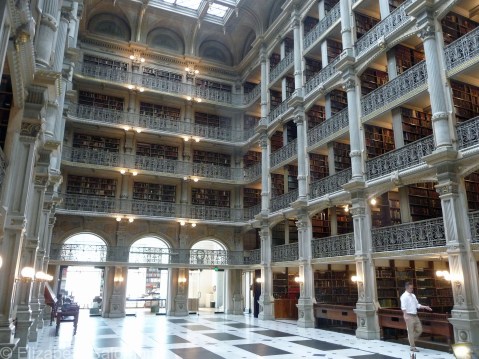
There are libraries. And then … well … and then there’s the George Peabody Library.
The George Peabody Library is one of the libraries of Johns Hopkins University in Baltimore, Maryland. It’s housed in a stunning building designed by architect Edmund Lind and has been open to the public since 1873. The library is named after George Peabody, the American–British financier and philanthropist who provided the funds for the library’s founding in 1857.
The collection consists of over 300,000 books, mostly from the eighteenth and nineteenth centuries, and specializes in all the good stuff: archaeology, British art and architecture, British and American history, English and American literature, Romance languages and literature, Greek and Latin classics, history of science, geography, and ― wait for it ― exploration and travel.
There are a lot of cool-looking libraries on this planet. As if I need another reason to travel, I plan to photograph as many of them as I can.
Through My Lens: Cathedral of Ávila
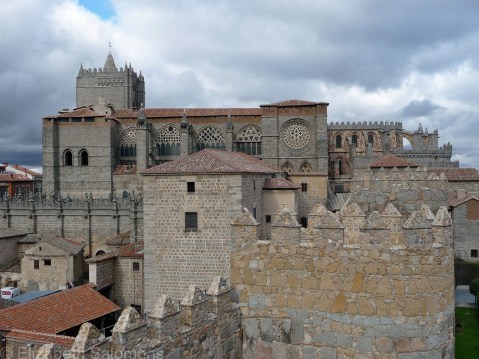
It’s the Second Sunday of Lent, and we’re still in Ávila. Today’s photo is of the Cathedral of Ávila, which, like the Basilica de San Vicente I showed you last week, was also built in both Romanesque and Gothic styles. What’s unique about this church is that its apse forms one of the 88 towers of the medieval city walls encircling the old town of Ávila. I took this photo from the top of those ramparts in November 2010.
Through My Lens: Basilica de San Vicente
Here we are again in the Season of Lent. Last year for Lent, I took you on a tour of Parisian churches. This year, I’m going to post a few photos of some of the magnificent churches I’ve seen in Spain.
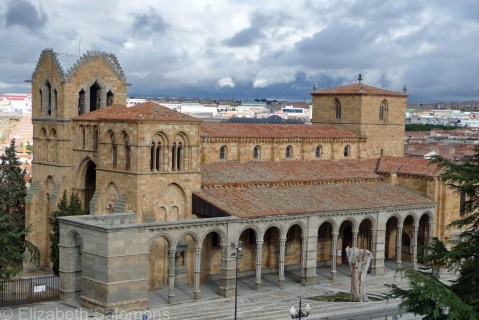
For today, the First Sunday of Lent, here’s a photo of Basilica de San Vicente in Ávila, a city in Castile and León, which is in northern Spain. This Romanesque–Gothic basilica dates back to the twelfth century.
The church was built to the memory of three martyrs: Saint Vincent and his sisters, Saint Sabina and Saint Cristela. They were killed in 303 by order of the Roman Emperor Diocletian. Inside the church is Saint Vincent’s tomb, which is covered with intricate and detailed bas-reliefs of the torture and execution of the three siblings. They’re rather, er, graphic, but incredibly fascinating.
The National Museum of the American Indian
In my post the other week on the Smithsonian, I mentioned how splendid the building that houses the National Museum of the American Indian is.
And then didn’t bother to post a single photo of the building.
I didn’t post any photos because I think the building is so impressive its photos deserve a blog post all their own.
If you’ve ever been to the Canadian Museum of Civilization in Gatineau, Quebec, you’ll recognize the architect’s work. Both buildings were designed by Douglas Cardinal. Born in Calgary, Alberta, to a Blackfoot father and a mother of Métis and German origins, Cardinal’s designs are known for their curved lines and organic shapes.
I could photograph this building over and over again. Here, take a look.
Through My Lens: New Orleans
Wait, there’s a game on?
For all you non-football fans out there, here’s a photo of what I find fascinating about New Orleans. I took this photo some years ago when a couple of friends and I were in the Big Easy for the New Orleans Jazz & Heritage Festival.


