
Hawaii Redux
Did you guess that Hawaii was the destination of my winter break? If so, you would be right.
It was my first time back to the Aloha State since my first visit more than 15 years ago, and it was lovely to be there. So very lovely.
I have many photos to choose from, but I decided to post this one first because, to my mind, Diamond Head is as iconic a symbol of Hawaii as the pineapple I posted last week.

Through My Lens: Heiliggeistkirche

It’s the Fourth Sunday of Lent, and we’re moving on to Heidelberg. The skyline of this city in the Neckar Valley would not be the same without the Heiliggeistkirche (Church of the Holy Spirit). Built in the fifteenth century, this Romanesque and Gothic church is the largest in Heidelberg and stands high above the Old Town. It is one of the most-visited churches in Germany.
Winter Break
So. I finally got off the continent. Last week was my first time out of the country since 2018, my first time outside of North America since 2017, and my first winter holiday since 2014.
That’s a whole lot of pent-up travel energy.
It was a fabulous week. Any guesses as to where I went? Here’s one hint: there’s a Union Jack in one corner of its flag.
And here’s another.

Through My Lens: Schlosskirche

For the Third Sunday of Lent, I’m posting a photo from inside the Schlosskirche (Castle Church) in Wittenberg. I’ve written about this church before, in connection with that revolutionary–reformer, Martin Luther.
A chapel has stood on this site since 1340. Between 1490 and 1511, a church in the Late Gothic style was built, attached to the castle just beside it. (Hence, the name.) That castle was the home of Frederick III, Elector of Saxony at the time. Both Frederick (also known as Frederick the Wise) and Martin Luther are buried in the church.
The Schlosskirche was destroyed during the Seven Years’ War in 1760, but later rebuilt. The doors that memorialize Martin Luther’s 95 theses were dedicated in 1858 and the church has been on the UNESCO World Heritage List since 1996.
Through My Lens: Kaiser-Wilhelm-Gedächtniskirche

Fourteen years after my first visit to Germany, I was back. Once again, I was hopping on and off trains, but this time I was on a European walkabout with my dad.
Two significant events took place between my first two trips to Germany. The first was the fall of the Berlin Wall and the second was the reunification of Germany. My dad and I stopped for just two nights in Berlin, so my impressions of the city are fleeting, but one image stayed with me. That would be the long line of construction cranes where a string of building projects were madly underway to fill the space where the Wall used to exist.
Another image that struck me was the Kaiser-Wilhelm-Gedächtniskirche (Kaiser Wilhelm Memorial Church), located in the centre of what used to be West Berlin. A church was first built on this site in the late nineteenth century. The kaiser at the time, Wilhelm II, named the Neo-Romanesque building after his grandfather, Kaiser Wilhelm I.
After being badly damaged during World War II, a new church was constructed, but the remnants of the original building were left as a memorial to the devastation of war. The photo above shows the original spire behind the bell tower of the new church.
The Kaiser-Wilhelm-Gedächtniskirche is my photo choice for today, the Second Sunday of Lent.
Through My Lens: Kölner Dom

A lifetime ago, when I was planning my first European walkabout, I went to a travel agent (remember those?) and came home with a bunch of pamphlets from those companies that offer multi-week tours of Europe. My travel partner and I were not in any way interested in joining an organized tour, but I did want to have in my head some kind of rough itinerary before we left Canada and started hopping on and off trains.
As I flipped through the pamphlets, I came across a photo of the Kölner Dom (Cologne Cathedral) from across the Rijn River, similar to the photo shown above. What a stunning cathedral, I thought. I have to see it in person. (This would not be the only time I made a choice regarding travel based solely on a single photo, but it may have been the first.)
It turned out that passing through Cologne was already in the works. My friend and I had agreed to plan our time in Germany around a two-day Rijn cruise included with our Eurail pass, and that cruise began in Cologne.
As you see, I got my photo.
Construction of the Kölner Dom began in 1248 but wasn’t completed until 1880, due to a several-centuries’ long stoppage of the building work. This Gothic cathedral is the tallest twin-spired church in the world. My friend and I climbed one of those spires and though my knees were protesting for days afterwards, I remember that the climb gave us a bird’s-eye view of some of the damage the cathedral suffered during World War II. I later learned that the city of Cologne was pretty much flattened; only the cathedral (miraculously) survived the bombardments. It is now on the UNESCO World Heritage List.
I took you on a tour of the Aachener Dom for last year’s Lenten series. This year, I’m staying in Germany, and the Kölner Dom is my photo choice for today, the First Sunday of Lent.
Danger: Thin Ice
We had our week of winter this past week and we got it all: polar vortex, Arctic outflow, and 28 centimetres of snow.
That’s the most snow we’ve had in one go since 1996, but the sad reality is any amount of snow pretty much shuts down the city and makes the national news.
And the rest of Canada laughs.
The sustained colder temperatures made for some thin ice conditions. This is Lost Lagoon. And yes, the kids were playing pond hockey at the other end of the lagoon the day before the snow fell. I like my ice a little thicker, but I’m sure it made for some lasting memories for those kids who did get out on the ice.

Merry Christmas!
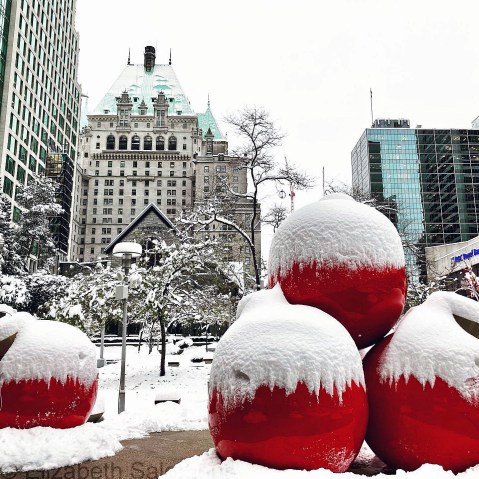
Burrard Street, Vancouver
Lights at Lafarge
There used to be a lovely light display in English Bay every winter. An orca, a heron, a tree. Also a bear and a beaver that I never got around to photographing.
But those beautiful lights did not come back last year, nor this year. I don’t know why they’re gone, but I sure do miss them.
Last year, feeling bereft, I went looking for an alternative light display. I found one, all the way out in Coquitlam. Lights at Lafarge is the largest free outdoor holiday light display in Metro Vancouver and is held every year at Lafarge Lake, a small pond created from an old quarry.
I convinced two friends to join me and one evening we rode the Skytrain all the way to the end of the line. The lake and its light display are located next to the station.
The trail forms a loop just over a kilometre long. Its flat and paved surface means it is both wheelchair- and stroller-friendly.

I didn’t get myself organized in time to post these photos last year, so I’m posting them for this month’s season of light. Although taking the Skytrain all the way to Coquitlam is a bit of a trek compared to walking down the street to my beach, Lights at Lafarge is definitely worth the trip.


Through My Lens: Golden Maple on Lost Lagoon

It’s been a while since I’ve posted a photo of our fall colours. And so, here’s one that I took a couple of weeks ago.


 There and Back Again