
Donkeys of Serifos
Of course, you can’t spend any amount of time in the Cyclades without encountering one or two donkeys.
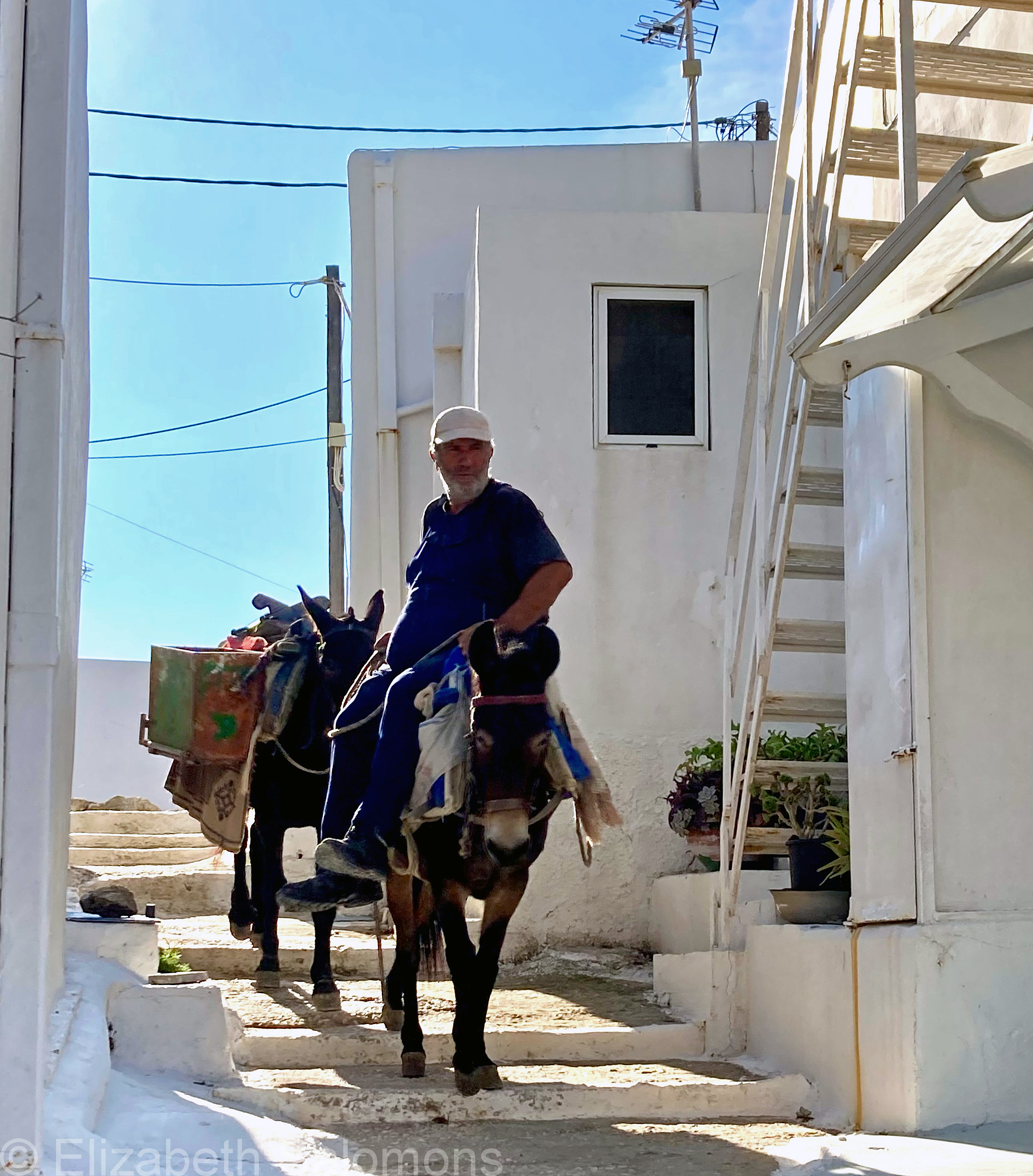
Donkeys have a long history as beasts of burden in the Mediterranean. And no wonder — they are sure-footed and able to easily navigate the narrow passageways of the Chora.
All they need for fuel are food and water. These two are drinking their fill at the tap just outside my door. I was all set to leave one morning when I realized they were blocking my way.
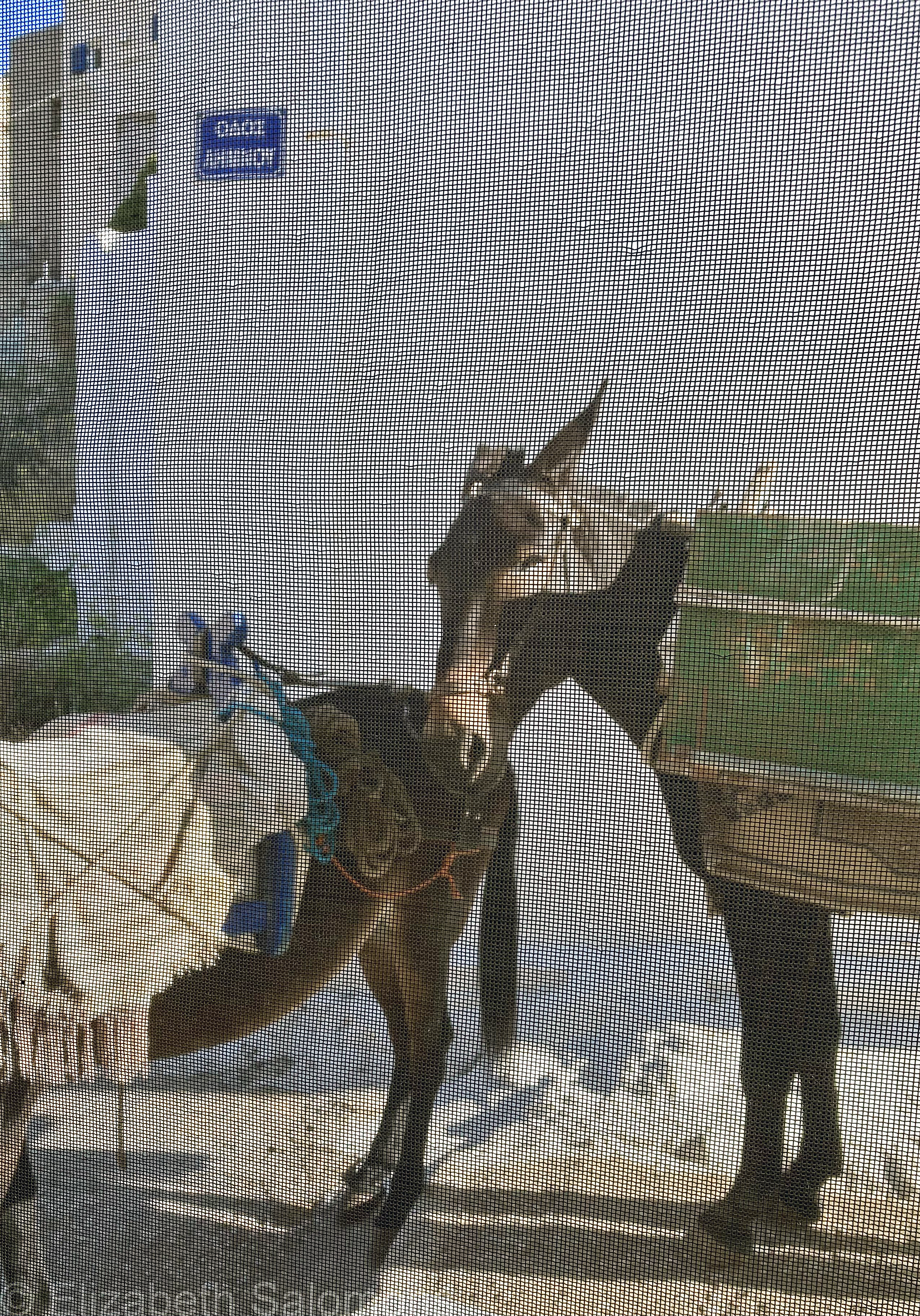
So I waited until they were sated and on their way.
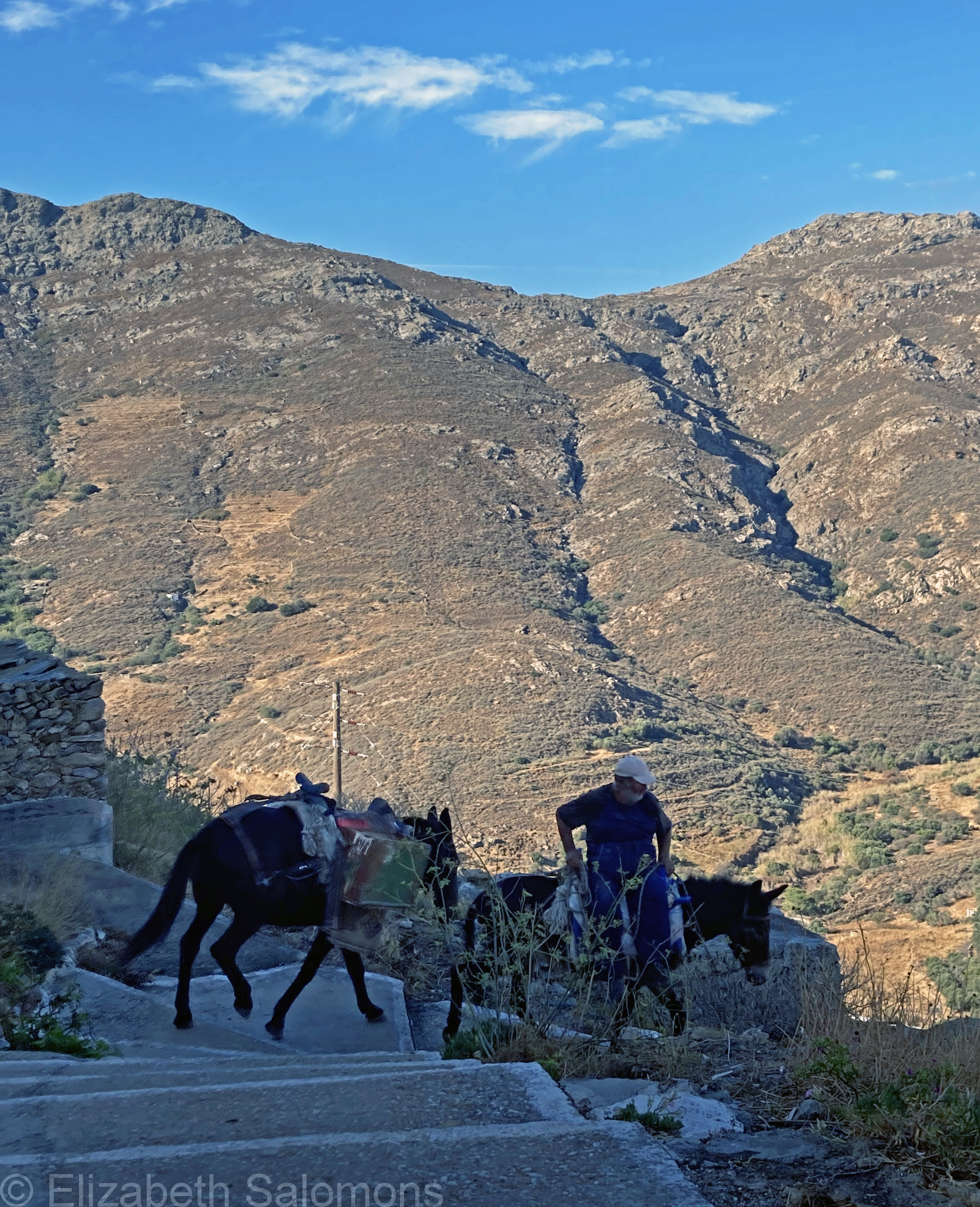
The man and his donkeys were hauling gravel from the road below my house to some unknown construction site above my house. And you know what I discovered?
There is no better way to remind yourself you are on vacation than watching others work.
Cats of Serifos
I now know why my home exchange partner did such a fabulous job taking care of my cats when she and her partner stayed in my Vancouver home.
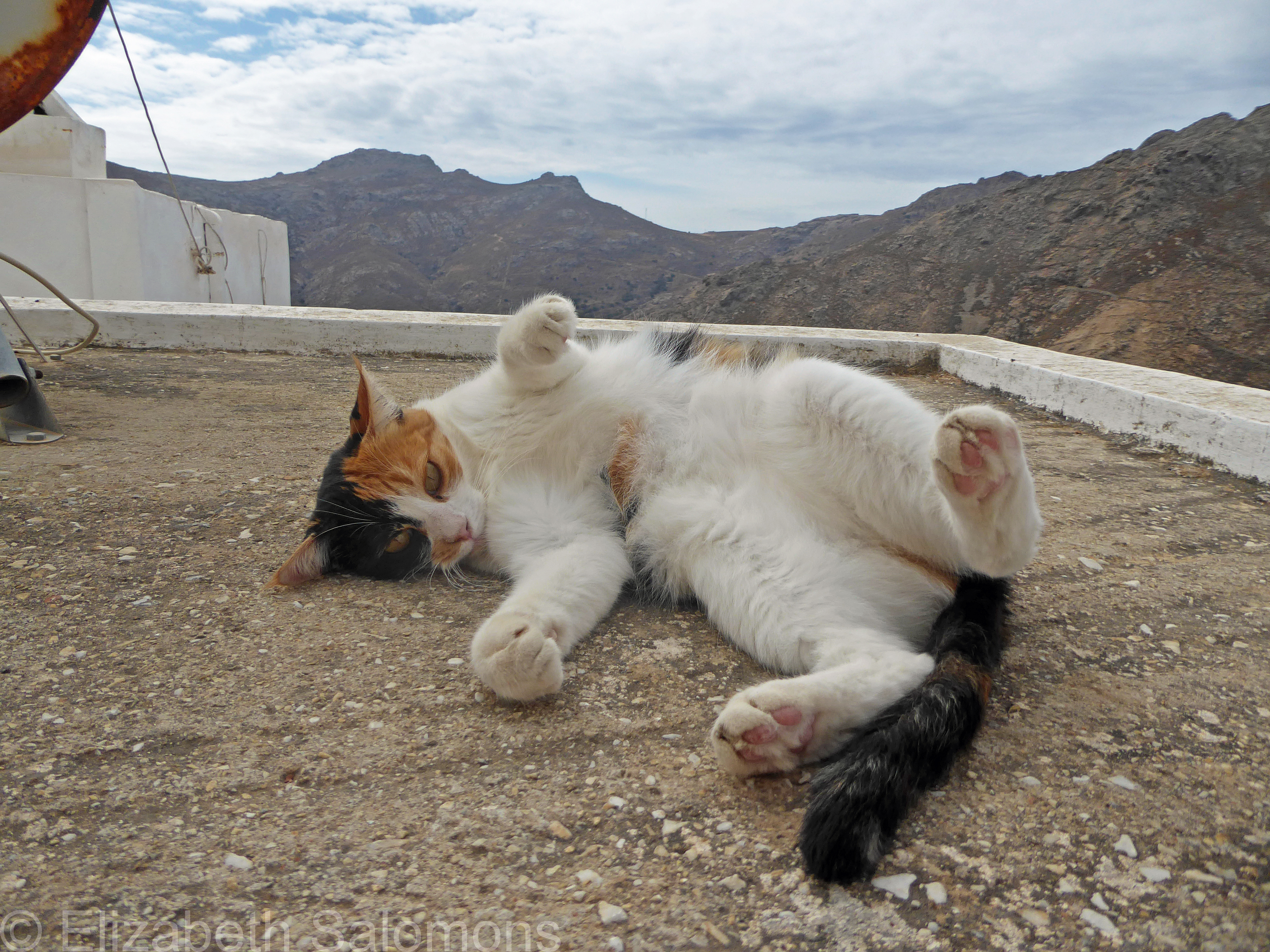
It’s because cats are as much a part of Serifos as whitewashed walls and blue domes.
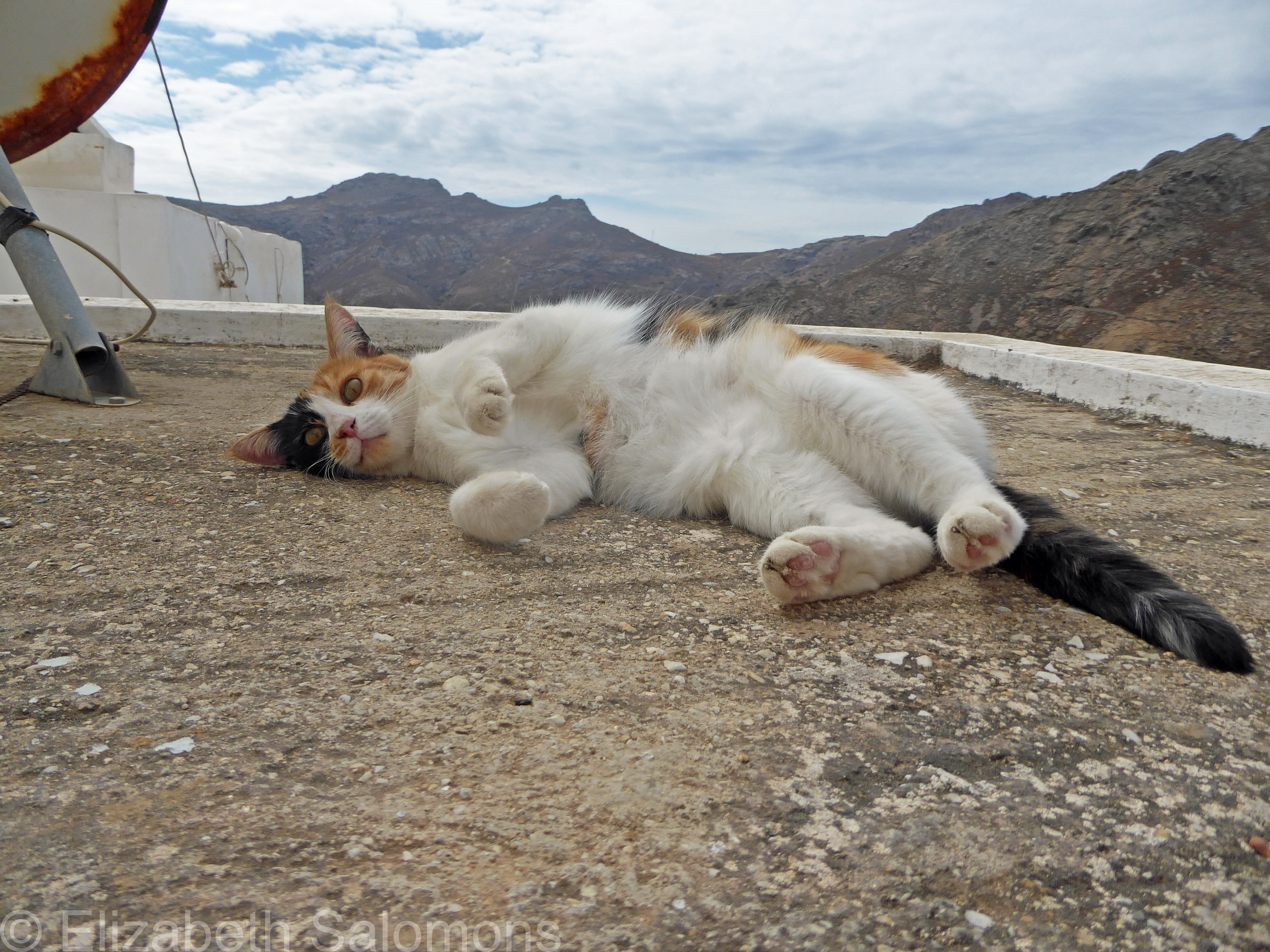
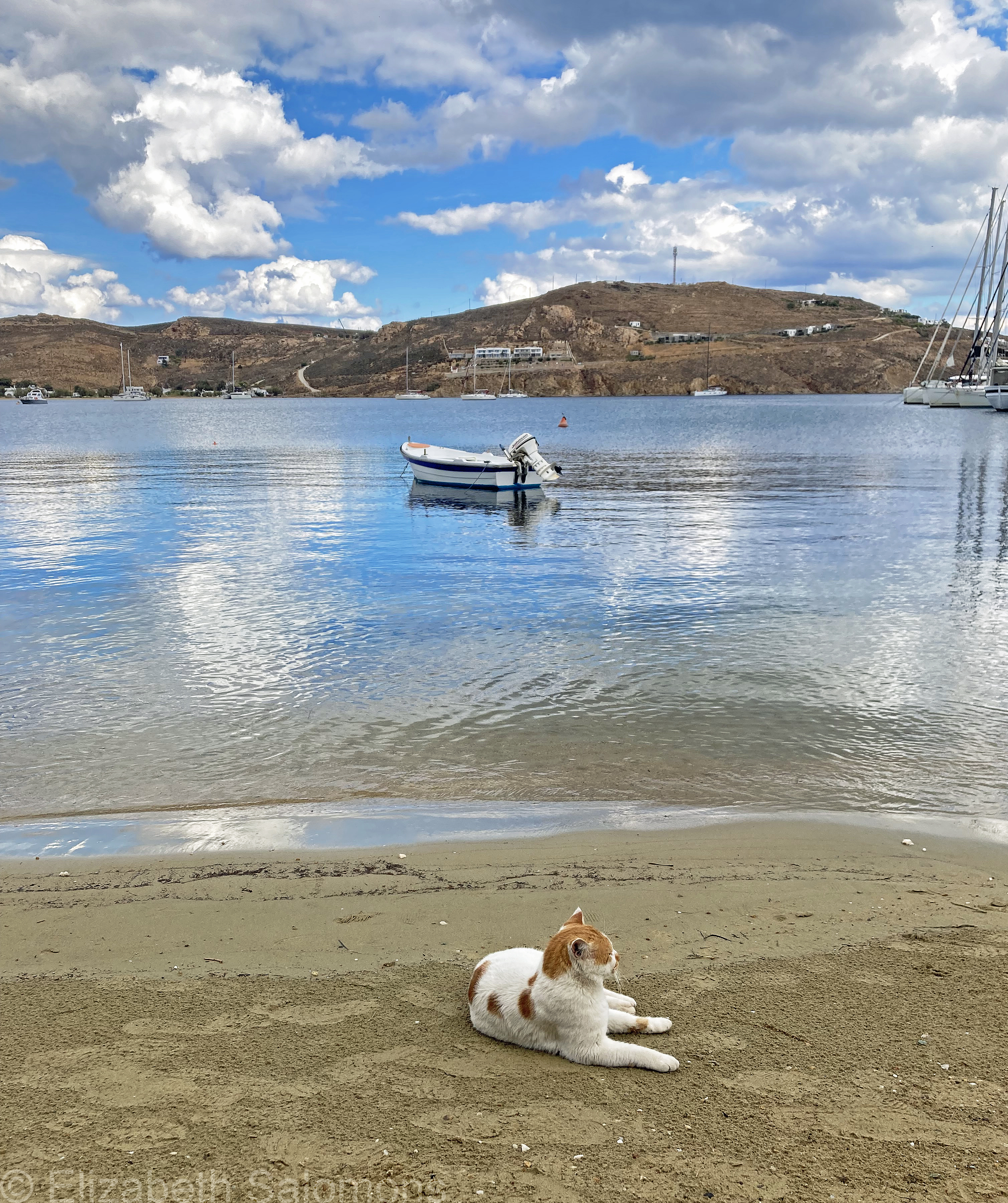
As far as I know, the cats of Serifos live completely outdoors and come and go as they please. But I wouldn’t call them feral. Or even strays.
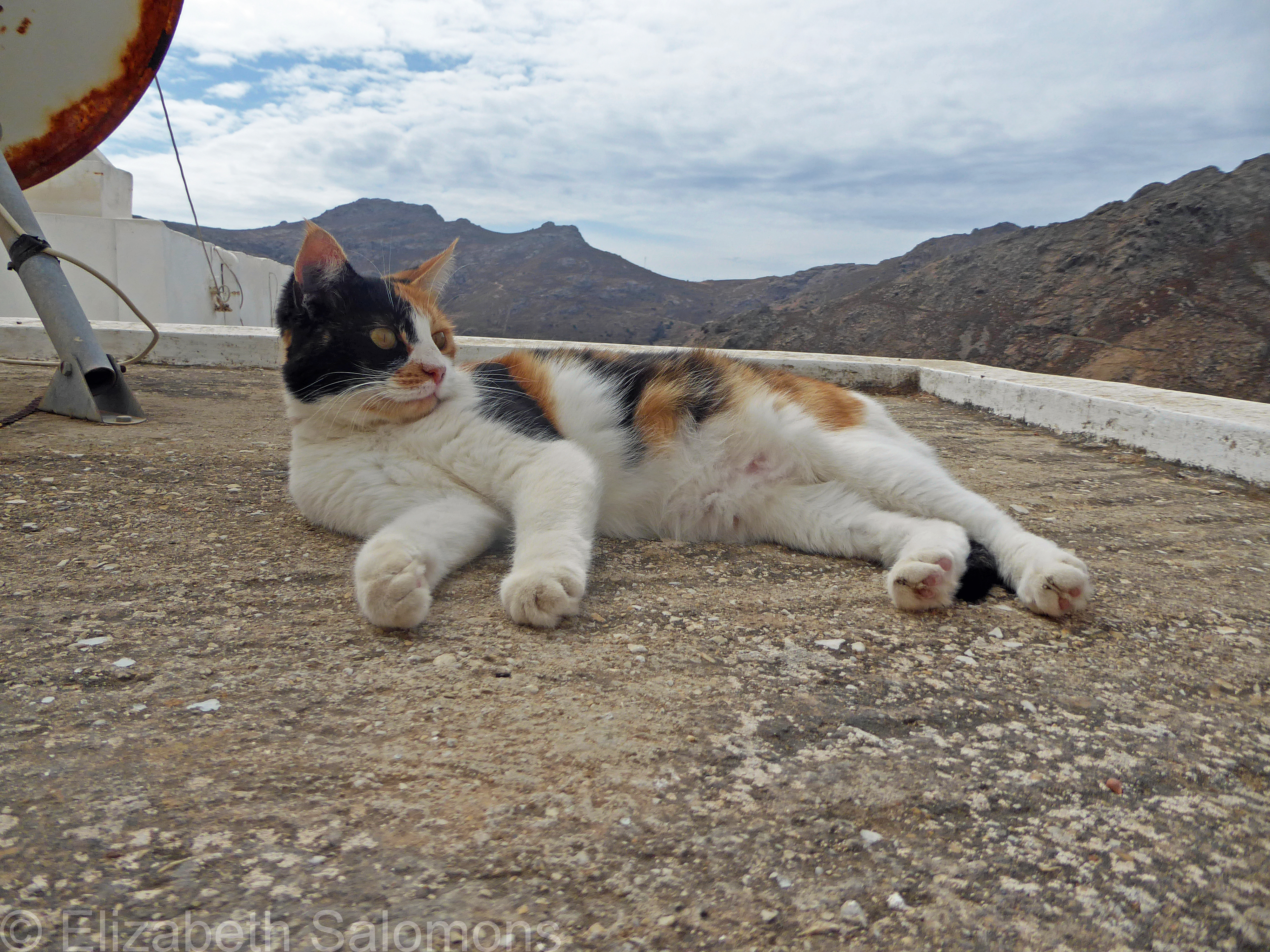
They belong to everyone and to no one. “Community cats” is probably the best way of describing them.
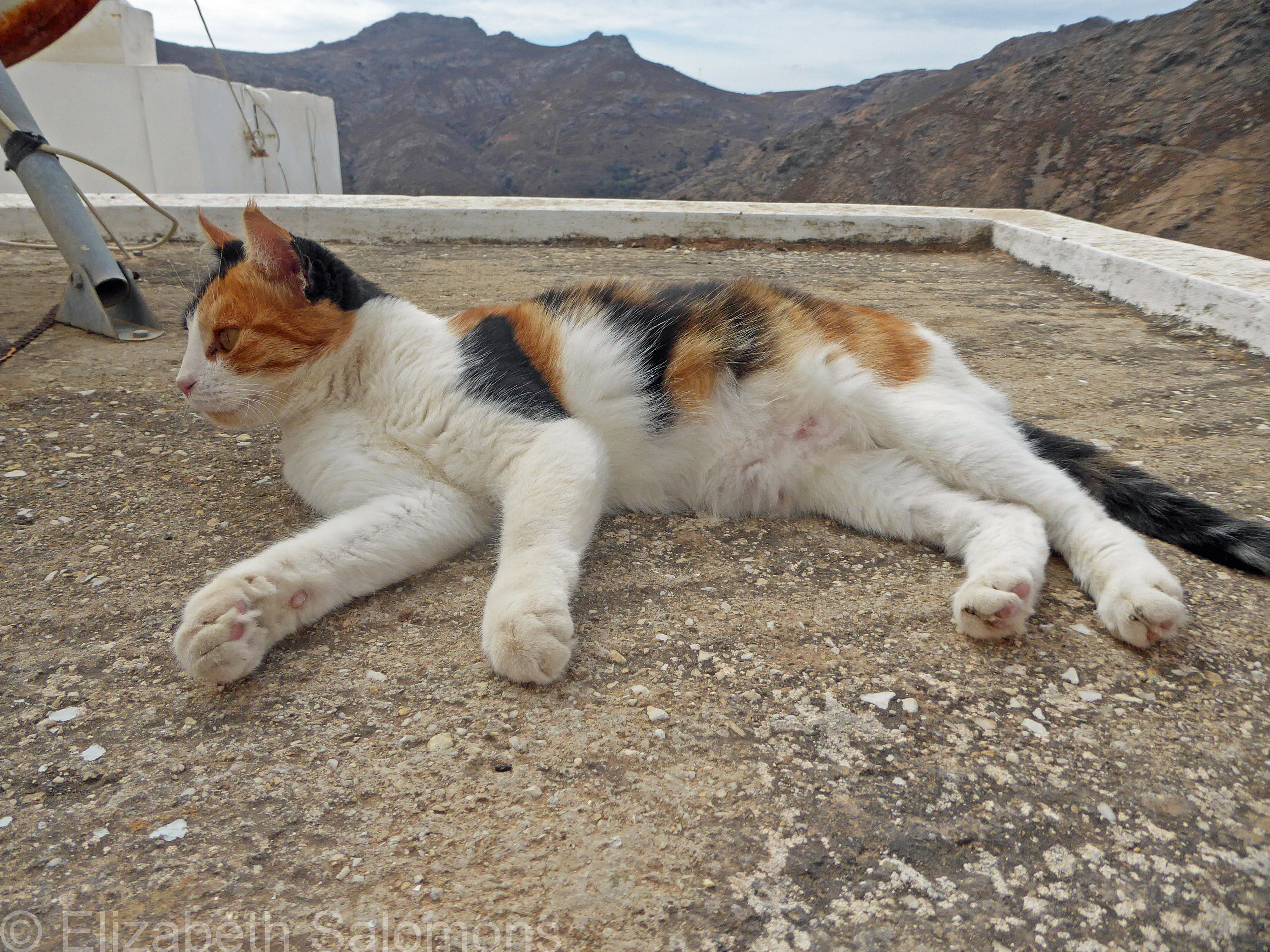
I fed my clan every morning and evening. The most I had at any one time was nine. Nine cats! (Isn’t that the name of a song?)
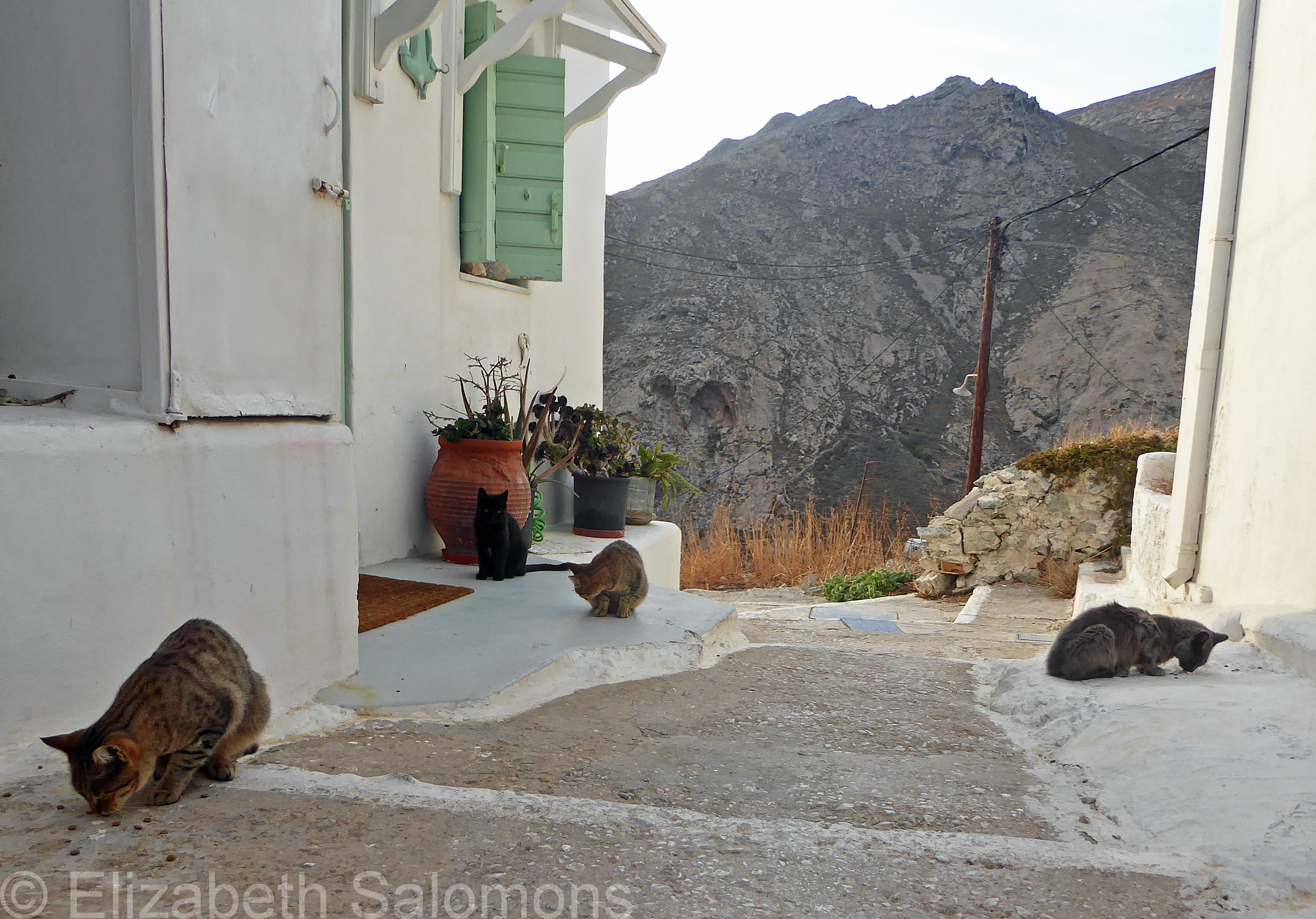
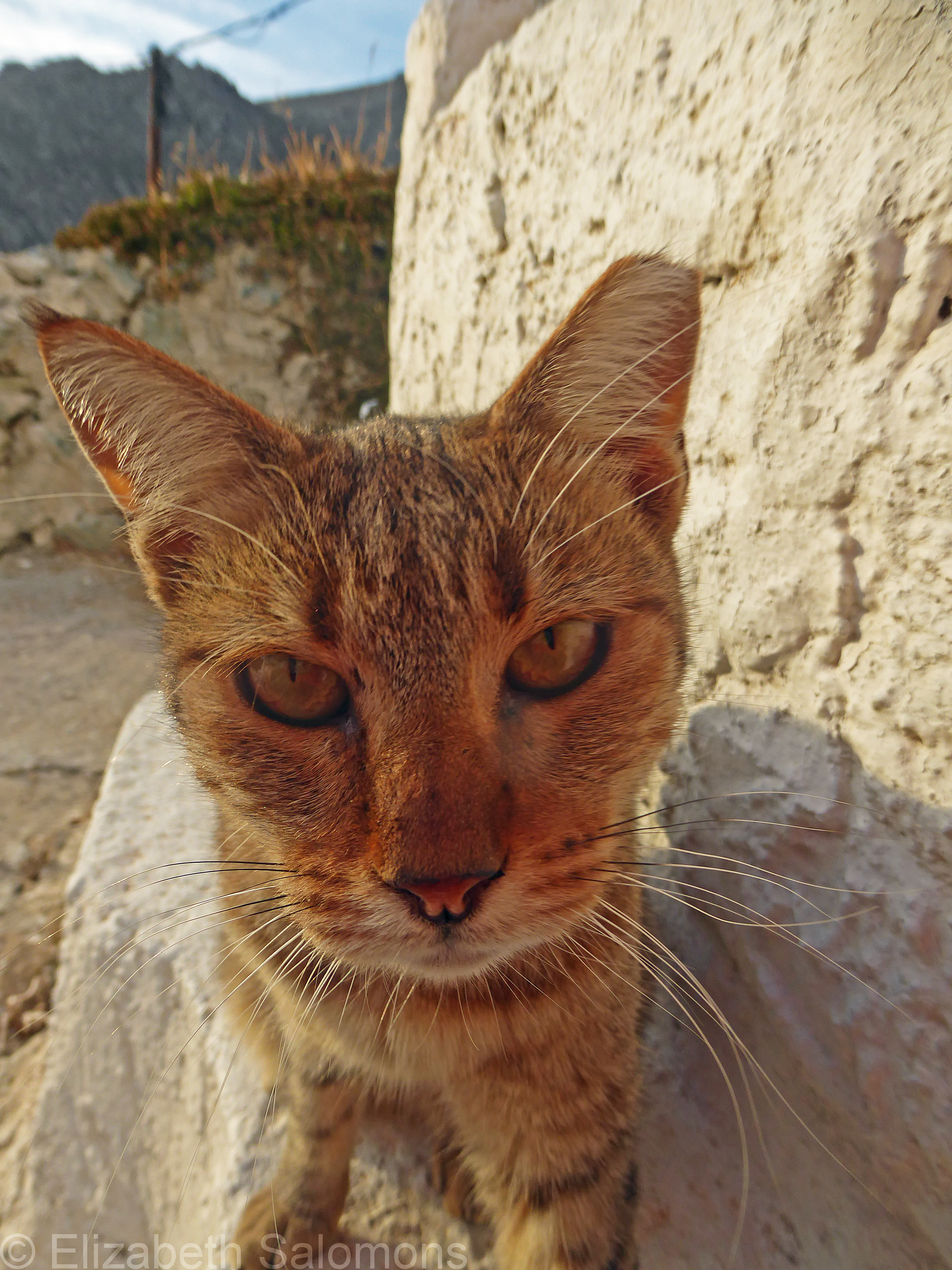
The cats of Serifos are small, but healthy and well fed (see above). I’m told the Aegean cat is a breed native to the Cyclades that developed naturally, without any human intervention.
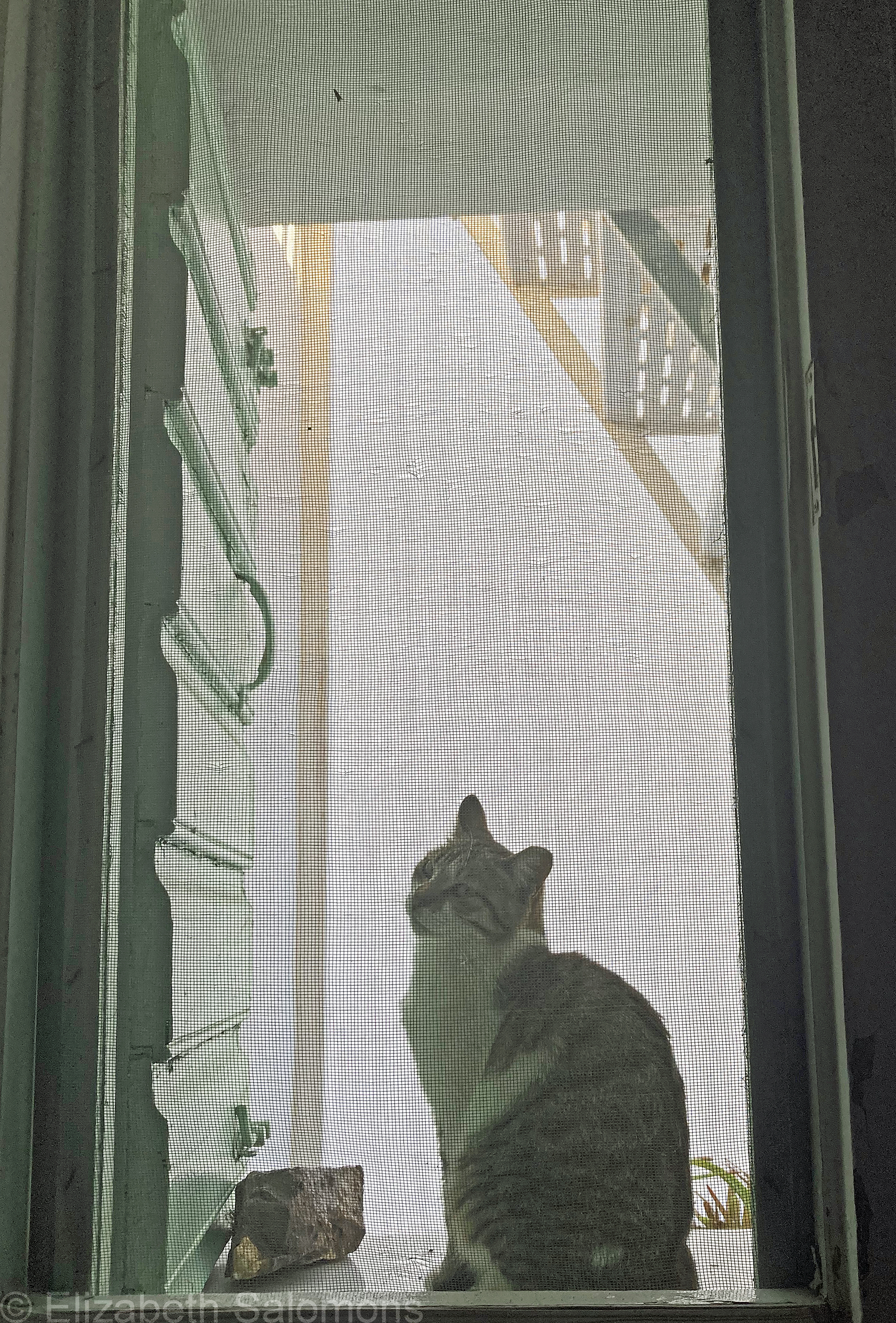
Often on my wanderings through the Chora, I’d see little piles of kibble set out for the cats — I wasn’t the only one feeding them.
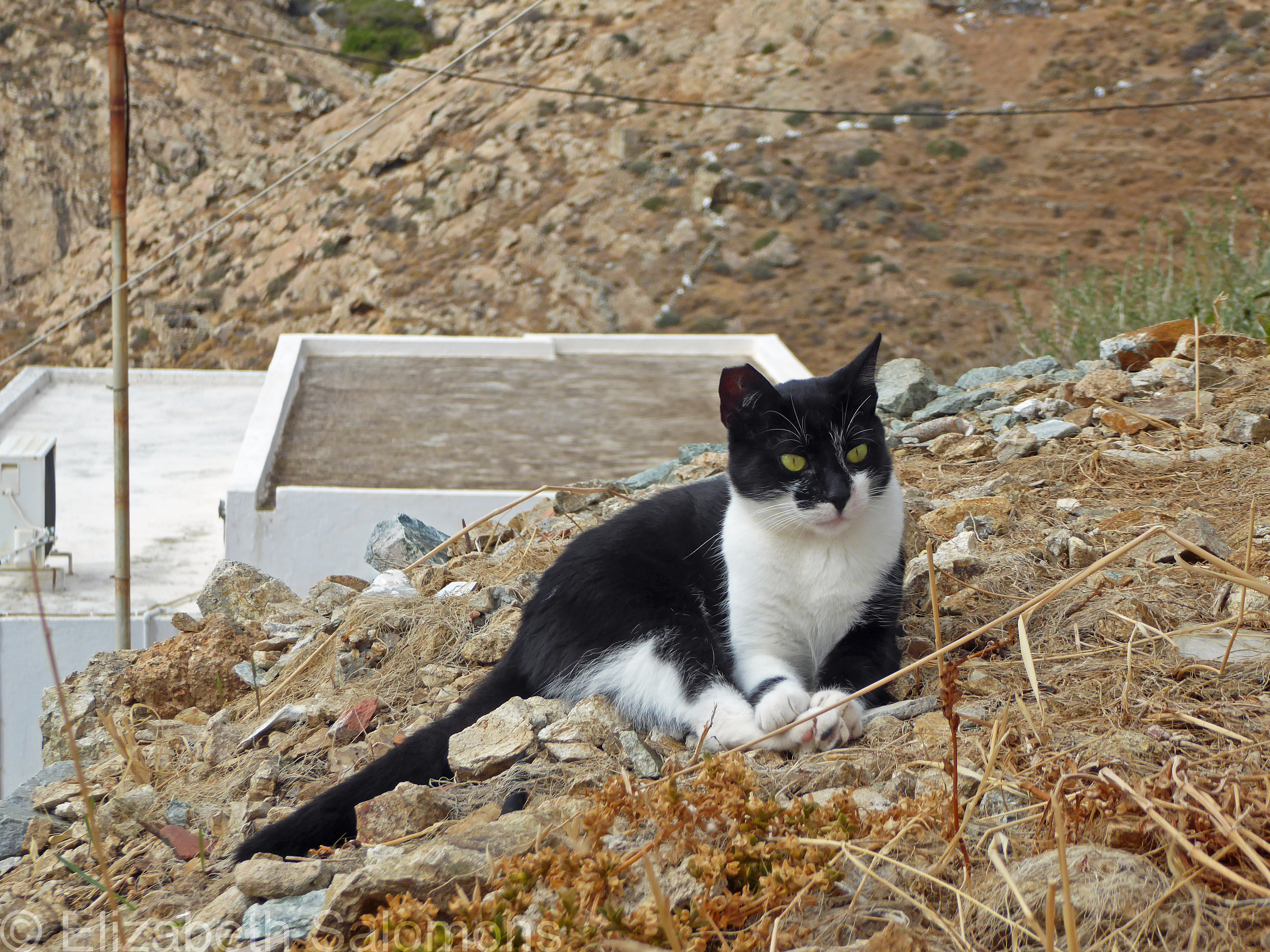
I loved how completely relaxed they looked and acted in their environment.
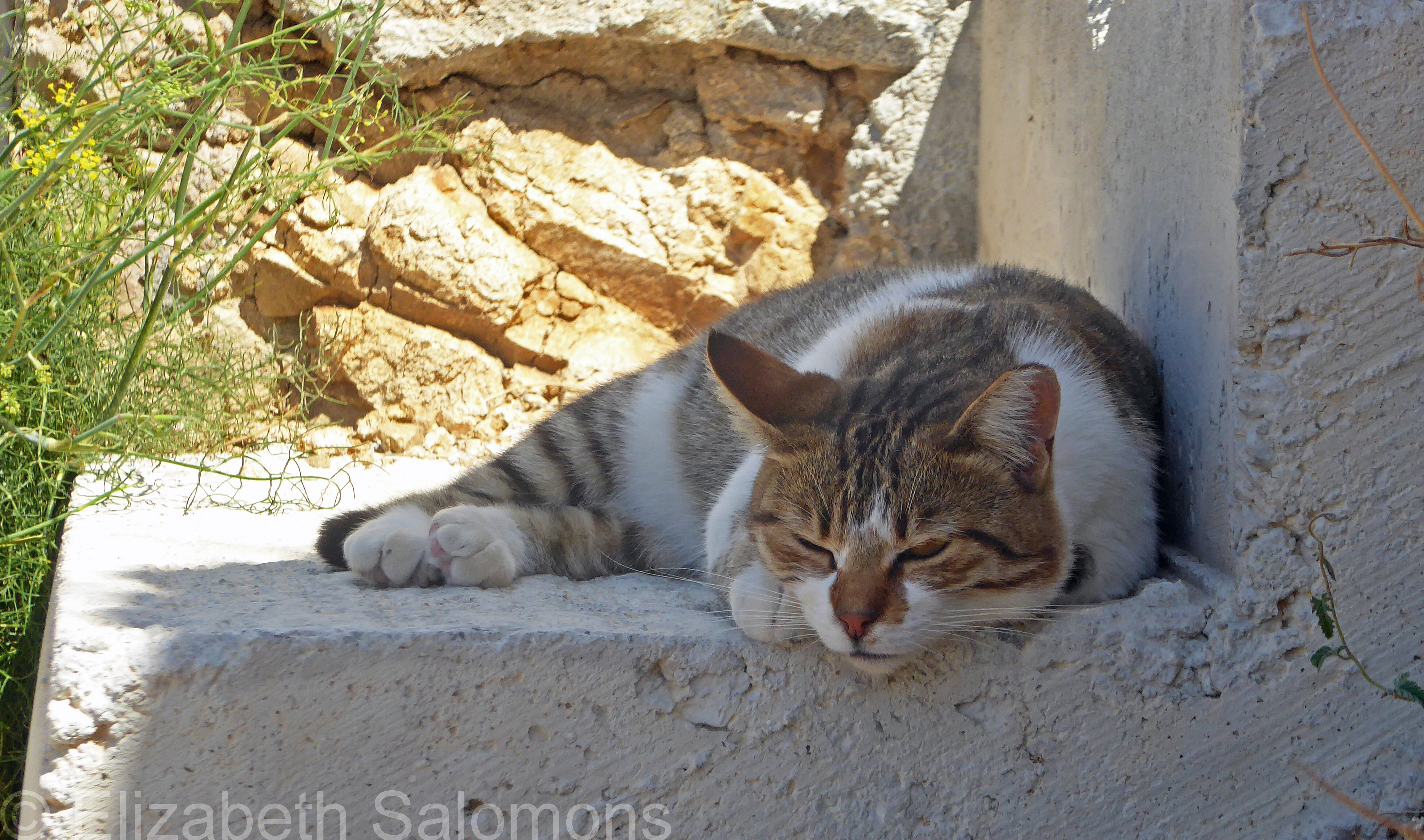
And they kept me good company while I was in my Grecian home.
From Vancouver to Serifos
When I told people I was going to spend two weeks on a Greek island, their reaction was always, “Nice!” But when I told them I was going to Serifos, their reaction was always, “Where?”
Like most Canadians, they had never heard of the place. Nor had I, until I got a home exchange offer I couldn’t refuse.
Serifos is in the Cyclades, an island group in the Aegean Sea — the part of the Mediterranean that lies between Greece and Turkey.
It’s also a bit of a trek from here to there. First, a long-haul flight from Vancouver to Athens (via Heathrow), then a taxi ride from my Athens hotel to the Port of Piraeus, and, finally, a catamaran fast ferry to Serifos.
The fast ferries that ply the Aegean are nothing like our BC Ferries. Because they are fast ferries, there are no outer decks and my assigned seat was in the bowel of the vessel, nowhere near a window.

The port at Serifos, too, is nothing like the highly automated ferry docks that line the coast of BC. The ferry comes alongside the concrete pier for just a few minutes; there’s no dawdling when offboarding as a foot passenger.

But once I disembarked, it was a short walk to where my home exchange partner was waiting with her car. And not long after that, we were pulled over on the main road that goes between the port of Serifos to the Chora.
We got out of the car, I grabbed my bags, and she pointed up to a white house with green trim.
“See the solar panels on the roof?” she asked. I nodded. She had an appointment to get to, so we said goodbye and I made my way up the donkey path to my new (temporary) home.

It was a typical Cyclades house: small and square, white on the outside, cool on the inside, painted door and shutters.

I was delighted by the welcoming committee.

A couple of hours later, I had decompressed from my journey, unpacked, and was wondering what to do next when my home exchanger messaged me. She was on her way back to Livadi — that was the name of the town by the port. Did I want a ride?

Yes, please.
When she asked where she could drop me, I said I hadn’t eaten since breakfast. She stopped the car in front of a restaurant she liked.
“Go sit at one of the tables by the water,” she said. “They will come to you.”

And so I enjoyed my first meal of many on Serifos, overlooking an idyllic scene and marvelling at how long it had taken me to get here, literally and figuratively.
And relishing the thought that I had two whole weeks to explore the place.
Wapiti
My camping mini-break at the end of August with my brother and his kids got me thinking about camping when I was a kid. Back then, everyone I knew went camping in the summer. It was the only kind of vacation most parents with a carful of kids could afford.
Most of our school friends went to the Okanagan every summer, but my parents’ preference was to camp in the middle of the forest, so we headed to the mountains. A fully-treed campground was always the destination — I suspect my parents would have not cared for Ruckle Park because of how exposed the campsites are.
The “mountains” was what we called Banff and Jasper. We would do a circuit, spending some time in Jasper, then head south to Lake Louse and Banff, and then, when we were badly in need of showers and clean laundry, Dad would point the car towards Lacombe. There, we would spend time with our grandmother and all the aunts, uncles, and cousins who lived in the area.
When the news broke last July that the entire town of Jasper, along with some 20,000 park visitors, was being evacuated because of encroaching wildfires, my co-worker (who had also spent her childhood camping in the mountains) and I spent a horrified morning looking at video on social media. We were both relieved to learn that only (only?!) a third of the structures in Jasper townsite had been destroyed.
At first, there was no word about the rest of the park — it would take some months before the wildfires were under control. In fact, it wasn’t until last week that the news showed images of some of the campgrounds. Given the scale of the wildfires, I knew it would be bad. And it is. The forest is just … gone.
Forests rebound, I know that. But until they do, camping in the forests of Jasper National Park will be much different.
One of the campgrounds we used to camp at is named Wapiti. Wapiti, or elk, are commonly seen throughout Jasper — I took this photograph of an elk cow just as we were leaving our campsite for a day of hiking the last time I was in Jasper. Wapiti is a Shawnee word for “white rump.”

Through My Lens: Kinderdijk Ponies

Who of you needs to see a photo of some ponies? Or a windmill?
I took this photo while exploring the windmills at Kinderdijk with some friends a few years ago. It didn’t make it into my earlier post because most of the mill is hidden.
But I really do like the ponies.
You Know It’s Cold When …
I know, I know. Here I go again, talking about the weather.
For the benefit of my non-Canadian readers (in case you haven’t figured this out yet), talking about the weather is a bit of a national obsession.
The western part of Canada is in the middle of a polar vortex. I got outside today to tramp through the deep snow that arrived overnight in Vancouver, but in this post, I’m going to talk about the next province over. That would be Alberta, where a lot of my family lives.
They’re cold, to put it mildly. My sister in Calgary was faced with a commute this morning in temperatures of –40° C.
Ouch!
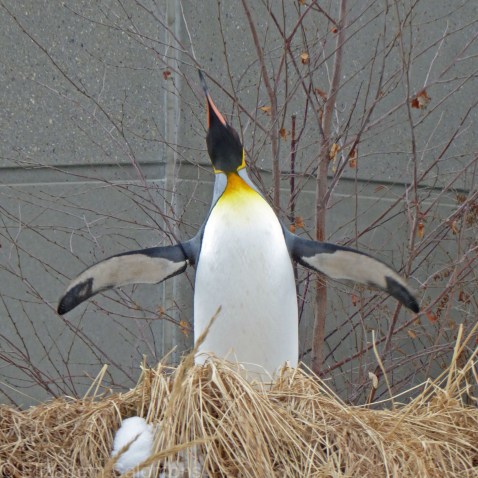
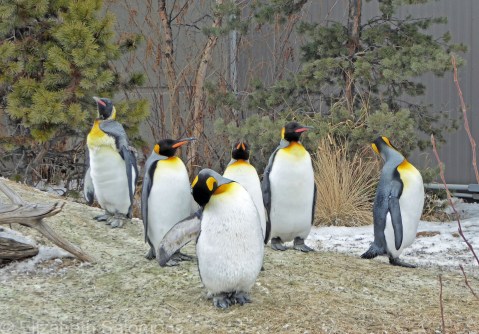
In fact, it’s been too cold all week for the Penguin Walk at the Calgary Zoo. That’s right. The zoo’s king penguins, native to the sub-Antarctic, had a Snow Day. And Calgary today was colder than Antarctica.
Double ouch!
I took these photos of the Calgary Zoo penguins almost a year ago, when I visited the zoo on a much balmier day than today.
Raccoon at Scarborough Bluffs
I spent much of May gallivanting around the Eastern Time Zone, and most of June sorting through my photos and planning what blog posts I might write about my travels.
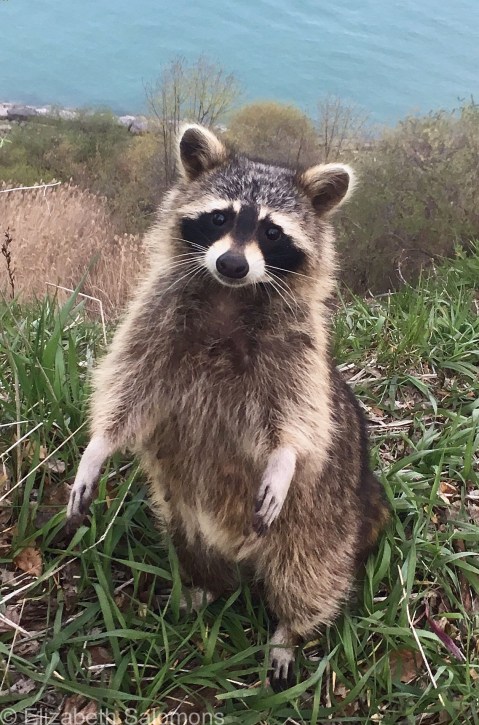
This photo though. Not your usual holiday snap, but it makes me laugh every time I look at it. I met up with this raccoon one evening in Toronto while exploring the Scarborough Bluffs with a friend.
For my non-Canadian readers, raccoons are known in this country as trash pandas. They’ve adapted remarkably well to urban living and are known for finding their dinner in our garbage cans. Toronto spent millions developing and purchasing raccoon-resistant green bins — only they turned out to be not so resistant.
Back when I lived in Toronto, I had a mom and her three kits hanging around my house for an entire summer. Every evening, like clockwork, they would amble along the fence in my backyard as I watched from my kitchen window.
Here in Vancouver, I see raccoons mostly in Stanley Park, although one hot summer afternoon, I noticed a hefty raccoon napping in the tree outside my window. The tree is long gone — it came down in a winter storm — but I thought the clever creature had found a innovative solution to the heat.
The raccoon got its name from the Anishinaabe word aroughcun, which means “one who rubs and scrubs and scratches with its hands.” Raccoons are known for washing their food before they eat it.
Turtles at Lost Lagoon
Everyone I talk to in Vancouver these past few weeks is gushing about the fantastic summer weather we’re experiencing. Yes, gushing!
Canadians can be pretty low-key except when it comes to (1) their sports teams and (2) the weather. We get absolutely patriotic when our teams win (sorry — I just had to get in at least one Raptors’ reference) and we get absolutely giddy when the summer temperatures kick in.
To celebrate the 16 hours and 15 minutes of sunshine that Vancouver experienced today on the first day of summer, here’s a photo I took of the turtles at Stanley Park’s Lost Lagoon.
They, like most Canadians, take their sun-worshipping seriously.


Through My Lens: Highland Cows at Ruckle Farm

Another island I hopped to this summer was Salt Spring Island. I go here often, thanks to the hospitality of one of my dearest friends.
These Highland cows are at Ruckle Farm on Salt Spring’s South End. Salt Spring has a long agricultural history and Ruckle Farm — founded in 1872 — is one of the oldest farms in the province. It is still being farmed by the Ruckle family.
Fun fact: Highland cows are a Scottish breed of cattle and my friend who lives on Salt Spring Island is a proud Scottish-Canadian.
Just though I’d mention that.
One more note: The haze in this photo is due to the smoke from BC’s wildfires, which blanketed the southern coast of the province the weekend I was on Salt Spring Island.


 There and Back Again