
Second Beach

Second Beach is the smallest of Vancouver’s beaches. It’s located alongside the Stanley Park Seawall, next to Second Beach Pool and Ceperley Meadow.
The beach is a popular picnic site, especially for large, multi-generational families, because of all the amenities available. The meadow provides lots of room for kicking around a ball, and in addition to the beach and the pool, there are two playgrounds and a concession stand.

English Bay Beach
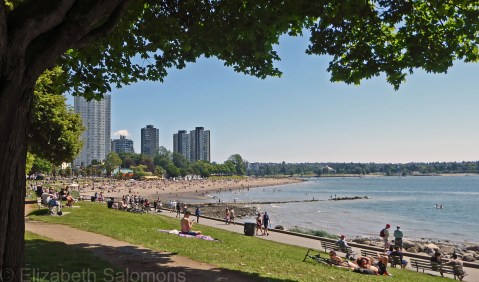
English Bay Beach is the most urban-looking of Vancouver’s beaches, thanks to its close proximity to the residential towers of the West End.
Also known as First Beach (although no one calls it that), English Bay Beach has been popular with the residents of Vancouver since the 1890s, which is when they first began building summer cottages along the bay. Two of those cottages were still standing when I moved to the neighbourhood some 20 years ago, but they’ve since been down torn down and replaced with a boutique condo.
Typically at the end of July, more than half a million people descend on English Bay Beach for three nights of fireworks competition during the annual Celebration of Light. Not this year, of course — and who would have thought I would miss all that chaos?
Instead, this year, English Bay Beach became infamous for its beach log jail when our iconic beach logs were locked up behind metal cages for the first ten weeks of the pandemic. The reason? To avoid large groups congregating on the logs.
English Bay Beach is popular with swimmers and although the lifeguards are back during this summer of Covid, the floating slide is not.
Maybe next year.

Sunset Beach
Here we go again. Sigh.
Who knew beaches would turn out to be such a lightning rod during this pandemic?
Beach-shaming has become the thing to do whenever Vancouverites take advantage of a sunny weekend and flock to the beaches. People who are not at the beach get upset at those who are, and, well, words are said.
The thing is, the people doing the shaming all seem to live in large suburban homes with large suburban backyards, while the people who are spending time on the beach live in tiny condos with little or no outdoor access.
The other issue is that those who are doing the shaming base their indignation on photos that, intentionally or not, are quite misleading. Camera angles and lens sizes can distort reality, I’ve learned. And when you walk past one of Vancouver’s beaches on a sunny weekend, it is clear that people are, for the most part, staying apart.
Vancouver has not been alone in its beach-shaming. There have been similar incidents of crowded parks and over-the-top reactions in Montreal and Toronto as well. The latest uproar — which is what prompted me to write this post — concerns the crowds seen at Sylvan Lake, Alberta, last weekend. I spent many childhood summers swimming in Alberta lakes — I know how lovely they can be on a hot summer’s day. I’ll reserve judgement on what the Albertans were up to last weekend, but I will say this: Central Alberta isn’t exactly known for its high-density neighbourhoods.
Some of the smartest talk I’ve heard about the pandemic relates to these kinds of incidents. We can’t see the virus, but a large group of people gathered together outdoors is visible in all kinds of ways. We know that yelling at a virus is pretty futile, but somehow yelling at a group of people who aren’t behaving as we think they should makes us feel better. Or morally superior? I dunno.
There’s also the novel idea that we — all of us — should focus not on what behaviours we are entitled to, but on what impact our actions have on others. Pandemic ethics in a nutshell, I call it. Meaning, those of us who do have access to a backyard, or perhaps a smallish, but perfectly adequate park in our immediate neighbourhood, should stay close to home instead of heading out to a popular park or beach where there might be a crowd. Leave room at the park or beach for those who don’t have a backyard — you know, the family who’s been cooped up indoors all day, or the group of people who live alone and have limited options for socializing in a physically distant way.
And that is why when reporters asked a few months ago why Vancouver wasn’t closing its parks and beaches, our provincial health officer responded by first reminding everyone that we need to stay apart, but then urging everyone to get outdoors for the sake of their mental health.
I’ve been meaning for some years to do a summer series on Vancouver’s beaches, but time got away from me, as time tends to do. Now I’m thinking my procrastination has been rather fortuitous in that there has never been a better time to talk about Vancouver’s beaches than during this summer of staycations. I have several within walking distance of my home — you can’t get much more staycation than that.
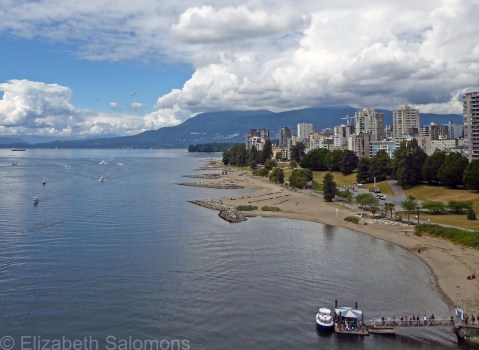
To start us off, here’s a photo of my closest beach. Located along the appropriately named Beach Avenue, Sunset Beach is not wildly popular for swimming, likely due to its proximity to False Creek and rather a lot of boat traffic. But it is a great spot for picnics, and for watching the sun set. I took this photo from Burrard Bridge a couple of summers ago.
Surf Scoter

Ever seen a Surf Scoter? In Vancouver, November is peak season to see these diving ducks. Large rafts of them hang out in English Bay where they feed on clams and mussels.

To see the ducks so close to the shore, however, is a bit unusual. I got lucky one afternoon about a week ago.

Through My Lens: Daffodils

Is this not the wettest, coldest spring ever?
I know, I know. I have no right to complain considering how many parts of the country are experiencing their longest winter in decades. Southern Ontario is in the grips of an ice storm as we speak, Edmonton has broken a 44-year record with 167 consecutive overnight lows below 0 °C, and Calgary’s forecast is for 10 to 20 centimetres of snow.
I have absolutely no right to complain.
And yet, I am. See the dark clouds in this photo? That’s what the skies in Vancouver have looked like for the better part of this winter and our oh-so-cold spring.
I’m posting this photo because these daffodils have been the one bright spot for me this spring. They appeared about a month ago along the seawall in English Bay, a new addition courtesy the Vancouver Parks Board. I love that they were planted in the middle of the grass, rather than set off in some flower bed somewhere.
Nothing says April like a crowd of daffodils.
Except in Canada, I suppose, where nothing says April like one last blast of winter.
Through My Lens: Snowy Rocks on the Beach

Typically, in February I am posting photos of crocuses. Instead, here’s a photo I took this morning of the snow-covered rocks along the beach at English Bay.
Which means it’s not a typical February. (Although … come to think of it, last year’s February wasn’t so typical either.)
Vancouver got dumped with about 25 centimetres of snow yesterday and last night. It’s not an unusual amount of snow for us — we often have one, maybe two good snowstorms every winter — but what is unusual is to get so much snow so late in the season. It’s almost March, folks.
The crocuses, I assure you, are in full bloom, but are well buried today. And tonight’s forecast is for rain, so tomorrow is going to be an unholy muddy mess.
Through My Lens: English Bay Morning
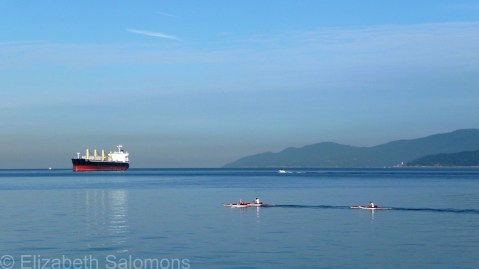
Now I’m really back.
Back in Vancouver, that is. After three months away, I’m so happy to see my English Bay again.
Isn’t it beautiful?
Through My Lens: Sunset at Sunset Beach

And … boom.
No sooner is it officially summer and we’re in the middle of our first heat wave. Heat waves in Vancouver are rare, which means few homes have air conditioning.
Which means I’m awfully warm.
Some friends surprised me with a picnic at Sunset Beach this evening, and instantly I was able to cool down. There’s often a breeze that comes in off the bay, but it also helped that the clouds moved in to block the sun’s heat from us as we enjoyed our meal.
Which means I didn’t take this photo tonight.
But you get the idea. There’s nothing like a picnic on the beach while watching the sun set.
Through My Lens: Celebration of Light
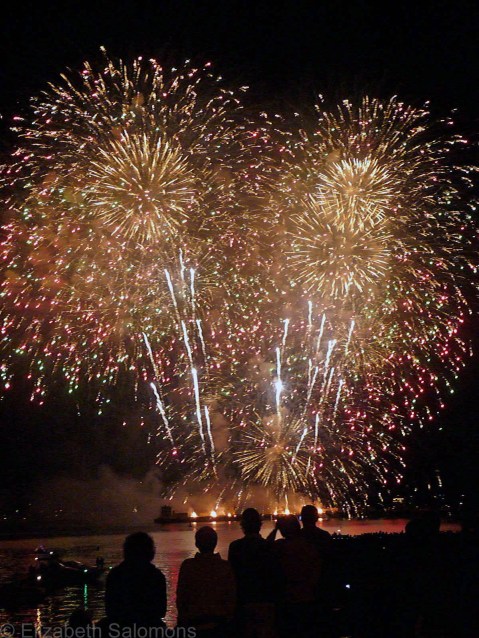
For three nights every summer, three different countries compete in Vancouver’s annual fireworks competition, known as the Celebration of Light. More than half a million people from the ’burbs descend upon my neighbourhood to watch some pretty impressive pyrotechnic displays set off from a barge moored in English Bay. This year will be the 27th consecutive competition. It’s the longest running offshore fireworks competition in the world and, I am told, BC’s largest event.
Which is obvious once you’ve tried to make your way through those crowds.
I used to overlook English Bay from a ninth floor apartment and I could watch from my balcony. Now, I walk down to the beach a few minutes before they’re scheduled to start and I always have a great view.
It’s one of the perks of living in the West End.
River Otter
In my last post, I mentioned that one of Lost Lagoon’s four remaining Mute Swans had been killed by a river otter. These furry fellows can be found in Lost Lagoon, but also like to hang out wherever there’s fish. Sometimes, that brings them to the beach in English Bay
Which is where I took this photo.
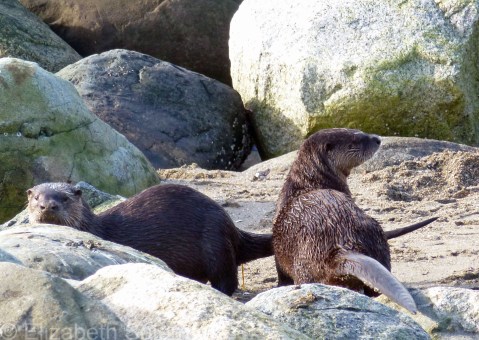
River otters are not the same as sea otters, so don’t be confused by the fact that they can be found near the ocean. They go wherever the fish are, so if that means they hang out on the beach, so be it.
Sea otters, I’ve been told, are not found in the Salish Sea. They live on the west coast of Vancouver Island or along BC’s northern coast. One clue, apparently, to tell the two types of otters apart: river otters almost never swim on their backs, while sea otters often do.


 There and Back Again