
City of Angels
Question: What do Los Angeles and Vancouver have in common?

Venice Beach
Answer: Both cities have beaches. (But the beaches in Los Angeles are a lot bigger and the surf is a lot higher.) Both cities have palm trees. (But the palm trees in Los Angeles are more varied and much taller, and the palm trees in Vancouver ― well, I am being kind when I say they look a little ridiculous. I mean, palm trees do not belong in Canada. Right?)
And both cities are surrounded by mountains. (Here, I think we win, as our mountains are a lot closer. I think ours are taller, too.)
But there is one area where Los Angeles and Vancouver have absolutely nothing in common. Hands down, the weather in Los Angeles is waaaay better than in Vancouver, and a whole lot more dependable. I know this because I spent last weekend in Los Angeles, soaking up some badly needed Vitamin D.
And now I can’t wait for summer to arrive in my home city.
Skiing at Cypress

Yesterday was the last day of the ski season on Cypress Mountain ― and what a season it was! I can’t remember when I’ve seen as much snow on the mountain as I did this year. Total snow accumulation of close to ten metres and a base of almost four metres made for some spectacular skiing.
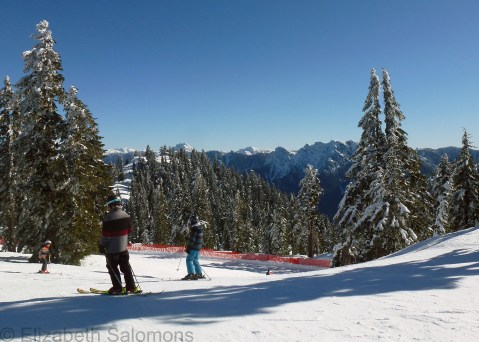
Not all years are alike on our local mountains (thank you, climate change), so I do not take a good ski season for granted. Cypress Mountain was the venue for the 2010 Olympics Freestyle Skiing and Snowboard events, but the conditions that year were close to disastrous. That snow had to be flown in by helicopter to make the mountain competition-worthy got a lot of media attention. And last year the snow conditions were just as bad, if not worse.

If you are from Vancouver, you’ve probably been skiing since before you could walk, but for those of us who grew up on the flat prairie, hurling oneself down a mountain doesn’t come as naturally. I finally decided I should give skiing a try after I spent a week hiking in the Swiss Alps with an Australian who could not stop talking about how much he loved the sport. But upon my return to Canada, and after my first few feeble attempts at skiing down a mountain, I quickly realized I badly needed expert help and should take some lessons.
And then … I promptly moved to Toronto and spent a decade there, where, yes, skiing takes much more effort than when you live in a city surrounded by mountains. (No, Blue Mountain does not count. When a friend from Collingwood showed me where she learned to ski, I laughed. And laughed and laughed.)
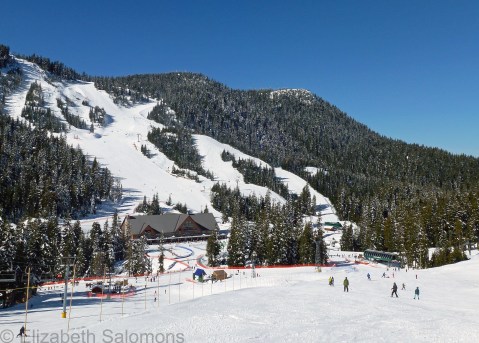
And so, after moving back west, with the urging of a co-worker who told me she was over the age of 40 when she learned to ski and assured me I could too, I found me some courage and signed up for the Adult Learn to Ski Program at Cypress. The program was a great bargain: five lessons, five full-day lift tickets, and five full-day rentals. Plus one night a week of night skiing for the entire season.
And here’s the thing I was thrilled to discovered: ski lessons are nothing like your grade school phys ed class. You remember those.

Howe Sound as seen from Lion’s Express Chair
No, ski lessons at Cypress are much different. The instructors are careful, considerate, and skilled. (After all, it’s in the resort’s interest to make sure you have fun ― they want you to come back.) I do think it helped me that I was familiar with the sensation of sliding on slippery surfaces, thanks to all those lunch hours spent on my elementary school’s outdoor ice rink. When the instructor told me to do a “hockey stop,” I knew what he meant and could do it on my first attempt. But more than all that, learning how to ski was just so much fun.
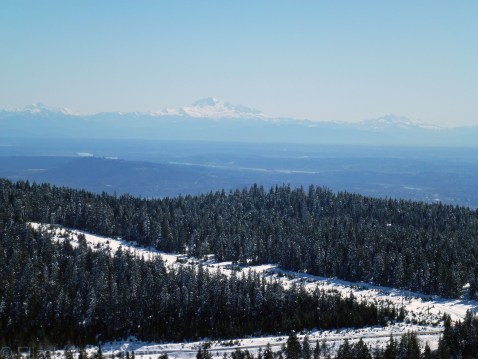
Mount Baker as seen from Black Mountain
The instructors begin by having you slide down a short incline in front of the ski lodge ― just a few metres to start. You move on to a longer incline, and before you know it, you’re on the bunny hill and learning how to turn.
After my first couple of seasons, I bought some second-hand skis and now, every year come December, I regularly check the ski report. The best are the blue bird days ― a brilliant day of sunshine after an overnight snow fall. Fresh powder is what you want. And then there’s spring skiing, which some years ― like this one ― can be awesome.
I know I’ll never be a great skier. No black diamond runs for me. But with 53 runs ― the longest is 4 kilometres ― and a vertical drop of more than 600 metres, there’s plenty on the Cypress Mountain to keep me challenged.
Vancouver can be a miserable place in the winter because of its rain. But all that rain in the city translates to snow on the North Shore mountains. So every winter, when I moan about how much it’s been raining, I only have to look up at the mountains and know that it’s going to be a great ski season.
Barring an early season Pineapple Express, of course.

Through My Lens: Vancouver Sunset

Of course, I don’t have to go all the way to Africa to see a spectacular sunset. I took this photo exactly a week ago while walking the seawall with a friend.
Missing Stanley

Oh, who am I kidding?
I’m no suburbanite.
Walking through Deer Lake Park while I’m hanging out in Solo is all well and fine, but I couldn’t wait to get back to my own urban park. (That would be Stanley.) I even felt a pang while crossing the Lion’s Gate Bridge the other day on my way back from snowshoeing with a friend. I looked at the wide expanse of Stanley Park from high above Burrard Inlet and said, “Ohhhh, I miss my park!”
What I like best about “my” park is how I can fit a walk through it in between errands. Like today. I returned some library books, headed over to Lost Lagoon to say hello to the ducks and to check if the river otters were out (they were), walked back along the beach, picked up a few groceries, went to the post office, and then came home.
And what did I see on that walk?
(What didn’t I see?)
Lots and lots of trees. The beach.
Ducks (including mallards, Wood Ducks, American Wigeons, American Coots, Common Mergansers, and Lesser Scaups), Canada Geese, a couple of Spotted Towhees, the above-mentioned river otters, and a raccoon.
And that was a short walk.
Oh. And, um, daffodils.
In full bloom.
Winter Wonderland

Last year around this time, I was bemoaning the lack of snow on the North Shore mountains. The ski season proved to be a washout ― one of the worst ever.

This year, the snow conditions couldn’t be more different. The North Shore mountains received a record amount of snow in December, and the three local ski resorts are reporting their best holiday season ever. The quality and quantity of snow we’ve received thus far this winter promises to give us one of the best ski seasons ever ― quite the contrast to last year.
The mountain where I play was operating at capacity the entire Christmas break. I witnessed those crowds for myself yesterday when I was up there to go snowshoeing with some friends. I’ve never seen anything like it at Cypress Mountain.
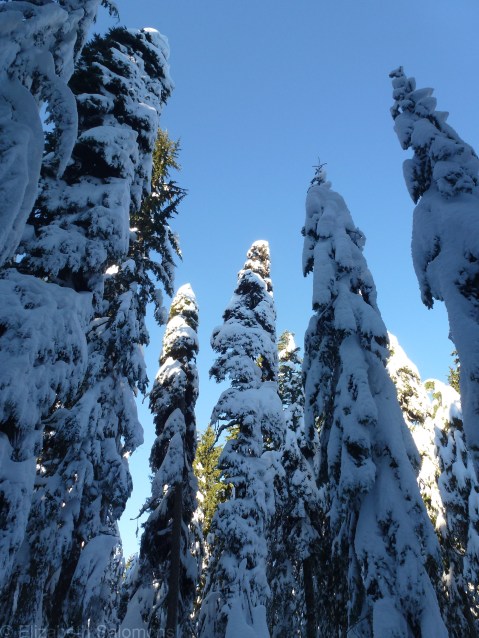
But for all the chaos, once we got going, it was like we’d passed through the Wardrobe Door and entered Narnia. It was certainly a winter wonderland. And that is what I love about Cypress: as busy as it gets, once you’re on the ski runs or the snowshoe trails, you have the mountain almost to yourself ― the resort is that big.
And it’s only a 20-minute drive from downtown Vancouver. I, for one, certainly don’t take that kind of wilderness access for granted.
Here are a few of the many photos I took yesterday. I kept stopping my friends so I could take yet another photo, although by the end of our snowshoe trek I did wonder aloud how many photos of snow-laden trees one might need.


Maybe just one more.

Through My Lens: Holiday Orca

Here’s one more holiday photo to finish out the year. This magnificent orca whale is a new display for 2015. Made by hand in Slovakia, it contains 6000 LED bulbs and was put up in Morton Park at English Bay as part of this year’s Lumière Festival.
A rather spectacular addition to the neighbourhood, don’t you think?
Through My Lens: Robson Square Ice Rink

Robson Square Ice Rink was looking mighty festive tonight. I wasn’t the only one who thought so ― check out the line of people on the left side of the photo. They’re all waiting for their turn on the ice.
Canyon Lights

The Capilano Suspension Bridge has been a Vancouver attraction since 1889 when George Grant Mackay, the man who owned the land on either side of the Capilano River, built a footbridge out of cedar planks and suspended it over the canyon using hemp rope. The bridge and the park that has developed around it is still privately owned and, to my mind, far too commercialized and far too pricey for what it offers. There are heaps of forest walks and plenty of other bridges to be accessed for free on the North Shore as an alternative to the Capilano Suspension Bridge. It’s on those walks and to those bridges where I take my out-of-town visitors who want a taste of the region’s rainforest.
However, sometimes out-of-town visitors have an agenda of their own and you end up tagging along wherever they want to go. I’m easy. I mean, it’s their vacation, right? And who knows? I might learn something new or see something spectacular.
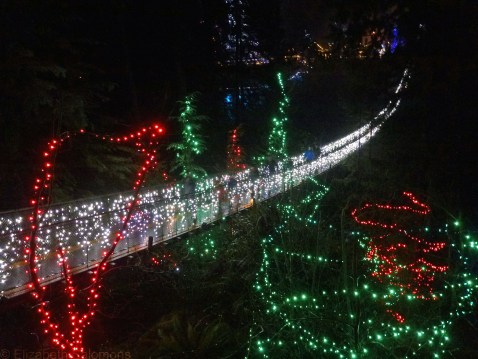
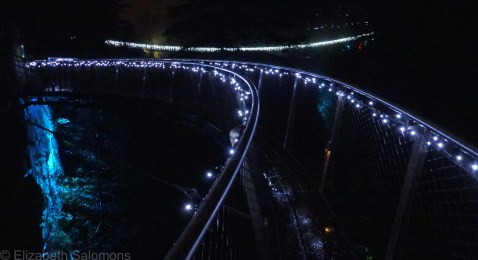
Such was the case when last week a friend of mine in town for the holidays wanted to see the Canyon Lights at the Capilano Suspension Bridge. In its tenth season, these light displays are part of the park’s massive efforts over the past decade to draw in more and more visitors.
And here was the surprise for me: the Canyon Lights are tasteful and magical, and I highly recommend them as a Vancouver tourist attraction if you happen to be visiting during the holiday season.
Here, take a look. (Click on any photo to open up the slide show.)


Capilano comes from Kia’palano, the name of a Squamish chief during the early 1800s. It means “beautiful river.”

One last note: if you have a fear of heights, Capilano Suspension Bridge might not be the place for you. But here’s a pro-tip: in the dark, you can’t see how high up you are!
The West End
I can’t let last month slip by without acknowledging that my neighbourhood, Vancouver’s West End, was awarded at the beginning of November the title of Great Neighbourhood in the fifth annual Great Places of Canada competition. (The contest is sponsored by the Canadian Institute of Planners, the same folks who bestowed the title of Great Street of Canada on Lacombe, Alberta, a couple of years ago.)
What makes the West End so great, according to the jurors of this year’s contest? They selected it because of its walkability and its diversity, and for the natural beauty that is its heart and soul: Stanley Park and the beaches of English Bay.
In short: it’s a community that rates high on the livability scale.
About that walkability: the main streets lining the edges of the neighbourhood allow easy access into and out of the West End for vehicles ― both public and private ― but what’s unique about the neighbourhood are the numerous parkettes, round-abouts, and one-way streets used to discourage traffic on residential streets. More than 40 percent of the population walks to work ― that’s a higher percentage than anywhere else in Vancouver. West Enders also typically walk to access their services, whether it’s their grocery or produce store, their butcher, fishmonger, or baker, the liquor store or pet store, or a doctor, dentist, or hairdresser. (Your every need met within a ten-minute walk!)
About that diversity: the West End, in particular Davie Village, is home to Western Canada’s largest LGBT community. Almost half of the neighbourhood’s 45,000 residents are between the ages of 20 and 39, a demographic reflected in the high number of residents (80 percent) who rent their homes. That, and a large concentration of Asian language students, makes for a high turnover in residents.
Despite being a transient population, the West End has more children than many areas of Vancouver traditionally considered family neighbourhoods. Those children are educated in two elementary schools and a high school that celebrated its 100th anniversary in 2014. The West End is also home to a large concentration of seniors (evident by the number of times I have almost been mowed down by one of them on a scooter). They have their own community centre at Barclay Manor, a heritage house in the centre of the West End.
Vancouver’s West End is bordered by West Georgia Street to the north, English Bay to the south, Burrard Street to the east, and Stanley Park to the west. As is all of Vancouver, the West End is unceded Coast Salish territory that was logged and developed after the arrival of the Canadian Pacific Railway. By the 1890s, it was home to Vancouver’s elite. When those elites crossed False Creek and began to settle in Shaugnessy, the West End became the transient community ― peopled with new arrivals to the city and the country ― that remains its defining characteristic to this day. Robson, Denman, and Davie streets became the business hubs, and apartments buildings were built: low-rise ones in the 1920s, ’30s, and ’40s, and multi-storey towers from the late 1950s on. Even so, many of the original houses from the late 1800s are still in use, creating an interesting architectural mix of heritage and modern buildings.
With everything it has to offer as a great place to live, work, and play, the West End is not without problems, however. Its housing is the least affordable in the city, yet the median annual income of its residents is far below that of Vancouver as a whole. St. Paul’s Hospital is being relocated some three kilometres away, leaving no acute care facility in the entire downtown peninsula. This is a worrisome issue in a city where a major earthquake that could happen at any time is likely to collapse all of the bridges that provide access to the downtown peninsula.
Development continues at lightning speed, and the buildings are becoming taller all the time. In a three-block stretch of Davie Street alone, three five residential condo towers are being proposed ― that’s a lot of construction in my near future only steps from my door.
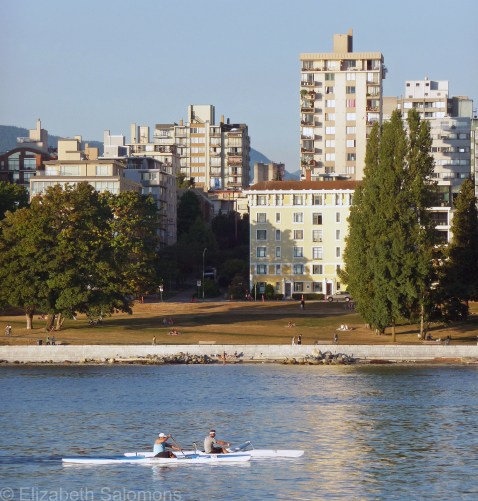
But for all that, I wouldn’t live anywhere else. And so, here’s a photo that shows everything I love about my neighbourhood: natural beauty, architectural diversity ― and my own beach (that I, um, share with several thousand neighbours).
Through My Lens: Freezing Fog
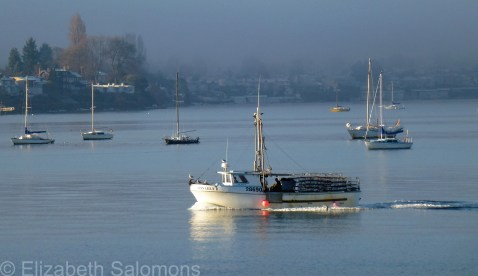
The meteorologists call it freezing fog.
I call it get outside and take some photos.


 There and Back Again