
Through My Lens: Bentley

This is a favourite photo of mine, and today is a good day to post it to the blog. That’s because this afternoon my dad and I took a drive to Bentley to deliver his sister (my aunt) safely home after a family get-together. Bentley, Alberta, is a small town due west of Lacombe where I spent a good chunk of my childhood summers.
Yup, I’m back in Wild Rose Country.
I took this photo almost five years ago. Alberta’s grain elevators are quickly disappearing ― in 1934, there were over 1700 of these iconic structures, but today there are maybe 120. Happily for me, this one is still standing.
Through My Lens: Vancouver in February

I feel a bit cruel posting this photo, but, well, it does reflect the reality of what it’s like to live in Vancouver.
Vancouver in February = crocuses.
I feel cruel because my friends in Halifax and Boston are struggling to keep up with all the snow shovelling and my friends in Toronto and New York are facing endless days of sub-Arctic temperatures ― all while Vancouver is experiencing a non-winter.
And now, on top of all that, we get an early spring.
I saw daffodils in bloom in Stanley Park on New Year’s Day. The snow drops made their first appearance about ten days later. The crocuses have been up for weeks, and I saw the first cherry blossoms on February 11 ― about two weeks earlier than most years ― and they’re now in full bloom. Last weekend I even saw a flowering rhododendron.
And all this past week I’ve noticed the magnolia trees are starting to blossom. I have never seen magnolia flowers appear so early ― the trees typically bloom in April.
It doesn’t seem fair, given the winter the rest of the continent is having (and it definitely doesn’t seem Canadian).
But, hey, whoever said life is fair?
Someone has to live in Vancouver. Might as well be me.
Through My Lens: Foggy Lost Lagoon

I took this photo about a month ago at Lost Lagoon in Stanley Park. I was there specifically to photograph ducks. That takes patience, always, and concentration, sometimes, but my focus was interrupted by the fellow beside me.
“Did you see the Pied-billed Grebe?” he said, rather excitedly. I looked in the direction he was pointing and saw the duck.
And then, as we stood there, the fog rolled in in about the same amount of time as it took me to get my camera out of my pocket. I saw the shot (his Pied-billed Grebe was flanked by two Common Mergansers), took the photo, and then, well, I couldn’t help myself. I turned to him and said, “I can’t believe I get to live here!”
He smiled.
“It’s a $10-billion dollar backyard,” he said.
That it is. But moments like those are priceless.
Happy Birthday to the Maple Leaf!
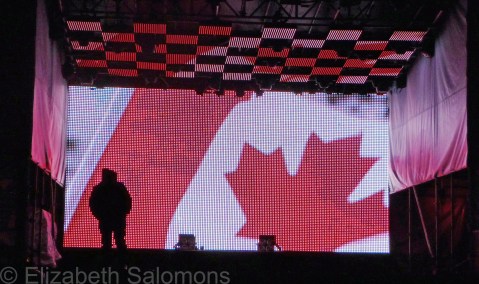
Yup, our flag turns 50 today.
Fifty is kind of a big deal. We should ―
Wait ― what? How come our national flag is only 50 years old when our country is almost 150?
A reasonable question, isn’t it? Well, let me put on my history geek hat and tell you the story, because it’s a good one and (dare I say it?) a typically Canadian one.
For decades prior to 1965, the Canadian Red Ensign had served as Canada’s de facto flag. The Canadian Red Ensign was a British Red Ensign with the addition of the shield of the Canadian Coat of Arms. (Just to clarify: the British Red Ensign is a red flag with a Union Jack in its top left corner. For comparison’s sake, the British Blue Ensign is a blue flag with a Union Jack in its top left corner ― the Australian and New Zealand flags are based on the Blue Ensign.)
With Canada’s Centennial fast approaching, then–Prime Minister Lester Pearson wanted Canada to have its own flag, unique and separate from the Union Jack. And thus ensued what is known as the Great Canadian Flag Debate. Pearson proposed a new flag consisting of three maple leafs in a white centre, bordered by two blue bars to represent the two oceans on our east and west coasts. It became known as “Pearson’s Pennant.” The Leader of the Opposition and former prime minister John Diefenbaker preferred that the Canadian Red Ensign become Canada’s official flag. The parliamentary debate dragged on for months. There was filibuster after filibuster, and eventually the issue was referred to committee, which was instructed to come up with a new design. In ― wait for it ― six weeks.
The 15-member committee was sent thousands of suggestions and sketches. Most included some form of a maple leaf. A much smaller number wanted some representation of the Union Jack (to represent our British heritage). An equal number wanted the fleur-de-lys (to represent our French heritage). And yet another equal number wanted ― oh, horrors ― the beaver (our national animal ― essentially an oversized rodent) represented somehow on our new flag.
After months of meetings, the committee was getting nowhere. Finally, one of the members slipped in a design by George Stanley, a Canadian soldier, historian, and author who, many years later, would became Lieutenant-Governor of New Brunswick. Stanley based his design on the flag of the Royal Military College in Kingston, Ontario. He believed that a new flag based on either the Union Jack or the fleur-de-lys (or both) would ultimately be divisive and therefore suggested something that was neither: a single red maple leaf in a white centre, bordered on both sides by red bars. The committee voted 15–0 for the Maple Leaf design.
The committee’s proposed flag still had to be passed by a vote in the House of Commons, and so debate ensued once again. Diefenbaker continued with the filibusters. Eventually, Pearson invoked closure and the flag was put to a vote on December 15, 1964. It passed and the Maple Leaf flag was raised for the first time on Parliament Hill on February 15, 1965.
Heh, heh. As they say, “only in Canada, eh?” I remember first hearing about the Great Canadian Flag Debate from my Canadian history prof, who summed it up as one of the longest and most divisive debates the House of Commons had ever seen.
But I wonder if the long, hard-fought political battle is why the Maple Leaf is so successful. It is truly our own flag ― not some variation on the British or French flag. It’s simple, and it’s distinct from any other flag on the planet.
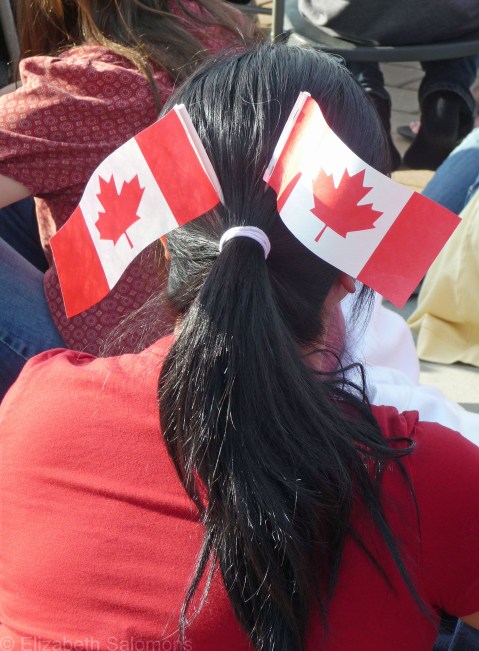
When I did my first backpacking trip outside of Canada, I sewed the obligatory Canadian flag onto the back of my backpack. How many conversations were initiated by that flag! One of them was with a fellow Canadian in the Venice train station. He caught my eye, then I watched as he casually circled behind me ― I knew exactly what he was doing; he was checking for a flag on my backpack ― and only then did he approach me. He needed to see my flag to confirm before speaking with me that I was one of those two Canadian girls he had met a few weeks earlier in a German youth hostel.
At that same hostel in Germany, my friend and I met two other Canadian women who were fresh off the plane from Canada. They were, in our oh-so experienced backpacker opinion (we’d been travelling for a whole month by that point), overdoing it with the flags. There were Canadian flags sewn to their backpacks, Canadian flags on their camera straps, Canadian flag pins on their shirt lapels….
My friend and I tried to avoid them ― they were embarrassing us. But a few weeks later, when a Greek waiter asked me why Canadians all sewed flags to their backpacks, I didn’t have an answer. It seemed so lame to say, “We don’t want you to think we’re Americans.” But that was the true reason. It’s the first bit of advice every Canadian backpacker is given before setting off for foreign shores.
The urban legend about Americans wearing Canadian flags to get better treatment while overseas? Although I never met these people myself, I did endure a long bus ride from New York City to Baltimore beside a hyper-talkative American girl who told me that when she travels in Europe she always tells people she is Canadian. I looked at her and quietly said, “You should stop doing that.” She didn’t seem to notice my frown. (To be honest, what truly amazed me is that she would actually ’fess up to impersonating a Canadian while talking to a Canadian on a bus in the United States. I mean ― really?)
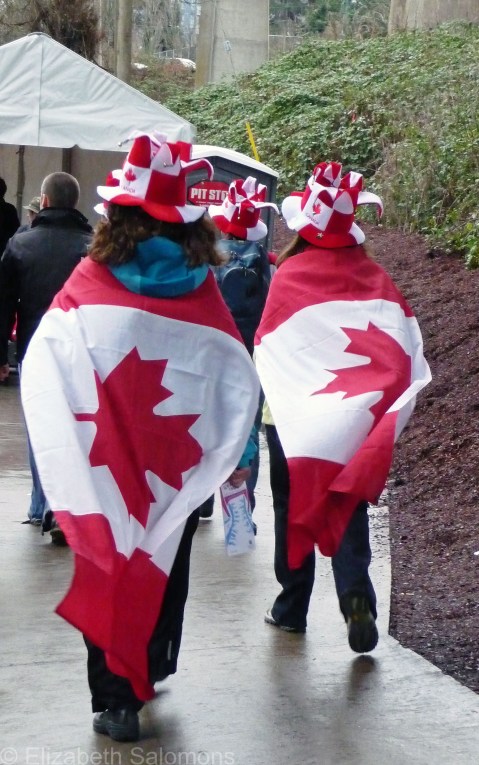
When Vancouver hosted the 2010 Winter Olympics five years ago this month, Canadian flags were everywhere. And I mean everywhere. Massive ones on the sides of buildings throughout the downtown core, little ones in condo windows throughout my neighbourhood, flags on the clothing we wore ― flags even on our faces. (Yes, even I, with my brother’s help, had a red Maple Leaf painted on my face before I headed off to watch the Canada–Germany men’s hockey game. Itchy stuff, that face paint.)
So, yeah, we Canadians proudly wear our Canadian flags on our sleeves when we want to. I may have been embarrassed to tell a Greek waiter that I wore my flag to identify myself as a non-American, but that was a long time ago and I was very young. If I met that waiter again, I would tell him, “Because it tells the world I’m Canadian.”
Snowshoeing at Cypress

It never happened.
The awesome ski season I was so looking forward to never happened.
In all my years of skiing, I’ve never seen a worse season than this past winter. What little snow the North Shore mountains received last November was washed away with an early season Pineapple Express. (A Pineapple Express is a storm system that moves in on the Pacific Northwest from Hawaii ― they are warm and wet and sometimes windy.)
Warm and wet do not good ski conditions make.
The irony of me writing a post about our lack of a ski season is that today is Family Day. Family Day is a provincial holiday enjoyed by most Canadian provinces on the third Monday of February (which is also the same day as Presidents’ Day south of the border). But in British Columbia, we celebrate Family Day on the second Monday of February. In my mind, it makes for a weird holiday ― knowing that the rest of Canada is working, I can’t help but feel I’m playing hooky.
Why did BC chose a different weekend than the rest of the country?
I’m so glad you asked as it’s still a sore point for me. I would love to spend a Family Day long weekend with my family in Alberta ― but that’s not possible since our holiday weekends don’t coincide.
The reason our oh-so-wise provincial government leaders chose to set the mid-winter holiday Monday on a different Monday than our neighbours to the east and south of us is so that BC families could have their ski resorts to themselves. (An aside: now there’s a government with a good grasp of how much it costs to raise a family in BC ― did you know that British Columbia has the highest child poverty rate in the country? I bet having a family day on the slopes is a high priority for parents who can’t afford to buy their kids a new pair of runners, much less ski clothes.)
At any rate, here we British Columbians sit with a holiday weekend during which our government promised us we’d have our mountains all to ourselves.
Which we do, because, oh yeah, there’s no snow.
So, what to do instead? Well, even when there isn’t enough snow for skiing, there is enough for snowshoeing, another of my favourite winter activities. (Although, truthfully, I should say was, as even the snowshoeing season appears to be over. The local mountains post daily updates that they remain hopeful more snow is on the way, but I have my doubts that Mother Nature is going to cooperate.)
OK. Enough with the whining. I did have a great day playing in the snow on the mountain a couple of weekends ago with some of my friends, and sharing the photos from that glorious day is the reason I’m posting today.
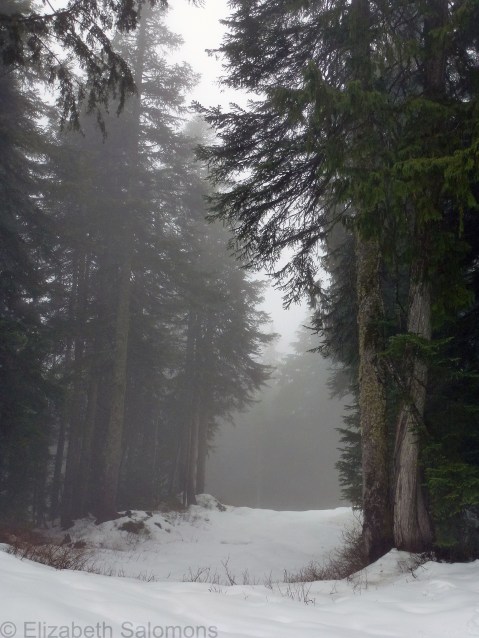
My friends and I went snowshoeing at Cypress Mountain. Just thirty minutes from downtown Vancouver, Cypress used to be known as Cypress Bowl and consists of three mountains, none of which are named Cypress. Black Mountain and Mount Strachan are where the downhill skiers and snowboarders hang out, and Hollyburn Mountain is the Nordic ski area. There are 11 km of self-guided snowshoe trails on Hollyburn that interlace the cross-country trails and, if you so desire, you can follow those trails all the way to the top of the mountain.
Believe me, it sounds more arduous than it is. Snowshoeing, to the uninitiated, is as simple as going for a hike in the snowy woods. Modern snowshoes have crampons, so climbing or descending the mountain trails is fairly easy to do. Some snowshoers prefer to use poles; they can give you extra stability on the steeper trails.

The bonus for us on the day we chose to go play in the snow was that Hollyburn was encased in fog, so we had a walk in snowy, misty woods. (Another indication of our warm winter has been the amount of fog we’ve seen these past few months.)

Part way up Hollyburn Mountain is Hollyburn Lodge, which has been the mountain’s refuge for skiers and snowshoers since 1926.
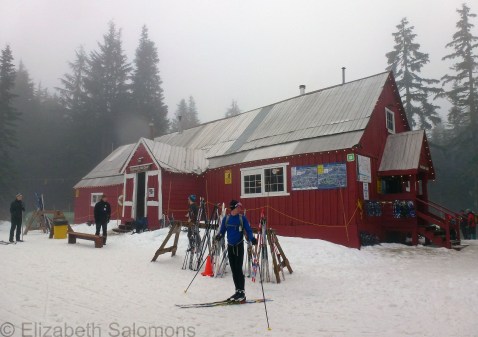
The licensed café inside sells hot and cold food and drinks, although you’re welcome to bring your own food to eat in the lodge. There’s also live music on weekends. And if you chose to join a guided snowshoe tour, fondues (chocolate or cheese!) are part of the package.

My friends and I are hoping to squeeze in one more day of snowshoeing this season, but if it doesn’t happen, I know we’ll be back as soon as we can next season.
Through My Lens: Foggy Bridges

Fog is a fact of life in Vancouver during the winter months. It can roll in from the ocean within a manner of minutes and stick around for weeks at a time. If the wind is in the right direction, I hear the fog horns from the freighter ships moored in English Bay, which is kinda cool. (What’s really cool is how they play those horns in harmony.)
The fog showed up again last night and was still here this morning, but I took this photo of the bridges over False Creek a few years ago.
Gastown Steam Clock
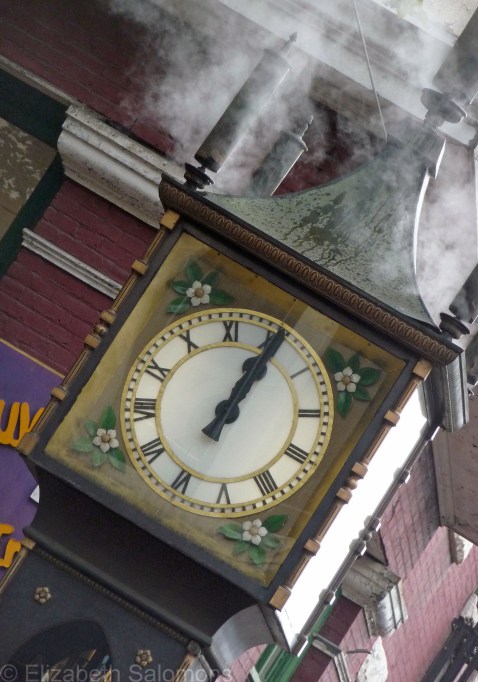
The Gastown Steam Clock is one of those attractions that visitors to Vancouver love to seek out. Tourists all want their photos taken in front of the whistling clock ― it’s hard to think of Gastown without it.
So imagine my surprise last month when I was wandering around Gastown and discovered the steam clock has gone walkabout. Turns out it’s in the shop for repairs and maintenance. In its place stands a cardboard replica ― which, sadly, doesn’t do it justice.
Why the love affair with the iconic steam clock?

Although designed to blend in with the Victorian architecture that surrounds it (it’s modelled after an 1875 English clock design), Gastown’s Steam Clock was built much more recently ― in 1977. The largest of its five steam whistles comes from the retired CPR steam tug SS Naramata.
The clock serves a more utilitarian purpose than merely decorative, though. It was built to cover a steam vent on the northwest corner of Cambie and Water. (An aside: did you know that a large section of downtown Vancouver, including BC Place, Rogers Arena, the Pacific Centre Mall, and the Vancouver Central Library, is heated by steam? I did not. The things I learn doing research for this blog.)
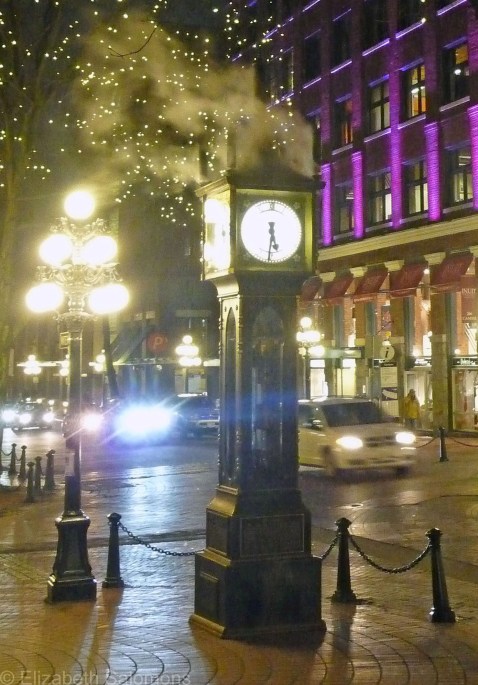
Gastown’s Steam Clock sounds the Westminster Chimes on the quarter-hour, so I guess you could say it is Vancouver’s Big Ben. That’s probably stretching it a tad, but the clock is beloved by tourists and locals alike.
Repairs are due to be completed sometime this month. When the steam clock is once again back in its place, all will be right in Gastown’s world.
Merry Christmas!

Morton Park, English Bay, Vancouver
Through My Lens: Kensington Place
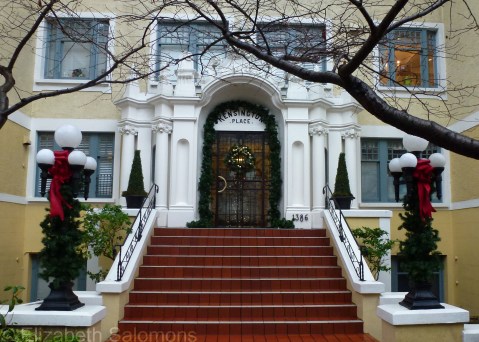
Just in case I am giving you the impression that only Europe knows how to dress for Christmas, here is a photo I took yesterday. This apartment building was built in 1912 and is a lovely piece of the West End’s historic past.
Through My Lens: Misty Mountain

November is notorious for being wet and windy in Vancouver, but we skiers don’t care. The more rain in the city, the more snow on the mountains. But this has been an unusual November in that the weather has been cold and clear for several weeks now. (Naturally, “cold” in Vancouver is relative; it’s hovering around 0°C most mornings ― quite balmy by Canadian standards.)
Turns out that cold and clear is perfect snow-making weather. Machine-made snow makes an excellent base, so as long as it doesn’t warm up when it (inevitably) starts to rain, we’re looking at a pretty good ski season. I can’t wait.
Someone must have known that, because this weekend the local mountains opened for the season.
The above photo was taken from Mount Strachan at the Cypress Mountain ski resort.


