
West Edmonton Mall
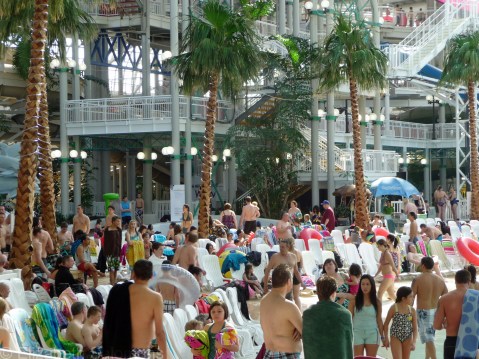
Yup. I’m writing about a mall. Not just any mall. The mall.
I’ve been debating whether to write this post. What is there to say about West Edmonton Mall? It’s big. It’s huge. It’s there.
But then I looked online to see what the Lonely Planet website had to say about Edmonton and laughed when I read, “Edmonton? Is that the place with the big mall?” After I stopped laughing, I realized that the mall does have a world-wide reputation. So, here’s a quick summary for you.
West Edmonton Mall gets 28 million visitors a year. (If you consider that the population of Edmonton is less than a million, that’s means either Edmonton is a city of shoppers or it gets a lot of out-of-town visitors. I suspect the latter.) Last weekend, my niece and I were two of those 28 million visitors. The mall’s claim to fame is not only that it’s the largest mall in North America, but that for 23 years (from its opening in 1981 until 2004) it was the largest mall in the world. That’s no mean feat for Edmonton, considering how many malls there are on this planet.
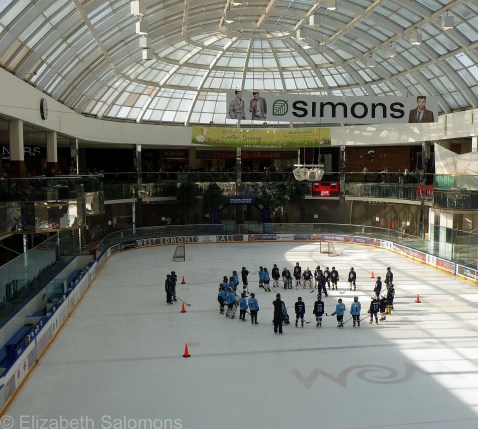
There’s an amusement park, a water park, an NHL-sized ice rink, a hotel, and, oh yeah, a few stores. Over 800 of them. For those of us urbanites who make it an art form to disparage West Edmonton Mall, we have to remember that Edmonton is a service centre for a vast chunk of rural Alberta. I’m quite sure there are a lot of Albertans who find a one-stop shop most convenient, especially if you have a handful of kids in tow. And a weekend of shopping and water-parking is a nice break from the cold icy winters northern Alberta is known for.
I won’t recommend you go to Edmonton just to see the mall. But if you happen to be in the vicinity, and have never seen the place, check it out. Just so you can say you’ve been in the largest mall in North America.
And then check out what else Edmonton has to offer. For more on that, stay tuned.
Great Blue Herons
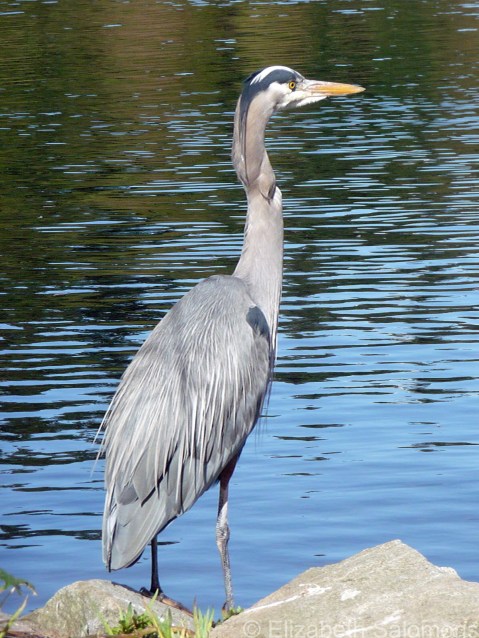
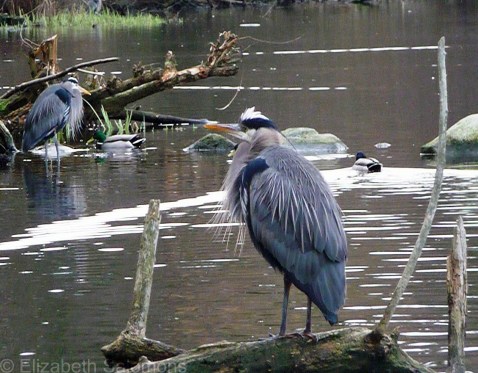
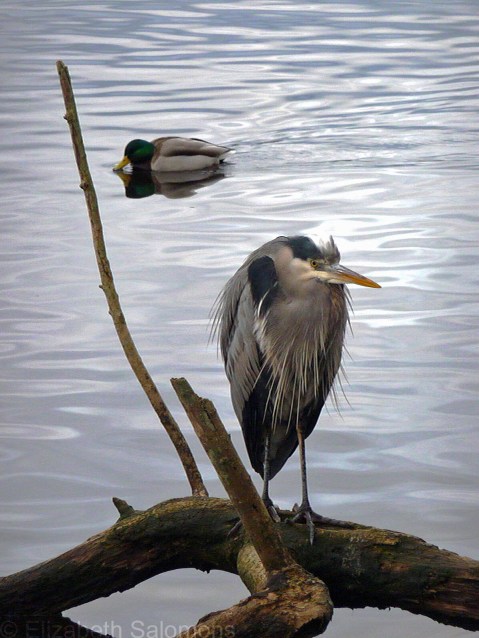
The herons are back!
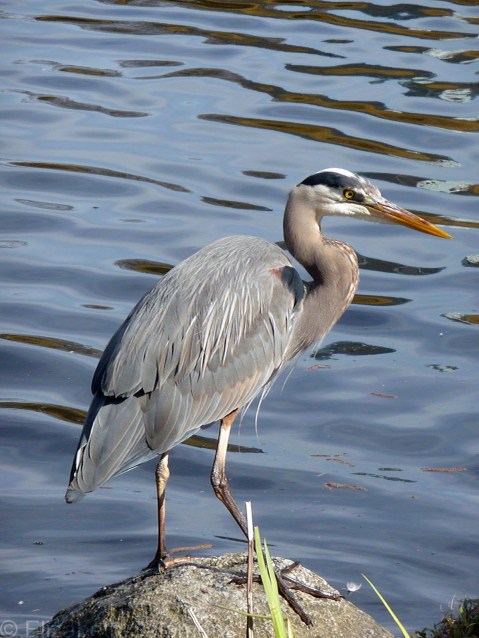
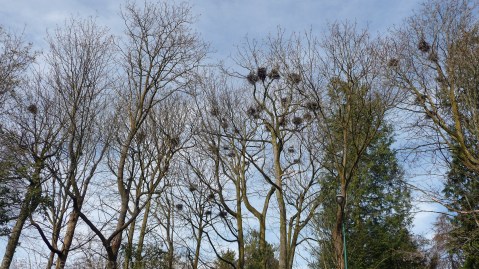
A sure sign of spring for me ― even more than crocuses or cherry blossoms in bloom ― is when the Pacific Great Blue Herons return to Stanley Park. They arrived a few weeks ago. This is the thirteenth consecutive year they’re nesting in what is one of the largest urban Great Blue Heron colonies in North America. Last year, the Stanley Park heronry hosted 86 mating pairs, which produced 169 fledglings.
The heronry is fenced off to keep people from walking beneath the nests, and metal flashing placed around the base of the trees keeps the raccoons from climbing the trees. The eggs are at risk from bald eagles, though, which also live in the park.
The Pacific Great Blue Heron is the largest heron native to North America.

Joe Fortes
I wanted to publish this post last month, but I had to wait for a break in the rain so I could take the photo. And … well … I had to wait quite awhile. I finally got my chance last weekend.
This photo is of a fountain in Alexandra Park that stands facing English Bay Beach. The fountain was erected in honour of Joe Fortes. There’s also a popular downtown restaurant named after Joe Fortes, and the local branch of the Vancouver Public Library is named after him. If you live in Vancouver’s West End, eventually you’re going to ask (as I did), “Who’s this Joe Fortes guy they keep naming things after?”
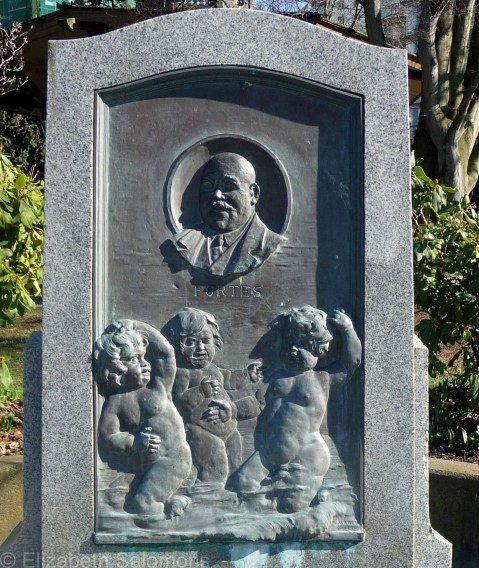
Joe Fortes was born in Trinidad and Tobago in 1863, and he arrived in Vancouver, via England, in 1885. He first started up a shoeshine business, then worked as a bartender and a porter.
When he wasn’t working, he hung out at English Bay, acting as a volunteer lifeguard. In 1897, the city of Vancouver made his volunteer position official when he was put on the payroll as the city’s first lifeguard. He lived in a little cottage just above the beach on Bidwell Street, and is credited with saving more than a hundred people from drowning, and with teaching thousands of children how to swim.
When Joe Fortes died in 1922, his funeral was attended by the mayor, the chief of police, and thousands of Vancouver citizens ― the largest public funeral Vancouver had ever seen. There was also a moment of silence held in the city’s schools.
On February 1, 2013 (which is why I wanted to publish this post a month ago), Canada Post issued a stamp featuring Joe Fortes to commemorate Black History Month. Joe Fortes is an appropriate choice for this year’s stamp as 2013 is the 150th anniversary of the year of his birth.
Dishing: Pizzeria Libretto
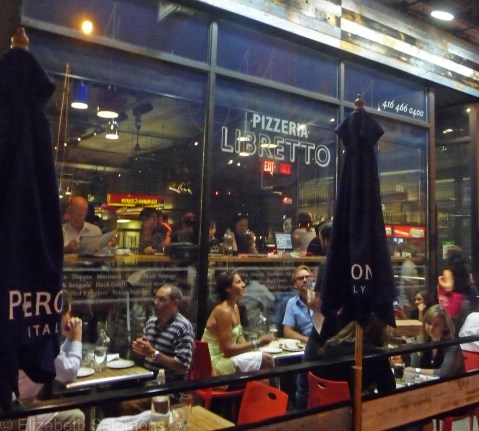
Here’s one last post on food, and then I’ll let you all go back to your New Year’s resolutions. (Which I know you’re following religiously.)
This post is about how I discovered Naples on the Danforth. The Danforth, for those of my readers unfamiliar with Toronto’s Greektown, is Souvlaki Central. A decade ago, there wasn’t much variety in the way of restaurants on the Danforth ― it was all Greek all the time. Every time I went back to Toronto for a visit, I made sure to get my fill of the best souvlaki in the country (in my humble opinion).
But during my most recent visit to the Centre of the Universe, I realized the Danforth is undergoing a transformation. There is still a heavy Greek influence, to be sure, but there’s a whole lot more as well.
Including Italian.
My friend insisted while I was in town that we eat at least one night at Pizzeria Libretto, a neighbourhood pizzeria that serves Real Neapolitan Pizza certified by VPN. (Verace Pizza Napoletana is a non-profit association that protects and promotes real Neapolitan pizza around the world.) She promised me I wouldn’t regret it.
I didn’t.
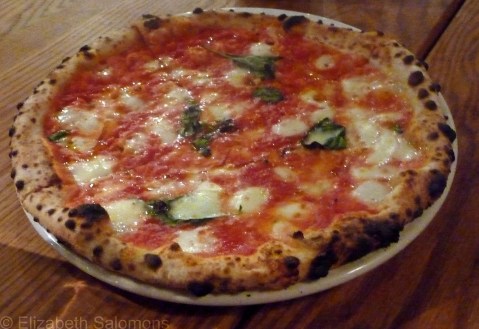
Pizzeria Libretto is about the closest I’ve been to Italian pizza outside of Italy. Libretto is Italian for “booklet.” You fold the pizza at Pizzeria Libretto like a booklet ― that’s the only way you’ll get it in your mouth, unless you deign to eat your pizza with a knife and fork. Pizza crust that soft and that thin ― that’s a true Neapolitan pizza. Our pizza Margherita had a super thin, soft crust, the thinnest layer of tomato sauce, the freshest basil, dollops of fresh mozzarella cheese … and it was baked in a wood-fired oven. Heaven on earth, truly, for pizza lovers.
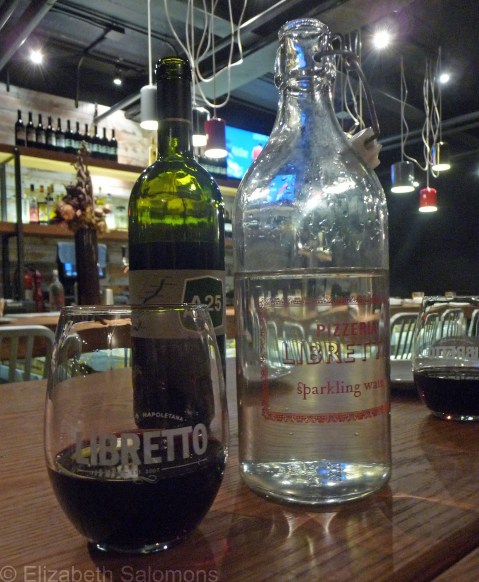
There was no room upstairs when we arrived (we didn’t have a reservation), but lots of room downstairs and the attentive service was excellent. Pizzeria Libretto has a stylish but down-to-earth décor ― I went dressed in a T-shirt, shorts, and Birkenstocks. I really liked the water bottles they used, with the name Pizzeria Libretto stamped on the side, and asked to buy one to take home with me. Our server said he was sure it wouldn’t be a problem, but then someone with a higher pay grade vetoed his decision. To help me get over my disappointment (I’m thinking), our server brought us complimentary after-dinner digestifs.
Before my evening at Pizzeria Libretto, I would tell people that the best souvlaki outside of Greece is made on the Danforth. Now I will tell everyone that the Danforth also has the best pizza outside of Italy. It was so good, in fact, I went back the next week with another friend for lunch. I never did get my souvlaki fix.
Dishing: Acadia
Update: Acadia closed in December 2013.
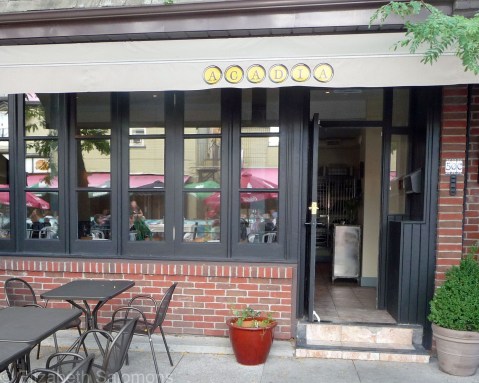
My friend was so impressed with our experience at Jean-Georges in New York City last summer that she decided we should check out some fine dining options in Toronto as long as I was in town. We decided on Acadia, which features the “flavors and techniques of Acadian and Lowcountry cuisine” and was rated by enRoute magazine as Canada’s fourth-best new restaurant of 2012. My friend (“C”) spends part of every summer in modern-day Acadia (aka Nova Scotia), she and I had travelled together many years ago to Louisiana, and I once spent a month in South Carolina, so we were both rather curious to see what Acadia had to offer on its menu.
Plus, a friend of C’s (“J”) ― also from Nova Scotia and in town for TIFF ― would be joining us. There was no debate. Acadia was our #1 choice.
(And we pause here momentarily for a brief history and geography lesson: Acadia, as I’m sure you all know, is that part of North America (present-day Maine, New Brunswick, Nova Scotia, and Prince Edward Island) settled by the French in the early seventeenth century. Its connection to Louisiana is that, when the British deported most of the Acadians between 1755 and 1763, many of them ended up in Louisiana, which at that time was still a colony of New France. Their descendents are known as Cajuns.
Not so well known (OK, yes, I admit it: I looked this up on Wikipedia) is the Lowcountry region. It’s the South Carolinian coast, and food typical to the area is known as Lowcountry cuisine.
That’s it for today’s lesson ― we now return to our regular programming.)
C and I arrived early, so we each ordered a bourbon-based cocktail to start. As we waited for J to arrive, we devoured an order of chicken cracklin’ with hot sauce and blue cheese. The cracklin’ are like thin, smooth potato chips, but they’re made from stretched chicken skin, not potatoes. I know, I know … it sounds disgusting, but trust me ― these are addictive. The blue cheese was foamy and light, and we scooped it up with each cracklin’ like dip.
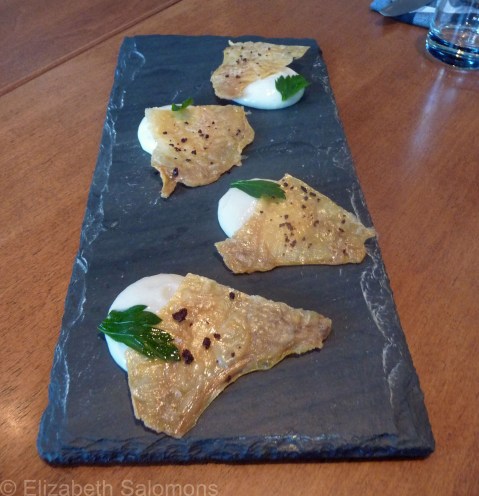
Chicken cracklin’ with hot sauce and blue cheese
When J arrived, appropriately famished as well, he ordered a beer and we ordered another round of the chicken cracklin’, as well as the spiced beer nuts, flavoured with brown butter and paprika, and Acadia’s cornbread, which is served with whipped pork butter and mesquite.
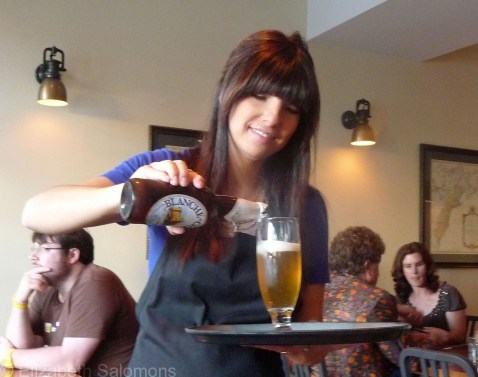

Acadia’s cornbread, with whipped pork butter and mesquite
After the nibblies and drinks were gone, we were ready for the serious stuff. We each ordered a different starter. C choose Anson Mills grits with Gulf prawn, oyster mushroom, pimento cheese, and ham hock consommé. Anson Mills is located in South Carolina, so these were the authentic southern grits I remember. I came to like grits mixed with scrambled eggs during my month of South Carolinian breakfasts. I like grits with eggs; I like grits for breakfast. But as a starter? With prawns? Never mind — C was happy. She gave me a taste, but I’ll be honest: not my favourite and I found it a curious dish.
J ordered the charred octopus served with crispy pork belly, tomatillo, new potato, spicy collards, and a black vinaigrette. He summed it up as simply the best octopus he’d ever eaten. I’ll admit I had some regrets on not ordering it when I saw his plate.
I had chilled corn soup with andouille, yellow plum, smoked cream, and tarragon. All the texture was in the andouille and plum that lay at the bottom of the bowl because the soup was as smooth as consommé. I soon got over my octopus-regret; my soup was delicious.

Chilled corn soup with andouille, yellow plum, smoked cream, and tarragon
Before the arrival of our main courses, our server came by with the most sincerest of warnings. We needed to prepare ourselves. More accurately, I needed to prepare myself, because, in her words, I was about to experience “some serious food envy.”
She wasn’t kidding. C and J had ordered the special of the night: an entire braised veal shank to share. It left all three of us speechless. It was encircled by chanterelle mushrooms and tomatoes of a variety of colours.
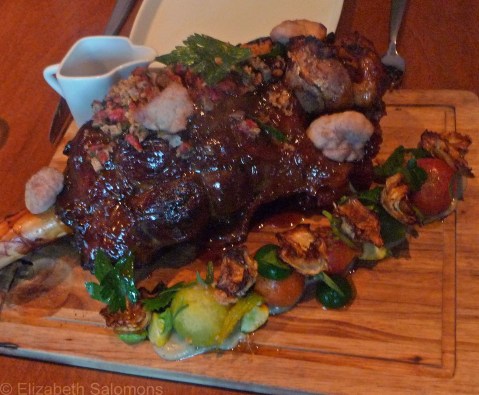
The magnificent veal shank
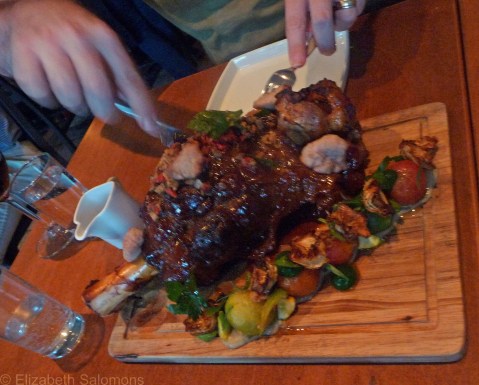
So magnificent it deserves a second photo
I had scallops (miniscule, our server teased me, compared to the veal shank), with shaved foie gras, celery purée, pecan, Concord grape, and scuppernong mustard. Scallop is one of my favourite types of sea food, so I can be quite forgiving, but no need this time. They were excellent. But I also had a few bites of the veal shank, and had to admit that it too was delicious.

Scallops with shaved foie gras, celery purée, pecan, Concord grape, and scuppernong mustard
It didn’t take long before J and C admitted they were defeated. Truthfully, that hunk of meat was enough for four people. Our server grinned. “Oh, so it’s going to be lunch tomorrow?” she asked.
C piped up that she would appreciate some suggestions on what to do with the veal in the way of leftovers. “I don’t want to ruin it,” she said. We were surprised and delighted to see Acadia’s chef, Patrick Kriss, come to our table after we had been served our desserts, speaking most earnestly, and advising C to braise the leftover meat in chicken stock to retain the moisture. “Don’t put it in the microwave,” he warned. “That will dry the meat out.” We were all impressed by the attention he gave us ― although, if I think about it, it was probably the veal shank he was most concerned about.
For dessert, I had wild blueberry sorbet with peaches, lavender, and ricotta, while J and C shared a dark chocolate cremeaux with milk sorbet, pistachio, and cherries. Espresso to finish, and we were sated. My Toronto readers: if you’re interested in a medley of cuisines and a lesson in geography, check out Acadia. I highly recommend it.
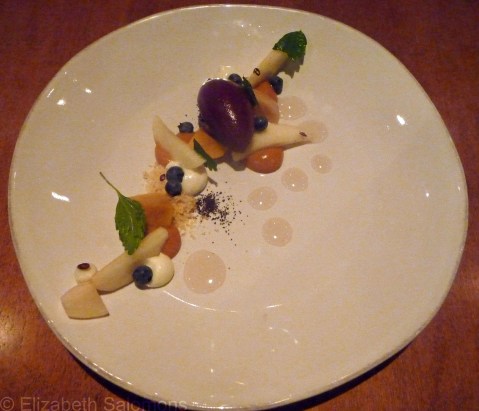
Wild blueberry sorbet with peaches, lavender, and ricotta
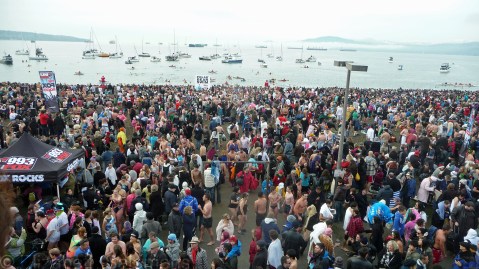
Vancouver’s 93rd Annual Polar Bear Swim
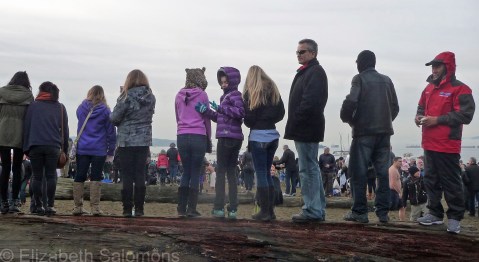
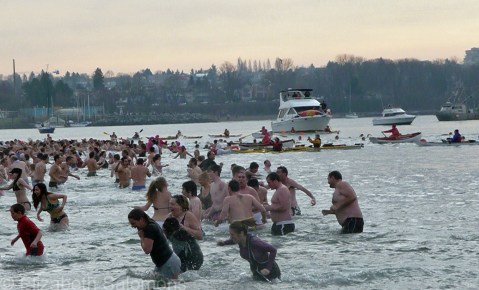
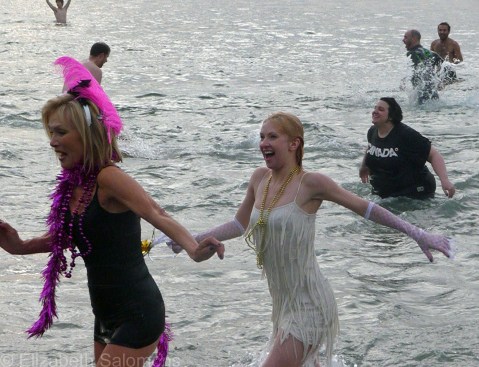
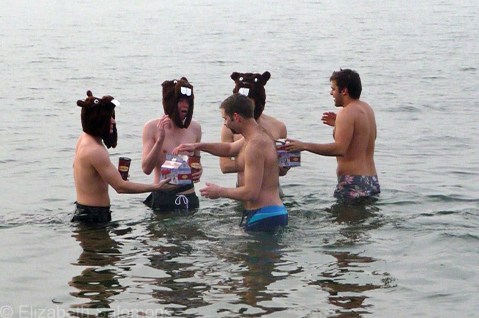
I can’t believe I’ve lived in this neighbourhood for 14 winters, and today was the first time I witnessed the annual New Year’s Day Polar Bear Swim. My reaction? They’re all nuts.
Vancouver’s Polar Bear Swim has been going on since 1920, and is one of the largest in the world. There are more than 2000 registered swimmers, but estimates of how many actually go into the water are as high as 10,000.
I’ll let the photos speak for themselves. (Note the guys in beaver hats enjoying their Timmy’s coffee and Timbits.)




Dishing: Monk McQueens

Last night was one night I regretted showing up late to the party. Monk McQueens at Stamps Landing on the south side of False Creek has been a Vancouver landmark ever since it opened during Expo 86. And yet, I’d never been. The announcement that it was shutting its doors for the last time on December 31 of this year was what finally motivated me to experience this famous fresh seafood and oyster bar for myself.
I made an occasion of it by reserving a table for the same night a friend from Boston was going to be in town. And so, five of us gathered last night to enjoy a leisurely dinner and a bit of a catch-up. Our table in one of the corner windows gave us a terrific view of False Creek.
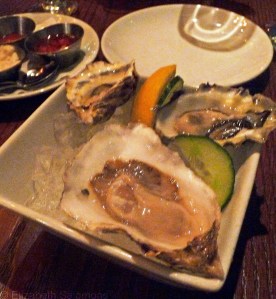
The food was delicious. My Bostonian friend and I shared a half dozen oysters on the half shell. For our mains, our party of five sampled almost every type of seafood on the menu: halibut, sea bass, sablefish, lobster, and scallops. We washed it all down with a very nice bottle of wine, and finished with coffee, brown sugar vanilla bean cheesecake, and Calvados. I can’t think of a nicer way to spend four hours with good friends on one of the last nights of the year.
Mahony & Sons Public House is moving in after Monk’s vacates the premises and will open sometime next summer. As much as I enjoy a good public house, it won’t be the same. Last night was proof that just because an establishment has been around since the Dark Ages (aka the 1980s) doesn’t mean it should be taken for granted. Pity I did.
Merry Christmas!
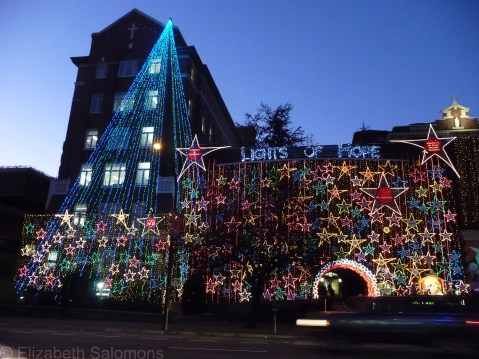
St. Paul’s Hospital, Vancouver
Through My Lens: Snow on the Mountains

Every once in a while, this time of year, the rain stops for a day, and you get a peek at what all that precipitation has done to the local mountains. I took this photo two days ago.
Through My Lens: December
I’m always glad to see the back side of November. I know, I know ― it’s a miserable month everywhere in Canada, not just here, but for some reason, out of all the places in Canada (and elsewhere) I’ve wintered, I find Vancouver’s Novembers the hardest to get through. Which is pretty ironic given the Lower Mainland’s nickname: “The Tropics of Canada.”
As soon as I flip the calendar over on the morning of December 1st (metaphorically speaking, of course, since I don’t actually have a wall calendar anymore), I feel so much better. December is when I shake off my November blues, and realize that the city has put on its glad rags when I wasn’t looking. Even the Scroogiest of Scrooges cannot help but feel a little festive.
Here’s an example: Robson Square. I’ve loved its light displays since my first ever office job in downtown Vancouver as a fresh university grad, when I would wander through the square after dark on my way to catch the bus home. The ice rink ― shut down for many years ― was refurbished for the 2010 Olympics, and has been open every winter since.


 There and Back Again