
Fort McHenry and Fort York
This year being the bicentennial of the War of 1812, we Canadians have been bombarded with what strikes me as an odd media campaign celebrating our nationhood. Odd, because we Canadians don’t typically yell and shout out our patriotism. Odd, because videos like this one
seem to be doing a pretty good job at celebrating our nationhood at the expensive of the other guys. You know, the ones who are suppose to be Canada’s Best Friend. Longest undefended border and all that.
Truth is, I don’t remember ever being taught anything in school about the War of 1812. That might be because I was (mostly) educated in Alberta, and the war took place in Upper Canada (what we now call Ontario), Lower Canada (what we now call Quebec), and the United States. Or maybe it’s because we Canadians don’t really give that war much thought.
What little I know about the War of 1812 is that it had something to do with the British boarding American merchant ships and drafting American sailors into the British Navy. (Britain was busy fighting Napoleon at the time and needed all the sailors it could get its hands on.) The Americans didn’t like that much (who would?) and they declared war on the British.
What little I have read about the War of 1812 says that nobody actually won. It more or less came to a stalemate, and sometime in 1814 the powers that be worked out an agreement called the Treaty of Ghent that more or less left everything pre-war as the status quo. And ― oh yeah ― we burned the White House. That was in retaliation for the Yanks burning our Parliament Buildings in York (what we now call Toronto), which was then the capital of Upper Canada.
(As an aside: burning government houses was considered bad form back then, and trashing non-military targets simply wasn’t done in the age of the Gentlemen’s War. Which is why the Brits got a tad upset and why they turned around and burned the White House. I find it ironic that everybody remembers the Brits burned the White House, but nobody seems to remember that the Americans burned York.)
(And, just one more aside: I found out during my visit to Washington DC last summer that the White House came to be called that because, after said burning, it was painted white to cover up all the soot marks. President Theodore Roosevelt made it official almost a hundred years later by having stationery printed with the words “The White House” at the top.)
Back to the war: a more accurate assessment of the War of 1812 might be that we both won. The Americans call it their “second war of independence,” and after it was over we Canadians began to think of ourselves as a nation, and not just some fur trading post for the British.
And so (finally!), to the main topic of this blog post. On my visits last summer to Baltimore and Toronto, with the War of 1812 being foremost in my mind due to our tax dollars hard at work, I decided to visit Fort McHenry and Fort York.
 Fort McHenry, I discovered, is not just a National Historic Monument, but a National Monument and Historic Shrine. That was pretty much evident during the video presentation I watched at the Visitors’ Center. The last image of the video, with the American anthem playing after the voice-over ends, is of the American flag. At the same time, the screen rises so that you are looking outdoors at the American flag flying over Fort McHenry. I tried not to snicker, but it was a bit hokey.
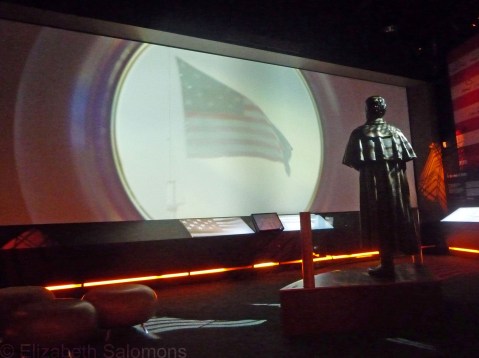
The end of the video presentation at the Fort McHenry Visitor’s Center. The statue is of Francis Scott Key, and he’s watching the Star Spangled Banner, still waving strong after the British bombarded the fort with rockets and guns for 25 hours.
Back to the War of 1812: the British knew they needed to capture Fort McHenry if their campaign against Baltimore was to succeed. They attacked the fort at dawn on September 13, 1814, bombarding the fort for a day and a night, but eventually they gave up and stopped the bombardment. The problem was, the American guns had a range of 1.5 miles, and the British guns had a range of two miles. The British navy parked itself just out of range of Fort McHenry’s guns, but that meant the shells from their guns couldn’t reach Fort McHenry accurately. Only two shells out of over 1500 fired actually hit the fort. Talk about a waste of ammunition.

Battery of guns overlooking the Patapsco River, with Francis Scott Key Bridge in the distance. During the Battle of Fort McHenry, the British fleet parked itself well past where that bridge now spans the river.

Another gun overlooking the Patapsco River

And yet another gun pointed at the Patapsco River
After the bombardment stopped, Francis Scott Key, an American lawyer who was being held by the British on a ship out in the Patapsco River, looked towards the fort and saw the large flag still flying. That told him the Americans were still in control of the fort. That same flag ― which measures an incredible 42 by 30 feet ― is now on display at the Smithsonian’s National Museum of American History.

When weather permits, an American flag the same dimensions of the original Star Spangled Banner is flown over Fort McHenry.
Francis Scott Key wrote the words to “The Star Spangled Banner” after the British released him and while he was on his way back to Baltimore. The “bombs bursting in air” line in the anthem refers to the British shells that were fired at Fort McHenry.
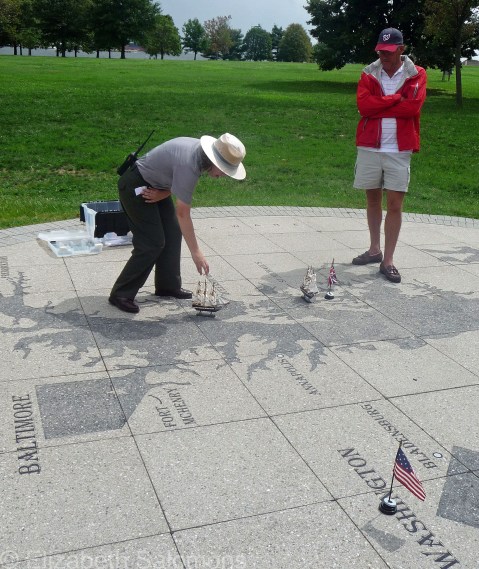
The national park ranger gives us a history lesson. I liked her model ships.
There isn’t much to see in Fort McHenry itself as it’s fairly small and there aren’t many buildings still standing. But you certainly get a feel for why its location was so important: it sits at the end of a narrow peninsula right at the entrance to Baltimore’s harbour, and is in a perfect position to defend the city. I took a water taxi out to the fort from Baltimore’s Inner Harbor, and it was a lovely, breezy way to see the harbour.

The barracks at Fort McHenry

Another view of the barracks. The barn-shaped building is the powder magazine.
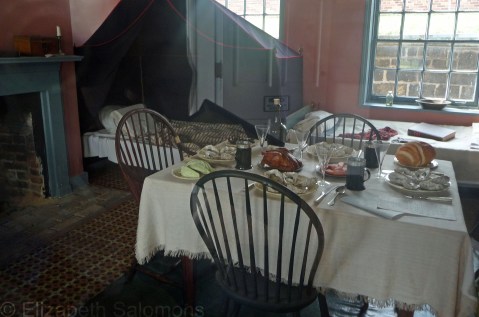
The junior officers’ quarters. Note the plates of oysters. Clearly the junior officers ate well.
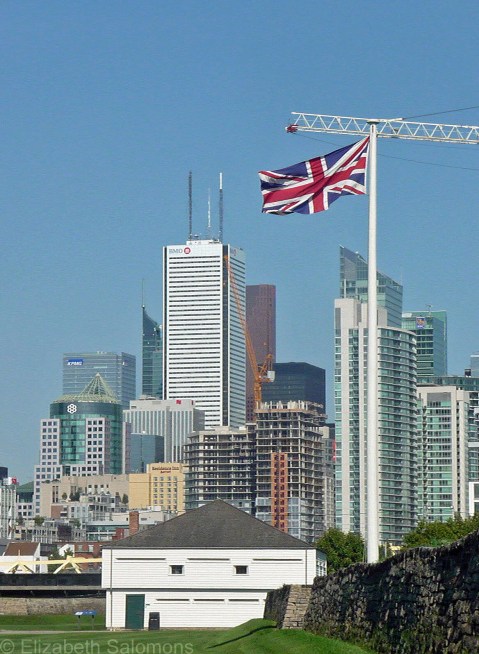
Fort York, on the other hand, is located in the midst of a bustling, growing city, right beside Toronto’s Gardiner Expressway. This made for some intriguing photos as I looked for interesting angles.




The museum displays at Fort York could use some updating, but it had many more rooms furnished in period pieces than did Fort McHenry, which makes a visit much more interesting. (Click on any of the photos below to open a slide show.)


The Americans attacked Fort York on April 27, 1813. The British were vastly outnumbered (750 British troops, 50 Mississauga and Ojibway warriors, and 12 guns vs. 2550 Americans, 15 naval vessels, and 85 cannon), and lost the battle, but the Americans suffered almost double the casualties of the British when the British blew up their own gunpowder magazine. The battle lasted six hours and cost 157 British lives and 320 American lives, including the American field commander. Afterwards, the Americans burned and looted the city of York, including the Government House and the Parliament Buildings (see above), and occupied the town for six days.

The Blue Barracks were built in 1814 to house the junior officers. These are a reconstruction.

The Brick Barracks and Mess, built in 1815, housed the unmarried officers and served as the mess for all of the garrison’s officers.

The Stone Magazine was built in 1815 and had room for 900 barrels of gunpowder. Its walls are two metres thick.
The Battle of York was a clear victory for the Americans, and marked their first invasion of British territory since the start of the war. But the battle itself wasn’t considered crucial to the outcome of the war and the Americans saw taking York merely as a stepping stone to the real prize: the Niagara Peninsula and, eventually, Kingston.
The Battle of Fort McHenry, on the other hand, was considered a turning point in the war, saved Baltimore from British invasion, and contributed to the early mythology of a nation still trying to forge its identity.
As for me, a gap in my Canadian history education has been filled, and my knowledge about the War of 1812 is now more complete. My government would be proud of me.
Through My Lens: Biomed Building
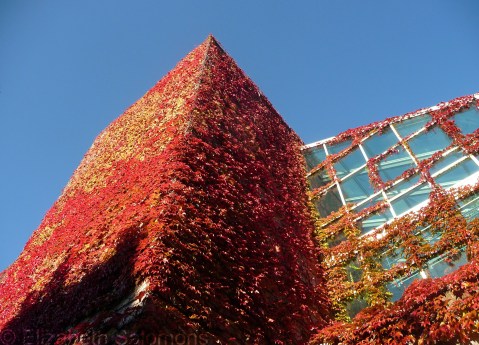
Since September, I’ve been spending most of my days at the University of British Columbia (UBC). It’s a beautiful campus located on the Point Grey peninsula of the west side of Vancouver. This is a photo I took in early October of the Biomedical Research Centre I walk by each day on my way from the bus loop to my office. I liked the contrast between the blue sky and the red ivy.
The Sylvia Hotel

The Sylvia Hotel is a small beachside hotel in Vancouver’s English Bay with a long and storied history. These photos were taken when the hotel is at its most colourful —in the fall, after the ivy has turned red.
The hotel has some other colour as well: Errol Flynn was a frequent guest and there is an urban legend that he died here. Team Russia, including (it was rumoured) the Russian hockey team, stayed at the Sylvia during the Vancouver 2010 Olympics.
The Sylvia Hotel has overlooked English Bay since 1912. Originally an apartment building, it was converted to an apartment hotel during the 1930s and to a full-service hotel after World War II. Its name is taken from the daughter of the building’s original owner. Until 1958, the Sylvia was the tallest building in Vancouver’s West End — hard to imagine today as the eight-storey building is dwarfed by the condo towers that surround it.
Two of my home exchangers came to Vancouver for family weddings and found the Sylvia most convenient for other members of their families to stay. It’s a lovely place to go for breakfast — I recommend the Beachside Benny — and the hotel is also the setting of two children’s books about a resident cat named Mister Got to Go.

Through My Lens: Canada Place
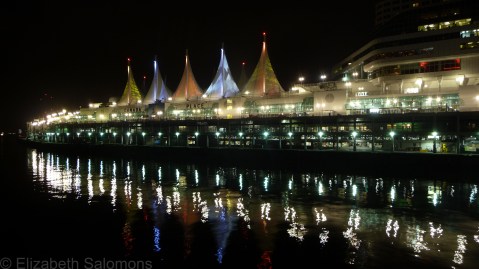
A friend was in town this week on business, so I met up with him one evening after work. We went for drinks and something to eat and a long catch-up at a bar near his hotel that overlooks Canada Place.
Afterwards, we took some photos. Here’s mine.
TIFF
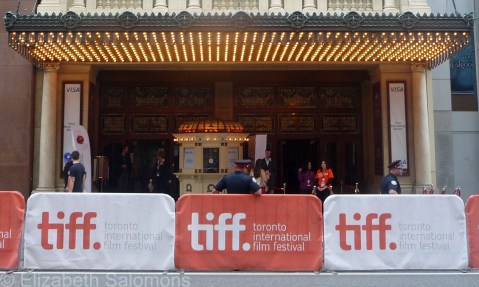
By happenstance, I was in Toronto this year during the Toronto International Film Festival (TIFF). Which led to me taking the above photo.
I was walking up Yonge Street one afternoon on my way to meet a friend. I liked the look of the lights underneath the canopy at the Elgin and Winter Garden Theatre, so I stopped to take a photo. Within seconds, several people stopped to see who I was taking a photo of (and by “who,” I mean which celebrity) and they began pulling out their own cameras and phones. At which point I smirked to myself, put my camera in my pocket, and continued on my way. Only during TIFF would pointing your camera at a movie theatre cause a traffic jam!
That night my friend and I saw a French film set in the Parc des Buttes-Chaumont, a beautiful park in Paris I have yet to see for myself. I tried to get tickets to a few more films, but no luck there ― the ones I wanted to see were selling out as fast as I was trying to buy them online. No matter, though. Two of the films I was able to see a few weeks later at VIFF.
TIFF is a smaller festival than VIFF ― it shows fewer films and is five days shorter ― but it’s an industry event, so to speak, and therefore gets a lot of attention because Hollywood and the world’s media comes to town. I could feel the buzz in the air the entire time I was there, which makes September an exciting time to visit Toronto.
VIFF
Travelling to another country doesn’t always require that you get on a plane. One of the best alternatives to travelling (for me) is hanging out at an international film festival.
Vancouver International Film Festival (VIFF) is held every October and is one of the largest film festivals in North America. This year, I had a choice of 380 films from 75 countries. Which meant that this month, for the price of a movie ticket, I saw Serbia, Bosnia, South Africa, France, and the Czech Republic.
How cool is that?

Through My Lens: September
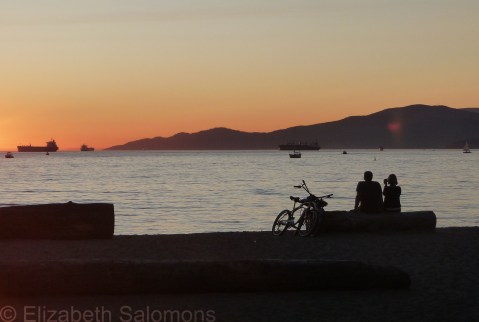
As much as I love to travel, I always love to be home again. Especially after a longer time away.
I was gone for six weeks this time, what with my house-sitting stint in Burnaby and my mad dash around the Eastern Time Zone. Now I’m back in my own space, in my own neighbourhood, enjoying all that I love about work and play in Vancouver.
Both this year and last, Vancouver endured a miserably cold, wet spring, but a fabulously long and hot summer. The highs this past week were an incredible 27°Celsius ― that’s warm for Vancouver at any time of the summer, but almost ten degrees above normal for late September. And so, everyone is spending as much time outdoors as possible; the beaches, the parks, and the seawall are filled with people enjoying the last gasp of summer. We all know it won’t last much longer.
Toronto Street Cars
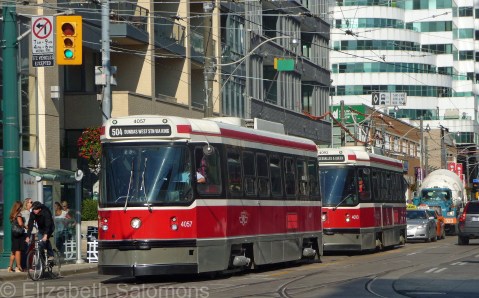
Nothing says “Toronto” to me as much as its iconic red street cars.
For several years, I rode the 504 King car every day on my way to and from work, but when I first moved to Toronto, it took me a while to figure out where and how I was expected to board the street cars. The only street cars I was familiar with were the trams in Amsterdam. In that city, there are raised concrete platforms along the tram tracks where you stand to wait for the tram.
Although some street-car stops in Toronto have platforms similar to those in Amsterdam, most stops are marked with a small sign attached to a light pole. The signs are easy to miss if you don’t know where to look. You wait on the sidewalk beneath the sign, just as you would wait for a bus at a bus stop. The street car pulls up, traffic in the lane between the street car and sidewalk stops, and you step out into the road to board the street car.
Street cars have been operating continuously in Toronto since 1861, and Toronto’s system is the largest in North America in terms of ridership, number of cars, and track length. Its eleven lines, most of which crisscross downtown and all of which connect with the subway, have a daily ridership of over a quarter of a million people.
Toronto
I’m on the last leg of my jaunt around the Eastern Time Zone, which means if it’s Wednesday, this must be Toronto.
Unlike my Baltimore leg, which was all about first impressions, my time in Toronto is all about memory. I used to live in Toronto and on each return visit, as the years go by, I am amazed by how much I remember and by how much I have forgotten. Buildings and streets I haven’t thought of in years come back to me with immediate familiarity the instant I see them. But then there are other times when I have to reach back into the recesses of my memory and think, “Have I been to this restaurant before? Do I remember how to get from here to there?”
There are a lot of things about living in Toronto that I miss when I’m not here. Like street cars. And patio restaurants. Upper Canada Lager. Victorian architecture. And how you can sit outside till well past dark on a September evening and not feel chilled.
And then there are the things that drove me crazy about living in Toronto. Like the traffic. And the smell of garbage lining the streets in front of the storefronts at the end of a hot summer’s day. The traffic. That there are people here who think when you say “out west,” you mean Mississauga.
And did I mention the traffic?
Each city has its own advantages and disadvantages and I was lucky enough to experience Toronto’s. It took me a long time to figure out how to live in this city, but once I had it mastered, I was happy to call it home for as long as I was here.

Deer Lake Park
The other day I wrote that, during my time hanging out in Solo, I’ve discovered a few of Burnaby’s treasures ― delightful treasures that redeem some of the annoying and ugly aspects of suburban living. Deer Lake Park is one such treasure.
A friend introduced me to Deer Lake Park one afternoon about a week ago. Her townhouse complex backs onto the 500-acre park, so you could say the park is right in her backyard. We walked a loop around the park and I took some photos of the lake. Here are a few of them.
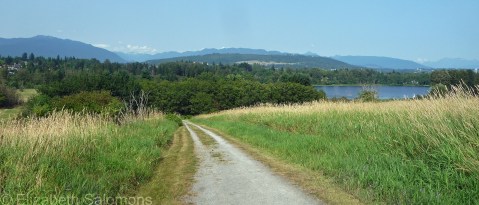
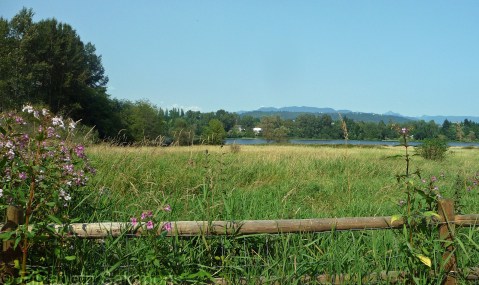

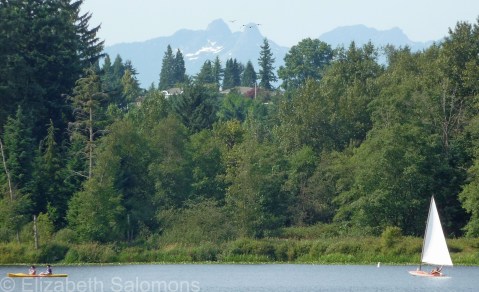
Deer Lake Park is a park for all seasons and I intend to come back to explore it some more.


