
BC’s Wacky Winter Weather
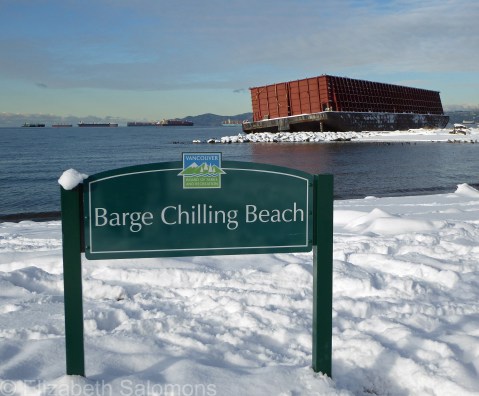
Yeah, that.
That is a wayward barge that was pushed onto the beach during last November’s atmospheric river — the storm that caused so many problems in our province. An atmospheric river is a band of heavy moisture up to several thousand kilometres long, but just a few hundred kilometres wide, that develops over tropical ocean areas before moving north and inland. (I’ve now added the term to my meteorological lexicon, along with heat dome.)
The atmospheric river that ran over southern BC last November dumped about a month’s worth of rain on the region in just 48 hours. Along with all that moisture came some strong winds, which is how this barge ended up on Sunset Beach in English Bay. It has its own Twitter account and is a constant reminder that not all is well, climatically speaking, in my home province.
(C’mon. You didn’t think I’d let a winter go by without talking about the weather, did you?)
That storm, the first of four atmospheric rivers to hit southern BC in one month, knocked out an unprecedented amount of BC’s infrastructure.
For starters, the Nooksack River in Washington State overflowed its banks and then flowed downhill into Canada, completely flooding the Sumas Prairie in the Fraser Valley for an entire month. Located about an hour east of Vancouver, the Sumas Prairie is on the other side of the mountain in this photo, but you get the idea from the photo of the geography involved.
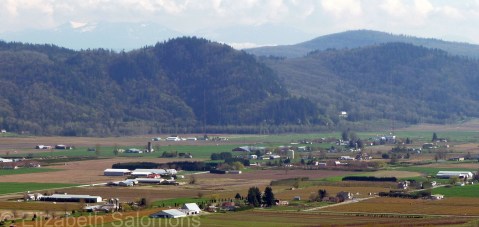
The first time I drove through the Fraser Valley was as a teenager when my family moved from Alberta to BC. After so many hours of driving through endless mountain passes, I could not believe how absolutely horizontal the landscape was.
“And they say the prairies are flat,” I remember thinking.
But that’s a river delta for you, and its rich soil is why the Fraser Valley is home to more than half of BC’s dairy and poultry production. Close to a million animals died during the floods, and thousands of acres of blueberry plants were also ruined. We’ll be feeling the effects of this flood for years to come as the farmers work to bring their fields and farms back into production.
Two other communities, Merritt and Princeton, were also flooded. To give you an idea of the scale involved, the area of BC under flood watch last November was equivalent to the size of Belgium.
Then, in addition to the floods, a series of mudslides and washouts extensively damaged all the railways and highways connecting Vancouver to the BC Interior and the rest of Canada. Five people died, and 275 people spent two days trapped between mudslides on one major highway until they were evacuated by helicopter.
With our transportation network knocked out, nothing from Canada’s largest port could get to the rest of the country and no shipments for export could get to the Port of Vancouver (including grain shipments at a most critical time of year).
The pipeline that brings fuel to the Lower Mainland was initially shut down as a precautionary measure but then remained shut for three weeks, which led to gas rationing in the Lower Mainland and on Vancouver Island. Fuel was brought in from the US by barge.
Talk about supply chain issues.
It was three weeks before the trains started running again. The largest and busiest highway in BC, the Coquihalla, reopened to commercial traffic only on December 20 and to all traffic last week. That it reopened as quickly as it did is quite the engineering feat: more than 130 kilometres of the highway in 20 different sections were extensively damaged, including five collapsed or heavily damaged bridges. It’s not business as usual — the highway will remain an active construction zone for the foreseeable future as all of the repairs are temporary.
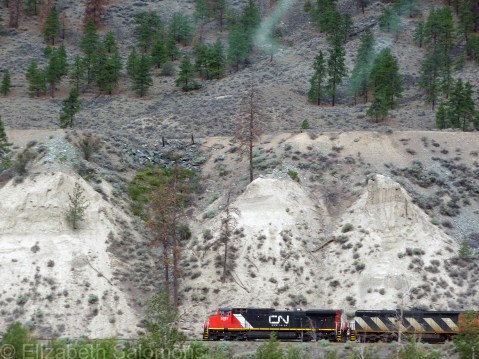
There is scarcely nothing left of Highway 8 between Merritt and Spences Bridge where the Nicola River changed course and took the road out with it. The Trans-Canada Highway through the Fraser Canyon reopened only this week. Just to give you a bit of an idea of what the engineers working on the repairs are faced with, this is what parts of the Fraser Canyon look like.
I missed out on all those atmospheric rivers while I was in Alberta. And although I also missed out on Vancouver’s first white Christmas in thirteen years, I did get back home in time for another spectacular dump of snow.
Which was … stunning.

But then, just over a week later, a king tide and wind storm pummelled the city and our world-famous Stanley Park seawall.
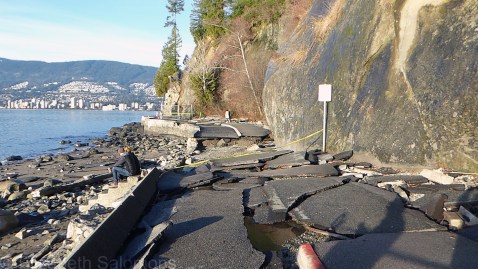
Some of the damage was caused by logs set free by the November floods that came down the Fraser River and have been in the water since.
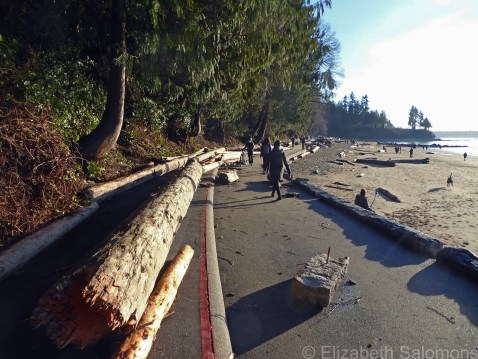
Why am I writing all this? Well, last year was pretty tough on all of us, but, to be honest, I don’t have much hope that this year will be any easier. If it’s not the pandemic, it’s drought and wildfires. And if it’s not drought and wildfires, it’s flooding and mudslides. We call these events natural disasters, but there is nothing natural about once-in-a-century storms happening every year. Atmospheric rivers are not new to BC, and they aren’t all bad. (They play an important role in maintaining BC’s water supply.) But they are increasing in intensity and frequency, so much so that oceanographers are coming up with a rating system for them, like the ones used for tornadoes and hurricanes, to help us better understand their risks.
What I find most sobering is the realization that BC has climate refugees. Months later, people who had to evacuate because of the wildfires or the floods are still out of their homes. Many will never go back to their communities.
It’s a lot to take in about the place where you live.
One last note: Barge Chilling Beach is a bit of an inside joke for those of us who live in Vancouver. Google “Dude Chilling Park” if you want to know more. The sign is temporary and has since been taken down.
Merry Christmas!

Fish Creek Provincial Park, Calgary, Alberta
Through My Lens: Prairie Slough
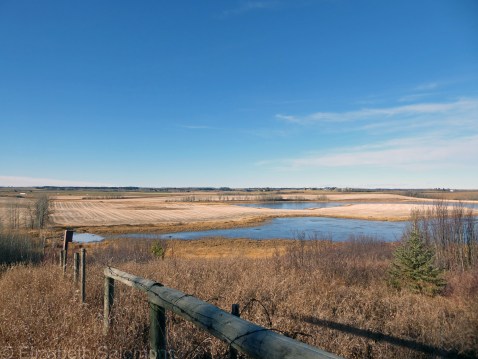
Here’s a landscape I never get to see in Vancouver: the wide open prairie with its big, big sky. I took this photo about a month ago, well before the first snowfall.
Through My Lens: Alberta Poplars
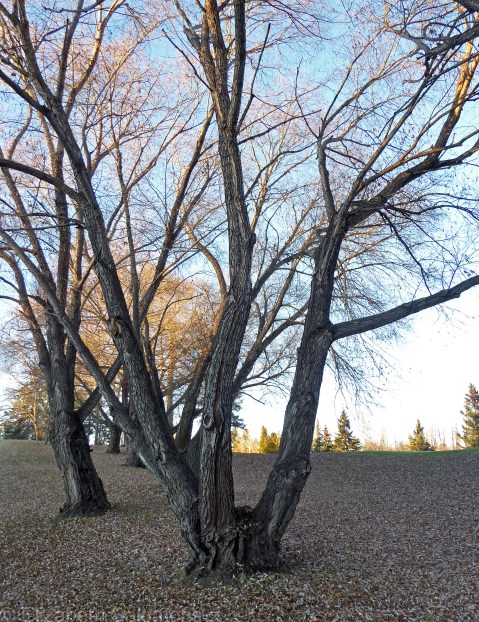
One of the cool things about my time here in Alberta are the variety of trees — so unlike any of the ones growing in Vancouver’s rainforests — that I get to photograph.
These, I’m told, are poplars.
Recipe Box: Gazpacho
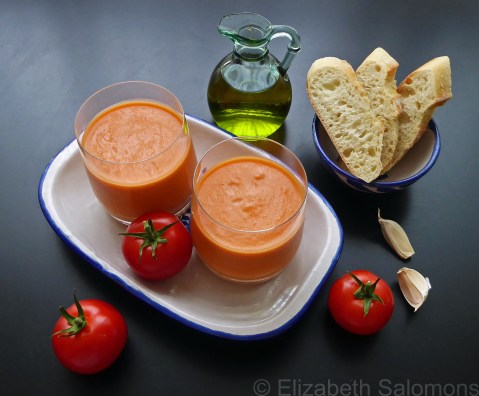
In my tour through Spain these past almost eleven (!!) months, I haven’t been talking about the food. That’s been rather intentional — there were so many memorable meals I could have written about that it would have taken me off on another tangent altogether.
Those meals were so memorable that I made sure to pick up a couple of cookbooks to take home with me. One is filled with recipes of typical Spanish dishes and the other contains only tapas recipes. (Both are published in English — let’s just make that perfectly clear!) But when it came down to deciding which recipe, of all the Spanish dishes I like to re-create in my own kitchen, to write about here — well, that was a near impossible choice.
In the end, it was last summer’s heat dome that decided it for me. Gazpacho is a life-saver when the temperature hovers near 40ºC and as soon as I saw what was headed our way back in June, I whipped up a batch to sustain me through that crazy week.
Confession: the first time I was served gazpacho I really didn’t see what the big deal was. I was at a small dinner party here in Canada, and the host came out with a large bowl of finely chopped cucumbers, tomatoes, and peppers all mixed together. Gazpacho, she called it. And so, many years later when my sister and I were enjoying a round of tapas on our first night in Córdoba, I was taken aback when the gazpacho arrived.
“This is gazpacho?” I said to my sister, pointing to my glass. It was beyond delicious and a world apart from the cold, sad mixture of vegetables I’d been led to believe was gazpacho. But, in case you are confused, gazpacho is not merely a thick version of V8 juice. It’s so much more than that.
My sister laments that she can no longer buy gazpacho by the carton the way she could when she lived in Spain. She now satisfies her craving with this recipe, which she claims is the closest to the gazpacho she had in Spain. And since we were always served gazpacho in a glass in Spain, I serve it that way here in Canada. Yes, it’s soup, but it’s perfectly quaffable.
And it’s the best meal to have when you’re in the middle of a heat dome.
Gazpacho
3 pounds ripe tomatoes, cored and roughly chopped
1 small cucumber, peeled, seeded, and roughly chopped
1 medium green bell pepper, cored and roughly chopped
1 small red onion, minced
2 medium garlic cloves, minced
1 small serrano chili, seeded and minced
kosher salt
several slices day-old baguette
1/2 cup extra virgin olive oil
2 tablespoons sherry vinegar*
1. Place in a large bowl two-thirds of the tomatoes and half of the cucumber, bell pepper, and onion. Add the garlic, chili, and 1 1/2 teaspoons of the salt. Combine well and set aside.
2. Toss with 1/2 teaspoon of salt the remaining tomatoes, cucumber, pepper, and onion, and place in a fine mesh strainer over a medium bowl. Set aside for one hour, then transfer to the bowl with the rest of the vegetables.
3. Add the baguette slices to the liquid drained from the vegetables. Soak for one minute, then add the bread and any remaining liquid to the vegetables. Toss well to combine.
4. Transfer half of the mixture to a blender and process several minutes until completely smooth. With the blender running, slowly add 1/4 cup of extra virgin olive oil. Strain soup through a fine mesh strainer into a large bowl, then repeat with the remaining mixture and olive oil.**
5. Stir in the sherry vinegar and season to taste. Transfer to a pitcher, cover, and refrigerate overnight before serving.***
Notes:
*Use the best sherry vinegar you can find. I’ve learned that a poor-quality vinegar will make your gazpacho pretty much undrinkable.
**Some recipes call for setting aside some of the chopped vegetables to use as a garnish if you like. I don’t like, so never do.
***The flavours need time to blend, so don’t skimp on the waiting time. Several hours is the minimum.
Elizabeth Lake
Who of us knew walking would become a thing when this pandemic first hit? Not me. Such a simple act, which has been my balm in Gilead these past nineteen months.
And yet, who of us by this time are not bored to tears with their neighbourhood, having explored every corner of it?
Even me — and I live next door to one of Canada’s most spectacular urban parks.
And so, on this Thanksgiving I am grateful that the stars have aligned and I have a (temporary) change of scenery. I’m in Central Alberta for some weeks, which at the moment is stunning in all its fall glory. There are lots of trails and walks to discover, too. Last Sunday, I spent the afternoon walking around Elizabeth Lake, in the centre of Lacombe.
Here’s some of what I saw.


Through My Lens: Mystic Beach
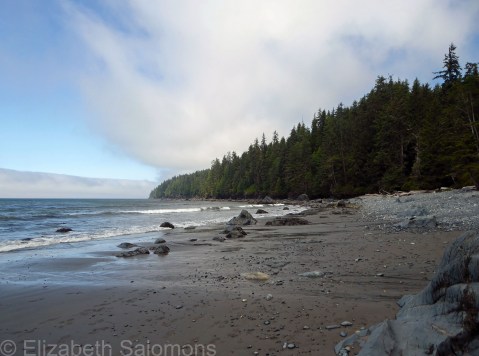
I always find it so overwhelming — and so very humbling — to stand on the edge of the continent, like I did earlier this week. This is at Mystic Beach, on the west coast of Vancouver Island.
Seeking Shade
I learned a new meteorological term this week: heat dome. What’s a heat dome, you ask?
A heat dome is when the summer sun warms the air, which then rushes up into the atmosphere to form a dome of slow-moving hot air. It’s different than an ordinary high-pressure system, however, because it’s stuck and can take a long time to move on.
The Pacific Northwest and British Columbia experienced a heat dome this past weekend, which has now moved on to Alberta. And so, this morning, for the first time in four days, I woke to comfortable temperatures.
Yup. It was four days of intense heat where the temperature was 20°C above the seasonal normal. Because we had a typical June-uary here in Vancouver (meaning the average daily high was about 18°C), the sudden change in temperature was a bit of a shock. But the time of year also means there is little time for the temperatures to cool down at night. It doesn’t get dark until after 10 p.m. and by 4 a.m., it is already starting to get light.
I know that many parts of the world have endured extreme heat waves before — northern Europe comes to mind — but it’s pretty unusual for Vancouver, which has a temperate climate and rarely experiences extreme hot or cold. I haven’t felt this warm in Vancouver in a very long time — more than a decade, to be honest.
Yesterday a colleague in Toronto asked me if we were also experiencing the same humidity that Toronto gets. I don’t think so, I told her. To my memory (which could certainly be faulty given the time that has passed since I lived in Toronto), what is an extreme heat wave for Vancouver actually feels much like a normal summer day for Toronto.
That’s not to say this heat dome didn’t have serious outcomes. At least 486 sudden and unexpected deaths have occurred in Metro Vancouver since Friday, which is about 300 deaths more than is typical in that time frame. To put that number into context, the health risks from this heat wave are greater than Covid right now. Much of the health risk is because the homes in Vancouver aren’t built to withstand this heat — most of us don’t have air conditioning. To provide some relief, cooling centres were set up in local community centres and libraries.
Until this past weekend, the hottest ever recorded temperature in Canada was 45°C in Saskatchewan, set back in July 1937. That record was shattered on Sunday at Lytton in the Fraser Canyon, about 250 kilometres northeast of Vancouver, when the temperature reached 46.6°C. That record lasted a mere 24 hours. And it was broken again yesterday, with a record high of 49.6°C. For my readers who think in Fahrenheit, that’s 121°F. These are not the kinds of records we want to be setting. That’s hotter than the highest-ever recorded temperature for Las Vegas.
Naturally, when there are hot, dry conditions, there is always the threat of wildfires. Tonight, Lytton burned to the ground. Residents of the village had only minutes to evacuate.
To get through my commitments for this week, I started work at 6 a.m. so I could stop at noon. And then, I headed to the beach where I found myself a comfortable spot in the shade. I do not know how I’d have gotten through these past few days without those hours of respite that the sea breeze off English Bay provided me.
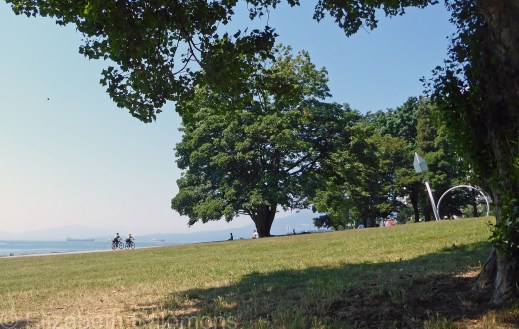
Through My Lens: Cherry Blossoms and Snowcaps
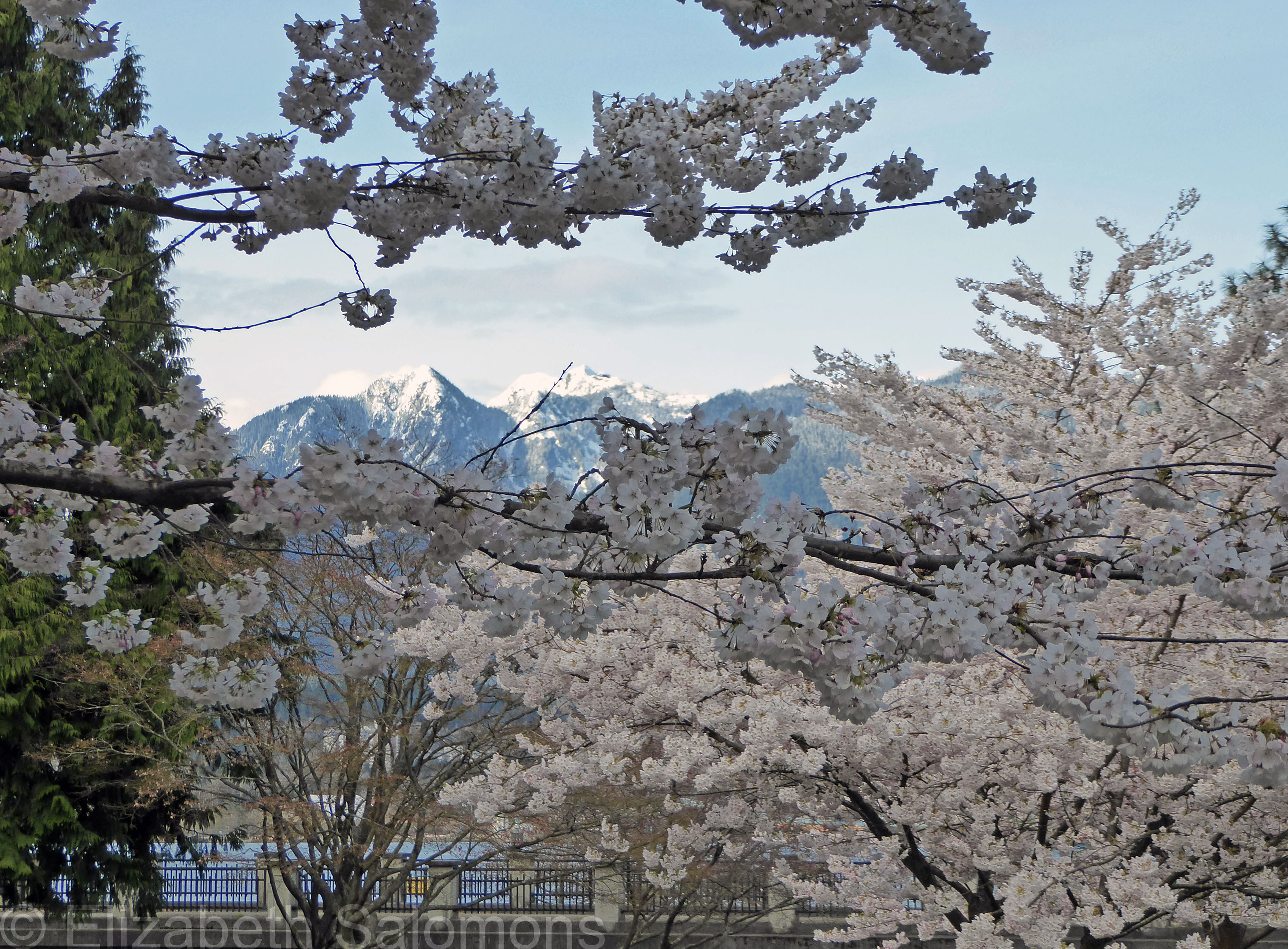
We reached peak Vancouver this week. I was in Stanley Park the other day, on the prowl for cherry blossoms to photograph, when the sun drew my eyes to the fresh snow atop the North Shore mountains.
Doesn’t get more Vancouver than that.
Winter Comes to the West End
Remember when I said I was going to stop writing about the weather? And the pandemic?
Yeah, that.
This was a tough weekend for some folks. Today is Family Day, a statutory holiday celebrated in about half of the country. This year it came right on the heels of Valentine’s Day and the Lunar New Year. Which means those of us who are inclined to get together with loved ones on any of these occasions have been three times tested in our resolve to follow the provincial health orders. Here in BC, we are now into our fourth month of in-person social gatherings being limited to the people we live with.
Also, come mid-February, most Canadians are utterly sick of winter. This is the time when those of us who can start escaping to the sun. But, with current travel restrictions, trips south just are not happening this winter.
So, yeah, that.
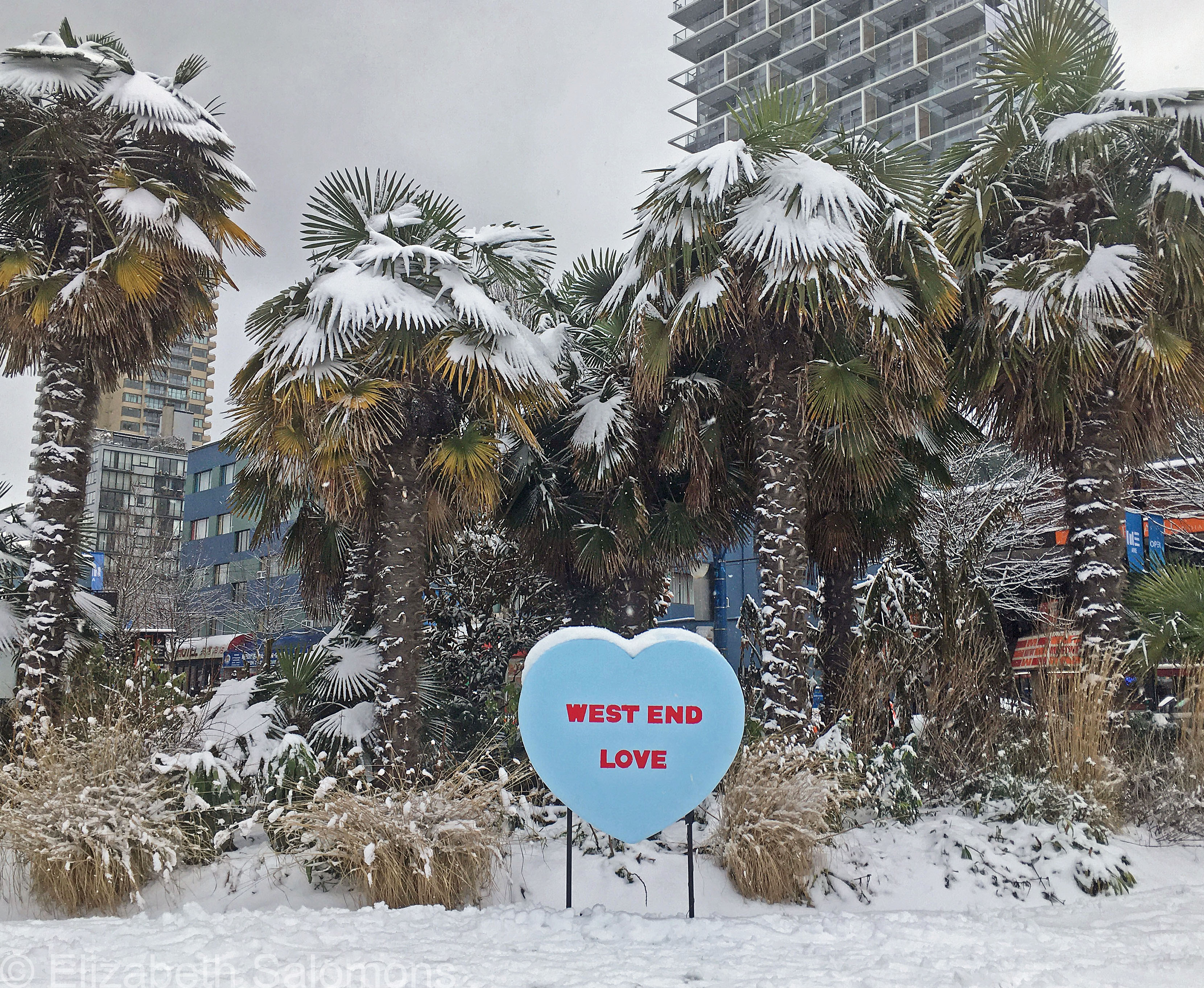
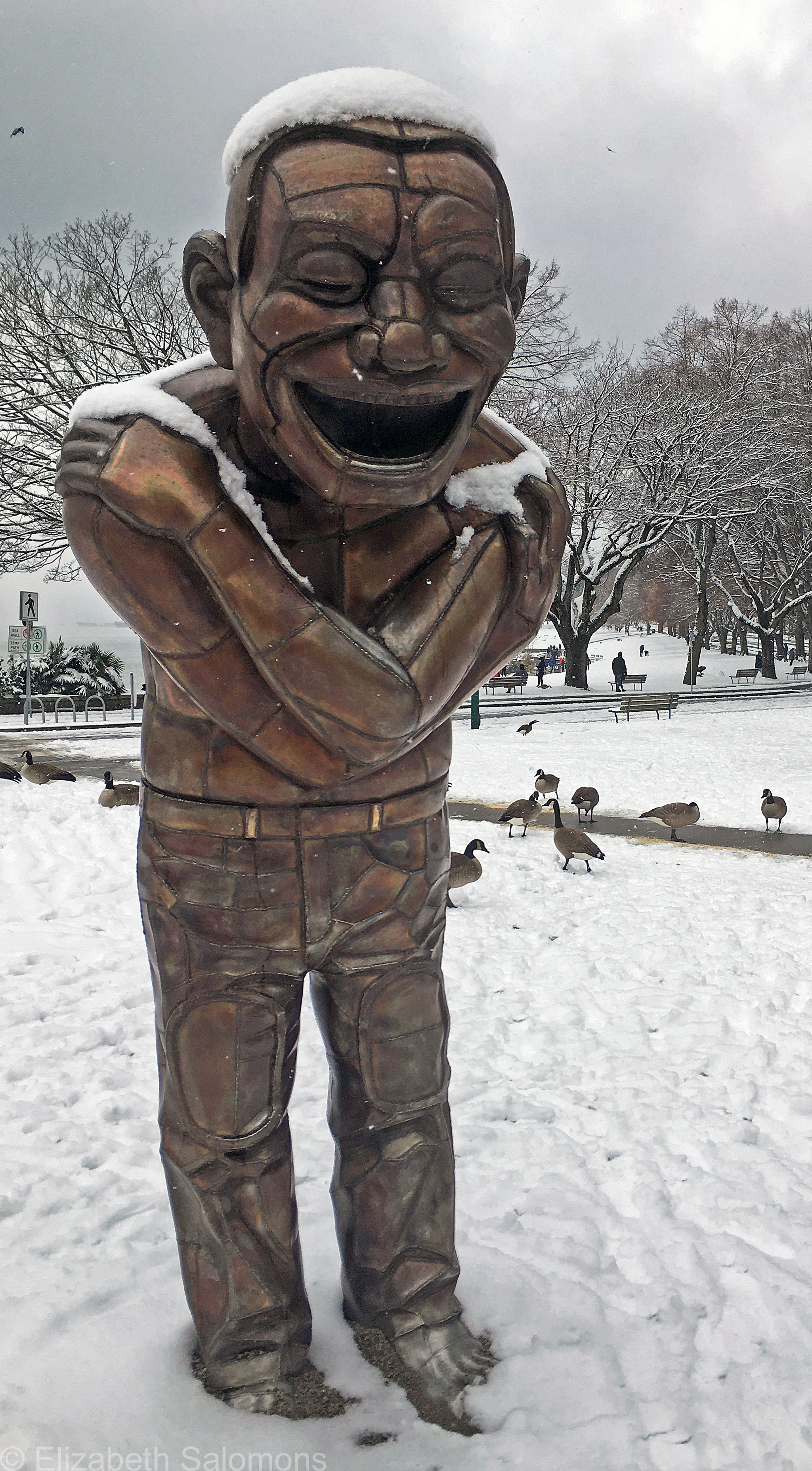
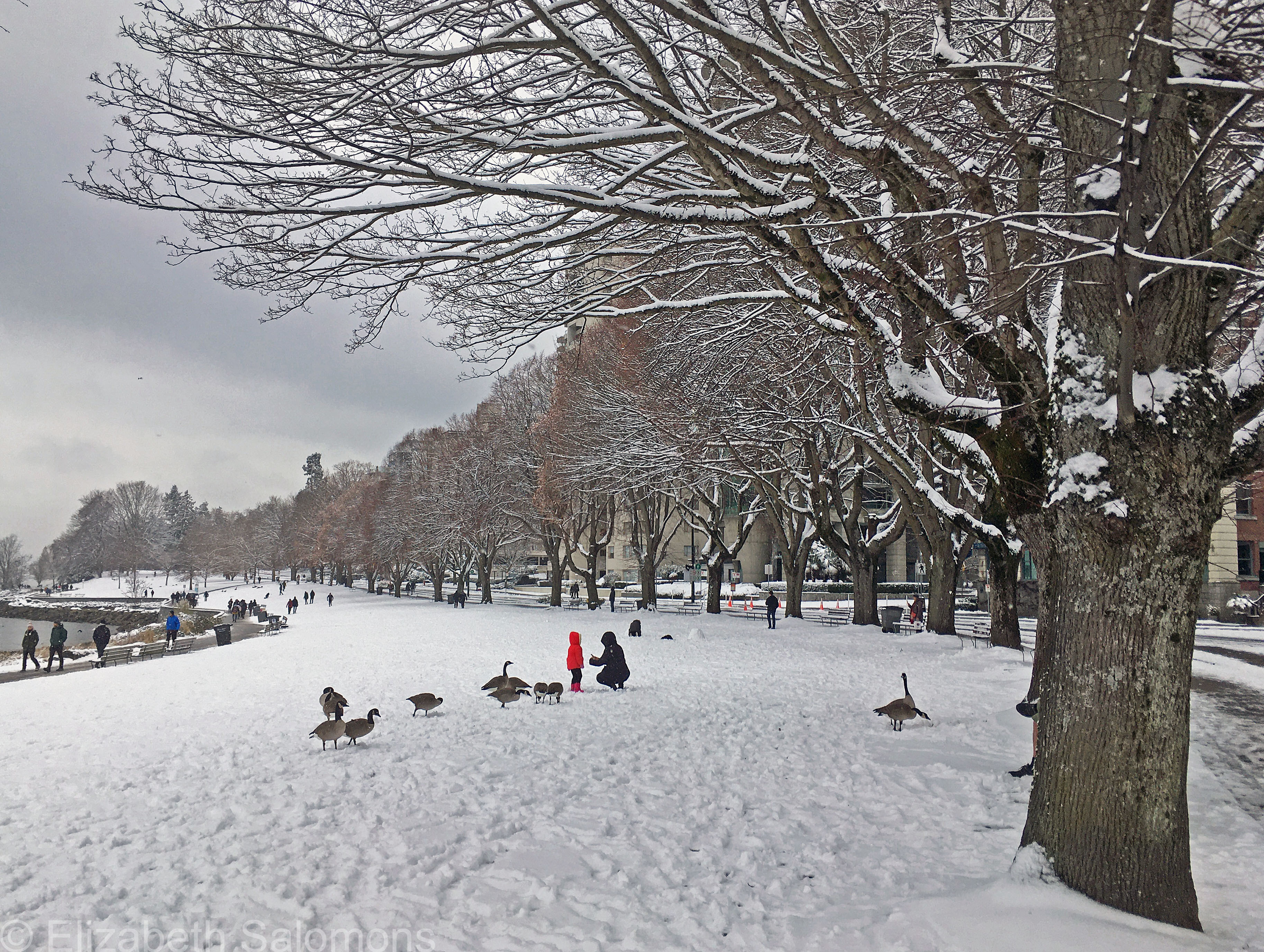
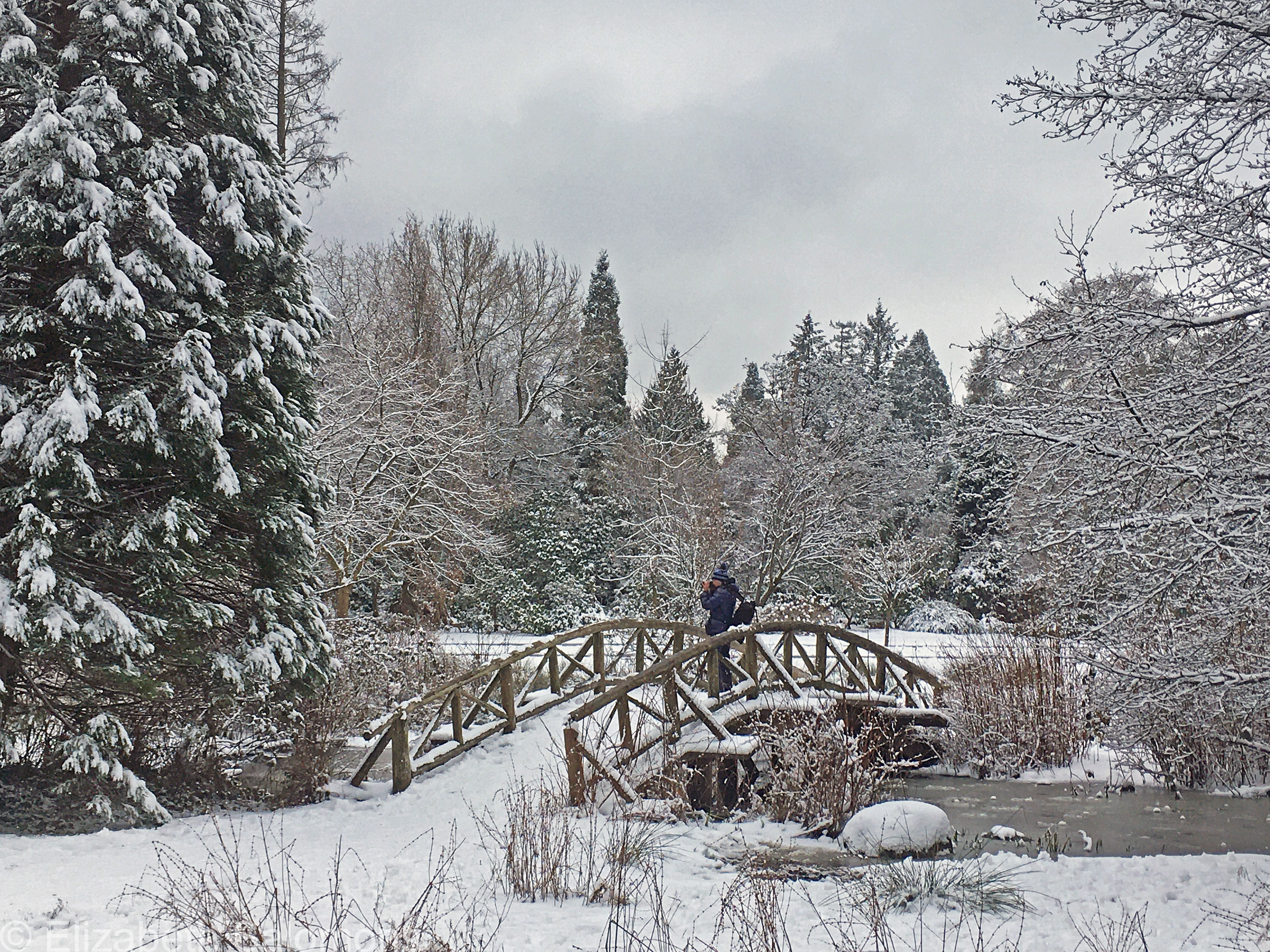
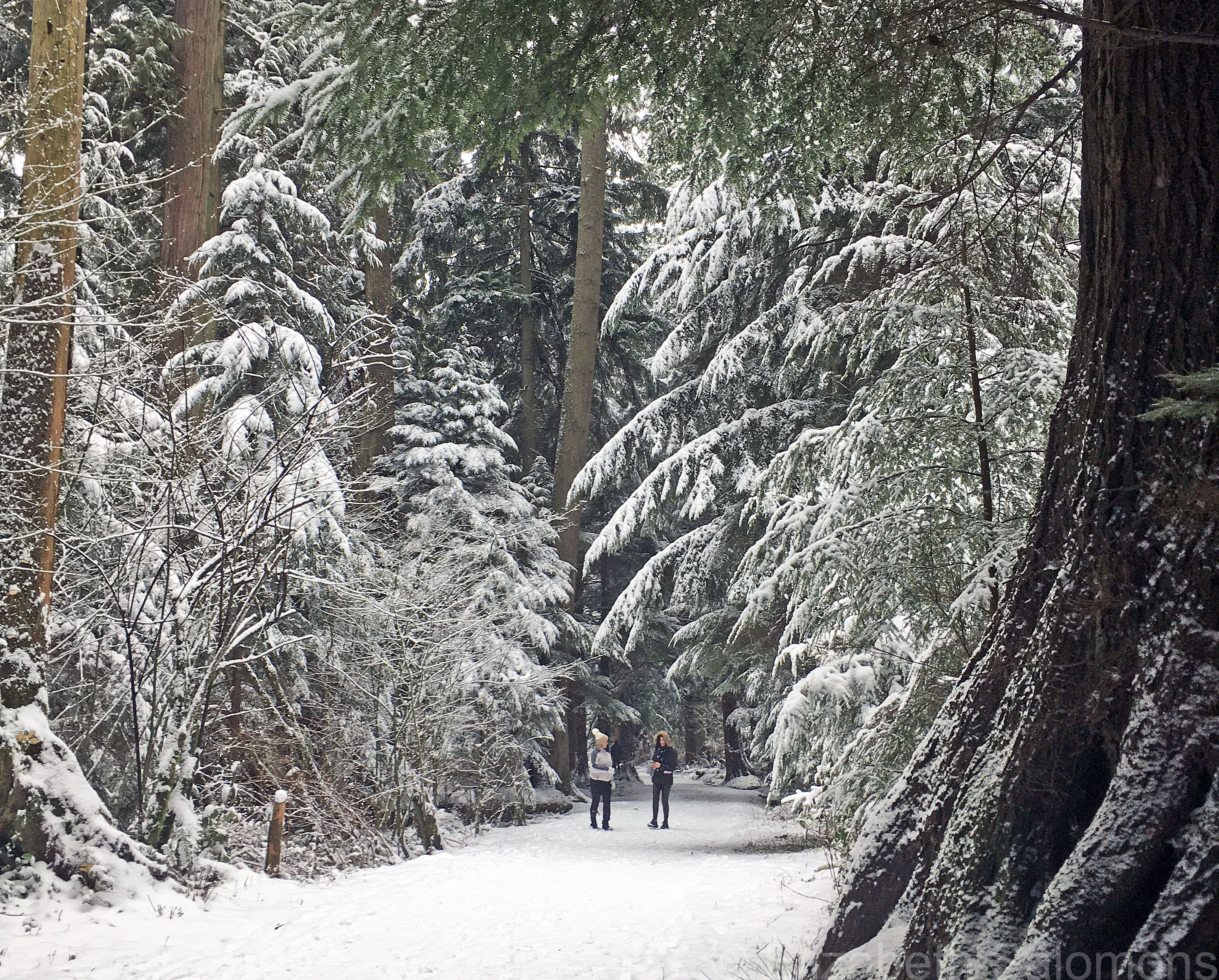
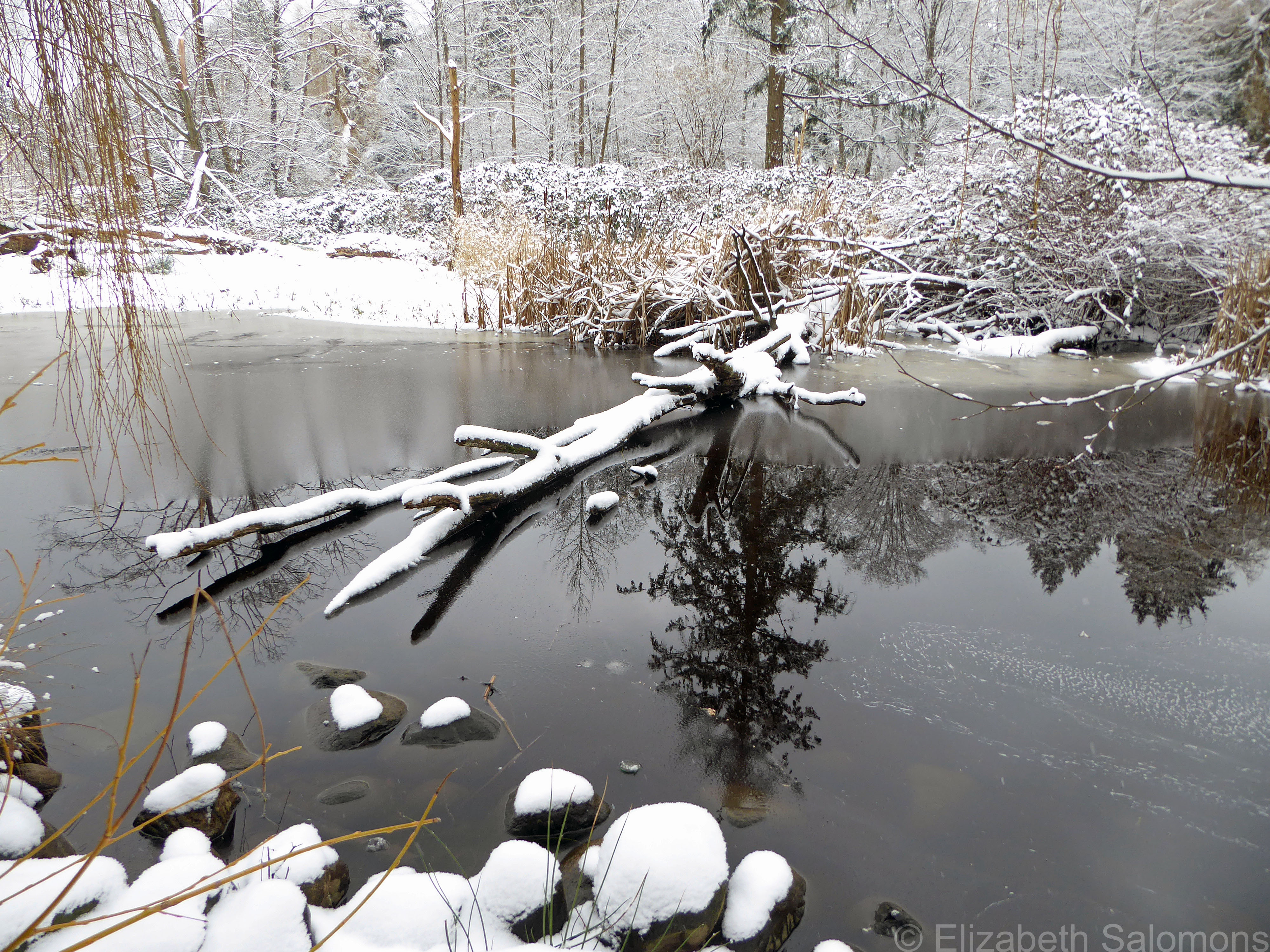
I, on the other hand, had so much to celebrate this weekend. Yes, my long-awaited snowfall finally showed up, thanks to the polar vortex. I woke up to a winter wonderland on Saturday morning and spent much of the day in Narnia (aka Stanley Park).
The snow is already gone, alas, washed away by last night’s rainfall. But for this Canadian, who loves snow but lives in a place where it is a novelty, it was a good weekend.
Here, take a look.




 There and Back Again